
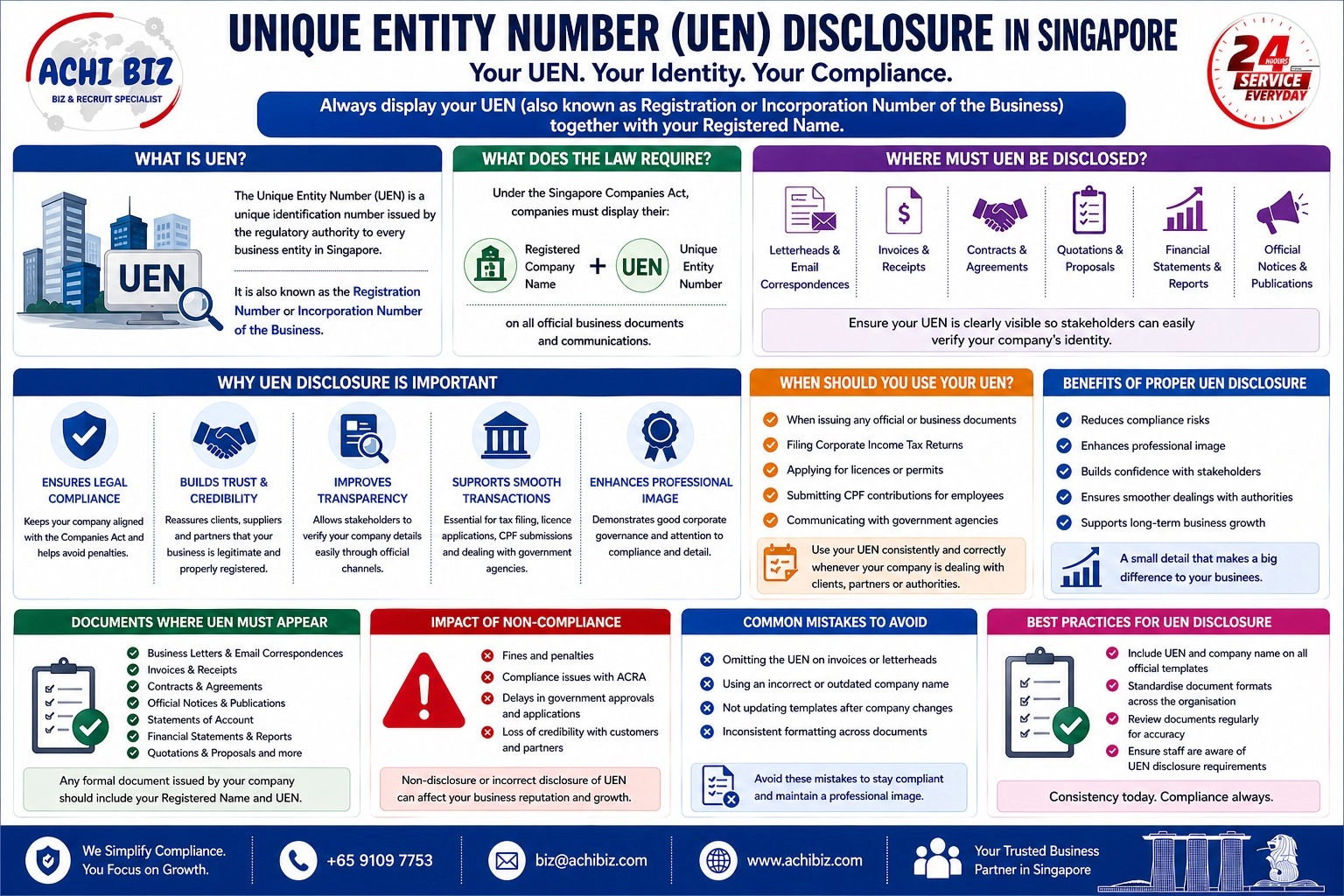
Unique Entity Number (UEN) Disclosure in Singapore Businesses: What You Must Know
If you run a private limited company (Pte Ltd) or any business in Singapore, your Unique Entity Number (UEN) is more than just an identifier—it’s a key part of your business identity.
Also commonly referred to as the registration number or incorporation number of the business, the UEN is used across all official and regulatory matters in Singapore.
Yet, many businesses overlook the importance of UEN disclosure requirements. Failing to display it correctly can lead to compliance issues and even penalties.
Let’s break it down in a clear and practical way.
What Is a Unique Entity Number (UEN)?
In Singapore, every registered business entity is issued a Unique Entity Number (UEN) by the regulatory authority.
The UEN is also known as the company’s registration number or incorporation number, and it:
- Identifies your company across all government agencies
- Is used for tax filing, licensing, and compliance matters
- Acts as your company’s official reference number
In simple terms, your UEN is your company’s identity in Singapore’s business ecosystem.
What Does the Law Require?
Under the Singapore Companies Act, companies must display their:
👉 Registered company name
👉 Unique Entity Number (UEN)
on all official business documents and communications.
This requirement applies to:
- Business letters
- Invoices
- Official notices
- Publications
- Statements of account
In short, any formal document issued by your company should clearly include your UEN and company name.
Where Must the UEN Be Disclosed?
Your UEN disclosure in Singapore should appear consistently across:
- Letterheads and email correspondences
- Invoices and receipts
- Contracts and agreements
- Quotations and proposals
- Financial statements and reports
- Official company publications
It ensures that anyone dealing with your company can easily verify your identity.
Why UEN Disclosure Is Important
This is not just a compliance requirement—it serves several practical purposes.
Ensures Legal Compliance
Displaying your UEN keeps your company aligned with the Companies Act and avoids unnecessary penalties.
Builds Trust and Credibility
When your UEN is clearly shown, it reassures clients, suppliers, and partners that your business is legitimate and properly registered.
Improves Transparency
It allows stakeholders to verify your company details easily through official channels.
Supports Smooth Transactions
Many government processes—such as corporate tax filing, licence applications, and CPF submissions—rely on your UEN.
When Should You Use Your UEN?
The rule is simple:
Use your UEN whenever your company is issuing official or business-related documents.
This includes:
- Filing Corporate Income Tax Returns
- Applying for licences or permits
- Submitting CPF contributions for employees
- Communicating with government agencies
Consistency is key—your UEN should always be visible and correctly stated.
Benefits of Proper UEN Disclosure
When you follow UEN disclosure requirements in Singapore, your business benefits in several ways:
- Reduces compliance risks
- Enhances professional image
- Builds confidence with stakeholders
- Ensures smoother dealings with authorities
It’s a small detail that makes a big difference.
Impact of Non-Compliance
Failing to disclose your Unique Entity Number (UEN) properly can lead to:
- Fines and penalties
- Compliance issues with ACRA
- Delays in processing government applications
- Loss of credibility with customers and partners
Even though it seems minor, it’s taken seriously by regulators.
Common Mistakes to Avoid
Many companies make simple but avoidable errors:
- Omitting the UEN on invoices or letterheads
- Using an incorrect or outdated company name
- Not updating templates after company changes
- Inconsistent formatting across documents
These small oversights can create unnecessary compliance risks.
Best Practices for UEN Disclosure
To stay compliant and professional:
- Include your UEN and company name on all official templates
- Standardise document formats across the organisation
- Review documents regularly for accuracy
- Ensure staff are aware of disclosure requirements
A consistent approach keeps everything in order.
Final Thoughts
Your Unique Entity Number (UEN)—also known as your registration or incorporation number—is a fundamental part of your company’s identity in Singapore. Proper disclosure is not just about following the law—it’s about building trust, maintaining transparency, and running a professional business.
The key takeaway is simple:
Always display your UEN and company name clearly on all official documents.
It’s a small step that goes a long way in keeping your business compliant and credible.
#achibiz