
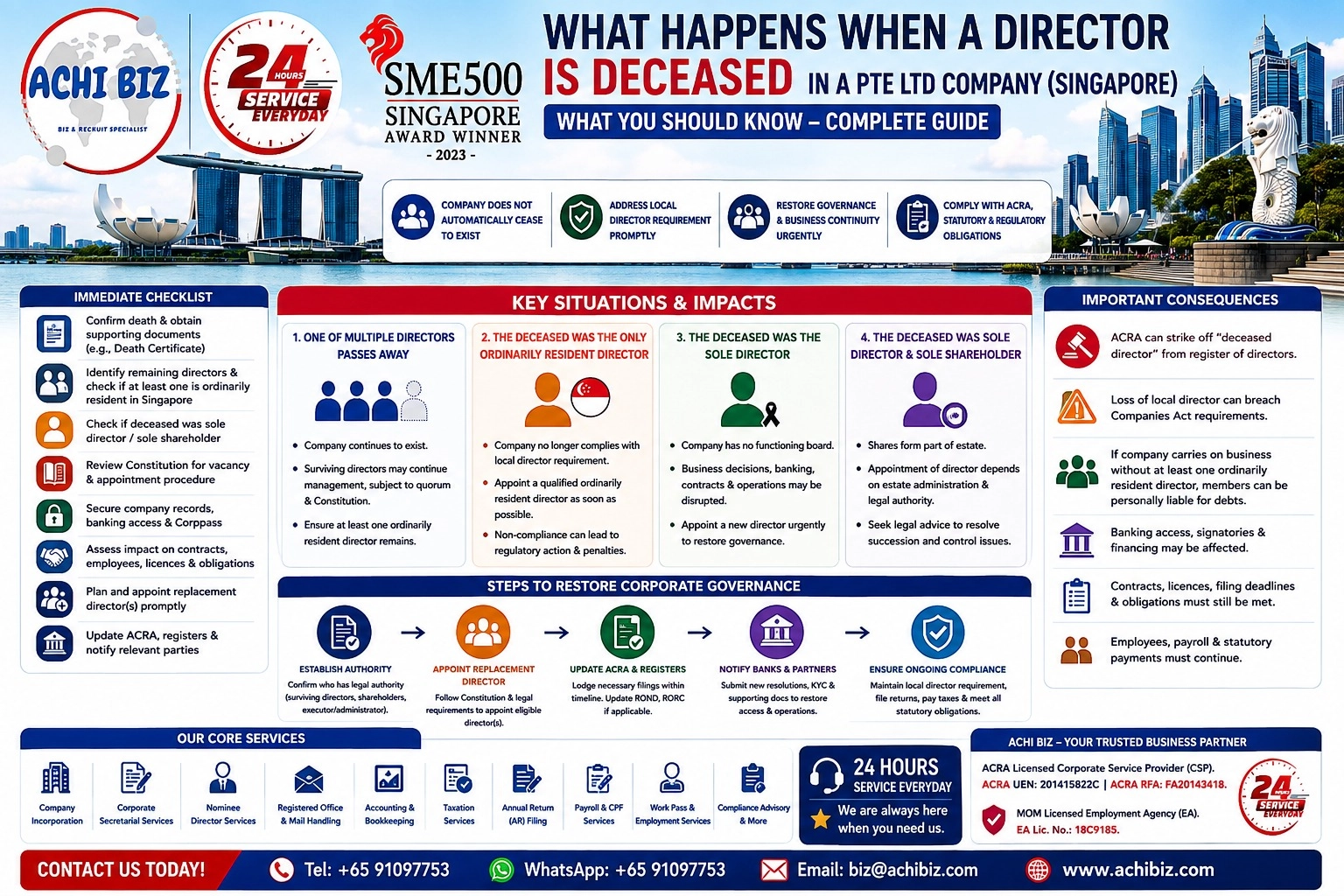
Complete FAQ Guide to Director Death, Sole Director Risk & Business Continuity
The death of a director of a Singapore Private Limited (Pte. Ltd.) company creates a very different corporate situation from resignation or disqualification. There is no notice period, no opportunity for the deceased director to complete a handover, and no possibility of that individual continuing to exercise corporate authority. The company must deal simultaneously with the loss of a director, regulatory records, management authority and, in some cases, succession to the deceased’s shares.
The impact can be relatively manageable where several directors remain. It can become much more serious where the deceased was the sole director, only ordinarily resident director, sole shareholder, bank signatory or key decision-maker.
Importantly, the death of a director does not mean that the Pte. Ltd. company dies with the individual. A Singapore company has its own legal identity. However, its ability to function can be severely affected until the company’s governance structure is restored.
Under Singapore law, every company must have at least one director who is ordinarily resident in Singapore. If death causes the company to lose that director, the resident-director requirement is no longer satisfied and the matter needs prompt attention.
Does a Singapore Pte. Ltd. company cease to exist when its director dies?
No. A Pte. Ltd. company is a separate legal entity from its directors and shareholders. The death of a director does not automatically dissolve, strike off or liquidate the company.
The company continues to own its assets, owe its liabilities and remain responsible for its contracts, employees, taxes and statutory obligations. The real question is whether there are surviving directors with sufficient authority to continue managing the company.
What happens to the deceased person’s position as director?
A deceased person can no longer act as a director.
Singapore’s Companies Act enables the Registrar, where there is reasonable cause to believe that a director has died, to amend the register of directors maintained by the Registrar to indicate that the person has ceased to be a director by reason of death.
Death therefore needs to be treated as an actual cessation of office, not merely as an inactive directorship.
Is death of a director legally the same as resignation?
No. This distinction matters.
A resignation is an intentional act by a living director. Death occurs automatically and cannot be made conditional upon notice, acceptance, completion of a handover or appointment of a replacement.
Accordingly, companies should not process a deceased director as though the person had submitted an ordinary resignation.
Does the rule preventing the last resident director from resigning prevent his or her office from becoming vacant upon death?
No. The resignation restriction cannot keep a deceased person in office.
The purpose of the statutory rule is to prevent a living director from voluntarily leaving a company without an ordinarily resident director. Death is fundamentally different because the individual is no longer capable of holding or exercising the office.
The company must instead address the resulting vacancy and restore compliance with the requirement to have at least one ordinarily resident director.
What is the first thing a company should establish after a director dies?
The company should establish its remaining governance position, rather than treating the death merely as an ACRA administrative update.
It should determine whether other directors remain, whether at least one surviving director is ordinarily resident in Singapore, whether the surviving board can satisfy its required quorum, whether the deceased was also a shareholder or sole shareholder, whether the deceased controlled banking or digital access, and whether urgent contracts, payroll or statutory filings require authorisation.
The company’s Constitution should also be reviewed to determine the applicable procedures for vacancies and appointment of replacement directors.
What happens if one director dies but several other directors remain?
This is generally the least disruptive scenario.
The surviving directors may ordinarily continue managing the company, subject to the company’s Constitution, board quorum and any particular allocation of authority.
The company should nevertheless determine whether the death affects board quorum, authorised signatories, committees, licences or other responsibilities previously assigned to the deceased.
Does the company still satisfy Singapore’s local director requirement after one director dies?
Only if at least one surviving director remains ordinarily resident in Singapore.
Singapore companies are required to have at least one ordinarily resident director. Therefore, the nationality or number of remaining directors alone does not answer the question. Their residency status for purposes of the statutory requirement must be considered.
What if the deceased director was the company’s only ordinarily resident director?
This creates an immediate corporate compliance deficiency.
Even if several overseas directors remain, the company no longer satisfies the statutory requirement if none of them qualifies as an ordinarily resident director.
A qualified replacement resident director should therefore be appointed promptly.
Is a foreign director enough if the company’s Singapore resident director dies?
Not necessarily.
A company can have foreign directors, but the statutory requirement for at least one ordinarily resident director in Singapore still applies.
Therefore, having several overseas directors does not solve the problem if none satisfies the resident-director requirement.
What happens when the deceased person was the sole director?
This is considerably more serious.
The company itself continues to exist, but it is left without a functioning board of directors. This can create an immediate corporate authority problem because many powers of the company are ordinarily exercised by its directors.
The company therefore needs a legally valid mechanism for appointing a new director.
Does the company automatically close when its sole director dies?
No.
The company does not automatically close, but it can become operationally paralysed.
There may temporarily be no director capable of approving transactions, dealing with banks, authorising certain contracts, overseeing employees or exercising other management powers.
This is why death of a sole director should be treated as a business continuity event, not simply a corporate secretarial filing matter.
What happens if the sole director who dies was also the only ordinarily resident director?
The company then faces two problems simultaneously.
First, it has no functioning director. Second, it no longer satisfies Singapore’s requirement for at least one ordinarily resident director.
Restoring a properly constituted board becomes urgent.
Can the company secretary simply take over the business after the sole director dies?
No—not merely because the person is the company secretary.
The roles of company secretary and company director are legally distinct. A secretary does not automatically acquire the board’s management powers because the director has died.
The secretary can assist with corporate records, compliance procedures and professional coordination, but should not simply assume the powers of the deceased director without proper legal authority.
Can employees continue running the company after the sole director dies?
Employees can continue performing functions within their existing authority, but they do not automatically become directors.
There is an important difference between carrying out routine employment duties and exercising powers legally reserved for the company’s board.
Where authority is uncertain, employees should not make major corporate decisions merely because the sole director is no longer available.
Who can appoint a replacement when there are surviving shareholders?
The company’s Constitution and applicable Companies Act provisions should be examined to determine the correct appointment mechanism.
Where shareholders retain the necessary powers, an eligible new director may be appointed through the appropriate corporate procedure.
The company should not merely lodge a person’s name with ACRA without first establishing valid corporate authority for the appointment.
Why is the company’s Constitution especially important after a sole director dies?
The Constitution determines important internal governance rules, including how directors can be appointed and how corporate powers may be exercised when vacancies arise.
A Constitution designed for a company with several directors may produce a different practical outcome from one containing provisions addressing a sole-director contingency.
This is one reason succession planning matters even for very small Pte. Ltd. companies.
What happens if the deceased sole director was not a shareholder?
This can be considerably easier than the sole-director-and-sole-shareholder situation.
If living shareholders remain, they may potentially exercise their rights under the Constitution and applicable law to appoint a replacement director.
The exact procedure should nevertheless be confirmed from the company’s governing documents.
What happens if the deceased was both the sole director and sole shareholder?
This is potentially the most complicated director-death scenario for a Singapore Pte. Ltd. company.
The company loses its entire board, while the shares form part of the deceased shareholder’s estate. There is no surviving shareholder who can simply exercise ordinary shareholder rights immediately.
The company’s Constitution, succession arrangements, estate administration and legal authority of the deceased’s personal representatives may therefore become critical.
Professional legal advice should be obtained where there is uncertainty about who has authority to appoint a replacement director or exercise rights attached to the deceased’s shares.
Does the deceased director’s shareholding disappear upon death?
No.
Directorship and share ownership are separate matters.
Death ends the person’s ability to act as director, but shares owned by the deceased are assets that must be dealt with as part of the deceased’s estate.
The shares do not simply become company property and should not be redistributed informally among family members.
Does a beneficiary named in the deceased shareholder’s Will immediately become the registered shareholder?
Not necessarily.
Being entitled to inherit an asset and being formally recognised on the company’s register as the holder of shares are separate matters.
Estate administration, the company’s Constitution, legal authority of executors or administrators and the applicable transmission or registration procedure need to be considered.
What is the difference between an executor and an administrator in this situation?
An executor is generally a person appointed under a valid Will to administer the deceased’s estate.
An administrator is generally appointed through the appropriate legal process where administration of the estate is required, including circumstances where there is no effective executor.
Both may generally be described as personal representatives, but their authority and supporting documents need to be properly established before the company acts on instructions concerning the deceased’s shares.
What if the sole director and shareholder died without leaving a Will?
The company may face additional delays because the estate must be dealt with under the applicable intestacy and estate-administration rules.
Until appropriate legal authority over the deceased’s estate is established, there can be uncertainty over who is entitled to exercise rights relating to the shares.
This can compound the company’s existing problem of having no director.
Can the deceased director’s family simply nominate somebody to become the new director?
No. Family relationship by itself does not confer corporate authority.
A spouse, child, sibling or other relative cannot simply take control of the company because they are the deceased’s next of kin.
The person or persons with proper authority under the company’s Constitution, Companies Act and, where relevant, the deceased’s estate must follow the appropriate procedure.
Can an executor automatically start managing the company?
Not merely because he or she is the executor.
Administering the deceased’s estate and acting as a director of the company are separate legal capacities.
An executor may have important rights concerning the deceased’s shares, but should not automatically assume that this makes the executor a company director.
What happens if there is a dispute among the deceased shareholder’s beneficiaries?
This can significantly complicate matters.
A dispute over the estate may delay decisions relating to the shares and, in a sole-director and sole-shareholder company, potentially delay restoration of effective corporate governance.
Where competing parties claim authority over the shares or company, the CSP should not attempt to decide the inheritance dispute. Appropriate Singapore legal advice or court intervention may be required.
What happens to the company’s bank account after a director dies?
The company’s bank account belongs to the company, not personally to the deceased director.
However, practical access can become a major issue if the deceased was the only authorised signatory, payment approver or internet-banking administrator.
The bank may require evidence concerning the death, newly appointed directors and revised mandates before changing access. This can affect payroll, suppliers, rent and other urgent payments.
Can the family use the deceased director’s online banking credentials to keep the company running?
That should not be treated as an acceptable business-continuity solution.
Credentials issued personally to the deceased should not simply be used by another person.
The company should regularise its governance and banking authority with the bank.
What happens to Corppass access when the director dies?
The company should promptly review its Corppass administrators, users and authorisations.
If the deceased was the only person controlling essential government-service access, the company may experience difficulties with ACRA, IRAS, MOM or other transactions until authorised access is properly restored.
This is a practical reason for businesses to avoid concentrating every digital authority in one individual.
What happens to contracts signed before the director’s death?
The director’s death does not generally cancel contracts properly entered into by the company.
The contracting party was ordinarily the company, not the director personally.
However, agreements containing key-person provisions, personal guarantees, director-specific obligations or special termination clauses need separate review.
What happens to a personal guarantee given by the deceased director?
This is different from an ordinary company contract.
A personal guarantee is an obligation undertaken personally by the guarantor. Its treatment after death can involve the guarantee terms, creditor rights and estate law.
The company and deceased’s estate should obtain appropriate legal advice where material personal guarantees exist.
Can the death affect the company’s bank loan or credit facilities?
Potentially.
Financing agreements may contain notification obligations, key-person provisions, guarantees, covenants or conditions concerning management.
The company should review its financing documents and communicate with the relevant financial institution where required.
What happens to employees when the director dies?
Their employment does not automatically terminate merely because a company director dies. The employer is generally the company.
However, a sole-director death can create practical difficulties with salary approvals, HR decisions, CPF matters, work-pass administration and operational leadership until appropriate authority is restored.
Does the company still have to pay salaries, CPF, suppliers and taxes?
Yes.
The company’s legal obligations do not disappear because a director has died. The challenge is ensuring that an authorised person can continue making decisions and payments.
Are ACRA and IRAS filing deadlines suspended because the director died?
There should be no assumption that statutory deadlines are automatically suspended.
The company continues to exist and remains subject to its corporate and tax compliance obligations.
Annual Returns, financial statements, tax filings and other regulatory matters should therefore be reviewed promptly.
What if the deceased director was responsible for all accounting and company records?
The company should secure the records immediately.
This can include accounting software, invoices, bank statements, contracts, statutory documents, tax records, corporate registers, email accounts and access credentials.
Loss of institutional knowledge can be just as damaging as loss of formal directorship.
Must ACRA’s records be updated following the director’s death?
Yes, the company’s position-holder records should be properly regularised following the director’s death.
The company or its CSP should determine the appropriate filing procedure and supporting documentation instead of simply leaving the deceased person reflected as an active director.
Does the usual 14-day reporting requirement matter when a director dies?
Changes involving company position holders are generally required to be reported to ACRA within the applicable statutory timeline.
Because death is different from an ordinary voluntary cessation, the company or its CSP should promptly establish the appropriate filing procedure and documentation rather than delaying action.
What documents may be needed to deal with the deceased director’s corporate records?
The exact documents depend on the circumstances, but evidence of death and relevant company records will generally be important.
Where the deceased was also a shareholder, additional estate documentation may eventually become relevant, such as the Will, Grant of Probate, Letters of Administration or other legally recognised evidence of the personal representative’s authority.
Requirements should be checked for the particular transaction rather than assuming one standard checklist applies to every case.
Does the Register of Nominee Directors (ROND) need attention if the deceased was a nominee director?
Yes, where applicable.
If the deceased director was recorded as a nominee director, the company should separately consider the consequences for its Register of Nominee Directors (ROND) and applicable filing requirements.
The death should not be treated solely as an update to the ordinary director record.
What happens if the deceased director was also a registrable controller?
The company should separately review its Register of Registrable Controllers (RORC) obligations.
Directorship, shareholding, nominee status and beneficial-control status are separate concepts. The death may therefore trigger more than one compliance review.
What happens to the deceased’s share certificate?
The share certificate is evidence connected with the deceased’s shareholding; the shares themselves must be dealt with through the proper estate and corporate procedures.
The certificate should not simply be cancelled and replaced in a family member’s name without appropriate authority and documentation.
Is stamp duty payable merely because a shareholder dies and shares pass through the estate?
A transmission of shares by operation of law following death should not automatically be treated as an ordinary sale or voluntary share transfer.
The precise IRAS stamp-duty treatment depends on the instrument and transaction involved. The company or personal representatives should therefore distinguish transmission upon death from a subsequent sale or transfer of inherited shares.
What if the deceased director held shares as a nominee for somebody else?
This requires additional analysis.
The company needs to distinguish the deceased’s registered legal position from any underlying nominee arrangement and review the relevant documentation, nominee-shareholder records and estate implications.
It should not assume that the beneficial owner’s existence automatically resolves the deceased registered holder’s estate issues.
Does the deceased director’s liability disappear upon death?
Death does not retrospectively change whether conduct during the director’s lifetime constituted a breach or created a liability.
However, enforcement against a deceased person’s estate raises separate legal and estate-administration questions.
The company, creditors, beneficiaries or personal representatives should obtain legal advice where significant historical claims, fraud allegations, guarantees or breaches are involved.
Can creditors claim directly against family members because the director died?
Not merely because they are relatives.
The company remains a separate legal entity, while personal obligations of the deceased are generally matters involving the deceased’s estate.
Family members do not automatically become personally responsible for company debts simply because they are beneficiaries or next of kin.
What happens if the company owes money to the deceased director?
The amount may potentially represent an asset or claim of the deceased’s estate, depending on the nature of the balance.
For example, a properly documented director’s loan account should be examined as part of the company’s accounts and estate administration.
It should not simply be written off because the director has died.
What if the deceased director owed money to the company?
Similarly, the balance does not automatically disappear.
The company should establish the nature and supporting records for the debt and determine, with appropriate professional advice, whether a claim exists against the deceased’s estate.
Can the company declare dividends after the shareholder’s death?
This can become complicated where the deceased was also a shareholder.
The board must first have proper authority to act, and entitlement to dividends associated with the deceased’s shares may need to be dealt with through the estate.
Where there is a sole-director and sole-shareholder death, resolving the company’s governance and estate representation may need to come first.
What happens to pending board resolutions after the director dies?
The answer depends on the board composition, Constitution and whether the resolution had already been validly passed.
A proposal that still required the deceased director’s approval cannot simply be treated as approved because the person has died.
The surviving board or newly constituted board should determine the appropriate next step.
What happens if the surviving directors cannot form a quorum?
The company may still face a governance problem even though technically one or more directors survive.
For example, a Constitution may require a particular number of directors for normal board decisions.
The surviving directors’ powers and procedure for filling vacancies should therefore be checked against the company’s Constitution.
Can a surviving director simply ignore the vacancy?
It depends on whether the remaining corporate structure remains compliant and functional.
If an eligible ordinarily resident director remains and the board can function properly, an immediate replacement may not always be necessary merely because the board has one fewer member.
However, replacement becomes urgent where the death causes failure of the resident-director requirement, board quorum or another regulatory or constitutional requirement.
What happens to a regulated business if its director dies?
Companies operating under licences or regulatory approvals need an additional review.
Some licences impose requirements concerning directors, managers, responsible persons, key appointment holders or fit-and-proper criteria.
The death may therefore require notification to a regulator or appointment of another qualified person independently of the ACRA update.
Can the death of a director affect the company’s work-pass matters?
Potentially, although the death itself does not automatically cancel employees’ work passes.
Problems can arise if the deceased was the company’s authorised person for MOM transactions or if the company’s management and operating structure changes materially.
The company should maintain proper Corppass and MOM access and assess any work-pass implications separately.
What happens if the company has foreign shareholders and its Singapore resident director dies?
The company still needs an ordinarily resident director in Singapore.
Foreign ownership does not remove this statutory requirement. Accordingly, foreign shareholders should arrange a properly qualified replacement rather than allowing the company to remain without a resident director.
Can the shareholders appoint a nominee director after the resident director dies?
Where appropriate, a properly appointed nominee director may potentially satisfy the resident-director structure, but Singapore’s current CSP regulatory framework must be observed.
A nominee director is not merely a name placed on ACRA records. Directors continue to have legal responsibilities, and arrangements involving nominee directorship should comply with applicable Singapore regulatory requirements.
What happens if the company does nothing after losing its only resident director?
That is risky.
The company remains subject to the requirement to have at least one ordinarily resident director. Regulatory action and other consequences can arise where the deficiency remains unresolved.
There can also be more serious consequences where a company continues carrying on business for an extended period without the required resident director.
The situation should therefore be addressed promptly.
Does this mean the company has a grace period before appointing another resident director?
No.
The company should take reasonable and prompt steps to restore compliance.
Should the company immediately stop trading when its sole director dies?
Not automatically, but the absence of a person with valid management authority must be taken seriously.
Routine operations already authorised may differ from new decisions requiring board authority.
Where there is no director, shareholders, personal representatives and professional advisers should prioritise establishing a valid replacement rather than allowing employees or family members to informally run the company without clear authority.
What happens if no replacement director can be appointed?
The company cannot simply continue indefinitely without satisfying its statutory governance requirements.
The correct solution depends on why appointment is impossible—for example, lack of a functioning shareholder, estate-administration delays or a dispute concerning the deceased’s shares.
Complex sole-director and sole-shareholder cases may require Singapore legal advice and potentially court involvement.
Should the company be struck off after the sole director dies?
Not automatically.
If shareholders or beneficiaries intend to continue the business, the priority is generally to restore proper governance.
Death itself is not a shortcut around the normal requirements for closing a company.
What happens if the company owns valuable property or investments?
Those assets remain assets of the company.
They do not automatically form part of the deceased director’s personal estate merely because the deceased controlled the company.
If the deceased also owned shares in the company, those shares may form part of the estate, but the underlying company assets remain owned by the company.
This distinction is extremely important in estate administration.
What if the deceased was the company’s founder and controlled all important business relationships?
The legal entity survives, but commercially the impact may be substantial.
Customers, suppliers, banks and employees may have relied heavily on that individual. The surviving management should therefore consider communication, continuity of contracts, replacement authority and preservation of customer and supplier confidence.
Director-death planning is therefore not solely a compliance exercise.
Should small Pte. Ltd. companies prepare for the unexpected death of a sole director?
Yes.
A company dependent on one individual has a clear key-person and governance continuity risk.
This is especially important where one person is simultaneously the sole director, sole shareholder, resident director and only bank signatory.
Should a sole director appoint another director purely for succession planning?
That depends on the company’s circumstances. However, appointing a properly chosen additional director can significantly reduce the governance vacuum caused by a sudden death.
The company should not make such an appointment merely for nominal purposes. Every appointed director assumes genuine statutory and fiduciary responsibilities.
Is having a Will enough to protect a sole-director company?
A Will is important for personal estate planning, but it does not by itself solve every company-governance problem.
The company has its own Constitution and legal structure, while the deceased’s shares form part of the personal estate.
Effective planning should therefore consider both estate succession and corporate succession.
Why should the deceased director’s family contact the company secretary or CSP promptly?
A properly appointed CSP can handle the corporate compliance aspects and coordinate with lawyers, accountants, banks and personal representatives where necessary.
What should a company avoid doing after a director dies?
The company should avoid treating the deceased’s login credentials as shared company credentials, allowing relatives to assume control without authority, transferring the deceased’s shares informally, assuming beneficiaries automatically become shareholders, ignoring the local-director requirement, delaying regulatory updates or assuming the company itself has ceased to exist.
The objective should be to preserve the company while legally restoring its decision-making authority.
What is the practical difference between the death of an ordinary director and the death of a sole director?
When one director among several dies, there is often a functioning board left behind.
When a sole director dies, there is no board left to manage the company.
If that person was also the only resident director, the company additionally loses compliance with the resident-director requirement.
If that person was also the sole shareholder, the situation becomes more complex because shareholder rights become intertwined with administration of the deceased’s estate.
In practical terms:
Director dies → the remaining board may continue.
Sole director dies → the company faces a governance vacuum.
Sole director and sole shareholder dies → the company faces both a governance and estate succession problem.
What should be checked when a replacement director is eventually appointed?
The replacement must be legally eligible to act, properly appointed under the company’s Constitution and applicable law, and appropriately recorded with ACRA.
The incoming director should also understand the company’s financial condition, outstanding statutory filings, banking arrangements, contracts, tax position and any unresolved matters left after the deceased director’s death.
Replacing a director should restore real governance, not merely add another name to the company profile.
How can ACHI BIZ assist when a director of a Singapore Pte. Ltd. company dies?
ACHI BIZ SERVICES PTE. LTD. can assist with the corporate secretarial and compliance aspects arising from the death of a director, including reviewing the company’s existing officer structure, resident-director position, replacement-director requirements, corporate documentation, ACRA lodgements and applicable statutory-register updates.
Where the deceased was also a shareholder, sole shareholder or beneficial owner, ACHI BIZ can coordinate the corporate procedures with the legally authorised personal representatives and their professional advisers. Appropriately qualified legal professionals should handle estate administration, inheritance disputes and contested legal authority.
ACHI BIZ operates as an ACRA Licensed Corporate Service Provider (CSP) and offers company incorporation, corporate secretarial, nominee director, registered office, accounting, bookkeeping, taxation, Annual Return and other related corporate services.
In addition, ACHI BIZ operates as a MOM Licensed Employment Agency (EA) and provides employment and work-pass related services.
ACRA UEN: 201415822C | ACRA RFA: FA20143418
MOM EA Lic. No.: 18C9185
What is the key takeaway when a director of a Singapore company dies?
The key point is that the director may have passed away, but the company has not.
The company remains responsible for its business, employees, creditors, contracts, taxes and statutory obligations. What changes is the company’s ability to exercise proper management authority.
Where other qualified directors remain, continuity may be relatively straightforward. Where the deceased was the only ordinarily resident director, the company must address its resident-director deficiency promptly. If the deceased was the sole director, the company may no longer have a functioning board. Where the deceased was both sole director and sole shareholder, corporate governance and estate succession become interconnected and require particularly careful handling.
Singapore companies should therefore treat the death of a director as both a corporate compliance issue and a business continuity event, with the priority being to establish who now has lawful authority, restore a properly constituted board and protect the ongoing company.
Disclaimer: This FAQ provides general information about Singapore corporate compliance and does not constitute legal, probate, succession or estate-administration advice. The consequences of a director’s death can vary according to the company’s Constitution, board and shareholding structure, the deceased’s estate arrangements and other circumstances. Professional legal advice should be obtained for complex or disputed cases.
Related Pages:
Resignation of Director in Pte Ltd Company-FAQ
Director Disqualification in Pte Ltd Company-FAQ
#achibiz