
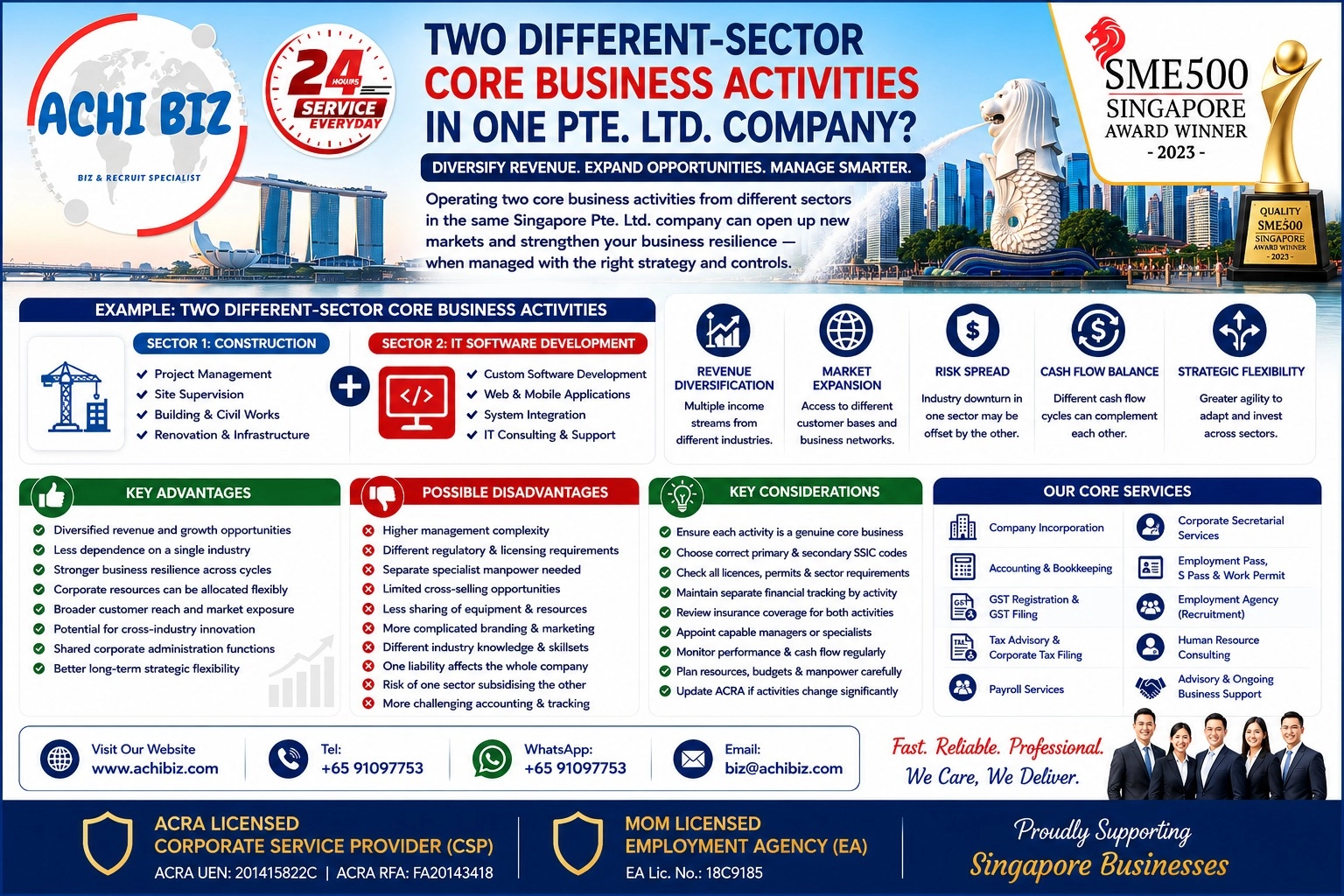
Why Choose Two Different-Sector Business Activities in One Pte Ltd Company
A Singapore Private Limited (Pte. Ltd.) company may sometimes operate two core business activities from completely different sectors. For example, the same company might undertake general construction while also carrying on IT software development.
This can be commercially workable where there is a genuine business reason, suitable management capability and proper regulatory planning. However, two unrelated activities can create a very different operating environment because customers, employees, licences, risks, suppliers, accounting considerations and business strategies may have little or no connection with each other.
ACRA uses the Singapore Standard Industrial Classification (SSIC) to classify business activities. An entity selects a primary business activity and, where applicable, a secondary business activity. The SSIC classification should accurately describe what the business actually does.
This FAQ focuses exclusively on the features, importance, advantages, disadvantages, risks and practical considerations of carrying on two different-sector core business activities within one Singapore Pte. Ltd. company. It does not compare this structure with using separate companies, as that broader structuring question is covered separately in our article “One Pte Ltd with Multiple Business Activities vs Two Separate Companies in Singapore: What Makes More Sense?”
What does having two different-sector core business activities in one Pte. Ltd. company mean?
It means the same legal company actively carries on two substantial businesses that belong to different commercial sectors.
For example:
Activity 1: General construction
Activity 2: IT software development
The construction operation may require project managers, construction workers, subcontractors, equipment and site management, while the software business may require developers, programmers, cloud infrastructure and technology customers.
Both businesses nevertheless operate under the same incorporated company.
Can a Singapore Pte. Ltd. company have two business activities from different sectors?
Generally, yes.
ACRA’s SSIC framework allows an entity to register a primary business activity and, where applicable, a secondary business activity.
There is no general principle that the two activities must belong to the same industry.
However, registration of an activity with ACRA should not be confused with regulatory permission to conduct it. Each business activity must separately satisfy any licences, approvals, permits, professional qualifications, premises requirements or other regulatory conditions applicable to that sector.
Must the primary and secondary SSIC activities be related?
Not necessarily.
A company’s primary and secondary business activities can describe different types of business operations.
What matters is that the registered activities accurately reflect the business actually being conducted and that the company satisfies the applicable requirements for each activity.
Which activity should be registered as the primary business activity?
The primary activity should reflect the company’s principal business.
If circumstances subsequently change and the registered business activities no longer properly describe what the company does, its ACRA information should be updated accordingly.
The company should not choose the primary activity simply because one industry appears more prestigious or commercially attractive.
What is the main feature of operating two different-sector businesses in one company?
The most important feature is diversification within a single legal entity.
The company is not dependent entirely on one industry. It may generate revenue from markets affected by different customer demands, economic conditions and technological or industry developments.
However, legally, the businesses remain part of the same company.
What is the biggest potential advantage?
The principal commercial advantage can be revenue and sector diversification.
If the two industries are affected by different economic factors, weakness in one business may not necessarily mean weakness in the other.
For example, a slowdown in construction activity does not automatically mean demand for software development will decline by the same amount or for the same reasons.
This diversification can potentially reduce dependence on a single market.
Can two different-sector activities create multiple sources of revenue?
Yes.
Instead of depending on one industry for substantially all its revenue, the company can earn income from two different commercial markets.
This may be useful where the owners have genuine expertise, customers or opportunities in both industries.
Can different-sector activities reduce dependence on one industry?
Potentially, yes.
Industry concentration creates exposure to sector-specific downturns.
Operating in two different sectors can spread commercial exposure where the sectors respond differently to economic conditions.
However, diversification only works when both businesses are commercially viable. A poorly managed second activity can create additional losses rather than reduce risk.
Can one business remain strong when the other sector slows down?
Potentially.
This is one of the attractions of unrelated diversification.
Construction, technology, retail, consultancy, manufacturing and other sectors may not always experience identical demand cycles.
Revenue from a stronger business could therefore help support the company’s overall cash flow when another division is temporarily weaker.
But this should never be assumed. Broader economic downturns can affect several industries simultaneously.
Does having two sectors automatically make the company financially safer?
No.
Diversification can spread business exposure, but it does not automatically reduce the company’s overall legal or financial risk.
If both businesses lose money, the company has simply accumulated losses from two sectors.
More importantly, liabilities incurred by either operation belong to the same legal company.
Can one activity financially support the other?
Yes.
Because both activities belong to the same company, available corporate resources may be deployed according to management’s requirements, subject to applicable legal, contractual, financing and accounting considerations.
For example, a profitable IT operation may contribute to the company’s overall cash resources while the construction operation experiences temporary weakness.
This flexibility can be useful, but it can also become dangerous if a profitable division continually subsidises an unsustainable one.
Can cross-subsidisation hide a weak business?
Yes.
This is an important disadvantage.
If management only looks at the company’s total profit or loss, strong results from one activity can conceal poor performance in the other.
The company might appear profitable overall even though one division is consistently losing money.
Management accounts should therefore distinguish the performance of each substantial activity.
Should bookkeeping distinguish between the two sectors?
Absolutely.
Separate internal accounting is particularly important when the businesses are unrelated.
The company should consider using appropriate:
- Revenue accounts
- Expense classifications
- Cost centres
- Departments
- Project codes
- Profitability reports
This allows management to determine what each business actually contributes.
Should separate profit and loss reports be prepared for each activity?
For management purposes, this can be highly beneficial.
A consolidated company profit and loss statement tells directors how the company performs overall, but divisional reporting can show which operation is generating the results.
For example, management may discover that software development generates 30% of revenue but 70% of operating profit.
That information can materially affect future strategy.
Can two different-sector activities improve cash-flow diversification?
Potentially.
Different sectors may have different revenue and payment cycles.
A software operation might generate recurring subscription or service revenue, while construction may operate through project-based progress payments.
Different cash-flow patterns can sometimes complement one another.
However, they can also create additional working-capital complexity.
Can different-sector activities provide more business opportunities?
Yes.
The company can pursue opportunities in two separate markets rather than depending on a single customer base.
This can be particularly attractive where the directors or shareholders already possess genuine commercial experience in both industries.
Can a business owner use existing entrepreneurial experience across both activities?
Yes.
Some capabilities are transferable even when industries are unrelated.
Leadership, financial management, recruitment, negotiation, sales discipline, corporate governance and strategic planning can benefit both businesses.
Industry-specific technical expertise, however, may not transfer.
Can corporate administrative functions be shared?
Yes, and this is one practical advantage.
Both activities are conducted through the same company, so certain corporate-level functions may support the overall organisation, such as finance, HR, payroll, corporate secretarial administration and general management.
However, sector-specific operational teams may still need to function independently.
Can both businesses use the same accounting system?
Generally, yes, provided the system is properly configured to distinguish the activities.
Using cost centres, tracking categories, departments or project codes can allow management to obtain divisional information while maintaining the company’s overall accounts.
The accounting structure becomes especially important when the two activities have very different cost structures.
Can both activities use the same bank account?
As activities of the same legal company, receipts and payments can generally flow through company banking arrangements, subject to the bank’s terms and any particular regulatory or contractual requirements.
From a management perspective, however, clear transaction coding becomes important so management can identify which activity generated or consumed the cash.
Can both sectors share the same employees?
Sometimes for corporate functions, but often less so operationally.
An accounts executive, HR employee or administrator may support the entire company.
A software developer, however, would ordinarily perform a very different role from a construction site supervisor.
Different-sector operations therefore tend to require more specialised teams.
Can different-sector activities create new employment opportunities?
Yes.
Expanding into another genuine business sector can create jobs requiring different skill sets.
The company may consequently develop a more diverse workforce and internal capabilities.
However, manpower planning becomes more complex because qualifications, salary structures, workplace environments and regulatory requirements may differ substantially.
Can foreign manpower requirements differ between the two activities?
Yes, potentially significantly.
Singapore’s work pass and foreign manpower framework can depend on matters such as the type of work, sector, employer eligibility, quota, levy and worker characteristics.
A company should never assume that manpower eligibility applicable to one business operation automatically applies to another merely because both activities are registered under the same company.
Can different-sector activities require different licences?
Yes.
This is one of the most important considerations.
Construction-related operations may involve industry-specific registrations, permits or safety requirements, while certain technology, financial, employment, food, healthcare, education or other activities may have completely different regulators and licensing frameworks.
Each activity must be assessed independently.
Does registering an SSIC code amount to obtaining a business licence?
No.
An SSIC code is a classification of business activity.
It does not automatically authorise the company to carry on an activity that requires separate regulatory approval.
Before commencing either business, the company should identify the licences, registrations and approvals applicable to that particular operation.
Can regulatory compliance become more complicated with two different sectors?
Yes.
This is one of the major disadvantages.
Management may have to understand two different regulatory environments rather than one.
Different regulators, licences, reporting requirements, safety standards, premises rules and professional requirements may apply.
The administrative burden can therefore increase substantially.
Can different sectors have different insurance requirements?
Yes.
A construction operation and a software development business have fundamentally different risk profiles.
Construction may involve workplace accidents, property damage and project-related liabilities. Technology businesses may face professional liability, cybersecurity or data-related risks.
The company should disclose all material activities to its insurer and obtain appropriate professional advice on coverage.
Can one activity’s liability affect the other activity?
Yes.
This is one of the most significant risks of operating two businesses within the same company.
The company is one legal entity.
If the construction division incurs a substantial contractual debt or liability, it is the company’s liability—not merely the liability of an internal “construction department.”
The company’s assets are therefore relevant regardless of which business activity generated them, subject to applicable law and security arrangements.
Does internal departmental separation create legal separation?
No.
Calling one operation the “Construction Division” and another the “IT Division” is useful for management, but it does not create two companies.
They remain operations of the same Pte. Ltd. company.
Can a serious problem in one business threaten the company’s overall finances?
Yes.
A major lawsuit, bad debt, project loss, regulatory issue or contractual claim arising from one activity can affect the financial position of the entire company.
This is an important distinction between commercial diversification and risk isolation.
Operating in multiple sectors can provide the former but does not automatically provide the latter.
Can the reputation of one activity affect the other?
Yes.
Both businesses operate under the same corporate identity.
A serious customer dispute, regulatory problem or negative publicity involving one operation can affect confidence in the company generally.
Conversely, a strong corporate reputation can also benefit both operations.
Can branding become more difficult with two unrelated activities?
Yes.
This is one of the clearest practical disadvantages.
Customers may find it difficult to understand what a company stands for if the same brand promotes two completely unrelated services.
For example:
“We build commercial properties and develop enterprise software.”
Both may be legitimate businesses, but communicating a clear brand identity can require more thought than where services naturally complement each other.
Can the company use different brands for each activity?
Potentially, subject to appropriate legal, business-name, intellectual-property and disclosure considerations.
Businesses sometimes use different trading identities or brands for different operations while contracts and invoices continue to identify the actual legal entity appropriately.
The structure should be properly implemented so customers are not misled about whom they are contracting with.
Can the same company website promote both activities?
Yes, but website architecture becomes important.
The business could create clearly separated service sections or divisional pages.
Where the target audiences are completely different, forcing both services into a single marketing journey can confuse visitors.
Clear navigation and branding are therefore important.
Is SEO more challenging when a website covers unrelated sectors?
It can be.
A website trying to establish authority in both construction and software development must produce useful, relevant content for two very different search audiences.
That does not make SEO impossible, but it may require more deliberate content architecture, keyword strategy and landing pages.
Can marketing costs increase?
Potentially.
Unlike related services targeting similar customers, unrelated activities may require different advertising channels, sales strategies, websites, social media content and business-development relationships.
The company may therefore lose some of the marketing synergies normally available between complementary activities.
Can customer databases be shared effectively?
Not necessarily.
A construction customer may have little interest in software development, while a software client may have no construction requirements.
This means cross-selling opportunities may be limited.
However, this depends entirely on the particular sectors and customer profile.
Is limited cross-selling a disadvantage?
Yes, compared with a business model where services naturally complement each other.
Different-sector diversification is generally more about accessing separate revenue markets than selling multiple related services to the same customer.
That distinction should be recognised when evaluating the business strategy.
Can supplier relationships be shared?
Often less effectively.
Construction suppliers and software vendors are likely to belong to completely different commercial ecosystems.
The company may therefore have to maintain separate supplier networks, procurement knowledge and contractual arrangements.
Can equipment and physical resources be shared?
Usually less than with related activities.
Construction equipment has little direct use in software development, while software development infrastructure has little use on a construction site.
Office space, administrative systems and certain corporate resources may still be shared.
Can management become overstretched?
Yes, and this is a major operational risk.
Senior management must understand two separate industries, customer expectations, competitors, regulations and business models.
If the directors do not have sufficient expertise or capable divisional managers, diversification can weaken rather than strengthen the business.
Does the company need sector specialists?
Often, yes.
Strong corporate management cannot replace specialised industry knowledge.
The company may need experienced managers or professionals responsible for each business division.
This becomes increasingly important as both activities grow.
Can decision-making become more complicated?
Yes.
Management must decide how much capital, manpower and attention should be allocated to each activity.
The two divisions may compete internally for resources.
Clear budgeting and performance measures become essential.
Should each activity have its own budget?
For substantial operations, yes.
Separate internal budgets help management assess:
- Revenue targets
- Direct operating costs
- Manpower expenses
- Capital requirements
- Working capital
- Profit margins
- Cash-flow needs
- Growth investment
This reduces the risk of one business consuming resources without management recognising the extent of the problem.
Should management track return on investment for each sector?
Yes.
Revenue alone does not tell the full story.
One business may require substantially more capital, manpower and management attention to generate the same profit as another.
Analysing return on investment can help directors decide where future resources should be concentrated.
Can one sector become much larger than the other?
Yes.
There is no requirement that the two activities remain equal in commercial size.
Over time, one may become the dominant business while the other remains smaller.
The company’s registered primary and secondary activities should continue to accurately reflect its actual operations, and changes should be updated where required.
Can the secondary activity eventually become the main business?
Yes.
Businesses evolve.
If the activity originally treated as secondary becomes the company’s principal operation, its registered information should be reviewed and updated appropriately.
Can a company add or change its business activity later?
Yes.
Singapore companies can update their business activity information through ACRA’s Bizfile where their activities change.
This allows the registered information to remain aligned with the company’s actual operations.
Is there an ideal revenue split between the two activities?
No universal percentage applies from a commercial perspective.
One business might account for 80% of revenue and another 20%, yet the smaller operation could still be strategically important.
Management should focus on profitability, risk, growth prospects and strategic value rather than trying to maintain an artificial 50/50 split.
Can unrelated diversification improve long-term business resilience?
Potentially.
If the sectors are affected by different demand cycles and both operations are well managed, diversification may reduce dependence on any single industry.
This can provide a broader commercial foundation.
However, resilience depends on the quality of each business—not simply the number of activities registered.
Can different-sector diversification help when one market becomes obsolete or disrupted?
Potentially.
A company heavily dependent on one industry can be vulnerable to technological change, regulatory change or declining demand.
A genuinely viable second business can provide another source of economic activity.
But entering another sector solely out of fear, without expertise or strategy, can introduce greater risk.
Can unrelated business activities encourage innovation?
Sometimes.
Knowledge from different industries can occasionally create new ideas, processes or technologies.
For example, experience in both construction and software could eventually create opportunities involving construction technology, project-management software or digitalisation.
This is not guaranteed, but cross-industry knowledge can occasionally produce unexpected synergies.
Can two initially unrelated activities eventually become strategically connected?
Yes.
Businesses evolve.
A company operating construction and software businesses might later develop digital tools specifically for construction projects, creating a connection that did not originally exist.
This can turn unrelated diversification into a more integrated business model over time.
Is it advisable to enter a second sector simply because there is an available SSIC slot?
No.
The availability of a secondary business activity classification is not a reason to start another business.
A second core activity should have genuine commercial substance, management capability, financing, customers and a realistic business plan.
Should a company register an unrelated activity “just in case” it may use it later?
Business activity information should accurately reflect the company’s intended or actual operations.
Adding an unrelated activity merely to make the company appear capable of operating across many sectors may create unnecessary confusion and could be commercially unhelpful.
Can an unrelated secondary activity affect dealings with banks or other institutions?
Potentially.
Banks, insurers, financiers, landlords, payment providers and other parties may consider the nature of a company’s actual business when assessing risk or providing services.
Where activities materially change, the company should ensure relevant counterparties receive information required under their agreements or applicable compliance requirements.
Can different activities have different tax treatments?
Potentially, depending on the nature of the income, transactions, incentives and applicable tax rules.
Businesses should not assume that every transaction is treated identically simply because the income is earned by the same company.
Proper accounting classification and professional tax advice become particularly important where one activity involves unusual or specialised transactions.
How does GST affect a company with two different activities?
Where a company is GST-registered, GST obligations generally apply at the legal-entity level, while the GST treatment of individual transactions depends on the nature of those supplies.
Different activities may therefore generate transactions requiring different GST analysis.
Accurate bookkeeping and transaction classification are important.
Can one business division use the profits generated by another for expansion?
Potentially, yes.
This is one of the financial flexibilities of conducting the activities within the same corporate entity.
Management can allocate corporate resources toward growth opportunities, subject to the company’s obligations, financing arrangements, solvency and other applicable considerations.
However, directors should ensure such decisions are commercially justified and in the interests of the company.
Can two different activities help attract different types of customers?
Yes.
This is an important diversification advantage.
The company is exposed to two separate customer markets, potentially reducing reliance on one customer profile.
However, the business must develop the expertise and marketing channels required to serve each market effectively.
Can different-sector operations expand the company’s network?
Yes.
The company may develop relationships across two industries, including customers, suppliers, professionals and business partners.
This broader network can occasionally create opportunities that would not arise from operating in a single sector.
Can diversification improve entrepreneurial flexibility?
Yes.
Where management genuinely understands both businesses, it can allocate attention and investment toward whichever sector presents stronger opportunities.
This provides strategic flexibility.
However, flexibility should not become constant switching between industries without a clear long-term plan.
Is having two unrelated activities suitable for every SME?
No.
For a small company with limited capital, manpower and management resources, operating two substantially different businesses can become difficult.
The structure is more likely to work where the owners have a clear commercial reason, sufficient financing and appropriate expertise for both activities.
Is it suitable for startups?
It depends.
A startup attempting to establish two unrelated businesses simultaneously may divide its limited resources too early.
However, where the founders already have established expertise, customers, technology, funding or management teams across both activities, the model may be workable.
Is it more suitable for an established company?
An established company may have greater financial and administrative capacity to develop another sector, but that alone does not make diversification appropriate.
Management should still analyse market demand, regulatory requirements, expected returns, risk and whether the company possesses the necessary expertise.
What are the key advantages of two different-sector core activities in one Pte. Ltd. company?
The main potential advantages include multiple revenue streams, reduced dependence on one industry, access to different customer markets, possible cash-flow diversification, broader business opportunities, shared corporate administration and greater strategic flexibility.
The strongest benefit is generally diversification rather than operational similarity.
What are the key disadvantages?
The principal disadvantages include management complexity, different regulatory environments, separate specialist manpower requirements, weaker cross-selling opportunities, more complicated branding, potentially higher marketing costs, limited sharing of operational resources and shared legal exposure across both activities.
The company may be commercially diversified while remaining legally concentrated in one entity.
What is the biggest misconception about operating two different-sector activities?
The biggest misconception is that because the operations are different, their risks are automatically separate.
They are not.
If both activities are carried on by the same Pte. Ltd. company, the company remains the contracting party and legal entity responsible for its obligations.
Internal accounting or departmental separation is extremely useful for management, but it does not create legal separation.
What should directors analyse before starting a second core activity in a different sector?
Directors should ask whether there is a genuine commercial opportunity, whether management understands the new industry, whether sufficient capital and manpower are available, whether licences or permits are required, whether insurance covers the new activity, how the activity will be branded and whether the accounting system can accurately measure its performance.
They should also consider whether the new operation creates risks that could materially affect the company’s existing business.
What warning signs suggest the second activity is becoming a problem?
Warning signs can include continuing losses, unexplained cash consumption, excessive management attention, regulatory difficulties, poor customer response, inability to recruit suitable employees, repeated funding from the stronger division and financial reports that cannot clearly identify each activity’s performance.
A second business should contribute strategic or financial value—not simply exist because the company is technically able to carry it on.
What internal controls are important when operating two different sectors?
Clear divisional responsibility is important.
Management should know who is responsible for each operation, who can approve expenditure, how contracts are authorised, how revenue and expenses are classified, how sector-specific compliance is monitored and how financial performance is reported to directors.
The more different the activities are, the more important this internal clarity becomes.
Should the directors review each activity separately?
Yes.
Directors should understand both the consolidated financial position of the company and the performance and risks of each substantial operation.
A profitable company can still contain a seriously underperforming division.
Regular divisional analysis allows problems to be addressed earlier.
What is the overall business logic behind two different-sector activities in one Singapore Pte. Ltd. company?
The central idea is diversification.
A company may deliberately develop two different revenue engines so that its future is not entirely dependent on one industry. When both operations are genuinely viable, properly managed and appropriately funded, this can broaden opportunities and potentially improve resilience.
But diversification comes with a price: greater complexity.
Different customers, employees, suppliers, licences, risks and business models require stronger management, accounting and internal controls. And because both activities belong to the same company, the risks and liabilities ultimately remain within that same legal entity.
The strategy therefore works best when the second activity is a real business supported by expertise and commercial purpose, rather than simply an additional SSIC code.
How can ACHI BIZ assist with registering business activities in Singapore?
ACHI BIZ can assist entrepreneurs and companies with Singapore company incorporation, business registration, SSIC business activity selection, corporate secretarial and compliance support, accounting and bookkeeping, tax and GST matters, payroll and employment-related services.
When a company intends to operate across different sectors, identifying the appropriate primary and secondary activities is only the starting point. The actual business model, regulatory requirements and ongoing corporate compliance should also be considered carefully.
For a broader structural analysis involving how business activities may be organised at company level, readers may separately refer to our published guide:
Disclaimer: This FAQ provides general information and should not be treated as legal, tax, accounting or regulatory advice for a particular business. Registration of an SSIC business activity with ACRA does not by itself constitute a licence or regulatory approval to undertake an activity that is otherwise regulated.
Related Pages
Why Choose Two Related Business Activities in One Pte Ltd Company? – FAQ Guide
Comparison of One Pte. Ltd. Company vs Two Separate Pte. Ltd. Companies in Singapore
#achibiz