
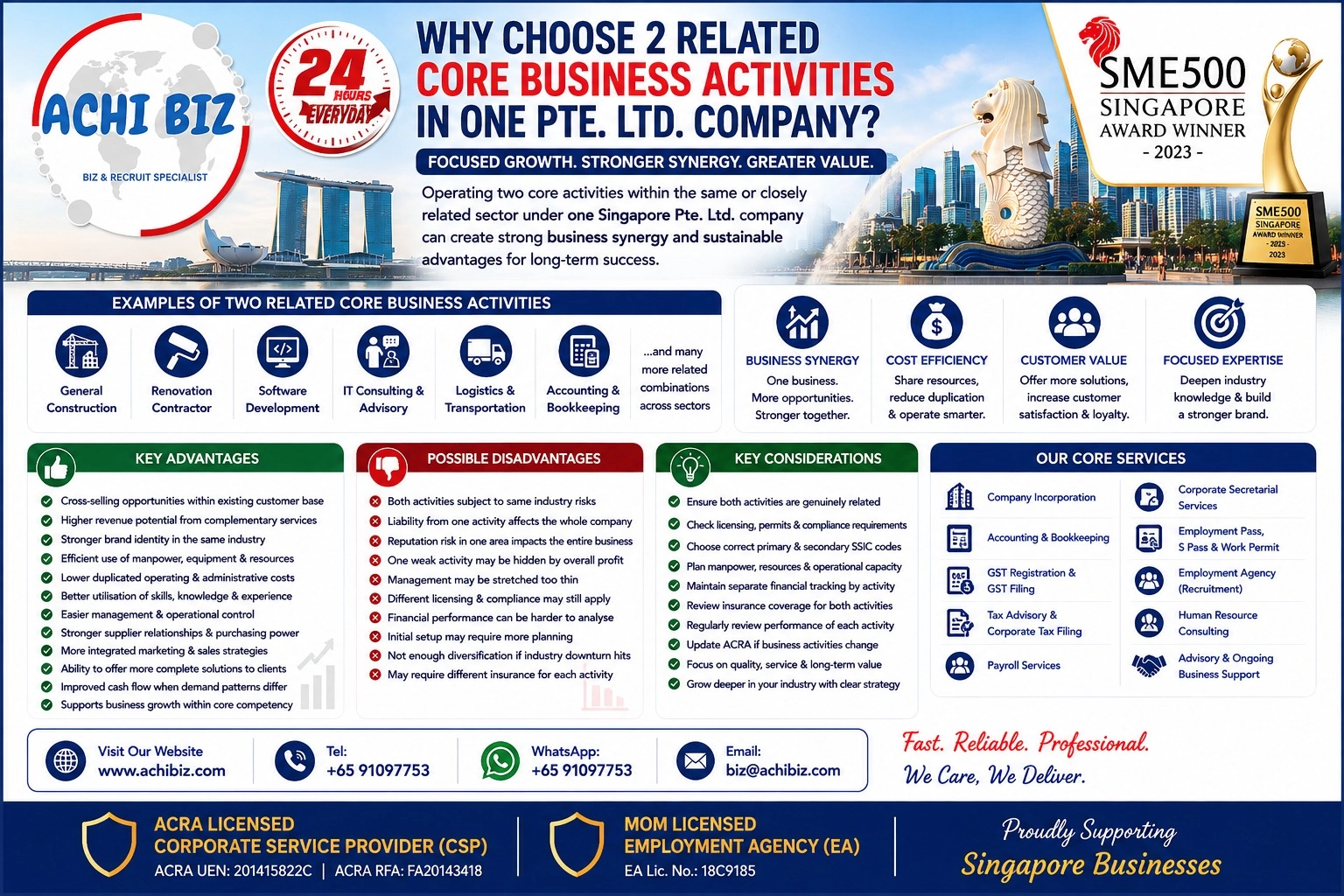
Why Choose Two Related Business Activities in One Pte Ltd Company? – FAQ Guide
When incorporating a Private Limited (Pte. Ltd.) company in Singapore, business owners should think carefully about the activities the company will actually carry on. ACRA uses the Singapore Standard Industrial Classification (SSIC) system to classify an entity’s primary business activity and, where applicable, its secondary business activity.
For many businesses, there can be practical advantages when the two core activities belong to the same or closely related business sector. For example, a company carrying on general construction and renovation contracting has two activities that can naturally complement one another. The same principle may apply to related activities in trading, IT, consultancy, engineering, logistics, professional services and many other industries.
This FAQ analyses the features, importance, advantages, possible disadvantages and practical considerations of operating two related core business activities within one Singapore Pte. Ltd. company. It does not deal with structuring unrelated businesses or deciding whether different businesses should be placed into separate companies, which should be considered independently.
What does having two related core business activities in one Pte. Ltd. company mean?
It means the company carries on two significant activities that have a natural commercial connection.
For example, a construction business may undertake general construction work as its primary activity while also providing renovation contracting as another core activity.
The two activities do not have to be identical. What matters commercially is whether they complement each other and can reasonably operate as parts of the same overall business.
Can a Singapore Pte. Ltd. company register both primary and secondary business activities?
Yes.
ACRA requires registered entities to select a five-digit SSIC code for their primary business activity and, where applicable, a second SSIC code for their secondary business activity.
The selected SSIC codes should accurately describe what the company actually does.
What is the difference between a primary and secondary business activity?
The primary activity generally represents the company’s principal business, while the secondary activity identifies another business activity carried on by the company.
The fact that an activity is described as “secondary” for classification purposes does not necessarily mean it is commercially insignificant.
A company may derive substantial business from both activities.
Why can two related business activities work well within the same company?
Because one activity can naturally support the other.
Consider a company undertaking both construction and renovation projects. A customer who initially engages the company for one scope of work may subsequently require another related service.
Instead of treating each activity as an isolated business, the company can develop an integrated service offering around the same industry.
What are examples of two related business activities?
The exact SSIC classifications should always be checked, but commercially related combinations could include:
- General construction and renovation contracting
- Software development and IT consultancy
- Accounting and bookkeeping
- Freight transportation and logistics support
- Engineering consultancy and technical services
- Wholesale and retail of related products
- Digital marketing and advertising services
- Interior design and renovation-related services
The important consideration is the commercial relationship between the activities, not simply whether two SSIC codes can be registered.
What is the biggest advantage of having two related core business activities?
The biggest advantage is business synergy.
The same customers, employees, management, suppliers, equipment, knowledge and business processes may be relevant to both activities.
Instead of developing two disconnected operating models, the company can build one stronger business ecosystem.
Can related business activities create cross-selling opportunities?
Yes, and this can be a significant advantage.
A renovation customer may require additional construction work. An IT consultancy client may subsequently require software development. A bookkeeping client may need related accounting support.
When the services are complementary, an existing customer relationship can create opportunities for additional revenue.
Can related activities increase revenue opportunities?
Potentially, yes.
A company is not dependent on generating revenue from only one narrow service line. It can pursue opportunities across both related activities.
This may allow the business to obtain a greater share of a customer’s overall project or requirements.
Can having related activities create a more complete service offering?
Yes.
Customers often prefer dealing with a business capable of handling several connected requirements.
For example, a contractor capable of coordinating both general construction and renovation works may be able to offer customers a more integrated solution than one providing only a narrowly defined service.
Can two related activities strengthen the company’s business identity?
They can.
Where both activities fit naturally together, customers can more easily understand what the company specialises in.
A focused industry identity may make branding, marketing and business development more coherent.
Can related business activities make marketing easier?
Generally, yes.
One website, marketing strategy and sales team can potentially promote both activities to overlapping customer groups.
Content created for one service can also generate enquiries for the other.
This can make marketing expenditure more productive.
Does a focused business sector help with SEO and online marketing?
Potentially.
A company whose website contains substantial expertise around connected topics can build a clearer thematic identity for users and search engines.
For example, a construction and renovation company can develop content around construction projects, renovation works, project management, contractor services and related topics without creating an obviously fragmented website.
However, SEO performance depends on many factors and is not guaranteed merely because the activities are related.
Can related activities make referrals easier?
Yes.
A customer who understands the company’s overall specialisation can more easily identify the type of work to refer.
For example, someone who knows a company as a construction and renovation contractor may refer both construction and renovation opportunities to it.
Clear positioning can therefore support word-of-mouth marketing.
Can the same workforce support both related activities?
In some industries, yes.
Employees may possess skills applicable to both service lines, although this depends on their qualifications, job scopes and regulatory requirements.
A construction-related business, for example, may be able to deploy certain project management, administrative, procurement or supervisory resources across several related projects.
This can improve manpower utilisation.
Can related business activities reduce idle manpower?
Potentially.
If demand for one activity temporarily slows while the other remains active, some shared employees may still have useful work available.
This is not possible for every job function, particularly where specialised qualifications are required, but related operations generally provide more opportunities for flexible resource deployment.
Can management oversee related activities more efficiently?
Usually.
Management does not have to understand two completely different commercial environments.
Industry knowledge, supplier relationships, customer expectations, pricing practices and operational risks developed in one related activity may also be relevant to the other.
That can make management oversight more focused.
Can the same administrative team support both activities?
Often, yes.
HR, payroll, bookkeeping, administration, procurement and other back-office functions may support the company as a whole.
Where operations are related, the administrative processes may also be similar, reducing unnecessary operational complexity.
Can the same suppliers support both activities?
Sometimes.
Related activities may use overlapping suppliers, subcontractors, materials, technology or professional services.
Greater purchasing volume with common suppliers may also strengthen commercial relationships and, in some circumstances, improve purchasing terms.
Can the company share equipment and other assets between related activities?
Where operationally appropriate, yes.
Vehicles, tools, machinery, computers, software, office facilities and other resources may potentially support both activities.
The benefit depends heavily on the industry. Specialised assets cannot always be shared, but related activities generally offer greater scope for resource utilisation.
Can two related activities reduce duplicated operating costs?
Potentially.
A company may use common management, accounting systems, HR processes, office infrastructure, technology and marketing resources to support both activities.
This can help prevent unnecessary duplication within the company’s internal operations.
Does having related activities make bookkeeping easier?
It can make bookkeeping more coherent, but the company should still distinguish the financial performance of each activity where useful.
Management may use separate revenue accounts, cost centres, project codes or departments to understand how each business line performs.
The advantage of related activities is that many common expenses may genuinely support the same overall business operation.
Should revenue from each business activity still be tracked separately?
Yes, particularly where both activities are substantial.
A company can be profitable overall while one particular service line is consistently losing money.
Separately tracking revenue, direct costs and margins allows management to determine which activity is performing better.
Can related activities improve financial analysis?
Yes.
Management can analyse whether the activities complement one another financially.
For example, one service might generate higher margins while another generates larger sales volume. One may create recurring work while another produces larger project-based revenue.
Understanding these relationships can improve management decisions.
Can related activities improve cash-flow stability?
Potentially, but not automatically.
If the activities have different billing cycles or demand patterns, income from one may partly offset fluctuations in the other.
However, where both activities are affected by the same industry downturn, they may decline at the same time.
This is an important limitation of operating within one concentrated sector.
Does having related activities help a company specialise?
Yes.
Diversification does not necessarily mean moving into unrelated industries.
A company can diversify within its area of expertise by developing several complementary services.
This is sometimes called related diversification or horizontal expansion.
Can related activities help the company build deeper industry expertise?
Yes.
Knowledge accumulated from one activity can strengthen the other.
Employees, directors and management continue learning within a broadly common commercial environment rather than dividing attention among entirely different industries.
Over time, this may strengthen the company’s technical and commercial capabilities.
Can related activities strengthen the company’s track record?
Potentially.
Projects completed under related service lines can contribute to a broader history of experience within the same industry.
However, where a tender, licence, accreditation or customer specifically requires experience in a particular activity, the company must still satisfy those exact requirements. Related experience should not automatically be treated as equivalent experience.
Can related business activities improve tender opportunities?
They may.
Some projects require several connected scopes of work. A business with relevant capabilities across those scopes may be commercially better positioned to tender for broader projects.
Nevertheless, registration of an SSIC activity by itself does not establish that the company possesses every licence, registration, financial grade, technical capability or track record required for a particular tender.
Does registering an SSIC code automatically give the company permission to carry out that activity?
No.
This distinction is important.
An SSIC code classifies the company’s business activity. It should not be treated as a substitute for licences, approvals, registrations or permits that may separately apply to the actual activity.
Businesses should determine whether their proposed operations require sector-specific regulatory approvals before commencing them.
Do two related activities always have the same licensing requirements?
No.
Even closely related activities can be subject to different regulatory requirements.
A company should therefore analyse each activity separately for licences, permits, registrations, qualifications and approvals.
The commercial relationship between the activities does not eliminate sector-specific compliance obligations.
Can related activities simplify compliance?
They can sometimes make compliance easier to manage because the regulatory environments may overlap.
For example, management may already understand the agencies, safety requirements or industry practices relevant to its sector.
However, the company must still identify and comply with every requirement applicable to each activity.
Is choosing related SSIC codes enough when incorporating the company?
No.
SSIC selection is only one part of business planning.
The founders should also consider licences, premises, manpower, insurance, contracts, financing, tax implications, operational requirements and whether the proposed activities are permitted at the intended location.
Why is selecting the correct SSIC code important?
SSIC codes formally classify what the company does and form part of its registered business information.
ACRA advises businesses to choose codes that best describe their business activities. Primary and secondary business activities are also included in ACRA’s publicly available entity datasets.
Using an inappropriate code can therefore create an inaccurate description of the company’s business.
Can a company change its business activities later?
Yes.
Business activities can change as the company develops. ACRA allows entities to update their primary and secondary business activities through Bizfile.
For local companies, changes to business activities should be updated with ACRA within 14 days.
Should a company choose a secondary activity merely because it might do that business someday?
Generally, business activities should reflect the company’s genuine intended or actual operations rather than being selected simply to make the company appear capable of doing many things.
A focused and accurate description usually provides a clearer picture of the company’s business.
Can two related activities improve customer confidence?
Potentially.
Customers may see the company as a specialist capable of addressing several connected requirements.
But credibility ultimately depends on actual experience, workmanship, qualifications, service quality and reliability—not merely the business activities recorded with ACRA.
Can related activities improve branding?
Yes.
A brand is generally easier to communicate when its services tell a coherent story.
For example, positioning a business around construction, renovation and related contracting services gives customers a relatively clear idea of its field.
Branding becomes more difficult when customers cannot easily understand what the business specialises in.
Can the company use one website for both related activities?
Usually, yes.
A properly structured website can have separate service pages for each activity while maintaining one overall industry identity.
This can also make it easier to cross-reference complementary services.
Can the company issue invoices for both related activities?
Yes, provided the company is genuinely carrying on those activities and complies with any applicable regulatory requirements.
For management purposes, invoices can also be categorised by service, project or department so that revenue can later be analysed separately.
Can the company enter contracts covering both activities?
Potentially, yes.
This can be particularly useful where a customer requires an integrated scope of work.
However, contracts should clearly define responsibilities, deliverables, pricing, warranties, liability and any subcontracting arrangements relevant to each scope.
Can related activities help increase the lifetime value of a customer?
Yes.
Instead of serving a customer for only one requirement, the company may continue supporting that customer through complementary services.
For example, an initial project can lead to alteration, renovation, maintenance or other related work where those services fall within the company’s capabilities.
This can deepen customer relationships and create repeat business.
Can related activities make business development more efficient?
Yes.
Sales staff can approach a similar customer profile for both services.
Networking, advertising, industry events and referral relationships may also generate opportunities across both activities.
The company is therefore able to concentrate business development resources within a defined market.
Can related activities create economies of scope?
Potentially.
Economies of scope occur when providing multiple related products or services together is more efficient than treating each service as an entirely isolated operation.
Shared management, knowledge, infrastructure, customers and resources can contribute to this efficiency.
What are the disadvantages of having two related core activities?
The arrangement has limitations.
Both activities may be exposed to the same industry cycle, so diversification within one sector may provide less protection against an industry-wide downturn.
Management can also spread itself too thin if it expands into a second activity before mastering the first. Separate licensing requirements may still apply, and financial performance can become difficult to understand if the company does not maintain proper segment or project-level records.
Related does not automatically mean easy.
Is industry concentration a disadvantage?
It can be.
If both activities depend on the same customers, economic conditions or industry demand, a downturn can affect both simultaneously.
For example, two construction-related activities may both be affected by reduced project demand or rising material and manpower costs.
This is one of the principal trade-offs of maintaining a concentrated sector strategy.
Can one activity financially subsidise an underperforming activity?
Yes, and this can become a hidden problem.
Because all revenue and expenses ultimately belong to the same company, strong performance in one activity can conceal losses in another unless management accounts distinguish them properly.
Management should therefore monitor profitability by activity or project where commercially meaningful.
Can one related activity create liabilities affecting the whole company?
Yes.
This is a major point to understand.
Although the company may operate two different service lines, they are being carried on by the same legal entity. A substantial claim, debt, contractual dispute or other liability arising from one activity is therefore a liability of that company.
Operational separation between departments does not create separate legal personalities.
Can the company’s reputation in one activity affect the other activity?
Yes.
Both activities operate under the same corporate identity.
Excellent performance in one area can strengthen the entire brand. Conversely, serious customer complaints, poor workmanship or reputational problems in one service line can affect confidence in the company as a whole.
Can regulatory problems in one activity affect the overall business?
Potentially.
The exact consequences depend on the relevant law, licence and regulator, but a serious compliance issue in one part of the business can consume management time, financial resources and reputation across the company.
This is why each activity requires proper compliance even when the two businesses are closely connected.
Can the company become too broad even within one sector?
Yes.
“Related” should not become an excuse to offer every conceivable service within an industry.
A business can still lose focus if it expands beyond its manpower, expertise, capital or management capacity.
Expansion should follow genuine capability and commercial demand.
Should a startup begin with two related activities immediately?
Not necessarily.
If both activities form part of the founders’ genuine business model and they have the resources to deliver them, it can be practical.
But a startup with limited capital and manpower may benefit from establishing its strongest service first and expanding when demand justifies it.
Registering an activity and successfully operating it are two very different things.
How should directors decide which activity should be primary?
The primary activity should appropriately reflect the company’s principal business.
Directors should consider what the company actually does, its main revenue-generating operations and which SSIC description most accurately represents that business.
ACRA’s SSIC search allows businesses to search by relevant industry keywords and choose the appropriate classification.
What happens if the secondary activity later becomes the main business?
The company’s ACRA information should continue to reflect its actual business.
If its activities materially change, the company should update the relevant business activity information through Bizfile. ACRA requires local companies to update changes to business activities within 14 days.
Is there an ideal revenue percentage between primary and secondary activities?
There is no universal percentage that makes a business combination commercially successful.
The appropriate mix depends on the industry and business model.
Management should focus on whether both activities remain commercially viable and whether their classification accurately reflects what the company does.
Should management prepare separate budgets for each activity?
For substantial business lines, this can be very useful.
Separate internal budgets allow directors to compare revenue, labour, materials, overheads, margins and cash requirements.
The company can then make informed decisions about where to invest additional resources.
Should profit margins be analysed separately?
Yes.
Two related activities can have very different economics.
One might generate higher revenue but lower margins, while another produces less revenue but greater profitability.
Without activity-level analysis, management may incorrectly assume that the largest revenue source is also the most valuable.
Should risks be analysed separately for each business activity?
Absolutely.
Commercial similarity does not mean identical risk.
Each activity should be considered for contractual liability, workplace safety, insurance, licensing, manpower, credit exposure and other relevant operational risks.
The company can then develop controls appropriate to each activity.
Should insurance coverage be reviewed for both activities?
Yes.
A policy suitable for one activity may not automatically cover another.
Businesses should accurately disclose their actual operations to their insurer or insurance adviser and ensure that relevant activities, risks and employees are appropriately covered.
Can the company maintain different departments for its two activities?
Yes.
One legal entity can internally organise itself into separate departments, divisions, cost centres or project teams.
This can provide operational clarity while allowing shared corporate functions such as finance, HR and administration to support the overall company.
Does having two related activities guarantee business success?
No.
Corporate structuring cannot substitute for good management.
Success still depends on demand, pricing, quality, manpower, cash flow, customer service, regulatory compliance, financial discipline and the ability to execute projects profitably.
The advantage of related activities is that they can create synergy when the business is properly managed.
When does having two related core business activities make the most commercial sense?
It tends to make sense when the activities serve similar customers, use overlapping resources, require related expertise, strengthen the same brand and naturally generate business for one another.
The stronger these connections are, the greater the potential operational and commercial synergy.
What should business owners consider before selecting two related activities for a Singapore Pte. Ltd. company?
They should consider whether both activities genuinely belong within the company’s business model, whether there is sufficient expertise and manpower to perform them, whether licences or approvals are required, whether insurance adequately covers both activities and whether the company can track the financial performance of each activity.
The decision should be based on business substance, not simply the availability of a second SSIC field.
What is the overall advantage of keeping a Singapore Pte. Ltd. company focused on two related core activities?
The key advantage is focus with room for growth.
The company can broaden its revenue opportunities without losing its core industry identity. Related activities may allow it to share resources, cross-sell services, deepen customer relationships, build stronger sector expertise and create a more coherent brand.
At the same time, management should recognise the disadvantages: concentration within one industry, shared corporate liabilities, possible licensing differences and the risk that one underperforming activity becomes hidden within the company’s overall results.
When properly planned, two complementary core activities can allow a Singapore Pte. Ltd. company to grow deeper within its chosen sector rather than simply becoming broader for the sake of diversification.
ACHI BIZ can assist business owners with Singapore company incorporation, selection and registration of appropriate business activities, corporate compliance and related business support. The appropriate SSIC codes and regulatory requirements should always be determined according to the company’s actual intended activities.
Disclaimer: This FAQ is for general information only. Registration of a business activity with ACRA does not by itself constitute regulatory approval or a licence to conduct a regulated activity. Businesses should check the specific licensing, approval, premises, manpower and other requirements applicable to their intended operations.
Related Pages
Comparison of One Pte. Ltd. Company vs Two Separate Pte. Ltd. Companies in Singapore – FAQ Guide
Why Choose Two Different-Sector Business Activities in One Pte Ltd Company – FAQ Guide
#achibiz