
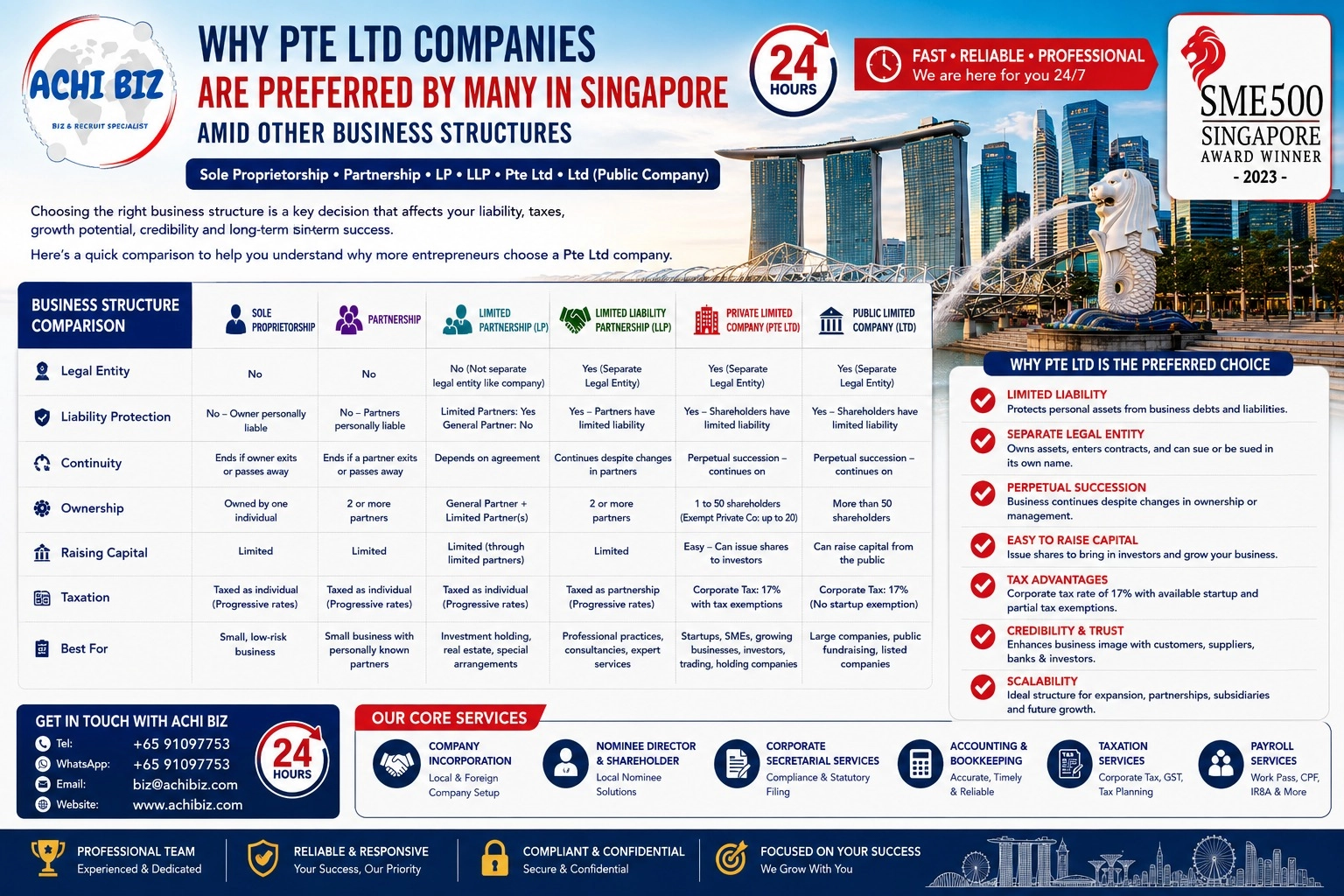
Why Pte Ltd Companies Are Preferred by Many in Singapore Compared with Sole Proprietorships, Partnerships, LPs, LLPs and Limited Companies
Choosing the right business structure in Singapore is one of the most important decisions an entrepreneur makes. The structure affects personal liability, taxation, ownership, business continuity, fundraising, compliance obligations and how customers, banks, investors and other stakeholders may view the business.
Singapore offers several structures, including Sole Proprietorship, Partnership, Limited Partnership (LP), Limited Liability Partnership (LLP), Private Limited Company (Pte Ltd) and Public Limited Company (Ltd).
For many entrepreneurs, startups and SMEs, however, the Private Limited Company (Pte Ltd) has become the preferred structure. ACRA itself states that most small business owners choose a Pte Ltd company for its combination of protection and simplicity, with exempt private companies and private companies limited by shares being the most popular options.
But does that mean a Pte Ltd is always better? No. Each structure serves a different purpose. The right choice depends on the owners, business risk, expected profits, growth plans, financing requirements, compliance budget and long-term objectives.
The following detailed FAQs analyse why Pte Ltd companies are preferred in Singapore and how they compare with other business structures.
Frequently Asked Questions About Pte Ltd Companies and Other Business Structures in Singapore
Why are Pte Ltd companies preferred by many business owners in Singapore?
The biggest attraction is the combination of limited liability, separate legal identity, perpetual succession, ownership flexibility, corporate taxation and scalability.
ACRA confirms that a company is a separate legal entity from its shareholders and directors. It can own property, enter contracts, sue and be sued in its own name. Shareholders generally have limited liability for the company’s debts and losses.
These characteristics make a Pte Ltd suitable not only for starting a business but also for building one that may eventually employ staff, take on investors, enter substantial contracts or expand internationally.
What does Pte Ltd mean in Singapore?
“Pte Ltd” means Private Limited.
A private company limited by shares is incorporated under Singapore’s Companies Act. Ownership is represented by shares, and the company has a legal personality separate from its shareholders and directors.
ACRA identifies both Exempt Private Company Limited by Shares and Private Company Limited by Shares as common private company structures.
Is a Pte Ltd company a separate legal entity?
Yes.
This is one of the fundamental differences between a company and some simpler business structures.
The company exists legally in its own right. It can:
- Own assets and property;
- Open accounts in its own name;
- Enter into contracts;
- Incur debts;
- Employ workers;
- Sue another party; and
- Be sued.
The business is therefore legally distinct from the individuals who own it.
Why is separate legal identity so important?
It creates a legal separation between the business and its owners.
For example, a company can purchase equipment or enter a commercial lease in its own name. The property or contractual rights belong to the company rather than directly to its shareholders.
This distinction becomes increasingly important as a business grows.
Does a sole proprietorship have a separate legal identity from its owner?
No.
A sole proprietorship is essentially a business owned by one person. Unlike a company, there is no separate corporate personality protecting the owner from the business itself.
This simplicity can be attractive for a very small operation, but it also creates greater personal exposure.
What is the biggest difference between a Pte Ltd and sole proprietorship?
The fundamental difference is legal separation and liability.
A Pte Ltd is a separate legal entity and its shareholders generally enjoy limited liability.
A sole proprietorship does not create the same legal separation between owner and business.
For a business involving meaningful contractual, financial or operational risks, this distinction can be extremely important.
Does a Pte Ltd protect the owner’s personal assets?
Generally, shareholders have limited liability and are not personally responsible simply because the company has debts or losses. ACRA specifically identifies limited shareholder liability as a key feature of a company.
However, “limited liability” should never be interpreted as absolute immunity.
Personal liability can still arise in circumstances such as personal guarantees, wrongdoing, breaches of directors’ duties or other situations provided by law.
Is limited liability one of the main reasons entrepreneurs choose Pte Ltd?
Yes.
For many entrepreneurs, it is one of the strongest reasons.
As businesses grow, they may enter leases, borrow money, hire employees, purchase goods on credit and undertake contractual obligations.
Having a separate corporate entity can provide an important layer of legal separation between business risk and personal ownership.
Does limited liability mean a director can never be personally liable?
No.
This is a common misunderstanding.
Limited liability principally concerns shareholders’ exposure as owners. Directors have separate statutory and fiduciary responsibilities.
A director cannot assume that incorporating a Pte Ltd eliminates every form of personal responsibility.
Is a Pte Ltd safer than a sole proprietorship?
From the perspective of separating business liabilities from the owner’s personal legal identity, a Pte Ltd generally provides substantially stronger protection.
However, the actual risk depends on the circumstances, contracts, guarantees and conduct of the people involved.
Is a Pte Ltd suitable for a one-person business?
Yes.
A Pte Ltd does not necessarily require several business owners.
A company must have at least one shareholder and at least one director, subject to the applicable requirements concerning directors and residency.
This means a solo entrepreneur can still choose a corporate structure instead of operating as a sole proprietor.
Why would a one-person business choose a Pte Ltd instead of a sole proprietorship?
The owner may want:
- Limited liability;
- A separate corporate identity;
- Better continuity;
- A structure capable of admitting future shareholders;
- Corporate tax treatment;
- Greater scalability; or
- A more formal structure for future expansion.
The additional benefits come with additional compliance responsibilities.
Is a Pte Ltd automatically better than a sole proprietorship?
No.
A sole proprietorship may be perfectly suitable for a small, low-risk business where the owner wants simplicity and does not require investors or a sophisticated ownership structure.
The Pte Ltd becomes more compelling when risk, revenue, employees, contracts, financing or growth ambitions increase.
What is a Partnership in Singapore?
A conventional partnership involves two or more persons carrying on a business together for profit.
It can be straightforward to establish, but conventional partnerships do not provide the same corporate separation and limited-liability structure as a Pte Ltd.
Why might business partners prefer a Pte Ltd over a conventional Partnership?
The Pte Ltd provides a clearer separation between ownership and the company’s legal obligations.
Ownership can also be represented through shares, making it easier to document different ownership percentages and subsequently transfer or issue shares, subject to the company’s constitution and applicable requirements.
What is a Limited Partnership (LP) in Singapore?
An LP consists of at least:
- One general partner; and
- One limited partner.
The roles are materially different. The general partner bears greater responsibility for the LP’s obligations, while the limited partner’s liability is generally limited subject to the applicable LP rules.
An LP can be useful for particular investment or business arrangements, but it does not provide the same structure as a company.
Why might a Pte Ltd be preferred over an LP?
A Pte Ltd generally provides a more straightforward limited-liability ownership model for an ordinary operating business.
In an LP, the distinction between general and limited partners is fundamental. A Pte Ltd instead has shareholders and directors, making it more familiar for many conventional businesses, investors and commercial counterparties.
What is an LLP in Singapore?
A Limited Liability Partnership (LLP) combines characteristics of a partnership and a corporate structure.
Importantly, an LLP is itself a separate legal entity, and its partners generally benefit from limited liability for the LLP’s debts and obligations. ACRA describes the LLP as combining partnership flexibility with the limited-liability protection normally associated with corporations.
Is an LLP also a separate legal entity?
Yes.
This is important because an LLP should not be confused with an ordinary partnership.
An LLP can own property and enter contracts in its own name, and it continues independently of changes among its partners.
If an LLP already offers limited liability, why choose a Pte Ltd?
Because limited liability is only one factor.
A Pte Ltd uses a shareholder-and-director structure, whereas an LLP operates through partners. Shares provide a conventional mechanism for dividing ownership, bringing in investors and transferring equity.
For a professional practice or partnership-style venture, an LLP may be highly suitable. For a scalable commercial enterprise seeking equity investment, a Pte Ltd may be more natural.
Is an LLP better than a Pte Ltd for professional practices?
It can be.
An LLP can work particularly well where several professionals want to conduct business together while retaining partnership-style management flexibility.
The appropriate choice depends on the profession, regulatory requirements, taxation and how the owners want to structure their relationship.
Is Pte Ltd more suitable for startups than an LLP?
Often, yes—particularly where the startup intends to raise equity capital.
A startup can issue shares to founders and investors, establish different shareholdings and change its capital structure as the business develops.
That makes the company model familiar to angel investors, venture capital investors and other equity participants.
Can a Pte Ltd have corporate shareholders?
Yes.
ACRA confirms that companies can have both individual and corporate shareholders.
This can be particularly useful for group companies, subsidiaries, joint ventures and foreign investment structures.
How many shareholders can a private company have?
ACRA states that:
- An Exempt Private Company may have up to 20 shareholders, subject to its specific requirements; and
- A Private Company Limited by Shares may have up to 50 shareholders.
A public company structure may be required where the intended ownership model goes beyond the private-company framework.
Can foreigners own a Singapore Pte Ltd company?
Singapore companies can generally have foreign shareholders, including corporate shareholders.
However, ownership should not be confused with management and regulatory requirements. A Singapore company must separately satisfy requirements relating to directors, registered office, company secretary and any applicable sector-specific licences or approvals.
Why is share ownership an advantage of a Pte Ltd?
Shares provide a defined mechanism for representing ownership.
For example, two founders might hold different percentages of a company. A new investor may later subscribe for shares, or an existing shareholder may transfer shares, subject to applicable procedures and restrictions.
This makes ownership easier to structure than in many non-company business forms.
Can a Pte Ltd issue different types of shares?
Yes.
ACRA recognises several types of shares, including ordinary shares and various forms of preference shares. Different share types can carry different economic or governance rights depending on their terms and the company’s constitution.
This provides considerably greater flexibility for investment structuring.
Why is a Pte Ltd better suited to investors?
Investors generally want a clearly defined ownership interest.
Shares can provide that interest while allowing founders and investors to document voting, dividend and other rights through the company’s share structure and relevant agreements.
That is one reason equity-funded startups commonly operate through companies rather than sole proprietorships.
Can a sole proprietorship issue shares to investors?
No.
A sole proprietorship is owned by one individual. It does not have share capital.
If the owner wants another person to acquire an equity interest, the business structure itself may need to change.
Can a Partnership issue shares?
A traditional partnership has partners rather than shareholders.
The partners’ rights arise from the partnership arrangement rather than corporate shares.
Does a Pte Ltd make it easier to bring in a new business partner?
Potentially, yes.
Instead of changing the fundamental business structure, a new owner can potentially become a shareholder through a share allotment or transfer, subject to the applicable legal and corporate procedures.
Can ownership of a Pte Ltd be transferred?
Yes.
Shares can generally be transferred subject to the Companies Act, the company’s constitution, existing shareholder arrangements and applicable procedures.
This provides an established mechanism for changing ownership.
Is it easier to sell a Pte Ltd business?
A company can potentially be sold by transferring its shares rather than transferring every individual business asset.
Whether this is actually easier depends on due diligence, contracts, liabilities, tax, licences and the buyer’s preferred transaction structure.
Nevertheless, a company provides a recognised ownership mechanism that can facilitate acquisitions.
Does a Pte Ltd continue if a shareholder leaves or dies?
A company has perpetual succession.
Its existence is not automatically terminated because a shareholder or director changes, retires or dies. ACRA states that a company continues until it is formally wound up or struck off.
This can be a major advantage for business continuity.
Why is perpetual succession important?
A successful business may survive its founders.
The ability of the legal entity to continue despite ownership or management changes makes succession planning, investment and long-term contracting easier.
Does a sole proprietorship have the same continuity as a company?
No.
Because the business and proprietor are legally intertwined, a sole proprietorship does not provide the same independent perpetual corporate existence.
This can become important when planning succession or sale of the business.
Does a Pte Ltd generally appear more established than a sole proprietorship?
It can.
The “Pte Ltd” designation tells counterparties that they are dealing with an incorporated entity governed by Singapore’s corporate framework.
However, incorporation itself does not prove that a company is financially strong, trustworthy or well managed. A newly incorporated Pte Ltd can be smaller than a long-established sole proprietorship.
Does a Pte Ltd improve business credibility?
It can contribute to credibility, particularly when dealing with larger corporate customers, overseas counterparties, investors and suppliers.
But credibility ultimately comes from factors such as financial strength, track record, management, compliance, service quality and reputation—not merely the letters “Pte Ltd”.
Do larger customers prefer dealing with Pte Ltd companies?
Some organisations may prefer incorporated suppliers because their procurement and due-diligence systems are designed around corporate entities.
This is a commercial preference rather than a universal legal rule.
Is a Pte Ltd more suitable for government and corporate tenders?
It may be, depending on the tender.
Many tenders impose their own requirements concerning business structure, track record, financial standing, licences, certifications and manpower.
Being incorporated does not automatically qualify a company for a tender, but a corporate structure can be advantageous where the procurement framework expects one.
Does a Pte Ltd make opening a corporate bank account easier?
A company can open accounts in its own legal name, subject to the financial institution’s approval.
However, incorporation does not guarantee bank-account approval. Banks conduct their own KYC, AML, business-purpose and risk assessments.
Can a Pte Ltd borrow money in its own name?
Yes, subject to lender approval.
Because the company is a separate legal entity, financing can be taken in the company’s name.
Banks may nevertheless require personal guarantees or security, particularly for new or small companies.
Does giving a personal guarantee remove limited liability?
For the guaranteed obligation, it can create direct personal exposure.
A shareholder or director who personally guarantees a company’s loan or lease may become personally responsible according to the terms of that guarantee if the company fails to meet the obligation.
This is why “Pte Ltd” should never be interpreted as protection from every business debt in every circumstance.
How is a Singapore Pte Ltd company taxed?
Companies are generally subject to Corporate Income Tax.
IRAS states that Singapore’s prevailing Corporate Income Tax rate is 17% of chargeable income for both local and foreign companies.
How is a sole proprietorship taxed?
A sole proprietorship is not treated as a company for Singapore corporate income tax purposes. Its business income is generally attributed to the proprietor and taxed under the applicable individual income tax framework.
IRAS specifically states that a sole proprietorship or partnership business is not considered a company for corporate income tax purposes.
Is a Pte Ltd always more tax-efficient than a sole proprietorship?
No.
This should be analysed rather than assumed.
The answer depends on profit level, allowable deductions, applicable exemptions, the owner’s circumstances, remuneration strategy and other tax considerations.
A low-profit sole proprietorship may not automatically benefit merely by converting into a company.
Are there tax exemptions available to Singapore companies?
Yes, subject to qualifying conditions.
For qualifying new companies where the relevant Years of Assessment fall in YA 2020 onwards, the Start-Up Tax Exemption generally provides a 75% exemption on the first S$100,000 of normal chargeable income and 50% on the next S$100,000 for the first three consecutive YAs.
Companies that do not qualify for the startup exemption may potentially benefit from the Partial Tax Exemption scheme where applicable.
Does every newly incorporated Pte Ltd automatically qualify for the startup tax exemption?
No.
Eligibility conditions apply.
The company must satisfy IRAS requirements for the relevant Year of Assessment. Incorporating a company solely because somebody says “new companies pay almost no tax” is therefore poor planning.
Is the 17% corporate tax rate applied to turnover?
No.
The 17% rate applies to chargeable income, not simply gross sales or revenue.
Accounting profit and taxable income are also not necessarily identical because tax adjustments may be required.
Can shareholders receive dividends from a Pte Ltd?
A company may declare and pay dividends when the applicable legal requirements are satisfied.
This creates another distinction between a company and a sole proprietorship, where the proprietor does not pay a “dividend” to himself or herself because the business is not a separate company.
Why can a Pte Ltd be better for retaining profits for business expansion?
Because profits belong to the company as a separate entity.
Subject to taxation and corporate requirements, the company can retain funds for working capital, equipment, hiring, expansion and future investment instead of treating all business income as belonging directly to an individual proprietor.
Is a Pte Ltd suitable for businesses planning overseas expansion?
Often, yes.
A company can provide a structured corporate base for establishing subsidiaries, investing in other entities, entering international contracts and receiving investment.
Its suitability still depends on the countries involved, tax arrangements and actual commercial structure.
Can a Pte Ltd own another company?
Yes.
Companies can be corporate shareholders in other companies.
This enables holding-company, subsidiary, joint-venture and group structures.
Can another company own a Singapore Pte Ltd?
Yes, subject to the particular company type and applicable restrictions.
A standard private company limited by shares can have corporate shareholders, making it suitable for subsidiaries and international corporate structures.
Is a Pte Ltd suitable as a Singapore subsidiary of a foreign company?
Yes.
Foreign businesses frequently use Singapore-incorporated subsidiaries because the subsidiary has its own Singapore legal identity.
This differs fundamentally from operating through a branch of the foreign company.
Is a Pte Ltd better for joint ventures?
It can be very suitable.
Joint-venture participants can hold agreed percentages of shares and document governance, reserved matters, funding obligations and exit arrangements.
The precise structure should be professionally planned where substantial investments are involved.
Is a Pte Ltd more suitable for employee share ownership?
Generally, yes.
Because ownership is represented by shares, companies can potentially establish equity arrangements for founders, employees and investors, subject to corporate, employment, tax and securities considerations.
Why is a Pte Ltd considered scalable?
A business might begin with one shareholder, one director and modest operations, then later:
- Add shareholders;
- Issue additional shares;
- Hire employees;
- Raise capital;
- Acquire assets;
- Establish subsidiaries;
- Expand overseas; or
- Bring in institutional investors.
The company does not necessarily need to change its fundamental legal form every time the business grows.
When might a Sole Proprietorship be preferable to a Pte Ltd?
A sole proprietorship can make sense where:
- The operation is very small;
- Business risk is limited;
- There is only one owner;
- External investors are not expected;
- The owner prioritises administrative simplicity; and
- The additional corporate compliance of a company would provide little practical benefit.
The cheapest or simplest structure is not necessarily the best long-term structure, however.
When might a Partnership be preferable?
A traditional partnership may suit a small group of people conducting a straightforward business together where they accept the partnership’s legal and liability characteristics.
As the business becomes larger or riskier, the partners may wish to reconsider whether a limited-liability structure is more appropriate.
When might an LP be preferable to a Pte Ltd?
An LP can be useful where the intended arrangement specifically requires general and limited partners, such as certain investment structures.
For an ordinary trading or operating SME, a Pte Ltd may often be easier for customers and investors to understand.
When might an LLP be preferable to a Pte Ltd?
An LLP can be particularly attractive for professional or partnership-style businesses where owners want:
- Separate legal personality;
- Limited-liability features; and
- Partnership-style operational flexibility.
A Pte Ltd may be preferable where equity ownership, investment and corporate scalability are greater priorities.
When might a Public Limited Company be preferable to a Pte Ltd?
A public company may be appropriate for a substantially larger business seeking broader access to capital and potentially public investment markets.
ACRA notes that public companies limited by shares can have more than 50 shareholders and may offer shares to the public, subject to additional requirements, including prospectus requirements where applicable.
Why doesn’t every business simply register as a Public Limited Company?
Because the additional flexibility comes with substantially greater regulatory and reporting responsibilities.
For most startups and SMEs, a private company provides sufficient corporate protection and ownership flexibility without the additional complexity associated with a public company.
What is the difference between “Pte Ltd” and “Ltd” in Singapore?
“Pte Ltd” generally identifies a private company, while “Ltd” is commonly associated with a public company.
Private companies restrict public access to their shares and have limits on shareholders. Public companies operate under a different framework and can have a broader ownership base.
Is Pte Ltd generally more appropriate for SMEs than Ltd?
Yes, in many cases.
ACRA specifically describes exempt private companies as suitable for small businesses and startups and private companies limited by shares as suitable for medium businesses.
A public-company structure is usually unnecessary for an ordinary SME.
What is an Exempt Private Company (EPC)?
An Exempt Private Company Limited by Shares is a type of private company.
ACRA currently describes it as suitable for small businesses and startups and states that it may have up to 20 shareholders, subject to the applicable requirements.
Is every Pte Ltd an Exempt Private Company?
No.
An Exempt Private Company Limited by Shares and a Private Company Limited by Shares are distinct company types under ACRA’s framework.
The appropriate classification depends on the company’s ownership and other applicable requirements.
Does a Pte Ltd require a company secretary?
Yes.
A company has ongoing corporate-governance requirements, including the appointment of a company secretary within the prescribed framework. ACRA lists appointment of a company secretary among the ongoing requirements applicable to companies.
This is one of the areas where a company involves more compliance than a sole proprietorship.
Does a Pte Ltd need a registered office in Singapore?
Yes.
A Singapore company must maintain a registered office in accordance with applicable requirements.
The registered office forms part of the company’s official corporate particulars.
Does every Pte Ltd need an auditor?
No.
Private companies that qualify under the small company audit exemption can be exempt from statutory audit.
Broadly, ACRA states that a private company must meet at least two of three quantitative criteria for the immediate past two consecutive financial years: annual revenue of S$10 million or less, total assets of S$10 million or less, and 50 or fewer employees. Additional rules apply, including for groups.
Does audit exemption mean a Pte Ltd does not need proper accounts?
Absolutely not.
Audit exemption only removes the statutory audit requirement where the company qualifies.
It does not eliminate bookkeeping, accounting, financial reporting, tax or corporate compliance obligations.
Does a Pte Ltd have to file an Annual Return with ACRA?
Yes.
All live Singapore companies must file an Annual Return, including inactive or dormant companies, subject to the applicable requirements.
When does a non-listed Pte Ltd generally file its Annual Return?
ACRA states that a non-listed company generally files its Annual Return within seven months after its financial year end, with specific rules applying in certain circumstances.
Does a Pte Ltd have more compliance obligations than a sole proprietorship?
Yes.
This is one of the main disadvantages of incorporating.
A company must deal with corporate governance, statutory registers, annual returns, accounting, tax and other ongoing obligations applicable to its circumstances.
The benefits of incorporation therefore need to justify the additional administration.
Does higher compliance make a Pte Ltd a bad choice for a small business?
Not necessarily.
Compliance has a cost, but limited liability, corporate continuity, tax treatment and scalability may provide greater long-term value.
The right question is not simply, “Which structure is cheapest to maintain?”
It is, “Which structure best protects and supports the business I intend to build?”
Can a sole proprietor later convert the business into a Pte Ltd?
A business owner can subsequently establish a company and transfer or restructure the business operations into it, subject to the necessary legal, contractual, accounting, tax, licensing and administrative steps.
However, this is not simply a matter of changing the letters after the business name. A company is a different legal entity.
When should a sole proprietor consider moving to a Pte Ltd?
Common triggers include:
- Increasing revenue or profitability;
- Taking on significant contracts;
- Hiring more employees;
- Increasing liability exposure;
- Bringing in a business partner or investor;
- Seeking external financing;
- Expanding overseas;
- Building a business intended for eventual sale; or
- Wanting clearer separation between personal and business affairs.
There is no single turnover level at which incorporation automatically becomes necessary.
Is Pte Ltd better for separating personal and business finances?
Yes, structurally.
Because the company is a separate legal person, company money should be treated as company money rather than as the shareholder’s personal funds.
This encourages clearer accounting and corporate governance.
Can a shareholder freely use company money for personal expenses?
No.
The company has a separate legal identity. Company funds should therefore be used and accounted for appropriately.
Payments to directors or shareholders may need to be classified as salary, reimbursement, dividend, loan or another legitimate transaction depending on the circumstances.
Why is this distinction important for owner-managed Pte Ltd companies?
Small-business owners sometimes treat the company’s bank account as though it were their personal account.
That undermines accounting clarity and can create tax, governance and record-keeping problems.
The benefit of separate corporate identity works best when the owners actually respect that separation.
Is bookkeeping more important for a Pte Ltd?
Proper accounting is important for every business, but companies have formal financial reporting and corporate tax obligations.
Reliable accounting records therefore become essential for determining financial performance, preparing financial statements and satisfying tax and corporate requirements.
Is a Pte Ltd more suitable for building a business that can eventually be sold?
Often, yes.
A company’s assets, contracts, employees and operations can remain within the same legal entity even when shareholders change.
That can make corporate succession and acquisitions structurally cleaner, although an actual business sale still requires substantial legal, financial and tax due diligence.
Is a Pte Ltd more attractive to venture capital investors?
Generally, an incorporated share-based structure is much more compatible with equity investment than a sole proprietorship.
Professional investors typically need clearly defined ownership, shareholder rights, governance and exit mechanisms.
A Pte Ltd provides a foundation for these arrangements.
Can a Pte Ltd provide better succession planning for a family business?
Potentially.
Instead of transferring every underlying business asset individually, ownership can potentially be reorganised through shares.
Family succession still requires proper estate, tax, corporate and legal planning, but a company provides a useful framework.
Does incorporating a Pte Ltd automatically make a business successful?
No.
A company structure does not create customers, profits or good management.
Pte Ltd is a legal and commercial framework. Success still depends on the business model, execution, financial discipline, people, market conditions and management.
Does incorporating a Pte Ltd automatically make the owner wealthy or protect the owner from business failure?
No.
Limited liability reduces certain forms of personal exposure; it does not eliminate commercial risk.
A shareholder can still lose the capital invested in the company, and directors or shareholders may have additional exposure where they provide personal guarantees or incur personal liability.
Is Pte Ltd the best business structure for every entrepreneur in Singapore?
No.
There is no universally superior structure.
A freelancer with minimal risk may prefer a sole proprietorship. Professionals may find an LLP more appropriate. An investment arrangement may favour an LP. A large organisation accessing public capital may require a public company.
The Pte Ltd is popular because it offers an unusually practical middle ground between protection, credibility, flexibility and compliance.
What are the main disadvantages of a Pte Ltd compared with simpler business structures?
The main disadvantages generally include:
- Higher setup and maintenance costs;
- More statutory compliance;
- Corporate record-keeping requirements;
- Annual Return obligations;
- Requirement for company officers;
- Financial reporting and tax obligations;
- Greater formality when taking money out of the business; and
- Formal procedures for certain corporate changes and closure.
These disadvantages should be weighed against the protection and flexibility provided by incorporation.
What happens if a Pte Ltd fails to comply with its annual obligations?
Late or missing filings can result in penalties and enforcement action.
For example, ACRA currently imposes late-lodgement penalties of S$300 where an Annual Return is filed up to three months late and S$600 where it is more than three months late for applicable filing deadlines. Continued non-compliance can result in further enforcement consequences.
This is why directors should understand that incorporation brings ongoing responsibilities.
Is closing a Pte Ltd more complicated than closing a sole proprietorship?
Generally, yes.
Because the company has an independent legal existence, it must be formally removed through an appropriate process such as striking off or winding up.
ACRA confirms that a company continues to exist until formally wound up or struck off.
Why should entrepreneurs think about exit before choosing a business structure?
Business structure affects not only how you start, but also how you eventually:
- Bring in investors;
- Transfer ownership;
- Sell the business;
- Pass it to family members;
- Remove a shareholder; or
- Close operations.
Choosing only according to the cheapest registration cost can therefore be short-sighted.
How do Sole Proprietorship, Partnership, LP, LLP, Pte Ltd and Ltd broadly compare?
At a high level:
| Structure | Separate Legal Entity | Liability Position | Ownership | Common Use |
|---|---|---|---|---|
| Sole Proprietorship | No | Owner personally exposed | 1 owner | Very small/simple businesses |
| Partnership | No | Partners generally personally exposed | 2 or more partners | Small joint businesses |
| Limited Partnership (LP) | Not the same separate corporate structure as Pte Ltd | Depends on general/limited partner status | General & limited partners | Certain investment/business structures |
| Limited Liability Partnership (LLP) | Yes | Partners generally enjoy limited liability, subject to applicable rules | Partners | Professional/partnership-style businesses |
| Private Limited Company (Pte Ltd) | Yes | Shareholders generally have limited liability | Shareholders | Startups, SMEs, subsidiaries, growing businesses |
| Public Limited Company (Ltd) | Yes | Shareholders generally have limited liability | Shareholders | Larger/public-capital businesses |
This is a broad comparison only. Each structure has specific legal, tax and regulatory rules. ACRA provides an official comparison of Singapore business entities.
What are the strongest advantages of a Pte Ltd over other Singapore business structures?
For many commercial businesses, the strongest advantages are the combination of:
- Separate legal identity
- Limited shareholder liability
- Perpetual succession
- Share-based ownership
- Ability to admit new shareholders
- Ability to have corporate shareholders
- Better suitability for equity investment
- Corporate income tax treatment
- Potential access to applicable corporate tax exemptions
- Easier ownership succession
- Stronger scalability
- Suitability for subsidiaries and corporate groups
- Established corporate governance framework
- Greater suitability for substantial commercial contracts
- Potentially stronger perception among institutional counterparties
No single advantage explains the popularity of Pte Ltd. It is the combination that matters.
Why is Pte Ltd often considered the “middle ground” among Singapore business structures?
It provides considerably more protection and structural flexibility than a sole proprietorship or ordinary partnership without the scale and regulatory complexity associated with a public company.
An LLP also provides separate legal identity and limited-liability characteristics, but its partnership model serves somewhat different needs.
For a conventional commercial business expecting to grow, the Pte Ltd therefore often occupies the practical middle ground.
What should I consider before choosing between Sole Proprietorship, LLP and Pte Ltd?
Do not choose based only on registration cost.
Consider:
Business risk: Could the business incur significant debts, claims or contractual liabilities?
Ownership: Will there be one owner, partners or investors?
Growth: Do you expect to expand, hire employees or enter larger contracts?
Investment: Will you need to issue equity?
Tax: How will profits be taxed under each structure?
Continuity: Should the business continue independently of its founders?
Compliance: Can the business manage the additional corporate obligations?
Exit: Do you eventually intend to sell or transfer the business?
These questions usually reveal which structure is more appropriate.
Why should a growing sole proprietor review whether Pte Ltd is more suitable?
The structure that works when revenue is small may become inappropriate as the business develops.
Increasing employees, contracts, liabilities, assets and profits can materially change the risk profile.
Business owners should therefore periodically reassess whether their existing structure still matches their circumstances.
Why shouldn’t entrepreneurs choose a business structure based only on the cheapest registration fee?
Because registration cost is usually tiny compared with the long-term consequences of choosing the wrong structure.
Liability exposure, taxation, investor access, succession, governance and compliance can ultimately matter far more than saving a relatively small amount at registration.
Why is professional advice useful before choosing a Singapore business structure?
The best structure depends on circumstances that an online comparison table cannot fully capture.
An entrepreneur may need to consider company law, taxation, ownership, foreign participation, work passes, licences, financing and future investment simultaneously.
Getting the structure right at the beginning can reduce the need for a more complicated restructuring later.
How can ACHI Biz Services assist with setting up a Pte Ltd company in Singapore?
ACHI Biz Services Pte. Ltd. can assist local and foreign entrepreneurs with Singapore company incorporation and related corporate services, including company secretarial services, registered address services, nominee arrangements where applicable, accounting, taxation, payroll and ongoing corporate compliance support.
The appropriate structure should be considered based on the proposed owners, directors, business activities, regulatory requirements and long-term plans.
What is the final takeaway when comparing Pte Ltd with Sole Proprietorship, Partnership, LP, LLP and Ltd?
A Pte Ltd is not automatically the right answer for every business, but its popularity in Singapore is understandable.
A sole proprietorship offers simplicity. A partnership enables people to operate together. An LP serves arrangements involving general and limited partners. An LLP combines partnership flexibility with separate legal identity and limited-liability characteristics. A public Ltd structure serves larger organisations requiring broader access to capital.
The Private Limited Company sits between these alternatives particularly well.
It combines a separate legal identity, limited shareholder liability, perpetual succession, share-based ownership, corporate tax treatment and room for future investment and expansion. ACRA itself notes that most small business owners choose a private limited company for its combination of protection and simplicity.
For entrepreneurs who intend to build a serious, sustainable and scalable business in Singapore, rather than simply conduct a small activity personally, a Pte Ltd is therefore often the structure worth considering first.
Related articles:
FAQ on Cheapest Way to Incorporate a Pte Ltd Company
FAQ Guide to Private Limited Company
#achibiz