
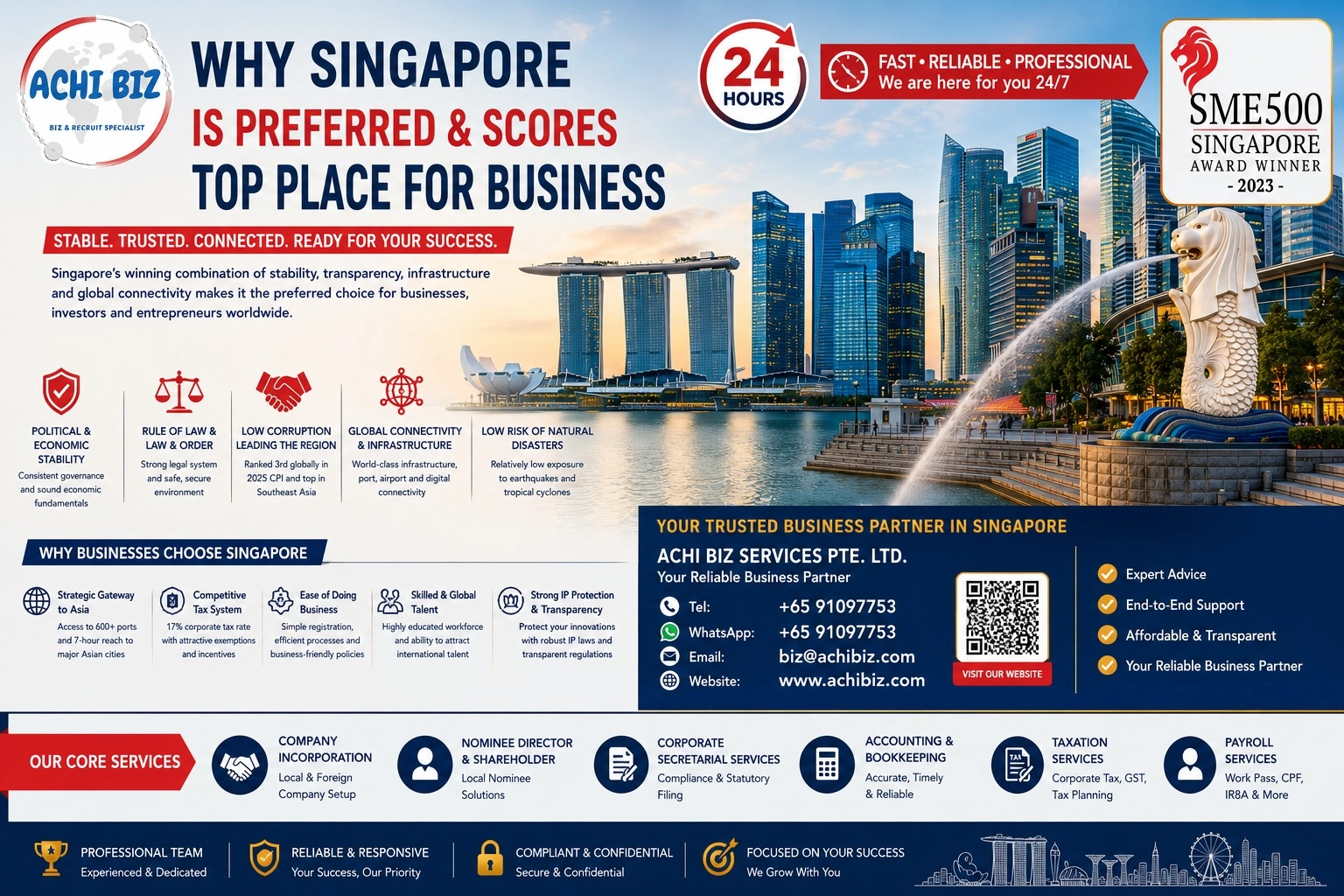
Why Singapore Is Preferred and Scores Top Place for Business – Detailed FAQ Guide
Singapore has built a strong international reputation as a preferred destination for business incorporation, investment, regional headquarters and international expansion. Its appeal goes well beyond corporate taxation. Businesses are attracted by a combination of political stability, consistent government policy, rule of law, low corruption, personal safety, efficient administration, world-class infrastructure, global connectivity and relatively low exposure to many major natural hazards.
As of 2026, Singapore is ranked 1st globally in the IMD World Competitiveness Ranking 2026. Singapore’s Economic Development Board (EDB) also describes the country as first in the world for doing business and a leading regional headquarters destination.
Singapore also ranked 3rd out of 182 countries in Transparency International’s 2025 Corruption Perceptions Index, scoring 84/100.
These strengths help explain why entrepreneurs, SMEs, multinational companies and foreign investors continue to consider Singapore when deciding where to incorporate a company or establish an Asian business base.
Frequently Asked Questions About Why Singapore Is Preferred for Business
Why is Singapore considered one of the best countries in the world for doing business?
Singapore combines many characteristics that businesses normally have to look for separately: political and economic stability, transparent regulation, effective administration, strong legal institutions, low corruption, international connectivity, sophisticated infrastructure and a competitive tax environment.
EDB describes Singapore as a trusted hub supported by political stability, transparent institutions and a pro-business environment. In 2026, Singapore also took first place in the IMD World Competitiveness Ranking.
Why does Singapore score highly in global business rankings?
Singapore’s performance is not based on one advantage alone. Its competitiveness reflects factors such as government efficiency, infrastructure, regulatory predictability, institutional credibility, talent, international trade and economic performance.
The 2026 IMD ranking is particularly relevant because competitiveness is assessed across economic, governmental, business and infrastructure dimensions rather than simply looking at taxation or GDP.
Is Singapore ranked No. 1 in the world for competitiveness?
Yes. Singapore is ranked 1st globally in the 2026 IMD World Competitiveness Ranking, according to Singapore EDB’s latest headquarters information.
This is particularly significant for companies evaluating a jurisdiction for long-term operations because competitiveness encompasses much more than the initial ease of incorporating a company.
Why is political stability important when choosing a country for business?
Businesses make investments that may take years or decades to recover. Political instability can introduce uncertainty over regulation, taxation, trade, employment, ownership and investment.
A politically stable environment gives businesses greater confidence to make long-term decisions about capital investment, employees, offices, factories, intellectual property and regional expansion.
Singapore’s political stability and transparent institutions are specifically identified by EDB as foundations of its position as a leading Asian business and financial hub.
Does Singapore have a stable government for businesses and investors?
Singapore is internationally recognised for consistent governance and institutional stability. This can be particularly valuable to investors because businesses generally prefer an environment where government policies and regulations are predictable enough for long-term planning.
EDB notes that Singapore’s consistent governance and overall stability support long-term planning.
How does stable government policy benefit businesses in Singapore?
Policy consistency allows businesses to make decisions with greater confidence.
Companies deciding whether to establish a regional headquarters, build manufacturing facilities, hire employees or commit substantial capital need reasonable certainty about the environment in which they will operate.
EDB notes that in an uncertain global environment, Singapore’s stability gives companies a base from which they can plan and invest with confidence.
Why is the rule of law an advantage for businesses in Singapore?
Strong rule of law provides businesses with greater confidence that laws, contracts and regulatory requirements will be applied through established institutions.
This matters when dealing with commercial agreements, property, employment, shareholders, creditors, intellectual property and business disputes.
In the 2025 World Justice Project Rule of Law Index, Singapore ranked 16th overall out of 143 jurisdictions. More specifically, it ranked 3rd globally for regulatory enforcement and 6th for civil justice.
Is Singapore a law-and-order society?
Singapore performs exceptionally strongly in international measures of order and security.
In the World Justice Project’s 2025 Rule of Law Index, Singapore ranked 2nd globally out of 143 jurisdictions for Order and Security, and first within the East Asia and Pacific region for this factor.
For businesses, a secure operating environment can reduce disruption and contribute to greater confidence among employees, customers, investors and expatriate personnel.
How safe is Singapore for business owners, employees and expatriates?
Personal safety is one of Singapore’s recognised strengths.
EDB reports that Singapore is among the world’s safest cities and cites Gallup data showing that 98% of people surveyed felt safe walking alone at night, compared with 73% worldwide.
Safety is not merely a lifestyle consideration. It can also make Singapore more attractive when multinational companies need to relocate executives and their families.
Is Singapore one of the least corrupt countries in the world?
Yes. According to Transparency International’s 2025 Corruption Perceptions Index, Singapore scored 84/100 and ranked 3rd out of 182 countries, behind only Denmark and Finland.
This places Singapore among the world’s highest-ranked countries for perceived public-sector integrity.
Is Singapore the least corrupt country in Southeast Asia?
Based on Transparency International’s 2025 Corruption Perceptions Index, Singapore is the highest-ranked Southeast Asian country.
Singapore ranked 3rd globally with a score of 84. For businesses operating across Southeast Asia, this strong standing can contribute to confidence in government institutions and the regulatory environment.
How does low corruption benefit businesses in Singapore?
Low corruption can reduce uncertainty and the hidden costs associated with doing business.
Businesses generally benefit when licences, approvals, taxation, regulatory enforcement and public administration operate according to established procedures rather than informal payments or personal influence.
The World Justice Project’s 2025 index ranked Singapore 2nd globally for Absence of Corruption and first in its East Asia and Pacific regional grouping for that factor.
Does Singapore have transparent business regulations?
Singapore places considerable emphasis on transparent and efficient regulation. EDB identifies transparent regulations, efficient processes and pro-enterprise policies as central components of Singapore’s business environment.
Predictable regulations can make it easier for companies to understand what is expected of them and plan compliance accordingly.
Is Singapore’s regulatory enforcement reliable?
Singapore performs strongly in this area. The 2025 World Justice Project Rule of Law Index ranked Singapore 3rd globally for Regulatory Enforcement and first within its regional grouping.
For legitimate businesses, consistent regulatory enforcement helps create a more predictable commercial environment and a more level playing field.
Does Singapore have an efficient company registration system?
Yes. Singapore has heavily digitised its business administration.
The World Bank’s B-READY 2025 Singapore assessment gave Singapore 94/100 for Business Entry and highlighted its simplified registration procedures, electronic business registration systems, interoperability of public services, and relatively low time and cost involved in incorporation.
Is Singapore really easy for foreigners to do business in?
Singapore is deliberately structured as an international business centre. Foreign investors can generally establish and own Singapore companies, subject to applicable company, regulatory, residency and sector-specific requirements.
Its English-speaking commercial environment, established financial system and international connectivity also make the country relatively accessible to overseas entrepreneurs.
Can foreigners own 100% of a Singapore Pte Ltd?
Generally, yes. A Singapore private limited company may generally be wholly foreign-owned, although the company must separately comply with requirements such as having at least one director who is ordinarily resident in Singapore.
Certain regulated sectors may have additional ownership or licensing requirements.
Why is Singapore preferred for setting up a Pte Ltd company?
A Singapore Private Limited Company provides a recognised corporate structure with separate legal personality and limited liability for shareholders, subject to applicable law.
When this corporate structure is combined with Singapore’s regulatory environment, international reputation, tax system and banking ecosystem, it can provide an attractive platform for both local and international businesses.
Why do multinational companies choose Singapore for regional headquarters?
Singapore combines access to Southeast Asia with political stability, talent, infrastructure, capital and international connectivity.
EDB identifies Singapore as the most popular regional headquarters destination in Asia, noting that global businesses use the country to manage regional and international operations.
Why is Singapore an attractive gateway to Southeast Asia?
Singapore sits strategically within Southeast Asia and is connected to major Asian economies by air and sea.
EDB notes that major Asian hubs can generally be reached from Singapore within seven hours, making the country a practical base for companies managing regional markets.
How does Singapore’s location benefit international businesses?
Singapore lies along major international shipping and aviation routes connecting Asia, Europe and the Middle East.
Its location is particularly useful for businesses involved in logistics, trading, financial services, technology, professional services, manufacturing and regional management.
How strong is Singapore’s international connectivity?
EDB’s 2026 information identifies Singapore as 1st globally for global connectedness. Singapore’s port links with more than 600 ports worldwide, while its aviation network provides extensive international access.
For companies, this means people, goods, capital and information can move efficiently across international markets.
Why is Singapore’s seaport important for businesses?
Singapore is one of the world’s major maritime hubs. Its port connectivity reaches more than 600 ports worldwide and handles more than 140,000 vessel calls annually, according to EDB.
This is especially valuable to trading, shipping, logistics, manufacturing and supply-chain businesses.
Why is Changi Airport important for Singapore’s business environment?
International businesses depend on efficient movement of executives, employees, clients and high-value cargo.
Singapore’s extensive air connectivity supports regional headquarters, international meetings, tourism, logistics and time-sensitive supply chains.
Does Singapore have good digital infrastructure?
Yes. Singapore has invested extensively in telecommunications and digital infrastructure. EDB identifies its advanced IT and internet infrastructure as a major foundation of the country’s digital economy and international competitiveness.
This benefits technology companies as well as conventional businesses increasingly dependent on cloud computing, e-commerce and digital services.
Does Singapore have world-class physical infrastructure?
Infrastructure is one of Singapore’s strongest competitive advantages. EDB cites Singapore as 1st in Asia for infrastructure, alongside its strong global connectivity.
Reliable transport, telecommunications, utilities, ports and airports reduce operational friction for businesses.
Is Singapore less vulnerable to natural disasters than many other Asian business locations?
Singapore has comparatively low exposure to several major natural hazards that directly affect many countries in the wider Asia-Pacific region. It does not lie on a major earthquake fault and is outside the main paths of tropical cyclones.
However, describing Singapore as completely free from natural-disaster risk would be inaccurate. Singapore can experience flash floods, intense rainfall, strong winds, regional haze, extreme heat and indirect effects from distant earthquakes or other regional events.
For business continuity planning, its comparatively sheltered geographic position can nevertheless be an advantage.
Does Singapore experience earthquakes?
Singapore is not located on a major active earthquake zone. Strong earthquakes occurring elsewhere in the region, particularly around Sumatra, can occasionally produce tremors that are felt in Singapore.
Businesses should therefore describe Singapore as having relatively low direct earthquake exposure, rather than saying earthquakes are impossible.
Is Singapore affected by typhoons or tropical cyclones?
Singapore is located close to the equator and outside the usual tracks of tropical cyclones. This significantly reduces its direct exposure compared with several other Asian jurisdictions.
Severe weather, heavy rainfall and strong winds can still occur, so normal business continuity and insurance planning remain important.
Why does lower natural-disaster exposure matter to businesses?
Major natural disasters can interrupt employees, transportation, electricity, telecommunications, factories, offices and supply chains.
A location with relatively low exposure to catastrophic earthquakes and tropical cyclones can therefore provide additional operational resilience, although businesses should never assume that any jurisdiction is completely risk-free.
Is Singapore economically stable?
Singapore has a highly developed and diversified economy spanning manufacturing and internationally tradeable services.
EDB describes Singapore as one of the world’s resilient economies and highlights its political stability, institutional transparency and diversified economic base.
Why is economic diversification important for businesses?
An economy dependent on only one industry can be particularly vulnerable when that sector experiences a downturn.
Singapore’s presence across advanced manufacturing, financial services, logistics, technology, professional services and other internationally tradeable sectors provides a broader economic foundation.
What is Singapore’s corporate income tax rate?
Singapore’s prevailing corporate income tax rate is a flat 17% of chargeable income for both local and foreign companies.
The headline rate does not necessarily represent the company’s effective tax rate because qualifying companies may benefit from applicable exemptions, rebates, deductions and incentives.
Are there tax exemptions for new Singapore companies?
Yes. Qualifying new companies can benefit from Singapore’s Start-Up Tax Exemption scheme during their first three consecutive Years of Assessment.
For qualifying companies where the relevant YAs fall in YA 2020 onwards, there is a 75% exemption on the first S$100,000 of normal chargeable income and a 50% exemption on the next S$100,000, subject to the applicable conditions.
Is Singapore attractive only because of low taxes?
No. This is one of the most important points when evaluating Singapore.
Singapore’s attractiveness comes from the combination of taxation, political stability, rule of law, low corruption, infrastructure, safety, connectivity, talent and international credibility.
A low-tax jurisdiction without reliable institutions or good banking access may not necessarily be a better place to conduct a real operating business.
Does Singapore have Free Trade Agreements with other countries?
Yes. EDB states that Singapore has a network of 29 Free Trade Agreements (FTAs) globally, providing businesses with preferential market access where the relevant requirements are satisfied.
This can be particularly valuable for businesses using Singapore as a trading or manufacturing base.
Does Singapore have Double Taxation Agreements?
Singapore has an extensive Double Taxation Agreement network. EDB reports 98 DTAs, alongside its 29 FTAs.
The availability and benefit of a particular treaty depend on the jurisdictions, transaction and applicable eligibility requirements.
Why is Singapore attractive to import and export businesses?
Singapore combines a strategic location, major seaport, international airport, Free Trade Zones, efficient customs infrastructure and extensive trade agreements.
This makes it particularly suitable for international trading, distribution, logistics and supply-chain operations.
Does Singapore provide good intellectual property protection?
Strong intellectual property protection is one of Singapore’s recognised business advantages. EDB specifically identifies strong IP protection and a sound legal system among the benefits available to businesses establishing operations in Singapore.
This is particularly relevant to technology, R&D, pharmaceutical, engineering, software and creative businesses.
Is Singapore suitable for technology and innovation businesses?
Yes. Singapore has developed a significant ecosystem around technology, R&D, digitalisation, artificial intelligence and advanced manufacturing.
Government programmes, research institutions, universities, multinational companies, investors and startups form part of this ecosystem.
Does Singapore have a skilled workforce?
Singapore has a highly educated workforce and continues to invest in skills development. EDB highlights both Singapore’s local talent base and its ability to attract international talent as competitive strengths.
For businesses, access to talent is particularly important when establishing headquarters, technology, finance, professional-services and advanced-manufacturing operations.
Why does Singapore’s multicultural environment benefit international businesses?
Singapore’s population and workforce have extensive exposure to different cultures, languages and international business practices.
This can help companies manage operations across culturally diverse Asian markets and makes Singapore useful as a base for regional sales, management and customer support.
Is English commonly used for business in Singapore?
Yes. English is extensively used in government administration, law, education and commerce, making Singapore relatively straightforward for international businesses to navigate.
This reduces language barriers for many foreign investors dealing with contracts, regulators, banks, employees and professional advisers.
Does Singapore offer good banking and financial services?
Singapore is a major international financial centre with a sophisticated banking, investment and professional-services ecosystem.
However, incorporating a Singapore company does not guarantee a bank account. Banks and financial institutions independently conduct KYC, AML, source-of-funds and business-risk assessments.
Does Singapore’s reputation help a company internationally?
Potentially, yes.
A company’s jurisdiction of incorporation can influence how banks, investors, suppliers and international customers assess it. Singapore’s reputation as a regulated international financial and commercial centre can therefore be commercially valuable.
However, credibility ultimately depends on the individual company’s actual activities, management, compliance and financial standing.
Is Singapore suitable for startups and SMEs?
Yes. Singapore’s Pte Ltd structure, business infrastructure, financing ecosystem, government support programmes and regional market access make it attractive to both startups and SMEs.
Not every grant or incentive is available to every company, however. Eligibility depends on the individual programme and company circumstances.
Is Singapore suitable for foreign investors?
Yes. Singapore’s combination of institutional stability, low corruption, international connectivity and business infrastructure has made it a major destination for foreign direct investment.
EDB reports Singapore as the second-largest recipient of FDI globally in its current overview.
Why do investors value predictability in Singapore?
Investors generally dislike unexpected regulatory and policy changes because they make long-term returns harder to forecast.
Singapore’s institutional consistency allows companies to plan investments, contracts, employment and expansion with greater confidence. EDB’s recent investor analysis notes that regulatory consistency carries particular weight at a time of increased global uncertainty.
Is Singapore politically and economically isolated from global risks?
No. Singapore is a small and highly open economy, so it is exposed to global trade conditions, geopolitical tensions, supply-chain disruptions and economic downturns.
Its advantage is not immunity from global risks. Rather, its strong institutions, diversified economy and connectivity can make it a comparatively resilient base from which businesses manage those risks.
Are there disadvantages to doing business in Singapore?
Yes. Singapore is highly competitive, and operating costs—including salaries and commercial premises—can be substantial for certain businesses. Companies also need to comply with corporate, tax, employment, beneficial-ownership and sector-specific regulatory requirements.
Singapore should therefore be selected because it suits the business model, not simply because it ranks highly internationally.
Is Singapore cheaper than every other Southeast Asian country for operating a business?
No. Labour, office and certain operating costs can be significantly lower in neighbouring markets.
Singapore’s proposition is generally based more on stability, efficiency, infrastructure, connectivity, legal certainty and access to capital and talent than simply being the cheapest location.
Why might a business still choose Singapore despite higher operating costs?
For many businesses, predictability and efficiency can be more valuable than the lowest possible operating cost.
A regional headquarters, financial-services company, technology business or international trading company may place greater importance on infrastructure, legal certainty, banking, talent, connectivity and international reputation.
Is Singapore a good base for managing businesses elsewhere in Southeast Asia?
Yes. This is one of Singapore’s strongest use cases.
Businesses can establish their headquarters, holding, management, financing or regional operations in Singapore while maintaining operating subsidiaries or commercial activities in other Southeast Asian countries, subject to appropriate legal and tax structuring.
Is Singapore better than other Southeast Asian countries for company incorporation?
There is no universally “best” country.
Singapore is particularly strong when the priorities are political stability, rule of law, low corruption, international banking and financial services, infrastructure, connectivity, regional headquarters functions and international credibility.
Other Southeast Asian countries may offer larger domestic markets, lower labour costs, particular manufacturing advantages or industry-specific opportunities.
Is Singapore the best Southeast Asian country for regional headquarters?
Singapore is one of the strongest choices and is currently identified by EDB as the most popular regional headquarters destination in Asia.
Whether it is best for a particular company depends on where its customers, employees, factories, suppliers and management are located.
Why should an entrepreneur consider Singapore before choosing an offshore jurisdiction?
A traditional offshore jurisdiction and Singapore generally serve different purposes.
Entrepreneurs planning a substantive operating business may value Singapore’s workforce, infrastructure, banking ecosystem, commercial law, international connectivity and access to regional markets.
A structure should therefore be selected based on its actual commercial purpose rather than tax considerations alone.
Is Singapore a tax haven?
Singapore should not simply be characterised as a zero-tax offshore jurisdiction. Companies are subject to Singapore’s corporate tax and compliance framework, with a prevailing corporate income tax rate of 17% of chargeable income.
Singapore does, however, maintain a competitive tax system, exemptions and incentives subject to qualifying requirements.
Is Singapore a good place to protect intellectual property and commercial contracts?
Singapore’s legal and regulatory environment makes it attractive to businesses for which contracts, proprietary technology, trademarks, patents and other intellectual property are commercially important.
EDB specifically highlights Singapore’s sound legal system and strong intellectual property protection.
How does Singapore’s public administration help businesses?
Digitisation and integrated government systems can reduce the administrative time required for many business transactions.
The World Bank’s B-READY 2025 assessment specifically highlighted Singapore’s electronic business registration systems, streamlined incorporation and interoperability of public services.
Is Singapore suitable for long-term business planning?
Yes. This is arguably one of Singapore’s biggest advantages.
A company evaluating a 10- or 20-year investment needs more than a quick incorporation process. It needs confidence in institutions, infrastructure, regulations and the broader operating environment.
Singapore’s stability and institutional credibility are therefore particularly relevant to businesses making substantial long-term commitments.
Why is Singapore considered resilient during global uncertainty?
Singapore cannot avoid global economic or geopolitical shocks, but its credible institutions, diversified economy, infrastructure and international relationships can help businesses navigate them.
EDB reported that companies continued to view Singapore as a trusted, stable and well-connected hub amid recent global volatility.
What are the strongest reasons to choose Singapore for business?
The case for Singapore is strongest when the factors are considered together:
- 1st globally in IMD World Competitiveness Ranking 2026
- Strong political and governmental stability
- 3rd least corrupt among 182 countries in the 2025 CPI
- 2nd globally for Order and Security in the WJP 2025 assessment
- Strong rule of law and regulatory enforcement
- Safe living and working environment
- Comparatively low direct exposure to major earthquakes and tropical cyclones
- 17% headline corporate income tax rate
- Extensive FTA and DTA networks
- World-class infrastructure and international connectivity
- Strong financial and banking ecosystem
- Skilled and international workforce
- Strategic access to Southeast Asia
- Strong intellectual property protection
- Efficient digital government administration
- Established reputation as a regional headquarters and investment hub.
Why should foreign entrepreneurs incorporate a company in Singapore?
Foreign entrepreneurs looking for a credible Asian base may find Singapore attractive because it combines an internationally recognised corporate structure with strong institutions, regional access and a sophisticated business ecosystem.
However, the decision should consider the entrepreneur’s target market, tax residence, management location, banking needs, business activities and immigration requirements.
How can ACHI Biz Services assist businesses setting up in Singapore?
ACHI Biz Services Pte. Ltd. can assist local and foreign entrepreneurs with Singapore company incorporation and related corporate services, including corporate secretarial support, registered address services, nominee arrangements where applicable, accounting, taxation, payroll and other business-support requirements.
The appropriate setup should be determined based on the proposed shareholders, directors, business activities, operational requirements and applicable regulatory or licensing obligations.
Why does Singapore remain a preferred place to incorporate and operate a business?
Singapore’s strength is not based on a single headline advantage.
A business operating from Singapore gains access to an environment where political stability, government consistency, law and order, low corruption, regulatory efficiency, safety, infrastructure, global connectivity and competitive taxation work together.
That combination is difficult to replicate. It explains why Singapore continues to attract entrepreneurs, international investors and multinational companies even though it is not necessarily the cheapest country in which to operate.
For companies seeking a stable, reputable and internationally connected base for long-term business in Asia, Singapore remains one of the world’s strongest jurisdictions to consider.
Related articles:
Best Country to Incorporate a Business with a Pte Ltd Structure – Complete FAQ Guide
Register Private Limited Company in Singapore – Complete FAQ Guide for Business Owners
#achibiz