
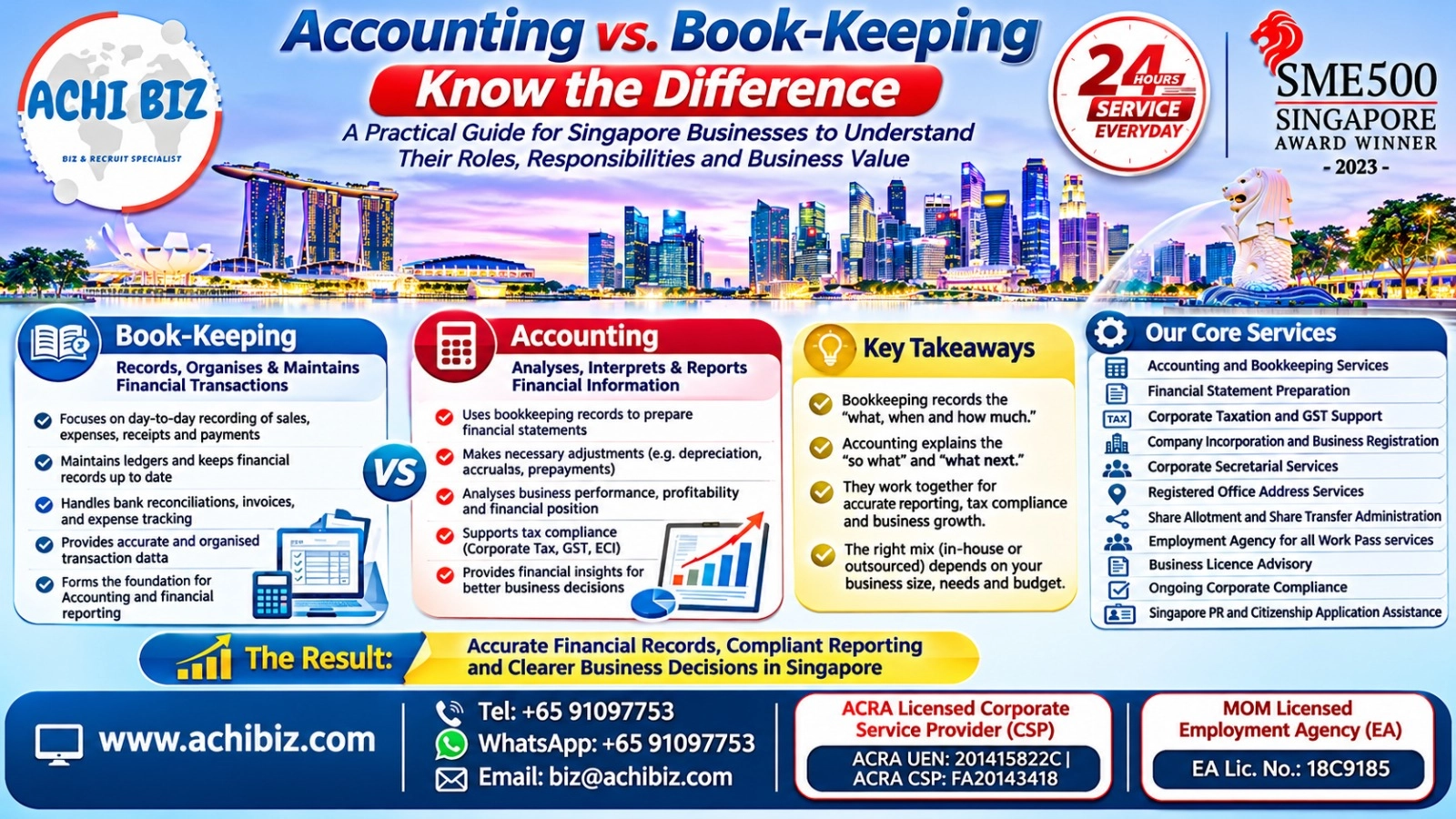
Accounting vs. Bookkeeping in Singapore: Key Differences, Functions, Responsibilities, Costs & Comprehensive FAQ Guide
A Complete Guide for Singapore SMEs, Startups and Business Owners on Bookkeeping vs. Accounting, Financial Records, Financial Statements, Tax Compliance, Outsourcing and Professional Accounting Support
Introduction
Accounting and bookkeeping are two terms that business owners frequently use interchangeably. Although they are closely connected, they serve different purposes in managing a company’s finances.
Bookkeeping focuses primarily on recording, organising and maintaining financial transactions. Accounting takes that information further by analysing, adjusting, interpreting and presenting financial results to support business decisions and statutory reporting.
For a Singapore business owner, understanding this distinction is important.
A company may have complete records of invoices, receipts and payments but still lack reliable financial statements. Similarly, an accountant cannot prepare accurate financial reports if the underlying bookkeeping records are incomplete or inconsistent.
Both functions are essential, but they contribute to financial management in different ways.
The distinction becomes especially relevant when a business is deciding whether to hire a bookkeeper, engage an accountant, purchase accounting software or outsource its financial administration.
It also matters when evaluating the scope of services offered by an accounting firm. A monthly bookkeeping package may not automatically include annual financial statement preparation, corporate income tax computations, GST reporting or management advisory services.
In Singapore, businesses must also consider applicable requirements under the Companies Act 1967, the Inland Revenue Authority of Singapore (IRAS) and relevant financial reporting standards.
This comprehensive FAQ article explains the differences between accounting and bookkeeping, their respective functions, how they work together, their costs and the practical considerations for Singapore small and medium-sized enterprises.
Rather than repeating a general discussion of accounting problems faced by small businesses, this guide concentrates on the distinction between the two functions, where their responsibilities overlap and how business owners can select the appropriate level of financial support.
Accounting vs. Bookkeeping in Singapore: Comparison at a Glance
| Comparison Factor | Bookkeeping | Accounting |
|---|---|---|
| Primary purpose | Record and organise financial transactions | Analyse, adjust, interpret and report financial information |
| Main focus | Transaction accuracy and record maintenance | Financial performance, position and reporting |
| Typical activities | Invoice entry, expense recording, bank reconciliation and ledger maintenance | Financial statements, adjustments, financial analysis and reporting |
| Frequency | Daily, weekly or monthly | Monthly, quarterly, annually or as required |
| Main information used | Invoices, receipts, bank statements and transaction records | Bookkeeping records, supporting schedules and accounting estimates |
| Typical output | General ledger, transaction reports, receivables and payables records | Financial statements, management reports and financial analysis |
| Skills required | Transaction processing, classification, reconciliation and software proficiency | Accounting principles, financial reporting, analytical judgement and technical knowledge |
| Financial interpretation | Usually limited | A major part of the function |
| Year-end adjustments | May assist with supporting schedules and entries | Determines and reviews appropriate accounting adjustments |
| Tax-related work | Organises records supporting tax reporting | May prepare tax computations and advise on accounting implications, depending on scope and qualifications |
| Business decision support | Provides organised financial data | Interprets financial results and supports management decisions |
| Professional judgement | Required for accurate classification and identifying exceptions | Generally greater for estimates, accounting policies and complex transactions |
| Automation potential | Many routine processes can be automated | Some processes can be automated, but significant judgement may remain |
| Typical service arrangement | Regular recurring bookkeeping engagement | Periodic reporting, year-end preparation or broader accounting engagement |
Important: These are functional distinctions rather than rigid professional boundaries. An experienced bookkeeper may perform some accounting tasks, and an accountant may also undertake bookkeeping. The actual responsibilities depend on competence, engagement scope and applicable professional or regulatory requirements.
Part 1: Understanding Accounting and Bookkeeping
What is bookkeeping in Singapore?
Bookkeeping is the systematic recording and organisation of a business’s financial transactions.
It involves maintaining records of money received, money paid, customer invoices, supplier bills and other transactions affecting the business.
The purpose is to create a complete and reliable record of financial activity.
For example, when a Singapore company issues a S$5,000 invoice to a customer, bookkeeping ensures that the sale and corresponding receivable are recorded appropriately.
When the customer subsequently pays, the receipt is recorded and matched against the outstanding invoice.
Bookkeeping provides the transaction-level information required for subsequent accounting and financial reporting.
What is accounting in Singapore?
Accounting is the broader process of measuring, classifying, adjusting, analysing and reporting financial information.
It uses bookkeeping records to determine a business’s financial performance and financial position.
Accounting may involve preparing financial statements, reviewing revenue recognition, calculating depreciation, assessing liabilities and interpreting financial results.
For example, an accountant may review whether revenue recorded during the year belongs in the correct reporting period and whether additional expenses or liabilities should be recognised.
Accounting therefore extends beyond transaction recording into financial measurement, reporting and interpretation.
What is the main difference between accounting and bookkeeping?
The central distinction is that bookkeeping establishes the financial records, while accounting uses those records to produce meaningful financial information.
Bookkeeping answers questions such as:
- What transaction occurred?
- When did it occur?
- How much was received or paid?
- Which account should record the transaction?
Accounting addresses broader questions such as:
- How profitable is the business?
- Are the financial statements accurate?
- What assets and liabilities does the business have?
- Are accounting adjustments required?
- What do the financial results mean for management?
Both functions are interconnected.
Why are accounting and bookkeeping often confused?
The terms are frequently confused because their activities overlap.
Modern accounting software allows the same person to record transactions, reconcile bank accounts and generate financial reports.
Some accounting service providers also offer bookkeeping as part of a combined package.
Consequently, business owners may not immediately recognise which tasks involve routine record maintenance and which require accounting analysis.
Understanding the actual work performed is more useful than relying solely on a service provider’s job title.
Is bookkeeping part of accounting?
Yes.
Bookkeeping is generally regarded as a foundational component of the broader accounting process.
Without accurate transaction records, financial reporting becomes difficult and potentially unreliable.
However, bookkeeping alone does not necessarily complete all accounting requirements.
Additional adjustments, reconciliations, assessments and reporting procedures may still be necessary.
Can accounting exist without bookkeeping?
Accounting requires reliable financial information.
That information may be obtained from manual records, accounting software, integrated business systems or other appropriate sources.
Regardless of the technology used, financial transactions must be captured and organised.
In practical terms, accounting cannot produce dependable results without adequate underlying records.
Can bookkeeping exist without accounting?
A business can maintain transaction records without preparing comprehensive financial reports.
For example, an owner may record sales and expenses in a spreadsheet without performing year-end adjustments or preparing financial statements.
However, this arrangement may not satisfy all reporting or statutory requirements applicable to the business.
Bookkeeping can therefore operate as a separate activity, but it does not necessarily replace the broader accounting function.
Are bookkeeping and accounting equally important for a small business?
Both are important, although their immediate value may differ depending on the business’s circumstances.
Bookkeeping ensures that financial information is captured and organised.
Accounting helps determine what the information means and whether it has been presented appropriately.
A business with poor bookkeeping cannot reliably assess performance.
A business with accurate bookkeeping but no meaningful accounting analysis may fail to use its financial information effectively.
Part 2: Differences in Daily Responsibilities and Work Processes
What are the main responsibilities of a bookkeeper?
A bookkeeper commonly handles transaction recording and routine financial record maintenance.
Typical duties include entering customer invoices, recording supplier bills, classifying expenses, matching payments and reconciling bank transactions.
A bookkeeper may also maintain customer and supplier balances, organise supporting documents and prepare transaction summaries.
The precise responsibilities depend on the business and engagement arrangement.
What are the main responsibilities of an accountant?
An accountant generally focuses on financial measurement, reporting, analysis and appropriate accounting treatment.
Responsibilities may include reviewing ledger balances, preparing adjusting entries, producing financial statements and analysing financial performance.
Accountants may also assist with budgeting, management reporting and tax-related matters where these services are included in their engagement and they have the appropriate expertise.
Who records daily sales transactions?
Daily sales transactions are commonly recorded through bookkeeping processes.
The transactions may be entered manually or imported from a point-of-sale system, invoicing platform or online marketplace.
The bookkeeper ensures that sales records are complete and appropriately classified.
An accountant may subsequently review the records to determine whether the revenue has been recognised correctly.
Who records supplier invoices and business expenses?
Routine supplier invoices and expenses are generally processed through bookkeeping.
This includes recording invoice amounts, payment dates and expense categories.
However, certain transactions may require accounting judgement.
For example, the purchase of machinery may need to be recognised as a fixed asset rather than an ordinary operating expense.
An accountant may review the appropriate treatment where necessary.
Who performs bank reconciliation?
Bank reconciliation is commonly a bookkeeping responsibility.
It involves comparing bank statement transactions with the accounting records and investigating differences.
However, an accountant may review reconciliations, particularly where unusual balances or material discrepancies arise.
In smaller businesses, the same individual may perform both functions.
Who prepares adjusting journal entries?
Adjusting journal entries are commonly associated with accounting.
Examples include depreciation, accruals, prepayments and impairment adjustments.
These entries require an understanding of the relevant accounting treatment.
A bookkeeper may enter approved adjustments into the accounting system, while an accountant determines or reviews their appropriateness.
Who maintains the general ledger?
The general ledger is maintained through the bookkeeping and accounting process.
Routine transactions are posted to the appropriate accounts.
Accountants may review ledger balances and make necessary adjustments.
The general ledger is therefore a shared foundation for both functions.
Who prepares the trial balance?
A trial balance can be generated from bookkeeping records or accounting software.
It lists account balances and helps confirm that total debits and credits agree.
A bookkeeper may prepare the trial balance.
An accountant then reviews the balances and determines whether adjustments are required.
A balanced trial balance does not, by itself, establish that the accounts are correct.
Who reviews unusual financial transactions?
Both functions may be involved.
A bookkeeper may identify an unfamiliar payment, missing invoice or transaction that does not fit an existing account category.
An accountant may determine the appropriate treatment where the transaction requires technical judgement.
A reliable process allows unusual items to be escalated rather than recorded based on unsupported assumptions.
Who is responsible for explaining financial results to management?
Financial interpretation is primarily associated with accounting and management reporting.
An accountant may explain changes in gross profit, operating expenses, cash flow or liabilities.
A bookkeeper can provide transaction details supporting those explanations.
The value comes from combining accurate records with informed analysis.
Part 3: Differences in Financial Records and Reporting
What documents does a bookkeeper normally work with?
A bookkeeper commonly works with customer invoices, supplier bills, receipts, bank statements, credit notes, payment confirmations and expense claims.
Other records may include payroll summaries, sales platform reports and inventory transaction documents.
These documents support the entries made in the accounting system.
What documents does an accountant normally review?
An accountant may review the general ledger, trial balance, bank reconciliations, receivables and payables schedules, fixed asset registers and other supporting records.
The accountant may also examine contracts, financing agreements and documents relevant to complex accounting transactions.
These records help determine the appropriate financial reporting treatment.
What reports are normally produced through bookkeeping?
Common bookkeeping reports include transaction listings, general ledger reports, customer outstanding balances and supplier payment summaries.
Bank reconciliation reports may also be prepared.
These reports provide detailed information about recorded transactions.
However, they may not include all adjustments required for complete financial reporting.
What reports are normally prepared through accounting?
Accounting may produce statements of profit or loss, statements of financial position, cash flow statements and other applicable financial reports.
It may also involve management accounts, financial analysis and supporting schedules.
The exact reports depend on the company’s requirements and the scope of the accounting engagement.
Is a profit and loss report generated by software considered a completed accounting report?
Not necessarily.
Accounting software can generate a profit and loss report using recorded transactions.
However, the report may be incomplete if depreciation, accruals, prepayments or other necessary adjustments have not been recorded.
The accuracy of the report depends on the underlying records and accounting treatment.
A software-generated report should not automatically be assumed to represent final financial statements.
Why can bookkeeping records be accurate while financial statements remain incorrect?
A bookkeeper may accurately record the amounts appearing on invoices and receipts.
However, the transactions may require adjustments under the applicable accounting framework.
For example, an annual insurance payment may need to be allocated across several reporting periods.
Similarly, a customer deposit may not represent revenue earned immediately.
The bookkeeping record can accurately reflect the cash transaction while further accounting treatment remains necessary.
What is the difference between a general ledger and financial statements?
The general ledger contains account-level records of financial transactions.
Financial statements summarise and present the financial position and performance of the business under the applicable reporting framework.
The ledger provides the underlying information.
The financial statements organise and adjust that information into a formal reporting structure.
Why are supporting schedules important in accounting?
Supporting schedules explain balances appearing in the financial statements.
Examples include fixed asset schedules, loan schedules, receivables ageing reports and accrual calculations.
Bookkeepers may maintain these schedules, while accountants use them to review financial balances and prepare adjustments.
They help make financial reporting more transparent and verifiable.
Part 4: Accounting Principles and Technical Differences
Does bookkeeping require knowledge of accounting principles?
Yes, particularly where the bookkeeper is responsible for classifying transactions.
A bookkeeper should understand basic concepts such as assets, liabilities, income, expenses, debits and credits.
More complex transactions may require additional accounting knowledge.
The extent of technical expertise needed depends on the nature of the work.
Does accounting require a deeper understanding of financial reporting standards?
Generally, yes.
Preparing financial statements may require the application of accounting policies, recognition criteria, measurement principles and disclosure requirements.
These matters can involve estimates and professional judgement.
In Singapore, the applicable financial reporting framework depends on the entity and relevant requirements.
What is double-entry bookkeeping?
Double-entry bookkeeping records transactions using corresponding debit and credit entries.
For example, when a company receives S$2,000 from a customer for an existing receivable, the accounting entries generally increase cash and reduce accounts receivable.
The double-entry system helps maintain the relationship between assets, liabilities and equity.
However, balanced entries do not guarantee that transactions have been classified correctly.
What is the accounting equation?
The fundamental accounting equation is:
Assets = Liabilities + Equity
It expresses the relationship between resources controlled by the business and the claims against those resources.
Bookkeeping transactions are recorded within this structure.
Accounting uses the resulting balances to prepare and interpret financial statements.
Is bookkeeping mainly concerned with historical transactions?
Bookkeeping generally records transactions that have occurred.
Accounting also uses historical information, but may involve estimates, forecasts and future-oriented analysis.
For example, management accounting may examine projected revenue, expected costs and future cash requirements.
This broader analytical role is one of the important differences between the two functions.
What is the difference between cash-basis bookkeeping and accrual accounting?
Cash-basis records generally recognise receipts and payments when cash changes hands.
Accrual accounting recognises income and expenses according to the relevant recognition principles, which may differ from payment timing.
For example, a company may recognise revenue when it satisfies the applicable revenue recognition requirements even if payment is received later.
Singapore companies must apply the appropriate accounting framework and statutory requirements rather than assuming cash-basis records are sufficient for financial reporting.
Why does accrual accounting require more than routine bookkeeping?
Accrual accounting may require recognition of amounts not yet received or paid.
Examples include accrued expenses, prepaid expenses and outstanding customer receivables.
It may also require estimates relating to asset values, depreciation or impairment.
These matters extend beyond simply recording cash movements.
How does revenue recognition differ from recording customer payments?
Recording a customer payment establishes that money has been received.
Revenue recognition determines when the business has earned revenue under the applicable accounting principles.
The two events may occur at different times.
For example, a customer may pay in advance for services that will be provided over several months.
The accounting treatment must reflect the underlying transaction.
How does depreciation illustrate the difference between bookkeeping and accounting?
Bookkeeping records the purchase of an asset and its payment.
Accounting determines whether the asset should be capitalised and how its depreciable amount should be allocated over its useful life.
Depreciation is an accounting expense that does not necessarily involve a corresponding cash payment during each reporting period.
This illustrates the difference between recording a transaction and measuring its financial impact over time.
How do accruals and prepayments demonstrate the relationship between bookkeeping and accounting?
Bookkeeping captures the original invoice or payment.
Accounting assesses whether the expense belongs entirely in the current period or should be allocated differently.
For example, an annual subscription paid in advance may initially be recorded as a prepayment.
The expense is then recognised over the relevant period where appropriate.
Both functions are needed to produce accurate results.
Part 5: Bookkeeping vs. Accounting for Singapore Tax Compliance
Is bookkeeping sufficient for corporate income tax filing in Singapore?
Bookkeeping provides important information for corporate tax preparation.
However, taxable income is not necessarily equal to accounting profit.
Tax computations may require adjustments for non-deductible expenses, capital allowances and other applicable tax provisions.
Therefore, routine bookkeeping alone may not be sufficient to complete the corporate income tax process accurately.
Who prepares corporate income tax computations: a bookkeeper or an accountant?
Corporate tax computations are generally handled by personnel with relevant tax knowledge, such as an accountant or tax professional.
A bookkeeper may provide the transaction records and supporting schedules.
The tax computation then applies the relevant Singapore tax rules to determine taxable income.
The actual responsibilities depend on the engagement and competence of the person performing the work.
What is the difference between bookkeeping records and a tax computation?
Bookkeeping records document financial transactions.
A tax computation adjusts accounting information according to the applicable income tax legislation.
For example, accounting depreciation may be added back in a tax computation, while qualifying capital allowances may be considered separately.
The tax computation is therefore not simply a copy of the profit and loss statement.
Does a bookkeeper calculate Estimated Chargeable Income (ECI)?
A bookkeeper may assist by preparing the financial information needed for ECI estimation.
However, determining estimated chargeable income may require tax adjustments and an understanding of IRAS requirements.
The task should be assigned to someone with appropriate tax knowledge.
Singapore companies generally must file ECI within three months after their financial year-end unless an applicable waiver applies.
Does bookkeeping include GST reporting?
Bookkeeping may include recording GST-related transactions and maintaining supporting records.
However, preparing an accurate GST return requires determining the correct tax treatment and reviewing relevant transactions.
GST-registered businesses must comply with applicable IRAS rules.
The scope of a bookkeeping engagement should clearly state whether GST return preparation and submission are included.
Can a bookkeeper prepare GST transaction reports?
Yes, where the person has the necessary knowledge and access to appropriate records.
A bookkeeper may generate reports showing output tax, input tax and relevant transaction classifications.
However, complex GST matters may require review by a person with appropriate technical expertise.
Why should GST reconciliation not be confused with ordinary bank reconciliation?
Bank reconciliation checks accounting cash records against bank statements.
GST reconciliation checks whether GST-related records agree with the amounts intended for or reported in GST returns.
These are different procedures.
A business may have fully reconciled bank accounts while still having incorrect GST classifications.
Can bookkeeping software automatically prepare accurate Singapore GST returns?
Software can assist with GST calculations and reporting.
However, its output depends on correct tax codes, transaction data and configuration.
Special transactions may require additional review.
Businesses should not assume that automated GST calculations eliminate their compliance responsibilities.
Why do accounting services and tax services sometimes have separate fees?
Accounting services focus on financial records, reporting and related analysis.
Tax services involve applying tax legislation, preparing tax computations and completing relevant tax filings.
Although the functions are connected, they require different work.
Service providers may therefore charge separately for bookkeeping, financial statement preparation and tax compliance.
Part 6: Financial Statements and Singapore Statutory Requirements
Are bookkeeping and accounting requirements the same under Singapore law?
No.
Singapore law imposes obligations concerning accounting records, financial statements and related reporting.
These obligations are connected but not identical.
Bookkeeping supports the maintenance of accounting records.
Accounting and financial reporting processes help ensure that the required financial information is prepared under the applicable framework.
What accounting records must Singapore companies maintain?
Under the Companies Act 1967, companies must maintain accounting and other records sufficient to explain their transactions and financial position and enable the preparation of financial statements that meet applicable requirements.
The precise obligations depend on the relevant statutory provisions and circumstances.
Maintaining invoices and receipts alone may not be sufficient if the overall records cannot properly explain the company’s financial position.
How long must accounting records be retained in Singapore?
IRAS generally requires businesses to retain relevant records for at least five years, subject to applicable rules.
Companies must also comply with relevant Companies Act recordkeeping requirements.
Other circumstances may require longer retention.
Businesses should maintain records in a form that allows relevant transactions to be identified and verified.
Does bookkeeping satisfy ACRA financial reporting requirements?
Bookkeeping is an important part of the process, but it does not automatically satisfy every financial reporting requirement.
Depending on the company’s circumstances, financial statements may need to be prepared under the applicable financial reporting standards.
Additional accounting adjustments, disclosures and review procedures may be necessary.
What is the difference between preparing accounts and filing an annual return?
Preparing accounts involves maintaining financial information and producing appropriate financial reports.
Filing an annual return is a separate statutory process involving information submitted to ACRA.
Some companies must also file financial statements, depending on applicable requirements and exemptions.
Business owners should not treat bookkeeping, financial statement preparation and annual return filing as the same service.
Does audit exemption mean a company only needs bookkeeping?
No.
Audit exemption concerns whether a company must have its financial statements audited.
It does not automatically remove obligations to maintain proper accounting records or prepare applicable financial statements.
A company qualifying for audit exemption may still require year-end accounting and financial reporting work.
Who prepares financial statements for a Singapore Pte. Ltd. company?
Financial statements may be prepared by suitably competent internal personnel or an external accounting service provider.
The company’s directors remain responsible for relevant statutory obligations.
The person preparing the statements must apply the appropriate accounting framework and consider necessary adjustments and disclosures.
Is an accountant legally required for every Singapore company?
Singapore companies are not generally required to appoint an external accountant simply because they are incorporated.
However, they must comply with applicable accounting recordkeeping, financial reporting and statutory requirements.
The company may fulfil relevant work internally or engage external assistance, provided the work is performed competently.
Certain regulated activities, including statutory audit services, have separate professional requirements.
Does a Singapore company need a bookkeeper, an accountant and an auditor?
Not necessarily.
A company’s needs depend on its size, complexity and applicable statutory obligations.
One competent service provider may handle bookkeeping and accounting.
An auditor performs a separate independent function where an audit is required or voluntarily commissioned.
An audit should not be confused with routine bookkeeping or financial statement preparation.
Part 7: Bookkeeper vs. Accountant: Skills, Qualifications and Professional Responsibilities
What skills should a competent bookkeeper have?
A competent bookkeeper should understand transaction recording, account classification, reconciliations and supporting documentation.
Accuracy, organisation and familiarity with accounting software are also important.
The ability to recognise unusual transactions and seek clarification is particularly valuable.
What skills should a competent accountant have?
An accountant generally needs a broader understanding of accounting principles, financial reporting, financial analysis and relevant regulatory requirements.
Technical judgement is important when dealing with estimates, complex transactions and accounting adjustments.
Communication skills are also necessary because financial information must be explained to management.
Does a bookkeeper need a professional accounting qualification in Singapore?
There is no general requirement that every person performing routine bookkeeping must hold a particular professional accounting qualification.
However, qualifications, training and experience can be useful indicators of competence.
Businesses should evaluate the individual’s actual capabilities and the complexity of the work.
Does every accountant in Singapore need to be a Chartered Accountant?
Not every person performing accounting work is required to hold the Chartered Accountant designation.
However, certain professional titles, regulated services and public accountancy activities are subject to specific requirements.
Businesses should distinguish between general accounting services and regulated professional activities.
Can a bookkeeper become an accountant?
Yes.
A person working in bookkeeping may develop broader accounting capabilities through education, professional training and practical experience.
Bookkeeping provides useful exposure to financial records and transaction processing.
However, preparing complex financial statements and providing technical accounting advice may require additional expertise.
Is an accountant automatically more accurate than a bookkeeper?
Accuracy depends on the individual’s competence, attention to detail, systems and review procedures.
An experienced bookkeeper may maintain excellent transaction records.
An accountant may have stronger technical expertise in financial reporting but still depend on complete and accurate source information.
The two roles should complement each other rather than be viewed as competing functions.
Can one person perform both bookkeeping and accounting?
Yes.
In many small businesses, one appropriately skilled person performs both functions.
The arrangement may be efficient when transaction volumes are manageable.
However, businesses should ensure that the person has the necessary expertise and that important financial work receives suitable review.
Why is professional judgement more significant in accounting?
Accounting often requires decisions where the appropriate treatment is not determined solely by the amount appearing on an invoice.
Examples include estimating useful lives, assessing recoverability of receivables and determining revenue recognition.
Such decisions may involve applying accounting standards to specific circumstances.
This is one reason accounting often requires broader technical knowledge.
Part 8: Differences in Accounting and Bookkeeping Software
Is bookkeeping software different from accounting software?
The distinction is not always clear.
Many modern systems combine transaction recording, invoicing, reconciliation and financial reporting.
Some products are designed primarily for simple recordkeeping, while others support more complex accounting functions.
Business owners should evaluate features rather than rely only on product labels.
Can accounting software replace a bookkeeper?
Accounting software can automate many routine bookkeeping activities.
However, transactions still need to be complete, appropriately classified and reviewed.
Incorrect data can produce incorrect reports regardless of software sophistication.
Automation may reduce manual work but does not necessarily eliminate the need for bookkeeping oversight.
Can accounting software replace an accountant?
Software can generate reports and assist with calculations.
However, it may not correctly interpret complex transactions or determine every necessary accounting adjustment.
Professional judgement may remain important for financial reporting, tax matters and business analysis.
The need for an accountant depends on the complexity of the business and the competence of those operating the system.
Why can automated bookkeeping still produce inaccurate financial statements?
Automated systems process information according to their settings and available data.
If transactions are assigned incorrect categories, the resulting reports may be misleading.
Missing invoices, inappropriate GST codes and incorrect opening balances can also affect accuracy.
Automated reports should therefore be reviewed rather than accepted without question.
What software features are most useful for bookkeeping?
Useful features include invoice management, expense recording, bank feeds, reconciliation tools and document attachment capabilities.
Customer and supplier tracking can also improve recordkeeping.
Businesses should consider whether the system supports their actual transaction processes.
What software features are most useful for accounting?
Accounting-related features may include journal adjustments, financial statement reporting, fixed asset schedules, budgeting and management reporting.
Some businesses may require multicurrency accounting, project reporting or more advanced controls.
The appropriate features depend on the company’s reporting needs.
Should Singapore SMEs choose cloud accounting software?
Cloud accounting software can provide convenient access, collaboration and integration capabilities.
However, businesses should assess data security, access controls, subscription costs and suitability.
Cloud-based systems are not automatically superior for every business.
The choice should reflect operational needs and appropriate risk management.
Can AI automate both bookkeeping and accounting?
Artificial intelligence can assist with transaction categorisation, document extraction, reconciliations and financial analysis.
However, AI-generated outputs can contain errors.
Complex accounting judgements and regulatory interpretations still require appropriate review.
Businesses should maintain human accountability for financial records and reporting.
Part 9: Bookkeeping vs. Accounting Costs in Singapore
Is bookkeeping generally cheaper than accounting?
Routine bookkeeping services are often less expensive than complex accounting and financial reporting services.
This reflects differences in the work involved, technical requirements and professional judgement.
However, actual fees depend on transaction volumes, complexity, reporting frequency and service scope.
A business should compare the work included rather than simply choose the lowest quotation.
What factors affect bookkeeping fees in Singapore?
Bookkeeping fees may depend on the number of transactions, bank accounts, customer invoices and supplier bills.
Additional complexity may arise from GST registration, inventory, foreign currency transactions and multiple sales platforms.
Incomplete records or historical backlogs may also increase the work required.
What factors affect accounting fees in Singapore?
Accounting fees may depend on financial reporting requirements, transaction complexity, adjustments, supporting schedules and management reporting needs.
Businesses with multiple entities, complex financing or unusual transactions may require more extensive work.
The frequency of reporting can also affect fees.
Why do some accounting firms charge separately for bookkeeping and financial statements?
Bookkeeping and financial statement preparation involve different stages of work.
A bookkeeping engagement may cover monthly transaction processing and reconciliation.
Financial statement preparation may involve year-end adjustments, reporting framework considerations and disclosures.
Separating the services allows businesses to understand what they are paying for.
Does a monthly bookkeeping package normally include corporate tax filing?
Not automatically.
A monthly bookkeeping package may cover only transaction recording and routine reconciliations.
Corporate tax computations and filing services may be separately quoted.
Business owners should confirm the scope in writing.
Does a bookkeeping package normally include GST filing?
Not necessarily.
Some providers include GST reporting support, while others charge separately for preparing and submitting returns.
The arrangement should also clarify responsibility for reviewing GST classifications and resolving discrepancies.
Is outsourcing bookkeeping and accounting more cost-effective for Singapore SMEs?
Outsourcing can be cost-effective when a business does not require full-time internal finance personnel.
It may also provide access to specialised skills.
However, the financial benefit depends on the service scope, provider quality and amount of internal coordination required.
Businesses should compare total costs and operational needs.
Should a business choose the cheapest bookkeeping service?
Price is important, but it should not be the only consideration.
Poor transaction records can create additional accounting work, tax complications and reporting delays.
Businesses should evaluate accuracy, communication, reporting frequency and the provider’s understanding of their operations.
How can small business owners avoid unexpected accounting service charges?
The engagement should clearly define included services, reporting frequency, transaction limits and additional fees.
It should also specify whether historical bookkeeping, financial statements, GST reporting and tax computations are included.
Clear documentation reduces misunderstandings.
Part 10: Choosing Between a Bookkeeper and an Accountant
Does a newly incorporated Singapore company need bookkeeping immediately?
A newly incorporated company should maintain appropriate records from the beginning of its activities.
Even before significant revenue is generated, transactions may include incorporation-related payments, share capital receipts, business expenses and loans.
Recording these transactions promptly helps establish reliable opening financial information.
When is a bookkeeper sufficient for a small business?
A bookkeeper may be sufficient for routine transaction processing where the business has straightforward operations and appropriate arrangements for accounting review and reporting.
However, whether additional accounting services are required depends on the company’s circumstances.
The business should not assume that bookkeeping alone completes every financial obligation.
When should a small business engage an accountant?
An accountant may be particularly useful when preparing financial statements, reviewing complex transactions, interpreting financial results or addressing tax-related accounting matters.
Businesses may also seek accounting assistance when expanding, obtaining financing or restructuring operations.
Does a sole proprietor need an accountant or bookkeeper?
A sole proprietor should maintain appropriate business records and comply with applicable tax obligations.
Whether external assistance is necessary depends on transaction volume, complexity and the owner’s capabilities.
A bookkeeper may assist with routine records, while an accountant or tax professional may provide additional support where needed.
Does a Singapore Pte. Ltd. company have different accounting needs from a sole proprietorship?
Yes.
A Pte. Ltd. company is a separate legal entity and is subject to company-specific statutory and financial reporting requirements.
A sole proprietorship has a different legal and tax structure.
Although both require appropriate records, the accounting and compliance processes may differ.
Should a business hire an in-house bookkeeper or outsource bookkeeping?
An in-house bookkeeper may provide immediate access to transaction processing and business information.
Outsourcing may reduce staffing commitments and provide flexibility.
The appropriate arrangement depends on transaction volume, confidentiality, operational complexity and available resources.
When does a small business need an internal finance team?
An internal finance team may become useful when the business has high transaction volumes, multiple outlets, extensive reporting requirements or complex financial operations.
However, there is no single revenue threshold at which every business must establish an internal finance department.
The decision should reflect actual operational needs.
Can a business outsource bookkeeping but retain accounting internally?
Yes.
An external provider may maintain transaction records while an internal accountant reviews adjustments, financial statements and management reports.
This arrangement can be useful when a business wants to retain strategic financial oversight internally.
Clear responsibilities are essential.
Can a business maintain bookkeeping internally and outsource accounting?
Yes.
This is a common arrangement for businesses that can manage routine transactions but require assistance with financial reporting or technical accounting matters.
The external accountant should receive complete records and supporting schedules.
Regular communication helps ensure that year-end work proceeds efficiently.
What is the best accounting support arrangement for a growing SME?
There is no universally best arrangement.
A growing business should consider transaction volume, reporting requirements, internal capabilities and available budget.
The ideal structure may combine automated transaction processing, routine bookkeeping and periodic professional accounting review.
The arrangement should evolve as the business becomes more complex.
Part 11: How Bookkeeping and Accounting Work Together
What is the typical bookkeeping-to-accounting workflow?
The process usually begins with collecting and recording financial transactions.
The records are then reconciled and reviewed.
Accounting adjustments are made where necessary.
The adjusted information is used to prepare financial statements and management reports.
Management may then use those reports for planning and decision-making.
Why should bookkeeping be completed before financial statement preparation?
Financial statements depend on the underlying transaction records.
If invoices, receipts and payments have not been recorded, the accountant may be unable to determine accurate balances.
Incomplete bookkeeping can therefore delay financial statement preparation.
Maintaining current records makes the reporting process more efficient.
What happens when the bookkeeper and accountant do not communicate?
Important information may be omitted or misunderstood.
For example, a bookkeeper may record a payment as an expense without knowing that it relates to an asset purchase or loan repayment.
If the accountant does not receive clarification, the financial statements may be incorrect.
A clear process for resolving unusual transactions reduces this risk.
How should a bookkeeper hand over records to an accountant?
The handover should include updated ledgers, bank reconciliations, supporting schedules and relevant documents.
Outstanding issues should be clearly identified.
The accountant should be able to trace significant balances to supporting records.
An organised handover reduces duplicated work.
Why should accounting adjustments be communicated back to the bookkeeper?
Adjustments may affect opening balances and future transaction processing.
If the bookkeeper continues using outdated balances, discrepancies may arise in the following period.
Updating the accounting system and explaining the adjustments helps maintain continuity.
Can bookkeeping and accounting be performed in the same software?
Yes.
Many systems support both routine transaction processing and accounting adjustments.
Using one integrated system can reduce data transfers and inconsistencies.
However, appropriate access controls and review procedures remain important.
Who should approve significant accounting adjustments?
Approval responsibilities should reflect the company’s internal controls and management structure.
Material adjustments should be appropriately supported and reviewed.
In small businesses, an external accountant may recommend adjustments while management provides necessary information and oversight.
How can businesses ensure bookkeeping and accounting remain consistent?
Businesses should establish a consistent chart of accounts, documented procedures and regular reconciliations.
They should also communicate changes in business operations or transaction arrangements promptly.
Periodic reviews help identify differences before year-end.
Part 12: Practical Examples of Accounting vs. Bookkeeping
Example: Recording a Customer Invoice vs. Recognising Revenue
A Singapore company issues a S$12,000 invoice for services.
Bookkeeping function: Record the invoice and the corresponding customer receivable.
Accounting function: Determine whether the revenue should be recognised immediately or over the relevant service period under the applicable accounting framework.
The invoice amount and revenue recognition timing may not always be identical.
Example: Recording Equipment Purchases vs. Calculating Depreciation
A company purchases equipment for S$18,000.
Bookkeeping function: Record the purchase, supplier invoice and payment.
Accounting function: Determine whether the equipment should be capitalised, assess its useful life and calculate appropriate depreciation.
The accounting treatment affects financial results beyond the purchase date.
Example: Recording Rental Payments vs. Accounting for Prepayments
A company pays S$24,000 for 12 months of rental.
Bookkeeping function: Record the payment and supporting invoice.
Accounting function: Determine the appropriate allocation of rental expense across reporting periods.
Where the payment relates to future periods, a prepayment may need to be recognised.
Example: Recording a Business Loan vs. Accounting for Interest
A company receives a S$100,000 business loan.
Bookkeeping function: Record the receipt and related liability.
Accounting function: Review the financing terms and determine the appropriate treatment of interest, fees and repayments.
The loan receipt is not ordinarily sales revenue.
Example: Recording Inventory Purchases vs. Valuing Closing Inventory
A retailer purchases S$30,000 of goods.
Bookkeeping function: Record purchases and related supplier payments.
Accounting function: Determine the appropriate cost of goods sold and closing inventory valuation.
Adjustments may be required for damaged or obsolete stock.
Example: Recording Employee Salaries vs. Accruing Bonuses
A company pays monthly salaries and promises an annual performance bonus.
Bookkeeping function: Record salary payments and related payroll transactions.
Accounting function: Assess whether a bonus expense and liability should be recognised before payment.
The timing depends on the relevant obligations and accounting principles.
Example: Recording Customer Deposits vs. Determining Earned Revenue
A customer pays S$6,000 in advance for services to be provided over six months.
Bookkeeping function: Record the receipt.
Accounting function: Determine the appropriate revenue recognition pattern and related liability, where applicable.
The full receipt may not represent revenue earned immediately.
Example: Recording Foreign Currency Payments vs. Recognising Exchange Differences
A Singapore business receives a foreign currency invoice.
Bookkeeping function: Record the transaction using an appropriate exchange rate.
Accounting function: Determine the applicable treatment of exchange differences at settlement or reporting dates.
The accounting process may require additional adjustments.
Example: Recording Unpaid Customer Invoices vs. Assessing Recoverability
A company has an outstanding customer invoice of S$15,000.
Bookkeeping function: Maintain the receivable and payment history.
Accounting function: Assess whether an impairment allowance or write-off is appropriate.
The decision depends on the available evidence and accounting requirements.
Example: Recording GST Transactions vs. Preparing a GST Return
A GST-registered business records taxable purchases and sales.
Bookkeeping function: Enter transactions with appropriate GST information.
Accounting function or tax compliance function: Review GST classifications, reconcile relevant balances and prepare the required return within the agreed service scope.
Accurate transaction entry supports GST reporting but does not eliminate the need for review.
Part 13: Management Accounting vs. Bookkeeping
What is management accounting?
Management accounting involves preparing and interpreting financial information for internal business decisions.
It may include budgeting, cost analysis, profitability assessment and performance reporting.
Unlike routine bookkeeping, management accounting focuses heavily on how financial information can improve future business decisions.
Is management accounting different from financial accounting?
Yes.
Financial accounting focuses on preparing financial information under applicable reporting frameworks, often for external stakeholders and statutory purposes.
Management accounting focuses on information useful to internal decision-makers.
Both rely on accurate underlying records.
Can a bookkeeper prepare management reports?
A bookkeeper may generate transaction summaries and other management information.
However, interpreting trends, assessing profitability and recommending financial actions may require broader accounting or analytical expertise.
The distinction depends on the work actually performed.
How does accounting help a business improve pricing?
Accounting can identify product costs, overheads and profit margins.
Management can then assess whether selling prices adequately cover costs.
Bookkeeping supplies the transaction data supporting these calculations.
The final pricing decision also depends on competition, demand and commercial strategy.
How does accounting support budgeting?
Accounting uses historical results and expected business conditions to prepare budgets.
Bookkeeping provides the historical records.
The accounting process may analyse fixed costs, variable costs and projected revenue.
Budgets can then be compared with actual results.
How does accounting support cash flow forecasting?
Accounting can use receivables, payables, financing obligations and historical cash movements to prepare forecasts.
Bookkeeping maintains the underlying records.
The forecast helps management anticipate future cash requirements.
This is different from merely recording cash already received or paid.
How does accounting help identify declining profitability?
Accounting analysis can compare gross margins, operating expenses and net profit across periods.
It may reveal changes that are not obvious from individual transactions.
Bookkeeping provides the detailed information necessary to investigate the causes.
Why is financial interpretation valuable even when bookkeeping is accurate?
Accurate records explain what happened financially.
Interpretation helps management understand why it happened and what actions may be appropriate.
For example, bookkeeping may show rising sales and rising costs.
Accounting analysis may reveal that profit margins are declining despite revenue growth.
Part 14: Outsourced Bookkeeping vs. Outsourced Accounting Services
What is outsourced bookkeeping in Singapore?
Outsourced bookkeeping involves engaging an external provider to maintain financial transaction records.
Services may include invoice processing, expense recording, reconciliations and routine reporting.
The exact scope should be agreed in advance.
What is outsourced accounting in Singapore?
Outsourced accounting involves engaging an external provider for broader accounting functions.
These may include financial statement preparation, adjustments, management reporting and financial analysis.
Some providers offer bookkeeping and accounting together.
What is the difference between a bookkeeping package and a full accounting package?
A bookkeeping package usually concentrates on routine transaction processing and record maintenance.
A broader accounting package may include review, adjustments, financial statements and additional reporting.
However, service descriptions vary between providers.
Business owners should examine the written engagement scope rather than rely solely on package names.
What should Singapore SMEs check before signing a bookkeeping service agreement?
Businesses should confirm the included tasks, reporting frequency, document submission requirements and fees.
They should also clarify whether bank reconciliations, GST support, payroll and historical bookkeeping are included.
The agreement should identify responsibilities for supplying and reviewing information.
What should SMEs check before engaging an accounting service provider?
Businesses should consider the provider’s technical expertise, reporting capabilities, communication and understanding of Singapore requirements.
The engagement should specify whether it includes financial statements, tax computations, GST reporting or management advisory services.
Any excluded services should be clearly identified.
Why is a written accounting service scope important?
A written scope helps prevent disputes about responsibilities and fees.
For example, a business may assume that annual tax filing is included in a monthly bookkeeping fee when it is actually a separate service.
Clear documentation helps both parties understand the expected deliverables.
Can the same provider offer bookkeeping, accounting and corporate secretarial services?
Yes.
Some Singapore corporate service providers offer several business administration services.
However, each service has its own scope and applicable requirements.
Businesses should confirm that the provider has the necessary competence and authorisations for the services offered.
What are the advantages of using one provider for multiple corporate services?
A combined service arrangement may improve coordination and reduce administrative complexity.
For example, accounting information may be relevant to financial statement preparation and certain corporate compliance processes.
However, businesses should still understand the scope, responsibilities and fees for each service.
What are the risks of relying entirely on an external accounting provider?
Outsourcing can create risks if the business does not provide complete information or review important reports.
Confidentiality, access controls and service continuity should also be considered.
Management should retain appropriate oversight of financial information.
How can a business assess the quality of outsourced bookkeeping and accounting?
Useful indicators include timely reporting, reconciled balances, clear explanations and consistent handling of queries.
Businesses should also examine whether errors are identified and resolved promptly.
The provider should be able to explain material balances and significant adjustments.
Part 15: Frequently Overlooked Differences Between Accounting and Bookkeeping
Is bookkeeping mainly data entry?
No.
Although data entry is an important component, competent bookkeeping also involves classification, reconciliation, document verification and identifying inconsistencies.
Poorly performed bookkeeping can affect the entire accounting process.
Is accounting only required once a year?
No.
Annual financial statement preparation is one accounting activity.
Accounting may also involve monthly management reports, budgeting, financial analysis and other ongoing work.
Businesses can benefit from accounting information throughout the year.
Does generating a balance sheet mean the bookkeeping process is complete?
Not necessarily.
A balance sheet generated by software reflects the transactions and adjustments entered into the system.
If records are incomplete or incorrectly classified, the report may be inaccurate.
Reconciliation and review remain necessary.
Does bookkeeping include financial advice?
Routine bookkeeping generally focuses on records and transaction information.
Financial analysis and advisory work may fall within a broader accounting or consultancy engagement.
The actual scope depends on the provider’s services and competence.
Can a business have excellent bookkeeping but poor financial management?
Yes.
A business may record every transaction accurately but fail to monitor cash flow, profitability or financial risks.
Reliable records are necessary, but management must also use the information effectively.
Can an accountant correct poor bookkeeping automatically?
Not automatically.
An accountant may identify errors and make corrections, but missing documents or incomplete information can limit what can be reconstructed.
Correcting historical records may require significant additional work.
Is bookkeeping less important because it involves fewer complex judgements?
No.
Bookkeeping accuracy is fundamental to reliable financial reporting.
Even sophisticated accounting analysis cannot compensate fully for missing or unreliable transaction data.
Both functions are important at different stages.
Does a business need separate software for bookkeeping and accounting?
Not necessarily.
Many integrated systems support both functions.
The important consideration is whether the system can handle the business’s transaction processing and reporting requirements.
Can a business change bookkeepers without changing accountants?
Yes.
The bookkeeping function may be transferred to another employee or service provider while retaining the same accountant.
The handover should include updated records, supporting schedules and unresolved issues.
Can a business change accountants without changing bookkeepers?
Yes.
The business may continue its existing bookkeeping arrangements while engaging a different accountant for reporting or other services.
The new accountant should review relevant records and opening balances.
Is bookkeeping more important for small businesses than large businesses?
Bookkeeping is essential for businesses of all sizes.
Larger businesses may have more complex systems and internal controls.
Smaller businesses may rely more heavily on a limited number of people.
The importance of accurate transaction records does not disappear with business size.
Why do bookkeeping and accounting responsibilities overlap more in small businesses?
Small businesses often have limited staffing and simpler organisational structures.
One person may record transactions, prepare reports and communicate with management.
As the business grows, responsibilities may become more specialised.
The functional distinction remains useful even when the same person performs both roles.
Part 16: Practical Decisions for Singapore Business Owners
How can a business owner determine whether bookkeeping or accounting support is the immediate priority?
The owner should first identify the main requirement.
If transactions are missing, invoices are disorganised or bank balances are unreconciled, bookkeeping may be the immediate priority.
If records are complete but financial statements, tax computations or financial analysis are needed, accounting support may be more relevant.
Many businesses require both.
What should a new business establish before engaging a bookkeeper?
A new business should establish appropriate bank accounts, document storage procedures and a consistent method for issuing invoices and recording expenses.
It should also identify the reporting information required for its operations.
A clear process makes bookkeeping more efficient.
What should a business prepare before engaging an accountant?
The business should organise its accounting records, bank statements, supporting documents and relevant agreements.
It should also identify outstanding questions and reporting requirements.
Complete information allows the accountant to perform the work more efficiently.
Should a small business pay for monthly accounting reports?
Monthly accounting reports can be valuable when the business needs regular information about profitability, expenses and financial position.
However, the appropriate reporting frequency depends on transaction volume and management needs.
The cost should be assessed against the usefulness of the information.
When should bookkeeping services be upgraded to a broader accounting package?
An upgrade may be appropriate when the business requires more frequent financial analysis, complex adjustments or additional reporting.
Growth, financing arrangements and changes in operations may increase accounting needs.
The service arrangement should evolve with the business.
How can business owners prevent duplication between bookkeeping and accounting providers?
Responsibilities should be documented clearly.
For example, one provider may maintain transaction records while another prepares year-end adjustments and financial statements.
Both parties should understand who is responsible for reconciliations, corrections and updating final balances.
What questions should a business owner ask before outsourcing both services?
The owner should ask what records will be maintained, how often reports will be provided and who will review significant balances.
It is also important to clarify responsibility for financial statements, GST, tax filings and communication with relevant authorities.
Fees and additional charges should be confirmed.
How can small businesses ensure accounting information remains useful for decision-making?
Financial information should be accurate, timely and presented in a form that management can understand.
Owners should review significant changes in revenue, costs, cash flow and liabilities.
They should also ask questions when figures appear unusual.
What is the most practical approach to bookkeeping and accounting for a Singapore SME?
A practical approach is to maintain accurate transaction records throughout the year and arrange appropriate accounting review and reporting.
The business should use systems and services proportionate to its size and complexity.
The objective is not to create unnecessary administration, but to obtain reliable information and meet applicable obligations.
Part 17: Additional Questions About Accounting and Bookkeeping in Singapore
Is bookkeeping necessary for a dormant Singapore company?
A dormant company may have few or no transactions.
However, it should still maintain appropriate records and determine which statutory obligations continue to apply.
Dormancy does not automatically eliminate every accounting or filing responsibility.
The relevant exemptions and requirements depend on the company’s circumstances.
Does a business need bookkeeping if all transactions pass through its bank account?
Yes.
A bank statement records money movements but does not necessarily explain their accounting nature.
For example, a bank receipt may represent revenue, a loan, share capital or a customer deposit.
Bookkeeping is needed to classify transactions appropriately and maintain supporting information.
Can a business rely only on invoices and receipts instead of maintaining a ledger?
Invoices and receipts are important supporting documents.
However, a business also needs organised accounting records that explain its transactions and financial position.
A collection of documents without a coherent recordkeeping system may be insufficient for effective reporting.
Is a bank reconciliation an accounting task or a bookkeeping task?
It is commonly performed as part of bookkeeping.
However, it is also an important accounting control.
An accountant may review reconciliations or investigate material differences.
The task illustrates how the two functions overlap.
Who should maintain the fixed asset register?
A bookkeeper may maintain the register by recording purchases, disposals and relevant asset details.
An accountant may determine depreciation policies and review carrying values.
Both functions can contribute to accurate fixed asset reporting.
Who should monitor accounts receivable and accounts payable?
Routine monitoring is commonly associated with bookkeeping.
However, accountants may analyse overdue balances, working capital and related financial risks.
The distinction is between maintaining the records and interpreting their implications.
Who should investigate unexplained suspense account balances?
A bookkeeper may identify and investigate the original transactions.
An accountant may determine the appropriate final classification and adjustments.
Unresolved suspense balances should not remain indefinitely without investigation.
Who should prepare financial information for a bank loan application?
A bookkeeper may provide transaction records and supporting schedules.
An accountant may prepare or review financial statements, forecasts and other financial information.
The lender’s specific requirements determine what documentation is necessary.
Who should prepare financial forecasts for business expansion?
Forecasting generally falls within accounting, financial planning or management advisory work.
Bookkeeping provides historical data.
The forecasts should reflect reasonable commercial assumptions and be reviewed by management.
Does bookkeeping include preparing financial statements under Singapore Financial Reporting Standards?
Routine bookkeeping does not automatically include preparing financial statements under an applicable reporting framework.
That work may require additional accounting adjustments and disclosures.
The service agreement should identify whether financial statement preparation is included.
Why should business owners distinguish bookkeeping errors from accounting policy decisions?
Bookkeeping errors involve incorrect or incomplete recording of transactions.
Accounting policy decisions concern the principles used to recognise, measure and present financial information.
Correcting an entry is not necessarily the same as determining an appropriate accounting policy.
Can poor bookkeeping increase annual accounting fees?
Yes.
An accountant may need to spend additional time correcting errors, reconciling balances and obtaining missing information.
This can increase the amount of work required.
Regular bookkeeping may therefore help reduce avoidable year-end complications.
Can accounting services improve bookkeeping procedures?
Yes.
An accountant may identify recurring transaction errors or weaknesses in the recordkeeping process.
Recommendations may include changes to the chart of accounts, reconciliations or document handling.
Such improvements can make future accounting more efficient.
Is there a difference between bookkeeping outsourcing and finance function outsourcing?
Yes.
Bookkeeping outsourcing usually covers routine financial records.
Broader finance function outsourcing may include management reporting, budgeting, forecasting, financial controls and other activities.
Businesses should understand the actual scope before comparing service proposals.
Can a business outsource only year-end accounting?
Yes.
A business may maintain its own bookkeeping and engage an external accountant for year-end adjustments and financial statement preparation.
The arrangement works best when records are complete and regularly reconciled.
Why is the accounting and bookkeeping distinction important when comparing quotations?
Two service providers may quote very different fees because they offer different work.
One quotation may include only transaction recording.
Another may include reconciliations, financial statements and tax-related support.
Comparing service scope helps businesses make a more informed decision.
Conclusion: Bookkeeping Records the Transactions, Accounting Explains the Financial Results
Accounting and bookkeeping are closely connected, but they are not identical.
Bookkeeping provides the organised record of a business’s financial transactions. It ensures that invoices, payments, receipts and other financial activities are properly documented.
Accounting uses those records to determine financial performance, prepare appropriate financial statements and provide information that supports business decisions.
For Singapore SMEs, understanding the distinction is particularly important when choosing external service providers, assigning internal responsibilities and planning accounting budgets.
A business that maintains reliable bookkeeping can make financial reporting more efficient.
A business that also uses accounting information effectively can better understand profitability, financial position and future requirements.
Neither function should be treated as a substitute for the other.
The most effective financial management approach combines accurate bookkeeping, appropriate accounting review and timely financial reporting.
Whether these activities are performed internally, outsourced or handled through a combination of both, the objective remains the same: reliable financial information that supports compliance and sustainable business operations.
Related Articles
Importance of Reconciliation in Accounting for Pte Ltd Companies in Singapore – FAQ Guide
Common Accounting Challenges for Singapore Small Businesses – FAQ Guide
#achibiz