
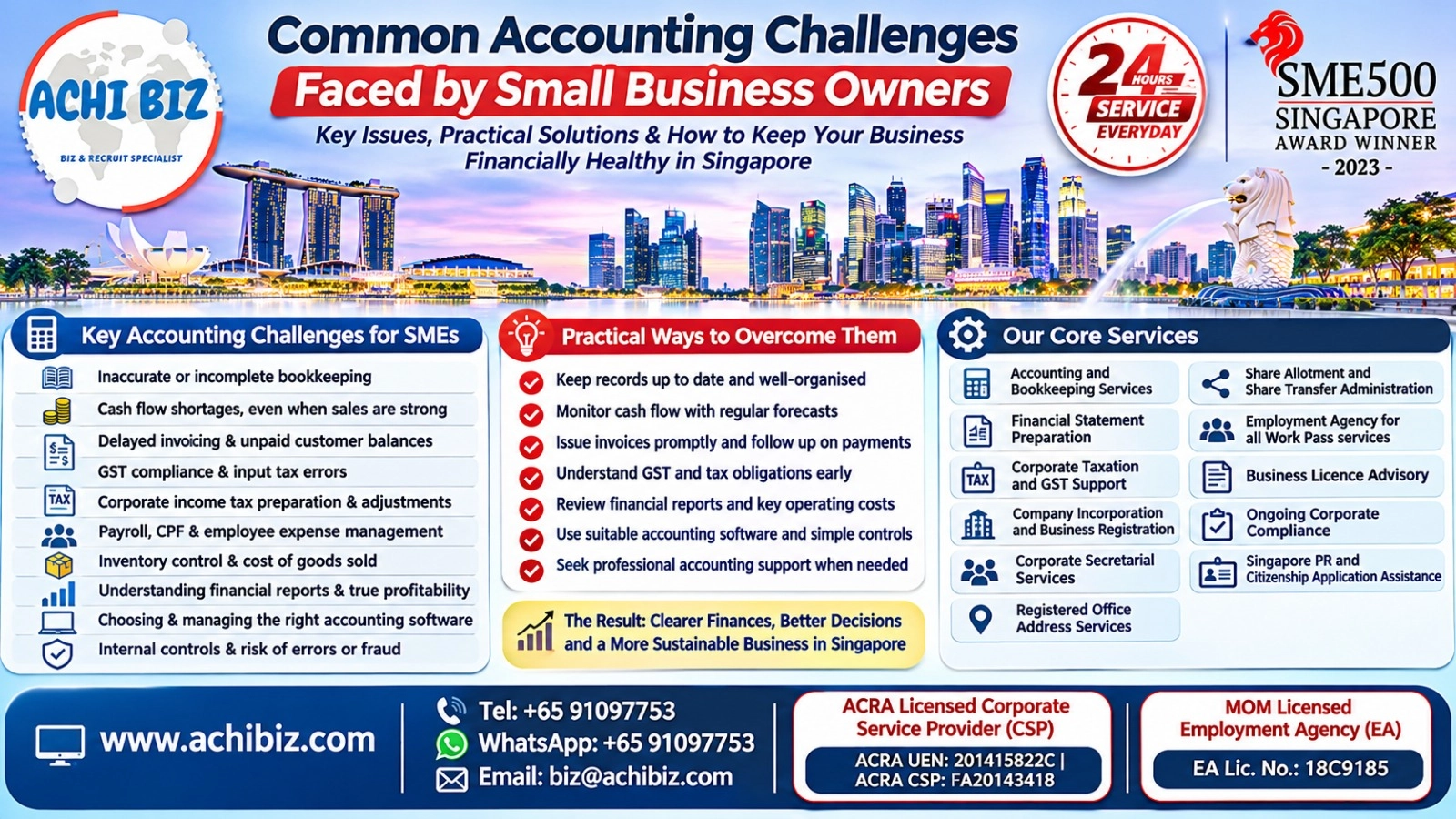
Common Accounting Challenges Faced by Small Business Owners in Singapore: Practical Solutions, Compliance Risks & Comprehensive FAQ Guide
An In-Depth Singapore SME Accounting Guide Covering Bookkeeping Problems, Cash Flow Management, Financial Reporting, GST, Corporate Tax, Payroll, Accounting Software, Internal Controls and Business Growth
Introduction
Running a small business in Singapore involves much more than attracting customers, generating sales and managing daily operations. Behind every successful business is a financial management system that helps its owners understand where money comes from, where it goes and whether the business is genuinely profitable.
For many small business owners, accounting becomes challenging not because they lack business knowledge, but because they must balance financial responsibilities with customer service, sales, marketing, staffing and operational decisions.
A business may generate healthy sales but still struggle to pay suppliers. Another may report accounting profits while having insufficient cash in its bank account. Some business owners maintain records diligently but overlook important adjustments, statutory filing requirements or tax obligations.
These challenges can become more complicated as a business grows, hires employees, registers for GST, takes on financing or expands into new markets.
In Singapore, accounting is also closely connected to statutory responsibilities under the Companies Act 1967, Inland Revenue Authority of Singapore (IRAS) requirements, GST legislation and applicable employment regulations.
Small businesses therefore need more than basic bookkeeping. They need reliable financial information, sensible internal controls and an understanding of their compliance responsibilities.
This comprehensive FAQ guide explains the most common accounting challenges faced by small business owners in Singapore, why these problems occur, how they affect business performance and what practical measures can help prevent them.
It focuses specifically on everyday accounting difficulties and solutions rather than repeating the broader subjects of company incorporation, directors’ duties, corporate secretarial responsibilities or share capital administration.
Part 1: Understanding Accounting Challenges in Singapore Small Businesses
What are the most common accounting challenges faced by small business owners in Singapore?
Small business owners commonly face difficulties involving incomplete bookkeeping, inconsistent recordkeeping, cash flow shortages, delayed invoicing, unpaid customer balances, inaccurate expense classification, GST compliance, corporate tax preparation and financial reporting.
Other frequent problems include mixing personal and business transactions, managing payroll, selecting accounting software, reconciling bank accounts and understanding the difference between profit and cash.
These challenges often arise together. For example, poor bookkeeping can make cash flow forecasting unreliable, while delayed invoicing can lead to payment shortages even when sales appear strong.
The most effective approach is to treat accounting as an ongoing business management function rather than a task performed only when financial statements or tax returns are due.
Why do small business owners struggle with accounting even when their businesses are profitable?
Profitability does not automatically make accounting straightforward.
A profitable business may have numerous transactions, complicated payment arrangements, outstanding customer invoices, inventory movements, employee expenses and financing obligations.
Owners may also lack the time or technical knowledge to maintain complete records.
A further difficulty is that accounting profit and available cash are not the same. Revenue may be recognised before a customer pays, while certain cash payments do not immediately become expenses in the income statement.
Consequently, a business can appear profitable while experiencing serious short-term financial pressure.
Why is accounting more than simply recording income and expenses?
Bookkeeping records transactions, but accounting uses those records to explain the financial position and performance of a business.
Accounting involves recognising revenue and expenses in the appropriate periods, identifying assets and liabilities, reconciling balances, preparing financial statements and interpreting financial results.
It also helps business owners understand whether pricing is sustainable, whether customers are paying promptly and whether sufficient resources are available for future obligations.
Accurate accounting therefore supports both regulatory compliance and commercial decision-making.
What are the warning signs that a small business has accounting problems?
Common warning signs include unexplained differences between bank balances and accounting records, frequent missing receipts, overdue invoices, unexpected tax liabilities and financial reports that are consistently delayed.
Other indicators include uncertainty about actual profit margins, repeated cash shortages, unexplained negative account balances and difficulty identifying how much customers owe.
A particularly serious warning sign is when the business owner cannot confidently explain the company’s cash position, outstanding liabilities or recent financial performance.
These issues should be investigated before they affect tax filings, financing applications or business continuity.
Why do accounting problems become more serious as a small business grows?
Business growth usually increases transaction volumes, staffing requirements, customer credit arrangements, supplier commitments and reporting complexity.
A spreadsheet that works for a small number of monthly transactions may become difficult to maintain when the business has hundreds of invoices, multiple employees and several payment platforms.
Growth may also introduce GST obligations, inventory accounting, foreign currency transactions and additional financing arrangements.
Without improved systems and controls, accounting errors can increase faster than the business owner’s ability to detect them.
How can accounting challenges affect the long-term survival of a small business?
Poor accounting can result in inaccurate pricing, uncontrolled spending, unpaid taxes, delayed customer collections and inadequate cash reserves.
It can also prevent owners from identifying declining profitability or deteriorating financial performance early enough to respond.
In serious cases, unreliable financial records may affect financing applications, investor confidence, regulatory compliance and the ability to continue operations.
Maintaining reliable accounting information helps business owners recognise financial problems while there is still time to take corrective action.
Part 2: Bookkeeping and Financial Recordkeeping Challenges
Why is poor bookkeeping one of the biggest accounting problems for Singapore SMEs?
Bookkeeping forms the foundation of financial reporting.
When transactions are omitted, duplicated or incorrectly classified, the resulting financial statements may be misleading.
Poor bookkeeping can also make it difficult to substantiate tax deductions, reconcile GST transactions and explain financial balances.
For Singapore businesses, proper recordkeeping is particularly important because accounting records may be required for tax reviews, audits, regulatory compliance and financial statement preparation.
What happens when a small business fails to record transactions regularly?
Delaying bookkeeping increases the likelihood of missing receipts, forgotten transactions and incorrect expense descriptions.
It also makes reconciliation more difficult because the person preparing the accounts may no longer remember the purpose of older payments.
When several months of transactions accumulate, correcting errors can become time-consuming and expensive.
A regular weekly or monthly bookkeeping schedule is generally more manageable than reconstructing an entire financial year at the last minute.
How can small business owners prevent missing invoices and receipts?
Businesses should establish a consistent process for collecting and storing supporting documents.
Supplier invoices, customer invoices, payment confirmations, expense claims and receipts should be saved promptly in an organised system.
Digital document storage can reduce dependence on physical paperwork, provided the records remain accessible, complete and properly maintained.
Owners should also check that every material accounting entry can be supported by appropriate documentation.
How long must Singapore businesses retain accounting records?
Singapore businesses generally need to retain relevant business records for at least five years under IRAS recordkeeping requirements, subject to the applicable rules and circumstances.
For companies, the Companies Act also imposes accounting record obligations.
Records may include invoices, receipts, bank statements, ledgers, contracts and documents supporting tax calculations.
Certain circumstances may require records to be kept longer, including where matters remain under investigation or other legal obligations apply.
Businesses should therefore avoid automatically deleting records immediately after the standard retention period without considering any outstanding requirements.
Is using Excel sufficient for small business bookkeeping?
Excel can be useful for a business with a limited number of straightforward transactions.
However, spreadsheets rely heavily on manual input, formulas and user discipline.
As transaction volumes increase, the risk of accidental deletion, incorrect formulas, duplicated entries and inconsistent reporting may become significant.
Dedicated accounting software may provide more reliable transaction tracking, bank reconciliation, invoice management and reporting.
The appropriate solution depends on the size, complexity and operational needs of the business.
What are the risks of maintaining accounting records manually?
Manual bookkeeping can create difficulties with data entry accuracy, document retrieval, version control and financial reporting.
A transaction entered incorrectly may affect several financial reports.
Manual processes can also make it difficult to identify who changed a record and when.
Businesses using manual systems should implement regular reviews, reconciliations, document backups and appropriate access controls.
Why is it important to separate personal and business transactions?
Mixing personal and business transactions makes it difficult to identify genuine business income, expenses and cash balances.
For a Singapore Pte. Ltd. company, the issue is especially important because the company is a separate legal entity from its shareholders and directors.
Personal payments made through company accounts must be properly identified and accounted for according to their actual nature.
Depending on the circumstances, a transaction may represent a reimbursement, salary-related payment, shareholder loan, director’s account movement or another type of transaction.
Incorrect treatment can distort financial statements and create tax or compliance concerns.
Can a business owner use personal funds to pay company expenses?
Yes, a business owner may pay genuine company expenses personally.
However, the payment should be supported by documentation and properly recorded in the company’s accounts.
Depending on the arrangement, the amount may be treated as a reimbursement payable or another appropriate liability or capital-related transaction.
The business should not simply ignore the payment because it did not pass through the company’s bank account.
How should a small business account for expenses without receipts?
An expense without supporting documentation creates difficulties in establishing its business purpose, amount and eligibility for tax deduction.
The owner should attempt to obtain a replacement invoice, supplier confirmation or other reliable supporting evidence.
Where adequate evidence cannot be obtained, the accounting and tax treatment should be assessed carefully.
Businesses should not assume that every expense recorded in their books is automatically deductible for income tax purposes.
Why do duplicate accounting entries occur?
Duplicate entries often arise when the same transaction is entered manually and also imported through a bank feed or payment platform.
They may also occur when supplier invoices are recorded more than once or when different employees process the same document.
Duplicates can overstate expenses, liabilities or revenue.
Regular bank reconciliations, invoice reference checks and duplicate-detection controls can help reduce this risk.
What is the difference between bookkeeping errors and accounting adjustments?
Bookkeeping errors arise when transactions are recorded incorrectly, omitted or duplicated.
Accounting adjustments are entries made to ensure that financial information reflects the appropriate accounting treatment.
Examples include depreciation, accrued expenses, prepaid expenses, inventory adjustments and impairment allowances.
Both affect financial statements, but they arise for different reasons.
A business may maintain accurate daily bookkeeping and still require year-end accounting adjustments.
Part 3: Cash Flow Management Challenges
Why do profitable small businesses experience cash flow problems?
A business may recognise revenue before receiving payment from customers.
At the same time, it may need to pay employees, suppliers, rent and other operating expenses.
This creates a timing difference between accounting profit and cash availability.
For example, a business may record substantial sales on 60-day credit terms while its suppliers require payment within 14 days.
Even if the sales are profitable, the business may experience a cash shortage before customer payments arrive.
What is the difference between cash flow and profit?
Profit measures financial performance after recognising income and expenses according to applicable accounting principles.
Cash flow measures the actual movement of money into and out of the business.
A profitable company can have negative operating cash flow if customers have not paid or if significant funds are tied up in inventory.
Similarly, receiving a bank loan increases available cash but does not create accounting revenue.
Business owners should monitor both measures rather than treating them as interchangeable.
How can a small business improve cash flow management?
Effective cash flow management begins with understanding expected receipts and payments.
Businesses should monitor outstanding customer invoices, supplier payment dates, payroll obligations, tax liabilities and planned capital expenditure.
Practical improvements may include requesting deposits, reducing unnecessary expenditure, negotiating appropriate payment terms and following up promptly on overdue invoices.
A regularly updated cash flow forecast can help identify shortages before they become urgent.
Why is a cash flow forecast important for Singapore SMEs?
A cash flow forecast estimates how much cash a business expects to receive and pay over a future period.
It can help owners prepare for payroll, rental commitments, GST payments, tax instalments and supplier obligations.
For example, a business may forecast sufficient revenue for the next quarter but discover that most customer receipts will arrive after several major payments are due.
The forecast allows management to consider corrective measures in advance.
How often should small business owners prepare cash flow forecasts?
The appropriate frequency depends on the business’s financial position and transaction patterns.
A stable business may find monthly forecasting sufficient for routine planning.
A business experiencing tight liquidity may need weekly forecasts or a rolling 13-week cash flow projection.
Forecasts should also be updated when significant changes occur in customer collections, supplier commitments or financing arrangements.
Why does rapid business growth sometimes create cash shortages?
Growth often requires additional spending before the related sales revenue is collected.
Businesses may need to purchase inventory, hire employees, expand premises or increase marketing expenditure.
If customers receive extended credit terms, cash may remain tied up in receivables.
Consequently, a growing business may need more working capital than a smaller, stable operation.
Owners should therefore assess the cash requirements of expansion before committing to major growth plans.
How can business owners determine whether they have sufficient working capital?
Working capital is commonly calculated as:
Working Capital = Current Assets − Current Liabilities
Current assets may include cash, trade receivables and inventory.
Current liabilities may include trade payables, short-term borrowings and other obligations due within the next operating cycle or 12 months, as applicable.
Positive working capital can indicate a financial buffer, but it does not automatically mean that sufficient cash is immediately available.
Owners should also examine the quality and timing of receivables, inventory and liabilities.
Why is relying only on the bank balance a poor financial management practice?
A bank balance shows the cash currently available in an account.
It does not necessarily show upcoming obligations, unpaid supplier invoices, outstanding tax liabilities or customer deposits that may need to be refunded.
A business with S$50,000 in the bank may still face a shortage if S$70,000 of payments becomes due shortly.
The bank balance should therefore be considered alongside accounts payable, accounts receivable and cash flow forecasts.
How can small businesses manage seasonal cash flow fluctuations?
Seasonal businesses may experience periods of high sales followed by months of lower revenue.
Owners should use historical financial information to identify recurring patterns.
They can then plan inventory purchases, staffing, marketing and reserves around expected changes in demand.
Maintaining a cash buffer during stronger months may help cover fixed expenses during slower periods.
What are the consequences of repeatedly delaying supplier payments?
Delaying supplier payments may temporarily preserve cash but can damage commercial relationships.
Suppliers may shorten credit terms, require advance payments or suspend deliveries.
Repeated delays can also indicate underlying problems with pricing, customer collections or working capital management.
Businesses should address the cause of cash shortages rather than relying indefinitely on overdue supplier balances.
Part 4: Customer Invoicing and Accounts Receivable Challenges
Why do unpaid customer invoices create accounting difficulties?
Unpaid invoices represent amounts that the business expects to collect.
When customers delay payment, the company may have already recognised revenue but not received the corresponding cash.
This affects liquidity and may increase the risk of bad debts.
Businesses need reliable accounts receivable records to identify overdue balances and assess whether amounts remain recoverable.
How can small businesses reduce late customer payments?
Businesses should communicate payment terms clearly before supplying goods or services.
Invoices should be issued promptly and include accurate customer information, payment details and due dates.
Regular reminders can help prevent overdue invoices from being overlooked.
For higher-risk transactions, businesses may consider deposits, milestone payments or shorter credit periods.
What should a business do when a customer refuses to pay an invoice?
The first step is to establish whether the customer disputes the amount, the quality of goods or services, or the contractual terms.
The business should review supporting documents, including quotations, contracts, delivery records and correspondence.
If the debt is valid, appropriate follow-up or recovery measures may be considered.
Legal action may be necessary in some cases, but the expected recovery should be weighed against the cost and practical consequences.
How should bad debts be recorded in the accounts?
The accounting treatment depends on the applicable financial reporting framework and the circumstances.
Where a receivable is unlikely to be fully recovered, the business may need to recognise an impairment allowance or write-off.
The accounting treatment and tax deductibility are separate questions.
For Singapore income tax purposes, bad debt deductions are subject to relevant conditions and supporting evidence.
Why is an accounts receivable ageing report important?
An ageing report groups unpaid invoices according to how long they have been outstanding.
For example, it may show balances that are current, 1–30 days overdue, 31–60 days overdue or more than 90 days overdue.
This allows business owners to identify customers who consistently pay late.
It also supports credit control, cash flow forecasting and the assessment of doubtful debts.
Should small businesses offer customers long credit terms?
Credit terms can help attract customers, particularly in business-to-business transactions.
However, extended payment periods increase the amount of cash tied up in receivables.
Before offering long credit terms, businesses should consider customer reliability, profit margins, working capital and supplier payment requirements.
A sale is not necessarily commercially attractive if collecting payment becomes excessively difficult or expensive.
How can customer deposits and advance payments complicate accounting?
A customer deposit may be received before the business has delivered the goods or performed the services.
Depending on the applicable accounting framework and transaction terms, the amount may initially represent a liability rather than earned revenue.
Revenue recognition and GST timing may also differ.
Businesses should avoid automatically treating every bank receipt as income earned during that period.
Part 5: Expense Management and Cost Control Challenges
Why do small business owners struggle to control operating expenses?
Operating expenses often increase gradually.
Software subscriptions, delivery charges, professional fees, utilities and other recurring payments may appear insignificant individually but become substantial collectively.
Without regular expense reviews, business owners may not recognise how these costs affect profitability.
Accounting reports should therefore help identify expense trends and unusual increases.
How can small businesses identify unnecessary business expenses?
Owners should review expenditure by category and compare it with previous periods, budgets and revenue levels.
Recurring subscriptions, duplicated services and underused resources are useful starting points.
However, cost reduction should not be based solely on the size of an expense.
Businesses should also consider whether the expenditure contributes to customer service, operational efficiency or future revenue.
Why is incorrect expense classification a common accounting problem?
Expenses may be recorded under inappropriate categories because their purpose is misunderstood.
For example, a purchase of equipment may be treated as an ordinary operating expense even though it should be recognised as an asset under the applicable accounting framework.
Incorrect classification can distort profitability, asset balances and tax computations.
A consistent chart of accounts and regular review can reduce these errors.
What is the difference between capital expenditure and operating expenditure?
Capital expenditure generally involves acquiring or improving assets expected to provide benefits over more than one accounting period.
Operating expenditure generally relates to the ongoing costs of running the business.
The distinction affects accounting recognition and the timing of expenses.
Tax treatment may differ from accounting treatment, including where capital allowances or other specific tax provisions apply.
How should small businesses account for prepaid expenses?
Prepaid expenses arise when a business pays for goods or services before receiving the related benefit.
Examples may include annual insurance premiums, software subscriptions or rental payments made in advance.
Under accrual accounting, the amount may initially be recorded as an asset and recognised as an expense over the relevant period.
This prevents the entire payment from unnecessarily distorting one month’s financial performance.
Why are accrued expenses important in financial reporting?
Accrued expenses relate to costs incurred before payment or before a supplier invoice is received.
Examples may include utilities, professional fees and employee-related expenses.
Recognising appropriate accruals helps ensure that financial statements reflect obligations relating to the reporting period.
Failing to record them may overstate profit and understate liabilities.
How can business owners avoid underestimating their true operating costs?
Owners should account for both visible and less obvious expenses.
These may include payment processing charges, software fees, maintenance, insurance, professional services, depreciation and financing costs.
They should also distinguish between fixed and variable costs.
Understanding the complete cost structure helps businesses set prices that support sustainable operations.
Part 6: GST Accounting and Compliance Challenges in Singapore
Why is GST accounting challenging for small businesses in Singapore?
GST accounting requires businesses to understand which transactions are taxable, zero-rated, exempt or outside the scope of GST.
GST-registered businesses must also account for output tax and determine whether input tax claims are allowable.
Errors may arise from incorrect tax codes, incomplete supporting documents, overseas transactions and misunderstanding the time of supply.
GST compliance therefore requires more than simply adding GST to customer invoices.
When must a small business register for GST in Singapore?
Singapore’s compulsory GST registration rules generally apply when a business’s taxable turnover exceeds S$1 million under the relevant retrospective or prospective tests.
The tests have specific timing and application requirements.
A business may also apply for voluntary GST registration, subject to IRAS conditions.
Owners should monitor taxable turnover regularly rather than waiting until annual financial statements are completed.
What is the prevailing GST rate in Singapore?
Singapore’s prevailing GST rate is 9%, effective from 1 January 2024.
GST-registered businesses must apply the correct GST treatment to relevant supplies.
Not every transaction is necessarily subject to 9% GST.
Zero-rated, exempt and out-of-scope transactions require separate consideration.
Why do businesses make mistakes when claiming input GST?
Input tax claims are subject to statutory conditions.
A business may incorrectly claim GST on expenses that do not qualify, lack proper documentation or relate to restricted categories.
Errors can also arise when supplier invoices are recorded with incorrect GST codes.
GST-registered businesses should review the eligibility of input tax claims and maintain appropriate supporting records.
Can a non-GST-registered business charge GST to customers?
A business that is not GST-registered generally must not charge GST on its supplies.
Charging GST without registration can create regulatory problems.
Businesses should verify their GST registration status before issuing tax invoices that include GST.
What happens if a GST-registered business submits an incorrect GST return?
An incorrect GST return may result in additional tax, penalties or other consequences depending on the circumstances.
The business should identify the error, determine the appropriate correction procedure and maintain supporting documentation.
IRAS provides mechanisms for correcting certain errors, subject to applicable conditions.
Prompt voluntary correction may be relevant when assessing compliance consequences.
Why is GST reconciliation important?
GST reconciliation compares GST recorded in accounting records with the amounts reported in GST returns.
It helps identify missing transactions, incorrect tax codes and discrepancies between financial reports and submitted returns.
Regular reconciliation reduces the risk of discovering accumulated errors after several reporting periods.
How can overseas purchases and sales complicate GST accounting?
International transactions may involve imported goods, overseas services, exports and transactions subject to special GST rules.
The applicable treatment depends on the nature of the transaction and the relevant statutory conditions.
Businesses should not assume that all overseas transactions are automatically zero-rated or outside the scope of GST.
Should small businesses voluntarily register for GST?
Voluntary GST registration may be useful for some businesses, particularly where substantial allowable input tax is incurred.
However, registration also creates ongoing compliance obligations.
Businesses must consider administrative costs, pricing implications, customer profiles and IRAS conditions.
The decision should be based on a practical financial assessment rather than the assumption that GST registration always benefits a growing business.
Part 7: Corporate Income Tax and Tax Computation Challenges
Why is corporate income tax preparation difficult for small business owners?
Accounting profit and taxable income are not necessarily identical.
Certain accounting expenses may be disallowed for tax purposes, while specific deductions, allowances or exemptions may apply.
Businesses must also consider revenue adjustments, capital allowances and other relevant tax provisions.
Preparing an accurate tax computation therefore requires an understanding of both accounting records and Singapore tax rules.
What is Singapore’s corporate income tax rate?
Singapore’s headline corporate income tax rate is 17%.
However, the effective tax burden of an individual company may differ because of applicable exemptions, deductions, rebates and other tax provisions.
Business owners should not calculate tax liability by automatically applying 17% to accounting profit without preparing the relevant tax adjustments.
Why is accounting profit different from taxable profit?
Accounting profit is determined using applicable financial reporting principles.
Taxable profit is calculated under income tax legislation.
For example, some expenses recognised in the financial statements may not be deductible for tax purposes.
Conversely, capital allowances or other tax deductions may affect taxable income differently from accounting depreciation.
The reconciliation between accounting profit and taxable income is an important part of tax preparation.
What is the difference between ECI and Form C-S or Form C?
Estimated Chargeable Income, commonly called ECI, is an estimate of a company’s taxable income for a Year of Assessment.
Form C-S, Form C-S (Lite) or Form C is used for the relevant annual corporate income tax filing, depending on eligibility and applicable requirements.
These are separate filing obligations.
A company should determine which forms it must submit and whether any filing waiver or exemption applies.
When must Singapore companies file ECI?
Companies generally must file ECI within three months after the end of their financial year, unless they qualify for an applicable waiver.
For example, a company with a financial year ending 31 December would generally have an ECI filing deadline of 31 March of the following year.
Businesses should check the current IRAS conditions before assuming that no ECI filing is required.
When is the corporate income tax return due in Singapore?
The general annual filing deadline for corporate income tax returns is 30 November.
The applicable Year of Assessment and form requirements should be confirmed for each company.
Companies should maintain a compliance calendar to ensure that accounting records and tax computations are prepared in sufficient time.
Why do small businesses underestimate their corporate tax liabilities?
Some owners assume that all business expenditure is deductible or overlook differences between accounting profit and taxable income.
Others fail to account for taxable income because cash has already been spent on inventory, equipment or loan repayments.
This can lead to insufficient cash being reserved for tax payments.
Periodic tax estimates help businesses anticipate potential liabilities.
Can a small business claim every expense recorded in its accounts as a tax deduction?
No.
The deductibility of expenses depends on the relevant provisions of Singapore income tax law.
Generally, expenses must satisfy applicable requirements, including their relationship to producing taxable income.
Certain expenses may be capital in nature, private, prohibited or otherwise non-deductible.
Businesses should review expense categories rather than assuming that accounting recognition automatically establishes tax deductibility.
Why is tax planning different from tax avoidance or evasion?
Legitimate tax planning involves understanding and applying available tax provisions in accordance with the law.
Tax evasion involves unlawful conduct such as deliberately concealing taxable income or falsifying records.
Businesses should maintain accurate documentation and avoid arrangements that misrepresent the commercial substance of transactions.
Professional tax advice may be appropriate for complex matters.
How can a small business prepare for a possible IRAS tax review?
Businesses should maintain complete accounting records, supporting invoices, tax computations and relevant correspondence.
They should also ensure that reported figures can be reconciled with financial statements and underlying records.
When discrepancies are identified, they should be investigated and corrected through appropriate procedures.
A well-organised accounting system can significantly reduce the time required to respond to tax enquiries.
Part 8: Financial Statements and Reporting Challenges
Why do small business owners find financial statements difficult to understand?
Financial statements contain accounting terms that may not be familiar to owners without a finance background.
For example, revenue, gross profit, operating profit, retained earnings, receivables and liabilities describe different aspects of financial performance.
A business owner may understand daily sales but struggle to interpret why reported profit differs from cash in the bank.
The solution is to focus on what each financial statement reveals and how the figures relate to business decisions.
What are the main financial statements a Singapore small business should understand?
The principal financial statements commonly include:
-
Statement of Profit or Loss: Reports income, expenses and financial performance.
-
Statement of Financial Position: Reports assets, liabilities and equity at a particular date.
-
Statement of Cash Flows: Explains cash movements from operating, investing and financing activities.
-
Statement of Changes in Equity: Explains movements in owners’ equity.
-
Notes to the Financial Statements: Provide accounting policies and other explanatory information.
The exact reporting requirements depend on the entity and applicable financial reporting framework.
Why is the profit and loss statement important for small business owners?
The profit and loss statement helps owners understand whether business activities generate sufficient revenue to cover costs.
It also provides information about gross margins, operating expenses and net profitability.
Comparing results across several months can reveal changes in sales performance or cost structure.
However, profit and loss information should be considered together with cash flow and balance sheet information.
What accounting challenges arise when preparing a balance sheet?
A balance sheet may contain balances that require careful review, including receivables, inventory, fixed assets, loans and accrued liabilities.
Errors often arise when transactions are recorded in the wrong accounts or when old balances are not investigated.
For example, an unpaid supplier invoice may remain in the accounts even after payment if the payment is incorrectly classified.
Regular reconciliations help ensure that reported balances remain reliable.
Why is a trial balance not proof that the accounts are correct?
A trial balance checks whether total debit balances equal total credit balances.
However, balanced debits and credits do not guarantee that transactions were recorded accurately.
An expense entered into the wrong account may leave the trial balance balanced.
Likewise, an omitted transaction may not affect the equality of debits and credits.
Additional reviews and reconciliations are necessary.
What is the difference between management accounts and annual financial statements?
Management accounts are generally prepared for internal business monitoring.
They may be produced monthly or quarterly and can include detailed performance reports, budgets and operational information.
Annual financial statements are prepared for the financial year under the applicable accounting framework and statutory requirements.
Management accounts help owners make timely decisions, while annual financial statements provide a more formal presentation of financial performance and position.
How frequently should small businesses review management accounts?
Monthly reviews are generally useful for businesses with regular transactions.
Owners should examine revenue, gross margins, operating expenses, receivables, payables and cash flow.
Businesses experiencing rapid growth or financial difficulties may need more frequent reviews.
The objective is to identify financial changes early rather than wait until the end of the financial year.
Why do year-end accounting adjustments create difficulties?
Year-end adjustments may involve depreciation, accruals, prepayments, inventory valuation, doubtful debts and other accounting estimates.
These adjustments can change the profit originally shown in preliminary bookkeeping reports.
When records are incomplete, preparing the adjustments may require substantial investigation.
Maintaining accurate monthly accounts reduces the workload at year-end.
What financial reporting standards apply to Singapore companies?
Singapore companies generally prepare financial statements using the applicable Singapore financial reporting framework.
Depending on eligibility and circumstances, this may include Singapore Financial Reporting Standards (International), Financial Reporting Standards in Singapore or the Singapore Financial Reporting Standard for Small Entities.
The appropriate framework should be determined based on the company’s circumstances and relevant requirements.
Business owners should not assume that every small company automatically qualifies to use the Small Entities framework.
Can a small company prepare financial statements without undergoing an audit?
Some Singapore companies qualify for audit exemption under the Companies Act.
For example, the small company audit exemption involves statutory eligibility conditions, including financial thresholds and, where applicable, group considerations.
However, audit exemption does not mean exemption from maintaining accounting records or preparing financial statements.
Other reporting or filing requirements may also apply.
What is the difference between audit exemption and financial statement filing exemption?
Audit exemption concerns whether a company is required to have its financial statements audited.
Financial statement filing requirements concern whether the company must lodge financial statements with ACRA.
These are separate matters governed by different conditions.
A company may qualify for audit exemption while still being required to prepare financial statements and meet applicable filing obligations.
Part 9: Bank Reconciliation and Payment Processing Challenges
Why is bank reconciliation essential for accurate bookkeeping?
Bank reconciliation compares transactions recorded in the accounting system with those appearing in bank statements.
It helps identify missing entries, duplicate transactions, bank charges, unrecorded receipts and incorrect payment amounts.
Without reconciliation, the accounting cash balance may differ from the actual bank balance.
Regular reconciliation is therefore one of the most important controls for maintaining reliable financial records.
How often should a small business reconcile its bank accounts?
Monthly reconciliation is generally a sensible minimum for businesses with regular transactions.
Businesses with high transaction volumes may benefit from weekly or more frequent reconciliation.
Reconciliations should be reviewed promptly so that unusual transactions can be investigated while supporting information is still available.
Why do bank balances differ from accounting cash balances?
Differences may arise from outstanding cheques, deposits in transit, bank charges, timing differences or transactions not yet entered into the accounting system.
They may also indicate errors or unauthorised transactions.
Not every difference represents an accounting mistake.
The reconciliation process should explain each outstanding item and determine whether an adjustment is necessary.
How should small businesses record payment gateway fees?
Payment platforms may deduct processing charges before transferring funds to the business bank account.
For example, a customer may pay S$100, but the payment provider may transfer only S$97 after deducting a S$3 fee.
Recording only S$97 as revenue may understate sales.
The business should account for the gross transaction and related processing fee according to the actual arrangement and applicable accounting requirements.
Why do PayNow, credit card and online payment transactions complicate bookkeeping?
Businesses may receive payments through several channels, each producing different transaction records and settlement dates.
Payment providers may also deduct fees, issue refunds or combine multiple customer payments into a single bank settlement.
Without proper reconciliation, businesses may duplicate revenue or overlook processing charges.
A clear process linking customer transactions to payment settlements helps maintain accurate records.
How can small businesses prevent unauthorised bank payments?
Businesses should establish appropriate approval procedures and restrict access to online banking.
Where practical, payment preparation and payment approval should be performed by different individuals.
Bank transactions should also be reviewed regularly by someone with appropriate oversight.
For very small businesses where segregation of duties is difficult, independent periodic reviews and transaction alerts can provide additional protection.
Part 10: Inventory and Cost of Goods Sold Challenges
Why is inventory accounting difficult for small retailers and trading businesses?
Inventory accounting requires businesses to track purchases, sales, stock movements, returns and remaining quantities.
Errors can arise when physical inventory does not match recorded balances.
Inventory valuation also affects the cost of goods sold and reported profit.
Poor inventory records can therefore distort both the income statement and balance sheet.
How does inaccurate inventory valuation affect business profitability?
If closing inventory is overstated, the cost of goods sold may be understated and profit overstated.
If closing inventory is understated, the opposite may occur.
The effect depends on the nature of the error and the accounting method used.
Accurate inventory valuation is important for assessing gross profit and financial position.
What is the cost of goods sold formula?
A simplified formula commonly used by trading businesses is:
Cost of Goods Sold = Opening Inventory + Purchases − Closing Inventory
Additional adjustments may be necessary for purchase returns, freight, inventory movements and other relevant costs.
The formula helps owners understand the direct cost of goods sold during a period.
However, it must be supported by accurate inventory and purchasing records.
Why do small businesses struggle with stock discrepancies?
Stock discrepancies may result from theft, damage, wastage, recording errors, incorrect deliveries or unrecorded returns.
They can also arise when stock movements are not entered promptly.
Regular stock counts and investigations help identify the underlying causes.
Businesses should avoid adjusting inventory balances without understanding why discrepancies occurred.
How should obsolete or damaged inventory be treated?
Inventory that is damaged, obsolete or unlikely to be sold at its original value may require an accounting adjustment.
Under applicable accounting principles, inventory is generally measured at the lower of cost and net realisable value.
The business should assess whether the expected recoverable selling value has fallen below cost.
Appropriate documentation should support material write-downs.
Why is inventory turnover important for small businesses?
Inventory turnover indicates how efficiently stock is sold and replaced.
Slow-moving inventory can tie up cash and increase storage or obsolescence costs.
Very rapid turnover may indicate efficient stock management, but it can also increase the risk of shortages.
Business owners should evaluate turnover alongside demand patterns, supplier lead times and profit margins.
Part 11: Payroll, CPF and Employee Expense Challenges
Why does payroll accounting become complicated when a small business hires employees?
Payroll involves more than calculating basic salaries.
Employers may need to account for overtime, allowances, bonuses, unpaid leave, statutory contributions and other employment-related payments.
Different employee arrangements may also create different legal and administrative requirements.
Accurate payroll records help businesses calculate employment costs and meet applicable obligations.
How do CPF contributions affect payroll accounting in Singapore?
For employees who are Singapore Citizens or Singapore Permanent Residents, CPF contributions may apply according to the relevant eligibility criteria and contribution rules.
Employers must distinguish between employee and employer contributions.
The rates can vary depending on factors such as age, wages and applicable CPF rules.
Businesses should use the latest CPF Board guidance rather than relying on outdated contribution tables.
Why is it important to record employer CPF contributions separately from employee deductions?
Employee CPF contributions are generally deducted from the employee’s gross wages and remitted together with the employer’s contribution.
Employer CPF contributions represent an additional employment cost.
If these amounts are recorded incorrectly, payroll expenses and liabilities may be misstated.
Separate accounting records help ensure that the financial statements accurately reflect both components.
What accounting problems arise from incorrect salary calculations?
Incorrect salary calculations can result in underpayments, overpayments and inaccurate payroll liabilities.
Errors may also affect CPF contributions, tax reporting and employee records.
Payroll calculations should be checked before payments are made.
Businesses should investigate discrepancies promptly and maintain documentation supporting corrections.
How should employee reimbursements be recorded?
Employee reimbursements should be supported by expense claims and appropriate documentation.
The accounting treatment depends on the nature and purpose of the underlying expense.
For example, a reimbursement for a genuine business purchase may be recorded differently from an allowance that forms part of employee remuneration.
Businesses should also consider whether particular payments have CPF or tax implications.
Why do bonuses and commissions require careful accounting treatment?
Bonuses and commissions may be earned in one accounting period but paid in another.
Where an obligation has arisen, the business may need to recognise the relevant expense and liability before payment.
The applicable treatment depends on the contractual arrangement and accounting framework.
Incorrect timing can distort the profitability of individual reporting periods.
What are the accounting implications of hiring foreign employees?
Foreign employment arrangements may involve work pass-related costs, salaries, levies where applicable, insurance and other employment expenses.
The requirements depend on the work pass category and the employee’s circumstances.
Employers should maintain accurate payroll and supporting records while ensuring that the employment arrangements comply with applicable Ministry of Manpower requirements.
How can small businesses reduce payroll errors?
A reliable payroll process should include accurate employee records, documented salary terms, approved changes and a review before payment.
Payroll software may help automate calculations, but its settings must remain accurate and current.
Owners should periodically reconcile payroll expenses, payment records and statutory contribution liabilities.
Part 12: Accounting Software and Digitalisation Challenges
Why do small business owners find it difficult to choose accounting software?
Accounting software differs in cost, features, complexity, integrations and reporting capabilities.
A system suitable for a freelance consultant may not meet the needs of a retailer with inventory, employees and multiple sales channels.
Businesses should consider their transaction volumes, GST requirements, reporting needs and expected growth.
Choosing software solely because it is inexpensive can create additional work if essential features are missing.
What features should Singapore SMEs look for in accounting software?
Useful features may include invoicing, expense tracking, bank reconciliation, financial reporting, customer and supplier records, GST reporting support and user access controls.
Some businesses may also require inventory management, payroll integration, multicurrency capabilities or project accounting.
The system should support the business’s actual processes and applicable reporting requirements.
Can accounting software automatically guarantee compliance with Singapore regulations?
No.
Accounting software can assist with calculations, recordkeeping and reporting, but it cannot guarantee that transactions are classified correctly or that all statutory requirements have been met.
Incorrect tax codes, incomplete data and inappropriate accounting assumptions can still produce inaccurate reports.
Human review remains necessary, particularly for complex transactions and compliance decisions.
What are the risks of using outdated accounting software?
Outdated systems may lack current functionality, security updates or support for changes in reporting requirements.
They may also create compatibility problems with banking systems or other applications.
Businesses should periodically review whether their software remains supported and suitable.
Data backups and migration planning are especially important when replacing older systems.
Why do small businesses struggle when migrating to new accounting software?
Migration requires transferring opening balances, customer records, supplier information and other accounting data.
Errors can arise when historical balances are incomplete or mapped incorrectly.
A poorly planned migration may create discrepancies that affect future reporting.
Businesses should reconcile opening balances and validate important data before relying on the new system.
How can automation improve bookkeeping efficiency?
Automation can reduce repetitive tasks such as invoice generation, transaction imports and payment reminders.
It may also improve the consistency of routine accounting processes.
However, automation should be supported by appropriate controls.
An incorrectly configured automated process can repeat errors across many transactions.
Can artificial intelligence replace a small business accountant?
Artificial intelligence may assist with document processing, transaction suggestions, anomaly detection and financial analysis.
However, accounting involves professional judgement, regulatory interpretation and decisions based on the circumstances of individual transactions.
AI-generated accounting recommendations can be incorrect or incomplete.
Businesses should therefore use AI as a supporting tool rather than assuming that it eliminates the need for competent accounting oversight.
How can small businesses protect confidential accounting information?
Accounting records may contain bank details, employee information, customer data and commercially sensitive financial information.
Businesses should implement appropriate access restrictions, secure passwords, backups and data protection measures.
Where personal data is involved, relevant obligations under Singapore’s Personal Data Protection Act should also be considered.
Access should generally be limited to individuals who need the information for legitimate business purposes.
Part 13: Budgeting, Pricing and Profitability Challenges
Why do small businesses struggle to prepare realistic budgets?
Many owners prepare budgets based on expected sales without fully considering operating costs, seasonal fluctuations and unexpected expenditure.
Others rely on historical figures without adjusting for changes in rent, wages, supplier prices or market conditions.
A realistic budget should be based on reasonable assumptions and updated when circumstances change.
Budgeting is most useful when it supports decisions rather than merely producing a financial target.
What is the difference between a budget and a cash flow forecast?
A budget sets out expected financial performance, including revenue and expenses.
A cash flow forecast focuses on the timing of money received and paid.
For example, a budget may show expected monthly sales of S$40,000, but the cash flow forecast may show that only S$20,000 will be collected during that month.
Both are useful because profitability and liquidity represent different financial concerns.
Why is budget variance analysis important?
Variance analysis compares actual financial results with budgeted amounts.
It helps owners understand why revenue, costs or profit differ from expectations.
For example, an increase in sales may appear positive, but the benefit may be reduced if delivery and labour costs increase disproportionately.
Investigating material variances can reveal operational problems and opportunities for improvement.
How can incorrect pricing affect small business profitability?
Pricing based only on direct purchase costs may fail to cover overheads, financing expenses, payment fees and other operating costs.
A business may attract customers through low prices but generate insufficient margins to remain sustainable.
Owners should understand their full cost structure and the contribution generated by each product or service.
Pricing decisions should also consider customer demand, competition and perceived value.
What is gross profit margin, and why should small business owners monitor it?
Gross profit margin measures the proportion of revenue remaining after deducting the cost of goods sold or relevant direct costs.
The formula is:
Gross Profit Margin = (Gross Profit ÷ Revenue) × 100%
For example, if revenue is S$100,000 and the cost of goods sold is S$60,000, gross profit is S$40,000 and the gross profit margin is 40%.
A declining margin may indicate rising supplier costs, discounting or changes in the sales mix.
What is net profit margin?
Net profit margin measures the proportion of revenue remaining as net profit after the relevant expenses.
A commonly used formula is:
Net Profit Margin = (Net Profit ÷ Revenue) × 100%
For example, a business generating S$100,000 in revenue and S$10,000 in net profit has a net profit margin of 10%.
The measure helps owners understand overall profitability.
However, comparisons should account for differences in accounting treatment, business models and industries.
Why can increasing sales fail to improve net profit?
Higher sales may require additional employees, marketing expenditure, delivery costs or discounts.
If these costs increase faster than revenue, net profit may remain unchanged or decline.
Some products may also generate substantially lower margins than others.
Owners should therefore evaluate the profitability of additional sales rather than focusing only on revenue growth.
What is break-even analysis, and how does it help small businesses?
Break-even analysis estimates the level of sales required to cover relevant costs.
A simplified formula is:
Break-Even Sales Volume = Fixed Costs ÷ Contribution Margin per Unit
Contribution margin per unit is generally calculated as selling price per unit minus variable cost per unit.
For example, if monthly fixed costs are S$12,000 and contribution margin is S$30 per unit, the business needs to sell 400 units to break even under those assumptions.
The calculation can support pricing, sales planning and cost management.
Why is relying only on revenue growth a financial management mistake?
Revenue growth does not necessarily indicate improving financial health.
A business may increase sales while experiencing lower margins, rising debts or deteriorating cash flow.
Owners should monitor profitability, liquidity, receivables and operating costs alongside revenue.
A balanced assessment provides a more reliable picture of business performance.
Part 14: Loans, Financing and Business Debt Challenges
Why does loan accounting confuse small business owners?
Loan repayments generally contain different components.
Interest is commonly recognised as a finance expense, while principal repayment reduces the outstanding liability.
Recording the entire repayment as an expense may understate profit and leave the loan balance incorrect.
The applicable accounting treatment should reflect the financing arrangement and relevant accounting requirements.
How should business loan repayments be recorded?
The accounting records should distinguish between principal, interest and any applicable fees.
The principal portion reduces the loan liability.
The interest portion is recognised according to the applicable accounting treatment.
Businesses should reconcile loan balances against lender statements and repayment schedules.
Why do financing arrangements affect cash flow differently from profit?
Receiving a loan increases cash but does not ordinarily represent revenue.
Repaying principal reduces cash but does not ordinarily represent an operating expense.
Interest and financing charges may affect profit.
This explains why a business’s cash movements can differ substantially from its reported financial performance.
What accounting challenges arise from director or shareholder loans?
Amounts advanced by directors or shareholders must be distinguished from share capital, revenue and other transactions.
Similarly, amounts paid by the company to directors or shareholders require proper classification.
Depending on the circumstances, transactions may create loan receivables, loan payables or other accounting balances.
Their legal, tax and financial reporting implications should be assessed carefully.
How can inaccurate accounting records affect business financing applications?
Banks and other financing providers may request financial statements, management accounts, bank statements and cash flow information.
Inconsistent or incomplete records can make it difficult to evaluate a business’s financial position.
Reliable accounting information may help demonstrate repayment capacity and financial discipline.
However, accurate records do not guarantee loan approval.
Why is excessive reliance on short-term borrowing risky?
Short-term borrowing can provide temporary liquidity, but it creates repayment obligations.
If borrowed funds are repeatedly used to cover operating losses, the business may become increasingly dependent on financing.
Interest costs and repayment commitments can place further pressure on cash flow.
Owners should distinguish between temporary working capital requirements and persistent underlying losses.
Part 15: Internal Controls, Fraud Prevention and Accounting Accuracy
Why are internal accounting controls important for small businesses?
Internal controls help prevent errors, unauthorised transactions and misuse of company resources.
They also improve the reliability of financial information.
Small businesses may have fewer employees, making it difficult to separate financial responsibilities.
Nevertheless, simple controls such as payment approvals, bank reconciliations and periodic reviews can reduce risks.
What is segregation of duties in small business accounting?
Segregation of duties means dividing responsibilities so that one individual does not control every stage of a financial transaction.
For example, the person preparing a supplier payment may be different from the person approving it.
This reduces the risk of unauthorised payments or concealed errors.
Where staffing limitations make full segregation impractical, owners should introduce compensating controls.
How can small businesses prevent fraudulent expense claims?
Businesses should establish clear expense reimbursement policies and require supporting documents.
Claims should be reviewed for business purpose, accuracy and duplicate submissions.
Unusual or high-value claims may require additional approval.
Consistent enforcement is important because informal arrangements can create opportunities for abuse.
Why should business owners review accounting reports even when bookkeeping is outsourced?
Outsourcing bookkeeping does not eliminate management’s responsibility to understand the company’s finances.
The owner should review significant expenses, outstanding receivables, bank balances and unusual transactions.
Regular discussions with the accountant can help identify errors or financial risks.
An external service provider can prepare information, but business decisions remain with the appropriate management personnel.
What are common indicators of accounting fraud?
Possible warning signs include unexplained payments, missing documents, unusual supplier details, repeated adjustments and transactions that do not appear commercially reasonable.
These indicators do not automatically prove fraud.
However, they justify appropriate investigation.
Businesses should maintain a process for reviewing suspicious transactions and escalating concerns.
Why are accounting data backups important?
Accounting information can be lost through hardware failure, cyber incidents, accidental deletion or software problems.
Without reliable backups, reconstructing financial records may be difficult and expensive.
Businesses should use secure backup arrangements and periodically confirm that data can be restored.
Access to backup information should also be appropriately controlled.
How can accounting errors be corrected without creating further problems?
The business should first identify the nature and period of the error.
Corrections should be documented and entered using appropriate accounting procedures.
Where an error affects previously issued financial statements or submitted tax returns, additional reporting or correction requirements may arise.
Businesses should avoid deleting historical entries without preserving an appropriate audit trail.
Part 16: Accounting Challenges for Different Types of Small Businesses
What accounting challenges are common among Singapore sole proprietors?
Sole proprietors often manage bookkeeping personally while handling daily operations.
Common difficulties include separating business and personal expenditure, tracking deductible expenses and maintaining complete transaction records.
Because a sole proprietorship is not a separate legal entity from its owner, its legal structure differs from that of a Pte. Ltd. company.
Nevertheless, accurate records remain necessary for tax reporting and business management.
What accounting challenges are common among Singapore Pte. Ltd. companies?
Private limited companies may face additional requirements involving corporate financial statements, directors’ and shareholders’ transactions, corporate income tax and ACRA-related obligations.
The company must maintain appropriate accounting records as a separate legal entity.
Accounting arrangements should also support applicable financial reporting and statutory requirements.
What accounting challenges affect newly incorporated Singapore companies?
New companies may struggle with establishing a chart of accounts, selecting accounting software and understanding their first financial year.
They may also overlook the need to record transactions occurring before regular trading begins.
Early accounting decisions can affect future reporting.
Establishing appropriate systems from the beginning is generally easier than correcting poorly organised records later.
What accounting challenges are common among small retail businesses?
Retail businesses often manage numerous daily sales, inventory purchases, discounts, refunds and payment methods.
Inventory discrepancies and gross margin calculations can be particularly challenging.
Point-of-sale systems should be reconciled with accounting records and bank settlements.
Regular stock counts also help identify discrepancies.
What accounting challenges affect food and beverage businesses?
Food and beverage businesses commonly face challenges involving ingredient costs, wastage, inventory, payroll and daily cash or electronic payment reconciliation.
Small changes in ingredient prices or wastage can significantly affect margins.
Owners should monitor food costs, labour costs and sales performance regularly.
What accounting challenges are common among service-based businesses?
Service businesses may need to track project costs, employee time, customer deposits, milestone billing and revenue recognition.
A project may generate substantial revenue but become unprofitable if labour or subcontractor costs exceed expectations.
Project-level financial reporting can help identify these problems.
What accounting challenges affect e-commerce businesses?
E-commerce businesses often receive sales through multiple marketplaces and payment gateways.
They may need to reconcile platform fees, refunds, promotions, shipping charges and settlement reports.
Cross-border sales can introduce additional currency and tax considerations.
Automated integrations may help, but the resulting transactions still require review.
What accounting challenges affect construction and project-based SMEs?
Project-based businesses may encounter long project durations, progress claims, retention sums, subcontractor payments and changing cost estimates.
Revenue recognition and cost allocation may require careful consideration under the applicable accounting framework.
Owners should monitor project profitability and cash flow separately from overall company performance.
What accounting challenges affect businesses with foreign currency transactions?
Businesses dealing in foreign currencies may experience exchange gains and losses.
Differences can arise between transaction dates, settlement dates and reporting dates.
Incorrect exchange rates or inconsistent treatment may distort financial statements.
A clear foreign currency accounting policy and regular reconciliation can reduce errors.
What accounting challenges affect businesses operating multiple outlets?
Multiple outlets create additional complexity in recording revenue, inventory, payroll and expenses.
Without consistent procedures, financial information may be difficult to compare.
Businesses may benefit from outlet-level reporting to identify differences in performance.
Centralised accounting controls can also help maintain consistency.
Part 17: Outsourcing Accounting and Bookkeeping Services
When should a small business consider outsourcing accounting services?
Outsourcing may be appropriate when the owner no longer has sufficient time to maintain records or when accounting complexity exceeds internal capabilities.
It may also be useful when the business requires more consistent reporting, tax preparation or compliance support.
The decision should consider cost, transaction volume, required expertise and the importance of timely financial information.
What are the benefits of outsourcing bookkeeping for Singapore SMEs?
Potential benefits include access to accounting expertise, more consistent recordkeeping and reduced administrative workload.
Outsourcing may also allow business owners to focus on sales, customers and operations.
However, the quality of service depends on the provider, agreed scope and availability of accurate supporting information.
What accounting responsibilities remain with the business owner after outsourcing?
Business owners and company management remain responsible for providing complete information and fulfilling applicable legal responsibilities.
An outsourced accountant cannot reliably prepare accounts when invoices, bank statements or transaction explanations are missing.
Owners should review financial reports, approve significant decisions and maintain appropriate oversight.
How can a small business choose a suitable accounting service provider in Singapore?
Businesses should consider the provider’s experience, scope of services, reporting practices, communication and understanding of relevant Singapore requirements.
They should clarify whether the engagement covers bookkeeping, financial statement preparation, GST reporting, tax computations or other services.
Not every accounting engagement includes every compliance function.
A written scope helps prevent misunderstandings.
What is the difference between a bookkeeper, accountant, tax agent and auditor?
A bookkeeper primarily records and organises financial transactions.
An accountant may prepare financial statements, perform adjustments and analyse financial information.
A tax professional assists with relevant tax matters.
An auditor provides an independent audit opinion where engaged and appropriately authorised.
The roles can overlap in certain areas, but their functions and responsibilities are not identical.
Is outsourced accounting always cheaper than hiring an in-house accountant?
Not necessarily.
Outsourcing may reduce the need for a full-time employee, but costs depend on transaction volume, reporting complexity and service requirements.
A business with extensive accounting needs may benefit from internal finance personnel.
The appropriate choice depends on operational requirements rather than cost alone.
Can outsourced accounting services help improve cash flow?
An accounting service provider may assist with cash flow reports, receivables monitoring and financial analysis where these services are included in the engagement.
However, improved cash flow also depends on management decisions and actual customer payment behaviour.
Accounting information can support better decisions, but it cannot independently solve every liquidity problem.
Why is communication important when outsourcing accounting?
An accountant may need clarification about unusual payments, customer deposits, loans or business expenses.
Delayed responses can lead to incomplete accounts or reporting delays.
Businesses should establish a regular process for providing documents and responding to queries.
Clear communication improves both accuracy and efficiency.
Part 18: Accounting Compliance and Financial Year-End Challenges
Why do small business owners struggle with accounting deadlines in Singapore?
Accounting deadlines may relate to different reporting periods and government agencies.
For example, corporate income tax filing deadlines are not necessarily the same as ACRA annual return deadlines or GST filing dates.
Businesses that do not maintain a compliance calendar may overlook important obligations.
A practical solution is to identify every applicable deadline and assign responsibility for completing the necessary work.
What is the difference between a company’s financial year-end and the calendar year?
A financial year-end determines the end of a company’s annual accounting period.
It does not necessarily fall on 31 December.
For example, a company may have a financial year ending 31 March, 30 June or 31 December.
The selected financial year-end affects the timing of financial statement preparation and various statutory obligations.
Business owners should understand how their financial year-end interacts with tax and ACRA filing requirements.
Why is choosing an appropriate financial year-end important?
A suitable financial year-end can make accounting administration more manageable.
Businesses may consider seasonal operations, inventory cycles, group reporting requirements and the availability of financial information.
However, changing a company’s financial year-end may be subject to statutory conditions and filing requirements.
It should not be changed without considering the relevant consequences.
What happens when accounting records are not ready at financial year-end?
Incomplete records can delay financial statement preparation, tax computations and other compliance work.
Accountants may need additional time to obtain missing invoices, reconcile bank balances and investigate outstanding transactions.
Delays can become more serious when they affect statutory deadlines.
Maintaining current accounting records throughout the year is generally more efficient than reconstructing information after year-end.
Why do businesses encounter problems when changing accountants?
Changing accountants may involve transferring accounting records, opening balances, supporting schedules and prior-year financial information.
Difficulties can arise when the previous records are incomplete or when important accounting assumptions are not documented.
A structured handover helps maintain continuity.
The incoming accountant should reconcile relevant opening balances and understand unresolved accounting matters.
Can a small business correct several years of incomplete bookkeeping?
In many cases, incomplete historical records can be reconstructed using available bank statements, invoices, receipts and other evidence.
However, the accuracy of reconstructed accounts depends on the quality of the available information.
Where statutory filings or tax returns have already been submitted, corrections may require additional procedures.
Businesses should address historical problems promptly rather than allow them to continue accumulating.
What should a business owner do after discovering inaccurate financial statements?
The owner should establish the nature, significance and period of the error.
Professional accounting advice may be necessary to determine the appropriate correction.
If the error affects filed financial statements or tax returns, the business should assess whether amendments or other notifications are required.
Material errors should not simply be ignored because they relate to a previous financial year.
Part 19: Financial Analysis and Business Decision-Making Challenges
Why do small business owners make poor decisions despite having accounting reports?
Financial reports are only useful when the information is accurate, timely and properly understood.
Some owners focus on revenue while overlooking margins, cash flow and liabilities.
Others receive financial reports too late to respond effectively.
Regular discussions about financial performance can help translate accounting information into practical decisions.
Which financial indicators should Singapore small business owners monitor?
The most relevant indicators depend on the business model.
Common measures include revenue growth, gross profit margin, net profit margin, operating cash flow, outstanding receivables, working capital and inventory turnover.
Businesses with financing arrangements may also need to monitor debt obligations and interest costs.
The objective is to select indicators that reveal meaningful changes in financial performance.
Why is comparing monthly financial results important?
Monthly comparisons help owners identify trends that may be difficult to detect from individual transactions.
For example, revenue may remain stable while gross margins gradually decline.
Alternatively, operating expenses may increase without a corresponding improvement in sales.
Consistent monthly reporting allows these changes to be investigated.
How can accounting information help small businesses decide whether to expand?
Expansion decisions should consider expected revenue, additional operating costs, working capital requirements and financing needs.
Accounting information provides a starting point for estimating these effects.
A business should assess whether projected profits and cash flow justify the additional investment.
Expansion based solely on strong current sales may expose the business to unnecessary financial risk.
How can accounting reports help identify unprofitable products or services?
Product-level or project-level reporting can reveal differences in revenue, direct costs and contribution margins.
A high-selling product may generate limited profit if its associated costs are substantial.
Businesses should also consider indirect costs and operational requirements.
Understanding profitability by product or service can support better pricing and resource allocation.
Why should small businesses monitor customer concentration?
A business that depends heavily on a small number of customers may face significant financial risk if one customer delays payment or terminates a contract.
Accounting records can help identify the proportion of revenue and receivables attributable to major customers.
This information supports credit control and business diversification decisions.
How can financial analysis help a business survive an economic slowdown?
Financial analysis can help identify essential expenditure, available cash reserves, outstanding liabilities and vulnerable revenue sources.
Businesses can use this information to prepare alternative budgets and cash flow scenarios.
Early planning may provide more options than waiting until cash shortages become severe.
However, financial forecasts should be reviewed regularly because economic conditions can change.
Part 20: Commonly Overlooked Accounting Problems in Small Businesses
Why is failing to reconcile intercompany transactions a problem?
Businesses operating through multiple related companies may record transactions between those entities.
These can include loans, shared expenses, service charges and reimbursements.
If the balances are not reconciled, one company’s records may show amounts that do not agree with the corresponding records of another.
Related-party transactions may also require appropriate financial reporting disclosures and tax consideration.
Why can incorrect treatment of fixed assets distort financial statements?
Fixed assets may include equipment, furniture, machinery and other qualifying long-term assets.
Incorrectly recording asset purchases as ordinary expenses can affect reported profit and asset values.
Similarly, failing to record depreciation or asset disposals may distort financial information.
Businesses should maintain a fixed asset register and review it periodically.
What happens when a business forgets to record depreciation?
Depreciation allocates the depreciable amount of certain assets over their useful lives under the applicable accounting framework.
Failure to record appropriate depreciation can overstate profit and the carrying value of assets.
The accounting depreciation charge is not necessarily the same as the deduction permitted for income tax purposes.
Why are unrecorded liabilities dangerous?
Unrecorded liabilities make a business appear financially stronger than it actually is.
They may include unpaid supplier invoices, accrued expenses, financing obligations and other amounts owed.
Owners relying on incomplete liability information may commit cash that is already needed for existing obligations.
Regular supplier statement reviews and reconciliations can help identify missing liabilities.
Why is an incorrect chart of accounts a long-term accounting problem?
A chart of accounts determines how financial transactions are categorised.
If account categories are inconsistent or unnecessarily complicated, financial reports may become difficult to interpret.
A well-designed chart of accounts should reflect the nature of the business and support useful reporting.
It should also be reviewed when business operations change.
Why should businesses avoid excessive manual journal entries?
Manual journal entries may be necessary for legitimate accounting adjustments.
However, excessive or unexplained entries can make financial records difficult to review.
They may also indicate problems with transaction processing or system configuration.
Material journal entries should be properly supported and reviewed.
Why is accounting consistency important when comparing financial years?
Changes in accounting policies, classification or reporting methods can affect comparability.
For example, moving certain costs between expense categories may create the appearance of improving margins even when the underlying business has not changed.
Businesses should apply accounting policies consistently unless a change is appropriate under the applicable framework.
Relevant changes should be properly assessed and disclosed where required.
How can poor accounting affect the sale or valuation of a small business?
Potential buyers may examine historical profitability, working capital, liabilities and financial records.
Incomplete accounts can make it difficult to establish reliable earnings or identify financial risks.
This may delay due diligence or affect negotiations.
Well-maintained accounting records can support a more transparent assessment of business performance.
Why can accounting problems create disputes between business partners?
Business partners may disagree about profits, expenses, withdrawals, loans or the financial condition of the company.
Inaccurate records can make these disagreements harder to resolve.
Regular financial reporting and transparent accounting procedures can reduce misunderstandings.
However, accounting records should be considered alongside relevant contractual and legal arrangements.
Part 21: Practical Accounting Improvement Strategies for Singapore SMEs
What is the first step in solving accounting problems in a small business?
The first step is to identify whether the main difficulty involves recordkeeping, cash flow, reporting, compliance or financial decision-making.
A business should review its current accounting records and determine which areas contain missing information or unexplained balances.
Immediate priorities should include bank reconciliation, outstanding customer invoices, unpaid liabilities and upcoming statutory deadlines.
Addressing the most significant risks first makes the improvement process more manageable.
How can a small business create a reliable monthly accounting routine?
A monthly accounting routine should include recording transactions, collecting supporting documents, reconciling bank accounts and reviewing outstanding receivables and payables.
Businesses should also review payroll, GST-related transactions where applicable, and significant accounting adjustments.
Once the accounts are updated, management should examine the resulting financial reports.
Consistency is more important than creating an unnecessarily complicated process.
What accounting tasks should a small business complete every week?
Weekly tasks may include issuing customer invoices, following up on overdue payments, recording supplier bills and reviewing cash balances.
Businesses experiencing tight liquidity may also update short-term cash flow forecasts.
Regular attention helps prevent minor issues from becoming substantial month-end problems.
What accounting tasks should a small business complete every month?
Monthly tasks commonly include bank reconciliations, accounts receivable and payable reviews, payroll reconciliation, expense analysis and management reporting.
Businesses may also review inventory, fixed assets and significant outstanding balances.
Where GST registration applies, transaction records should be maintained in a way that supports accurate GST reporting.
What accounting tasks should a small business complete at financial year-end?
Year-end tasks may include finalising bookkeeping, reconciling balance sheet accounts, reviewing inventory, calculating depreciation and preparing appropriate accruals.
The business should also assess receivables, liabilities and other accounting estimates.
These procedures support financial statement preparation and relevant tax computations.
How can small businesses improve accounting accuracy without significantly increasing costs?
Improvements do not always require expensive systems.
Simple measures include maintaining organised digital records, using consistent invoice references, reconciling bank accounts regularly and reviewing financial reports.
Businesses can also reduce errors by documenting routine accounting procedures.
The most effective controls are those that employees can follow consistently.
What should a small business do if its accounting records are already several months behind?
The business should gather available bank statements, invoices, receipts and other supporting documents.
Transactions should then be reconstructed systematically, beginning with the earliest incomplete period.
Bank reconciliations can help identify missing or duplicated entries.
If significant statutory deadlines or tax matters are involved, professional assistance may be appropriate.
When should a business owner seek professional accounting assistance?
Professional assistance may be appropriate when accounting records contain persistent discrepancies, tax treatment is uncertain or financial statements cannot be prepared reliably.
It may also be useful when the business grows, registers for GST, hires employees or undertakes complex transactions.
Seeking assistance early can be more efficient than correcting extensive historical errors.
How can small business owners measure whether their accounting processes are improving?
Useful indicators include the time required to close monthly accounts, the number of unreconciled transactions and the age of outstanding customer invoices.
Businesses may also monitor the frequency of accounting corrections and whether statutory deadlines are consistently met.
Improvement should be reflected in both greater accuracy and more timely financial information.
What is the most important accounting habit for long-term business success?
The most valuable habit is maintaining current and reliable financial records while reviewing their implications regularly.
Accounting should not be treated solely as an annual compliance exercise.
When owners understand their financial position, they can make more informed decisions about pricing, spending, hiring and expansion.
Part 22: Practical Accounting Scenarios for Singapore Small Business Owners
Scenario: A Profitable Business Cannot Pay Its Suppliers
A Singapore trading company reports S$150,000 in monthly sales but frequently struggles to pay suppliers.
Its accounting records show that customers are allowed 60 days to pay, while suppliers require payment within 15 days.
The problem is not necessarily insufficient sales or poor gross profitability.
It may be a working capital mismatch.
The company should review receivables, payment terms, inventory commitments and short-term cash flow forecasts.
Possible improvements include stronger customer collection procedures and better alignment of payment terms.
Scenario: A Business Owner Discovers Missing Receipts Before Tax Filing
A small business owner prepares the annual accounts and discovers that several expenses lack supporting documents.
Although the payments appear in bank statements, their purposes are not clearly documented.
The owner should attempt to obtain replacement invoices or other reliable evidence.
The expenses should then be reviewed for appropriate accounting and tax treatment.
For future transactions, the business should establish a process for saving supporting documents immediately.
Scenario: An Online Retailer Reports Incorrect Revenue
An e-commerce business records only the amounts transferred by its marketplace provider into its bank account.
The provider has already deducted platform commissions and other charges.
As a result, the recorded revenue may be understated and the related expenses omitted.
The business should review the marketplace settlement statements and record transactions according to the underlying arrangements.
Regular reconciliation between sales reports and bank settlements can prevent similar problems.
Scenario: A New Company Treats Every Bank Receipt as Revenue
A newly incorporated Pte. Ltd. company receives funds from shareholders, customers and a bank loan.
The owner records all deposits as sales revenue.
This creates an inaccurate profit figure.
The transactions must be reviewed and classified according to their nature.
Share capital, loans, customer advances and earned revenue are not interchangeable accounting categories.
Scenario: A GST-Registered Business Uses Incorrect Tax Codes
A company records purchases and sales without reviewing the applicable GST treatment.
Some transactions are incorrectly classified, causing discrepancies in its GST reporting.
The company should reconcile its GST records, identify affected transactions and determine the appropriate correction procedure.
It should also review its tax codes and provide guidance to employees responsible for entering transactions.
Scenario: A Restaurant Has Strong Sales but Declining Profits
A restaurant experiences increasing customer traffic and revenue.
However, ingredient costs, food wastage and labour expenses have risen faster than sales.
Monthly management accounts reveal a declining gross profit margin.
The owner can use this information to review menu pricing, purchasing practices, portion control and staffing arrangements.
The accounting information identifies the problem, while operational decisions determine how it is addressed.
Scenario: A Small Company Records Loan Repayments as Expenses
A business obtains financing and begins making monthly repayments.
The bookkeeper records the entire repayment amount as an operating expense.
This understates reported profit and leaves the outstanding loan liability incorrectly stated.
The business should separate principal repayments from interest and other applicable financing charges.
The loan balance should be reconciled with the lender’s statements.
Scenario: A Company Discovers Unexplained Director’s Account Balances
A company finds that payments made by and to its director have accumulated in an account without clear descriptions.
Some payments relate to company expenses, while others may represent loans or reimbursements.
The company should investigate each material transaction and obtain supporting documentation.
The appropriate accounting, legal and tax treatment should then be determined.
Scenario: A Growing SME Outgrows Its Spreadsheet System
A small company initially manages its accounting using Excel.
As the business expands, transaction volumes increase and several employees begin maintaining separate spreadsheets.
Differences arise between sales records, bank balances and supplier information.
The business should review whether an integrated accounting system would improve reliability.
A properly planned migration, including opening balance reconciliation, can help prevent further discrepancies.
Scenario: A Business Faces Unexpected Corporate Tax Payments
A business owner assumes that accounting profit is the same as taxable income.
The company later discovers that certain expenses are not deductible and that tax adjustments are necessary.
The resulting tax liability is higher than expected.
Periodic tax estimates and proper tax computations can help prevent similar surprises.
The business should also maintain adequate cash reserves for anticipated tax obligations.
Conclusion: Accurate Accounting Is Essential for Sustainable Small Business Growth
Accounting challenges are a normal part of operating a small business, but persistent financial inaccuracies should never be treated as unavoidable.
Incomplete bookkeeping, poor cash flow management, overdue customer invoices, incorrect expense classification, GST errors and delayed financial reporting can affect both profitability and regulatory compliance.
For Singapore small business owners, the most effective approach is to establish reliable accounting procedures early and improve them as the business grows.
Regular bookkeeping, bank reconciliation, financial reporting and cash flow forecasting provide a clearer understanding of business performance.
They also help owners identify financial risks before those risks become serious.
Importantly, accounting is not simply about meeting statutory deadlines.
Good accounting helps business owners understand their financial position, protect cash flow, control costs and make better commercial decisions.
Whether a business is newly established or has been operating for many years, reliable financial information remains essential to its long-term stability.
Related Articles
Accounting vs. Book-Keeping: Know the Difference – FAQ Guide
Importance of Reconciliation in Accounting for Pte Ltd Companies in Singapore – FAQ Guide
#achibiz