
What Every Company Must Know (Complete Guide)
If you run a company in Singapore, you’ve probably heard about ACRA registers Singapore—but most directors only realise their importance when something goes wrong. These registers aren’t just administrative records. They are legal documents that define your company’s ownership, management, and corporate compliance Singapore status. Understanding them properly can save you from disputes, penalties, and unnecessary complications during audits, transactions, or due diligence Singapore company.
What Are ACRA Registers?
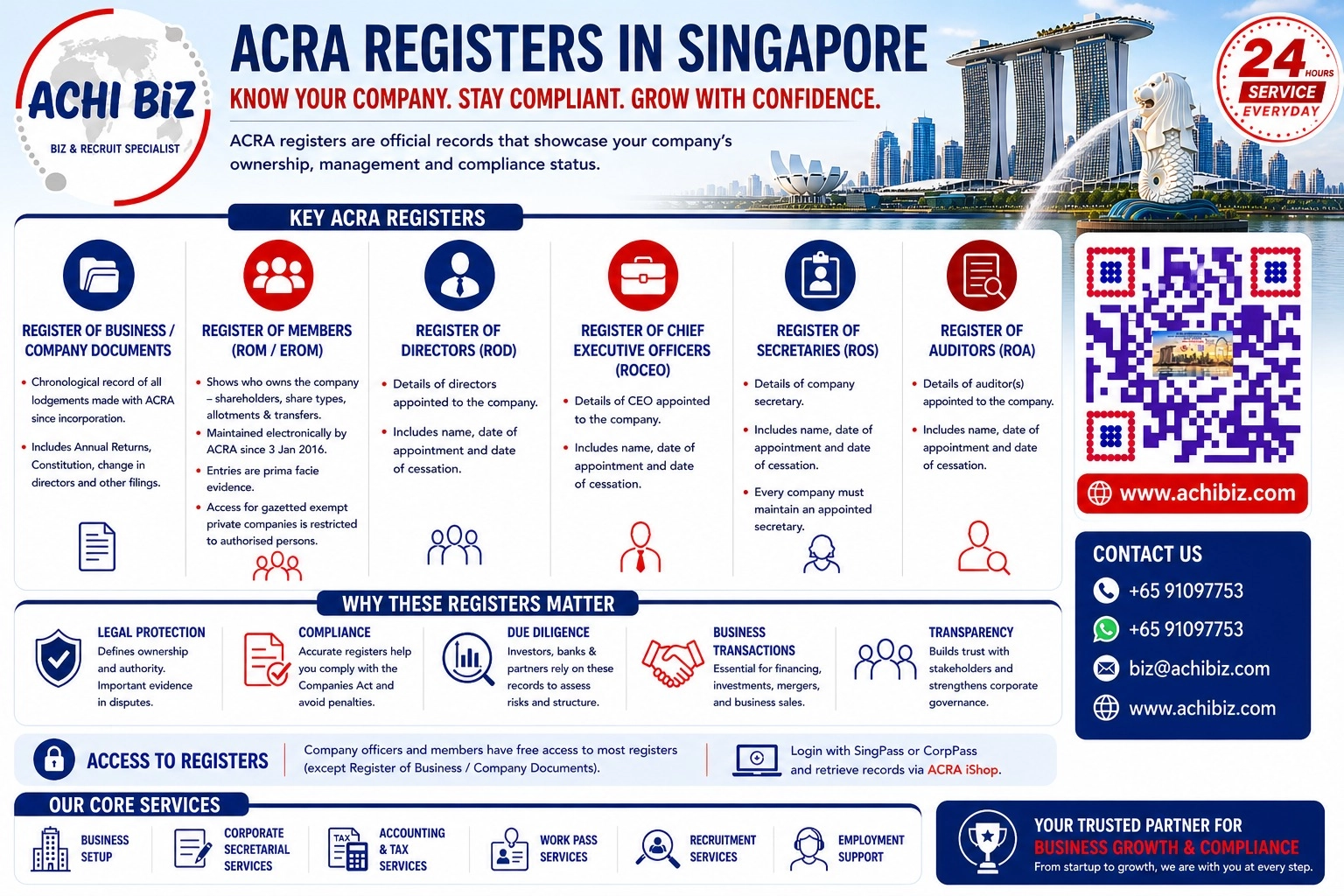
ACRA registers Singapore are official records maintained either by the company or electronically by ACRA. They give a clear picture of who owns the company, who manages it, who is responsible for compliance, and what filings have been made over time. These records are essential for Singapore company transparency requirements and are often reviewed by banks, investors, auditors, and regulators.
Register of Business / Company Documents
This is essentially your company filing history Singapore. It shows a chronological list of all documents lodged with ACRA since incorporation, including Annual Returns, the Constitution (previously Memorandum & Articles), and changes in directors or officers. It’s like a timeline of your company’s compliance journey and is often the first place people look when verifying information.
Register of Members (ROM / EROM)
The Register of Members (ROM / EROM) is one of the most important records because it shows who actually owns the company. Since 3 January 2016, ACRA maintains this electronically as the Electronic Register of Members (EROM). It includes shareholder information Singapore, the number and type of shares, and the dates of allotment or transfer. What many don’t realise is that entries in the EROM are treated as prima facie evidence, meaning they are legally accepted as correct unless proven otherwise. If the company has not submitted complete information, the EROM may show partial or incomplete data, and in such cases, you may need to approach the company directly for full records. For gazetted exempt private companies, access to the ROM is restricted to authorised persons such as directors, CEO, secretary, auditor, and members.
Register of Directors (ROD)
The Register of Directors (ROD) tells you who is managing the company. It includes director information Singapore, along with their appointment and cessation dates. It’s commonly used during due diligence, business partnerships, and regulatory checks, as it reflects the company’s management structure at any point in time.
Register of Chief Executive Officers (ROCEO)
The Register of Chief Executive Officers (ROCEO) captures details of the CEO, including the name and appointment or cessation dates. It helps identify who is responsible for the company’s day-to-day executive decisions.
Register of Secretaries (ROS)
The Register of Secretaries (ROS) records the company secretary’s details, including appointment and cessation dates. Maintaining this is essential as part of Companies Act Singapore compliance, since a company cannot operate without a secretary for more than six months.
Register of Auditors (ROA)
The Register of Auditors (ROA) records the appointed auditor, including their name and tenure. It ensures proper oversight of financial reporting and supports overall corporate governance Singapore companies.
Access to ACRA Registers
Company officers and members are entitled to free access to most registers, except for the Register of Business / Company Documents. To retrieve these records, users need to log in via SingPass or CorpPass and access them through ACRA iShop Singapore. This makes it easy to obtain up-to-date company records and compliance Singapore when required.
Why These Registers Matter More Than You Think
Many companies treat registers as routine paperwork, but they play a much bigger role. They provide legal protection by clearly defining ownership and authority, and in disputes, they often serve as the first line of evidence. They are also critical for ACRA filing requirements Singapore, as failure to maintain accurate records can lead to penalties and director liability. During due diligence Singapore company, investors, banks, and buyers rely heavily on these registers to verify ownership and assess risks. Whether you’re raising funds, applying for financing, or planning a business sale, these records will be closely reviewed.
Common Mistakes Companies Make
In practice, many companies fall short in this area. Some fail to update company registers Singapore after changes, others assume ACRA records are automatically complete, and many overlook maintaining consistent internal records. These issues usually surface at the worst possible time, such as during audits or transactions, when accuracy matters most.
Best Practices for Companies
To stay compliant, companies should maintain statutory registers Singapore properly by updating them immediately after any change and ensuring that ACRA filings are accurate and complete. Keeping proper internal records alongside ACRA records and reviewing them periodically helps maintain consistency and avoid compliance risks.
How Achibiz Can Help
Managing statutory registers requires attention to detail and a strong understanding of regulations. Achibiz provides corporate secretarial services Singapore, helping businesses maintain registers, handle filings, and stay compliant with ACRA and the Companies Act. From incorporation to ongoing compliance, Achibiz ensures your business remains structured and audit-ready.
Final Thoughts
ACRA registers Singapore are not just formal records—they form the backbone of your company’s legal and corporate structure. When managed properly, they support corporate compliance Singapore, strengthen governance, and build trust with stakeholders. Ignoring them can create serious risks, but maintaining them well can become a strong advantage for your business.
Click here to learn about RORC, ROND & RONS for Pte Ltd Companies
Click here to learn about Statutory Registers of a Singapore Pte Ltd Company
#achibiz