
Register of Registrable Controllers (RORC), Register of Nominee Directors (ROND) & Register of Nominee Shareholders (RONS) in Singapore: Full Compliance Guide for Pte Ltd Companies
If you’re running a Pte Ltd company in Singapore, you’ve probably heard about statutory registers. But three registers that are often misunderstood—or simply overlooked—are the Register of Registrable Controllers (RORC), Register of Nominee Directors (ROND), and Register of Nominee Shareholders (RONS). These are no longer just internal records. Today, they come with strict regulatory requirements, mandatory lodgement with ACRA, tight timelines, and significant penalties for non-compliance.
What Are RORC, ROND & RONS?
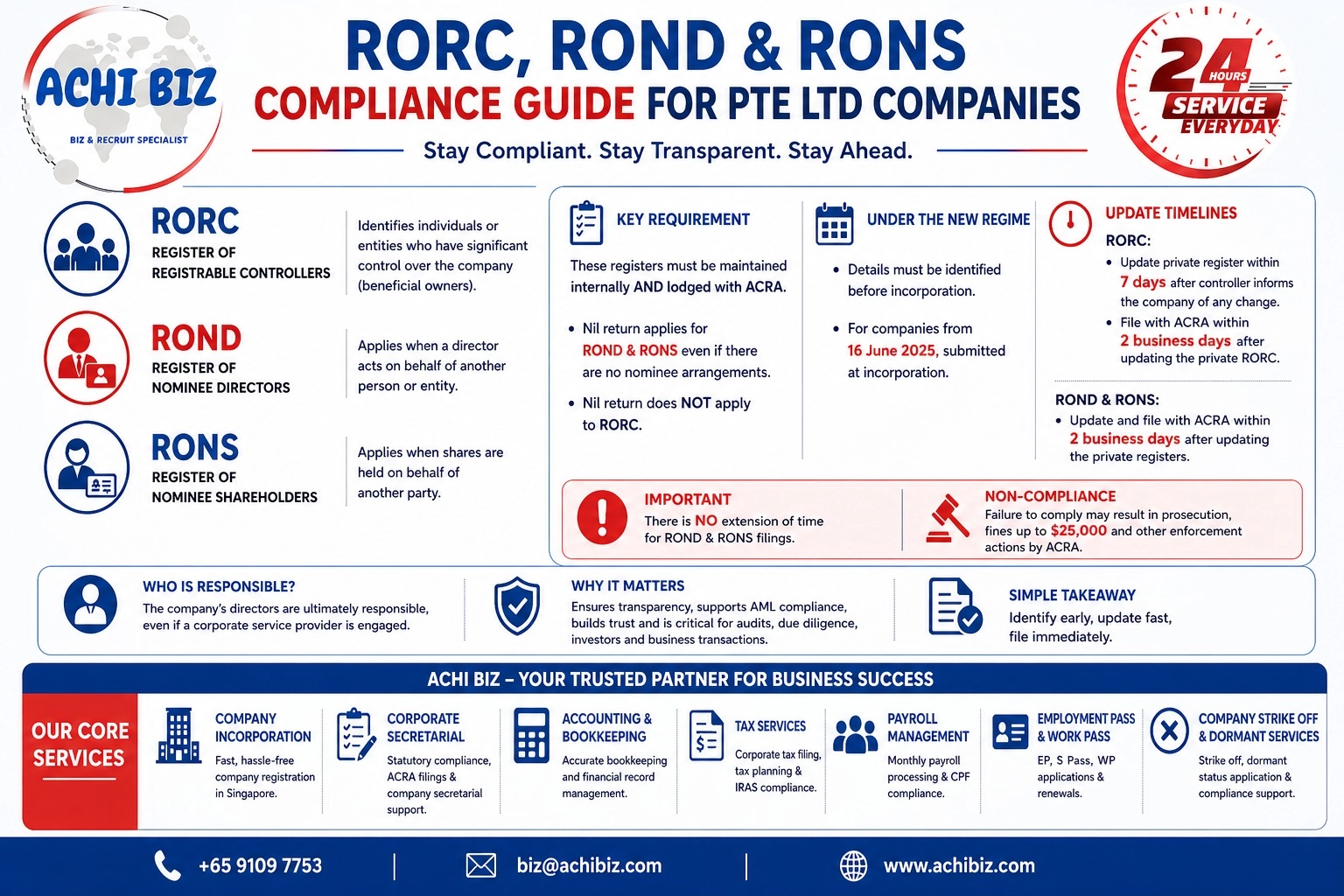
The Register of Registrable Controllers (RORC) identifies individuals or entities who have significant control over the company, commonly referred to as beneficial owners. These may include persons with substantial shareholding, voting rights, or influence over company decisions. The Register of Nominee Directors (ROND) applies when a director acts on behalf of another person or entity, capturing both the nominee director’s details and the nominator’s information. The Register of Nominee Shareholders (RONS) applies where shares are held on behalf of another party, recording both the nominee and the actual beneficial owner. All three registers are designed to ensure transparency of ownership and control.
Key Requirement: Lodgement with ACRA
Unlike many other statutory registers, these three must not only be maintained internally but also lodged with ACRA’s central register system. This means companies must both keep proper records and submit them to ACRA.
👉 For ROND and RONS, even if there is nothing to declare, a nil return must still be lodged. Many companies assume that no nominee means no action is required, but that is incorrect.
👉 For RORC, companies must properly identify and maintain their controllers, but the nil concept does not apply in the same way as ROND and RONS.
Timeline and Requirement Under the New ACRA Regime
Under the current ACRA framework, RORC, ROND, and RONS must be identified even before incorporation to ensure transparency from the start.
👉 For companies incorporated from 16 June 2025, these details are submitted directly at the point of incorporation through ACRA’s system.
For any changes after incorporation, timelines are strict. The company must update its internal registers promptly, followed by timely lodgement with ACRA. For ROND and RONS, once the internal register is updated, the company must lodge the updated information with ACRA within 2 business days.
Maintaining and Updating RORC
RORC has its own specific compliance approach.
👉 You only need to update your RORC when there are changes to your controllers’ details.
👉 Even if there are no changes, companies must send annual notices to confirm and verify the accuracy of controller information.
If there is a change, the process must follow two clear steps:
- The company must update its private RORC within 7 days after the controller informs the company of the change
- After updating the internal register, the company must lodge the update with ACRA’s Central RORC within 2 business days
👉 This two-step process is critical and must not be delayed.
Requirement for Nil Returns (ROND & RONS Only)
A key clarification many companies miss is this:
👉 Nil return requirement applies only to ROND and RONS.
Even if there are no nominee directors or nominee shareholders, companies must still lodge this status with ACRA.
👉 This requirement does not apply in the same way to RORC, although proper identification and maintenance are still mandatory.
Who Is Responsible?
Responsibility ultimately lies with the company’s directors. Even if a corporate service provider is engaged, the legal obligation does not shift. Directors must ensure that registers are properly maintained and filings are completed accurately and on time.
Key Compliance Requirements
To stay compliant, companies must identify relevant persons early, maintain accurate and updated internal registers, issue notices where required, and ensure timely lodgement with ACRA. Proper documentation must also be maintained to support the information recorded, especially for nominee arrangements and control structures.
Important Note on ROND & RONS Filings
👉 There is no option to apply for an extension of time for ROND and RONS filings.
If you fail to lodge these registers on time:
- You may face prosecution
- You may be fined up to $25,000
👉 This is a strict compliance area with very little flexibility.
Why These Registers Matter
These registers are part of Singapore’s broader effort to enhance corporate transparency and strengthen regulatory oversight. They ensure clarity in ownership and control structures, support anti-money laundering measures, and build trust in the business environment. They also become critical during audits, due diligence, investor entry, or when selling a company.
Impact of Non-Compliance
Non-compliance is taken seriously. Failure to maintain or lodge RORC, ROND, and RONS can result in penalties of up to $25,000, along with enforcement actions by ACRA. It can also lead to legal exposure for directors, reputational damage, and complications during audits or business transactions.
Common Mistakes Companies Make
Many companies fail because they do not identify these details early, assume they are not applicable, misunderstand nil requirements, miss deadlines, or forget to update ACRA after making internal changes. Others keep incomplete records or lack proper documentation for nominee arrangements. These are common but avoidable mistakes.
Best Practices for Compliance
To stay compliant, identify controllers and nominee arrangements before incorporation, maintain these registers from day one, send annual notices for RORC, review ownership and control structures regularly, update records immediately when changes occur, and ensure that updates are lodged with ACRA within the required timeframe. Keeping proper documentation and working with a professional corporate service provider can make the process much smoother.
Final Thoughts
RORC, ROND & RONS compliance in Singapore is no longer just a technical requirement—it’s a critical part of running a transparent and well-governed business. The key takeaway is simple: identify these details upfront, maintain them properly, follow the exact timelines for updates, and ensure timely lodgement with ACRA—while remembering that nil filings apply specifically to ROND and RONS. When handled correctly, it protects your company and strengthens its credibility in Singapore’s strict regulatory environment.
Click here to learn about ACRA Registers in Singapore
Click here to learn about Statutory Registers of a Singapore Pte Ltd Company
#achibiz