
Complete Guide, Compliance & Why It Matters
If you’re running a private limited company (Pte Ltd) in Singapore, maintaining your statutory registers is not optional—it’s a legal obligation under the Companies Act.
While many business owners focus on filings and operations, statutory registers are often overlooked. The problem? These records form the backbone of your company’s legal and ownership structure. If they’re not properly maintained, it can quickly become a compliance issue.
Let’s break everything down clearly.
What Are Statutory Registers?
Statutory registers are official records that a company must maintain to document key details about its:
- Ownership
- Management
- Control structure
They are part of your company’s internal compliance records and must be kept updated at all times.
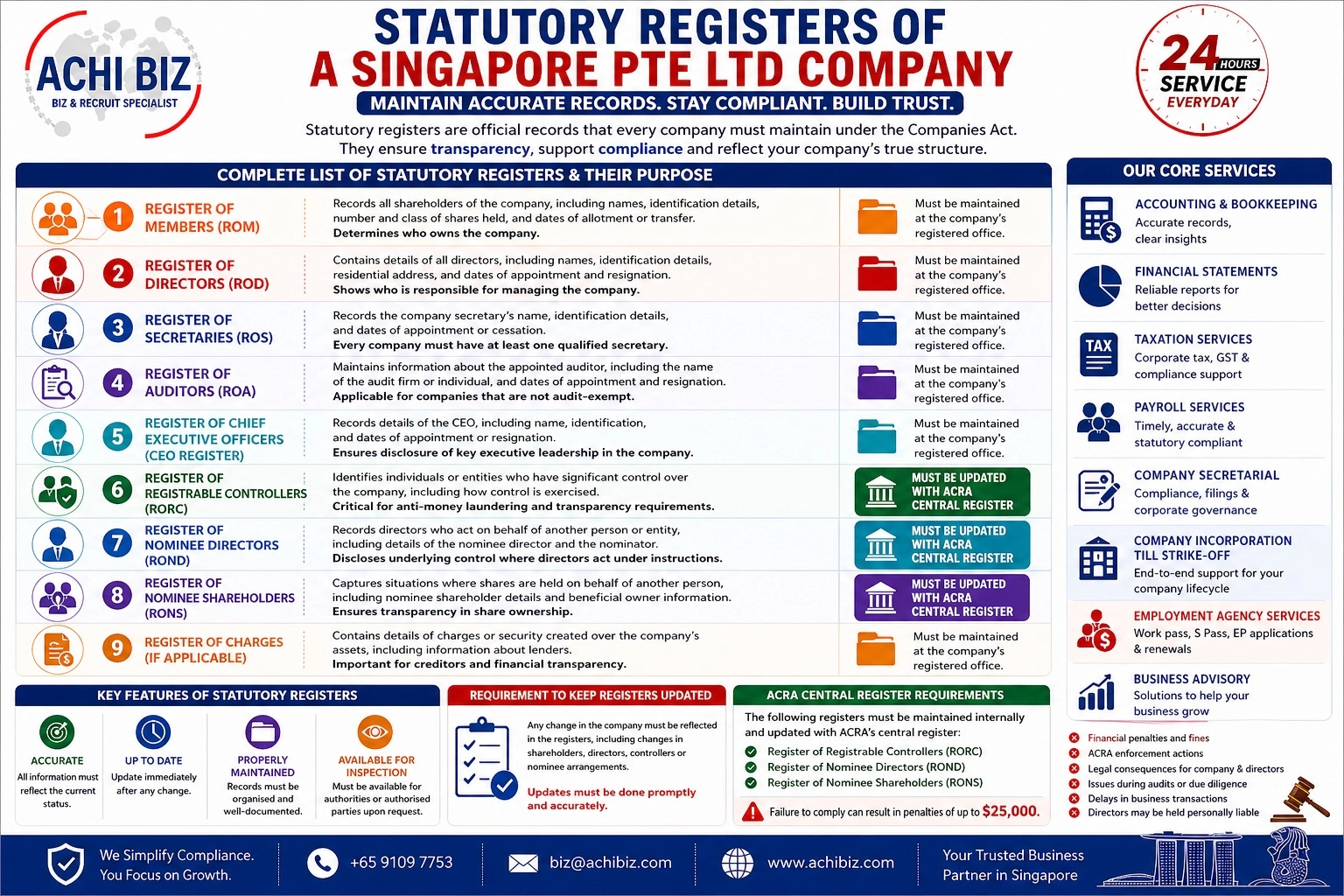
Complete List of Statutory Registers (With Detailed Description)
Register of Members (ROM)
This is one of the most important registers. It records all shareholders of the company, including:
- Names and identification details
- Number and class of shares held
- Date of allotment or transfer
👉 This register legally determines who owns the company.
Register of Directors (ROD)
This contains details of all company directors, including:
- Full name and identification details
- Residential address
- Date of appointment and resignation
👉 It ensures transparency on who is managing the company.
Register of Secretaries (ROS)
Records details of the company secretary, including:
- Name and identification details
- Date of appointment or cessation
👉 Every Singapore company must have at least one qualified secretary.
Register of Auditors (ROA)
Maintains information about the appointed auditor, such as:
- Name of audit firm or individual
- Date of appointment and resignation
👉 Applicable for companies that are not audit-exempt.
Register of Chief Executive Officers (CEO Register)
If applicable, this records details of the CEO, including:
- Name and identification
- Appointment and resignation dates
👉 Ensures disclosure of key executive leadership.
Register of Registrable Controllers (RORC)
This register identifies individuals or entities who have significant control over the company (beneficial owners), including:
- Persons with significant interest or control
- Details of how control is exercised
👉 This is critical for anti-money laundering and transparency requirements.
⚠️ Must also be updated in ACRA’s central register.
Register of Nominee Directors (ROND)
Records directors who act on behalf of another person or entity, including:
- Details of the nominee director
- Details of the nominator
👉 Helps disclose underlying control where directors are acting under instructions.
⚠️ Must be lodged with ACRA’s central register.
Register of Nominee Shareholders (RONS)
Captures situations where shares are held on behalf of another person, including:
- Nominee shareholder details
- Beneficial owner information
👉 Ensures transparency in share ownership structures.
⚠️ Must also be maintained and updated with ACRA.
Register of Charges
Applicable if the company has secured borrowings, this register includes:
- Details of charges or security created over company assets
- Information about lenders
👉 Important for creditors and financial transparency.
Key Features of Statutory Registers
Statutory registers must be:
- Accurate – Reflecting the latest company information
- Up to Date – Updated immediately after any changes
- Properly Maintained – Well-organised and documented
- Available for Inspection – When required by authorities
Requirement to Keep Registers Updated
This is where many companies fail.
👉 Any change in the company must be reflected in the registers, including:
- Changes in shareholders
- Appointment or resignation of directors
- Updates to nominee or controller information
👉 Updates must be done promptly—not months later.
ACRA Central Register Requirements (RORC, ROND & RONS)
Certain registers go beyond internal records.
👉 Companies must update ACRA’s central register for:
- RORC (Register of Registrable Controllers)
- ROND (Register of Nominee Directors)
- RONS (Register of Nominee Shareholders)
⚠️ Failure to comply can result in penalties of up to $25,000.
This is a high-risk compliance area and strictly enforced.
Why Statutory Registers Are Important
- Ensures Transparency
Clear ownership and control structure of the company.
- Supports Compliance
Required under Singapore’s Companies Act.
- Builds Trust
Banks, investors, and stakeholders rely on accurate records.
- Facilitates Due Diligence
Critical when selling a company or bringing in investors.
Impact of Non-Compliance
Ignoring statutory registers can lead to:
- Financial penalties
- Legal consequences
- ACRA enforcement actions
- Issues during audits or due diligence
- Delays in business transactions
👉 Directors may also be held personally liable.
Common Mistakes Companies Make
- Not maintaining registers at all
- Delaying updates after changes
- Confusing ACRA filings with statutory registers
- Ignoring RORC, ROND, and RONS obligations
- Poor documentation of nominee arrangements
Best Practices for Compliance
To stay compliant:
- Maintain all registers from day one
- Update immediately after any change
- Keep proper supporting documents
- Conduct regular reviews
- Engage professional support if needed
Final Thoughts
Statutory registers in Singapore Pte Ltd companies are not just paperwork—they are essential legal records that reflect your company’s structure and integrity.
The key takeaway is simple:
Properly maintaining and updating statutory registers is not just compliance—it’s a foundation for transparency, trust, and smooth business operations.
Ignore them, and risks follow. Manage them well, and your company stays protected and credible.
FAQ on Registrable Controllers (RORC)
Click here to learn about RORC, ROND & RONS for Pte Ltd Companies
#achibiz