
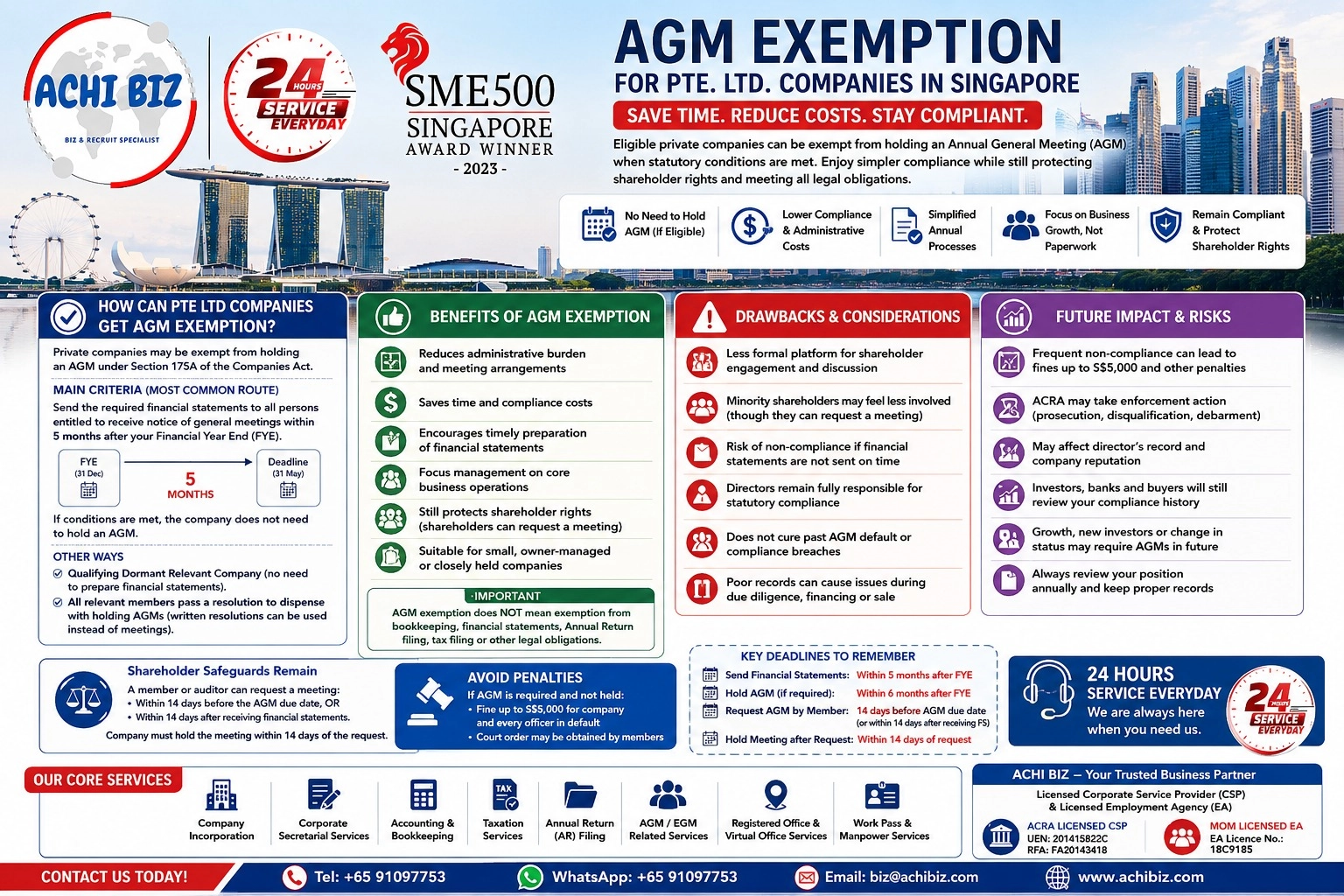
AGM Exemption for Singapore Pte. Ltd. Companies: Eligibility, Criteria, Benefits, Drawbacks and Future Impact
For many owners and directors of a Singapore Private Limited (Pte. Ltd.) company, the Annual General Meeting (AGM) is often understood as an unavoidable yearly corporate exercise. That is no longer necessarily the case.
Under Singapore’s Companies Act 1967, a private company may be exempt from holding an AGM when the statutory conditions are satisfied. A private company may also separately choose to dispense with holding AGMs through the prescribed members’ resolution process. These are related but legally distinct routes.
AGM exemption can reduce unnecessary administrative work, particularly for owner-managed companies and companies with only a few shareholders. However, it does not mean that the company is exempt from maintaining accounting records, preparing financial statements where required, filing its Annual Return, complying with corporate tax obligations or observing other statutory requirements.
This FAQ guide examines AGM exemption for Pte. Ltd. companies in Singapore, including eligibility, financial statement requirements, shareholder rights, advantages, disadvantages, compliance risks and possible future consequences.
Frequently Asked Questions About AGM Exemption in Singapore
What is an Annual General Meeting (AGM) in Singapore?
An AGM is an annual meeting at which a company presents its financial statements to shareholders and gives shareholders an opportunity to consider the company’s financial position, ask questions and address relevant concerns.
Unless an exemption or other permitted arrangement applies, a non-listed Singapore company must generally hold its AGM within six months after its financial year end (FYE).
Is an AGM compulsory for every Singapore Pte. Ltd. company?
No.
Private companies can skip holding an AGM if they qualify for an exemption under the Companies Act or validly dispense with holding AGMs.
This distinction is important because “AGM exemption” and “dispensing with AGM” should not be treated as exactly the same thing.
What is AGM exemption for a Singapore private company?
Under section 175A of the Companies Act, a private company need not hold an AGM for a financial year in specified circumstances.
One of the most commonly relevant routes is where the company sends the required financial statements to all persons entitled to receive notice of general meetings within five months after the FYE.
What are the main ways a private company can avoid holding an AGM?
Broadly, a private company may not need to hold an AGM where:
- it qualifies for the statutory exemption by sending the required financial statements to members within the prescribed period;
- it is a qualifying dormant relevant company exempt from the relevant financial statement requirements; or
- all relevant members pass the required resolution to dispense with holding AGMs.
These routes have different requirements and should not be confused.
What is the most common AGM exemption criterion for an active Pte. Ltd. company?
For an ordinary active private company, the practical route is generally to ensure that the required financial statements are properly prepared and sent to all persons entitled to receive notice of general meetings within five months after the company’s FYE.
If the statutory conditions are met, the private company does not need to physically convene an AGM merely to present those accounts.
Does a company need to apply to ACRA every year for AGM exemption?
The statutory exemption under section 175A is based on satisfying the applicable conditions; it should not be confused with an individual discretionary application to ACRA seeking permission each year.
The company’s compliance position must nevertheless be correctly reflected when its Annual Return is filed.
ACRA requires companies to declare AGM information in the Annual Return whether an AGM was held, the company was exempt, or it had dispensed with holding AGMs.
Does AGM exemption mean the company no longer needs financial statements?
Generally, no.
This is one of the biggest misconceptions surrounding AGM exemption.
All Singapore-incorporated companies generally have to prepare financial statements except qualifying dormant relevant companies. The AGM exemption for an ordinary private company is actually linked to sending the required financial statements to the relevant persons within the prescribed period.
When must financial statements be sent to members for AGM exemption?
For the commonly used exemption route, they must be sent to the persons entitled to receive notice of general meetings within five months after the FYE.
For example, if a company’s FYE is 31 December, the relevant five-month period ordinarily ends on 31 May of the following year.
Why is the five-month financial statement deadline so important?
Because merely being a private company does not mean management can decide at the end of six months that it does not want to conduct an AGM.
The company needs to satisfy the statutory conditions for the exemption.
If it relies on the financial-statement route, timely preparation and circulation of those statements becomes critical.
Does AGM exemption mean there is no deadline six months after FYE?
No.
The six-month AGM timeline remains important because shareholders retain statutory safeguards, including the ability in specified circumstances to require an AGM.
A member may request an AGM no later than 14 days before the date by which the AGM would otherwise have been required to be held.
Can a shareholder still demand an AGM even when the company qualifies for exemption?
Yes.
AGM exemption does not remove shareholders’ statutory rights.
Where a member makes a valid request within the prescribed period, the company must hold an AGM within six months after its FYE, subject to any applicable extension arrangements.
Can a shareholder request a meeting after receiving the financial statements?
Yes.
ACRA states that a member or auditor can request a general meeting after receiving the financial statements. The request must be made within 14 days after receiving the financial statements, and the company must hold the general meeting within 14 days after the request.
This safeguard prevents AGM exemption from being used to shut shareholders out of meaningful discussion about the company’s accounts.
Is AGM exemption the same as passing a resolution to dispense with AGMs?
No.
They are separate mechanisms.
A private company can be exempt from holding an AGM when the statutory exemption requirements are satisfied.
Separately, private companies may choose to dispense with AGMs where all relevant members approve the required resolution. The company can then handle matters that would ordinarily be dealt with at the AGM through written resolutions.
What does “dispensing with AGM” mean?
It means the shareholders have formally agreed, through the statutory resolution mechanism, that the company need not hold annual general meetings.
The resolution continues to have effect for the year in which it is made and subsequent years, subject to the Companies Act and shareholders’ rights.
Does a resolution dispensing with AGMs cure previous AGM defaults?
No.
Section 175A specifically provides that the resolution does not affect liabilities already incurred because of a previous failure to hold an AGM.
A company therefore cannot retrospectively erase an old compliance breach simply by passing an AGM-dispensation resolution today.
Which route is better: AGM exemption or dispensing with AGMs?
It depends on the company’s circumstances.
For a straightforward private company that prepares and circulates its financial statements promptly every year, statutory AGM exemption can be convenient.
A company with stable shareholders who unanimously prefer not to conduct AGMs may consider formally dispensing with AGMs.
The correct approach should be determined from the company’s constitution, shareholder structure and compliance circumstances rather than selecting an option purely for convenience.
Is AGM exemption available only to Exempt Private Companies (EPCs)?
No.
The terminology causes considerable confusion.
An Exempt Private Company (EPC) is a particular company classification. Exemption from holding an AGM is a separate Companies Act concept.
A company should therefore not assume that only EPCs can benefit from the AGM exemption provisions.
Is AGM exemption the same as audit exemption?
No.
These are entirely different compliance concepts.
AGM exemption concerns whether the company needs to hold an annual shareholders’ meeting.
Audit exemption concerns whether the company’s financial statements need to be audited.
For example, ACRA’s small-company audit exemption has separate eligibility tests, including quantitative criteria relating to revenue, assets and employees.
A company may therefore be exempt from holding an AGM without necessarily being exempt from audit, and vice versa.
Is AGM exemption the same as exemption from filing financial statements with ACRA?
No.
Again, these are separate requirements.
ACRA states that Singapore-incorporated companies generally must prepare financial statements, while certain companies may be exempt from filing them with ACRA.
Whether an AGM must be held does not by itself determine whether financial statements must be prepared, audited or filed.
Is AGM exemption the same as Annual Return exemption?
No.
A company exempt from holding an AGM must still comply with its Annual Return (AR) filing obligations.
ACRA specifically requires AGM information to be completed during Annual Return filing even where the company was exempt from holding the meeting.
What AGM information is declared when filing the Annual Return?
When filing the Annual Return, the appropriate AGM status must be selected.
For a company relying on AGM exemption, ACRA’s filing process requires the date on which the financial statements were sent to members to be entered.
This is another reason proper documentary records of financial statement circulation should be maintained.
What documents should a company retain to support its AGM exemption?
Good corporate governance would normally include retaining evidence such as:
- final financial statements;
- directors’ approvals where applicable;
- records showing when financial statements were sent;
- details of recipients;
- relevant emails or electronic delivery records;
- shareholder resolutions;
- records concerning requests for meetings; and
- Annual Return filing records.
These documents can help demonstrate that the company actually satisfied the statutory conditions it relied upon.
Can financial statements simply be prepared after the deadline and backdated?
No.
Companies should never attempt to manufacture compliance retrospectively.
If the company is relying on the statutory exemption because financial statements were sent within the required period, the actual circulation needs to have occurred in accordance with the law.
False or misleading corporate records can create much more serious problems than simply dealing properly with an overdue AGM.
What are the main benefits of AGM exemption?
For an eligible private company, the advantages can include reduced administrative work, fewer formal meeting arrangements, lower compliance costs and less paperwork.
It can be especially useful for:
single-shareholder companies, family-owned companies, closely held SMEs, owner-managed businesses and foreign-owned Singapore subsidiaries with straightforward shareholder structures.
Can AGM exemption reduce corporate compliance costs?
Potentially, yes.
If a physical or formal AGM provides little practical value to a small company with one shareholder or a few closely connected shareholders, removing the requirement to convene that meeting can save administrative time and related costs.
However, companies should not confuse reduced meeting formalities with reduced accounting or filing responsibilities.
Does AGM exemption make year-end compliance easier?
It can streamline one element of the process.
A well-organised exempt company may follow a workflow such as:
FYE → Complete Bookkeeping → Reconcile Accounts → Prepare Financial Statements → Directors’ Review → Send Financial Statements to Members Within Deadline → Complete Tax Compliance → File Annual Return.
The AGM itself may disappear from the workflow, but the underlying financial reporting and statutory compliance work remains.
Can AGM exemption encourage companies to prepare their financial statements earlier?
Yes, and this is an important indirect benefit.
Because the commonly used exemption is tied to sending financial statements within five months after FYE, companies have an incentive to close their accounts, complete reconciliations and prepare their financial statements promptly.
That can also improve management reporting and facilitate subsequent corporate tax work.
Is AGM exemption particularly useful for a one-shareholder company?
Often, yes.
Where the sole director/shareholder already has complete knowledge of the company’s operations, conducting a formal annual meeting with oneself may add limited practical value.
The exemption framework can therefore reduce unnecessary formality while preserving financial reporting and filing obligations.
What about companies with several unrelated shareholders?
The analysis becomes more nuanced.
An AGM can provide genuine governance value where several shareholders have different interests.
It gives shareholders a structured opportunity to review financial statements, question management and discuss company matters.
For such companies, avoiding the AGM solely to save administrative time may not always be the best governance decision.
What are the disadvantages of AGM exemption?
The main drawback is the loss of a regular formal forum for shareholder engagement.
Potential disadvantages include:
- fewer structured discussions between shareholders and directors;
- reduced opportunity for shareholders to question management collectively;
- less formal review of financial performance;
- possible communication gaps;
- disputes over whether shareholders received financial statements; and
- misunderstanding among directors who assume exemption removes other compliance obligations.
Can AGM exemption weaken corporate governance?
Potentially, particularly in companies with multiple shareholders.
An AGM can serve as a useful governance checkpoint.
For an owner-managed company with one shareholder, that benefit may be minimal. For a company with numerous independent investors, it may be significant.
Therefore, legal eligibility and good corporate governance are not always the same question.
Does AGM exemption reduce directors’ responsibilities?
No.
Directors remain responsible for complying with the Companies Act and their broader statutory duties.
Skipping an AGM does not allow directors to ignore accounting records, financial statements, shareholder rights, Annual Returns or other corporate obligations.
Can AGM exemption affect minority shareholders?
It can change the normal interaction between minority shareholders and management because there is no automatic annual meeting.
This is precisely why the Companies Act retains safeguards allowing members to request meetings in specified circumstances.
Can the auditor request a meeting even when the company does not hold an AGM?
Yes, in the circumstances specified by the Companies Act and ACRA guidance.
ACRA states that a member or auditor may request a general meeting within 14 days after receiving the financial statements.
Can an AGM-exempt company still voluntarily hold an AGM?
The exemption removes the obligation to hold the AGM when its requirements are satisfied; it does not mean shareholder meetings become prohibited.
Where there are important matters to discuss, a company may still decide that holding an appropriate meeting is commercially or administratively useful.
What happens if the company fails to qualify for AGM exemption but does not hold an AGM?
That can amount to non-compliance.
Under section 175 of the Companies Act, where the AGM requirement applies and is breached, the company and every officer in default may be guilty of an offence and liable on conviction to a fine of up to S$5,000, together with a default penalty. A member may also apply to the Court for an order requiring a general meeting to be called.
ACRA also warns that AGM non-compliance can result in enforcement measures, including prosecution and consequences for directors.
Can repeated AGM non-compliance affect directors in the future?
Yes.
Repeated corporate compliance failures should not be regarded simply as an administrative inconvenience.
ACRA identifies possible enforcement consequences relating to AGM non-compliance, including prosecution, disqualification and debarment in applicable circumstances.
Does AGM exemption improve a company’s compliance history?
AGM exemption itself does not provide a special positive rating or compliance advantage.
The benefit comes from correctly using the exemption and continuing to meet all remaining obligations on time.
Conversely, incorrectly declaring an exemption when the conditions were not satisfied can create a compliance problem.
Will AGM exemption affect future bank financing?
Normally, the fact that a company lawfully did not hold an AGM should not by itself be treated as financial weakness.
Banks and lenders are more likely to be concerned with financial statements, profitability, cash flow, liabilities, creditworthiness, business performance and supporting documentation.
However, poor underlying record keeping merely hidden behind an AGM exemption can obviously create difficulties.
Can AGM exemption affect investors or due diligence during a future share sale?
The exemption itself is lawful and should not be problematic where properly used.
During due diligence, however, a potential investor or purchaser may examine whether:
- the company was actually eligible;
- financial statements were circulated on time;
- Annual Returns were properly filed;
- shareholder rights were respected; and
- corporate records are complete.
Good documentation therefore remains important even when no AGM was held.
Can incorrect AGM exemption declarations create problems during due diligence?
Yes.
A future buyer, investor, lawyer, auditor or professional adviser reviewing the company’s corporate history may identify discrepancies between financial statement dates, Annual Return declarations and corporate records.
Compliance shortcuts that appear insignificant today can become inconvenient during fundraising, restructuring, financing or sale of the business.
Does AGM exemption affect corporate income tax filing with IRAS?
Not directly.
Corporate income tax obligations are separate from whether an AGM was held.
The company must still maintain proper accounts and comply with applicable IRAS filing requirements.
Does AGM exemption affect ECI filing?
No automatic exemption from Estimated Chargeable Income arises merely because the company is exempt from holding an AGM.
Tax compliance should be considered separately from Companies Act AGM requirements.
Does AGM exemption change the company’s Financial Year End?
No.
The FYE remains the reference point for determining various accounting, corporate and tax deadlines.
AGM exemption changes whether the meeting needs to be held; it does not itself change the FYE.
Can a newly incorporated Pte. Ltd. company qualify for AGM exemption?
Yes, provided the applicable statutory requirements are met.
Being newly incorporated does not by itself prevent a private company from relying on the exemption.
The company’s first FYE should nevertheless be established carefully because multiple compliance deadlines flow from it.
Can a foreign-owned Singapore Pte. Ltd. company qualify?
Yes.
AGM exemption is not restricted to Singapore-owned companies.
A foreign-owned Singapore private company may qualify if it satisfies the relevant Companies Act requirements.
This can be particularly convenient for foreign shareholders who would otherwise need to coordinate annual corporate formalities from overseas.
Does having a foreign director affect AGM exemption?
Not by itself.
The important questions concern the company’s legal status and whether the relevant statutory conditions are met, rather than the director’s nationality.
Can a company with a corporate shareholder qualify?
Potentially, yes.
Having a corporate shareholder does not automatically disqualify a private company from AGM exemption.
However, the company’s overall corporate structure and specific circumstances should be checked before relying on an exemption.
Does the company’s constitution matter?
Yes.
The Companies Act provides the statutory framework, but the company’s constitution should also be reviewed where relevant.
Companies should not assume that one generic compliance approach is suitable for every corporate structure.
Should directors formally document their decision to rely on AGM exemption?
Maintaining clear corporate records is advisable.
The company should be able to demonstrate why no AGM was held and which statutory basis applied.
This is particularly useful when corporate secretaries, auditors, banks, investors or future professional advisers subsequently review the company’s records.
Can a company alternate between holding an AGM and relying on exemption?
Depending on the statutory route and circumstances, a company may not necessarily follow the same practical approach forever.
However, each financial year’s compliance must be assessed properly, particularly where the company is relying on the financial-statement circulation exemption.
What if a company qualifies this year but not next year?
It should assess its position for the relevant financial year rather than assuming that previous exemption automatically determines future compliance.
Changes in company status, shareholder circumstances or failure to meet statutory timelines may alter the position.
Does AGM exemption mean written resolutions are unnecessary?
No.
Corporate decisions may still require directors’ or shareholders’ resolutions depending on the matter concerned.
AGM exemption removes the requirement to hold the annual meeting when the statutory conditions are satisfied. It does not abolish corporate decision-making procedures.
Can dividends still be dealt with if there is no AGM?
The absence of an AGM does not prevent a company from dealing with dividends through legally appropriate corporate procedures.
However, dividend decisions must still comply with the Companies Act, the company’s constitution and applicable financial requirements.
Can directors’ fees still be dealt with without an AGM?
Potentially, but the appropriate approval mechanism should be determined from the Companies Act and the company’s constitution.
AGM exemption should never be interpreted as blanket authority for directors to approve matters that otherwise require shareholder approval.
What happens if financial statements cannot be completed within five months after FYE?
If the company cannot satisfy the conditions of the relevant AGM exemption route, it should not simply assume that no AGM is required.
The company should review whether another lawful route applies and whether an AGM must be held.
Where an extension is genuinely required, ACRA provides a process for applying for an extension of time to hold an AGM.
Can a company apply for an extension of time for an AGM?
Yes.
ACRA provides an extension-of-time process where a company cannot meet its AGM deadline. ACRA’s current guidance refers to an extension of up to 60 days.
An extension is different from an exemption: one postpones a deadline; the other removes the requirement to hold the AGM when statutory conditions are satisfied.
Is AGM exemption permanent?
Not necessarily.
The company’s circumstances and the legal requirements applicable to each financial year need to be considered.
A company should never treat “AGM exempt” as a permanent label that eliminates future compliance reviews.
What is the future impact if a company grows substantially?
Growth can change the practical value of holding shareholder meetings.
A small owner-managed company may initially find AGMs unnecessary. Later, it may bring in investors, institutional shareholders, new directors or more complex financing arrangements.
At that point, formal annual shareholder engagement may become beneficial even where the law still provides mechanisms to avoid an AGM.
What happens if a private company later becomes a public company?
The private-company AGM exemption regime cannot simply be assumed to continue.
Section 175A’s exemption routes discussed here specifically concern private companies.
A change in company status should therefore trigger a fresh compliance review.
Should a company choose AGM exemption purely to save money?
No.
Cost saving is a legitimate benefit, but it should not be the only consideration.
Directors should consider:
shareholder structure, financial reporting readiness, governance needs, minority shareholder interests, investor expectations, future fundraising plans and administrative efficiency.
For a one-shareholder SME, AGM exemption may be entirely logical. For a company with several unrelated shareholders, an annual meeting may still provide meaningful value.
What is the biggest misconception about AGM exemption in Singapore?
Probably this:
“If my company is AGM-exempt, there is nothing to do after the financial year end.”
That is incorrect.
The company may still need bookkeeping, account reconciliation, financial statements, tax computation, ECI and corporate tax filing, financial statement circulation, Annual Return filing and other statutory compliance work.
Only the requirement to hold the AGM is removed when the applicable conditions are satisfied.
What is a sensible annual compliance workflow for an AGM-exempt Pte. Ltd. company?
A well-managed company should coordinate the entire process rather than treating each deadline separately:
Financial Year End → Complete Bookkeeping → Reconcile Accounts → Prepare Management Reports → Prepare Financial Statements → Directors Review → Circulate Financial Statements Within the Applicable Deadline → Complete Corporate Tax Requirements → File Annual Return → Maintain Supporting Corporate Records.
This approach makes AGM exemption part of a broader compliance system rather than an isolated checkbox.
Should companies obtain professional advice before relying on AGM exemption?
It can be worthwhile, particularly where there are multiple shareholders, foreign corporate shareholders, unusual constitutional provisions, outstanding compliance defaults, incomplete financial statements or uncertainty about which exemption route applies.
A Corporate Service Provider can also help coordinate the exemption position with financial statement circulation and Annual Return filing.
How can ACHI BIZ assist with AGM exemption and corporate compliance in Singapore?
ACHI BIZ SERVICES PTE. LTD. can assist eligible Singapore companies with AGM-related compliance as part of its corporate services, including assessing the applicable AGM position, coordinating relevant corporate documentation, financial statement-related timelines and Annual Return filing with ACRA.
The broader objective should not simply be to “avoid an AGM”, but to ensure that the company uses the correct statutory route and that its remaining compliance requirements continue to be completed properly and on time.
ACHI BIZ also provides company incorporation, corporate secretarial services, bookkeeping and accounting, taxation services, registered office/virtual office services and applicable employment agency/work pass services.
Conclusion: Is AGM Exemption Beneficial for a Singapore Pte. Ltd. Company?
For many small and closely held Singapore Pte. Ltd. companies, AGM exemption can significantly simplify annual corporate administration.
Its greatest value is eliminating a meeting that may add little practical benefit while retaining the safeguards that matter: timely financial reporting, shareholder access to information and shareholders’ ability to request a meeting.
However, AGM exemption should never be confused with exemption from financial statements, accounting, Annual Returns, corporate tax or directors’ responsibilities.
The most effective approach is therefore:
Use AGM exemption where legally available and commercially sensible—but maintain the same discipline over accounting, financial reporting, shareholder communication and statutory compliance as if an AGM were being held.
For owner-managed and closely held Pte. Ltd. companies, this can provide the right balance between reduced administrative burden and proper corporate governance.
Related pages:
Annual General Meeting (AGM) for Pte Ltd Companies
Dormant Pte Ltd Company in Singapore: ACRA, Audit Exemption, FS Exemption & IRAS Criteria Explained
#achibiz