
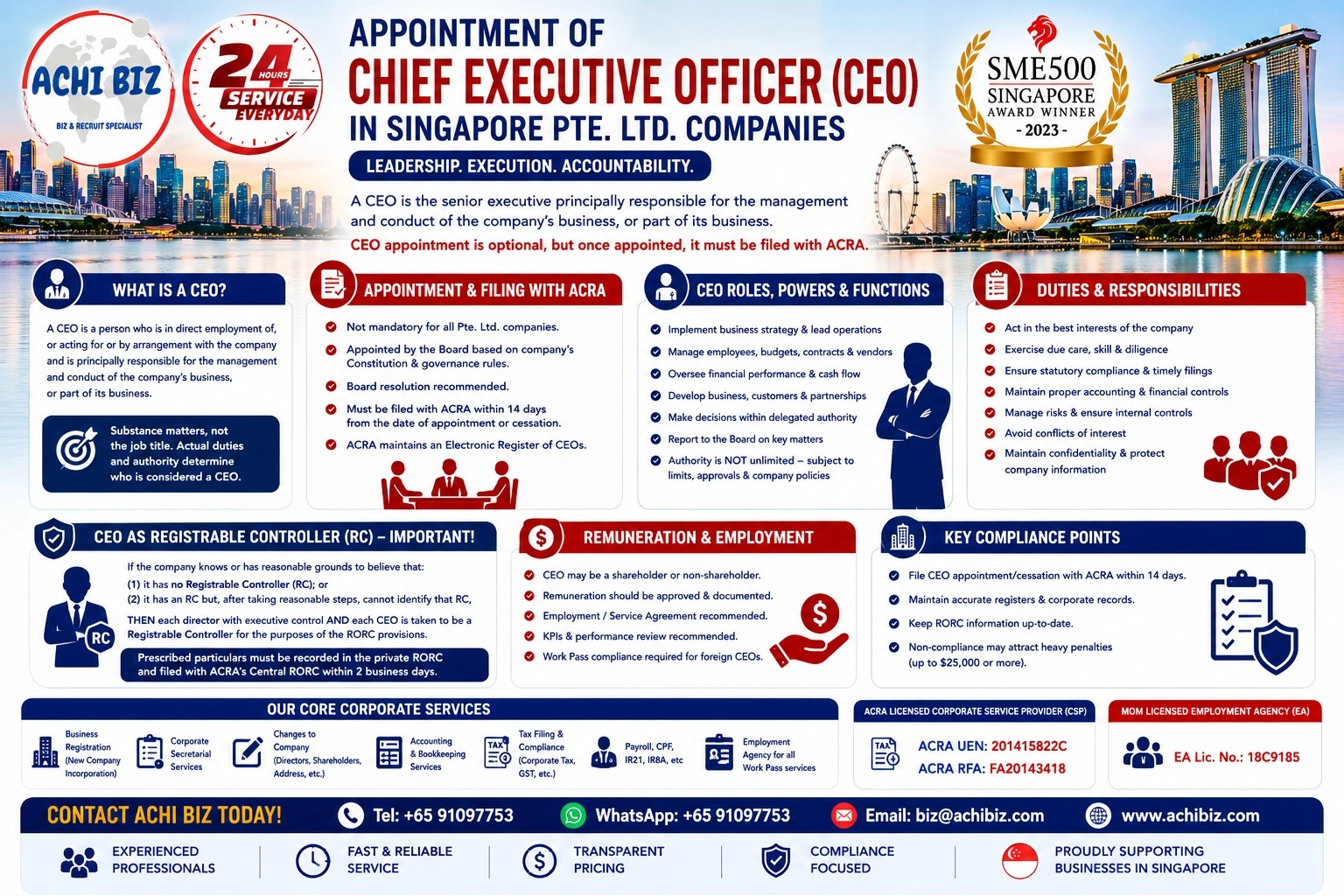
Appointment of Chief Executive Officer (CEO) in Pte Ltd Company – FAQ Guide
The Chief Executive Officer (CEO) of a Singapore Private Limited (Pte. Ltd.) company is generally the senior executive principally responsible for managing and conducting the company’s business, or part of its business. A CEO can therefore occupy a highly influential position in the company’s operational leadership, strategy execution, financial management, employees, commercial relationships and overall performance.
However, a Singapore Pte. Ltd. company is not generally required to appoint a CEO. ACRA states that a company can appoint a CEO to run the business. Importantly, once a CEO is appointed, the CEO is a reportable position holder and the appointment must be filed with ACRA.
There is another important compliance aspect that companies sometimes overlook. Under Singapore’s Register of Registrable Controllers (RORC) regime, if a company knows or has reasonable grounds to believe that it has no registrable controller, or it has a registrable controller but cannot identify that controller after taking the required reasonable steps, each director with executive control and each CEO is taken to be a registrable controller for the purposes of the RORC provisions. Their prescribed particulars must then be recorded in the private RORC and filed with ACRA’s Central RORC.
This FAQ examines the appointment, registration, authority, rights, functions, duties, responsibilities, remuneration, governance, RORC implications and risks of appointing a CEO in a Singapore Pte. Ltd. company.
What is a Chief Executive Officer (CEO) under Singapore company law?
The Companies Act 1967 does not determine whether someone is a CEO merely by looking at the person’s job title.
Under the statutory definition, a chief executive officer, in relation to a company, means one or more persons, by whatever name described, who:
- is in direct employment of, or acting for or by arrangement with, the company; and
- is principally responsible for the management and conduct of the company’s business, or part of its business.
This means substance matters, not merely the title printed on a business card or employment contract.
Can a company have more than one person falling within the definition of CEO?
Potentially, yes.
The Companies Act definition refers to “any one or more persons” who satisfy the relevant conditions. It also contemplates responsibility for the company’s business or part of the business.
Companies should therefore look at the person’s actual responsibilities and authority rather than assuming that only someone formally carrying the title “CEO” can ever fall within the statutory definition.
Is appointing a CEO compulsory for a Singapore Pte. Ltd. company?
Generally, no.
ACRA states that a company can appoint a CEO to run the business. Unlike the mandatory requirement to have at least one director and a company secretary within the applicable timeframe, there is no general requirement for every ordinary Singapore Pte. Ltd. company to appoint a CEO.
Whether a CEO is appropriate is therefore primarily a business, management and governance decision.
Must a CEO be appointed as a director before becoming CEO of a Singapore Pte. Ltd. company?
No. A person does not need to be appointed as a director before being appointed as the Chief Executive Officer (CEO) of a Singapore private limited company.
The positions of director and CEO are separate appointments. A CEO is generally the person principally responsible for managing and conducting the company’s business, or part of its business. Therefore, a CEO may be:
- a CEO without being a director; or
- a director who also holds the position of CEO.
Unlike the statutory requirement for a Singapore company to have at least one director who is ordinarily resident in Singapore, appointing a CEO is not compulsory. However, once a company appoints a CEO, the company must comply with the applicable ACRA registration and filing requirements for that appointment.
Whether the CEO should additionally be appointed as a director depends on the company’s governance structure, constitution, operational requirements and the level of board authority the company intends to give that individual. Appointment as CEO by itself does not automatically make the person a director or give the CEO all the statutory powers and responsibilities of a company director.
In short: Director appointment → CEO appointment is not a compulsory sequence. A person can be appointed directly as CEO without first becoming a director.
When should a Singapore company consider appointing a CEO?
A CEO becomes particularly useful when the business requires clearly defined executive leadership.
For example, appointment may be appropriate where the company has grown substantially, employs multiple management teams, operates several business divisions, has significant commercial operations, requires centralised executive accountability, is expanding internationally, has external investors or needs one senior executive to coordinate implementation of the company’s business strategy.
For a very small owner-managed company, creating a separate CEO position may not always provide meaningful additional value.
Why is the CEO position important in a growing Pte. Ltd. company?
As a company grows, operational decisions become increasingly complex.
A clearly defined CEO can provide a central point of accountability for business performance, implementation of strategy, management coordination, budgets, employees, commercial development and risk management.
The position can also create a clearer reporting structure between the company’s governing body and its operational management.
Who appoints the CEO of a Singapore Pte. Ltd. company?
The company should first review its Constitution, shareholders’ agreement where applicable, existing governance arrangements and internal approval procedures.
In many companies, the appointment will be authorised through the Board.
The company should not simply give someone the CEO title informally without documenting the appointment, because the CEO is a recognised position holder whose particulars must be maintained and reported to ACRA.
Should the company’s Constitution be checked before appointing a CEO?
Yes.
The Constitution should be reviewed to determine whether it contains provisions affecting executive appointments, delegation of powers, remuneration, reserved matters or approval procedures.
Where shareholders have entered into a shareholders’ agreement, that agreement should also be reviewed for provisions concerning senior executive appointments.
The CEO’s authority should be consistent with the company’s overall governance structure.
Should the CEO appointment be approved by a Board resolution?
Proper corporate documentation is strongly advisable.
The resolution can record the identity of the CEO, effective appointment date, authority, responsibilities, reporting arrangements, remuneration or reference to the relevant service agreement, and any limits imposed on executive authority.
Clear documentation becomes especially important where disputes later arise over whether the CEO was authorised to enter into a particular transaction.
Does the appointment of a CEO need to be filed with ACRA?
Yes.
This is an important compliance requirement.
ACRA states that if a company appoints a CEO, the CEO’s details must be filed with ACRA. The CEO is also included among the position holders whose appointment or withdrawal must be reported.
How soon must the appointment of a CEO be filed with ACRA?
The company must notify ACRA of the appointment within 14 days from the date of the change.
The same 14-day requirement generally applies when the CEO subsequently withdraws from the position or when reportable position-holder information changes.
Does ACRA maintain an Electronic Register of CEOs?
Yes.
ACRA identifies an Electronic Register of CEOs for companies where a CEO has been appointed.
When relevant position-holder changes are properly filed through Bizfile, the corresponding electronic register is updated.
What happens if the company fails to notify ACRA about a CEO change?
Failure to report changes to key officers, including the CEO, can constitute an offence.
ACRA states that changes involving a director, CEO, secretary or auditor must generally be notified within 14 days. Failure to do so can attract a fine of up to $5,000, plus applicable default penalties for each officer in default.
Timely filing should therefore form part of the company’s internal appointment and cessation procedures.
Does a CEO have to be a shareholder?
No.
Share ownership and appointment as CEO are separate matters.
A company may appoint an appropriate individual to lead its business without requiring that person to own shares, subject to the company’s governance arrangements and contractual terms.
Can a shareholder be appointed as CEO?
Yes, if properly appointed.
Being a shareholder does not prevent an individual from taking an executive management role.
However, the person’s rights as a shareholder and authority as CEO arise from different legal and corporate capacities and should not be confused.
Does a CEO have to be a director?
Not necessarily.
The statutory definition of CEO focuses on the person’s employment or arrangement with the company and principal responsibility for management and conduct of the business. It does not state that the CEO must also be a director.
Accordingly, a person can potentially hold the CEO position without being appointed to the Board.
Can the sole shareholder appoint another person as CEO?
Potentially, yes, subject to proper corporate approval and governance arrangements.
The ownership of all shares by one person does not prevent the company from employing or appointing another suitable individual to manage its business.
Can a foreigner be appointed CEO of a Singapore Pte. Ltd. company?
Potentially, yes, but corporate appointment and immigration/work authorisation are separate matters.
If the foreign individual will be working in Singapore, the company and individual must consider the applicable MOM work pass and immigration requirements.
A corporate title or ACRA appointment does not by itself provide permission to work in Singapore.
Can an Employment Pass holder become CEO?
Potentially, provided the employment and appointment are consistent with the individual’s valid work authorisation and applicable MOM requirements.
Companies should ensure that the actual role, employing entity and work-pass conditions remain properly aligned.
What are the main functions of a CEO?
The actual functions depend on the company’s size, industry and governance structure, but a CEO commonly takes primary responsibility for areas such as:
- implementing business strategy;
- managing day-to-day operations;
- leading senior employees and management;
- preparing and managing business plans;
- overseeing financial performance and cash flow;
- developing major customer and commercial relationships;
- implementing approved budgets;
- managing operational and regulatory risks;
- monitoring business performance; and
- reporting significant developments to the appropriate governing body.
The exact authority should nevertheless be documented rather than assumed from the title alone.
Does the CEO automatically have unlimited authority over the company?
No.
Being principally responsible for management does not mean the CEO has unrestricted legal authority to do anything on behalf of the company.
The CEO’s authority can be governed by corporate approvals, contractual arrangements, the Constitution, internal policies, bank mandates, expenditure limits and matters reserved for higher-level approval.
What powers can be given to the CEO?
Depending on the company’s requirements, authority can extend to operations, employees, procurement, contracts, customers, suppliers, budgets, banking, financing discussions, marketing, business development and other executive matters.
Companies should define the extent of those powers clearly.
A well-drafted delegation-of-authority framework can specify what the CEO may approve independently and what must be escalated.
Can the CEO sign contracts for the company?
Yes, where the CEO has appropriate authority.
The company should ideally establish contract-signing thresholds.
For example, the CEO may be authorised to enter ordinary commercial contracts within approved limits, while exceptionally large or unusual transactions require further corporate approval.
Can the CEO operate the company’s bank accounts?
Yes, where the company’s banking mandate permits it.
CEO status by itself should not be assumed to provide unrestricted access to company bank accounts.
Bank signatory arrangements should be separately approved and documented.
Can the CEO hire and terminate employees?
The CEO may be given substantial responsibility for human resources and workforce management.
However, the company can reserve certain senior appointments, remuneration levels or major restructuring decisions for additional approval.
Employment decisions must also comply with applicable Singapore employment laws and contractual obligations.
Can the CEO determine his or her own remuneration?
The CEO should not simply determine personal remuneration without appropriate corporate approval.
Salary, bonuses, commissions, share-based incentives and other benefits should be approved according to the company’s governance arrangements and properly documented.
This is particularly important where the CEO also has another relationship with the company that could create a conflict of interest.
Should the CEO have a written employment or service agreement?
Yes, this is strongly advisable.
A properly drafted agreement can address the CEO’s role, authority, salary, bonuses, benefits, performance expectations, confidentiality, intellectual property, termination provisions, notice requirements and other applicable employment terms.
The agreement should be consistent with the corporate approvals authorising the appointment.
Should the CEO have clearly defined KPIs?
Yes.
A CEO should ideally have measurable objectives aligned with the company’s business strategy.
Depending on the company, KPIs may cover revenue, profitability, cash flow, market expansion, customer retention, operational efficiency, regulatory compliance, employee development and risk management.
Financial performance should not be the only measurement if it encourages excessive compliance or operational risk.
What are the CEO’s responsibilities for financial management?
The CEO will commonly have substantial operational responsibility for budgets, cash flow, expenditure, financial performance and management reporting.
However, the company should maintain proper financial controls rather than allowing one executive unrestricted control over the entire financial process.
Appropriate segregation of duties, approval limits and financial reporting can reduce fraud and governance risks.
Is the CEO responsible for the company’s statutory compliance?
Responsibility depends on the relevant law and circumstances.
The company itself and its directors or other officers may carry particular statutory obligations. The CEO’s operational responsibilities may nevertheless include ensuring that appropriate systems exist to support compliance.
A CEO should therefore work closely with directors, the company secretary, accountants, tax advisers, employment professionals and other specialists.
What compliance areas should a CEO monitor?
Depending on the company’s activities, important areas may include corporate compliance, taxation, accounting, employment requirements, work passes, licences, data protection, workplace safety, contractual obligations, industry regulation and financial controls.
A CEO does not need to personally perform every compliance function, but should ensure that responsibilities are properly assigned and material issues are escalated.
What is the CEO’s role in corporate risk management?
The CEO is often in the best position to identify operational risks because of direct involvement in the company’s business.
Material financial, contractual, regulatory, employment, cybersecurity, litigation, reputational and operational risks should be identified, monitored and reported appropriately.
Risk management should form part of executive management rather than being treated only as a response after a problem occurs.
What is the CEO’s responsibility for internal controls?
The CEO can play a major role in establishing and maintaining effective internal controls.
Depending on the size of the company, these may include expenditure approval limits, dual banking authorisation, procurement procedures, contract approval thresholds, financial reporting, access controls, inventory management, conflict declarations and fraud-prevention measures.
Strong controls protect both the company and its management.
What happens if the CEO exceeds his or her delegated authority?
The consequences depend on the circumstances.
Internally, the CEO may have breached the employment agreement, delegated authority, company policies or corporate instructions.
Externally, questions may arise as to whether the company is nevertheless bound by the transaction based on applicable principles concerning authority.
This is why important authority limits should be documented clearly.
Can the CEO delegate responsibilities to other managers?
Yes, where appropriate and within the company’s governance arrangements.
A CEO cannot personally perform every function in a growing organisation.
Delegation should nevertheless include clear responsibility, appropriate supervision, reporting mechanisms and escalation procedures.
Is a CEO personally liable for company debts?
Not merely because the person is CEO.
A Singapore Pte. Ltd. company is a separate legal entity and its liabilities are generally its own.
However, personal liability may potentially arise from personal guarantees, personal wrongdoing, breaches of applicable statutory obligations, fraud or other circumstances creating individual liability.
Can a CEO be personally liable for his or her own wrongful acts?
Potentially, yes.
Holding a senior corporate position does not provide immunity for an individual’s own unlawful or wrongful conduct.
The precise consequences depend on the nature of the conduct and the applicable law.
Does limited liability protect the CEO?
The concept of limited liability primarily concerns the company’s separate legal personality and shareholders’ exposure as members.
It should not be understood as giving an executive blanket immunity for personal wrongdoing or liabilities personally assumed.
Can a CEO also become a Registrable Controller (RC) of the company?
Yes, and this requires careful explanation.
A CEO may independently qualify as a registrable controller if the individual satisfies the normal significant interest or significant control tests.
Separately, the Companies Act contains a special rule where the company cannot identify an RC or has no RC.
These two situations should not be confused.
Is every CEO automatically a Registrable Controller?
No.
A CEO should not automatically be recorded as an RC merely because the person holds the CEO title.
The special rule applies where the company knows or has reasonable grounds to believe that:
- it has no registrable controller; or
- it has a registrable controller but, after taking the required reasonable steps, has been unable to identify that registrable controller.
When that situation applies, each director with executive control and each CEO is taken to be a registrable controller for the relevant RORC purposes.
What happens to the CEO under RORC rules when the company cannot identify its Registrable Controller?
This is an important compliance requirement.
Where the statutory conditions apply, the company must identify its individuals with executive control. For a company, this includes the directors with executive control and the CEO.
The company must record the prescribed particulars in its private RORC and file the corresponding information with ACRA’s Central RORC.
Is the CEO the only person to be recorded when no Registrable Controller can be identified?
Not necessarily.
This point is important because saying simply that “the CEO becomes the RC” can be incomplete.
The legislation provides that each director with executive control and each CEO is taken to be a registrable controller when the relevant circumstances exist.
Therefore, if the company has a CEO as well as one or more directors with executive control, the required individuals must be considered rather than recording only the CEO.
Why does Singapore’s RORC regime treat the CEO as a controller in this situation?
The RORC regime is intended to improve transparency over who ultimately owns or exercises control over companies.
Where no beneficial owner/controller can be identified, identifying individuals who actually exercise executive control provides authorities with information about the natural persons exercising senior management control over the business.
ACRA describes the Central RORC as its database of beneficial owners and controllers and notes that the information supports law-enforcement investigations into financial crime.
Must the company first try to identify its actual controllers before using the CEO fallback rule?
Yes.
The CEO/executive-control mechanism is not a shortcut that allows a company to avoid investigating its beneficial ownership.
ACRA states that companies must identify their own controllers. Where a company has taken the required efforts but still cannot identify any controllers, it must then identify individuals with executive control. Companies should retain documentation demonstrating the reasonable steps taken because ACRA may request evidence.
What information about the CEO must be entered into the RORC when the fallback rule applies?
ACRA requires prescribed particulars for the CEO or director with executive control, including identifying and contact information and the relevant date on which the individual is taken to be a controller.
The private RORC should be maintained at the company’s registered office or its Corporate Service Provider’s office, as applicable.
Must the CEO’s RORC information also be filed with ACRA’s Central RORC?
Yes, where the special executive-control rule applies.
The information in the private RORC must correspondingly be filed with ACRA’s Central RORC according to the applicable filing requirements.
Is Central RORC information available to the general public?
No.
ACRA states that Central RORC information is not available to the public. It is maintained to support regulatory and law-enforcement objectives.
This should be distinguished from the company’s public position-holder information.
How quickly must changes to the Central RORC be filed?
Where the private RORC is updated, corresponding changes generally have to be filed with ACRA’s Central RORC within two business days of updating the private RORC.
ACRA also states that an extension of time is not available for Central RORC filings.
What are the consequences of failing to comply with RORC requirements?
RORC compliance should be treated seriously.
Depending on the particular breach, the company and officers in default can face prosecution and substantial financial penalties. ACRA states that failure to file Central RORC information on time may result in prosecution and fines of up to $25,000. The Companies Act also provides for fines of up to $25,000 for specified failures involving the executive-control RORC requirements.
If the actual Registrable Controller is later identified, does the CEO remain the fallback RC forever?
No.
The RORC should reflect the company’s actual circumstances.
Where the circumstances that caused directors with executive control and the CEO to be treated as controllers change, the register should be updated according to the applicable statutory requirements.
Companies should therefore treat RORC identification as an ongoing compliance process rather than a one-time exercise.
Does the CEO have to respond to RORC compliance requests?
Where a person is subject to applicable RORC notice or information requirements, those obligations should be complied with within the prescribed period.
Companies should maintain supporting documentation and ensure that controller information remains accurate.
Can a CEO have a conflict of interest?
Yes.
A CEO may have personal investments, external business interests, family relationships, supplier interests or other circumstances that conflict with the company’s interests.
The company should establish procedures requiring disclosure and proper management of material conflicts.
Can the CEO run another business simultaneously?
Potentially, depending on the CEO’s employment agreement, fiduciary or other legal obligations where applicable, conflict-of-interest considerations, confidentiality obligations and work-pass conditions.
A company appointing a full-time CEO should clearly address outside appointments and competing business activities in the employment or service agreement.
Does the CEO have confidentiality obligations?
Normally, yes, through contractual obligations and potentially other applicable legal duties.
The CEO is likely to have access to sensitive information including financial results, customer data, pricing, strategic plans, employee information, intellectual property and commercial negotiations.
Confidentiality and information-security provisions should therefore be clearly documented.
Who owns intellectual property created by the CEO?
The position should be addressed clearly in the employment or service agreement and assessed under applicable intellectual-property and employment law.
Companies should not leave ownership of valuable software, designs, business processes, inventions or other intellectual property uncertain.
Can the CEO receive shares or share options as part of remuneration?
Potentially, yes.
Equity-based incentives may be used to align executive performance with the company’s longer-term success.
However, any issue, transfer or grant involving shares should comply with the Companies Act, Constitution, shareholder arrangements, required corporate approvals and applicable tax considerations.
Can the CEO borrow money on behalf of the company?
Only where appropriately authorised.
Borrowing can create significant financial commitments and may therefore be subject to approval thresholds or reserved matters.
Banks and lenders may also require specific resolutions, guarantees or other documentation.
Can the CEO give a personal guarantee for company borrowing?
An individual can potentially provide a personal guarantee if willing and legally capable of doing so, but this is fundamentally different from acting merely as CEO.
A personal guarantee can create personal financial exposure if the company defaults.
Independent advice may be appropriate before undertaking such an obligation.
What should the CEO do if the company is experiencing financial distress?
The CEO should ensure that accurate information about the company’s financial condition reaches the appropriate decision-makers promptly.
Serious cash-flow problems, creditor pressure, inability to meet debts, threatened litigation or potential insolvency should not be concealed or delayed.
Professional accounting, restructuring, insolvency or legal advice may become necessary depending on the circumstances.
Can the CEO be removed from office?
Yes, subject to the company’s governance arrangements and contractual obligations.
The company should consider both the corporate withdrawal of the CEO position and the separate employment or service relationship.
Removing the CEO as a registered position holder does not automatically resolve contractual issues such as notice, termination payments or other employment rights.
Must the cessation of a CEO be filed with ACRA?
Yes.
ACRA requires appointment and withdrawal of CEO position holders to be reported, generally within 14 days of the change.
The company should therefore coordinate termination documentation with its corporate filing obligations.
What happens to the Electronic Register of CEOs after cessation?
Once the relevant withdrawal is properly filed through Bizfile, the company’s electronic position-holder records can be updated accordingly.
The company should ensure that the cessation date reported to ACRA corresponds with the underlying corporate documentation.
Should bank mandates and signing authorities also be changed when a CEO leaves?
Yes, where applicable.
ACRA filing alone does not automatically revoke every internal or external authority previously granted to the CEO.
The company should review bank mandates, payment access, contracts, electronic systems, corporate cards, passwords, procurement authority, powers of attorney and other delegations.
What should happen to confidential information when the CEO leaves?
The company should implement an appropriate exit procedure.
This may include return of company property, disabling systems access, recovering documents, reminding the outgoing CEO of continuing confidentiality obligations and ensuring proper handover of records and responsibilities.
Can an outgoing CEO remain a shareholder?
Yes.
Cessation as CEO does not automatically terminate share ownership.
Any sale, transfer, compulsory transfer or buyback of shares must be considered separately according to the Constitution, shareholders’ agreement and applicable law.
Should the CEO’s performance be formally reviewed?
For companies with a meaningful executive structure, yes.
A periodic review allows the company to assess whether the CEO is meeting agreed strategic, operational, financial, compliance and leadership objectives.
It also provides an opportunity to review remuneration, delegated authority and future objectives.
What are the benefits of appointing a CEO?
A properly structured CEO role can provide:
- clear executive leadership;
- faster operational decision-making;
- defined accountability;
- stronger coordination across departments;
- disciplined implementation of business strategy;
- a central point for senior management reporting; and
- clearer separation between ownership and professional management where appropriate.
The value depends on giving the CEO sufficient authority while maintaining proper governance controls.
What are the risks of giving a CEO excessive authority?
Concentrating too much authority in one individual can create financial, operational and governance risks.
For example, allowing one person unrestricted control over banking, contracts, accounting, hiring, procurement and reporting creates opportunities for errors, conflicts or abuse to remain undetected.
Appropriate checks and balances should therefore accompany executive authority.
What are the risks of giving a CEO too little authority?
A CEO who is held responsible for business performance but cannot make ordinary operational decisions may be unable to perform effectively.
Excessive approval requirements can slow the company and blur accountability.
The goal should therefore be appropriate authority with appropriate oversight, rather than either unlimited control or constant interference.
Should the CEO’s authority be reviewed as the company grows?
Yes.
A delegation structure suitable for a small start-up may become inadequate when the company expands, hires more employees, borrows significant funds, acquires subsidiaries or enters new markets.
The company should periodically review signing limits, banking authority, expenditure thresholds, reporting requirements and reserved matters.
Should a company have a formal delegation-of-authority policy for its CEO?
For larger or growing companies, this can be highly useful.
The policy can specify authority over expenditure, contracts, banking, recruitment, procurement, borrowing, litigation, asset purchases and other material decisions.
It can also specify matters that cannot be decided by the CEO independently.
What should be checked before appointing a CEO?
Before appointment, the company should consider the candidate’s suitability and intended role, review the Constitution and relevant agreements, determine the proper approving authority, agree remuneration and contractual terms, establish delegated powers and limitations, consider work-pass requirements for a foreign candidate, prepare appropriate corporate documentation and ensure that the appointment is filed with ACRA within the required timeframe.
The company should also consider the potential RORC implications because a CEO can become an individual with executive control who is taken to be an RC in the special circumstances described above.
Why should the CEO’s actual functions match the corporate records?
Because Singapore’s statutory definition focuses on what the person actually does.
Calling someone a “General Manager”, “President”, “Executive Head” or another title does not necessarily prevent the person from falling within the statutory CEO definition if the actual role satisfies the statutory criteria.
Companies should therefore assess substance over title when deciding whether a person should be treated and reported as CEO.
Can a company simply avoid filing a CEO by giving the person another title?
A company should not rely on relabelling the position.
The Companies Act definition expressly applies to persons “by whatever name described” where the substantive conditions are satisfied.
The individual’s actual authority and responsibility should therefore be assessed.
Why should CEO appointment be coordinated with the company secretary or Corporate Service Provider?
CEO appointment is not merely an HR matter.
It can affect ACRA position-holder records, corporate documentation, the Electronic Register of CEOs and potentially the company’s RORC.
Coordinating the appointment with the company secretary or Corporate Service Provider helps ensure that the corporate and employment processes remain aligned.
Can an ACRA Licensed Corporate Service Provider (CSP) assist with CEO appointment and ACRA filing?
Yes.
An ACRA Licensed Corporate Service Provider (CSP) can assist with the relevant corporate documentation and filing processes within the scope of its engagement.
ACRA expressly lists registered CSPs among those able to file Central RORC information and also provides for CSPs to perform corporate transactions for clients.
How can ACHI BIZ assist with CEO appointment and corporate compliance?
ACHI BIZ, an ACRA Licensed Corporate Service Provider (CSP), provides corporate secretarial and compliance services for Singapore companies.
Depending on the engagement, ACHI BIZ can assist with corporate documentation relating to the CEO appointment or cessation, ACRA position-holder filings, maintenance of relevant company information, RORC and Central RORC compliance, statutory registers and other ongoing corporate secretarial matters.
ACHI BIZ also provides company incorporation, changes to directors/shareholders/company particulars, share-related transactions, accounting & bookkeeping, tax filing & compliance, payroll/CPF/IR21/IR8A and Employment Agency services for Work Pass matters, among other business support services.
What is the most important point to remember when appointing a CEO?
A CEO should not be treated merely as a prestigious corporate title.
The company should clearly establish who is being appointed, what the person is responsible for, what authority is granted, what limits apply, who supervises performance and how the appointment affects statutory compliance.
Unlike some internal executive designations, a CEO is specifically recognised as a position holder whose appointment and withdrawal must be reported to ACRA.
Conclusion
The appointment of a Chief Executive Officer in a Singapore Pte. Ltd. company is generally optional, but once the company appoints a person who falls within the CEO position, important corporate and regulatory consequences follow.
The CEO can be entrusted with substantial responsibility for running the business, implementing strategy, managing operations, employees, finances and commercial relationships. However, executive authority should be properly documented and accompanied by sensible internal controls.
Companies must also remember two important ACRA requirements. First, the CEO is a reportable position holder, and appointment or withdrawal must generally be notified to ACRA within 14 days. Second, where a company has no registrable controller or, after taking the required reasonable steps, cannot identify its registrable controller, each director with executive control and each CEO is taken to be a registrable controller for the relevant RORC provisions. Their prescribed particulars must accordingly be recorded and filed.
For that reason, CEO appointment should be approached as both an executive management decision and a corporate compliance matter.
Disclaimer: This FAQ is provided for general information and service related purposes only and does not constitute legal, employment, immigration, tax, accounting or other professional advice. CEO appointments, powers, employment arrangements and RORC implications can differ depending on the company’s Constitution, ownership structure, agreements, actual management arrangements and applicable legislation. Regulatory requirements may change, and professional advice should be obtained for specific circumstances.
Related Pages
Appointment of Managing Director in Pte Ltd Company – FAQ Guide
Managing Director vs Chief Executive Officer in Pte Ltd Companies – FAQ Guide
#achibiz