
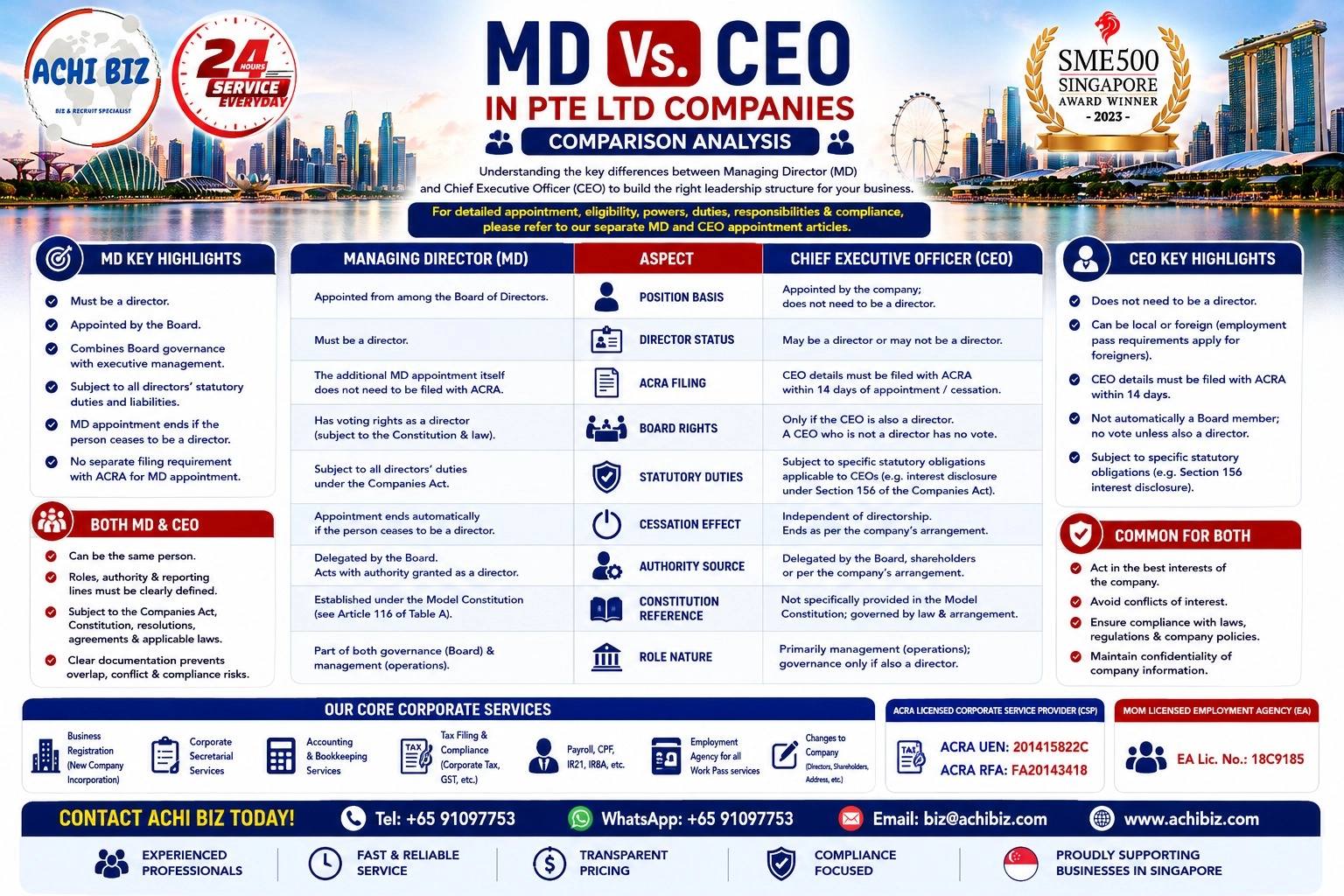
Managing Director vs Chief Executive Officer in Pte Ltd Companies – FAQ Guide
The titles Managing Director (MD) and Chief Executive Officer (CEO) are sometimes used loosely in business conversations, but they should not be treated as automatically interchangeable in a Singapore Pte. Ltd. company.
The most important structural distinction is straightforward: ACRA describes a Managing Director as someone appointed from the Board of Directors, whereas a company may appoint a CEO to run the business without the CEO necessarily being a director. ACRA also expressly states that the CEO’s details must be filed with ACRA, while the additional appointment of a director as Managing Director does not need to be filed as an MD appointment.
This article concentrates exclusively on MD vs CEO comparison points. For appointment procedures, eligibility, powers, duties, responsibilities, remuneration and other detailed matters concerning each position, please refer to our separate articles on Appointment of a Managing Director in a Singapore Pte. Ltd. Company and Appointment of a Chief Executive Officer in a Singapore Pte. Ltd. Company.
What is the fundamental difference between an MD and CEO in a Singapore Pte. Ltd. company?
The fundamental difference is their relationship with the company’s Board.
A Managing Director must be one of the company’s directors. Under ACRA’s Model Constitution, the directors may appoint one or more of their own body as Managing Director.
A CEO does not have to be a director. Singapore’s statutory concept of a CEO focuses on whether the person is employed by, acts for or by arrangement with the company and is principally responsible for managing and conducting the company’s business, or part of it.
Therefore:
MD → must also be a director.
CEO → may be a director, but directorship is not a prerequisite.
Is an MD always a director while a CEO may or may not be a director?
Yes.
This is probably the clearest legal and governance distinction between the two positions.
An MD’s position originates from membership of the Board. Under the Model Constitution, the MD appointment automatically ends if the individual ceases to be a director.
A CEO’s position is different. The statutory definition does not require the CEO to sit on the Board.
Does a person need to become a director before being appointed CEO?
No.
There is no compulsory sequence of:
Director → CEO
A person can be appointed as CEO without first becoming a company director.
By contrast, the MD position inherently requires the person to be a director.
Are MD and CEO both compulsory appointments for a Singapore Pte. Ltd. company?
No.
Neither position is generally compulsory for an ordinary Singapore Pte. Ltd. company.
ACRA identifies both as additional key management positions that a company may appoint. A company must, however, satisfy its separate statutory requirements concerning directors and the company secretary.
Can a Pte. Ltd. company operate without both an MD and CEO?
Yes.
A company can operate without appointing either position.
Whether an MD, CEO or both are commercially useful depends on the company’s size, management structure, ownership, business complexity and governance needs.
Is an MD appointment filed with ACRA in the same way as a CEO appointment?
No. This is a major practical difference.
ACRA expressly states that a company may appoint a Managing Director from its Board and does not need to file that additional MD appointment with ACRA.
For a CEO, ACRA states that if the company appoints one, the CEO’s details must be filed with ACRA.
Why does the CEO appear in ACRA records while the MD designation generally does not require a separate filing?
The CEO is specifically maintained as a position holder for statutory registration purposes. The Companies Act provides for a register of a company’s CEOs containing prescribed particulars including the CEO’s name, addresses, nationality, identification and appointment and cessation dates.
An MD, meanwhile, is already a director. The MD designation represents an additional management office held by a member of the Board, and ACRA expressly says the additional appointment need not be filed.
Is the MD’s underlying directorship still registered with ACRA?
Yes.
The fact that the MD designation itself does not require a separate filing does not mean the individual is absent from ACRA records.
An MD must already be a director, and the person’s underlying directorship remains subject to the normal director registration requirements.
Does CEO appointment create an additional ACRA compliance step compared with appointing an existing director as MD?
Yes.
Where an existing director is internally appointed MD, ACRA states that the additional MD appointment itself does not need to be filed.
A CEO appointment, on the other hand, creates a position-holder filing obligation. ACRA generally requires position-holder changes to be reported within 14 days.
Can the same individual simultaneously be MD and CEO?
Potentially, yes, provided the individual satisfies the requirements applicable to each position and the company properly establishes the respective appointments.
Because an MD must already be a director, a person holding both positions would necessarily also be a director.
Companies considering such an arrangement should clearly document the individual’s capacities, authority, remuneration and reporting arrangements rather than relying solely on multiple titles.
If the same person is both MD and CEO, are the titles automatically interchangeable?
No.
Holding both positions does not make the legal concepts identical.
The individual would hold an MD position arising from his or her status as a director and a separately recognised CEO position. The CEO position also carries its own ACRA registration implications.
Can an MD exist without a CEO?
Yes.
A company can appoint one of its directors as Managing Director without appointing a CEO.
Can a CEO exist without an MD?
Yes.
A company can appoint a CEO without appointing any director as Managing Director.
This arrangement may be particularly relevant where the company wants professional executive management while keeping Board membership separate.
Can a CEO exist without being on the Board at all?
Yes.
A CEO does not automatically become a director simply by being CEO.
This creates an important governance distinction: the CEO can have substantial executive authority without necessarily possessing the legal status, voting rights or statutory responsibilities arising specifically from directorship.
Can an MD exist without being on the Board?
No.
An MD must be selected from the Board. Under the Model Constitution, cessation as a director automatically ends the MD appointment.
Which position has Board voting rights – MD or CEO?
An MD has Board voting rights because the MD is a director, subject to the company’s Constitution, applicable law and any conflict-of-interest restrictions.
A CEO who is not also a director does not acquire a director’s Board vote merely because of the CEO title.
If the CEO is separately appointed as a director, the person may exercise director rights in that separate capacity.
Can a CEO attend Board meetings even if not a director?
The company may invite a non-director CEO to attend Board meetings where appropriate, particularly to report on operations, financial performance, strategy and business risks.
However, attending a meeting does not itself convert the CEO into a director or automatically give the CEO a director’s vote.
Which position sits between ownership, governance and management more directly?
The MD inherently occupies both Board governance and executive management because the MD is simultaneously a director.
A non-director CEO primarily occupies an executive management position.
This distinction can be particularly useful where shareholders want the Board to retain governance oversight while delegating substantial operational responsibility to professional management.
Is the MD’s authority derived partly from being a director?
Yes.
An MD starts with the underlying legal position of director and can additionally receive executive powers delegated by the Board.
Under ACRA’s Model Constitution, directors may entrust and confer upon an MD powers exercisable by the directors, subject to whatever terms, conditions and restrictions they consider appropriate.
Does a CEO automatically obtain the powers of a director?
No.
A CEO who is not a director does not become a Board member merely because the person is principally responsible for running the business.
The CEO’s executive authority should therefore be distinguished from powers arising from directorship.
Which position is inherently subject to directors’ statutory duties?
The MD.
Because every MD is necessarily a director, all statutory and general duties applicable to directors continue to apply to that individual. ACRA emphasises that all directors remain responsible under the legislation regardless of how their roles are described.
A CEO who is not a director should not automatically be described as carrying every duty that applies specifically because someone is a director. However, CEOs can have their own statutory obligations; for example, section 156 of the Companies Act expressly applies certain interest-disclosure requirements to both directors and CEOs.
Does appointing a CEO instead of an MD remove the Board’s responsibilities?
No.
Appointment of executive management does not eliminate the statutory responsibilities of the company’s directors.
ACRA makes clear that directors remain responsible under the legislation and cannot escape their responsibilities by being described as inactive or sleeping directors.
Does appointing an MD remove the responsibilities of the other directors?
No.
An MD may receive extensive operational authority, but the remaining directors do not cease to be directors.
The Board should therefore continue exercising appropriate oversight.
Which position is more suitable when the company wants its operational leader to sit on the Board?
An MD can naturally suit such a structure because Board membership is built into the position.
A CEO could also sit on the Board, but that requires the individual to be separately and validly appointed as a director.
Therefore, the company should decide whether Board membership is intentionally part of the executive leader’s role rather than allowing titles to determine governance accidentally.
Which position is more suitable when shareholders want professional management without giving the executive a Board seat?
A CEO can accommodate this structure more naturally because the CEO need not be a director.
The company can therefore appoint a professional executive to manage the business while maintaining a separate Board composition.
Is a CEO necessarily senior to an MD?
Not as a universal legal rule.
Job titles alone should not be used to determine hierarchy.
Where both positions exist, their practical relationship should be determined by the company’s Constitution, Board resolutions, employment or service agreements, organisational structure and delegation of authority.
Is an MD necessarily senior to a CEO?
Again, not automatically.
The MD has the additional legal status of director, but that does not by itself establish every aspect of operational hierarchy between two senior executives.
Where a company appoints both, it should deliberately define reporting lines instead of assuming that everyone understands what the titles mean.
If a company has both an MD and CEO, who should report to whom?
There is no single structure suitable for every private company.
Depending on the governance arrangement, the company could allocate different business responsibilities or establish a specific reporting relationship.
The important point is to document the hierarchy clearly.
Without clear reporting arrangements, having both positions can create overlapping authority and internal conflict.
Can the MD supervise the CEO?
Potentially, if the company’s governance structure and delegated authority establish that relationship.
However, this is not an automatic consequence of the titles.
Can the CEO supervise operational functions while the MD concentrates on Board-level strategy?
Potentially, yes.
A company can divide responsibilities according to its needs, provided the arrangements remain consistent with applicable law, its Constitution and valid corporate approvals.
The division should preferably be written into the relevant resolutions, contracts and authority matrix.
What happens when MD and CEO responsibilities overlap?
Overlapping authority can create uncertainty over who has the final say on employees, contracts, budgets, borrowing, banking, procurement, investments and strategic decisions.
Where both positions exist, the company should establish a written delegation-of-authority matrix identifying:
- responsibilities of each position;
- independent approval limits;
- matters requiring joint involvement;
- matters reserved for the Board; and
- escalation procedures where disagreement occurs.
This is often more important than the titles themselves.
Can the MD and CEO have different signing limits?
Yes.
The company can establish different authority thresholds according to each individual’s role.
For example, one executive may have authority over ordinary operational expenditure while certain major transactions require another level of approval or Board approval.
Can the MD and CEO have different banking authority?
Yes.
Banking authority is not determined solely by job title.
The company can establish single or joint signatory arrangements, transaction limits and approval requirements according to its internal-control framework.
Can a non-director CEO approve matters that an MD cannot?
Potentially, if the company has expressly delegated different responsibilities.
The fact that the MD is a director does not mean every operational transaction must necessarily be approved by the MD.
Likewise, CEO status does not automatically create unrestricted authority.
The actual delegation framework matters.
Can the MD overrule the CEO simply because the MD is a director?
Not necessarily in every operational matter.
The MD’s directorship gives the person a place within Board governance, but day-to-day authority depends on the company’s established management arrangements.
Where a matter requires a Board decision, the MD participates as a director rather than personally becoming the entire Board.
Can the CEO overrule the Board?
No.
A CEO’s executive authority operates within the company’s governance framework.
A company should not structure the CEO’s authority in a way that effectively makes the Board incapable of discharging its statutory responsibilities.
Does the MD represent the Board while the CEO represents management?
That can be a useful practical description in some companies, but it should not be treated as a universal legal formula.
An MD participates in both Board governance and executive management.
A CEO is principally an executive management position, although the CEO may separately also be appointed as a director.
Which position has greater personal statutory exposure?
It is misleading to rank them purely by title.
An MD necessarily carries the responsibilities associated with being a director, in addition to responsibilities arising from the executive role.
A CEO who is not a director does not automatically carry every director-specific duty, but CEOs are expressly covered by certain Companies Act provisions and may incur liability under applicable laws depending on their conduct and responsibilities. Section 156, for example, expressly addresses both directors and CEOs in relation to disclosure of interests.
Are conflicts of interest treated identically for MD and CEO?
There is substantial overlap, but the legal basis should be identified carefully.
An MD is necessarily subject to director-related conflict and disclosure obligations.
Separately, the Companies Act expressly applies certain disclosure requirements to CEOs as well as directors.
Companies should therefore maintain conflict-of-interest procedures covering both positions.
Is remuneration for an MD and CEO necessarily structured the same way?
No.
Their remuneration packages can differ substantially depending on responsibilities, employment status, performance arrangements and company policy.
Under ACRA’s Model Constitution, an MD may receive salary, commission or both as determined by the directors, subject to the relevant agreement.
A CEO’s remuneration should likewise be appropriately authorised and documented, but should not simply be assumed to follow the MD provisions of the Model Constitution.
Can both MD and CEO be employees of the company?
Potentially, depending on the particular arrangements.
Holding a corporate office and having an employment or service relationship can involve separate legal considerations.
The company should document each person’s corporate capacity, employment terms and remuneration clearly.
Which appointment ends automatically if the individual stops being a director?
The MD appointment.
Under the Model Constitution, a person’s appointment as Managing Director automatically ends if that person ceases to be a director.
A CEO who was never a director does not face that particular consequence because CEO status does not depend on directorship.
If someone is both MD and CEO and resigns as director, what happens?
The different capacities should be considered separately.
Under the Model Constitution, cessation as director causes the MD appointment to end.
Whether the person also ceases to be CEO depends on the relevant CEO cessation arrangements. If the CEO appointment ends, the corresponding ACRA position-holder change must be dealt with.
If someone ceases to be CEO, can the person remain a director?
Yes, if the person separately holds a directorship and that directorship has not ended.
CEO cessation does not automatically terminate a separate director appointment.
If someone ceases to be MD, can the person remain a director?
Potentially, yes.
Removing or resigning from the additional MD office does not necessarily mean the person’s underlying directorship ends.
The company’s resolutions and contractual arrangements should clearly distinguish the two.
Which cessation must be notified to ACRA as a CEO position-holder change?
Cessation as CEO.
ACRA requires changes to CEO position-holder information to be reported within the applicable timeframe. ACRA’s current guidance states that changes to appointed position holders should be updated within 14 days.
Is MD cessation separately filed as an MD change with ACRA?
ACRA’s incorporation guidance states that the MD appointment itself does not need to be filed.
However, where the person’s underlying directorship also ends, the cessation as director is a separate reportable event.
This distinction is important when preparing corporate documentation.
Which position has greater significance for ACRA’s public company records?
The CEO has a distinct statutory register maintained for CEO particulars, while an MD is already reflected through the individual’s underlying directorship.
ACRA states that companies maintain electronic registers of relevant company personnel and that most of these registers are publicly accessible, subject to the specific exceptions identified by ACRA.
Does the RORC regime treat MD and CEO identically?
Not simply by title.
RORC analysis depends on the statutory tests and circumstances. A CEO is specifically relevant to the special executive-control provisions where the company cannot identify its registrable controller after taking the required steps.
An MD is necessarily a director, so the relevant analysis concerns the person’s status and actual executive control rather than merely the label “Managing Director.”
For the detailed RORC implications applicable to CEOs, refer to our separate CEO Appointment article.
Does being MD or CEO automatically make someone the beneficial owner of the company?
No.
Executive authority and beneficial ownership are different concepts.
A person can manage a company without owning its shares, while a shareholder can own a substantial interest without being involved in daily management.
RORC analysis should therefore be carried out under the applicable statutory tests rather than inferred from an executive title.
Which role is more appropriate for a founder who wants to remain directly involved in both Board decisions and daily management?
An MD structure may be suitable where the founder is already a director and the company wants that individual formally involved in both Board governance and executive management.
However, the choice should still reflect the company’s actual governance arrangements rather than simply adopting a title because it sounds appropriate.
Which role is more appropriate for an external professional hired to run the company without joining the Board?
CEO is generally the more natural structure because a CEO does not need to be a director.
This allows the company to separate executive management from Board membership.
Which structure may be more suitable for a family-owned Pte. Ltd. company?
There is no automatic answer.
Some family-owned companies want family members to retain Board control while appointing an external professional CEO to run operations.
Others prefer an owner-director to take an MD role and remain directly involved in both governance and management.
The appropriate structure depends on succession planning, ownership, professional-management needs and the degree of operational involvement desired by shareholders.
Which structure may be more appropriate when investors want stronger separation between governance and management?
A non-director CEO can provide a clearer structural separation between executive management and Board governance.
The Board can supervise strategy, risk and performance while professional management operates the business within delegated authority.
However, the effectiveness of that separation depends on actual governance practices, not merely titles.
Does having both an MD and CEO improve corporate governance?
Not automatically.
Two senior titles do not create good governance by themselves.
Having both can be useful where the company genuinely needs two clearly differentiated senior leadership functions. It can be counterproductive where responsibilities overlap or employees do not know whose instructions take priority.
When can having both an MD and CEO become problematic?
Problems commonly arise when:
- both believe they have final operational authority;
- employees receive conflicting instructions;
- contract-signing powers overlap;
- banking authority is unclear;
- neither knows which matters require Board approval;
- performance accountability is duplicated; or
- shareholders use the two positions to create competing power centres.
Clear documentation is therefore essential.
Should a small Pte. Ltd. company appoint both MD and CEO?
Usually, the company should first ask whether there is a genuine operational need.
A small owner-managed company may gain little from maintaining multiple senior executive titles if one individual effectively controls and manages the entire business.
Adding titles without corresponding governance functions can create unnecessary complexity.
At what stage might separating MD and CEO functions become useful?
Separation may become more useful as the company grows, attracts investors, professionalises management, expands overseas, develops multiple business divisions or requires stronger Board oversight of executive management.
There is no statutory company-size threshold at which separation automatically becomes necessary.
Does the company Constitution matter more for an MD than for a CEO?
The Constitution is important to the company’s overall governance in both cases, but it has particular relevance to the MD because the MD is appointed from among the directors and may receive powers that would otherwise be exercisable by the Board.
ACRA’s Model Constitution contains express provisions dealing with appointment, cessation, remuneration and delegation of powers to an MD.
Should the Constitution simply call the CEO an MD or vice versa?
No.
The company should use terminology that accurately reflects the intended legal and governance arrangement.
Changing a title does not change the underlying reality that an MD must be a director while a CEO does not necessarily have to be one.
Can shareholders use a shareholders’ agreement to define the relationship between MD and CEO?
Yes, where appropriate.
A shareholders’ agreement may address rights to nominate senior executives, approval requirements, reserved matters and governance arrangements.
However, it should be coordinated with the company’s Constitution, Board authority, employment agreements and applicable law.
Should separate job descriptions be prepared when the company has both an MD and CEO?
Yes.
Separate job descriptions can reduce overlap and establish accountability.
The documents should clearly distinguish strategy, operations, employees, financial authority, business development, reporting, compliance and decision-making responsibilities.
Should there also be a Board-reserved matters list?
For companies with both positions, this can be particularly useful.
A reserved-matters list identifies decisions that neither executive should make independently because they require Board or shareholder approval.
Examples can include major borrowing, acquisitions, disposals, substantial capital expenditure, changes in business direction and significant related-party transactions.
Is a delegation-of-authority matrix more important than deciding which title sounds senior?
Yes.
From a practical governance perspective, who can do what matters considerably more than whether someone’s business card says MD or CEO.
A clear authority matrix can prevent internal disputes, unauthorised transactions and confusion with banks, employees, customers and suppliers.
Can one title be used merely for commercial prestige while the other reflects the person’s actual function?
Companies should be cautious about this.
The statutory concept of CEO focuses on the person’s actual role and is not necessarily defeated by using another description. ACRA materials reproduce the Companies Act concept of a CEO as one or more persons, by whatever name described, who satisfy the substantive management criteria.
Substance therefore matters.
Can calling someone an MD avoid CEO registration requirements if that person is actually functioning as CEO?
Companies should not assume that changing the title automatically changes the legal analysis.
The CEO definition focuses on actual management responsibility and expressly accommodates persons described by other names.
Where there is uncertainty about whether an individual’s actual functions amount to the statutory CEO position, professional advice should be obtained rather than relying on job-title engineering.
Is it better to appoint an MD or CEO?
Neither position is universally “better.”
The more useful question is what governance structure the company wants.
An MD is structurally suitable where the executive leader should necessarily be a member of the Board.
A CEO provides greater flexibility where the company wants a senior executive who may remain outside the Board.
The correct choice depends on ownership, Board composition, investor expectations, business complexity and the desired separation between governance and management.
What questions should shareholders ask before choosing between an MD and CEO structure?
They should consider whether the executive leader should have a Board seat, whether professional management should be separated from ownership and governance, what authority should be delegated, who should supervise executive performance, whether more than one senior executive position is genuinely necessary and how succession would work if the executive leaves.
These questions are generally more important than the prestige associated with either title.
What should a company consider before appointing both an MD and CEO?
The company should first establish a clear governance map covering:
- Board membership;
- reporting hierarchy;
- operational responsibilities;
- delegated authority;
- contract-signing powers;
- banking authority;
- expenditure limits;
- hiring and termination authority;
- Board-reserved matters;
- conflict-management procedures;
- performance evaluation; and
- succession or cessation arrangements.
If these cannot be clearly distinguished, appointing both positions may create more confusion than benefit.
What is the simplest way to remember the MD vs CEO distinction in Singapore?
A useful starting point is:
MD = Director + executive management role
CEO = Executive management role, with or without directorship
There are additional legal and governance considerations, but this captures the most important structural distinction.
Should businesses refer to the separate ACHI BIZ articles on MD and CEO appointments?
Yes.
This article intentionally focuses on MD vs CEO comparison in Singapore Pte. Ltd. companies rather than repeating the full appointment, eligibility, duties, powers, remuneration, cessation and compliance requirements already covered elsewhere.
For detailed information, refer separately to:
Appointment of a Managing Director in Singapore Pte. Ltd. Companies – Requirements, Roles, Powers, Duties & Responsibilities
and
Appointment of a Chief Executive Officer (CEO) in Singapore Pte. Ltd. Companies – Requirements, Roles, Powers, Duties & Responsibilities
How can ACHI BIZ assist a company considering its senior management structure?
ACHI BIZ, an ACRA Licensed Corporate Service Provider (CSP), can assist Singapore Pte. Ltd. companies with corporate secretarial and compliance matters connected with directors, CEOs and other corporate appointments.
Depending on the engagement, assistance can include reviewing corporate records and the company’s Constitution, preparing appropriate resolutions and corporate documentation, handling applicable ACRA position-holder filings, maintaining company records and supporting other ongoing corporate compliance requirements.
Where a company is deciding how its MD and CEO functions should be structured, legal or specialist governance advice may also be appropriate where the arrangements are complex.
What is the key takeaway from the MD vs CEO comparison?
The biggest mistake is assuming that MD and CEO are simply two different names for exactly the same legal position.
They can perform overlapping executive functions, and the same individual can potentially hold both positions, but their corporate foundations differ.
An MD must be a director. A CEO does not have to be a director. A CEO is a reportable position holder whose details must be filed with ACRA, while ACRA states that the additional MD appointment from the Board does not need to be filed as an MD appointment.
The appropriate structure therefore depends less on which title sounds more senior and more on Board membership, executive authority, reporting lines, accountability and the company’s desired separation between governance and management.
Conclusion
For Singapore Pte. Ltd. companies, the distinction between a Managing Director and Chief Executive Officer becomes much clearer when viewed through corporate structure rather than job-title hierarchy.
The MD necessarily combines directorship with executive management, while the CEO can provide executive leadership without necessarily becoming a member of the Board. This distinction affects Board participation, statutory director responsibilities, ACRA registration and the way a company can separate governance from management.
Where both positions are used, the company should clearly document their respective authority, reporting lines and reserved matters. Where only one is required, the choice should reflect the company’s actual governance needs rather than convention or prestige.
For the complete requirements concerning each appointment, refer to our separate MD and CEO appointment FAQ articles.
Disclaimer: This FAQ provides general information on the comparison between Managing Directors and Chief Executive Officers in Singapore Pte. Ltd. companies. It does not constitute legal, employment, tax, accounting or other professional advice. The actual authority and responsibilities of an MD or CEO depend on the Companies Act 1967, the company’s Constitution, contractual arrangements, Board decisions and individual circumstances. Professional advice should be obtained where appropriate.
Related Pages
Key Differences: Fiduciary vs. Statutory Duties of Directors in Singapore Pte Ltd Companies
Understanding the Features and Risks of a Nominee Director
#achibiz