
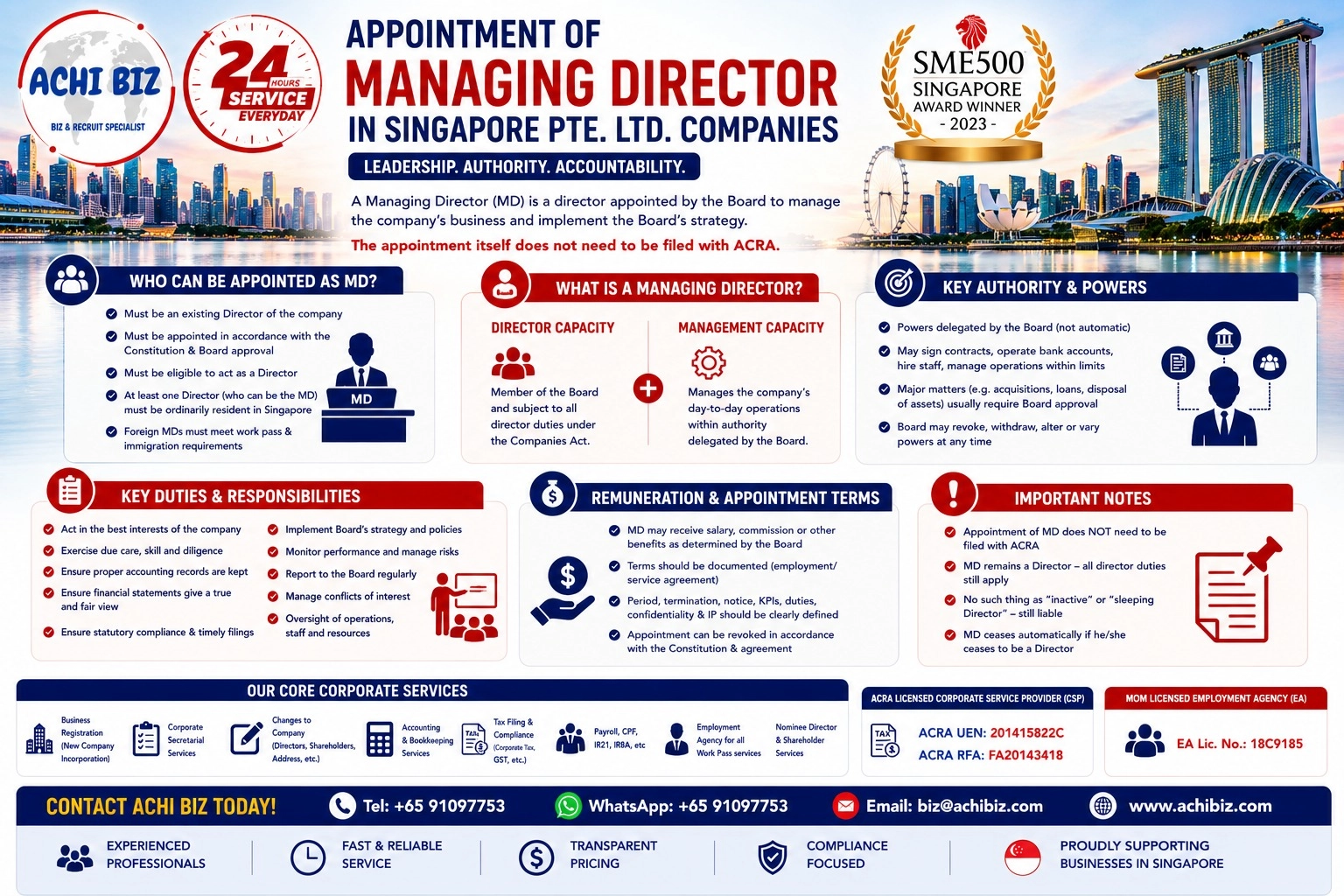
Appointment of Managing Director in Pte Ltd Company – FAQ Guide
A Managing Director (MD) can play an important role in a Singapore Private Limited (Pte. Ltd.) company, particularly where the Board wants one of its directors to take primary responsibility for managing the company’s day-to-day business and implementing the Board’s strategy.
However, appointing a Managing Director is not compulsory for an ordinary Singapore Pte. Ltd. company. ACRA expressly states that a company may appoint a Managing Director from its Board of Directors to run the company, and that the appointment itself does not need to be filed with ACRA.
The important point is that an MD is still a director. Giving a director the additional title of Managing Director does not remove or reduce the statutory and general duties that apply to directors. ACRA states that director obligations apply to all directors, including different categories of directors.
This FAQ examines the appointment, authority, importance, rights, remuneration, duties, responsibilities, governance and risks of a Managing Director in a Singapore Pte. Ltd. company.
What is a Managing Director in a Singapore Pte. Ltd. company?
A Managing Director is a member of the company’s Board of Directors who has additionally been appointed to manage the company.
The role therefore combines two dimensions:
Director capacity: The person remains a member of the Board and is subject to the duties and responsibilities applicable to directors.
Management capacity: The Board may delegate specified management powers and operational responsibilities to the Managing Director.
This distinction is important when determining what the MD can independently decide and what must remain subject to Board or shareholder approval.
Is it compulsory for a Singapore Pte. Ltd. company to appoint a Managing Director?
No.
Singapore companies must have at least one director who is ordinarily resident in Singapore, but there is no general requirement for an ordinary Pte. Ltd. company to appoint one of its directors as Managing Director.
The appointment is therefore generally a business and governance decision, rather than a mandatory corporate position.
When should a Pte. Ltd. company consider appointing a Managing Director?
Appointment becomes more useful when the business has grown beyond a structure where every operational decision can conveniently be handled collectively by the Board.
For example, an MD may be appropriate where the company has several directors, multiple business functions, employees requiring central leadership, significant customer or supplier relationships, regular commercial decisions, overseas operations or a need for one senior executive director to coordinate the overall business.
A small owner-managed company may not require a separate MD designation if its existing director structure already works effectively.
Must the Managing Director already be a director of the company?
Yes. ACRA describes the Managing Director as someone appointed from the Board of Directors.
The company’s constitution should also be checked. Under ACRA’s Model Constitution for a private company limited by shares, the directors may appoint one or more of their body as Managing Director.
Therefore, a person should not simply be given the MD title without considering whether the person’s underlying directorship has been properly established.
Can a company appoint more than one Managing Director?
Potentially, yes, if permitted by the company’s constitution and governance arrangements.
The Model Constitution expressly contemplates directors appointing one or more of their body to the office of Managing Director.
However, appointing multiple MDs requires particularly clear allocation of responsibilities and authority. Otherwise, overlapping powers can create confusion over contracts, expenditure, employees and strategic decisions.
Who appoints the Managing Director?
This depends primarily on the company’s constitution and applicable corporate arrangements.
Under ACRA’s Model Constitution, the directors may appoint one or more of themselves as Managing Director on such period and terms as they consider appropriate.
A company with a customised constitution should therefore review its own provisions rather than automatically assuming that the Model Constitution applies.
Should the company check its Constitution before appointing an MD?
Yes.
The Constitution should be reviewed to determine:
- who has authority to appoint the MD;
- whether particular approval procedures apply;
- whether more than one MD can be appointed;
- how powers can be delegated;
- whether the appointment can be revoked;
- how remuneration is determined; and
- what happens when the MD ceases to be a director.
For companies adopting the Model Constitution, specific provisions address Managing Directors, remuneration and delegation of powers.
How should the appointment of a Managing Director be documented?
Where the Constitution gives the Board authority, the appointment should ordinarily be properly approved and recorded through the appropriate Board resolution and corporate records.
The documentation should clearly state the effective date, term where applicable, delegated authority, responsibilities, remuneration arrangements and any restrictions or conditions.
If a separate service or employment agreement is used, it should be consistent with the Board resolution and Constitution.
Does the appointment of a Managing Director need to be filed with ACRA?
No. ACRA specifically states that while a company can appoint a Managing Director from its Board to run the company, the MD appointment does not need to be filed with ACRA.
This is an important distinction.
The underlying appointment as a director, however, is a registrable corporate matter. The fact that the additional MD designation itself is not filed does not eliminate the company’s obligations concerning the person’s directorship.
Does appointing an existing director as Managing Director change the ACRA register?
Generally, the additional internal designation as Managing Director does not itself require an ACRA filing.
Nevertheless, if there is a separate change affecting the person’s registered particulars or directorship, the relevant filing requirements must still be considered.
What documents should a company maintain after appointing an MD?
Depending on the circumstances, the company’s internal records may include the Board resolution, relevant minutes, service or employment agreement, delegation-of-authority document, remuneration approval, updated organisation chart, bank mandates and other internal authorisations.
Maintaining clear records helps establish precisely what authority was granted to the MD and when.
What is the main role of a Managing Director?
The MD generally provides executive leadership over the company’s business within the authority delegated by the Board.
Typical responsibilities can include implementing strategy, overseeing operations, supervising senior management, managing budgets, monitoring performance, negotiating commercial arrangements and reporting material developments to the Board.
However, there is no universal list that automatically applies to every MD. The actual role depends substantially on the company’s Constitution, Board decisions, contractual arrangements and nature of business.
What powers can the Board give to a Managing Director?
The Model Constitution provides considerable flexibility.
It allows directors to entrust and confer upon the Managing Director powers exercisable by the directors, subject to whatever terms, conditions and restrictions they consider appropriate. The Board may also revoke, withdraw, alter or vary those powers.
Therefore, an MD’s authority should not simply be assumed from the job title.
Does a Managing Director automatically have all powers of the Board?
No.
The Board should determine the scope of authority actually delegated to the MD.
Some authority may be broad, while other matters may remain specifically reserved for collective Board approval.
The company should ideally document this through a delegation-of-authority framework.
What matters should normally remain subject to Board approval?
This depends on the company, but significant matters may be reserved to the Board, such as major acquisitions or disposals, substantial borrowing, material contracts, major capital expenditure, changes in business direction, significant related-party transactions or matters requiring shareholder approval.
The objective is not to restrict ordinary management unnecessarily, but to distinguish day-to-day executive authority from major corporate decision-making.
Can the MD sign contracts on behalf of the company?
Potentially, yes, where the MD has the necessary authority.
The company should clearly establish contractual signing limits and whether particular transactions require additional approval.
For example, an MD may have authority to sign ordinary commercial contracts up to a specified value while larger commitments require Board approval.
Can the Managing Director operate the company’s bank accounts?
Yes, if appropriately authorised under the company’s banking mandate and internal approvals.
Being appointed MD does not necessarily mean that the person automatically becomes the sole bank signatory.
Banking authority should be separately documented according to the company’s internal controls.
Can the MD hire and dismiss employees?
The Board can generally allocate appropriate operational authority to the MD, including employment decisions, subject to applicable laws, internal policies and reserved matters.
For senior appointments or substantial remuneration packages, the company may choose to require additional Board approval.
Can the Managing Director make decisions without consulting other directors?
Only within the authority properly delegated to the MD.
Operational independence can be one reason for creating the position, but it does not mean the MD can disregard the Board.
Where a decision exceeds delegated authority or is reserved for Board approval, the matter should be escalated appropriately.
Can shareholders directly control the Managing Director’s daily decisions?
The company’s governance structure should be respected.
Shareholders exercise rights through mechanisms available to them under the Companies Act, Constitution and relevant agreements, while the Board is responsible for the company’s direction and management arrangements.
A shareholder who is also a director may participate in Board decisions in that separate capacity, but share ownership alone should not be confused with unrestricted executive authority.
Is the Managing Director more powerful than the Board?
No.
The MD derives management authority from the company’s governance arrangements and powers delegated by the Board.
The Model Constitution expressly allows directors to revoke, withdraw, alter or vary powers previously conferred on an MD.
The MD therefore does not replace the Board.
Does appointing an MD reduce the responsibilities of the other directors?
No.
This is particularly important.
Directors cannot assume that appointing a Managing Director allows the rest of the Board to become passive. ACRA expressly states that there is no concept of an “inactive director” or “sleeping director” that escapes director responsibilities; directors remain responsible under the legislation.
Delegation can improve management efficiency, but it does not automatically eliminate the duties of other directors.
Is a Managing Director subject to the same director duties as other directors?
Yes.
The person remains a director and continues to be subject to applicable director duties under the Companies Act and general law.
ACRA highlights key responsibilities including maintaining proper records, preparing required financial reports, filing required documents on time and acting in the company’s best interests.
The MD’s substantial involvement in operations can actually mean that the person has greater practical access to information and decision-making than some other directors.
Must an MD act in the company’s best interests?
Yes.
The MD’s executive position does not permit the person to place personal interests ahead of the company’s interests.
Potential conflicts of interest should be identified and properly managed, and applicable disclosure and approval requirements should be followed.
Is the MD responsible for financial reporting?
As a director, the MD shares applicable director responsibilities concerning the company’s financial reporting.
ACRA states that directors must ensure required financial statements comply with prescribed accounting standards and give a true and fair view of the company’s financial position and performance.
Appointing accountants, finance staff or external professionals does not remove directors’ underlying responsibilities.
Is the Managing Director responsible for keeping proper accounting records?
The company must keep proper accounting records, and directors have legal responsibilities in this area.
ACRA states that records generally need to be retained for at least five years after the end of the relevant financial year and must enable true and fair financial statements to be prepared.
An operationally active MD should therefore ensure appropriate financial controls and reporting systems exist.
What compliance responsibilities should an MD monitor?
Depending on the authority assigned, an MD may oversee operational compliance involving corporate filings, financial reporting, taxation, employment matters, licences, contracts, workplace requirements, data protection and industry-specific regulations.
However, responsibility should be coordinated with the Board, company secretary, finance function and relevant professional advisers rather than assuming that one individual can personally perform every compliance task.
What is the MD’s role in risk management?
An effective MD should identify material business risks and ensure significant matters are reported to the Board.
These may include financial risk, credit exposure, contractual obligations, employment issues, regulatory compliance, litigation, cybersecurity, operational disruption and reputational risk.
The MD should not conceal material problems merely because they arose within management.
What is the MD’s responsibility towards the Board?
An MD should keep the Board sufficiently informed to enable directors to discharge their responsibilities.
This may involve regular reporting on financial performance, cash flow, major contracts, operational developments, regulatory issues, litigation, employee matters and significant risks.
A Board cannot effectively supervise the business if material information is withheld from it.
Can an MD have a conflict of interest?
Yes.
An MD can encounter conflicts through personal investments, related businesses, family interests, external appointments, supplier relationships or transactions involving connected persons.
Such conflicts should be disclosed and managed according to applicable law and the company’s governance arrangements.
Can the MD receive remuneration?
Yes, subject to the company’s applicable governance arrangements.
The Model Constitution provides that a Managing Director may, subject to the relevant agreement, receive remuneration by salary or commission, as determined by the directors.
Companies using customised constitutions should follow their own provisions and applicable law.
Should the MD have a written service agreement?
It is generally sensible, particularly where the role is substantial.
A properly structured agreement can address responsibilities, remuneration, benefits, confidentiality, intellectual property, termination, notice periods, restrictive covenants where appropriate and other employment or service terms.
However, contractual provisions should remain consistent with the Constitution and valid corporate approvals.
Is appointment as Managing Director permanent?
Not necessarily.
The Model Constitution allows directors to appoint an MD for such period and on such terms as they think fit, subject to the particular agreement.
The appointment may therefore be for a defined period or otherwise governed by the terms approved by the company.
Can the Board remove a Managing Director?
Subject to the Constitution and any contractual agreement, yes.
Under the Model Constitution, directors may revoke the appointment, subject to the terms of any agreement entered into in the particular case.
However, removing the MD title and terminating the person’s employment or service agreement can involve separate contractual considerations.
Does removing someone as MD automatically remove that person as a director?
Not necessarily.
The offices should be distinguished.
A person could cease being Managing Director while remaining an ordinary director, depending on the Board’s decision, Constitution and contractual arrangements.
What happens if the Managing Director ceases to be a director?
Under the Model Constitution, the MD appointment automatically ends if the person ceases to be a director.
This follows logically because the MD must be one of the directors.
Can the Managing Director resign only from the MD position but remain a director?
Potentially, yes, depending on the governing arrangements and terms of appointment.
The resignation should be properly documented so that there is no ambiguity about whether the person has resigned only from executive management or from the Board itself.
This distinction is especially important because cessation as a director has separate corporate consequences.
Can a shareholder also be Managing Director?
Yes, provided the individual is also validly appointed as a director and the MD appointment is made according to the company’s Constitution and corporate approvals.
Many closely held Singapore companies have individuals who simultaneously hold shares, serve as directors and perform executive management functions.
Each role nevertheless has a different legal character.
Can the sole shareholder and sole director also act as Managing Director?
Potentially, yes.
Singapore law permits a company with one member to have that person as the sole director, provided applicable director requirements are satisfied.
Whether formally designating that person as MD provides any practical benefit depends on the circumstances.
Must a Managing Director be ordinarily resident in Singapore?
The MD must first be a director.
Every Singapore company must have at least one director who is ordinarily resident in Singapore, but this does not necessarily mean every director must satisfy that residency requirement.
Accordingly, the residency position of a proposed MD should be considered together with the company’s overall Board composition and, for foreign individuals, applicable immigration or work-pass conditions.
Can a foreigner be appointed Managing Director of a Singapore company?
Potentially, provided the individual can lawfully serve as a director and all relevant immigration, work-pass and regulatory requirements are satisfied.
ACRA specifically advises FIN holders to check with their pass issuer before accepting a director role.
Corporate appointment and immigration permission are separate issues and should not be confused.
Must the proposed MD sign a director consent form?
If the individual is being newly appointed as a director, the applicable director appointment requirements must first be satisfied.
ACRA updated Form 45 – Consent to Act as Director and Statement of Non-Disqualification to Act as Director with effect from 6 May 2026, including updated declarations concerning statutory obligations and disqualification matters.
If the person is already an existing director and is merely receiving the additional internal MD appointment, the position is different because the MD designation itself is not filed with ACRA.
Can a disqualified person be appointed Managing Director?
A person who cannot lawfully act as a director cannot bypass that restriction by being called Managing Director.
Because an MD must be a director, director eligibility and disqualification rules remain fundamental.
What happens if an MD exceeds the authority given by the Board?
This can create significant internal and potentially external legal issues.
Internally, the MD may have breached the terms of delegated authority, Board instructions or contractual obligations.
Externally, whether the company remains bound by a transaction can depend on the circumstances and applicable principles of corporate authority.
For this reason, significant delegations should be documented clearly rather than left to informal assumptions.
Can the MD delegate his or her authority to other employees?
Possibly, where the company’s governance arrangements and delegated authority permit it.
However, an MD should distinguish between delegating operational tasks and attempting to transfer responsibility entirely.
Appropriate supervision, approval limits and reporting systems should remain in place.
What happens if the Managing Director fails to perform director duties?
Depending on the breach, consequences may include regulatory enforcement, civil liability, financial penalties, disqualification and, for certain offences, imprisonment.
ACRA emphasises that directors who fail to meet their legal duties can face enforcement action and penalties.
The exact consequence depends on the specific statutory or legal breach involved.
Can the Managing Director be personally liable for company losses?
Not simply because the company makes a commercial loss.
Business decisions can legitimately result in losses.
Personal exposure becomes more relevant where the MD breaches director duties, acts outside authority, engages in wrongful conduct, provides personal guarantees, commits statutory offences or otherwise incurs personal liability under applicable law.
Can the Managing Director be personally liable for company debts?
A Pte. Ltd. company is a separate legal entity, so directors are not ordinarily personally liable merely because the company owes money.
However, limited liability is not absolute protection against consequences arising from personal guarantees, breaches of duty, wrongful conduct or statutory liability.
What should happen when the company experiences serious financial difficulties?
An MD should ensure the Board receives accurate and timely information about the company’s financial position.
Cash-flow deterioration, inability to meet debts, substantial creditor pressure or threatened legal proceedings should not be concealed or postponed.
Professional restructuring, insolvency, accounting or legal advice may be necessary depending on the circumstances.
Should an MD be evaluated by the Board?
Yes, particularly in companies with meaningful separation between governance and management.
Performance can be evaluated against financial results, strategic implementation, operational performance, compliance, risk management, leadership, employee development and achievement of Board-approved objectives.
The assessment should not focus solely on revenue or profit if those results are achieved through excessive legal or operational risk.
What internal controls should surround the MD’s authority?
A company should consider controls proportionate to its size and risk profile.
Useful controls can include expenditure limits, dual bank authorisation, contract approval thresholds, conflict-of-interest procedures, Board-reserved matters, periodic management accounts, procurement controls and regular Board reporting.
Good governance does not require preventing the MD from managing; it requires ensuring that management authority is clear, accountable and reviewable.
Should the company’s Constitution be amended before appointing an MD?
Not necessarily.
If the existing Constitution already contains suitable provisions, amendment may not be required.
However, a customised Constitution should be reviewed carefully. If its provisions do not accommodate the intended management arrangement or impose unsuitable restrictions, the company can consider whether amendment is appropriate under the Companies Act and its Constitution.
What is the difference between appointing a director and appointing that director as Managing Director?
Appointment as a director creates membership of the Board and is subject to statutory appointment, eligibility, consent and registration requirements.
Appointment as Managing Director gives an existing director an additional executive management position and whatever powers the Board validly confers.
ACRA expressly distinguishes the MD appointment by stating that it does not need to be filed with ACRA.
Is the title “Managing Director” by itself enough to establish authority?
It should not be relied upon as the sole governance mechanism.
The company should formally document the appointment and define the MD’s authority through appropriate resolutions, contractual terms and internal delegation arrangements.
A title without clear authority can create uncertainty for the MD, other directors, employees and third parties.
What are the advantages of appointing a Managing Director?
Where appropriate, an MD can provide clearer executive leadership, faster operational decisions, defined accountability, stronger coordination between the Board and management, and a central person responsible for implementing strategy.
The position can be particularly useful as a company grows and the Board no longer wants to collectively handle routine management.
What are the risks of giving an MD too much authority?
Excessive concentration of authority can create governance, financial and operational risks.
Problems can arise where one person controls banking, contracting, hiring, expenditure and financial reporting without meaningful oversight.
The solution is not necessarily to weaken the MD role, but to establish sensible checks, approval thresholds and Board supervision.
What are the risks of giving an MD too little authority?
The opposite problem also exists.
If every routine decision requires full Board approval, the MD may have responsibility without sufficient authority to manage effectively.
The delegation framework should therefore strike a practical balance between operational independence and corporate oversight.
Should the company review the MD’s authority periodically?
Yes.
Delegated powers that were appropriate when the company had five employees may be unsuitable when it has fifty employees, substantial borrowing or overseas operations.
The Board should periodically review authority limits, remuneration, responsibilities and reserved matters as the business changes.
What should be checked before appointing a Managing Director?
Before proceeding, the company should confirm the proposed individual is properly appointed and eligible to act as a director, review the Constitution, identify the correct appointing authority, determine delegated powers and reserved matters, agree remuneration and contractual terms, address conflicts of interest, document the appointment properly and consider any immigration or work-pass implications for a foreign individual.
This preparatory work can prevent substantial governance problems later.
Is professional corporate secretarial assistance useful when appointing a Managing Director?
Yes.
Although the MD designation itself does not require filing with ACRA, the appointment can involve reviewing the company’s Constitution, preparing Board documentation, confirming the underlying director position, updating internal corporate records and ensuring related corporate actions are properly documented.
A professional Corporate Service Provider can assist the company with these corporate governance and secretarial aspects.
How can ACHI BIZ assist with the appointment of a Managing Director?
ACHI BIZ, an ACRA Licensed Corporate Service Provider (CSP), can assist Singapore Pte. Ltd. companies with corporate secretarial and governance matters connected with appointing or changing a Managing Director.
Depending on the engagement, assistance may include reviewing the company’s existing corporate records and Constitution, preparing relevant Board resolutions and documentation, handling related director changes where applicable, maintaining corporate records and supporting other ongoing corporate secretarial and statutory compliance requirements.
ACHI BIZ also provides company incorporation, corporate changes, share-related transactions, statutory register maintenance and other corporate services for Singapore businesses.
What is the key takeaway for companies considering appointing an MD?
A Managing Director should not be appointed merely as an impressive job title.
The role works best when the company clearly answers four questions:
Who appoints the MD? What is the MD responsible for? What authority does the MD have? What decisions remain with the Board?
When those matters are properly documented, an MD can provide strong executive leadership while preserving appropriate Board oversight.
Conclusion
The Managing Director of a Singapore Pte. Ltd. company occupies an important position between corporate governance and day-to-day management. Appointment is generally optional, and ACRA confirms that a company can appoint an MD from its Board without filing the additional MD appointment with ACRA.
The MD remains a director and therefore continues to carry the duties and responsibilities applicable to company directors. At the same time, the Board can delegate substantial management powers to the MD, subject to the company’s Constitution and whatever limits or conditions it establishes. The Model Constitution expressly provides for this delegation and allows those powers to be subsequently revoked, withdrawn, altered or varied.
For most companies, the key is therefore not simply whether to appoint a Managing Director, but how to structure the appointment, authority, accountability and Board oversight properly.
Disclaimer: This FAQ provides general information about the appointment and role of a Managing Director in a Singapore Pte. Ltd. company. It does not constitute legal, employment, tax, accounting or other professional advice. The appropriate appointment procedure, powers, remuneration and contractual arrangements depend on the company’s Constitution, agreements, circumstances and applicable laws. Regulatory requirements may also change, so specific professional advice should be obtained where necessary.
Related Pages
Appointment of Chief Executive Officer (CEO) in Pte Ltd Company – FAQ Guide
Managing Director vs Chief Executive Officer in Pte Ltd Companies – FAQ Guide
#achibiz