
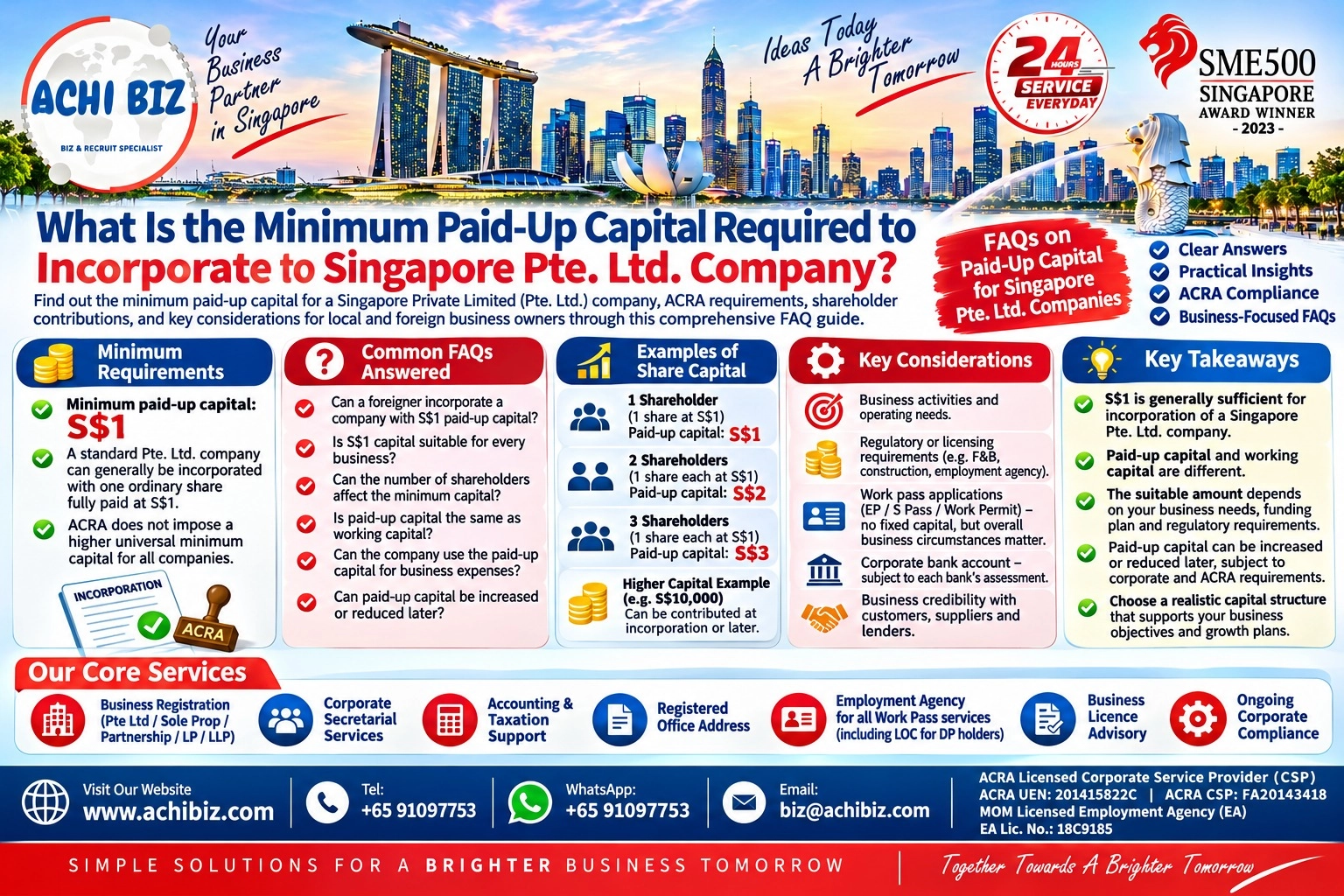
A Comprehensive FAQ Guide to Minimum Share Capital, Paid-Up Capital, ACRA Requirements and Company Incorporation in Singapore
Starting a Private Limited (Pte. Ltd.) company in Singapore is relatively straightforward, but one question frequently arises before incorporation: How much paid-up capital must a company have to get started?
Many entrepreneurs assume that incorporating a company requires thousands of dollars in initial capital. Others believe that declaring S$1 as paid-up capital means the business can operate without additional funding.
The reality is more straightforward, but there are important legal, financial and practical considerations.
This FAQ guide explains the minimum paid-up capital required to incorporate a Singapore Pte. Ltd. company, how paid-up capital works, what shareholders need to contribute, and how the amount declared may affect business operations, regulatory requirements and future growth.
Frequently Asked Questions (FAQs) About Minimum Paid-Up Capital in Singapore
What is the minimum paid-up capital required to incorporate a Singapore Pte. Ltd. company?
For a typical Singapore Private Limited company, the minimum initial issued share capital is generally S$1, represented by one ordinary share. Where that share is fully paid, the company’s paid-up capital will also be S$1. This makes Singapore attractive to entrepreneurs who want to establish a company without committing substantial initial share capital. However, certain regulated business activities, licensing conditions or specific business arrangements may require higher capital.
Is S$1 paid-up capital legally sufficient to register a Singapore company with ACRA?
Yes. A standard Singapore Pte. Ltd. company can generally be incorporated with one ordinary share issued for S$1 and fully paid. The Accounting and Corporate Regulatory Authority (ACRA) does not impose a universal minimum paid-up capital of S$10,000, S$50,000 or S$100,000 for all private limited companies. The S$1 starting point does not remove the company’s obligation to meet other incorporation and regulatory requirements.
Is the minimum share capital the same as the minimum paid-up capital?
Not necessarily. Issued share capital refers to the shares issued by the company and the amount payable for those shares. Paid-up capital refers to the portion of the issued share capital that shareholders have actually paid or otherwise satisfied through valid consideration. For example, if a company issues one ordinary share for S$1 and receives the full S$1, both its issued share capital and paid-up capital are S$1. If the share has not been fully paid, the two amounts may differ.
Can a Singapore Pte. Ltd. company be incorporated with zero paid-up capital?
A company generally needs at least one issued share and at least one shareholder at incorporation. A company may have issued shares that are not fully paid, depending on the terms of issue and the applicable incorporation arrangements. However, this should not be confused with incorporating a company without issuing any shares. For a straightforward incorporation, issuing one fully paid ordinary share for S$1 is generally the simplest approach.
Why do many Singapore companies start with S$1 paid-up capital?
Starting with S$1 reduces the amount shareholders need to commit as equity at incorporation. It is particularly common among entrepreneurs establishing small businesses, consultancy firms, holding companies and other businesses that do not require substantial initial share capital. Nevertheless, S$1 is only a legal starting point. It is not necessarily the most suitable amount for every business.
Is S$1 paid-up capital suitable for every Singapore company?
No. Although S$1 may satisfy the general incorporation requirement, the appropriate amount depends on the company’s business activities, anticipated expenses, financing needs and applicable regulatory conditions. A company expecting to employ staff, lease commercial premises, purchase inventory or apply for a regulated business licence may need considerably more funding.
Does Singapore law require S$1,000 paid-up capital for a Pte. Ltd. company?
No. There is no general requirement for every Singapore private limited company to start with S$1,000 paid-up capital. A shareholder may choose to contribute S$1,000 or more, but that is usually a commercial decision rather than a universal statutory requirement. Certain businesses may nevertheless be subject to specific minimum capital conditions.
Is S$10,000 paid-up capital compulsory for foreign-owned companies in Singapore?
No. Foreign ownership alone does not create a universal S$10,000 paid-up capital requirement. A foreign-owned Singapore Pte. Ltd. company can generally begin with S$1 paid-up capital, subject to the same incorporation rules and any industry-specific conditions. Foreign shareholders should separately consider work pass eligibility, licensing requirements, banking arrangements and operational funding.
Can a foreigner incorporate a Singapore Pte. Ltd. company with S$1 paid-up capital?
Yes. Foreign individuals and foreign corporate entities may generally hold shares in Singapore private limited companies, including companies incorporated with S$1 paid-up capital. However, the company must satisfy Singapore’s incorporation requirements, including having at least one director who is ordinarily resident in Singapore. Foreign ownership and the right to work in Singapore are separate legal matters.
Does a Singapore company need a local shareholder to qualify for S$1 paid-up capital?
No. A Singapore private limited company may generally be wholly foreign-owned. The requirement to appoint at least one ordinarily resident director does not mean that the company must have a Singapore citizen or permanent resident shareholder.
Can a Singapore citizen incorporate a company with only S$1 paid-up capital?
Yes. A Singapore citizen may incorporate a standard Pte. Ltd. company with one fully paid ordinary share of S$1, provided all other incorporation requirements are met. The same general minimum capital principle applies regardless of whether the shareholder is Singaporean or foreign.
Can a Singapore permanent resident incorporate a Pte. Ltd. company with S$1 paid-up capital?
Yes. A Singapore permanent resident can generally incorporate a private limited company with S$1 paid-up capital. The company must still meet its statutory requirements concerning directors, shareholders, company secretary, registered office and other applicable matters.
Can a single shareholder own 100% of a Singapore company with S$1 paid-up capital?
Yes. A company may have one shareholder holding one ordinary share issued for S$1. If that is the company’s only issued share, the shareholder owns 100% of its issued shares. Ownership percentage is determined by the relevant shareholdings and share rights, not by how large the paid-up capital amount is.
Can two shareholders incorporate a Singapore company with S$1 paid-up capital?
A company can have two shareholders, but the share structure must be planned carefully. For example, two shareholders could each subscribe for one ordinary share issued for S$1, resulting in S$2 issued and paid-up capital. Alternatively, different issue prices or other valid arrangements may be considered. The company should avoid assuming that S$1 paid-up capital can always be divided into two conventional shares of equal nominal value, because Singapore shares operate under a no-par-value regime.
Can three or more shareholders incorporate a Singapore Pte. Ltd. company with low paid-up capital?
Yes. A company may have multiple shareholders and relatively low initial paid-up capital. For simplicity, three shareholders might subscribe for one ordinary share each at S$1, resulting in S$3 paid-up capital. The actual number of shares, subscription prices and ownership percentages should reflect the intended shareholder arrangements.
Does the number of shareholders determine the minimum paid-up capital?
Not directly. The number of shareholders affects the proposed share allocation, but it does not create a fixed statutory minimum capital amount for each shareholder. The company must ensure that its share structure is valid and accurately recorded.
Does every shareholder need to contribute the same amount of paid-up capital?
No. Shareholders may subscribe for different numbers of shares or, where properly authorised, shares issued on different terms. For example, one shareholder may contribute S$9,000 while another contributes S$1,000. However, capital contributions and share ownership must be documented correctly, and shareholders should understand the resulting ownership and voting rights.
Can shareholders contribute different amounts but own equal percentages of the company?
Potentially, yes. Different subscription prices or appropriately structured share arrangements may result in equal shareholdings despite unequal financial contributions. Such arrangements should be properly authorised, documented and assessed for their legal, accounting and tax implications. The company should not assume that unequal contributions automatically produce equal ownership.
What is the difference between S$1 paid-up capital and S$1,000 paid-up capital?
The main difference is the amount of equity contributed to the company. A company with S$1 paid-up capital has received substantially less initial equity funding than a company with S$1,000 paid-up capital. However, higher paid-up capital does not automatically mean the company is profitable, solvent or financially successful.
Is S$1 paid-up capital enough to operate a business in Singapore?
It may be legally sufficient to incorporate the company, but it is rarely enough to cover meaningful business operating expenses. Even a small business may incur costs for accounting, corporate secretarial services, software, banking, licences, marketing and other activities. The company should have a realistic funding plan beyond simply meeting the minimum incorporation requirement.
Does paid-up capital have to cover the company’s first-year operating expenses?
There is no universal requirement for paid-up capital to equal the company’s first-year operating expenses. A company may obtain funding through equity, shareholder loans, commercial loans or other lawful sources. However, directors should ensure that the company can meet its financial obligations as they fall due.
Is paid-up capital the same as the company’s working capital?
No. Paid-up capital represents shareholder equity contributed to the company. Working capital generally refers to current assets less current liabilities. A company may have substantial paid-up capital but limited working capital if its funds have already been used or invested.
Does S$1 paid-up capital mean the company has only S$1 in its bank account?
No. Paid-up capital and the bank balance are different financial measures. A company may start with S$1 paid-up capital and subsequently receive business revenue, loans or additional funding. Its bank balance can therefore be higher or lower than its recorded paid-up capital.
Must the paid-up capital remain in the company’s bank account permanently?
No. Paid-up capital is not ordinarily required to remain untouched in the company’s bank account. Once properly contributed, it becomes part of the company’s funds and may generally be used for legitimate business purposes. However, shareholders cannot simply withdraw company capital for personal use without a proper legal basis.
Can the company use its S$1 paid-up capital immediately after incorporation?
Generally, yes. Once the funds are properly contributed to the company, they may be used for legitimate business expenses. The company must maintain appropriate accounting records and comply with applicable legal requirements.
Must shareholders deposit paid-up capital before incorporating the company?
Not necessarily. A newly incorporated company may not yet have a corporate bank account before registration. Where shares are represented as fully paid, the company must nevertheless ensure that the subscription consideration has genuinely been provided and is accurately recorded. The timing and method of payment should be properly documented rather than assumed.
Can paid-up capital be deposited after the company has been incorporated?
Depending on the agreed subscription arrangements, payment may be made after incorporation. However, shares should not be described as fully paid when the subscription consideration remains outstanding. The company’s statutory records, accounting entries and ACRA information must accurately reflect the actual position.
Can shareholders pay their share capital using personal bank transfers?
Yes, shareholders may generally transfer subscription funds from their personal bank accounts to the company’s bank account. The company should retain supporting records identifying the shareholder, payment date, amount and purpose of the transfer. A clear transaction description, such as “Share Capital Contribution”, can assist with recordkeeping.
Can shareholders contribute paid-up capital in cash?
Cash contributions may be possible, but proper evidence and accounting documentation are essential. The company should maintain reliable records showing the amount received, the contributing shareholder and the corresponding shares. Cash transactions may also attract additional banking and anti-money-laundering scrutiny.
Can paid-up capital be contributed in a foreign currency?
Yes, subject to the company’s share capital denomination and proper recording of the transaction. Singapore companies may have share capital denominated in currencies other than Singapore dollars. The company should ensure that the currency, consideration and accounting treatment are accurately documented.
Can a Singapore Pte. Ltd. company be incorporated with US$1 paid-up capital?
A company may generally issue shares denominated in a foreign currency, including US dollars. However, the incorporation details, share denomination and applicable regulatory conditions must be handled correctly. The company should not assume that a foreign-currency amount satisfies a particular licensing requirement stated in Singapore dollars.
Can a Singapore company have share capital in more than one currency?
Potentially, yes. Singapore companies may have share capital arrangements involving different currencies, subject to applicable filing and accounting requirements. Such arrangements can introduce additional complexity in financial reporting and capital management.
Is paid-up capital the same as money invested by shareholders?
Not always. Money contributed by shareholders in exchange for shares generally forms part of the company’s equity. However, shareholders may also provide funds as loans or other forms of financing. The legal and accounting treatment depends on the nature of the transaction, not merely on who provided the money.
Can shareholders provide additional funding without increasing paid-up capital?
Yes. A shareholder may lend money to the company without subscribing for additional shares. Such funding is generally recorded as a shareholder loan or another appropriate liability, depending on the terms. It should not automatically be classified as paid-up capital.
Is a director’s loan considered paid-up capital?
No. A genuine director’s loan is generally a liability owed by the company to the director. Paid-up capital represents equity contributed in respect of shares. The two have different legal and accounting consequences.
Can a company increase its paid-up capital after incorporation?
Yes. A Singapore private limited company may increase its paid-up capital after incorporation through appropriate corporate actions. Depending on the circumstances, this may involve issuing new shares or receiving payment for previously unpaid issued shares. The company must comply with the Companies Act, its Constitution and relevant ACRA filing requirements.
Is there a deadline for increasing paid-up capital after incorporation?
There is no universal requirement for an ordinary Singapore Pte. Ltd. company to increase its paid-up capital from S$1 to a particular amount within a fixed period. However, a business licence, financing arrangement or other regulatory condition may impose its own capital requirements or deadlines.
Can a Singapore company increase paid-up capital from S$1 to S$10,000?
Yes. For example, a company with one fully paid S$1 ordinary share may issue additional shares for an aggregate subscription amount of S$9,999. If the new shares are fully paid, the company’s total paid-up capital would become S$10,000. The number of shares and their issue prices should be determined according to the intended share structure.
Can paid-up capital increase without issuing additional shares?
Yes, in appropriate circumstances. If existing issued shares are partly paid, shareholders may pay the outstanding subscription amounts. This can increase the paid-up portion of issued share capital without issuing additional shares. The company must ensure that its records and any applicable regulatory notifications are updated correctly.
Can paid-up capital be reduced after incorporation?
Yes, but reducing share capital is not the same as withdrawing money from the company. A formal capital reduction may require compliance with statutory procedures, shareholder approvals, solvency requirements and other safeguards. It should not be treated as a routine reversal of an earlier capital contribution.
Can shareholders withdraw their paid-up capital whenever they want?
No. Once contributed as share capital, the funds belong to the company. Shareholders cannot simply reclaim their contributions as if the money were held in a personal savings account. Any return of capital must follow an appropriate lawful procedure.
Is paid-up capital refundable when a shareholder leaves the company?
Not automatically. A departing shareholder may sell or transfer shares, participate in a lawful share buyback or receive proceeds under another permitted arrangement. The company is not automatically required to refund the original subscription amount.
Does paid-up capital affect the shareholder’s ownership percentage?
Paid-up capital alone does not determine ownership percentage. Ownership generally depends on the number and classes of shares held and their associated rights. For example, a shareholder holding 60 out of 100 ordinary shares of the same class generally holds 60% of that class, regardless of the company’s current bank balance.
Does higher paid-up capital give shareholders more voting rights?
Not necessarily. Voting rights depend on the company’s Constitution, share classes and terms of issue. A shareholder who contributes more money does not automatically receive additional voting rights unless the share arrangements provide for them.
Does S$1 paid-up capital limit the company’s ability to earn revenue?
No. A company incorporated with S$1 paid-up capital is not subject to a general revenue ceiling simply because its initial share capital is low. Its ability to conduct business depends on its lawful activities, operational capacity, funding and applicable regulatory requirements.
Does S$1 paid-up capital limit the number of employees a company can hire?
There is no universal rule linking employee headcount directly to S$1 paid-up capital. However, the company must have sufficient resources to meet salary obligations, CPF contributions where applicable, and other employment costs. Work pass applications may involve separate assessments of the company’s business activities and financial position.
Is higher paid-up capital compulsory before applying for an Employment Pass?
There is no universal rule requiring every Singapore company to have a fixed paid-up capital amount before submitting an Employment Pass application. MOM assesses applications according to the applicable eligibility criteria and may consider the employer’s business circumstances. A higher paid-up capital figure does not guarantee Employment Pass approval.
Does S$1 paid-up capital prevent a company from applying for an S Pass?
Not automatically. S Pass applications are governed by MOM’s eligibility requirements, including salary, quota, levy and other applicable conditions. A company’s actual business operations and ability to employ the worker may also be relevant. S$1 paid-up capital alone should not be treated as an automatic disqualification or as proof that the company qualifies.
Does paid-up capital affect Work Permit applications?
Paid-up capital is not the sole determining factor for Work Permit eligibility. The applicable rules depend on the company’s sector, worker category, quota, levy and other MOM requirements. Employers should assess the relevant Work Permit conditions separately from their incorporation capital.
Does a company need higher paid-up capital to sponsor foreign employees?
Not necessarily as a universal statutory requirement. However, a company planning to hire foreign employees should maintain adequate business funding, proper records and genuine operational activities. MOM may require information relevant to the employer’s circumstances.
Does higher paid-up capital guarantee approval of a Singapore work pass?
No. Work pass approval is determined by MOM under the applicable work pass framework. Increasing paid-up capital solely to create the appearance of financial strength does not guarantee approval and should never involve inaccurate or artificial capital declarations.
Does S$1 paid-up capital affect the opening of a corporate bank account?
It may influence a bank’s assessment, but it does not automatically prevent account opening. Banks typically conduct customer due diligence and consider matters such as ownership, business activities, expected transactions, source of funds and risk profile. Individual banks may have their own account-opening and minimum-balance conditions.
Is there a minimum paid-up capital requirement imposed by Singapore banks?
There is no single paid-up capital requirement applicable to every corporate bank account in Singapore. Each bank may apply its own onboarding criteria and account conditions. A minimum account balance or initial deposit should not be confused with a statutory minimum paid-up capital requirement.
Can a company with S$1 paid-up capital obtain business financing?
Potentially, yes. However, lenders may consider the company’s financial statements, cash flow, creditworthiness, business history, security and shareholders’ financial support. A company with minimal equity and no operating history may find borrowing more difficult.
Does higher paid-up capital improve a company’s credibility?
It can be one factor in how customers, suppliers, lenders and business partners assess a company. However, paid-up capital is not proof of available cash, profitability or financial stability. Business track record, audited or unaudited financial information, payment history and management capability may be equally or more important.
Is S$1 paid-up capital appropriate for a consultancy or professional services company?
It may be suitable for a small consultancy with limited initial expenses and no specific regulatory capital requirement. However, professional licences, insurance obligations, staffing requirements and operating costs should be assessed separately.
Is S$1 paid-up capital suitable for an online business or e-commerce company?
It may be legally sufficient for incorporation. Nevertheless, an e-commerce business may need funds for inventory, website development, payment processing, advertising, logistics and customer refunds. The amount of initial paid-up capital should reflect the business’s funding strategy.
Can a trading company be incorporated with S$1 paid-up capital?
Generally, yes, where no specific regulatory capital requirement applies. However, suppliers, customers, banks and trade-finance providers may assess the company’s financial capacity before extending credit or entering into significant contracts.
Can an investment holding company start with S$1 paid-up capital?
Generally, yes. A private investment holding company may be incorporated with low initial paid-up capital, subject to its actual activities and applicable laws. However, a company conducting regulated fund management or other regulated financial activities may be subject to separate licensing and capital requirements.
Can a property investment company start with S$1 paid-up capital?
A property investment company may generally be incorporated with S$1 paid-up capital. However, acquiring property may involve substantial funding, financing requirements, stamp duties and other legal or regulatory considerations. The minimum incorporation capital should not be confused with the funds required to purchase or hold property.
Can a construction company be incorporated with S$1 paid-up capital?
A construction company may generally be incorporated with S$1 paid-up capital. However, particular BCA registrations, contractor classifications, licensing schemes or tender requirements may impose additional financial criteria. The company should assess these requirements before commencing the relevant activities.
Can a food and beverage company be incorporated with S$1 paid-up capital?
Generally, yes. However, a restaurant, café or other food business may require licences, premises, equipment, staffing and substantial operating funds. The company’s ability to operate legally and commercially depends on more than its initial paid-up capital.
Can an employment agency be incorporated with S$1 paid-up capital?
A company intending to operate an employment agency may generally be incorporated with low initial share capital. However, conducting employment agency activities requires compliance with MOM’s employment agency licensing framework, including applicable security bond and other licensing conditions. The incorporation minimum should not be mistaken for the requirements to obtain or maintain an employment agency licence.
Can a company increase its paid-up capital to meet licensing requirements?
Yes, where increasing capital is an appropriate way to satisfy the applicable requirement. However, the company should verify whether the regulator requires paid-up capital, issued share capital, net tangible assets, shareholders’ funds or another financial measure. These terms are not interchangeable.
Does paid-up capital determine whether a company qualifies as an SME?
Not by itself. Different Singapore government schemes, financial institutions and programmes may use criteria such as annual revenue, employment size, local shareholding or group structure. A company’s paid-up capital alone does not establish its SME status.
Does paid-up capital affect eligibility for government grants?
It may be relevant to certain schemes, but it is not a universal eligibility criterion. Grant requirements vary and may consider local ownership, business activities, operating history, revenue and other factors. Companies should review the specific conditions of each grant.
Is paid-up capital taxable income for a Singapore company?
Genuine share capital contributions are generally capital receipts rather than ordinary business revenue. They are not normally treated as taxable trading income merely because shareholders contribute funds in exchange for shares. However, the actual nature of the transaction and its documentation must be considered.
Is GST charged when shareholders contribute paid-up capital?
A genuine cash contribution in exchange for shares does not ordinarily attract GST simply because money is received as share capital. However, transactions involving non-cash consideration or other arrangements may require a more detailed GST assessment.
Can a company claim paid-up capital as a tax-deductible expense?
No. Paid-up capital is an equity contribution, not an ordinary business expense incurred by the company. The company may separately claim qualifying business expenses according to the Income Tax Act and IRAS rules.
Does higher paid-up capital reduce corporate income tax?
No. Singapore corporate income tax is generally based on taxable income, subject to applicable exemptions, deductions and reliefs. Increasing paid-up capital does not automatically reduce the company’s tax liability.
Does S$1 paid-up capital affect the company’s corporate income tax rate?
No. The general corporate income tax rate does not change merely because a company has S$1 rather than S$100,000 paid-up capital. Tax treatment depends on the relevant tax legislation and the company’s circumstances.
Is paid-up capital shown in the company’s financial statements?
Yes. Paid-up share capital is generally presented within the equity section of the statement of financial position, subject to the applicable accounting framework. The notes to the financial statements may also disclose details of issued shares and share capital movements.
Is paid-up capital recorded as revenue in the company’s accounts?
No. Genuine share capital contributions should be recorded as equity rather than sales or operating income. Incorrectly treating capital contributions as revenue can distort the company’s financial statements and tax reporting.
Can a company have S$100,000 paid-up capital but no money in its bank account?
Yes. A company may have received S$100,000 in share capital and subsequently used the funds for legitimate business expenditure or asset purchases. Its paid-up capital may remain S$100,000 even though its current bank balance is much lower.
Can a company have S$1 paid-up capital but S$1 million in its bank account?
Yes. The additional funds may arise from business revenue, loans, customer payments or other lawful sources. The company’s bank balance does not automatically determine its paid-up capital.
Does a company’s paid-up capital change when it makes a profit?
No. Profit generally increases retained earnings or another relevant component of equity, rather than automatically increasing share capital. A formal corporate action may be required to convert eligible reserves into share capital.
Does paid-up capital decrease when the company makes a loss?
Not automatically. Business losses generally reduce retained earnings or increase accumulated losses. The recorded paid-up capital does not automatically decrease merely because the company has incurred losses.
Does a company need to increase paid-up capital when it expands?
There is no universal requirement to increase paid-up capital whenever a company expands. However, additional equity funding may be commercially useful, and certain business activities or licences may require stronger capitalisation.
Can a company issue additional shares to existing shareholders after incorporation?
Yes. A Singapore private limited company may issue additional shares to existing shareholders, subject to applicable approvals, the Companies Act and its Constitution. The company should also consider how the issue affects ownership percentages and shareholder rights.
Can a company issue new shares to an investor without increasing the existing shareholders’ contributions?
Yes. A new investor may subscribe for newly issued shares while existing shareholders retain their current shares. However, the new allotment may dilute existing shareholders’ ownership percentages unless appropriate arrangements are made.
Does increasing paid-up capital always change the shareholders’ ownership percentages?
No. If all shareholders subscribe for new shares proportionately, their ownership percentages may remain unchanged. Likewise, payment of outstanding amounts on existing partly paid shares may increase paid-up capital without changing the number of shares held.
Does increasing paid-up capital automatically increase the value of each share?
No. The economic value of a share depends on various factors, including the company’s assets, liabilities, earnings, prospects and share rights. An increase in paid-up capital does not automatically produce an equivalent increase in the market or fair value of each share.
Can shares be issued at a price higher than S$1 per share?
Yes. Singapore operates a no-par-value share regime, and shares may be issued at different prices, subject to applicable legal and corporate requirements. A company may therefore issue a relatively small number of shares for a substantial total subscription amount.
Does Singapore still require authorised share capital?
No. Singapore abolished the traditional authorised share capital concept as part of its no-par-value share regime. Companies should distinguish historical references to authorised capital from the issued and paid-up share capital information relevant under the current framework.
Does a Singapore company need to issue shares with a nominal value of S$1 each?
No. Singapore shares do not have a statutory par or nominal value. Although issuing one share for S$1 is a common and convenient incorporation arrangement, it is not a mandatory nominal-value rule.
Can shares be issued for non-cash consideration?
Yes, subject to applicable legal requirements. Examples may include the transfer of eligible assets or other properly documented consideration. The company should ensure that the valuation, approvals, accounting treatment and relevant ACRA filings are appropriate.
Can intellectual property be contributed as share capital?
Potentially, yes. Intellectual property may be used as non-cash consideration for shares where the arrangement is legally valid and properly documented. Independent valuation and professional advice may be appropriate, particularly where the asset’s value is material or difficult to establish.
Can a shareholder contribute equipment or machinery instead of cash?
Potentially, yes. The company may issue shares in exchange for eligible assets, subject to proper approval, valuation and documentation. The transaction should not be recorded as a cash contribution when no cash was actually received.
Can a Singapore company issue partly paid shares?
Yes, subject to its Constitution, terms of issue and applicable law. A partly paid share is one for which some of the subscription consideration remains outstanding. Shareholders and directors should understand the payment obligations and any relevant rights or restrictions.
Is unpaid share capital considered money owed to the company?
Generally, unpaid subscription amounts may represent obligations of the relevant shareholders, depending on the terms of issue. The precise accounting treatment depends on the contractual arrangements and applicable accounting standards. The company should maintain clear records of amounts paid and outstanding.
Can the company demand payment of unpaid share capital later?
Potentially, yes. The company’s ability to call for payment depends on the share terms, Constitution and applicable law. Shareholders should understand these obligations before accepting partly paid shares.
Can a shareholder be personally liable for unpaid share capital?
Yes. A shareholder’s limited liability does not necessarily eliminate the obligation to pay amounts outstanding on shares. In a company limited by shares, a shareholder’s exposure may include unpaid amounts on the shares held.
Does S$1 paid-up capital mean the shareholder can never lose more than S$1?
Not necessarily. Although limited liability generally protects shareholders from the company’s debts beyond their relevant share obligations, separate personal guarantees, contractual commitments, misconduct or other legal liabilities may create additional exposure. The S$1 capital amount should not be interpreted as universal protection against every financial obligation.
Can directors be personally liable even when the company has only S$1 paid-up capital?
Yes, in certain circumstances. A company’s separate legal personality does not remove directors’ statutory duties and potential personal liabilities. Directors must comply with the Companies Act and other applicable laws regardless of the company’s paid-up capital.
Does S$1 paid-up capital make a company less legally valid than one with S$100,000?
No. A properly incorporated company with S$1 paid-up capital is a legally recognised corporate entity. The amount of share capital does not determine whether the company has separate legal personality.
Can a company with S$1 paid-up capital enter into large commercial contracts?
Generally, yes. There is no universal rule preventing a company from entering into a substantial contract solely because it has low paid-up capital. However, counterparties may require evidence of financial capacity, guarantees, deposits or other contractual safeguards.
Can a company with S$1 paid-up capital participate in government tenders?
Potentially, yes. Tender eligibility depends on the specific procurement requirements. Some tenders may impose financial, registration, track-record or other qualifying conditions that a newly incorporated company may not satisfy.
Is the minimum paid-up capital different for an Exempt Private Company (EPC)?
There is no separate universal S$1,000 or S$10,000 paid-up capital requirement merely because a company qualifies as an Exempt Private Company. EPC status concerns the company’s ownership and statutory classification, not a higher general incorporation capital threshold.
Is the minimum paid-up capital different for a wholly owned subsidiary?
Not ordinarily. A Singapore subsidiary owned by a local or foreign corporate shareholder may generally be incorporated with low initial paid-up capital. However, the parent company’s investment policies, regulatory requirements or financing arrangements may call for a higher amount.
Can a holding company own a subsidiary with S$1 paid-up capital?
Yes. A holding company may subscribe for one fully paid ordinary share of S$1 in a subsidiary, subject to the applicable incorporation requirements. The subsidiary’s future funding needs should be assessed separately.
Does a Singapore company need to disclose its paid-up capital to ACRA?
Yes. Share capital and shareholding information form part of the company’s statutory and ACRA records. The company must ensure that relevant information and subsequent changes are accurately maintained and filed where required.
Is paid-up capital information publicly available in Singapore?
Certain share capital and company information may be available through ACRA’s business information products. The extent of information accessible depends on the relevant product and applicable disclosure rules.
Must a company notify ACRA when it receives additional paid-up capital?
The required action depends on the nature of the transaction. For example, a new share allotment generally involves statutory filing obligations. Where an existing partly paid share becomes further paid, the company should determine the applicable notification and record-update requirements. Not every receipt of money from a shareholder is a share capital transaction.
Can a company secretary assist with changes to paid-up capital?
Yes. A company secretary or corporate service provider can assist with the relevant resolutions, share allotment documentation, statutory registers and ACRA filings. The exact work depends on whether the transaction involves a new share issue, payment of unpaid capital, capital reduction or another corporate action.
What documents are generally required when increasing paid-up capital?
The required documents depend on the transaction, but may include directors’ and shareholders’ resolutions, subscription documents, evidence of payment, updated share records and relevant ACRA filings. The company’s Constitution and any shareholders’ agreement should also be reviewed.
Can a company increase its paid-up capital immediately after incorporation?
Yes. There is generally no universal waiting period preventing a company from increasing its share capital shortly after incorporation. The necessary approvals, subscription arrangements and statutory filings must still be completed.
Should entrepreneurs start with S$1 or a higher paid-up capital amount?
There is no single answer suitable for every business. S$1 may be appropriate where the company has minimal initial expenses and no special capital requirement. A higher amount may be preferable where the company expects substantial operating expenses, regulatory capital conditions or commercial commitments. The decision should reflect genuine funding needs rather than appearances alone.
What are the disadvantages of incorporating a company with only S$1 paid-up capital?
The principal disadvantage is that the company begins with minimal shareholder equity funding. This may be commercially inconvenient where the business needs immediate expenditure or where banks, suppliers and counterparties expect evidence of financial resources. However, low paid-up capital does not automatically prevent successful operations.
What are the advantages of starting with S$1 paid-up capital?
It reduces the amount of equity shareholders must initially commit and provides flexibility to arrange further funding as business needs become clearer. It can be suitable for entrepreneurs testing a business concept or establishing a company with limited initial operating requirements.
Is there a maximum paid-up capital permitted for a Singapore Pte. Ltd. company?
There is no general statutory maximum paid-up capital applicable to every Singapore private limited company. However, share issues must comply with applicable law, corporate approvals, the company’s Constitution and any relevant regulatory restrictions.
Can paid-up capital be increased in stages?
Yes. A company may receive additional equity contributions through properly structured transactions at different stages of its development. Each transaction should be documented and recorded accurately.
Can a company maintain S$1 paid-up capital for many years?
Generally, yes. An ordinary Singapore private limited company is not automatically required to increase its paid-up capital merely because it has been operating for several years. However, its business and regulatory circumstances may change.
Does paid-up capital affect the company’s annual return filing requirements?
The amount of paid-up capital does not generally remove a company’s obligation to comply with applicable annual return requirements. Share capital information may form part of the company’s statutory records and filings. The company must continue meeting its Companies Act obligations regardless of whether its paid-up capital is S$1 or substantially higher.
Does S$1 paid-up capital exempt a company from preparing financial statements?
No. A company must assess its financial reporting obligations under the Companies Act and applicable accounting standards. Low paid-up capital alone does not create a blanket exemption from preparing financial statements.
Does paid-up capital determine whether a company needs an audit?
Not by itself. Singapore’s audit exemption framework considers the relevant statutory criteria, including the applicable small-company and group requirements. A company should not assume that S$1 paid-up capital automatically makes it audit-exempt.
Does S$1 paid-up capital exempt a company from appointing a company secretary?
No. A Singapore company must comply with the statutory requirement to appoint a company secretary within the prescribed period after incorporation. The amount of paid-up capital does not remove that obligation.
Does S$1 paid-up capital exempt a company from maintaining accounting records?
No. Every company must maintain proper accounting records as required by law. Accurate records are essential even where the company’s initial capital and transaction volume are minimal.
Does a dormant company still need paid-up capital?
A dormant company may continue to have issued and paid-up share capital even when it is not carrying on business. Dormancy does not automatically cancel shares or eliminate the company’s capital structure.
Can a dormant company retain only S$1 paid-up capital?
Yes. A dormant company may retain its original S$1 paid-up capital, subject to its actual share capital arrangements and any applicable legal requirements. Dormancy and paid-up capital are separate concepts.
What is the most common misunderstanding about minimum paid-up capital in Singapore?
One of the most common misunderstandings is that S$1 paid-up capital means S$1 is sufficient to establish and operate a functioning business. In reality, S$1 is generally sufficient for the initial share capital of a standard Singapore Pte. Ltd. company, but it is not a measure of the funds required to run the business. Entrepreneurs should distinguish legal incorporation requirements from actual business funding needs.
What should business owners consider before deciding their initial paid-up capital?
Business owners should consider their expected operating costs, shareholder funding arrangements, proposed ownership structure, regulatory requirements, banking expectations and future investment plans. They should also determine whether additional funds will be contributed as equity or loans. Choosing an appropriate capital structure at the beginning can help avoid unnecessary complications later.
Can ACHI BIZ assist with incorporating a Singapore company with S$1 paid-up capital?
Yes. ACHI BIZ SERVICES PTE. LTD., an ACRA Licensed Corporate Service Provider (CSP), assists local and foreign entrepreneurs with Singapore company incorporation, share capital structuring, corporate secretarial services and related ACRA compliance matters. Where appropriate, ACHI BIZ can also assist with subsequent share capital changes, share allotments and maintenance of statutory company records. Clients should assess whether the minimum capital amount is appropriate for their proposed business rather than selecting S$1 automatically.
Final FAQ: What Is the Best Minimum Paid-Up Capital for a New Singapore Pte. Ltd. Company?
The general starting point is S$1, represented by one fully paid ordinary share. This is sufficient for the initial share capital of many standard Singapore private limited companies.
However, the best amount depends on what the company intends to do after incorporation.
A small consultancy with limited operating expenses may have different funding needs from a restaurant, construction company, employment agency, investment business or company planning to employ foreign professionals.
The most practical approach is to begin with a legally compliant share structure and a realistic funding plan, while keeping future capital requirements in mind.
For assistance with company incorporation, share capital arrangements and corporate secretarial compliance in Singapore, contact ACHI BIZ SERVICES PTE. LTD.
Related Pages
Reduction of Capital in Singapore Pte Ltd Companies
Importance of Paid-Up Capital in Private Limited Companies (Pte Ltd)
Disclaimer: This article provides general information about Singapore company incorporation and share capital. Specific capital, licensing, tax and regulatory requirements depend on the company’s activities and circumstances. Professional advice should be obtained where appropriate.
#achibiz