
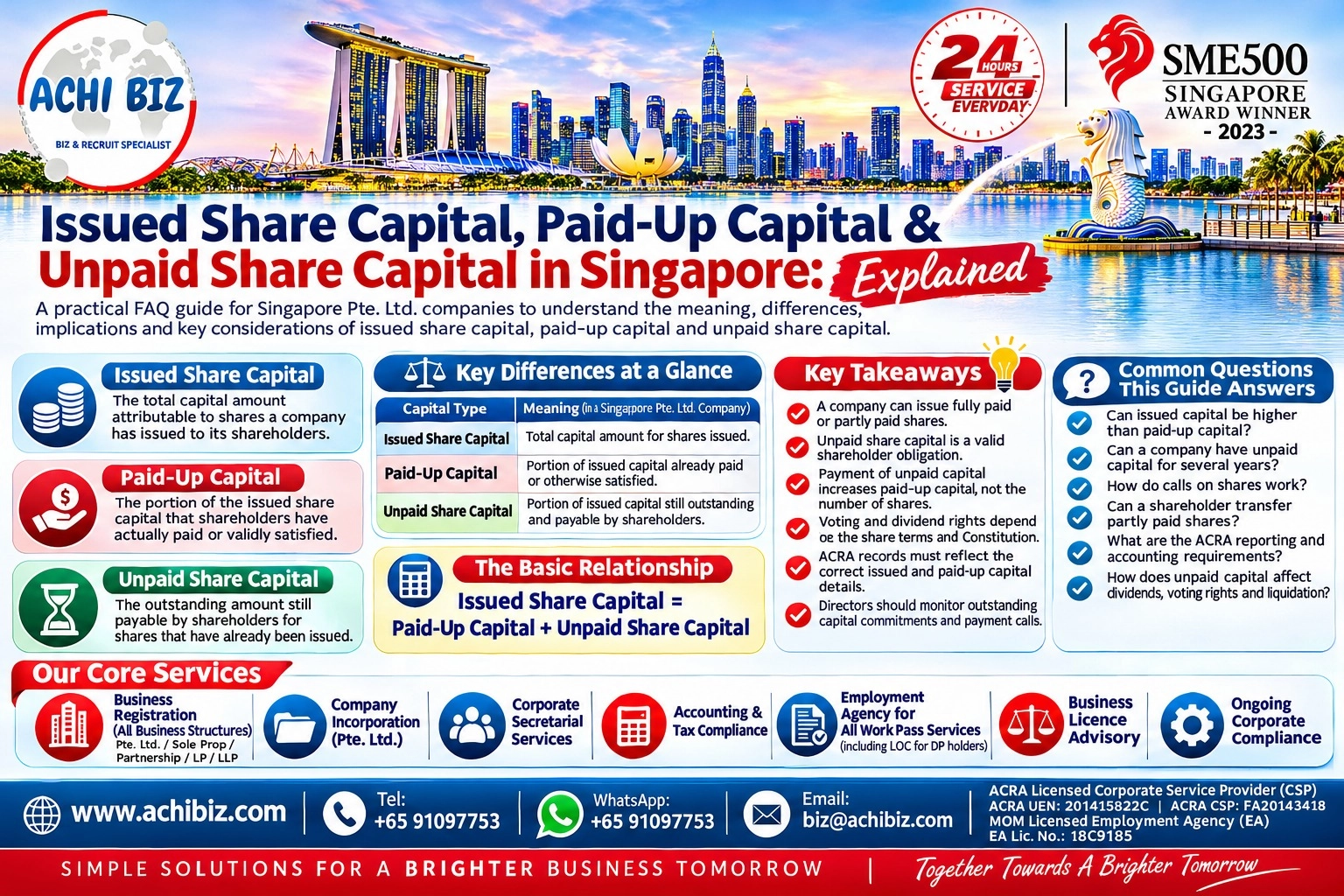
Issued Share Capital, Paid-Up Capital & Unpaid Share Capital in Singapore: Explained
A Comprehensive FAQ Guide for Singapore Pte. Ltd. Companies, Shareholders, Directors and Business Owners
When incorporating or managing a Singapore Private Limited (Pte. Ltd.) company, understanding the difference between issued share capital, paid-up capital and unpaid share capital is essential.
These three terms are closely related, but they do not mean the same thing. A company may issue shares without receiving their full subscription price immediately. It may also receive further payments on existing shares without issuing any additional shares.
Such distinctions matter when preparing company records, reviewing shareholders’ financial obligations, reporting capital information to ACRA and preparing financial statements.
For business owners, the practical questions are often more important than the terminology. How much does a shareholder actually owe? Can shares remain partly paid? Does unpaid share capital affect voting rights? What happens when a shareholder fails to pay? Can paid-up capital increase without changing the number of shares?
This FAQ guide by ACHI BIZ SERVICES PTE. LTD. explains these matters through practical examples, focusing on Singapore’s Companies Act 1967, ACRA compliance, corporate governance and accounting considerations.
The article concentrates on the differences, legal consequences and practical treatment of issued, paid-up and unpaid share capital. Detailed incorporation capital requirements, share allotment procedures, capital reduction and pre-emption rights are addressed separately in related articles to avoid unnecessary duplication.
Frequently Asked Questions (FAQs) About Issued Share Capital, Paid-Up Capital and Unpaid Share Capital in Singapore
What is issued share capital in a Singapore Pte. Ltd. company?
Issued share capital refers to the shares a company has issued to its shareholders and the capital amount attributable to those shares.
For example, if a company issues 10,000 ordinary shares at S$1 per share, its issued share capital would ordinarily be S$10,000.
However, the full amount may not have been received from shareholders. This is why issued share capital must be distinguished from paid-up capital.
What is paid-up share capital in Singapore?
Paid-up share capital is the portion of the issued share capital that shareholders have actually paid or otherwise validly satisfied.
For example, if a shareholder subscribes for 10,000 shares at S$1 each and pays the full S$10,000, the company’s issued share capital and paid-up capital are both S$10,000.
If only S$6,000 has been paid, the company has S$6,000 paid-up capital and S$4,000 unpaid share capital, assuming the full subscription amount remains legally payable.
What is unpaid share capital in a Singapore company?
Unpaid share capital refers to the outstanding amount payable by shareholders for shares already issued to them.
It represents the difference between the amount payable for the issued shares and the amount actually paid or otherwise discharged.
For example, a shareholder subscribes for 5,000 shares at S$2 each, creating a total subscription obligation of S$10,000. If S$7,000 is paid, the remaining S$3,000 is unpaid share capital.
What is the main difference between issued share capital, paid-up capital and unpaid share capital?
The distinction is straightforward:
| Capital type | Meaning |
|---|---|
| Issued share capital | Total capital amount attributable to shares issued |
| Paid-up capital | Portion of issued capital already paid or satisfied |
| Unpaid share capital | Portion of issued capital remaining payable |
In a straightforward subscription arrangement:
Issued Share Capital = Paid-Up Capital + Unpaid Share Capital
This relationship assumes the amounts are measured on a consistent basis and the unpaid subscription obligation remains valid.
Can issued share capital be higher than paid-up capital?
Yes.
This occurs when a company issues partly paid shares.
For example, a company issues shares with an aggregate subscription amount of S$100,000 but receives only S$40,000.
Its issued share capital may be S$100,000, with S$40,000 paid and S$60,000 remaining unpaid.
The company’s statutory records and accounting treatment must reflect the actual arrangements.
Can paid-up capital be higher than issued share capital?
Not ordinarily when comparing the same share capital amounts on a consistent basis.
Paid-up capital represents the paid portion of issued share capital, so it cannot exceed the amount attributable to those issued shares merely because the company has received additional funds.
Money received beyond the subscription obligations must be properly classified according to its actual nature.
Can unpaid share capital exist even though shares have already been issued?
Yes.
The issue of shares and the full payment for those shares are separate matters.
A company may issue shares under terms allowing the subscription consideration to be paid in instalments or when validly called.
The shares can therefore exist before the full subscription amount is paid.
Does unpaid share capital mean the shares are invalid?
No.
Properly issued partly paid shares can be legally valid.
However, their terms, payment obligations, rights and restrictions must comply with the Companies Act, the company’s Constitution and any relevant agreements.
What is the difference between fully paid shares and partly paid shares?
Fully paid shares are shares for which the entire subscription consideration has been paid or validly satisfied.
Partly paid shares are shares for which some consideration remains outstanding.
For example, a share issued for S$10 with S$10 paid is fully paid. A share issued for S$10 with S$4 paid and S$6 outstanding is partly paid.
What does it mean when shares are described as unpaid?
It generally means that the shareholder has not yet paid some or all of the amount payable for the shares.
An entirely unpaid share has no subscription consideration paid, while a partly paid share has some consideration paid.
The exact legal position depends on the share terms and applicable law.
Can a Singapore company issue shares without receiving immediate full payment?
Yes, where the terms of issue and the company’s governing documents permit.
The company must accurately record the amount paid and outstanding.
Directors should also consider whether the payment arrangement serves a legitimate commercial purpose and adequately protects the company’s interests.
Is unpaid share capital the same as a shareholder loan?
No.
Unpaid share capital represents an amount the shareholder owes the company for issued shares.
A shareholder loan generally represents money the shareholder has lent to the company.
These transactions have different legal, accounting and repayment consequences.
Is unpaid share capital the same as a director’s loan?
No.
An unpaid share subscription is an obligation arising from shares.
A director’s loan is a financing arrangement between the director and the company.
A person may be both a director and shareholder, but their obligations in each capacity must be distinguished.
Is unpaid share capital considered a company debt?
Depending on the subscription terms and when payment becomes due, unpaid share capital may give rise to an enforceable obligation owed by the shareholder to the company.
However, not every unpaid amount is necessarily immediately due and payable.
The company should distinguish amounts already due from amounts that may become payable following a valid call or another contractual event.
Does unpaid share capital automatically become payable immediately after shares are issued?
Not necessarily.
The payment date depends on the terms of issue, subscription agreement, Constitution and applicable law.
Some shares may require immediate payment, while others may provide for instalments or future calls.
Can unpaid share capital remain outstanding for several years?
Potentially, yes.
There is no universal rule requiring every partly paid share to become fully paid within a fixed period.
However, the arrangement must remain consistent with the relevant legal documents, and the company should monitor outstanding obligations and their financial reporting implications.
Is there a statutory maximum percentage of unpaid share capital?
There is no universal percentage applicable to every Singapore private limited company.
The permissible arrangement depends on the share terms, governing documents and any applicable regulatory conditions.
A regulated business may face additional capital requirements that make substantial unpaid capital commercially or legally unsuitable.
Can a shareholder pay only 10% of the subscription amount initially?
Potentially, yes.
For example, shares with a total subscription amount of S$50,000 may be issued with S$5,000 initially paid and S$45,000 outstanding, where the arrangement is properly authorised and legally valid.
The company should ensure that the unpaid amount and payment conditions are clearly documented.
Can shares be issued with 100% of the subscription amount unpaid?
Potentially, subject to the terms of issue, applicable law and the company’s Constitution.
However, entirely unpaid shares require particular care because the company has issued ownership interests without receiving the subscription consideration.
The directors should consider the commercial rationale, enforceability of payment obligations and protection of the company’s interests.
Does Singapore’s no-par-value share regime affect issued and paid-up capital?
Yes.
Singapore abolished the traditional par-value system for shares.
Accordingly, a share does not have to carry a fixed nominal value such as S$1.
The amount payable for shares depends on the relevant issue terms rather than a statutory nominal value.
Does one ordinary share always represent S$1 issued share capital?
No.
One ordinary share may be issued for S$1, S$100, S$10,000 or another valid subscription amount.
The number of shares and the amount attributable to their issue are separate matters.
Can two companies have the same paid-up capital but different numbers of shares?
Yes.
Company A might have 10,000 fully paid ordinary shares with total paid-up capital of S$10,000.
Company B might have 100 fully paid ordinary shares with the same total paid-up capital of S$10,000.
Their capital amounts are equal, but their share structures differ.
Can two companies have the same number of issued shares but different paid-up capital?
Yes.
One company may issue 1,000 shares for an aggregate S$1,000, while another issues 1,000 shares for an aggregate S$100,000.
The number of shares does not, by itself, determine the capital amount.
Can a Singapore company have multiple classes of shares with different paid-up amounts?
Yes, subject to the Companies Act, the Constitution and the terms of issue.
A company may have ordinary shares, preference shares or other permitted share classes with different rights and payment arrangements.
The company should maintain accurate records for each class.
Does unpaid share capital affect the percentage of shares owned?
Not automatically.
A shareholder’s percentage ownership generally depends on the number and relevant classes of shares held.
For example, a shareholder holding 60 out of 100 ordinary shares of the same class generally holds 60% of that class even if those shares are partly paid.
However, rights attached to partly paid shares may be subject to valid restrictions.
Can a shareholder hold 50% of a company despite paying less than another shareholder?
Yes, depending on the share structure.
Two shareholders may each hold 500 ordinary shares out of 1,000 issued shares, giving each 50% of that class.
If one shareholder’s shares are fully paid and the other’s partly paid, their ownership percentages may remain equal, although their outstanding financial obligations differ.
Does the amount of paid-up capital determine voting rights?
Not necessarily.
Voting rights depend on the applicable statutory provisions, the Constitution and the rights attached to the shares.
A company should not assume that the shareholder who has contributed the most money automatically has the most votes.
Can partly paid shares carry voting rights?
Yes, depending on the applicable law and the company’s share terms.
However, voting rights may be affected by valid provisions relating to unpaid calls or other restrictions.
The company must review its Constitution and the terms of the relevant shares.
Can a shareholder with unpaid share capital vote at a general meeting?
Potentially, yes.
The answer depends on whether the shareholder is entitled to vote under the relevant share rights and whether any applicable restriction has arisen.
Unpaid capital alone should not automatically be treated as removing every voting right.
Can unpaid share capital affect dividend entitlements?
Yes, depending on the terms attached to the shares and the company’s Constitution.
Certain arrangements may provide for dividends to be calculated or paid by reference to amounts paid on shares.
However, such treatment must have a proper legal basis and should not be assumed to apply to all ordinary shares.
Can a company declare dividends when some shares are partly paid?
Potentially, yes.
The company must comply with the legal rules governing dividends and consider the rights attached to the relevant shares.
Dividend entitlements should be determined according to the company’s lawful share arrangements.
Can a shareholder receive dividends while still owing unpaid share capital?
Potentially, yes.
Receiving dividends and owing unpaid subscription consideration are separate legal matters.
However, the Constitution or applicable agreements may contain provisions affecting dividends or allowing lawful set-off arrangements.
Can dividends be used to settle unpaid share capital?
Possibly, where a valid dividend entitlement and legally effective set-off or payment arrangement exist.
The company should not automatically treat a proposed dividend as payment of share capital.
The dividend must first be lawfully declared or otherwise become payable, and the settlement must be properly documented.
Can unpaid share capital affect a shareholder’s entitlement during liquidation?
Yes.
Partly paid shareholders may have outstanding contribution obligations, and the rights attached to their shares may affect distributions.
The liquidator may need to consider unpaid amounts and the statutory framework governing contributories.
Can a shareholder be required to pay unpaid share capital when the company is wound up?
Yes, subject to the applicable law and the nature of the outstanding obligation.
In a company limited by shares, shareholders may remain liable for amounts unpaid on their shares.
This is an important qualification to the principle of limited liability.
Does limited liability protect shareholders from unpaid share capital obligations?
No, not from valid unpaid amounts on their shares.
Limited liability generally restricts shareholder exposure in respect of the company’s debts, but it does not automatically cancel outstanding share subscription obligations.
Can a shareholder lose their shares for failing to pay unpaid capital?
Potentially, where a lawful forfeiture mechanism applies.
The company must follow its Constitution, the relevant share terms and applicable legal requirements.
Shares should not be forfeited merely through an informal management decision.
What is a call on shares?
A call on shares is a formal demand for payment of an amount outstanding on partly paid shares, made in accordance with the applicable share terms and the company’s Constitution.
For example, a company may call for S$2 per share on shares with unpaid subscription amounts.
Who has authority to make a call on unpaid share capital?
The directors commonly exercise this authority where permitted by the Constitution and the relevant share terms.
The company should verify the required approval, notice period, payment date and procedural conditions before issuing a call.
Can directors demand payment of unpaid share capital at any time?
Not necessarily.
Their authority depends on the company’s Constitution, subscription terms and applicable law.
Directors must act within their powers and comply with their duties.
Must a shareholder receive notice before paying a call on shares?
Where the applicable provisions require notice, the company must provide it in the prescribed manner.
The notice should clearly identify the amount payable, payment deadline and other relevant requirements.
What happens if a shareholder ignores a valid call on shares?
The company may have legal remedies under its Constitution, subscription arrangements and applicable law.
Depending on the circumstances, these may include recovery of the outstanding amount, interest where validly provided for, or forfeiture procedures.
The company should obtain appropriate advice before taking enforcement action.
Can a company charge interest on overdue unpaid share capital?
Potentially, where the Constitution, subscription terms or another enforceable arrangement permits it.
The company should verify the applicable rate and legal basis.
Interest should not be imposed arbitrarily.
Can the company sue a shareholder for unpaid share capital?
Potentially, yes.
Where an amount is legally due and payable, the company may have a contractual or statutory basis to recover it.
The available remedy depends on the specific facts and governing documents.
Can a shareholder refuse to pay unpaid share capital because the company is making losses?
Not automatically.
A shareholder’s payment obligation does not ordinarily disappear merely because the company has become unprofitable.
The enforceability and timing of the obligation depend on the relevant terms and law.
Can a shareholder refuse to pay because they disagree with the directors?
Not necessarily.
Disagreement with management does not, by itself, extinguish a valid share subscription obligation.
Any dispute should be assessed separately from the shareholder’s payment duties.
Can a shareholder cancel an unpaid subscription obligation by resigning as a director?
No.
Resigning as a director does not automatically terminate obligations arising from share ownership.
A person’s position as director is legally distinct from their position as shareholder.
Can a shareholder avoid unpaid capital obligations by transferring their shares?
Not automatically.
The legal consequences depend on the terms of transfer, the company’s Constitution, applicable law and any continuing liabilities.
The transfer should not be treated as automatically releasing the transferor from every existing obligation.
Can partly paid shares be transferred to another person?
Potentially, yes.
The transfer must comply with the Companies Act, the company’s Constitution and any applicable contractual restrictions.
The parties should clearly address responsibility for outstanding subscription amounts.
Does the buyer of partly paid shares become responsible for unpaid capital?
The transferee may become subject to obligations attached to the shares, depending on the applicable law and transfer arrangements.
However, the transferor’s potential continuing liability must also be considered.
Professional advice is advisable where substantial unpaid capital is involved.
Can a company refuse to register a transfer of partly paid shares?
Potentially, where the Constitution and applicable law provide a valid basis for refusal.
The company should follow the relevant statutory and constitutional procedures.
Can partly paid shares be inherited?
Shares may pass through an estate according to the applicable succession and company law rules.
Where shares are partly paid, outstanding obligations and the company’s registration requirements must also be considered.
Can a shareholder gift partly paid shares to a family member?
Potentially, yes, subject to the applicable transfer rules and restrictions.
However, gifting shares does not automatically eliminate unpaid subscription obligations.
The financial consequences should be considered before completing the transfer.
Can unpaid share capital be waived by the company?
A company should not assume that it can simply waive unpaid share capital through an informal directors’ decision.
A waiver or release may affect the company’s capital structure, shareholder obligations and creditor interests. Depending on the circumstances, a formal capital reduction or another legally permitted procedure may be required.
The company should obtain professional advice before releasing a shareholder from an outstanding subscription obligation.
Can directors write off unpaid share capital as a bad debt?
Not merely because the shareholder has failed to pay.
The accounting treatment of an unrecoverable subscription amount and the legal release of the shareholder’s obligation are different matters.
A financial reporting adjustment does not necessarily extinguish the company’s legal right to recover the outstanding amount.
Can unpaid share capital be cancelled without reducing issued share capital?
Not automatically.
If a company intends to extinguish a shareholder’s obligation to pay for issued shares, it must consider whether the transaction changes the amount attributable to those shares and whether statutory capital maintenance procedures apply.
The legal substance of the arrangement matters more than the description used in accounting records.
Can unpaid share capital be converted into a shareholder loan?
This is not ordinarily a simple accounting reclassification.
Unpaid share capital is an amount owed by the shareholder to the company, whereas a shareholder loan normally represents money owed by the company to the shareholder.
Converting one into the other would require a legally coherent transaction and proper documentation. A journal entry alone cannot reverse the direction of the underlying obligation.
Can a shareholder’s existing loan to the company be used to settle unpaid share capital?
Potentially, yes.
For example, if the company genuinely owes a shareholder S$20,000 under a loan and that shareholder owes the company S$20,000 in unpaid subscription consideration, an appropriately authorised and documented set-off may be considered.
The company must establish that the obligations are genuine and that the settlement is legally effective.
Can unpaid share capital be settled through non-cash consideration?
Potentially, where the relevant share subscription arrangements and applicable law permit.
However, if the original subscription required cash payment, the company should not simply substitute assets or services without considering whether a valid variation or another corporate procedure is necessary.
Valuation, documentation and accounting treatment are important.
Can a shareholder settle unpaid capital by transferring property to the company?
Potentially, subject to the relevant legal arrangements.
For example, a shareholder might propose transferring equipment or another asset to satisfy an outstanding subscription obligation.
The company must assess whether the asset is acceptable consideration, whether the transfer is legally effective and whether the value attributed to it is supportable.
Can services performed by a shareholder automatically count as payment for shares?
No.
A shareholder’s work or services should not automatically be treated as payment of unpaid share capital.
Any arrangement involving shares issued for services or other non-cash consideration requires proper legal and accounting assessment.
Can unpaid share capital be paid in instalments?
Yes, where the terms of issue permit.
For example, a shareholder may agree to pay S$25,000 upon subscription and the remaining S$75,000 in three instalments.
The company should document the instalment dates, payment amounts and consequences of non-payment.
Can shareholders pay unpaid capital before the agreed due date?
Potentially, yes.
The company should verify whether advance payment is permitted under its Constitution and the relevant subscription terms.
It must also determine whether the amount received immediately becomes paid-up capital or is initially treated as an advance against future calls.
Is money paid in advance of a share call automatically paid-up capital?
Not necessarily.
Where the Constitution distinguishes payments made in advance of calls from amounts formally called or due, the company must consider the legal treatment of those advance payments.
The company should not assume that every advance automatically changes the paid-up status of the shares.
Can a company receive payment for unpaid shares from someone other than the shareholder?
Potentially, yes.
A third party may pay an amount on behalf of a shareholder, subject to the company’s acceptance and appropriate documentation.
However, the payment does not automatically transfer share ownership to the person providing the funds.
Can a director personally pay another shareholder’s unpaid share capital?
Potentially, yes.
The company must identify whether the payment is being made on behalf of the shareholder and whether any separate reimbursement arrangement exists.
The accounting records should reflect the actual transaction rather than treating the director as the shareholder without a valid share transfer or share allotment.
Can a parent company pay unpaid share capital on behalf of its subsidiary’s shareholder?
Potentially, depending on the corporate relationships and agreed arrangements.
The payment must have a legitimate legal and accounting basis.
Where related parties are involved, the company should also consider corporate approvals, financial reporting and any relevant tax consequences.
Does payment of unpaid share capital create new shares?
No.
Payment of an outstanding subscription amount on shares already issued does not, by itself, increase the number of issued shares.
It changes the paid-up status of the existing shares.
Does payment of unpaid share capital increase issued share capital?
It does not ordinarily increase the number of shares or the aggregate amount for which those shares were issued.
For example, where shares were issued for S$50,000 and S$30,000 remains unpaid, receiving the outstanding S$30,000 increases the paid-up portion without requiring a new issue of shares.
Does payment of unpaid capital change shareholder ownership percentages?
Not ordinarily.
If shareholders retain the same number and classes of shares, their ownership percentages generally remain unchanged.
However, payment may affect rights where the share terms distinguish between fully paid and partly paid shares.
Can payment of unpaid capital change voting rights?
Potentially, depending on the company’s Constitution and the rights attached to the shares.
For example, a valid restriction arising from unpaid calls may cease to apply after the outstanding amount is settled.
The company should verify the relevant provisions rather than assuming an automatic change.
Can payment of unpaid capital affect dividend rights?
Potentially, yes.
If dividend rights are calculated by reference to paid-up amounts, further payment may affect future entitlements.
The exact consequences depend on the relevant share rights and applicable law.
FAQs About ACRA Reporting, Statutory Registers and Corporate Secretarial Compliance
Must a Singapore company report its issued share capital to ACRA?
Yes.
Issued share capital information forms part of the company’s statutory corporate records and relevant ACRA filings.
The company must ensure that its share capital information is accurate when shares are issued and when subsequent reportable changes occur.
Must a company report paid-up and unpaid share capital separately?
Companies must maintain and provide the share capital particulars required by the applicable statutory framework and ACRA filing processes.
These may include the amounts paid and unpaid on issued shares.
The company should ensure that the information submitted accurately reflects the actual payment position.
Can ACRA records show issued capital higher than paid-up capital?
Yes.
Where a company has validly issued partly paid shares, the amounts recorded as issued and paid-up capital may differ.
This difference should be supported by the relevant share subscription and payment records.
Does ACRA automatically assume that all issued shares are fully paid?
Companies should not rely on such an assumption.
The actual paid-up status must be determined from the terms of issue and payments received or otherwise validly satisfied.
Information submitted to ACRA should reflect the true position.
Can a company declare shares as fully paid before receiving the subscription consideration?
A company should not falsely represent shares as fully paid.
However, full payment need not always involve a cash transfer. Shares may be validly paid through legally recognised non-cash consideration or another effective settlement arrangement.
The key issue is whether the full subscription obligation has genuinely been discharged.
What happens if the paid-up capital declared to ACRA is incorrect?
Incorrect share capital information should be investigated and rectified through the appropriate procedure.
The company may need to review its incorporation documents, share subscription agreements, accounting records and relevant ACRA transactions.
Material inaccuracies can create regulatory, financial reporting and corporate governance concerns.
Can an incorrect paid-up capital declaration be corrected?
Generally, an appropriate correction or rectification process may be available, depending on the nature of the error.
The company should first establish the correct legal and factual position.
It should not create artificial backdated payments or documents merely to make the records appear consistent.
Does receiving unpaid share capital require an ACRA filing?
The company must assess the reporting requirements applicable to the particular change.
A payment against existing issued shares is different from a new share allotment.
The company should determine whether an update to paid-up capital particulars or another statutory filing is required under the current ACRA framework.
Is the ACRA filing procedure the same for new share allotments and payment of unpaid capital?
No.
A new share allotment creates additional issued shares, while payment on existing partly paid shares does not.
The required documentation and reporting process must reflect the actual transaction.
Must a company issue new share certificates when partly paid shares become fully paid?
Not necessarily in every circumstance.
The company should review the relevant share certificate requirements, its Constitution and any applicable arrangements for replacing or updating certificates.
Where a certificate records payment status, appropriate updating may be necessary.
Must the register of members show whether shares are fully paid?
The company must maintain the particulars required by the Companies Act and the applicable register framework.
Relevant records should enable the company to establish shareholders’ holdings and payment obligations.
The company should also maintain supporting subscription and payment documentation.
Can a company’s register of members show partly paid shares?
Yes, where the relevant shares are validly issued and the required particulars are properly recorded.
The company’s records should distinguish the legal ownership of shares from the outstanding payment obligations.
Does a shareholder’s name appear in the register of members before the shares are fully paid?
Yes, where the person has validly become a registered shareholder.
Full payment is not necessarily a prerequisite to holding issued shares.
Can a person be a shareholder even if they have not paid the full subscription price?
Yes.
A person may be the registered holder of partly paid shares while remaining liable for the unpaid amount.
The company’s records must accurately reflect both matters.
Does a share certificate prove that the shareholder has paid the full subscription amount?
Not necessarily.
A share certificate is evidence relating to share ownership, but the paid-up status must be determined from the certificate’s particulars, the share terms and supporting company records.
The company should not treat possession of a certificate alone as conclusive proof of full payment.
Can the company’s business profile show its share capital information?
Yes.
ACRA business information products may contain issued and paid-up capital particulars, depending on the product.
However, the business profile should not be treated as a substitute for reviewing detailed subscription agreements, payment records and statutory documents when determining outstanding obligations.
Can shareholders rely entirely on ACRA’s business profile to determine unpaid capital?
No.
A business profile may provide useful capital information, but the precise terms governing unpaid subscriptions may not be fully apparent from it.
Shareholders should review the relevant corporate documents and supporting records.
Who is responsible for ensuring share capital records are accurate?
The company’s directors are responsible for ensuring that the company complies with its statutory obligations.
The company secretary and appointed corporate service provider may assist with maintaining records and preparing filings.
Shareholders also have responsibilities to provide accurate information and fulfil their subscription obligations.
Can a corporate service provider verify whether share capital has actually been paid?
A corporate service provider can review the available evidence, such as bank statements, payment confirmations, subscription documents and accounting records.
However, the extent of verification depends on the engagement and available documentation.
A filing agent should not knowingly submit inaccurate capital information.
What evidence should a company retain for paid-up share capital?
Useful supporting evidence may include bank transfer records, bank statements, payment receipts, subscription agreements, resolutions and relevant accounting entries.
Where shares are paid through non-cash consideration, additional documentation may be necessary.
How long should share capital records be retained?
The company must comply with applicable statutory recordkeeping requirements.
Certain accounting records are generally subject to minimum retention periods, while statutory corporate records may have different preservation obligations.
Companies should not assume that all share capital documents can be destroyed after the same fixed period.
Can shareholders request information about issued and paid-up capital?
Shareholders may have statutory or contractual rights to inspect certain company records or obtain relevant information.
The scope of access depends on the Companies Act, the company’s Constitution and any applicable shareholders’ agreement.
Can a company refuse to disclose unpaid share capital information to a shareholder?
The answer depends on the nature of the information requested and the shareholder’s legal rights.
A company must comply with applicable statutory inspection and disclosure obligations.
However, not every internal financial document is automatically available to every shareholder.
Can unpaid share capital information affect due diligence during a company sale?
Yes.
A prospective buyer may examine the company’s issued shares, paid-up amounts, unpaid subscriptions and shareholder obligations.
Outstanding capital commitments can affect transaction pricing, warranties, indemnities and completion conditions.
Can incorrect share capital records delay a share transfer or company acquisition?
Yes.
Inconsistent capital records can create uncertainty about ownership, outstanding liabilities and the rights attached to shares.
Such discrepancies may need to be resolved before a transaction can proceed.
FAQs About Accounting Treatment and Financial Statements
How is issued share capital recorded in a Singapore company’s financial statements?
Issued share capital is generally presented within equity in the statement of financial position, subject to the applicable financial reporting framework.
Where shares are not fully paid, the company must assess how the outstanding subscription consideration should be recognised and presented.
The accounting treatment should reflect the substance of the transaction and the applicable Singapore Financial Reporting Standards.
Is issued share capital always equal to the amount shown under share capital in the balance sheet?
Not necessarily.
The amount presented in the financial statements depends on the applicable accounting framework, the terms of issue and the treatment of outstanding subscription consideration.
The company should reconcile its accounting records with its statutory share capital information.
Is unpaid share capital recorded as an asset?
Not automatically.
Where the company has an enforceable right to receive payment, the outstanding amount may require recognition as a receivable, depending on the applicable accounting requirements.
However, the accounting treatment may differ where the payment is not yet due, remains conditional or does not satisfy the relevant recognition criteria.
Professional accounting assessment is advisable.
Is unpaid share capital always classified as a trade receivable?
No.
Unpaid share subscription consideration does not arise from ordinary sales of goods or services.
Where recognition as a receivable is appropriate, it should generally be distinguished from ordinary trade receivables.
Can unpaid share capital appear as a deduction from equity?
Depending on the applicable financial reporting framework and the substance of the arrangement, unpaid subscription amounts may require presentation or disclosure that differs from an ordinary financial asset.
Companies should not adopt a deduction-from-equity presentation without assessing the relevant accounting standards.
What is the accounting entry when fully paid shares are issued for cash?
For a straightforward issue of 10,000 ordinary shares for S$10,000 cash, the accounting entry would generally be:
| Account | Debit | Credit |
|---|---|---|
| Bank | S$10,000 | |
| Share Capital | S$10,000 |
This assumes the shares have been validly issued and the full subscription consideration has been received.
What is the accounting entry when shares are issued but only partly paid?
Consider a company issuing shares for S$20,000, with S$12,000 received and S$8,000 outstanding.
Where the applicable accounting requirements support recognising the full share capital and an enforceable subscription receivable, an illustrative entry may be:
| Account | Debit | Credit |
|---|---|---|
| Bank | S$12,000 | |
| Share Subscription Receivable | S$8,000 | |
| Share Capital | S$20,000 |
Important: This is an illustrative entry, not a universal accounting rule. The company must determine the appropriate recognition and presentation of unpaid share capital under the applicable financial reporting framework.
What is the accounting entry when a shareholder subsequently pays unpaid share capital?
Assuming the company previously recognised an S$8,000 subscription receivable, the subsequent receipt would generally be:
| Account | Debit | Credit |
|---|---|---|
| Bank | S$8,000 | |
| Share Subscription Receivable | S$8,000 |
The payment settles the outstanding receivable without creating additional shares.
Should payment of unpaid share capital be recorded as business revenue?
No.
Genuine payment of outstanding share subscription consideration is a capital-related transaction, not revenue earned from ordinary business activities.
It should not be recorded as sales income.
Is unpaid share capital considered a company expense?
No.
Unpaid share capital represents outstanding subscription consideration rather than an operating expense.
It should not be treated as a deductible business expense merely because payment remains outstanding.
Does unpaid share capital affect the company’s net assets?
It may affect the reported financial position, depending on the applicable recognition and presentation requirements.
The company should distinguish the amount of capital legally issued from the assets actually available to support its operations.
Does unpaid share capital count as cash available for business operations?
No.
An outstanding subscription obligation is not cash received.
Even if the company has an enforceable claim against the shareholder, it cannot spend that claim as though the funds were already in its bank account.
Can a company have S$100,000 issued share capital but only S$10,000 in cash received from shareholders?
Yes.
For example, the company may have issued shares for S$100,000, with S$10,000 paid and S$90,000 outstanding.
However, the company should not describe the entire S$100,000 as paid-up capital.
Does receiving unpaid capital increase the company’s cash balance?
Yes, where the outstanding consideration is settled through a cash payment.
The company receives additional cash, while the outstanding subscription obligation decreases.
This does not necessarily change the company’s total issued share capital.
Does receiving unpaid capital increase the company’s profit?
No.
Receiving payment for issued shares is not ordinarily recognised as operating profit.
The transaction relates to the company’s capital and financial position rather than income generated through business operations.
Can a company report a profit despite having unpaid share capital?
Yes.
Profitability and unpaid share capital are separate matters.
A company may earn profits while some shareholders still owe outstanding subscription consideration.
Can a company report losses despite having fully paid share capital?
Yes.
Fully paid share capital does not guarantee profitability.
A company may have received all shareholder contributions and subsequently incurred operating losses.
Does unpaid share capital affect a company’s solvency?
It may be relevant to a solvency assessment, but it should not automatically be treated as immediately available funds.
The company must consider whether the outstanding amounts are enforceable, when they become payable and whether the shareholders are financially capable of paying.
Can unpaid share capital affect an auditor’s assessment?
Yes.
An auditor may consider the existence, valuation, recoverability, classification and disclosure of unpaid subscription amounts.
The significance depends on the amount involved, the applicable accounting requirements and the company’s circumstances.
Must unpaid share capital be disclosed in the notes to financial statements?
The applicable disclosure requirements depend on the financial reporting framework and the materiality of the information.
Where unpaid capital is significant, appropriate disclosure may be necessary to explain the company’s share capital arrangements and outstanding obligations.
Can unpaid share capital affect the company’s financial ratios?
Yes.
Depending on the accounting presentation, unpaid subscriptions may influence measures such as shareholders’ equity, net assets, liquidity and leverage.
Financial statement users should examine the underlying figures rather than relying solely on the headline issued capital amount.
FAQs About Taxation, Funding and Business Implications
Is unpaid share capital taxable income for the company?
No, not merely because a shareholder owes subscription consideration.
A genuine share subscription obligation is a capital matter rather than income earned through ordinary business activities.
The tax treatment of any subsequent restructuring, release or settlement should be considered separately.
Is payment of unpaid share capital subject to corporate income tax?
Genuine payment of outstanding share subscription consideration is generally a capital receipt rather than taxable business revenue.
However, the company should maintain proper evidence of the transaction.
Is GST charged when a shareholder pays unpaid share capital in cash?
A genuine cash payment settling a share subscription obligation does not ordinarily attract GST merely because the company receives the money.
More complex arrangements involving non-cash consideration or additional supplies may require separate assessment.
Can a shareholder claim a personal income tax deduction for paying unpaid share capital?
Not ordinarily.
Payment for shares is generally a capital investment rather than a deductible personal expense.
Specific tax consequences depend on the nature of the transaction and the applicable legislation.
Does unpaid share capital affect the company’s corporate income tax rate?
No.
The general corporate income tax rate does not change merely because a company has partly paid shares.
Does unpaid share capital affect the company’s ability to obtain financing?
Potentially, yes.
Banks and lenders may consider the company’s actual paid-up capital, available assets, financial position and outstanding shareholder commitments.
An obligation to contribute capital in the future is not necessarily equivalent to cash already available.
Can a bank request shareholders to pay their outstanding share capital before approving financing?
Potentially, yes.
A lender may impose financial conditions requiring additional equity contributions or the settlement of outstanding subscription amounts.
Such conditions depend on the lender’s assessment and financing arrangements.
Can unpaid share capital affect a company’s business credibility?
Yes.
Customers, suppliers and investors may distinguish between capital actually contributed and amounts merely promised by shareholders.
A company with substantial issued capital but limited paid-up capital should avoid creating a misleading impression of its financial resources.
Can unpaid share capital affect a company’s ability to meet licensing requirements?
Yes.
Some regulatory schemes distinguish between issued capital, paid-up capital, shareholders’ funds and other financial measures.
A company should verify the exact capital requirement imposed by the relevant regulator.
Unpaid share capital should not automatically be assumed to satisfy a requirement for fully paid capital.
Can unpaid share capital affect Employment Pass or S Pass applications?
Potentially, depending on the circumstances and information relevant to MOM’s assessment.
However, there is no universal rule that every Employment Pass or S Pass application requires all issued shares to be fully paid.
Work pass eligibility should be assessed under the applicable MOM requirements rather than through share capital figures alone.
Can unpaid share capital affect an application for a business licence?
Yes, where the licensing framework imposes financial requirements.
The company must determine whether the regulator considers paid-up capital, net tangible assets, security deposits or another measure.
These requirements should not be treated as interchangeable.
Is fully paid share capital preferable to partly paid share capital?
For many small and medium-sized private companies, fully paid shares offer simpler administration because there are no outstanding subscription amounts to monitor.
However, partly paid shares may serve legitimate commercial purposes where shareholders have agreed to contribute capital progressively.
The appropriate structure depends on the company’s circumstances.
FAQs About Corporate Governance, Shareholder Disputes and Practical Risks
Why should directors monitor unpaid share capital?
Directors should understand the company’s outstanding shareholder funding commitments and the terms under which payment can be demanded.
Failure to monitor material unpaid amounts may create financial reporting, governance and cash-flow concerns.
Can directors be responsible for failing to recover unpaid share capital?
Potentially, depending on the circumstances.
Directors must exercise their powers and discharge their duties in accordance with the Companies Act and applicable law.
Whether failing to recover an outstanding amount constitutes a breach depends on the facts, the terms of payment and the directors’ decision-making process.
Can directors favour one shareholder by allowing them more time to pay?
Different payment arrangements may be permissible where legally valid and commercially justified.
However, directors must act properly and consider their duties to the company.
Preferential treatment should not be granted arbitrarily or for an improper purpose.
Can shareholders agree among themselves to extend the payment deadline?
Potentially, but an agreement between shareholders does not necessarily alter the company’s legal rights.
Where the company is entitled to receive payment, any variation must be properly authorised and legally effective.
Can a shareholders’ agreement override the company’s Constitution on unpaid share capital?
Not automatically.
A shareholders’ agreement may create contractual obligations among its parties, but it cannot simply override mandatory statutory requirements.
Any inconsistency with the Constitution must be assessed carefully.
Can unpaid share capital lead to shareholder disputes?
Yes.
Disputes may arise over payment deadlines, calls on shares, voting rights, dividend entitlements, forfeiture or the transfer of partly paid shares.
Clear subscription terms and proper documentation can reduce the likelihood of such disputes.
Can a shareholder challenge an improperly issued call on shares?
Potentially, yes.
A shareholder may dispute a call that does not comply with the company’s Constitution, the terms of issue or applicable law.
The validity of the call should be assessed before enforcement action is taken.
Can a shareholder demand repayment of paid-up capital because another shareholder has not paid?
Not automatically.
One shareholder’s failure to pay does not ordinarily entitle another shareholder to withdraw their capital contribution.
The company must address each shareholder’s rights and obligations according to the applicable legal arrangements.
Can unpaid share capital be used to pressure a minority shareholder?
Directors and controlling shareholders must not misuse corporate powers for improper purposes.
Any call on shares, enforcement action or proposed forfeiture must comply with the law and the company’s governing documents.
A minority shareholder who believes the company’s affairs are being conducted unfairly may need to consider the remedies available under Singapore law.
Can a company selectively call unpaid capital from only one shareholder?
The answer depends on the share terms, Constitution and applicable law.
Where the governing provisions require calls to be made on an equal or proportionate basis, the company must comply with those requirements.
Selective calls should not be made without a valid legal basis.
Can unpaid share capital affect negotiations between existing shareholders and new investors?
Yes.
A new investor may examine the outstanding capital commitments of existing shareholders before agreeing to invest.
The parties may need to address whether existing unpaid subscriptions should be settled before the investment proceeds.
Should unpaid share capital be settled before selling a company?
Not necessarily in every transaction, but outstanding subscriptions should be identified and addressed.
The buyer and seller may agree on appropriate arrangements concerning payment obligations, warranties and transaction completion.
Can unpaid share capital become an issue during shareholder succession planning?
Yes.
Partly paid shares may carry obligations that affect inheritance, transfers to family members or restructuring of ownership.
Shareholders should consider these obligations when preparing succession arrangements.
Can unpaid share capital affect the valuation of a shareholder’s interest?
Potentially, yes.
A valuation may consider the rights attached to the shares, outstanding payment obligations and the company’s financial position.
Two shareholdings with the same number of shares may have different economic characteristics if their payment obligations differ.
What are the main risks of having substantial unpaid share capital?
The principal risks include uncertainty over future funding, non-payment by shareholders, disputes over calls, inaccurate financial reporting and complications during financing or corporate transactions.
These risks are particularly relevant where the company relies on unpaid capital to meet future obligations.
How can a company reduce disputes relating to unpaid share capital?
The company should maintain clear subscription terms, accurately record amounts paid and outstanding, document payment deadlines and follow proper procedures for calls and enforcement.
Regular reconciliation between statutory and accounting records is also important.
Should a company review its unpaid share capital before preparing annual financial statements?
Yes.
The company should reconcile issued shares, subscription amounts, payments received and outstanding obligations.
Any material accounting or legal issues should be addressed before the financial statements are finalised.
Should a company review unpaid share capital before declaring dividends?
Yes, particularly where partly paid shares have different dividend entitlements or outstanding calls.
The company must ensure that any proposed dividend complies with the Companies Act and the rights attached to the relevant shares.
Should unpaid share capital be reviewed before a capital restructuring?
Yes.
Existing unpaid subscriptions may affect the proposed transaction and the rights or obligations of shareholders.
The company should establish the current capital position before implementing any restructuring.
Practical Examples of Issued, Paid-Up and Unpaid Share Capital
Example: What happens when all issued shares are fully paid?
Company A issues 10,000 ordinary shares for S$1 each, and the shareholder pays S$10,000.
| Particulars | Amount |
|---|---|
| Number of issued shares | 10,000 |
| Issued share capital | S$10,000 |
| Paid-up share capital | S$10,000 |
| Unpaid share capital | S$0 |
All shares are fully paid.
Example: What happens when only half of the issued capital is paid?
Company B issues 20,000 ordinary shares for an aggregate subscription amount of S$20,000.
The shareholder initially pays S$10,000.
| Particulars | Amount |
|---|---|
| Number of issued shares | 20,000 |
| Issued share capital | S$20,000 |
| Paid-up share capital | S$10,000 |
| Unpaid share capital | S$10,000 |
The company has partly paid shares, with S$10,000 outstanding.
Example: What happens when two shareholders pay different portions of their subscriptions?
Company C issues 10,000 ordinary shares equally between two shareholders at S$1 per share.
Shareholder A pays the full S$5,000, while Shareholder B pays only S$2,000.
| Particulars | Shareholder A | Shareholder B |
|---|---|---|
| Shares held | 5,000 | 5,000 |
| Subscription amount | S$5,000 | S$5,000 |
| Amount paid | S$5,000 | S$2,000 |
| Amount unpaid | S$0 | S$3,000 |
| Percentage of ordinary shares held | 50% | 50% |
Both shareholders hold 50% of the ordinary shares, but their outstanding payment obligations differ.
Their voting and dividend rights must be assessed according to the applicable share terms.
Example: What happens when unpaid share capital is subsequently paid?
Company D has:
-
Issued share capital: S$50,000
-
Paid-up capital: S$30,000
-
Unpaid capital: S$20,000
The shareholder subsequently pays the outstanding S$20,000.
The resulting position is:
| Particulars | Before payment | After payment |
|---|---|---|
| Issued share capital | S$50,000 | S$50,000 |
| Paid-up capital | S$30,000 | S$50,000 |
| Unpaid share capital | S$20,000 | S$0 |
The issued capital amount remains unchanged, while the shares become fully paid.
Example: Can a company have substantial issued capital but very little paid-up capital?
Yes.
Company E issues shares for an aggregate S$500,000, but shareholders have paid only S$50,000.
| Particulars | Amount |
|---|---|
| Issued share capital | S$500,000 |
| Paid-up share capital | S$50,000 |
| Unpaid share capital | S$450,000 |
Although the company has S$500,000 issued share capital, only S$50,000 has actually been contributed.
This distinction is particularly important when assessing the company’s financial resources.
Example: Can a company have substantial paid-up capital but little cash remaining?
Yes.
Company F receives S$200,000 in fully paid share capital.
It subsequently uses S$180,000 for legitimate business expenditure and asset purchases.
The company’s paid-up share capital may remain S$200,000 even though its cash balance has fallen significantly.
Paid-up capital is therefore not the same as cash currently available.
Example: What happens when a shareholder pays unpaid capital without receiving additional shares?
Company G has 1,000 issued ordinary shares with a total subscription amount of S$100,000.
The shareholder has paid S$60,000 and owes S$40,000.
When the shareholder pays the remaining S$40,000, the company continues to have 1,000 issued shares.
The payment does not create additional shares or automatically change ownership percentages.
Example: What happens when a shareholder fails to pay a valid call on shares?
Company H has partly paid shares with S$15,000 outstanding.
The company issues a valid call requiring payment of S$5,000 by a specified date.
If the shareholder fails to pay, the company must review its Constitution, subscription terms and applicable law before pursuing any recovery or forfeiture procedure.
The company should not automatically cancel the shares or transfer them to another shareholder.
Final FAQs and Key Takeaways
What should a Singapore company check when reviewing its issued, paid-up and unpaid share capital?
A company should establish the total number and classes of issued shares, the subscription consideration attributable to those shares, the amounts actually paid and any outstanding payment obligations.
It should also confirm that its statutory records, accounting records and relevant ACRA information are consistent.
What is the most common mistake when interpreting issued share capital?
A common mistake is assuming that the full issued capital amount has already been received by the company.
Where shares are partly paid, the issued amount may be significantly higher than the amount actually contributed.
What is the most common mistake when interpreting paid-up capital?
One common mistake is treating paid-up capital as the company’s current bank balance.
Paid-up capital reflects amounts contributed for shares, while the company’s available cash changes through business transactions.
What is the most common mistake when interpreting unpaid share capital?
A common mistake is assuming that unpaid capital has no legal significance until the shareholder voluntarily decides to pay.
Depending on the subscription terms and applicable law, the company may have enforceable rights to recover outstanding amounts.
Which is more important: issued share capital or paid-up share capital?
Both are important, but they answer different questions.
Issued share capital helps explain the company’s share capital structure and subscription commitments.
Paid-up capital indicates the portion of that capital that has actually been contributed or validly satisfied.
Unpaid share capital identifies the remaining subscription obligations.
A proper assessment requires considering all three together.
Should a Singapore Pte. Ltd. company issue fully paid shares or partly paid shares?
There is no universal answer.
Fully paid shares are often simpler for smaller companies because they avoid ongoing payment obligations and related administrative complications.
Partly paid shares may be appropriate where there is a genuine commercial reason for phased capital contributions and the arrangement is properly structured.
Can ACHI BIZ assist with issued share capital, paid-up capital and unpaid share capital matters?
Yes.
ACHI BIZ SERVICES PTE. LTD., an ACRA Licensed Corporate Service Provider (CSP), assists Singapore companies with corporate secretarial matters, share capital documentation, share allotments, statutory records and relevant ACRA compliance requirements.
Where share capital arrangements involve complex accounting, legal or tax issues, additional professional assessment may be necessary.
What is the key difference business owners should always remember?
The distinction can be summarised as follows:
Issued share capital tells you the amount attributable to shares the company has issued. Paid-up capital tells you how much of that amount has been paid or validly satisfied. Unpaid share capital tells you how much remains outstanding.
These amounts should never be used interchangeably.
Understanding the differences helps directors, shareholders and business owners maintain accurate company records, manage financial obligations and make informed decisions.
Need Assistance with Share Capital Matters in Singapore?
Whether your company has fully paid shares, partly paid shares or outstanding shareholder subscription obligations, maintaining accurate records is essential.
ACHI BIZ SERVICES PTE. LTD. provides professional corporate services to support Singapore companies with incorporation, corporate secretarial administration, share capital matters and ongoing statutory compliance.
Disclaimer: This article is intended for general information about issued share capital, paid-up capital and unpaid share capital in Singapore. The legal and accounting treatment of particular share arrangements depends on the Companies Act 1967, the company’s Constitution, subscription terms and applicable financial reporting requirements. Professional advice should be obtained where appropriate.
Related Pages
Minimum Paid-Up Capital for a Singapore Pte. Ltd. Company – FAQ Guide
Importance of Paid-Up Capital in Private Limited Companies (Pte Ltd)
#achibiz