
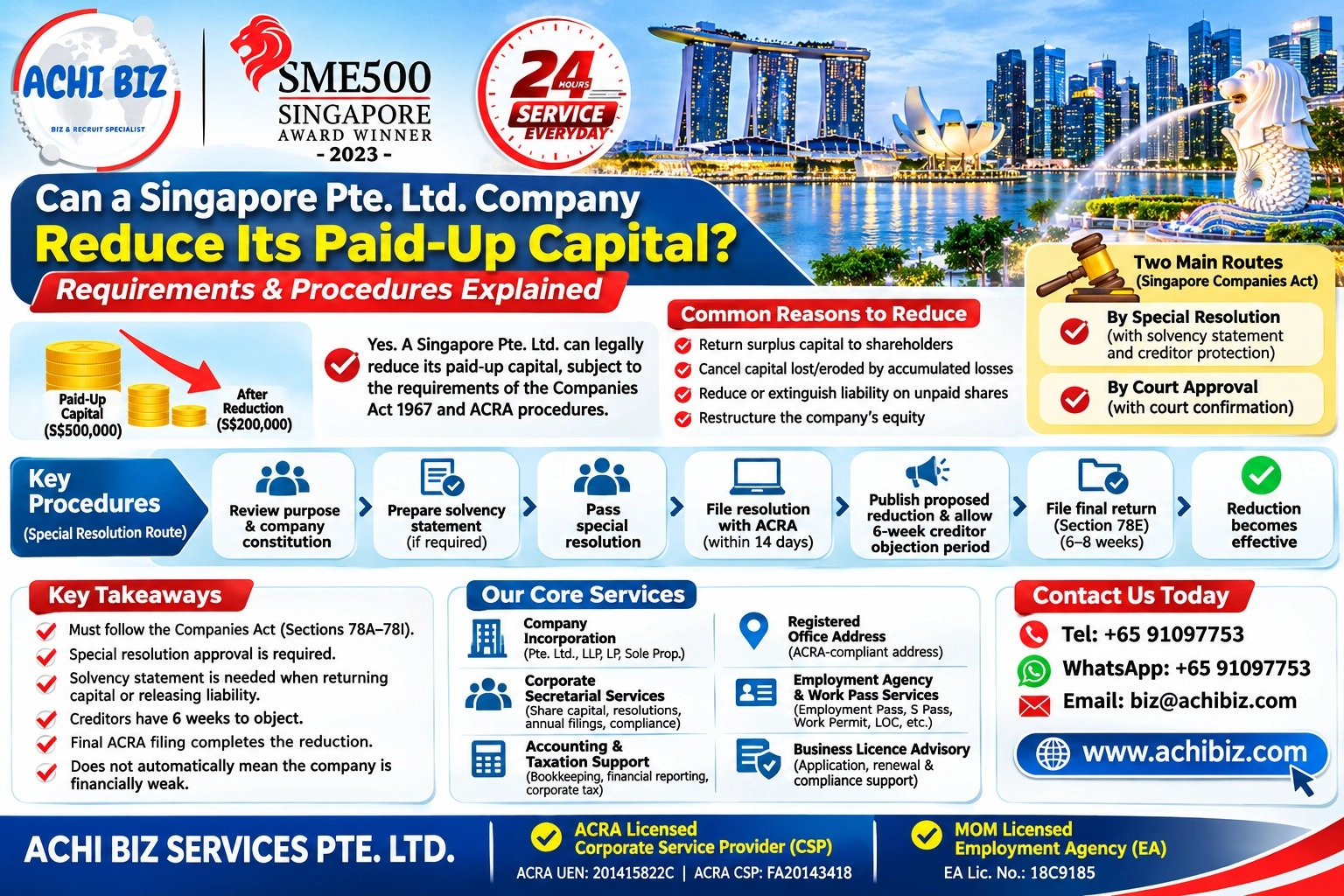
Can a Singapore Pte. Ltd. Company Reduce Its Paid-Up Capital? Requirements & Procedures
A Comprehensive FAQ Guide to Share Capital Reduction in Singapore, ACRA Requirements, Solvency Statements, Creditor Protection, Shareholder Approvals, Court-Approved Reductions and Corporate Compliance.
Introduction: Can a Singapore Company Legally Reduce Its Paid-Up Capital?
Yes. A Singapore Private Limited Company (Pte. Ltd.) can legally reduce its paid-up share capital, provided it follows the requirements of the Companies Act 1967 and the applicable procedures prescribed by the Accounting and Corporate Regulatory Authority (ACRA).
However, reducing paid-up capital is fundamentally different from increasing share capital, issuing additional shares or receiving payments on existing partly paid shares.
A reduction of share capital may involve returning surplus capital to shareholders, cancelling capital that has been lost or is no longer represented by available assets, or reducing liability on unpaid shares.
For example, a Singapore company with S$500,000 in paid-up share capital may wish to reduce its share capital to S$200,000 because it no longer requires the original level of equity funding.
Such a reduction cannot be completed merely by transferring S$300,000 to shareholders or changing the amount shown in the company’s accounting records.
The company must identify a legally permitted reduction method, obtain the necessary approvals, protect creditors’ interests and complete the applicable statutory procedures.
Under Singapore company law, a private company generally has two principal routes for reducing its share capital:
-
The solvency statement route, involving a special resolution, directors’ solvency statement and statutory creditor-protection procedures.
-
The court-approved route, involving a special resolution and confirmation by the court.
The appropriate route depends on the company’s circumstances, financial position and proposed capital reduction.
This comprehensive FAQ article by ACHI BIZ SERVICES PTE. LTD., an ACRA Licensed Corporate Service Provider (CSP), examines the legal requirements, commercial considerations, financial implications and practical procedures involved in reducing share capital in Singapore.
Article scope: This guide concentrates on the reduction of existing share capital under Singapore law. It deliberately avoids repeating the detailed procedures for increasing issued shares, collecting unpaid share subscriptions or calculating ordinary shareholder dilution, which are covered in separate ACHI BIZ articles.
Understanding Paid-Up Capital Reduction in Singapore
Can a Singapore Pte. Ltd. company reduce its paid-up capital?
Yes.
A Singapore private company limited by shares may reduce its share capital in accordance with the Companies Act 1967.
The reduction must be properly authorised and completed through the applicable statutory procedure.
The company cannot simply declare that its paid-up capital has decreased.
What does reducing paid-up capital mean?
Reducing paid-up capital generally means implementing a lawful reduction of the company’s share capital that decreases the amount of capital attributed to its issued shares.
Depending on the transaction, this may involve returning capital to shareholders, cancelling capital affected by accumulated losses or restructuring existing share capital.
The precise effect depends on how the reduction is structured.
Is reducing paid-up capital the same as reducing issued share capital?
Not necessarily.
A share capital reduction can involve cancelling shares, reducing the capital amount associated with existing shares or reducing unpaid liability.
Consequently, the number of issued shares may decrease, remain unchanged or be affected in another legally permissible manner.
The company should distinguish the monetary reduction from any change in the number of shares.
Can a Singapore company reduce its paid-up capital without cancelling shares?
Yes, potentially.
A capital reduction may be structured to reduce the capital amount attributable to existing shares while retaining the same number of issued shares.
However, the company must ensure that the proposed arrangement is legally valid and properly documented.
Can a company reduce paid-up capital by cancelling some existing shares?
Yes, where cancellation forms part of a lawful share capital reduction.
The company should identify which shares will be cancelled, how shareholders will be affected and whether any class rights or other protections apply.
Can a company reduce its share capital without paying money to shareholders?
Yes.
For example, a company may reduce capital that has been lost or is no longer represented by available assets.
Such a reduction may be undertaken as part of a balance-sheet restructuring without a cash distribution.
Can a company reduce its paid-up capital and return money to shareholders?
Yes, subject to compliance with the applicable capital reduction requirements.
A return of capital may be appropriate where the company has surplus capital that is no longer needed for its business.
However, the company must consider its ability to meet its debts and other financial obligations.
Can a company reduce paid-up capital to S$1?
Potentially, yes.
A company may propose a substantial capital reduction, subject to the applicable legal requirements and any relevant licensing, contractual or regulatory restrictions.
However, a company should not assume that reducing its capital to S$1 is commercially appropriate or legally permissible in every circumstance.
Can a company reduce its paid-up capital to zero?
A proposed reduction to zero requires particular care.
The company must consider the legal consequences for its issued shares, membership structure and continued status as a company limited by shares.
Such a restructuring should not be attempted without specialist legal advice.
Can a company reduce its paid-up capital more than once?
Yes, potentially.
There is no general principle that limits a company to a single capital reduction during its lifetime.
However, each proposed reduction must independently satisfy the applicable legal requirements.
Is there a minimum number of years a company must operate before reducing its share capital?
There is no universal requirement that a Singapore private company must operate for a fixed number of years before considering a capital reduction.
However, the company’s financial circumstances, constitutional arrangements and statutory requirements remain relevant.
Can a newly incorporated Singapore company reduce its paid-up capital?
Potentially, yes.
A newly incorporated company may consider a reduction if there is a legitimate commercial reason.
Nevertheless, the company must follow the appropriate statutory procedure and assess its financial obligations.
Does reducing paid-up capital automatically reduce the company’s bank balance?
No.
The effect depends on the nature of the reduction.
Where capital is returned in cash, the company’s bank balance may decrease.
Where capital is reduced to eliminate accumulated losses without a cash payment, the bank balance may remain unchanged.
Does reducing paid-up capital mean the company is financially weak?
Not necessarily.
Some financially healthy companies reduce capital because they have surplus funds.
Others reduce capital as part of a restructuring following accumulated losses.
The commercial significance depends on the reasons for the reduction and the company’s overall financial position.
Legal Requirements Under the Singapore Companies Act 1967
Which sections of the Companies Act govern share capital reduction in Singapore?
The principal provisions are found in Sections 78A to 78I of the Companies Act 1967.
For a Singapore private company, the most relevant provisions include:
| Companies Act provision | Main purpose |
|---|---|
| Section 78A | Permitted forms and general rules for capital reduction |
| Section 78B | Reduction of share capital by a private company |
| Section 78D | Creditors’ right to object to a proposed reduction |
| Section 78E | Completion and effectiveness of a reduction by special resolution |
| Section 78F | Court proceedings concerning creditor objections |
| Section 78G | Reduction confirmed by the court |
| Section 78I | Extension of time for relevant court-order filings |
These provisions establish the legal framework for reducing capital while protecting shareholders and creditors.
What are the three principal types of share capital reduction permitted under Section 78A?
Section 78A expressly recognises reductions involving:
-
Extinguishing or reducing liability on shares in respect of unpaid share capital.
-
Cancelling paid-up capital that has been lost or is no longer represented by available assets.
-
Returning paid-up capital that exceeds the company’s requirements.
These are examples of permitted reductions rather than an exhaustive description of every possible restructuring.
Can a company’s constitution restrict its ability to reduce share capital?
Yes.
Section 78A allows a company’s constitution to exclude or restrict the statutory power to reduce share capital.
Therefore, directors should review the constitution before proposing any reduction.
A company should not assume that a special resolution alone overrides every constitutional restriction.
Does a capital reduction require shareholder approval?
Yes.
Both the special-resolution route and the court-confirmed route involve the necessary shareholder approval.
For a typical private company, the proposed reduction must be authorised by a special resolution.
What is a special resolution for share capital reduction?
A special resolution is a formal shareholder decision meeting the applicable statutory voting and procedural requirements.
It must clearly identify the proposed reduction and comply with the Companies Act and the company’s constitution.
The relevant approval threshold is generally at least 75% of the votes cast by members entitled to vote, subject to the applicable legal requirements.
Can shareholders approve a capital reduction through a written resolution?
A private company may be able to use the statutory written-resolution procedure, provided the applicable requirements are satisfied.
The company should verify whether a written resolution is available and appropriate in its circumstances.
Does every shareholder have to agree to the reduction?
Not necessarily.
A valid special resolution does not ordinarily require unanimous approval.
However, the company must consider separate class rights, constitutional restrictions, contractual protections and whether the proposed treatment of shareholders is lawful.
Can a minority shareholder object to a proposed capital reduction?
Yes.
A minority shareholder may oppose the resolution and, depending on the circumstances, may have other legal remedies.
A shareholder who disagrees with the transaction should examine whether the company has complied with its statutory and contractual obligations.
Can directors reduce capital without consulting shareholders?
No.
Directors cannot independently complete a statutory capital reduction merely by passing a board resolution.
The necessary shareholder and statutory procedures must be followed.
Can a company reduce share capital through a simple accounting adjustment?
No.
Section 78A requires a reduction to be carried out through a procedure permitted under the relevant statutory division.
An accounting adjustment cannot substitute for the legal process.
Solvency Statement Requirements for Capital Reduction
What is a solvency statement in a Singapore share capital reduction?
A solvency statement is a formal statement made by directors concerning the company’s financial ability to meet its obligations.
It is intended to support the statutory solvency requirements where those requirements apply.
The statement is a substantive legal declaration, not merely an administrative form.
Is a solvency statement mandatory for every private-company capital reduction?
No. This is an important legal distinction.
Under Section 78B(2), a private company does not need to satisfy the solvency statement requirements where the proposed reduction involves neither:
-
A reduction or distribution of cash or other assets by the company; nor
-
A release of liability owed to the company.
For example, a reduction solely cancelling capital lost through accumulated losses may qualify for this exception.
However, the company must still comply with the other applicable statutory procedures, including the special resolution and creditor-protection process.
Is a solvency statement generally required when capital is returned to shareholders?
Yes, where the company uses the special-resolution route and the proposed reduction involves distributing cash or other assets.
The statutory exception for reductions without distributions or releases of liabilities would not ordinarily apply.
Alternatively, the company may consider the court-confirmed route.
Who must sign the solvency statement?
Under Section 78B, all directors must make the solvency statement where the solvency requirements apply.
It is not sufficient for only the managing director or majority shareholder to sign simply because they control the company.
Can one director sign the solvency statement for a company with three directors?
Not where Section 78B requires all directors to make the statement.
Each director must properly consider the company’s financial position before making the declaration.
How recent must the solvency statement be?
For a private company, the statement must be made within the statutory period connected to the special resolution.
ACRA’s guidance identifies a 20-day period for private companies, compared with 30 days for public companies.
The company should ensure that the statement is prepared and made within the applicable statutory timeframe.
What financial matters should directors examine before signing a solvency statement?
Directors should carefully assess the company’s financial position, including its present and reasonably foreseeable obligations.
Relevant considerations include cash balances, trade creditors, outstanding loans, tax liabilities, contractual commitments, contingent liabilities and projected cash flow.
The assessment should reflect the company’s actual circumstances rather than relying only on the latest balance sheet.
Can directors rely solely on the company’s bank balance when making a solvency statement?
No.
A substantial bank balance does not automatically establish solvency.
The company may have significant liabilities, future payment obligations or contingent claims.
Directors should assess the company’s ability to meet its debts and obligations, not merely its cash holdings on a particular date.
Can a company with outstanding bank loans make a solvency statement?
Potentially, yes.
The existence of borrowing does not automatically mean the company is insolvent.
However, the directors must consider repayment obligations, financing terms and the company’s projected ability to meet its liabilities.
Can a company with accumulated losses satisfy the solvency requirements?
Potentially.
Accumulated accounting losses and insolvency are not identical concepts.
Nevertheless, directors must carefully examine whether the company satisfies the applicable statutory tests.
Can directors sign a solvency statement when the company’s financial records are incomplete?
They should not sign without sufficient information to form the required opinion on reasonable grounds.
Incomplete records may prevent a reliable assessment of the company’s financial position.
The company should resolve material accounting uncertainties before proceeding.
What happens if directors make a solvency statement without reasonable grounds?
Directors may face serious legal consequences where the statement is made improperly or without the required reasonable grounds.
The solvency statement should never be treated as a routine formality.
Where the financial position is uncertain, legal and accounting advice is particularly important.
Is an independent audit mandatory before every capital reduction?
Not automatically.
However, directors may need current financial statements, supporting schedules or professional accounting assistance to establish a reliable financial position.
The extent of the review depends on the complexity and risks of the transaction.
ACRA Procedures for Reducing Share Capital by Special Resolution
How can a Singapore Pte. Ltd. company reduce share capital without obtaining a court order?
A private company may use the special-resolution procedure under Sections 78B and 78E, provided all applicable conditions are satisfied.
The process involves the required shareholder approval, any applicable solvency statement, statutory publication, a creditor-objection period and a final filing with ACRA.
What are the main steps for a share capital reduction under Section 78B?
-
Review the proposed reduction
Examine the company’s constitution, financial position, shareholder rights and commercial purpose.
-
Prepare the solvency statement, where required
All directors make the required statement within the statutory timeframe.
-
Pass a special resolution
Obtain the necessary shareholder approval for the proposed capital reduction.
-
Complete the initial ACRA filings
Lodge the special resolution and required publication concerning the proposed reduction.
-
Observe the six-week creditor-objection period
Creditors have the statutory opportunity to apply to the court.
-
Submit the final Section 78E filing
Where the statutory conditions are satisfied, lodge the required documents between six and eight weeks after the resolution.
-
Update the company’s records
Reconcile the completed reduction with the company’s share capital records, accounting records and relevant contractual obligations.
ACRA confirms that the reduction takes effect upon the successful final Section 78E filing, not merely when shareholders approve the proposal.
What is the deadline for filing the special resolution with ACRA?
ACRA’s current filing guidance specifies that the special resolution for share capital reduction must be filed within 14 days of the resolution date.
This is separate from the later filing required to complete the reduction.
What is the publication requirement for a proposed share capital reduction?
The company must complete the applicable publication filing to provide statutory notice of the proposed reduction.
ACRA offers a dedicated filing service for publication of a proposed reduction under Section 78B or 78C.
The publication procedure forms part of the creditor-protection framework.
Must the company advertise its capital reduction in a newspaper?
Companies should follow the current statutory publicity requirements and ACRA’s prescribed publication procedure.
They should not assume that an ordinary newspaper advertisement is sufficient or necessary in every case.
ACRA provides an electronic publication mechanism through Bizfile.
Why is there a six-week waiting period?
The waiting period protects creditors.
It allows qualifying creditors to apply to the court to challenge the proposed reduction before it becomes effective.
When does the six-week creditor-objection period begin?
Under Section 78D, the six-week period begins with the date on which the special resolution is passed.
Companies should calculate the statutory period carefully and avoid treating the filing date as automatically replacing the resolution date.
Can the company complete the reduction immediately after passing the special resolution?
Not through the ordinary Section 78B and Section 78E procedure.
The company must satisfy the statutory requirements, including the creditor-objection period and final filing.
When must the final Section 78E filing be submitted?
ACRA states that the final filing should be made between six and eight weeks from the special resolution date, provided the applicable conditions are satisfied.
The company should plan the transaction timetable accordingly.
When does the capital reduction legally take effect?
Under the special-resolution route, the reduction takes effect when the required final filing is successfully lodged with ACRA in accordance with Section 78E.
Passing the resolution does not itself complete the reduction.
What is the ACRA filing fee for the Section 78E capital reduction filing?
S$0
Published government fee for the final Section 78E filing
ACRA currently lists this filing as free, with immediate processing.
Professional legal, accounting and corporate secretarial fees are separate.
Does immediate ACRA processing mean the entire capital reduction takes only one day?
No.
Although the final filing may be processed immediately, the statutory procedure ordinarily requires the six-week creditor-objection period and other preparatory steps.
Companies should distinguish filing processing time from the overall transaction timeline.
Creditor Protection and Objections to Share Capital Reduction
Why do creditors have a right to object to a capital reduction?
A reduction may decrease the company’s assets or release obligations owed to it.
This can affect the resources available to satisfy creditors.
The statutory objection mechanism helps protect creditors against reductions that may prejudice their interests.
Which creditors can object to a proposed capital reduction?
Section 78D provides a right to apply to the court for qualifying creditors whose debts or claims meet the statutory criteria.
This may include creditors with claims that would be admissible in proof if the company were being wound up at the relevant time.
The precise position depends on the nature of the claim.
Can a supplier object to a company’s proposed capital reduction?
Potentially, yes.
A supplier with an outstanding qualifying claim may have grounds to apply to the court.
The company should consider trade creditor balances before proceeding with a reduction involving the return of capital.
Can a bank object to a capital reduction?
Potentially.
A lender may have statutory rights as a creditor and contractual rights under its financing agreements.
A company should review its loan documents before approving a reduction.
Can a creditor object even if the shareholders unanimously approve the reduction?
Yes.
Shareholder approval does not eliminate the statutory rights of creditors.
The company must satisfy the applicable creditor-protection requirements independently.
What happens if a creditor applies to the court to cancel the reduction?
The company must address the application in accordance with Section 78D and the relevant court procedures.
It must also notify ACRA as required.
The proposed reduction should not proceed as though no objection had been made.
Can a creditor’s objection delay the reduction?
Yes.
Court proceedings may delay or prevent completion of the transaction.
The outcome depends on the circumstances and the court’s decision.
Can the company resolve an objection by paying the creditor?
Potentially.
A settlement may resolve the underlying commercial dispute, but the company must still comply with the relevant legal procedures and filing requirements.
It should not assume that a private settlement automatically removes every procedural consequence of a court application.
Can a company return capital to shareholders while a creditor objection remains unresolved?
It should not implement the proposed reduction before it becomes legally effective.
Where an objection or court proceeding exists, the company should obtain appropriate legal advice before distributing funds.
Can a company avoid creditor objections by obtaining shareholder approval only?
No.
The statutory creditor-protection process cannot be bypassed merely because shareholders support the transaction.
What happens if the company misses the final filing window?
The company should promptly obtain advice on the legal status of the proposed reduction and the appropriate next steps.
It should not assume that a late filing will automatically be accepted or that the reduction has already taken effect.
Court-Approved Share Capital Reduction in Singapore
Can a Singapore private company reduce share capital through the court?
Yes.
The Companies Act provides a court-confirmed route for reducing share capital.
This route involves the required special resolution, court proceedings and the relevant ACRA filing.
When might a company consider a court-approved capital reduction?
The court route may be considered where the company cannot appropriately use the special-resolution procedure or where the circumstances justify judicial confirmation.
Examples may include complex shareholder arrangements, creditor issues or unusual capital restructuring proposals.
However, the need for court involvement must be assessed on the facts.
Does a court-approved capital reduction still require shareholder approval?
Yes.
A special resolution is part of the statutory process.
Court confirmation does not ordinarily replace the requirement to obtain the necessary shareholder approval.
What does the court examine when considering a capital reduction?
The court may consider whether the statutory requirements have been satisfied and whether the proposed reduction appropriately addresses the interests of creditors and shareholders.
The precise issues depend on the application and applicable legal principles.
Can the court refuse to confirm a proposed capital reduction?
Yes.
Court confirmation should not be assumed.
The company must establish an appropriate legal and factual basis for the proposed transaction.
Is the court-approved procedure more expensive than the special-resolution route?
Generally, it may involve higher professional costs because court proceedings require additional legal work.
The actual costs depend on the complexity of the matter and whether the application is contested.
How long does a court-approved capital reduction take?
There is no single guaranteed timeline.
The duration depends on preparation, court scheduling, procedural requirements and any objections.
What happens after the court confirms the reduction?
The company must lodge the relevant court order and required information with ACRA.
ACRA identifies the final filing as the Notice of court order for approval of reduction of share capital under Section 78G.
What is the deadline for filing the court order with ACRA?
ACRA states that the relevant notice should be filed within 90 days after the court order date.
Where additional time is required, the company should consider the applicable extension procedure.
When does a court-approved reduction take effect?
ACRA states that the reduction takes effect upon the successful filing of the relevant court-order notice.
The court’s confirmation and the final statutory filing are therefore distinct steps.
Can a company choose between the special-resolution route and the court route?
Potentially, yes, depending on the circumstances.
The company should consider statutory eligibility, creditor risks, financial condition, cost and transaction complexity before selecting the appropriate route.
Returning Surplus Paid-Up Capital to Shareholders
Can a profitable Singapore company return excess capital to shareholders?
Yes, subject to the statutory capital reduction requirements.
A company may have more capital than it reasonably requires for its operations.
However, the proposed return must not compromise its ability to meet its obligations.
What does surplus capital mean?
Surplus capital refers, in this context, to capital that the company considers unnecessary for its ongoing business and financial requirements.
It is not simply the amount currently held in the company’s bank account.
The assessment should consider future working capital, liabilities, investment commitments and commercial risks.
Can a company reduce paid-up capital from S$1 million to S$500,000?
Potentially, yes.
For example, a company with S$1 million in paid-up capital may propose a reduction of S$500,000.
The treatment of the reduced amount depends on whether the company intends to return funds to shareholders or undertake a different type of capital restructuring.
Can a company return capital to shareholders without changing the number of issued shares?
Potentially, yes.
The reduction may be structured to reduce the capital amount associated with existing shares while retaining the same share quantities.
The company must document the precise legal effect of the transaction.
Must capital be returned equally to all shareholders?
Not necessarily in every transaction.
However, the proposed treatment must comply with applicable law, the company’s constitution, share class rights and any relevant agreements.
A selective or disproportionate return requires particular scrutiny.
Can a company return capital to only one shareholder?
A selective capital reduction may be possible in appropriate circumstances.
However, it can raise issues involving shareholder fairness, class rights, valuation and minority protection.
Specialist legal advice is advisable.
Can a company return capital to a foreign shareholder?
Potentially, yes.
A foreign shareholder may receive a lawful capital return, subject to applicable banking, tax and regulatory considerations.
The company should retain proper transaction and payment records.
Can a company return capital in assets instead of cash?
Potentially.
However, a non-cash distribution requires appropriate valuation, documentation and consideration of tax, creditor and other legal implications.
Can the company pay shareholders before the reduction becomes effective?
It should not implement the proposed capital return prematurely.
The company should complete the statutory procedure and establish the legally effective date before making payments pursuant to the reduction.
Can shareholders demand a capital return simply because the company has excess cash?
No.
Shareholders do not automatically have a right to demand repayment of their paid-up capital.
The company must decide whether a reduction is appropriate and follow the relevant legal process.
Can a company use a capital reduction to allow a shareholder to exit the business?
Potentially.
A capital reduction may form part of a shareholder exit or ownership restructuring.
However, the company should assess whether a share transfer, buyback or another transaction is more appropriate.
The detailed procedures for those alternatives should be addressed separately.
Reducing Share Capital to Address Accumulated Losses
Can a Singapore company reduce paid-up capital because it has accumulated losses?
Yes.
Section 78A expressly recognises cancellation of paid-up capital that has been lost or is no longer represented by available assets.
This can be relevant where historical losses have significantly reduced the company’s net assets.
Does a loss-related capital reduction require the company to pay money to shareholders?
Not necessarily.
A reduction intended to eliminate capital lost through accumulated losses may involve no cash distribution.
This is different from returning surplus capital.
Can a company reduce share capital to eliminate a negative retained earnings balance?
Potentially, as part of a properly structured capital reorganisation.
However, the accounting treatment depends on the transaction and applicable financial reporting standards.
A reduction should not be presented as automatically eliminating every accumulated loss without examining the relevant accounting requirements.
Does cancelling lost share capital create new cash?
No.
A loss-related capital reduction may change the presentation of equity, but it does not itself generate cash.
Does a capital reduction automatically restore profitability?
No.
A company may improve the presentation of its balance sheet without improving its operating performance.
Profitability depends on the company’s actual business activities, income and expenses.
Can a company with negative equity reduce share capital?
Potentially.
However, the company should carefully consider its financial condition, the proposed reduction and the appropriate statutory route.
A capital reduction does not itself solve insolvency or liquidity problems.
Is a solvency statement always required for a loss-related capital reduction?
No.
As explained earlier, Section 78B(2) provides an exception where the reduction involves neither a distribution of cash or other assets nor a release of liability owed to the company.
The company must still satisfy the other statutory requirements.
Can reducing capital make a company’s financial statements look healthier?
It may change the presentation of share capital and accumulated losses.
However, it does not automatically increase total assets or improve cash flow.
A company should avoid presenting a purely accounting restructuring as evidence of improved operating performance.
Can a company reduce share capital to facilitate future dividend payments?
A capital restructuring may be relevant to the company’s accumulated losses and future distribution capacity.
However, a capital reduction does not itself guarantee that dividends may lawfully be declared.
The company must still comply with the applicable rules governing dividends and profits.
Can a company use capital reduction to conceal past financial losses?
No.
Financial statements and statutory records must accurately reflect the company’s financial position and transactions.
A lawful capital reduction does not remove the obligation to maintain proper accounting records or provide truthful disclosures.
Reduction of Unpaid Share Capital
Can a Singapore company reduce liability on unpaid shares?
Yes.
Section 78A permits a reduction that extinguishes or reduces liability on shares in respect of unpaid share capital.
This is a distinct form of capital reduction and should not be confused with shareholders paying outstanding amounts on existing shares.
Can a company release shareholders from outstanding share subscription obligations?
Potentially, through a legally valid capital reduction.
However, the release may affect the company’s assets and creditor interests.
The applicable solvency requirements and other statutory procedures must be considered.
Is releasing unpaid share capital the same as collecting unpaid share capital?
No.
Collecting unpaid share capital satisfies the shareholder’s outstanding payment obligation.
Releasing unpaid share capital reduces or extinguishes that obligation through a legally permitted restructuring.
The financial and legal consequences are different.
Can directors simply forgive unpaid share capital?
They should not assume that they have unrestricted authority to release shareholders from outstanding capital obligations.
Where the proposed forgiveness amounts to a reduction of share capital, the statutory reduction procedure must be considered.
Does releasing unpaid share capital require a solvency statement?
Where the release involves liability owed to the company, the exception under Section 78B(2) would not ordinarily apply.
The company must assess the relevant solvency requirements if it proposes to use the special-resolution route.
Can unpaid share capital be reduced without returning any cash?
Yes, potentially.
A reduction of unpaid liability may involve no cash payment to shareholders.
However, releasing a shareholder’s obligation can still affect the company’s financial position and creditor protection.
Can a company reduce only part of a shareholder’s unpaid capital obligation?
Potentially, subject to the statutory procedure and applicable shareholder rights.
The company must clearly identify the amount of liability being reduced or extinguished.
Can a company reduce unpaid capital owed by one shareholder but not another?
A selective reduction may raise issues involving fairness, class rights, creditor protection and directors’ duties.
The company should not assume that different shareholders can be treated arbitrarily.
Shareholder Ownership and Voting Rights After Capital Reduction
Does reducing paid-up capital automatically change shareholder percentages?
No.
A proportionate reduction that leaves the number of shares held by each shareholder unchanged may leave ownership percentages unchanged.
However, a selective cancellation of shares can change the ownership structure.
Can a company reduce capital while maintaining the same number of shareholders?
Yes.
A capital reduction does not necessarily require any shareholder to leave the company.
Can a company cancel shares held by one shareholder only?
Potentially, through a properly structured and legally valid reduction.
However, the company must consider the rights of affected shareholders and the applicable statutory requirements.
Can a capital reduction increase another shareholder’s percentage without issuing new shares?
Yes.
If shares held by one shareholder are validly cancelled while another shareholder’s shares remain unchanged, the remaining shareholder’s percentage may increase.
This is a consequence of the changed share quantity rather than a new allotment.
Can a capital reduction change voting control?
Yes, where it affects the number or rights of voting shares.
For example, a selective cancellation may alter voting percentages.
The company should calculate the proposed voting position before proceeding.
Can preference shares be affected by a capital reduction?
Yes, potentially.
However, preference shares may carry specific rights that require additional consideration.
The company should examine the relevant class rights and constitutional provisions.
Can shareholders lose rights through a capital reduction?
A reduction may affect shareholders’ economic or voting interests depending on its structure.
The company must comply with applicable legal protections and should not assume that shareholder rights can be disregarded.
Can a capital reduction trigger disputes between shareholders?
Yes.
Disputes may arise over valuation, selective treatment, ownership changes or the commercial justification for the reduction.
Careful documentation and appropriate legal advice can help reduce these risks.
Taxation and Accounting Implications of Capital Reduction
Is a return of paid-up capital automatically tax-free in Singapore?
No such assumption should be made.
The tax treatment depends on the nature and substance of the transaction, the shareholder’s circumstances and the applicable tax rules.
A genuine capital return should be distinguished from dividends, remuneration, sale proceeds and other payments.
Does Singapore charge GST on a reduction of share capital?
The GST treatment depends on the nature of the transaction.
A straightforward reduction of share capital should not automatically be treated as an ordinary taxable supply of goods or services.
Transactions involving asset distributions or other consideration may require separate analysis.
Is stamp duty payable when a company reduces share capital?
Not every capital reduction automatically attracts share transfer stamp duty.
However, transactions involving transfers of shares, immovable property or other dutiable instruments may require assessment.
The company should examine the actual documents and transaction structure.
Can foreign shareholders face tax consequences when receiving capital?
Yes.
Although the company is incorporated in Singapore, foreign shareholders may have tax obligations in their countries of residence.
Cross-border tax advice may be appropriate.
How is a cash capital reduction recorded in the company’s accounts?
In a straightforward capital return, the company’s share capital is reduced and the corresponding payment or payable is recognised according to the applicable accounting standards.
The precise accounting entries depend on the transaction’s effective date and structure.
Does a capital reduction decrease total equity?
A cash return of capital generally reduces the company’s assets and equity.
However, a reduction used to offset accumulated losses may reclassify components within equity without necessarily changing total equity.
Does reducing share capital increase retained earnings?
Not automatically.
A reduction used to eliminate accumulated losses may affect the relevant equity accounts, subject to the applicable accounting requirements.
The company should not assume that the reduced capital amount becomes freely distributable profit.
Can a capital reduction be recorded before ACRA confirms its legal effectiveness?
The company should ensure that its accounting treatment reflects the actual legal and economic circumstances.
For statutory share capital records, it must not treat a proposed reduction as completed before the applicable legal requirements are satisfied.
Does a capital reduction affect the company’s financial ratios?
Potentially.
Depending on the transaction, it may affect total equity, cash, leverage and other financial indicators.
The company should evaluate the effect before approving the reduction.
Commercial and Regulatory Considerations
Can reducing paid-up capital affect corporate banking relationships?
Potentially.
Banks may review a material reduction in capital, especially where the company has outstanding borrowing or financing facilities.
The company should check whether any contractual notification or consent requirements apply.
Can a capital reduction breach a bank loan agreement?
Yes, depending on the agreement.
Some financing arrangements restrict distributions, changes in capital or transactions affecting the company’s financial position.
A company should obtain any required lender consent before proceeding.
Can reducing paid-up capital affect a Singapore business licence?
Potentially.
Certain regulated activities may be subject to financial, capital or net-worth requirements.
The company should verify whether its proposed reduction would affect ongoing licensing eligibility.
Can a capital reduction affect an Employment Agency licence?
Potentially, depending on the applicable licensing requirements and the company’s circumstances.
The company should not assume that a capital reduction has no regulatory implications simply because its Employment Agency licence remains valid.
Can reducing paid-up capital affect Employment Pass or S Pass applications?
There is no universal rule that every reduction in paid-up capital automatically results in rejection of a work pass application.
MOM assesses applications under the applicable eligibility criteria.
However, the company should ensure that information submitted to authorities accurately reflects its financial and corporate position.
Can a company reduce capital while holding government contracts?
Potentially.
However, the company should review any financial eligibility conditions, contractual restrictions or notification obligations.
A reduction may be commercially significant where the contract depends on particular financial requirements.
Can a company reduce capital while applying for a tender?
Potentially.
The company should consider whether the proposed reduction affects financial eligibility, required net worth or other tender conditions.
Can reducing capital affect supplier confidence?
Yes.
Suppliers may regard a substantial capital reduction as relevant to their credit assessment.
However, the significance depends on whether the company is returning surplus capital, restructuring accumulated losses or addressing another commercial objective.
Can a company reduce capital while retaining substantial cash reserves?
Potentially.
The company must still consider its liabilities, future operating requirements and statutory obligations.
Having substantial cash does not eliminate the need for the formal reduction procedure.
Can a foreign-owned Singapore subsidiary reduce its paid-up capital?
Yes, subject to the applicable requirements.
Foreign ownership does not, by itself, prohibit a lawful reduction.
However, the company should review any group financing, shareholder, tax or regulatory considerations.
Can a parent company request its Singapore subsidiary to return excess capital?
Yes, the parent may propose such a transaction.
However, the subsidiary remains a separate legal entity and must comply with Singapore law.
The subsidiary’s directors must properly consider its financial position and legal obligations.
Practical Examples of Share Capital Reduction in Singapore
The following examples are hypothetical and illustrate the commercial and accounting effects of different types of capital reduction. They do not replace the required statutory procedures.
Example 1: Can a company reduce paid-up capital from S$500,000 to S$200,000 and return S$300,000?
Potentially, yes.
Suppose a Singapore company has S$500,000 in fully paid ordinary share capital and sufficient surplus assets to support a proposed S$300,000 capital return.
| Particulars | Before reduction | After reduction |
|---|---|---|
| Paid-up share capital | S$500,000 | S$200,000 |
| Capital reduction | — | S$300,000 |
| Cash returned to shareholders | — | S$300,000 |
| Number of shares | 500,000 | 500,000 |
This example assumes the reduction is structured without cancelling shares.
The company must complete the applicable statutory process before implementing the capital return.
Example 2: Can a company reduce share capital to eliminate S$150,000 in accumulated losses?
Potentially.
Suppose the company has S$300,000 in share capital and accumulated losses of S$150,000.
A properly structured capital reduction may be used to cancel S$150,000 of capital lost through those accumulated losses.
| Equity component | Before | After |
|---|---|---|
| Share capital | S$300,000 | S$150,000 |
| Accumulated losses | (S$150,000) | S$0 |
| Total equity | S$150,000 | S$150,000 |
| Cash distributed | S$0 | S$0 |
This simplified illustration assumes there are no other equity components and the accounting treatment is appropriate.
The reduction does not create S$150,000 of cash or profit.
Example 3: Can a company reduce share capital without changing its shareholders’ ownership percentages?
Yes.
Suppose two shareholders own 60% and 40% respectively.
The company reduces its paid-up capital from S$200,000 to S$100,000 without changing the number of shares.
| Shareholder | Shares before | Shares after | Ownership after |
|---|---|---|---|
| Shareholder A | 60,000 | 60,000 | 60% |
| Shareholder B | 40,000 | 40,000 | 40% |
| Total | 100,000 | 100,000 | 100% |
The capital amount decreases, but ownership percentages remain unchanged.
Example 4: Can a capital reduction change ownership percentages by cancelling shares?
Yes.
Suppose Shareholder A holds 70,000 shares and Shareholder B holds 30,000 shares.
The company proposes a lawful selective cancellation of 20,000 shares held by Shareholder A.
| Particulars | Before | After |
|---|---|---|
| Shareholder A | 70,000 shares | 50,000 shares |
| Shareholder B | 30,000 shares | 30,000 shares |
| Total issued shares | 100,000 | 80,000 |
| Shareholder A ownership | 70% | 62.5% |
| Shareholder B ownership | 30% | 37.5% |
The resulting ownership changes arise from cancellation rather than the issuance of new shares.
The company must assess the legality and fairness of the proposed selective reduction.
Example 5: Can a company reduce unpaid share capital without returning cash?
Potentially.
Suppose a company has shares issued for total consideration of S$100,000, of which S$40,000 has been paid and S$60,000 remains unpaid.
A lawful reduction may be proposed to extinguish the outstanding S$60,000 liability.
| Particulars | Before | After |
|---|---|---|
| Total agreed capital amount | S$100,000 | S$40,000 |
| Amount already paid | S$40,000 | S$40,000 |
| Outstanding share liability | S$60,000 | S$0 |
| Cash returned to shareholders | S$0 | S$0 |
This is not the same as cancelling capital lost through accumulated losses.
Because the transaction releases an obligation owed to the company, the applicable solvency requirements must be assessed.
Example 6: Can a company reduce capital even though it has outstanding trade creditors?
Potentially, yes.
However, the company must consider whether the reduction would prejudice its ability to pay those creditors.
A company with S$400,000 in cash but S$350,000 in near-term liabilities should not assume that S$300,000 is available for distribution.
The directors must assess the company’s actual financial obligations and projected cash requirements.
Example 7: Can a company reduce share capital to S$1 after closing most of its business operations?
Potentially.
However, the company must consider remaining liabilities, regulatory obligations and its intended future activities.
If the business is being permanently closed, a formal winding-up or striking-off process may be more appropriate, depending on the circumstances.
A capital reduction is not a substitute for properly closing a company.
Example 8: Can a foreign parent recover surplus funds from its Singapore subsidiary through capital reduction?
Potentially.
For example, a wholly owned Singapore subsidiary may have S$1 million in paid-up capital but require only S$400,000 for its continuing operations.
The parent may consider a proposed S$600,000 capital return.
However, the subsidiary must independently comply with Singapore’s capital reduction requirements and consider its own creditors, liabilities and future financial needs.
Example 9: Can a company reduce capital while its shareholders disagree?
Potentially, if the required approvals and other legal requirements are satisfied.
However, disagreement over the purpose, valuation or allocation of the reduction may create legal risks.
A contested selective reduction should be reviewed carefully.
Example 10: Can a company reverse an unsuccessful capital reduction proposal?
Before the reduction becomes effective, the company may be able to withdraw or revoke the proposal in accordance with the applicable statutory and procedural requirements.
Once a reduction has become legally effective, reversing its consequences may require a separate lawful transaction.
The company should not assume that completed capital changes can be undone by simply changing its records.
Common Mistakes When Reducing Paid-Up Capital in Singapore
What are the most common mistakes companies make during a capital reduction?
Common mistakes include:
-
Treating a capital reduction as a simple refund of shareholder funds.
-
Failing to review the company constitution.
-
Proceeding without the required special resolution.
-
Assuming every reduction requires a solvency statement, or incorrectly assuming none is required.
-
Signing a solvency statement without adequate financial information.
-
Failing to complete the statutory publication requirements.
-
Ignoring the six-week creditor-objection period.
-
Returning money before the reduction becomes legally effective.
-
Missing the final Section 78E filing window.
-
Failing to consider financing agreements and business licensing requirements.
-
Incorrectly calculating the post-reduction share capital and ownership position.
-
Confusing a capital reduction with a share buyback or share transfer.
-
Recording the reduction incorrectly in the company’s accounts.
-
Failing to reconcile the completed transaction with ACRA records.
Can a company correct an incorrect capital reduction filing?
The appropriate correction procedure depends on the nature of the error.
ACRA warns that some share transaction errors may require a court order if they cannot be resolved through the available administrative correction procedures.
Companies should verify all figures and shareholder details before submitting the final filing.
Can the company simply reverse a completed capital reduction in Bizfile?
Not necessarily.
Once a reduction has legally taken effect, the company cannot assume that it can be reversed through an ordinary administrative amendment.
A separate legal process or transaction may be necessary.
Can a company reduce capital to avoid paying creditors?
A capital reduction should not be used improperly to defeat legitimate creditor claims.
The Companies Act contains creditor-protection provisions, and directors remain subject to their legal duties.
Can directors be personally exposed to liability for an improper reduction?
Potentially.
Directors may face consequences where they breach applicable statutory obligations or duties.
The risks may be particularly serious where solvency statements are made without reasonable grounds or company assets are improperly distributed.
Final FAQs: Reducing Paid-Up Capital in a Singapore Pte. Ltd. Company
What is the simplest legal method for a solvent private company to reduce capital?
Where appropriate, the company may use the special-resolution route under Sections 78B and 78E.
However, the procedure still involves the relevant statutory requirements and creditor-objection period.
Can a company reduce capital without hiring a lawyer?
The law does not impose a universal requirement to appoint a lawyer for every reduction through the special-resolution route.
However, professional legal advice is advisable where the transaction involves substantial capital returns, creditor issues, selective reductions or complex shareholder rights.
Can a corporate secretary handle the ACRA filings?
Yes.
An appropriately authorised corporate secretary or corporate service provider can assist with the administrative and filing requirements.
Legal and financial assessments should be undertaken by suitably qualified professionals where necessary.
Can a company reduce capital without informing ACRA?
No.
A statutory reduction must be completed through the applicable procedures, including the required ACRA filings.
Can a company reduce capital without issuing new shares?
Yes.
A reduction ordinarily concerns existing share capital and does not necessarily involve issuing additional shares.
Can a company reduce capital without changing its shareholders?
Yes.
A properly structured reduction may leave the shareholder identities unchanged.
Can a company reduce capital without affecting ownership percentages?
Yes, depending on the structure of the reduction.
A proportionate reduction may preserve existing ownership percentages.
Can a company reduce paid-up capital by S$10,000?
Potentially.
The amount alone does not determine whether a reduction is permissible.
The company must satisfy the applicable statutory requirements.
Can a company reduce paid-up capital by S$1 million?
Potentially.
However, the company’s financial circumstances, creditor obligations and the commercial consequences of a substantial reduction require careful consideration.
Is a capital reduction effective immediately after shareholder approval?
No.
The relevant statutory procedure must be completed.
For the Section 78E route, the reduction takes effect upon the successful final ACRA filing.
How long does a capital reduction usually take without court proceedings?
The statutory special-resolution route includes a six-week creditor-objection period.
The final filing is generally made between six and eight weeks from the resolution date, assuming the applicable requirements are satisfied and no unresolved objections prevent completion.
Can a capital reduction be completed within one week?
Not through the ordinary Section 78B and Section 78E procedure, because of the statutory waiting period.
Does ACRA automatically approve every proposed capital reduction?
No.
A successful filing does not eliminate the company’s responsibility to comply with all statutory requirements.
The company and its directors remain responsible for the legality and accuracy of the transaction.
Can a company reduce capital if it is dormant?
Potentially.
Dormant status does not automatically prohibit a reduction.
However, the company must still follow the statutory procedures.
Can a company reduce capital before applying for striking off?
Potentially, where a lawful reduction is appropriate.
However, a capital reduction and a striking-off application serve different purposes.
The company should consider whether the reduction is necessary and whether another closure procedure would be more suitable.
Can a company reduce capital and subsequently increase it again?
Yes, potentially.
However, a subsequent increase must be carried out through an appropriate legal procedure.
The company should not undertake unnecessary repeated capital changes without a clear commercial purpose.
What is the most important consideration before reducing paid-up capital?
The company must establish that the proposed reduction is legally permissible, commercially justified and consistent with its financial obligations.
A capital reduction should never be treated as a simple withdrawal of shareholders’ original investment.
Practical Checklist: Before Reducing Paid-Up Capital in Singapore
| Review item | What the company should verify |
|---|---|
| Commercial purpose | Reason for reducing capital |
| Current issued share capital | Existing share quantity and capital amount |
| Current paid-up capital | Amount currently paid on issued shares |
| Proposed reduction | Exact monetary amount |
| Reduction structure | Cash return, cancellation of lost capital, release of unpaid liability or another permitted arrangement |
| Post-reduction capital | Proposed remaining share capital |
| Share cancellation | Whether any issued shares will be cancelled |
| Shareholder ownership | Effect on existing ownership percentages |
| Share classes | Rights attached to ordinary and preference shares |
| Constitution | Restrictions on capital reduction |
| Shareholder agreements | Relevant consent or protection provisions |
| Directors’ duties | Proper consideration of the company’s interests |
| Financial statements | Current financial position and accumulated losses |
| Cash-flow forecasts | Ability to meet future obligations |
| Outstanding creditors | Trade, banking, tax and other liabilities |
| Contingent liabilities | Guarantees, claims and potential obligations |
| Solvency statement | Whether required and properly supported |
| Special resolution | Valid shareholder approval |
| ACRA resolution filing | Filing within the applicable deadline |
| Statutory publication | Required publication of proposed reduction |
| Creditor-objection period | Six weeks from the resolution date |
| Court proceedings | Whether objections or court confirmation are involved |
| Final ACRA filing | Section 78E or Section 78G, as applicable |
| Effective date | Confirmation of legal completion |
| Accounting records | Correct treatment of capital and related balances |
| Banking agreements | Relevant restrictions or consent requirements |
| Business licences | Ongoing capital or financial requirements |
| Tax implications | Relevant Singapore and overseas tax considerations |
| Corporate records | Accurate post-reduction information |
| Professional advice | Legal, accounting and corporate secretarial review where appropriate |
Conclusion: Reducing Paid-Up Capital in Singapore Requires More Than Shareholder Approval
A Singapore Private Limited Company can legally reduce its paid-up share capital, but the process must comply with the Companies Act 1967.
A reduction may be appropriate where the company has surplus capital, accumulated losses requiring restructuring or outstanding share capital obligations that it proposes to reduce or extinguish.
However, the transaction must be properly structured and cannot be completed merely by returning funds to shareholders or changing accounting figures.
For private companies, the special-resolution route under Sections 78B and 78E provides a statutory procedure that includes shareholder approval, applicable solvency requirements, publication and creditor protection.
The court-confirmed route may also be available where appropriate.
Companies must pay particular attention to the distinction between capital reductions involving cash distributions and those that do not involve a distribution of assets or release of liabilities.
The former generally require the relevant solvency assessment under the special-resolution route, while certain non-distributive reductions may qualify for the statutory exception.
The central principle is that paid-up capital belongs to the company’s legal capital structure. Reducing it requires a lawful corporate transaction, not merely an agreement between shareholders to withdraw money.
Careful planning can help protect creditors, preserve shareholder rights, maintain accurate ACRA records and avoid costly mistakes.
How ACHI BIZ Can Assist with Share Capital Reduction in Singapore
ACHI BIZ SERVICES PTE. LTD., an ACRA Licensed Corporate Service Provider (CSP), provides corporate secretarial and business compliance support to Singapore companies, shareholders and entrepreneurs.
For companies considering a reduction of paid-up capital, ACHI BIZ can assist with the relevant administrative and corporate secretarial requirements, including:
-
Reviewing existing share capital and shareholder records.
-
Coordinating information about the proposed reduction.
-
Preparing relevant corporate resolutions and supporting secretarial documentation.
-
Assisting with ACRA Bizfile filing requirements.
-
Coordinating statutory publication and filing schedules.
-
Updating relevant corporate records following a completed reduction.
-
Liaising with appropriate legal and accounting professionals where specialist advice is required.
-
Providing ongoing corporate secretarial and compliance support.
Because capital reductions can affect creditors and shareholder rights, companies should obtain suitable professional advice before proceeding with complex or substantial transactions.
Disclaimer: This article is intended for general information purposes. It does not constitute legal, accounting, tax or financial advice. The correct procedure depends on the company’s constitution, financial condition, shareholder rights, creditor obligations, transaction structure and applicable law. Companies should verify current statutory requirements and obtain appropriate professional advice before implementing a capital reduction.
Related Articles
Can a Singapore Company Increase Paid-Up Capital Without Issuing New Shares? – FAQ Guide
Can a Singapore Company Issue Shares Without Receiving Full Payment? – FAQ Guide
#achibiz