
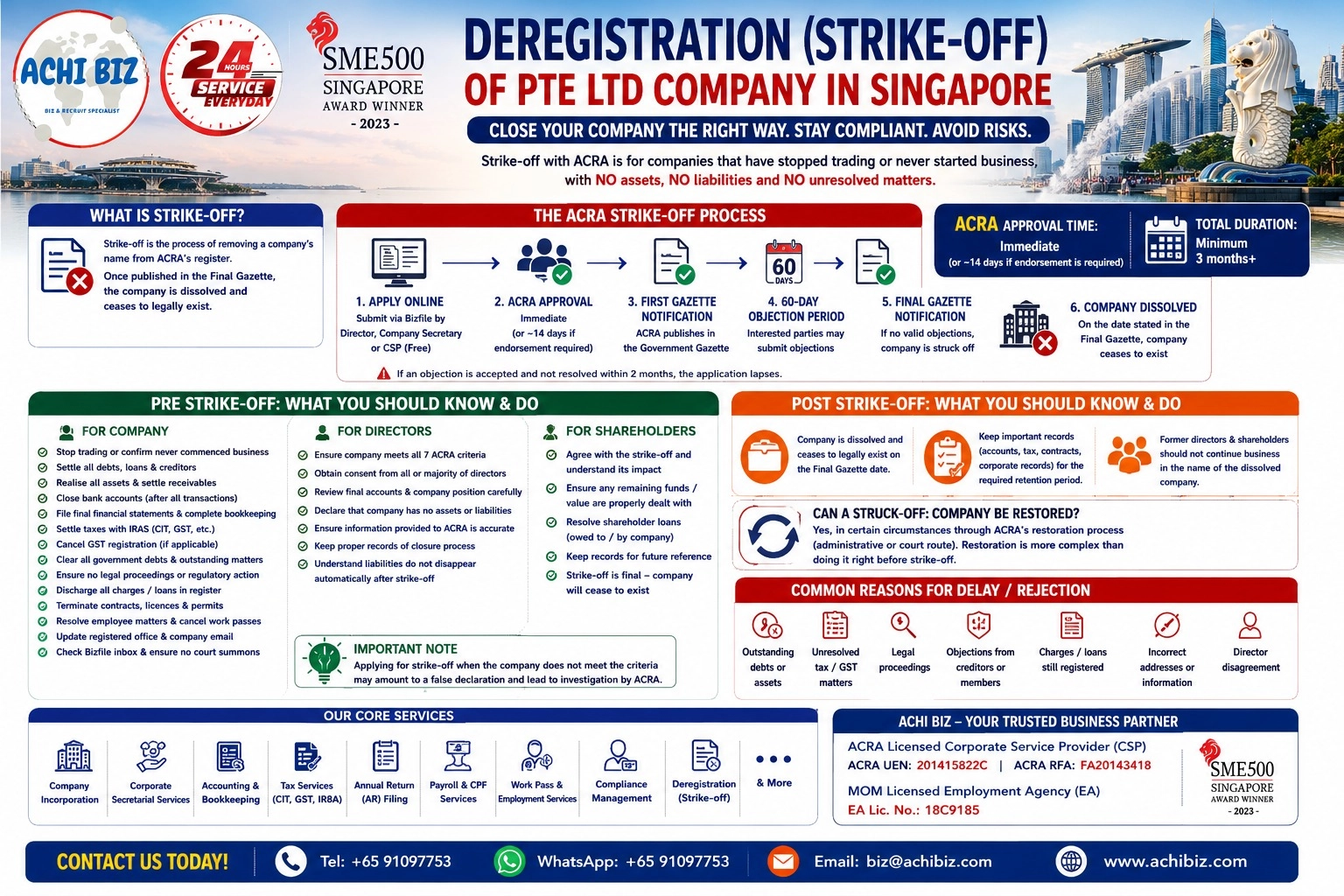
Deregistration (Strike-Off) of a Pte Ltd Company-FAQ
Closing a Singapore Private Limited (Pte. Ltd.) company is not as simple as stopping business, closing the bank account and leaving the company inactive. If a company is no longer required, one possible route to formally close it is to apply to the Accounting and Corporate Regulatory Authority (ACRA) to strike the company’s name off the register.
Strike-off is intended for a company that has stopped trading or never commenced business and has no remaining assets, liabilities, unresolved government matters, legal proceedings or other outstanding issues. If the company still has debts requiring a formal liquidation process, winding up may be the appropriate route instead.
A smooth company strike-off therefore starts before the application is submitted. Directors and shareholders should properly close the company’s affairs, settle creditors and taxes, deal with assets, terminate contracts, complete applicable corporate compliance and ensure there is nothing left inside the company that needs to be recovered after dissolution.
This FAQ explains what Singapore companies, directors and shareholders should know about the pre-strike-off, ACRA strike-off and post-strike-off stages.
What does “strike-off” of a Singapore Pte. Ltd. company mean?
Strike-off is a process through which a company’s name is removed from ACRA’s register.
Once the process has been completed and ACRA publishes the company’s name in the Final Gazette Notification, the company is officially struck off and no longer legally exists.
It should therefore be regarded as the formal closure of the company—not merely putting the business on hold.
Is “deregistration” the same as “strike-off” in Singapore?
In everyday business usage, people sometimes use “deregistration”, “strike-off”, “striking off” and “company closure” interchangeably.
For a Singapore local company, striking off is the specific ACRA process through which an eligible inactive company applies to have its name removed from the register.
Is strike-off the same as winding up a company?
No.
Strike-off is generally suited to a company that has ceased business and can satisfy ACRA’s strike-off criteria, including having no assets and no liabilities.
Winding up is a formal liquidation process involving the company’s affairs, settlement of obligations and distribution of remaining assets. ACRA describes winding up as the formal process for closing a local company that has debts to settle.
A company should therefore determine the appropriate closure route before applying.
When should a Pte. Ltd. company consider strike-off?
Strike-off may be appropriate where a company has genuinely ceased operations and there is no intention to continue using it.
Common situations include a business that has permanently stopped trading, a company incorporated for a project that never proceeded, a dormant company no longer required, or a business whose operations have been permanently discontinued after all affairs have been settled.
Eligibility ultimately depends on whether the company satisfies ACRA’s strike-off criteria.
What are ACRA’s current criteria for striking off a local company?
ACRA states that the company must satisfy all of the following conditions:
- it has stopped trading or has never started business since incorporation;
- it has no unpaid debts or unresolved issues with any government agency;
- it has no loans or charges in the charge register;
- it is not involved in legal cases in Singapore or overseas;
- it is not subject to ongoing or pending regulatory action or disciplinary proceedings;
- it owns nothing and owes nothing, including having no property, debts or potential future claims; and
- all directors, or a majority of directors, agree to strike off the company.
These conditions should be verified carefully before the application is submitted.
Can a company apply for strike-off while it is still conducting business?
No. ACRA’s criteria require the company to have stopped trading or never commenced business since incorporation.
A company intending to continue normal commercial operations should therefore not apply merely because the shareholders are thinking about closing it later.
Must the company be dormant before applying?
The important ACRA requirement is that the company has stopped trading or never started business and satisfies all the other strike-off criteria.
Simply calling a company “dormant” does not automatically make it eligible.
A dormant company can still have outstanding taxes, assets, investments, liabilities, statutory filings or other unresolved matters that need attention before strike-off.
Can a company with outstanding debts apply for strike-off?
It should not.
ACRA requires the company to have no unpaid debts or unresolved matters with government agencies and to own nothing and owe nothing.
Creditors should therefore be properly settled before the application.
Can a company with assets apply for strike-off?
ACRA’s criteria require the company to own nothing, including having no property or other assets.
Assets should therefore be properly dealt with before dissolution, rather than leaving them in the company and expecting shareholders to retrieve them afterwards.
Why is it important to deal with every company asset before strike-off?
Because dissolution changes the legal position fundamentally.
The company will cease to exist. Leaving bank balances, investments, receivables, property or other assets unresolved can make recovery considerably more complicated.
ACRA specifically warns companies to check for outstanding tax credits before applying because, after dissolution, outstanding tax credits are transferred to the Insolvency and Public Trustee’s Office (IPTO). Shareholders may subsequently approach the Insolvency Office to claim them, but processing fees may apply.
The cleaner approach is therefore to resolve company property and entitlements before strike-off.
What types of assets should be checked before applying?
Directors should conduct a final review for items such as:
cash in the company bank account, trade receivables, deposits, security deposits, loans receivable, fixed assets, vehicles, equipment, intellectual property, investments, shares in other companies, property, tax credits and refunds, insurance claims and other contractual rights.
The exact list depends on the company’s activities.
The objective is straightforward: nothing valuable belonging to the company should be accidentally left behind.
Should outstanding receivables be collected before strike-off?
Yes.
If customers or other parties still owe money to the company, the company still has an asset or claim.
Those receivables should ordinarily be collected, settled, waived or otherwise properly dealt with before the company represents that it satisfies the strike-off criteria.
What about money remaining in the company’s bank account?
The company should complete its legitimate payments, settle liabilities and appropriately deal with any remaining funds before closing the account.
How remaining value is distributed should be considered carefully from corporate, accounting and tax perspectives rather than simply transferring the balance without documentation.
When should the corporate bank account be closed?
The bank account should generally remain available long enough to complete legitimate final transactions, such as collecting outstanding receipts, paying creditors, settling taxes and receiving refunds.
Once those matters have been completed and the balance has been properly dealt with, the company can proceed with closing the account.
Closing it too early can make final settlement unnecessarily difficult.
Must company loans be settled before strike-off?
Yes, outstanding liabilities need to be resolved.
In addition, ACRA specifically requires that there be no loans or charges in the charge register.
Where registered charges exist, the company should ensure the underlying matter and the appropriate discharge or satisfaction documentation are properly handled.
Can a company under a bank charge simply apply for strike-off?
Not while the charge remains an issue under ACRA’s strike-off criteria.
The company should resolve the financing obligation and ensure the relevant charge position is properly dealt with before applying.
What happens to money the company owes its directors or shareholders?
Director loans and shareholder loans are still liabilities of the company.
They should therefore be properly settled, waived, capitalised where legally and commercially appropriate, or otherwise resolved and accurately recorded before applying.
Simply ignoring a director’s loan because the director also owns the company does not make the liability disappear.
What if a director or shareholder owes money to the company?
That is potentially an asset or receivable of the company.
It should also be properly dealt with before strike-off.
This is why an accurate final balance sheet and properly reconciled accounts can be extremely useful before deciding whether the company is genuinely ready for closure.
Should bookkeeping be completed before strike-off?
Yes.
Proper bookkeeping helps directors establish whether the company truly has nil assets and nil liabilities.
Without up-to-date accounts, the company may overlook receivables, unpaid expenses, director balances, taxes, deposits or other amounts.
Strike-off should therefore not be based merely on the statement, “The company has not traded recently.”
Should final management accounts be prepared?
This can be highly useful.
A final set of management accounts—particularly a balance sheet, profit and loss statement and supporting schedules—can help identify unresolved assets, liabilities and tax matters.
It also provides the accountant, tax agent, company secretary and directors with a clearer basis for completing the closure.
What should be done with outstanding suppliers and creditors?
Outstanding creditors should be identified and settled before the strike-off application.
This includes obvious trade creditors as well as accrued expenses, professional fees, employee-related amounts, landlord obligations, loans and other contractual liabilities.
A creditor with an unresolved claim may also object to the company’s strike-off.
Can creditors object to a company’s strike-off?
Yes.
ACRA allows any interested person to submit an objection while the entity has not yet been struck off. Non-government objectors are required to provide supporting documents as evidence of unresolved matters.
A company therefore improves its chances of a smooth strike-off by resolving genuine creditor issues before applying.
What happens if somebody objects after the strike-off application?
If ACRA accepts an objection, the company receives information identifying the objector and the reason.
The company and objector then have a period to resolve the issue. ACRA states that if the objection is not resolved within two months, the strike-off application lapses. The company cannot submit another application while an objection remains pending.
Can a company involved in litigation apply for strike-off?
It should not.
ACRA’s criteria require the company not to be involved in legal proceedings in Singapore or overseas.
The company should therefore resolve outstanding litigation before applying.
What about potential future claims?
These matter too.
ACRA requires the company to have no assets, liabilities or potential future claims.
Directors should therefore consider warranties, guarantees, indemnities, unresolved customer disputes and other circumstances that may give rise to future claims.
Can a company facing regulatory action apply?
ACRA’s criteria require the company not to be subject to ongoing or pending regulatory action or disciplinary proceedings.
Those matters should be resolved before applying.
Must outstanding ACRA matters be cleared first?
Yes, unresolved matters with government agencies can prevent the company from satisfying the strike-off criteria.
Companies should therefore check their ACRA/Bizfile position and resolve outstanding summonses or other issues.
ACRA specifically advises companies to ensure there are no ongoing court summonses and to check the Bizfile inbox for notices.
Should overdue Annual Returns be filed before applying for strike-off?
A company should review and regularise its compliance position rather than assuming that an application for strike-off automatically erases previous obligations.
Outstanding regulatory matters can interfere with a smooth closure, and the company should have its CSP assess its particular filing position before applying.
Must company information be updated before strike-off?
Yes.
ACRA specifically instructs companies to ensure their information is current, including their registered office address and company email address.
This is particularly important because ACRA may send strike-off correspondence to the registered office and company officers.
Why is the registered office address important during strike-off?
The company remains registered during the strike-off process.
ACRA may send striking-off letters to the company’s registered office and officers’ residential addresses. ACRA warns that incorrect addresses can result in the strike-off failing and the company returning to “Live” status.
The registered office should therefore not simply be abandoned when business operations stop.
What tax matters should be completed before applying to ACRA?
Corporate income tax matters should be properly finalised with IRAS.
Companies should ensure the necessary Corporate Income Tax Returns, tax computations and financial statements have been filed up to the cessation of business, outstanding assessments and queries have been dealt with, and tax liabilities have been settled.
From 1 August 2026, companies applying for strike-off that need to file Corporate Income Tax Returns for advance Years of Assessment up to the cessation date must use IRAS’ Apply for Waiver/File last Form C-S/C (Dormant/Striking Off) digital service. IRAS indicates that straightforward cases are generally completed within about two months, while complex cases can take longer.
Should the company apply to ACRA before completing IRAS matters?
The cleaner approach is to settle applicable tax matters first.
ACRA requires there to be no unpaid debts or unresolved issues with government agencies. Tax liabilities and unresolved IRAS matters therefore need proper attention before the company represents that it meets the strike-off criteria.
Does a dormant company automatically have no corporate income tax obligations?
No.
Dormancy does not automatically mean all tax filing obligations disappear.
IRAS has a separate process under which qualifying dormant companies can apply for a waiver from filing Corporate Income Tax Returns. The company must meet the relevant conditions.
What if the company is GST-registered?
A GST-registered company that has ceased business must deal separately with its GST registration.
IRAS states that compulsory cancellation must generally be applied for within 30 days when the business has ceased or stopped making taxable supplies with no intention to make them in future.
GST deregistration should therefore be incorporated into the pre-strike-off plan.
Is filing the final GST return important?
Yes.
GST cancellation can involve filing the final GST return (GST F8) and accounting for applicable GST matters, including certain assets held at the point of deregistration.
A company should not assume that cancelling its ACRA registration automatically closes every tax account.
Should employee matters be settled before strike-off?
Yes.
Where the company has employees, directors should ensure that employment relationships have been properly terminated and outstanding salary, leave, reimbursements, CPF contributions and other employment obligations have been addressed.
Where foreign employees are involved, applicable work pass cancellation and tax clearance requirements should also be reviewed.
The company should not proceed on the assumption that dissolution automatically resolves employment obligations.
What should happen to Employment Passes, S Passes or Work Permits sponsored by the company?
The employer should deal with applicable MOM cancellation and departure-related requirements as part of closing operations.
This should be completed as a separate employment compliance exercise rather than waiting for ACRA’s Final Gazette.
Should leases and commercial contracts be terminated before applying?
Yes.
The company should review leases, subscriptions, utilities, insurance policies, equipment rentals, software agreements, supplier contracts, customer contracts and other continuing arrangements.
Otherwise, liabilities may continue accruing while the strike-off application is pending.
Should the company’s licences and permits be cancelled?
Where the business holds industry-specific licences or permits, the company should review the requirements of the relevant regulator.
ACRA strike-off does not necessarily replace separate closure or cancellation procedures administered by other government agencies.
Who decides that the company should be struck off?
ACRA requires all directors or a majority of directors to agree to the strike-off.
The company should also review its constitution, shareholders’ arrangements and internal governance requirements to determine whether additional corporate approvals are appropriate or required for its circumstances.
Must shareholders consent to the strike-off?
ACRA’s published strike-off criteria specifically require agreement from all or a majority of the directors.
However, directors should not ignore shareholders. Closing a company affects the shareholders’ investment and ownership interests, and the company’s constitution or shareholders’ agreement may contain relevant provisions.
For good governance, the decision should be properly documented and communicated.
What should directors do before approving strike-off?
Directors should satisfy themselves that the company genuinely meets ACRA’s criteria.
They should review the company’s accounts, assets, liabilities, bank position, tax status, creditors, legal proceedings, regulatory matters, employees, contracts and corporate records.
A director should not approve a strike-off merely because someone says the company is “not being used anymore.”
What is the shareholder’s role before strike-off?
Shareholders should ensure that their economic interests in the company have been properly dealt with.
That includes understanding how any legitimate remaining value is handled, ensuring outstanding shareholder loans or other balances are resolved, and keeping appropriate records relating to their investment and the company’s closure.
Who can submit the ACRA strike-off application?
ACRA permits the application to be filed by a director, company secretary or Corporate Service Provider (CSP).
A company can therefore engage an ACRA Licensed Corporate Service Provider (CSP) to manage the application.
What additional requirement applies when a CSP submits the strike-off?
ACRA requires the CSP to ensure that the majority of the company’s directors have consented to the strike-off before the CSP applies.
This is why a professional CSP should not simply file an application based on an informal instruction from one person without checking the necessary authority.
Are supporting documents required to be uploaded with the ACRA application?
ACRA currently states that supporting documents are not required for the strike-off application itself.
However, the applicant must complete the required declarations and confirm that the company satisfies the criteria.
The absence of an upload requirement does not mean supporting corporate records are unnecessary internally.
Is there an ACRA fee for applying to strike off a company?
ACRA currently lists the application fee as free.
Professional fees charged by a CSP, accountant, tax agent or other adviser for preparing and managing the closure are separate from ACRA’s filing fee.
What information is needed for the strike-off application?
ACRA identifies the company’s UEN and, where applicable, the cessation date among the information that should be prepared.
The applicant must also verify the entity and confirm that it satisfies the strike-off criteria.
Where is the strike-off application submitted?
The application is made through Bizfile, using the “Apply to strike off business entity” eService under the deregistration services for local companies.
Does ACRA approve the application immediately?
ACRA currently states an approval time of immediate, or approximately 14 days where endorsement is required.
This is only approval for the strike-off process to proceed. It does not mean the company has already been dissolved.
Do other directors need to endorse the application?
Where endorsements are required, all or most of the directors must endorse the application through Bizfile within 14 days.
If the required endorsements are not obtained within that period, the application lapses. Where a CSP files the application, Bizfile endorsement is not required in the same manner because the CSP must have already ensured majority director consent.
Is the company immediately closed once ACRA approves the application?
No. This is an important distinction.
After ACRA approves the application for processing, the company remains “Live” and registered with ACRA while the strike-off process continues.
The company legally ceases to exist only after the process reaches the Final Gazette stage.
How long does the complete ACRA strike-off process take?
ACRA states that the strike-off process takes at least three months after ACRA approval, depending on whether objections arise.
Companies should therefore avoid telling banks, customers or other parties that they have already been dissolved simply because the application was submitted or approved.
What happens after ACRA accepts the application?
The process broadly proceeds through:
ACRA review → applicable objection opportunity → First Gazette Notification → 60-day objection period → Final Gazette Notification → company officially struck off.
The timeline can be extended or interrupted where objections or unresolved matters arise.
What is the First Gazette Notification?
If the application proceeds without preventing objections, ACRA publishes the company’s name in the First Gazette Notification.
This publicly signals that the company is intended to be struck off.
What happens during the 60-day Gazette period?
Interested parties have an opportunity to object to the proposed strike-off.
This protects creditors and others who may have legitimate unresolved dealings with the company.
If an objection is accepted, it must be resolved for the strike-off to continue.
What is the Final Gazette Notification?
If the process completes without unresolved objections, ACRA publishes the company’s name in the Final Gazette Notification.
On the stated date, the company is officially struck off, removed from ACRA’s register and no longer legally exists.
Can a strike-off application be withdrawn?
Yes.
The original applicant—or someone from the same CSP firm where applicable—can withdraw an approved strike-off application through Bizfile.
ACRA currently states that withdrawal is free and processed immediately.
Why might a company withdraw its strike-off application?
Circumstances may change.
For example, a previously unknown asset or liability may be discovered, a creditor issue may arise, shareholders may decide to continue the company, a tax matter may remain unresolved or a new business opportunity may justify retaining the company.
Withdrawing is preferable to continuing with an application where the company no longer satisfies the criteria.
Can making an incorrect declaration in a strike-off application have consequences?
Yes.
ACRA specifically warns that applying without meeting the strike-off criteria can amount to a false declaration and lead to an investigation.
Directors and CSPs should therefore conduct proper pre-application checks rather than treating the filing as a routine formality.
What happens to the company after the Final Gazette date?
The company ceases to legally exist.
It can no longer continue normal business as though it remained a live Pte. Ltd. company.
The company’s former directors and shareholders should retain relevant closure records and should not continue issuing invoices, signing contracts or representing the dissolved company as an operating business.
Do directors automatically remain directors after the company is struck off?
Once the company has ceased to exist, there is no continuing live company board to manage in the ordinary sense.
However, dissolution does not mean former directors should destroy all records or assume that historical conduct and liabilities have disappeared.
Does strike-off erase a director’s previous misconduct or liability?
No automatic rule should be assumed that dissolution wipes out every issue arising from conduct before the company was struck off.
Historical liabilities and potential legal consequences need to be assessed according to the applicable law and circumstances.
Strike-off should therefore never be used as an attempt to hide or escape unresolved wrongdoing.
Does strike-off erase shareholder obligations?
Not necessarily.
Shareholders should not assume that dissolution retrospectively validates improper distributions, unresolved transactions or other matters.
The company’s affairs should be properly regularised before dissolution rather than relying on strike-off to cure earlier problems.
What records should former directors and shareholders keep after strike-off?
Relevant corporate, accounting, tax, banking, contractual and closure records should be retained for the applicable statutory retention periods.
The fact that the company has been dissolved does not mean records should immediately be destroyed.
This is particularly important if questions later arise concerning tax, historical transactions, restoration or legal claims.
Can a struck-off company ever be restored?
Potentially, yes.
Singapore law provides mechanisms through which a struck-off company may be restored in qualifying circumstances, including administrative restoration and restoration through court processes depending on the situation. ACRA has a specific restoration eService and sets out the supporting documentation required.
Restoration can be significantly more complicated than properly resolving an issue before strike-off.
Why might somebody seek restoration of a struck-off company?
Common practical reasons may include discovering an asset after dissolution, needing the company to pursue or defend a claim, dealing with property that remained in the company, correcting an improper strike-off or addressing other unfinished affairs.
This is another reason directors should conduct a thorough pre-strike-off review.
Does striking off a company automatically release its name for immediate reuse?
Not necessarily.
Singapore’s company-name rules include restrictions relating to names of entities that have been struck off. The Companies Act contains applicable periods concerning reuse of names following strike-off.
Anyone intending to reuse the same or a similar name should check availability and the prevailing ACRA rules separately.
What are the most common reasons a strike-off becomes delayed or unsuccessful?
Common practical problems include unresolved tax matters, unpaid creditors, remaining assets, registered charges, outstanding legal proceedings, regulatory issues, incorrect registered addresses, director disagreement, objections from interested parties or incomplete endorsement.
Many of these problems can be prevented by doing the closure work before filing the application.
What is the best pre-strike-off checklist for a Singapore Pte. Ltd. company?
A practical sequence is:
Stop business → complete bookkeeping → prepare final accounts → collect receivables → realise or distribute assets properly → settle creditors and loans → resolve director/shareholder balances → complete tax matters → cancel GST where applicable → settle employees and work passes → terminate contracts and licences → discharge charges → check litigation/regulatory matters → update ACRA particulars → close the bank account at the appropriate stage → obtain director approval → submit the strike-off application.
The exact order may need adjustment depending on the company’s circumstances.
What should directors do during the three-month or longer strike-off period?
They should continue monitoring the company’s registered office, email, Bizfile notifications and correspondence.
They should also ensure no new liabilities arise and respond promptly if ACRA, IRAS, another government agency or an objector raises an issue.
The company remains legally registered until the Final Gazette date.
What should shareholders do while the strike-off is pending?
Shareholders should keep their contact information available, retain relevant records and avoid treating the company as already dissolved.
If an unresolved asset, liability or claim is discovered, the directors and CSP should be informed immediately so the appropriate action—including withdrawal of the application where necessary—can be considered.
What should be checked immediately after the company is finally struck off?
The former directors/shareholders should verify the final status, retain evidence of the Final Gazette/ACRA status, ensure company operations have ceased completely, maintain the required historical records and deal appropriately with any correspondence relating to the pre-dissolution period.
Is strike-off always the cheapest and easiest way to close a Pte. Ltd. company?
Only when the company is genuinely suitable for it.
Trying to force a company with unresolved debts, assets, disputes or complex affairs through the strike-off route can create more work and risk than choosing the correct closure process from the beginning.
Eligibility should therefore be assessed before cost becomes the deciding factor.
Should a company simply stop filing Annual Returns and wait for ACRA to strike it off?
No.
Abandoning a company is not a proper voluntary closure strategy.
Failure to comply with statutory filing obligations can lead to penalties and enforcement consequences for the company and directors. A voluntary strike-off should instead be properly prepared and submitted once the company satisfies the applicable criteria.
What is the difference between a clean strike-off and abandoning a company?
A clean strike-off means the company’s affairs have been deliberately closed: assets and liabilities are resolved, taxes and regulatory matters are addressed, records are reconciled and the proper ACRA process is followed.
Abandonment means simply stopping operations and ignoring the company.
The second approach can leave directors with years of avoidable compliance problems.
Why should directors plan the strike-off before the company actually stops operating?
Because some closure steps take time.
Tax assessments may need finalisation, receivables may need collection, leases may require notice, employees need proper termination, GST cancellation may be necessary and creditors need payment.
Planning ahead allows the company to reach the required nil-assets, nil-liabilities and no-unresolved-matters position more efficiently.
Can ACHI BIZ assist with striking off a Singapore Pte. Ltd. company?
Yes. ACRA expressly permits a Corporate Service Provider (CSP) to submit a strike-off application on behalf of a company, provided the applicable requirements are met.
ACHI BIZ is an ACRA Licensed Corporate Service Provider (CSP) and can assist companies with the corporate compliance and administrative aspects of closure, including reviewing the company’s corporate position, preparing the necessary corporate documentation, coordinating applicable accounting and tax matters, addressing outstanding ACRA compliance and submitting the strike-off application where the company qualifies.
Where employment and work pass matters also need to be closed, ACHI BIZ is a MOM Licensed Employment Agency (EA) and can assist with applicable employment-related services within the scope of its licence.
What is the key takeaway before striking off a Pte. Ltd. company in Singapore?
The most important work happens before the ACRA application.
A company should not apply merely because it has stopped generating revenue. Directors need to establish that the business has genuinely ceased, assets and liabilities have been dealt with, taxes and government matters are resolved, charges and legal proceedings are cleared, corporate information is current and the necessary director consent has been obtained.
After submission, the company remains legally alive until the Final Gazette Notification. ACRA’s process takes at least three months after approval and can take longer if objections arise.
A properly planned strike-off therefore follows three distinct stages:
Pre-strike-off: clean up and close the company’s affairs.
During strike-off: monitor ACRA’s process and resolve any objection or outstanding matter.
Post-strike-off: stop acting for the dissolved company and retain the necessary historical records.
That approach gives a Singapore Pte. Ltd. company the best chance of achieving a smooth, orderly and compliant closure with ACRA.
Disclaimer:
This FAQ provides general information on company strike-off in Singapore and does not constitute legal, tax or insolvency advice. Companies with outstanding debts, disputes, substantial assets or complex affairs should obtain appropriate professional advice before choosing a closure method.
Related Pages:
Click here to learn with FAQ on Winding Up a Local Company in Singapore
Click here to learn about Key Differences: Strike-Off vs Winding Up of a Singapore Pte. Ltd. Company
#achibiz