
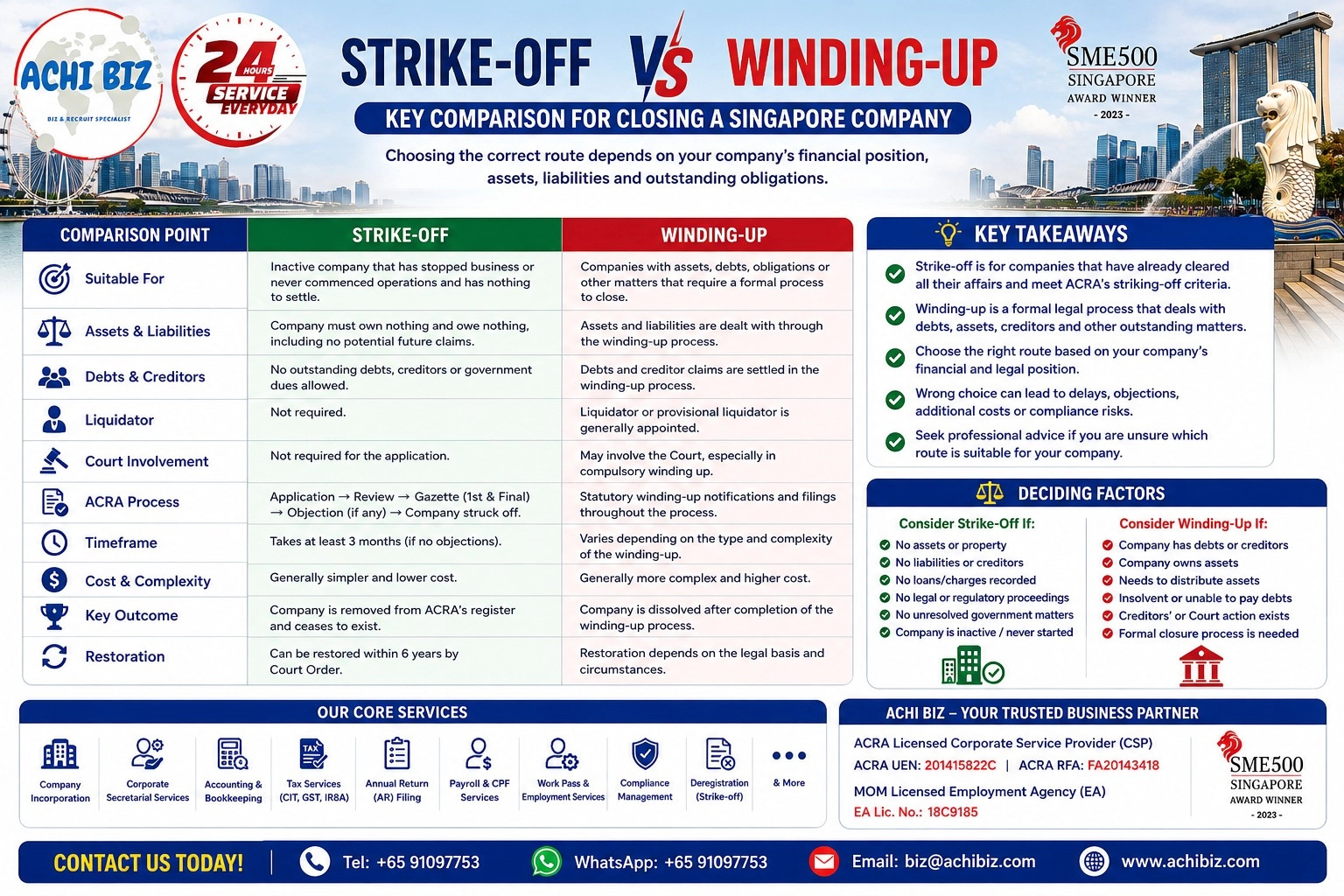
Key Differences: Strike-Off vs Winding Up of a Singapore Pte. Ltd. Company
Closing a Singapore Private Limited (Pte. Ltd.) company requires choosing the correct legal route. Two terms commonly encountered are strike-off and winding up, but they should not be treated as interchangeable ways of achieving the same result.
This FAQ focuses specifically on the comparison between strike-off and winding up in Singapore, rather than repeating the detailed procedures covered separately in our guides on each subject.
The central distinction is practical: strike-off is generally suited to an inactive company that has already cleared its affairs and satisfies ACRA’s striking-off criteria, whereas winding up is a formal process for bringing a company’s affairs to an end, including dealing with debts, obligations and assets through the applicable insolvency or corporate process. ACRA currently describes winding up as the formal process for closing a local company that has debts to settle, while its strike-off criteria require, among other things, that the company owns nothing and owes nothing.
What is the main difference between striking off and winding up a Singapore company?
The easiest way to distinguish them is to look at the condition of the company at the point of closure.
A company applying for strike-off should essentially have completed the work of closing its affairs: it must have stopped trading or never commenced business, have no assets or liabilities, no unresolved government matters, no outstanding charges, no litigation and no ongoing or pending regulatory or disciplinary proceedings.
Winding up, on the other hand, is itself a formal process for administering the company’s remaining affairs. Depending on the form of winding up, this may involve debts, creditors, assets, a liquidator and statutory filings.
Is strike-off simply a cheaper version of winding up?
No. This is an important misconception.
The two routes exist for different company circumstances. A company should not choose strike-off merely because it appears easier or less costly if it does not satisfy the eligibility criteria.
The first question should therefore be:
“What is the actual financial and legal position of the company?”
Only after answering that question should the appropriate closure route be considered.
How can directors quickly determine whether strike-off or winding up is more appropriate?
A useful comparison is:
| Comparison point | Strike-Off | Winding Up |
|---|---|---|
| Typical company position | Inactive and affairs already cleared | Company requires a formal closure process |
| Outstanding debts | Should have none | May be dealt with through winding up |
| Remaining assets | Should have none | Assets may need to be realised or distributed |
| Creditors | No unresolved creditor liabilities | Creditors can be central to the process |
| Liquidator | Not normally part of strike-off | Generally central to conventional winding-up processes |
| Court involvement | Not normally required for the original application | May arise, particularly in compulsory winding up |
| ACRA process | Application, review, gazette stages and possible objections | Statutory winding-up notifications and filings |
| Main focus | Removal of an eligible inactive company from the register | Formal administration and closure of company affairs |
| Final result | Company ceases to legally exist after being struck off | Company is ultimately dissolved |
The correct route depends on the actual facts rather than what shareholders or directors would prefer administratively.
Why is the “assets and liabilities” test so important when comparing strike-off and winding up?
Because this is one of the clearest dividing lines.
For strike-off, ACRA requires the company to own nothing and owe nothing, including having no property, debts or potential future claims.
Winding up is designed to accommodate situations where company affairs still require formal administration, including settlement of obligations and dealing with remaining assets.
Can a company with outstanding creditors choose strike-off instead of winding up?
Generally, it should not proceed with strike-off while creditor debts remain unresolved because this would conflict with ACRA’s striking-off criteria.
The existence of unpaid creditors is therefore a strong signal that directors need to examine whether a formal insolvency or winding-up route is required rather than attempting administrative deregistration.
What if the company has money in its bank account but otherwise qualifies for strike-off?
That money is still an asset.
This illustrates why directors should not equate “no longer trading” with “ready to strike off”. A company may have ceased operations while still owning cash, receivables, deposits, equipment, investments or other property.
ACRA’s strike-off criterion is that the company owns nothing and owes nothing. Remaining assets therefore need to be properly dealt with before an eligible strike-off application is made.
Does insolvency automatically rule out strike-off?
If the company cannot pay outstanding debts, it would not satisfy the requirement that it owes nothing.
The issue then moves beyond administrative deregistration and into how the company’s debts and affairs should legally be resolved. ACRA identifies creditors’ voluntary winding up, the Simplified Winding Up Programme for qualifying micro or small companies, and court-ordered winding among the routes applicable in debt-related circumstances.
Is winding up only for insolvent Singapore companies?
No.
This is another important difference that is sometimes overlooked. Winding up is not exclusively an insolvency mechanism.
A solvent company may undergo members’ voluntary winding up where the applicable requirements are satisfied. Therefore, the existence of solvency does not automatically mean strike-off is the appropriate choice.
If a solvent company can qualify for either route, how should the choice be analysed?
Directors should look beyond solvency alone.
Questions include whether there are assets requiring formal distribution, the complexity of the company’s affairs, contractual obligations, shareholder considerations, potential claims and whether a formal liquidation process is preferable.
Strike-off is most naturally suited to a company whose affairs have already been brought to a clean endpoint. A solvent winding up provides a more structured process where the company’s affairs still need formal administration.
What is the difference in the role of a liquidator?
This is one of the strongest procedural distinctions.
Strike-off does not ordinarily involve appointing a liquidator. The company must instead put itself into a position where it meets ACRA’s striking-off criteria.
In conventional winding up, the liquidator or provisional liquidator performs a formal role in administering the company’s affairs, and ACRA provides specific eServices for notifications relating to appointment, cessation, accounts and other winding-up matters.
Is ACRA’s role the same in strike-off and winding up?
No.
In a strike-off, ACRA considers whether the company satisfies the striking-off criteria and administers the deregistration process, including gazette notifications and objections.
In winding up, ACRA acts as the corporate registry receiving the prescribed winding-up notifications and filings, while the substantive process may involve a liquidator, creditors and, in certain cases, the Court or Official Receiver.
What is the difference between an ACRA strike-off and a Court-ordered winding up?
They are fundamentally different mechanisms.
An ordinary voluntary strike-off begins with an application to ACRA for an eligible company to be removed from the register.
A court-ordered compulsory winding up arises when the Court orders that the company be wound up under applicable circumstances—for example, inability to pay debts. A liquidator is involved, and the Court may appoint one or the Official Receiver may act as liquidator.
Which process gives creditors a more formal role?
Winding up generally provides the more structured framework for creditor-related matters.
This follows naturally from its purpose: where liabilities remain, creditor claims need to be dealt with as part of bringing the company’s affairs to an end.
Strike-off assumes a substantially different starting point—the company should already have no unpaid debts and no unresolved government issues.
Can a creditor object to a company being struck off?
Yes. ACRA allows any interested person to submit an objection against a striking-off application while the entity has not yet been struck off.
This safeguard is important because strike-off should not be used to make unresolved obligations disappear.
What happens if an objection is lodged against a strike-off?
If ACRA accepts an objection, the company is informed of the objector and reason. The company then has a period to resolve the matter.
ACRA states that if the objection is not resolved within two months, the strike-off application lapses. A fresh application can be made only after the objection has been cleared.
Does winding up involve the same objection mechanism as strike-off?
No. The two processes should not be confused.
The ACRA strike-off procedure specifically incorporates an objection mechanism and gazette waiting period. Winding up operates through the legal framework applicable to the particular form of liquidation and the rights and procedures applicable to creditors and other parties.
Is strike-off faster than winding up?
It is usually administratively simpler, but it is not immediate deregistration.
ACRA states that after approval, the strike-off process takes at least three months, depending on whether objections arise. The company remains “Live” during the process until the final stage is completed.
Winding-up duration cannot sensibly be reduced to one universal timeframe because it depends on the type of winding up and the complexity of the company’s affairs.
Does submitting a strike-off application mean the company is immediately closed?
No.
Approval of the application starts the striking-off process. The company remains registered and “Live” while the process is underway.
Only upon the Final Gazette Notification on the stated date is the company officially struck off and no longer legally exists.
What is the difference in dealing with company assets?
Under strike-off, there should be no company assets remaining when the eligibility criteria are assessed.
Under winding up, identifying, realising and ultimately dealing with company assets forms part of the formal administration of the company’s affairs.
This makes asset position one of the most useful practical indicators when deciding which closure framework needs consideration.
What is the difference in dealing with liabilities?
The distinction is equally clear.
Strike-off: liabilities should already have been settled or otherwise properly resolved.
Winding up: liabilities can form part of the process itself, with debts and obligations being addressed under the applicable winding-up framework.
What if the company has potential future claims?
This requires particular caution.
ACRA’s strike-off criteria expressly refer not only to current property and debts but also to potential future claims.
A company should therefore not assume that a zero bank balance and zero accounting liabilities automatically make it suitable for strike-off. Contingent or unresolved claims can materially change the analysis.
How do pending legal proceedings affect the comparison?
A company involved in legal proceedings in Singapore or overseas does not meet ACRA’s striking-off criteria.
Where litigation or claims remain unresolved, directors should therefore address those matters rather than treating strike-off as a shortcut to closure.
What about outstanding government matters?
Again, the distinction matters.
ACRA requires a strike-off applicant to have no unpaid debts or unresolved issues with government agencies.
The existence of unresolved tax, regulatory or other government matters should therefore trigger further review before any strike-off application is made.
Can a company with registered charges apply for strike-off?
ACRA states that a company seeking strike-off must have no loans recorded in the charge register.
This is another example of why the company’s corporate profile and financial position should be reviewed before choosing the closure route.
Is shareholder approval treated identically under strike-off and winding up?
No.
The approval and decision-making framework depends on the closure method being used.
For strike-off, ACRA’s current criteria require all directors, or a majority of directors, to agree to strike off the company. Where a CSP files the application, it must ensure that the majority of directors have consented.
Winding-up procedures have their own corporate and statutory decision-making requirements depending on the particular form of winding up.
Can directors use strike-off to avoid a complicated winding up?
They should not.
Administrative convenience does not override eligibility requirements.
If a company does not genuinely satisfy the striking-off criteria, directors should not make declarations suggesting otherwise. ACRA expressly warns that applying without meeting the criteria may amount to a false declaration and lead to investigation.
Is a dormant company automatically eligible for strike-off?
No.
“Dormant”, “inactive” and “eligible for strike-off” are not synonymous.
A company may have stopped trading but still hold cash, property, liabilities, tax credits, contractual rights, unresolved claims or other matters.
Eligibility must therefore be assessed against the actual ACRA criteria, not merely whether the company has generated revenue recently.
Is having no revenue enough to choose strike-off over winding up?
No.
Revenue is only one aspect of a company’s condition.
The more important comparison involves assets, liabilities, creditors, claims, litigation, government matters and the company’s overall financial position.
Which process is more appropriate if the company owns substantial assets?
A company with substantial assets cannot simply meet the strike-off requirement that it “owns nothing”.
If those assets need to be realised and distributed through a formal closure process, winding up may be the route requiring consideration, depending on the company’s circumstances.
Which process is more appropriate if the company owes substantial debts?
A company owing unresolved debts does not satisfy ACRA’s strike-off criteria.
The directors should instead consider the appropriate debt-management, restructuring, insolvency or winding-up route based on the company’s circumstances rather than attempting deregistration.
Does strike-off eliminate company debts?
No. Strike-off should not be understood as a mechanism for escaping debt.
The eligibility framework works in the opposite direction: the company is expected to have no unpaid debts before applying.
Does winding up automatically mean the company has failed?
No.
A solvent business may be wound up voluntarily for commercial or organisational reasons. Accordingly, “winding up” should not automatically be interpreted as “bankruptcy” or business failure.
The company’s solvency position determines which winding-up route may be relevant.
Is company bankruptcy the same as company winding up?
No. In Singapore corporate terminology, a company is generally dealt with through insolvency and winding-up mechanisms rather than personal bankruptcy terminology.
This distinction matters when business owners search for information about “company bankruptcy vs strike-off in Singapore”.
Can a strike-off application be withdrawn?
Yes. ACRA allows an eligible striking-off application to be withdrawn through Bizfile by the relevant lodger. After withdrawal, the company remains “Live” and registered.
Can a struck-off company ever be restored?
Yes.
ACRA states that a struck-off company may be restored within six years through a Court Order. Once the Court Order is filed and processed through Bizfile, its status can return to “Live”.
Is restoration after winding up identical to restoring a struck-off company?
No. The legal basis and circumstances surrounding restoration can differ.
This is another reason not to regard strike-off and winding up as merely two administrative versions of the same closure procedure.
What happens to the company’s legal existence at the end of each process?
Both routes can ultimately result in the company ceasing to exist, but they reach that endpoint differently.
In strike-off, the company is removed from ACRA’s register following completion of the striking-off process and Final Gazette Notification.
In winding up, dissolution follows completion of the applicable liquidation process and statutory requirements.
Why is “strike-off vs liquidation” commonly searched together?
Because “liquidation” is commonly used to describe the process involved in winding up a company’s affairs, while strike-off is a deregistration mechanism for a company meeting the relevant eligibility conditions.
For SEO and practical understanding, the important distinction is:
Strike-off = eligible company whose affairs have essentially already been cleared.
Winding up/liquidation = formal process used to administer and bring the company’s affairs to an end.
Which option involves more formal administration?
Generally, winding up.
It can involve a liquidator, creditor processes, asset realisation, statutory notices, accounts and prescribed filings.
Strike-off is administratively lighter precisely because the company should already have reached a clean position before applying.
Which option generally involves greater professional and administrative cost?
Winding up generally involves greater cost because a formal liquidation can require a liquidator and more extensive administration.
However, cost should not determine whether a company qualifies for strike-off. Eligibility and the company’s actual financial and legal condition come first.
Can shareholders simply distribute the company’s remaining assets and then apply for strike-off?
The company should ensure that any disposal or distribution of assets is carried out properly and lawfully before representing that it owns nothing.
Directors should avoid treating pre-strike-off asset extraction as merely an administrative exercise. Accounting, tax, corporate-law and shareholder considerations may arise depending on the nature and value of the assets.
Why should tax credits be considered when comparing the two routes?
ACRA specifically advises companies applying for strike-off to check for outstanding tax credits.
If the company is dissolved while tax credits remain, those credits are transferred to the Insolvency and Public Trustee’s Office, and shareholders seeking recovery may have to incur processing fees.
What is the biggest practical mistake directors make when comparing strike-off with winding up?
Focusing on which process is easier instead of which process fits the company’s actual condition.
A better sequence is to determine:
- whether the company is solvent;
- whether it has assets;
- whether it has liabilities or creditors;
- whether there are contingent claims;
- whether litigation or regulatory matters remain;
- whether government matters are unresolved; and
- only then, which closure route is legally appropriate.
Can a company continue business while applying for strike-off?
That would conflict with the fundamental basis of a voluntary strike-off application because ACRA’s criteria require the company to have stopped trading or never commenced business.
A company actively carrying on business is therefore not in the normal position contemplated for voluntary strike-off.
What happens if the strike-off process fails?
The company remains or returns to “Live” status and continues to exist.
ACRA specifically reminds companies that if striking off is unsuccessful and the company remains Live, it must continue meeting its applicable compliance obligations.
Why is winding up more suitable where company affairs are complicated?
Because winding up provides a formal framework for dealing with unresolved company affairs rather than requiring those matters to disappear before the closure application.
Complex creditor positions, significant assets, disputed claims and insolvency can therefore point away from a simple strike-off analysis.
Does a company need to be debt-free before winding up?
Not necessarily.
That is precisely one of the major differences. Some forms of winding up specifically address companies unable to pay their debts, while members’ voluntary winding up applies in solvent circumstances.
Is there only one type of winding up but one type of strike-off?
No. However, their structures are very different.
For local companies, ACRA currently identifies four winding-up routes based largely on financial circumstances: members’ voluntary winding up, Simplified Winding Up Programme, creditors’ voluntary winding up and court-ordered compulsory winding up.
The strike-off comparison is different because the fundamental question is whether the company satisfies ACRA’s criteria for removal from the register.
Can the directors choose freely between strike-off and winding up?
Not in the sense of choosing between two equivalent products.
The company’s circumstances determine what is legally and practically available.
A company with no assets, liabilities or unresolved matters may potentially satisfy the strike-off criteria. A company requiring formal administration of debts, assets or creditor matters presents a fundamentally different closure situation.
Why should directors make this assessment before stopping all corporate compliance?
Because a company does not cease to exist merely because management has decided to close it.
During a strike-off application, for example, the company remains “Live” until it is actually struck off. If the process fails, ongoing compliance requirements continue to apply.
What is the simplest way to remember the difference between strike-off and winding up?
Think about when the clean-up happens.
With strike-off, the company’s affairs generally need to be cleaned up before it qualifies for deregistration.
With winding up, the formal process itself is used to administer and conclude the company’s remaining affairs.
That distinction explains many of the differences between the two routes.
What questions should directors ask before deciding between strike-off and winding up?
Before deciding, directors should establish whether the company is still trading; whether it owns anything; whether it owes anything; whether creditors remain unpaid; whether there are contingent claims; whether government agencies have unresolved matters; whether litigation or regulatory proceedings exist; whether charges remain registered; whether tax credits remain; and whether the company’s affairs require formal administration.
The answers provide a much better basis for choosing the closure route than cost or convenience alone.
Should a Singapore company obtain professional advice before choosing between strike-off and winding up?
Where the company has a straightforward, clean financial position, the distinction may be relatively clear. Where there are debts, substantial assets, disputes, creditor issues, tax matters, potential claims or uncertainty about solvency, professional advice becomes much more important.
Choosing the wrong route can cause delays, objections, a failed application or more serious compliance consequences.
What is the key takeaway on strike-off vs winding up in Singapore?
Strike-off and winding up are not competing shortcuts for closing the same type of company. They address different corporate circumstances.
Strike-off generally starts from the position that an inactive company has already settled and cleared its affairs sufficiently to satisfy ACRA’s eligibility criteria.
Winding up provides a formal framework for concluding company affairs where assets, debts, creditors or other matters require administration.
The correct question is therefore not “Which is easier: strike-off or winding up?” but “Which closure process correctly matches the company’s present financial, legal and operational position?”
Related Pages:
Deregistration (Strike-Off) of a Pte Ltd Company-FAQ
Winding Up a Local Company in Singapore-FAQ
#achibiz