
Winding Up a Local Company in Singapore-FAQ
Closing a Singapore company is not always a matter of applying for strike-off. Where a company has debts or obligations that need to be dealt with through a formal insolvency or liquidation process, winding up may be required or appropriate.
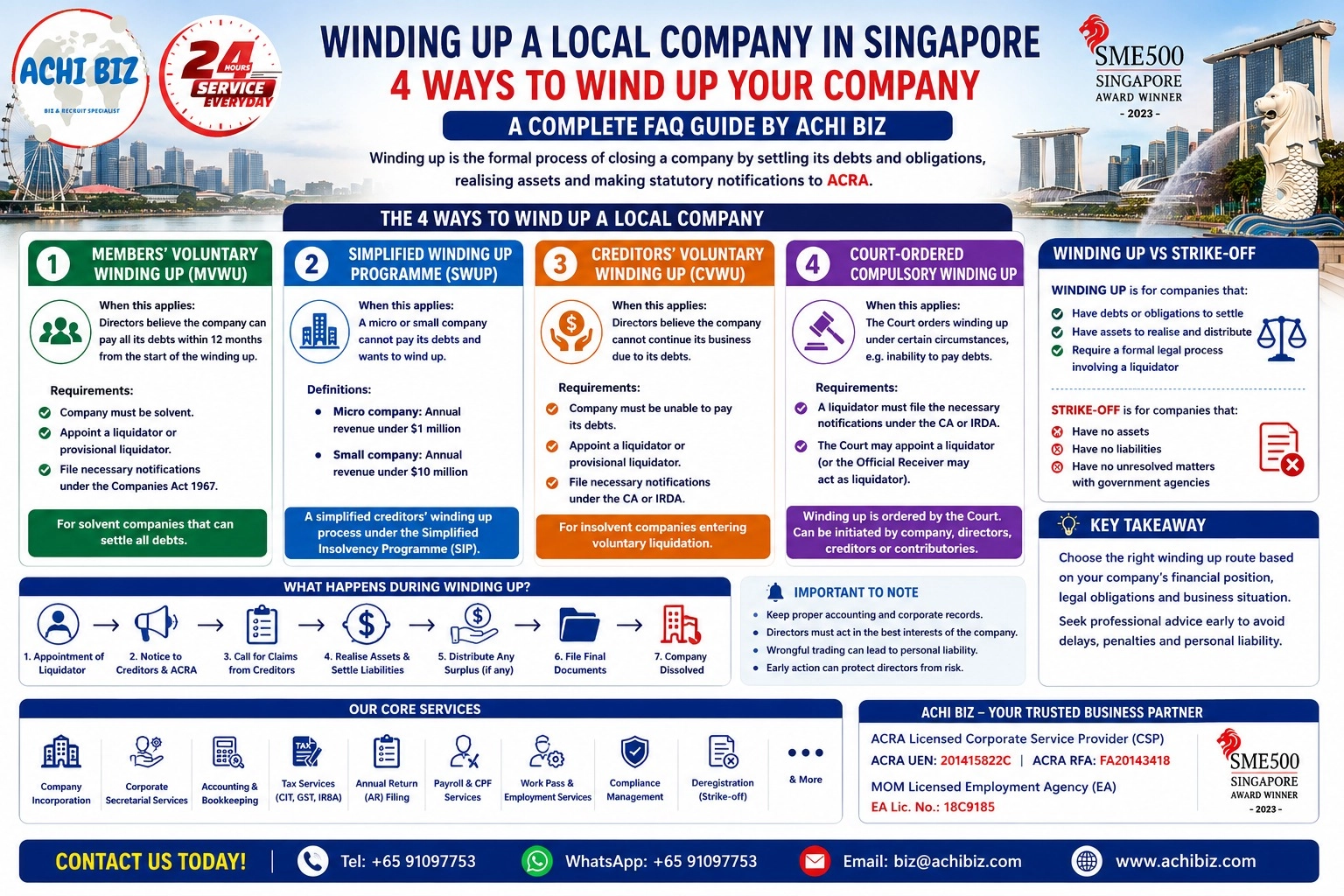
According to ACRA’s guidance on winding up a local company, winding up is the formal process of closing a local company involving the settlement of debts and obligations, dealing with remaining assets and making the required legal notifications to ACRA. ACRA currently identifies four ways to wind up, depending principally on the company’s financial circumstances.
This FAQ explains the four routes — members’ voluntary winding up, Simplified Winding Up Programme (SWUP), creditors’ voluntary winding up and court-ordered compulsory winding up — and how Singapore companies should distinguish between them.
What does “winding up” a company mean in Singapore?
Winding up is a formal legal process through which a company’s affairs are brought to an end. It generally involves identifying and realising assets, dealing with creditors and liabilities, settling the company’s obligations, distributing any remaining assets where applicable, completing statutory filings and ultimately bringing the company to dissolution.
It is therefore different from simply stopping business operations. A company can cease trading while continuing to exist as a registered legal entity.
What are the four ways to wind up a local company in Singapore?
ACRA identifies four routes based on the company’s circumstances:
- Members’ voluntary winding up
- Simplified Winding Up Programme (SWUP)
- Creditors’ voluntary winding up
- Court-ordered compulsory winding up
The appropriate route depends significantly on whether the company can pay its debts, its size and eligibility for a simplified process, and whether the winding up is voluntary or ordered by the Court.
How can a company determine which type of winding up applies?
A useful starting point is the company’s financial position.
If the company is solvent and can satisfy its debts within the applicable period, a members’ voluntary winding up may be relevant.
If it cannot pay its debts, the situation moves into an insolvency context. Depending on its circumstances, a company may consider creditors’ voluntary winding up or, if eligible, SWUP. A company may also be wound up by order of the Court where the statutory grounds are established.
The classification should not be selected merely because one procedure appears easier or cheaper. The company’s actual financial circumstances and applicable legal requirements determine which process is appropriate.
What is a Members’ Voluntary Winding Up (MVWU) in Singapore?
A members’ voluntary winding up is essentially the voluntary winding-up route for a solvent company.
The central distinction is the company’s ability to meet its debts. ACRA describes this route as applying where the directors believe the relevant entity can pay all its debts within 12 months from commencement of the winding up. A liquidator or provisional liquidator must be appointed and the applicable statutory notifications must be filed.
Is Members’ Voluntary Winding Up only for companies with financial problems?
No. That is an important distinction.
A company may be commercially viable or have sufficient assets to pay its creditors but its shareholders may nevertheless decide that the business should be brought to an end.
For example, the owners may wish to retire, restructure their investments, discontinue a particular business venture or close an entity that is no longer required.
The fact that the company is being wound up does not automatically mean it is insolvent.
Why is the company’s ability to pay its debts important in a Members’ Voluntary Winding Up?
Solvency is fundamental to this route.
A members’ voluntary winding up proceeds on the basis that the company’s assets and resources are sufficient to satisfy its liabilities within the required period.
If that assumption is incorrect and the company is actually unable to meet its debts, the situation may need to be addressed under the procedures applicable to an insolvent company.
What is the Simplified Winding Up Programme (SWUP) in Singapore?
The Simplified Winding Up Programme (SWUP) is designed as a simplified winding-up mechanism for eligible financially distressed companies.
ACRA describes SWUP as a simplified creditors’ winding-up process. Current legislation establishes a simplified winding-up programme for eligible companies meeting the prescribed requirements.
Is SWUP intended for solvent companies?
No. SWUP is aimed at eligible companies that cannot pay their debts.
Under the current statutory framework, entry into the programme involves, among other requirements, the company resolving by special resolution that it is unable to pay, and will not be able to pay or provide for payment of, its debts in full.
Which companies are generally associated with SWUP?
ACRA characterises this route as being available where a micro or small company cannot pay its debts and wants to wind up.
For the categorisation shown by ACRA:
- a micro company has annual revenue below $1 million; and
- a small company has annual revenue below $10 million.
These revenue descriptions should not, however, be treated as the complete eligibility test. Companies considering SWUP should check the current statutory eligibility and suitability requirements applicable at the time of application.
Is being a “small company” enough to qualify for SWUP?
Not necessarily.
Company size is only part of the analysis. SWUP operates under a specific statutory framework containing requirements for entry and circumstances that can make a company unsuitable for the programme.
Therefore, a company should not assume that revenue below a particular threshold automatically guarantees admission.
Does SWUP count as a creditors’ voluntary winding up?
The current IRDA expressly provides that the voluntary winding up of a company under SWUP is treated as if it were a creditors’ voluntary winding up, subject to the modifications and provisions applicable to the simplified programme.
This helps explain why SWUP should be understood as a simplified insolvency procedure rather than an alternative version of an ordinary solvent closure.
What is a Creditors’ Voluntary Winding Up (CVWU) in Singapore?
A creditors’ voluntary winding up applies where the company is unable to continue its business because of its debts and the company moves into a voluntary winding-up process.
ACRA states that the company must appoint a liquidator or provisional liquidator and make the necessary notifications under the applicable legislation.
What is the main difference between Members’ Voluntary Winding Up and Creditors’ Voluntary Winding Up?
The key distinction is solvency.
In simplified terms:
Members’ voluntary winding up: the company is capable of paying its debts within the required timeframe.
Creditors’ voluntary winding up: the company cannot continue its business because of its debts.
This financial distinction affects the legal procedure, role of creditors and manner in which the company’s affairs are administered.
Does “voluntary” mean creditors have no involvement in a Creditors’ Voluntary Winding Up?
No.
“Voluntary” describes how the winding-up process is initiated; it does not mean creditors cease to have an interest in the process.
Where a company is insolvent, creditors are directly affected because the company’s available assets may be insufficient to satisfy all claims. The winding-up framework therefore provides mechanisms for dealing with creditors and the company’s financial affairs through the liquidator.
What is Court-Ordered Compulsory Winding Up in Singapore?
A court-ordered compulsory winding up occurs when the Court orders a company to be wound up under the applicable law.
Inability to pay debts is one example of a circumstance in which winding up may be ordered, but it is not the only possible statutory ground. ACRA states that the Court may appoint a liquidator, while the Official Receiver may also act as liquidator in applicable circumstances.
Who can apply to the Court to wind up a Singapore company?
Section 124 of the Insolvency, Restructuring and Dissolution Act 2018 identifies several persons who may make a winding-up application, depending on the circumstances.
They include the company, a director, a creditor (including certain contingent or prospective creditors), and certain contributories, among other persons specified by law.
Accordingly, compulsory winding up should not be understood as something that can only be initiated by a creditor.
Is inability to pay debts the only reason a Court may wind up a company?
No.
Although insolvency is an important and common ground, the IRDA contains several circumstances in which the Court may order winding up.
These can extend beyond straightforward non-payment of debts. The legal basis for a particular winding-up application therefore needs to be considered against the statutory grounds rather than assuming that every compulsory winding up is simply a debt-recovery action.
What is the simplest way to distinguish the four winding-up routes?
They can broadly be understood as follows:
| Winding-up route | General situation |
|---|---|
| Members’ Voluntary Winding Up | Company is solvent and can satisfy its debts within the applicable period |
| SWUP | Eligible micro/small company is unable to pay its debts and qualifies for the simplified regime |
| Creditors’ Voluntary Winding Up | Company cannot continue business because of its debts and enters voluntary winding up |
| Court-Ordered Compulsory Winding Up | Company is wound up pursuant to an order of the Court |
The table is a practical overview only. Each route has its own statutory requirements and procedures.
What is the difference between voluntary and compulsory winding up?
A voluntary winding up originates through the company’s internal decision-making process in accordance with the applicable legislation.
A compulsory winding up is ordered by the Court.
The distinction therefore concerns not merely whether the company wants to close, but the legal mechanism through which the winding up commences.
Is winding up the same as striking off a Singapore company?
No. They are different closure mechanisms.
ACRA describes winding up as a formal process for closing a local company involving the settlement of debts and obligations.
Strike-off, by contrast, is available where the company satisfies ACRA’s striking-off criteria. Those criteria include, among other things, that the company owns nothing and owes nothing, has no unpaid government debts or unresolved government matters, and is not involved in legal proceedings.
Can a company with substantial outstanding debts simply apply for ACRA strike-off instead of winding up?
Generally, a company that still has outstanding liabilities would not satisfy ACRA’s strike-off criteria.
ACRA specifically requires a strike-off applicant to have no unpaid government debts or unresolved government matters and to own nothing and owe nothing, including having no potential future claims.
Where liabilities remain, the directors need to consider the company’s actual financial position and the appropriate legal mechanism rather than using strike-off as a substitute for dealing with creditors.
Why should directors assess solvency before choosing a company closure method?
Because solvency can fundamentally change the appropriate winding-up route.
Directors should have a proper understanding of the company’s assets, liabilities, contingent liabilities, cash flow, creditor claims and ability to satisfy debts before deciding how the company should be closed.
Choosing a process based on convenience without understanding the company’s true financial condition can create additional legal and practical problems.
What happens to a company’s assets during winding up?
A central purpose of winding up is to bring the company’s financial affairs to an orderly conclusion.
The liquidator generally takes responsibility for administering the winding up, which can include identifying and dealing with company assets and applying available funds according to the applicable legal framework.
Only after liabilities and the costs of winding up have been properly dealt with can any remaining value be addressed in accordance with the rights of the relevant parties.
What happens to the company’s creditors during winding up?
Creditors become an important part of the process, particularly where the company is insolvent.
Claims need to be identified and dealt with through the winding-up administration. The fact that a company has ceased trading does not cause its debts to disappear.
This is one of the fundamental reasons why winding up is materially different from simply abandoning an inactive company.
What is the role of a liquidator in winding up a Singapore company?
The liquidator is central to the formal administration of the winding up.
Depending on the type of winding up and applicable legislation, the liquidator deals with the company’s affairs, assets, liabilities, creditor matters and required procedural steps toward dissolution.
ACRA’s guidance specifically requires the appointment of a liquidator or provisional liquidator for the relevant voluntary winding-up routes, while in a compulsory winding up the Court may appoint a liquidator or the Official Receiver may act as one.
What is a provisional liquidator?
A provisional liquidator may be appointed at an earlier stage of the process in circumstances permitted by law.
The role should not simply be treated as another name for the final liquidator. The appointment, powers and duration of the role depend on the applicable winding-up procedure and statutory provisions.
Does the board of directors continue controlling the company normally after liquidation starts?
Winding up fundamentally changes how the company’s affairs are administered.
Once the applicable winding-up regime and liquidator’s appointment take effect, directors cannot simply continue operating the company as though nothing has happened. Their powers and the liquidator’s authority are governed by the relevant insolvency legislation and the circumstances of the winding up.
Are shareholders automatically entitled to receive the company’s remaining assets?
Not before the company’s liabilities and winding-up obligations are properly addressed.
Shareholders are residual stakeholders. A solvent company may ultimately have surplus assets available for distribution after creditors and relevant winding-up costs have been satisfied.
An insolvent company, however, may have no surplus remaining for shareholders.
Does winding up immediately dissolve the company?
No. Winding up and dissolution are not the same moment.
Winding up is the process of bringing the company’s affairs to an end. Dissolution is the eventual termination of the company’s legal existence after the required winding-up procedures have been completed.
This distinction is important because a company undergoing liquidation continues to have a legal status during the winding-up process.
What ACRA filings may arise during winding up?
ACRA provides winding-up eServices for filings associated with the process.
Depending on the circumstances, filings can include notices relating to the appointment or cessation of a liquidator or provisional liquidator, liquidator accounts and statements, Statement of Affairs, notices concerning creditor meetings, dissolution and certain early-dissolution notifications.
The precise filings depend on the particular winding-up route and stage of proceedings.
Are winding-up filings made through Bizfile?
ACRA provides Manage winding up and General lodgement eServices through its corporate filing framework for the relevant winding-up notifications and documents.
Companies and insolvency practitioners should identify the correct filing based on the winding-up procedure rather than assuming there is one single “winding-up application” covering the entire process.
Which laws principally govern company winding up in Singapore?
The winding-up framework principally involves the Insolvency, Restructuring and Dissolution Act 2018 (IRDA) together with relevant provisions of the Companies Act 1967, subsidiary legislation and applicable procedural requirements.
The IRDA expressly recognises that a company may be wound up either by the Court or voluntarily.
Can directors simply stop operating an insolvent company and leave it dormant?
That does not resolve the underlying insolvency.
Ceasing business operations does not extinguish debts, creditor claims or other liabilities. Directors of a financially distressed company should therefore assess the position promptly and determine what restructuring, insolvency or winding-up process is appropriate.
Should a company distribute its assets to shareholders before paying creditors?
Directors should not treat company assets as belonging directly to shareholders merely because the business is closing.
Where liabilities exist, the company’s assets need to be dealt with in accordance with the applicable insolvency and winding-up framework. Improperly extracting or distributing assets can create serious issues, particularly when creditors remain unpaid.
Can a winding-up process uncover earlier transactions or conduct?
Yes. Formal liquidation can involve examination of the company’s affairs and transactions.
Accordingly, directors should not view winding up merely as an administrative mechanism for cancelling the company’s registration. The company’s books, transactions, assets, liabilities and conduct may become relevant during the liquidation process.
Does winding up automatically remove all potential liability of directors?
No.
The dissolution of a company should not be understood as an automatic release from every issue arising from conduct that occurred while the company was operating.
Questions concerning a director’s personal exposure depend on the circumstances, applicable legislation and the nature of the conduct concerned.
What records should a company prepare when winding up?
A company should ensure its accounting, corporate and financial records accurately reflect its affairs.
Depending on the winding-up route, information concerning assets, liabilities, creditors, bank accounts, contracts, employees, tax matters, secured obligations, litigation and other financial commitments may be relevant to the liquidator and statutory process.
Good records can materially reduce uncertainty and delays.
What is a Statement of Affairs in a winding-up process?
A Statement of Affairs provides financial information concerning the company’s position in connection with the winding-up process.
ACRA specifically lists Statement of Affairs among the documents that may be lodged through its General lodgement eService for winding-up matters.
Whether and when one is required depends on the applicable procedure.
What should directors do when a company starts experiencing serious financial difficulty?
Directors should not wait until the company’s financial position becomes impossible to manage.
They should understand the company’s current cash position, debts, secured obligations, creditor demands, tax liabilities, employee obligations, contingent liabilities and available assets. They should also consider whether the business can realistically continue, whether restructuring is viable, or whether an insolvency process should be considered.
Early assessment usually provides more options than waiting until creditors or other parties commence proceedings.
Can winding up be used simply because shareholders no longer want the company?
Potentially, but the appropriate closure route depends on the company’s circumstances.
A solvent company whose shareholders wish to terminate it may consider a solvent winding-up route. However, where the company satisfies all of ACRA’s strike-off criteria, strike-off may be another closure mechanism.
The important point is to determine the company’s financial and legal position first, rather than selecting a procedure merely because the owners no longer need the entity.
Which winding-up route gives creditors the greatest relevance?
Creditors are particularly central where the company is insolvent — notably in a creditors’ voluntary winding up, SWUP or insolvency-based compulsory winding up.
In contrast, a members’ voluntary winding up proceeds on the basis of solvency and the company’s ability to satisfy its debts.
Is Court-Ordered Winding Up always initiated against the wishes of the company?
Not necessarily.
Although compulsory winding up commonly brings to mind a creditor applying against a debtor company, the IRDA permits several categories of applicants. The company itself and, in applicable circumstances, a director can also apply for winding up by the Court.
What is the biggest practical mistake when deciding how to close a Singapore company?
One of the biggest mistakes is treating strike-off, solvent liquidation and insolvent liquidation as interchangeable procedures.
They are not.
The correct starting point is to determine:
Does the company have assets? Does it have liabilities? Can it pay its debts? Are creditors outstanding? Is it involved in proceedings? Is it eligible for strike-off or a simplified insolvency process?
Those answers determine which closure mechanism should actually be examined.
What should a Singapore company know before beginning winding up?
Winding up is a formal legal process rather than an administrative cancellation of a business registration.
Before proceeding, the company’s directors and shareholders should understand its solvency, debts, assets, creditor position, legal proceedings, tax and employment matters, records, applicable winding-up route and the role of the liquidator.
For insolvent companies in particular, early and accurate assessment is important because delaying action may reduce the options available.
What is the key takeaway about the four ways to wind up a Singapore company?
There is no single winding-up procedure suitable for every company.
A solvent company, a small insolvent company eligible for SWUP, a company voluntarily entering insolvent liquidation and a company subject to a Court winding-up order are in materially different circumstances.
The correct process therefore starts with the company’s financial health and legal position, followed by the applicable statutory procedure. Understanding these distinctions helps directors and shareholders avoid confusing ordinary business closure with the much more formal process of company liquidation and dissolution.
Related Pages:
Deregistration (Strike-Off) of a Pte Ltd Company-FAQ
Click here to learn about Key Differences: Strike-Off vs Winding Up of a Singapore Pte. Ltd. Company
#achibiz