
Why Disclosure of Conflicts of Interest by Directors Is Important in Singapore Pte. Ltd. Companies
Directors of a Singapore Private Limited (Pte. Ltd.) company are entrusted with making decisions for the company. That responsibility can become complicated when a director has a financial, business, family or other personal interest connected with a matter involving the company.
A conflict of interest does not automatically mean misconduct. The problem arises when a director’s personal or external interests conflict, or may conflict, with the duties owed to the company—and the situation is not properly identified, disclosed and managed.
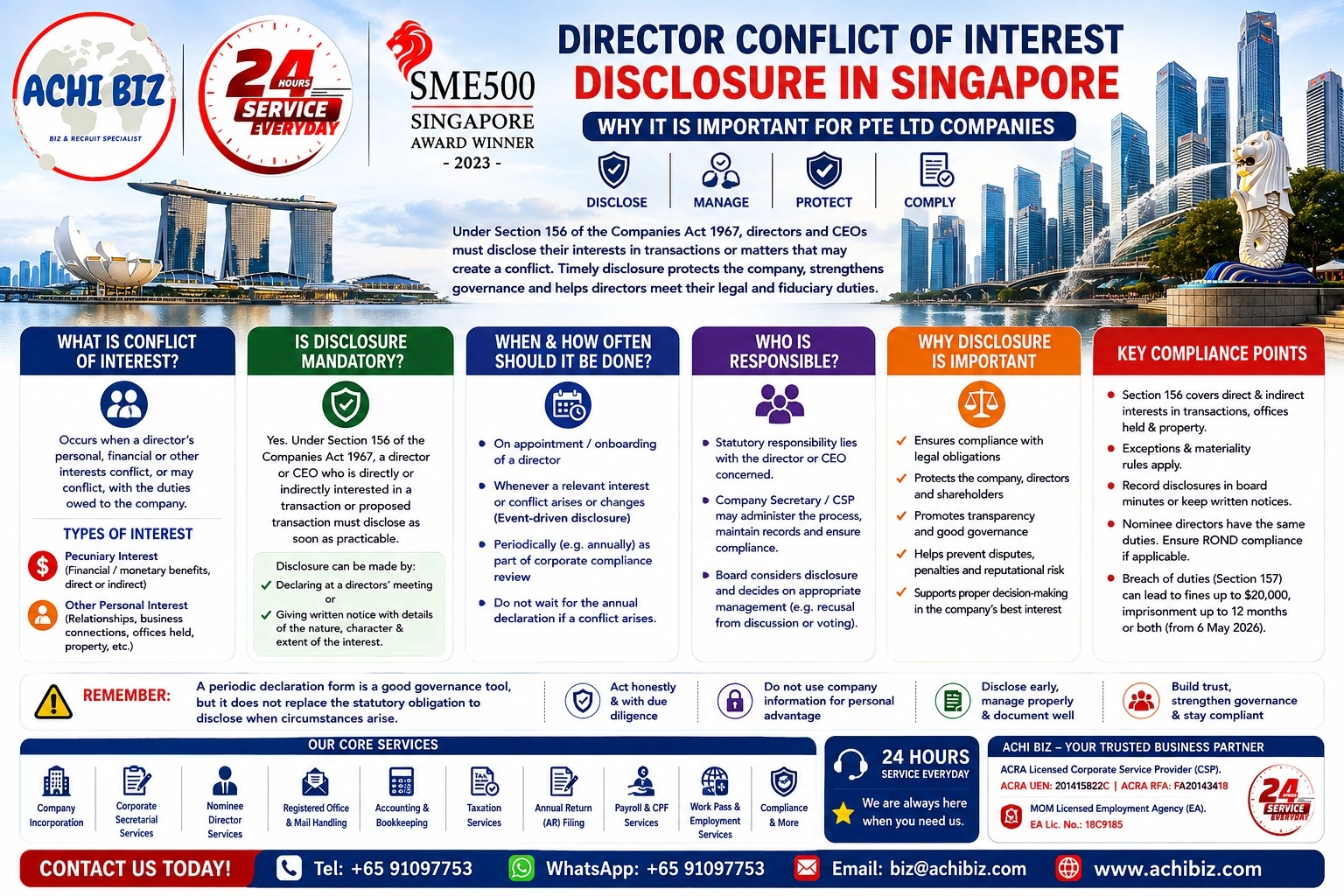
Under Section 156 of the Companies Act 1967, a director or chief executive officer (CEO) who is directly or indirectly interested in a transaction or proposed transaction with the company must disclose the interest as soon as practicable after the relevant facts come to his or her knowledge. The law also addresses certain interests arising from offices held or property possessed.
For companies, a written Disclosure of Conflict of Interests by Director declaration can therefore be a useful internal compliance control. It provides a structured way to ask directors whether they have any pecuniary or other personal interests and to document their responses.
However, an important distinction must be understood: a periodic declaration form does not replace a director’s statutory obligation to make a disclosure whenever circumstances requiring disclosure arise.
What is a conflict of interest for a director of a Singapore Pte. Ltd. company?
A conflict of interest generally occurs when a director’s personal, financial, professional or other interests compete with, influence or potentially interfere with the director’s responsibilities towards the company.
For example, a director may be involved in deciding whether the company should appoint a particular supplier while also having a financial interest in that supplier.
The director’s personal interest and the company’s interest have therefore intersected, and the situation needs to be properly assessed and managed.
What does “pecuniary interest” mean in a director’s conflict-of-interest declaration?
A pecuniary interest is essentially an interest involving money or financial benefit.
It may arise where the director stands to receive, preserve, increase or otherwise benefit financially from a decision, transaction or arrangement involving the company.
Examples may include a director having a financial interest in a supplier dealing with the company, receiving a commission connected with a company transaction, owning an interest in another business involved in the transaction, or having another financial arrangement that could be affected by the company’s decision.
The important issue is not merely whether money is paid directly to the director. Indirect financial interests can also be relevant. Section 156 expressly refers to interests held directly or indirectly.
Does pecuniary interest mean only money received directly by the director?
No.
A director should not interpret “pecuniary interest” so narrowly that only a direct cash payment counts.
An interest may be indirect. For example, a transaction could potentially benefit another business in which the director has a relevant financial interest.
Whether a particular interest legally requires disclosure depends on the facts and the applicable provisions of the Companies Act, but directors should not assume that an indirect financial benefit is automatically outside the disclosure rules.
What does “other personal interest” mean?
Other personal interest is broader than a purely monetary interest.
A director may have an interest arising from a personal relationship, external position, business connection, professional responsibility, property ownership or another circumstance that could affect—or appear capable of affecting—the director’s independent judgment.
For example, a director may have no direct financial interest in a particular decision but may also serve in another organisation whose interests could conflict with those of the company.
Section 156 specifically addresses circumstances where a director or CEO holds an office or possesses property whereby a duty or interest might be created, directly or indirectly, in conflict with the person’s duties or interests as director or CEO.
What is the difference between pecuniary interest and other personal interest?
The simplest distinction is:
Pecuniary interest = financial or monetary interest.
Other personal interest = a relevant non-financial personal, professional, relational or external interest that may conflict with the director’s duties.
A particular situation can involve both at the same time.
The purpose of using broader wording such as “pecuniary or other personal interest” in an internal declaration is to encourage directors to look beyond obvious cash benefits when considering whether a potential conflict exists.
Does having a personal interest automatically mean the director has done something wrong?
No.
A conflict can arise naturally in business. Directors may have investments, other directorships, businesses, professional appointments and commercial relationships.
The critical questions are whether the interest should be disclosed, whether disclosure was made at the proper time, and whether the resulting conflict was appropriately managed.
Is disclosure of a director’s conflict of interest mandatory in Singapore?
Yes, where the statutory circumstances requiring disclosure exist.
Section 156 provides that every director or CEO who is directly or indirectly interested in a transaction or proposed transaction with the company must, as soon as practicable after the relevant facts come to his or her knowledge, either declare the nature of the interest at a directors’ meeting or send written notice to the company containing details of the nature, character and extent of the interest.
There are statutory exceptions and qualifications, so each situation should be considered on its facts.
Is every director legally required to sign the particular conflict-of-interest declaration form shown above every year?
This requires a distinction between statutory disclosure and an internal compliance declaration.
The Companies Act does not simply state that every director of every Pte. Ltd. company must sign that particular form once every year.
The statutory obligation under Section 156 is principally event-driven: when circumstances requiring disclosure arise, disclosure must be made in accordance with the Act.
An annual declaration can nevertheless be a valuable internal governance measure because it requires directors to periodically reconsider whether their circumstances have changed.
Why should a company obtain a written conflict-of-interest declaration?
A written declaration creates a documented compliance trail and encourages directors to actively consider whether they have relevant interests.
Instead of relying on assumptions, the company can ask each director to confirm whether:
“I have no pecuniary or other personal interest…”
or
“I have pecuniary or other personal interest…”
Where an interest exists, the director can provide particulars for the company to assess and document appropriately.
Is a “no conflict” declaration useful?
Yes, as an internal governance measure.
A signed declaration showing that the director considered the matter and declared no relevant conflict can support the company’s compliance records.
But it is only accurate as at the circumstances existing when the declaration was made.
It does not permanently clear the director of future disclosure obligations.
What happens if a director declares “no interest” and later develops a conflict?
The director should reassess the situation and make the necessary disclosure when the new circumstances arise.
A director cannot reasonably rely on a declaration signed months earlier if circumstances have subsequently changed.
The statutory requirement is tied to the relevant facts becoming known—not merely to the company’s annual paperwork cycle.
When should a conflict-of-interest declaration first be obtained from a director?
A sensible corporate governance practice is to include it as part of director onboarding.
This allows the company to identify existing interests at the beginning of the appointment and also reminds the new director that disclosure is an ongoing responsibility.
The company should separately determine whether any existing interest triggers a statutory disclosure obligation.
How often should a company obtain the internal declaration?
There is no universal statutory rule requiring the particular internal declaration to be signed monthly, quarterly or annually.
As a practical governance framework, a company could obtain it:
- upon appointment of a director;
- periodically, such as during an annual corporate compliance review; and
- whenever a relevant change or potential conflict occurs.
Most importantly, an annual declaration should never become an excuse for postponing an event-driven disclosure required under Section 156.
When must a director disclose an interest in a company transaction?
The disclosure must generally be made as soon as practicable after the relevant facts have come to the director’s or CEO’s knowledge.
Disclosure may be made by declaring the nature of the interest at a directors’ meeting or by sending the company a written notice containing details of the nature, character and extent of the interest.
Can an indirect interest require disclosure?
Yes.
Section 156 specifically refers to a director or CEO being interested directly or indirectly in a transaction or proposed transaction with the company.
Companies should therefore avoid a compliance approach that looks only for contracts signed personally by the director or payments made directly into the director’s account.
Are all small or insignificant shareholdings automatically conflicts?
Not necessarily.
The Companies Act itself contains qualifications. For example, Section 156 provides an exception concerning an interest consisting only of being a member or creditor of a corporation interested in the transaction where the director’s or CEO’s interest may properly be regarded as not being a material interest.
This is another reason not to treat conflict disclosure as a simple tick-box exercise.
Can a director’s external directorship create a conflict?
Potentially, yes.
A person may be a director of Company A while also serving Company B. If the companies enter into negotiations or their commercial interests diverge, the director’s responsibilities need to be carefully considered.
Section 156 expressly addresses an office that may create, directly or indirectly, a conflicting duty or interest.
Can ownership of property create a conflict of interest?
Yes, depending on the circumstances.
Section 156 also addresses property possessed by a director or CEO where it may create a duty or interest that conflicts directly or indirectly with the person’s duties or interests in the company.
For example, property ownership may become relevant where the company proposes a transaction connected with that property.
Can relationships with suppliers, customers or contractors create conflicts?
Potentially.
Suppose a company is choosing between suppliers and a director has a significant financial or other relevant personal connection with one of them. The director should assess whether the relationship creates a direct or indirect interest requiring disclosure.
The same principle may apply to customers, contractors, consultants, landlords, business partners and other counterparties.
Are family relationships relevant to conflict-of-interest analysis?
They can be.
The correct legal treatment depends on the facts and the relevant statutory rules, so companies should avoid automatically assuming either that every family connection is a conflict or that family interests never matter.
Where a family or connected-party relationship could give rise to an indirect interest or affect the director’s independent judgment, the situation should be carefully assessed.
Can a director make a general disclosure regarding an interest in another business?
Section 156 contains provisions allowing a director or CEO, subject to specified conditions, to make a declaration or written notice concerning the person’s position or interest in a specified corporation, firm or limited liability partnership so that the person is regarded as interested in transactions with that entity.
The nature and extent of the interest must be stated, and the statutory conditions must continue to be satisfied.
Does a general disclosure remain valid forever?
Not necessarily.
If the nature or extent of the director’s interest changes, the director should reassess the situation.
Conflict-of-interest compliance should reflect the actual current circumstances, rather than relying indefinitely on an outdated declaration.
Who is responsible for disclosing the conflict?
The statutory responsibility rests on the director or CEO who has the interest.
A director cannot simply transfer responsibility for identifying his or her personal interests to the company secretary, accountant or CSP.
Who should obtain and maintain the company’s internal conflict-of-interest declarations?
The company should establish an appropriate internal compliance process.
Administratively, the company secretary or its Corporate Service Provider (CSP) may circulate declarations, obtain completed forms, maintain supporting records and prepare the relevant corporate documentation.
However, the director remains responsible for accurately disclosing his or her own interests.
Should the declaration provide space for directors to explain the conflict?
Yes.
A simple “Yes” checkbox may not provide enough information.
Where an interest exists, the company should obtain sufficient particulars to understand its nature, character and extent, consistent with the terminology used in Section 156 for written notice of an interest in a transaction or proposed transaction.
Should the disclosure be recorded in board minutes?
Where the disclosure is made at a directors’ meeting, it should be properly reflected in the corporate record.
Accurate board minutes help establish what was disclosed, when it was disclosed and how the board dealt with the matter.
Where written notice is used instead, the company should retain the relevant documentation appropriately.
Does disclosure automatically allow the interested director to vote?
Not necessarily.
Companies should review the Companies Act, their Constitution and other applicable legal and governance requirements before determining how the director should participate in deliberation or voting.
Disclosure identifies the conflict; it does not automatically resolve every consequence flowing from it.
Should a conflicted director leave the meeting while the matter is discussed?
This depends on the applicable legal requirements, the company’s Constitution and the particular circumstances.
From a governance perspective, recusal may be appropriate in some situations, but companies should not turn this into a universal rule without considering their governing documents and applicable law.
Does declaring the conflict automatically protect the director from liability?
No.
Disclosure is important, but it is not a blanket immunity.
Section 157 separately requires a director to act honestly and use reasonable diligence and prohibits improper use of position or company information to gain an advantage for the officer or another person or cause detriment to the company.
How are fiduciary duties connected with conflict-of-interest disclosure?
Conflict management forms part of the broader framework governing directors’ conduct.
A director is expected to make decisions for the company rather than secretly allowing personal interests to determine corporate decisions.
Section 157’s statutory duties operate alongside other applicable rules of law concerning directors’ duties and liabilities.
Can a director use company information to benefit another business?
Improper use of information acquired through the director’s position can have serious consequences.
Section 157 prohibits an officer or agent from improperly using company information to obtain an advantage for himself, herself or another person, or to cause detriment to the company.
What are the consequences of breaching a director’s duties under Section 157?
Following amendments effective 6 May 2026, a breach of Section 157 can result in liability to the company for profit made or damage suffered and, on conviction, a fine of up to S$20,000, imprisonment for up to 12 months, or both.
These consequences reinforce why conflicts should be treated as genuine governance matters rather than routine paperwork.
Are nominee directors also required to consider conflicts of interest?
Yes.
Nominee status does not turn the director into a person who can simply follow the nominator’s instructions without considering the company’s interests.
Where nominee arrangements exist, companies also need to separately consider their Register of Nominee Directors (ROND) obligations.
Is conflict-of-interest disclosure the same as ROND disclosure?
No. These are different compliance requirements.
Conflict-of-interest disclosure concerns interests that may conflict with the director’s duties.
The Register of Nominee Directors (ROND) identifies directors who act on behalf of another person or entity—the nominator.
A director can therefore have a conflict without being a nominee director, and a nominee director has separate nominee disclosure obligations.
What additional ROND compliance applies if the director is a nominee?
Unless exempt, companies must maintain their private ROND and file the relevant information with ACRA’s Central ROND.
ACRA states that changes requiring an update to the private register must generally be entered within seven days, followed by filing with the Central ROND within two business days after the private register is updated.
This should be managed separately from the company’s conflict-of-interest declaration.
Is a conflict-of-interest declaration filed with ACRA?
The internal declaration discussed in this article is generally part of the company’s corporate governance records; it should not be confused with information that must specifically be lodged with ACRA.
However, a conflict may reveal another fact—such as a nominee arrangement—that carries separate statutory register or filing requirements.
Should small Pte. Ltd. companies bother with formal conflict declarations?
Yes, formal documentation can be particularly useful for small companies.
In owner-managed businesses, the same individuals may simultaneously be directors, shareholders, employees, landlords, lenders or suppliers. Personal and corporate interests can therefore overlap frequently.
A simple but properly maintained disclosure procedure creates clarity and can help prevent disputes later.
Is conflict disclosure important in a family-owned company?
Yes.
Family ownership does not eliminate directors’ duties.
Where directors, shareholders and related businesses are closely connected, documenting interests can actually become more important because transactions that seem informal within the family may still be transactions of the company.
Should a sole director make conflict disclosures?
Having only one director does not make potential conflicts disappear.
The sole-director structure may require particular care because there is no second director providing an independent board-level perspective. The director should still comply with applicable statutory disclosure and duties and ensure that transactions and interests are properly documented.
What should a company do after receiving a positive conflict declaration?
The company should first understand exactly what has been disclosed.
It should then determine whether the matter triggers Section 156 or another legal requirement, review the company’s Constitution, determine the appropriate decision-making process and properly document the outcome.
For significant or contentious conflicts, legal advice may be appropriate.
Should conflict-of-interest declarations form part of the company’s annual corporate compliance review?
They can, and this is a sensible governance practice.
An annual review provides a useful opportunity to ask whether directors’ interests, external appointments or circumstances have changed.
But the company should make it clear to every director:
Do not wait for the annual declaration if a relevant conflict arises during the year.
What internal policy should a Pte. Ltd. company adopt for director conflicts?
A practical policy should establish when directors are asked for declarations, who receives them, how changes are reported, how disclosed matters are escalated to the board, how meeting participation is handled, and how records are retained.
The process should be proportionate to the company’s size and activities rather than creating paperwork with no practical purpose.
What records should the company retain?
Depending on the circumstances, records may include signed declarations, written notices of interests, supporting particulars, relevant board resolutions and minutes, correspondence concerning changes and documents showing how the conflict was handled.
The objective is to maintain a coherent corporate record rather than merely collect signed forms.
Is a conflict-of-interest declaration enough to demonstrate good corporate governance?
No single form can do that.
A declaration is valuable only when directors understand what they are being asked, disclose accurately, update the company when circumstances change and the company appropriately responds to identified conflicts.
A signed form sitting in a file while actual conflicts are ignored provides little protection.
What is the biggest compliance mistake companies make with conflict declarations?
Treating the declaration as a once-a-year checkbox.
Conflict-of-interest compliance is dynamic. Interests change, companies enter new transactions, directors accept new appointments, business relationships develop and personal circumstances evolve.
The correct approach is therefore:
declare → assess → manage → document → update when circumstances change.
How does proper conflict disclosure protect the company?
Effective disclosure promotes transparency and helps directors make decisions on an informed basis.
It can also reduce uncertainty over whether a director had an undisclosed personal interest, strengthen corporate records, assist with governance reviews and help prevent disagreements among directors and shareholders.
How does proper disclosure protect the director?
A clear and timely disclosure provides evidence that the director identified the interest rather than concealing it.
However, directors should remember that disclosure does not excuse subsequent conduct that breaches their statutory, fiduciary or other duties.
Should conflict-of-interest compliance be considered when appointing a new director?
Yes.
Director onboarding should not focus only on filing the appointment with ACRA.
The incoming director should understand directors’ duties, conflicts of interest, disclosure responsibilities, confidentiality obligations and, where relevant, nominee director requirements.
Starting with proper documentation creates a stronger compliance foundation.
Can ACHI BIZ assist with director conflict-of-interest compliance?
Yes. ACHI BIZ is an ACRA Licensed Corporate Service Provider (CSP) and can assist Singapore companies with corporate secretarial and compliance administration, including director appointment documentation, corporate resolutions and minutes, maintaining applicable company records and registers, and supporting companies with their ongoing statutory compliance requirements.
Where a matter involves a complex legal dispute, interpretation of fiduciary duties or contentious conflict between directors or shareholders, independent legal advice may also be necessary.
What is the key takeaway for Singapore Pte. Ltd. companies?
A director’s conflict of interest should never be treated merely as a form-filling exercise.
Companies should understand the difference between pecuniary interests, meaning financial or monetary interests, and other personal interests, which may include relevant non-financial relationships, offices, responsibilities, property or other circumstances capable of conflicting with the director’s duties.
Most importantly, directors should understand that disclosure is ongoing and event-driven. A periodic declaration is a useful compliance control, but it does not replace the statutory requirement to disclose an interest when the relevant circumstances arise.
For a well-managed Singapore Pte. Ltd. company, the objective is straightforward: identify conflicts early, disclose them properly, manage them appropriately and maintain clear records of what was done.
ACHI BIZ SERVICES PTE. LTD.
ACRA Licensed Corporate Service Provider (CSP)
ACRA UEN: 201415822C | ACRA RFA: FA20143418
MOM Licensed Employment Agency (EA)
EA Lic. No.: 18C9185
ACHI BIZ – Corporate & Business Services Singapore
Disclaimer:
This FAQ is intended as general corporate compliance information and should not be treated as legal advice for a particular conflict or transaction.
Related Pages:
What Happens When a Director is deceased in Pte Ltd Company-FAQ
Resignation vs Removal vs Disqualification of a Director in Pte Ltd Company-FAQ
#achibiz