
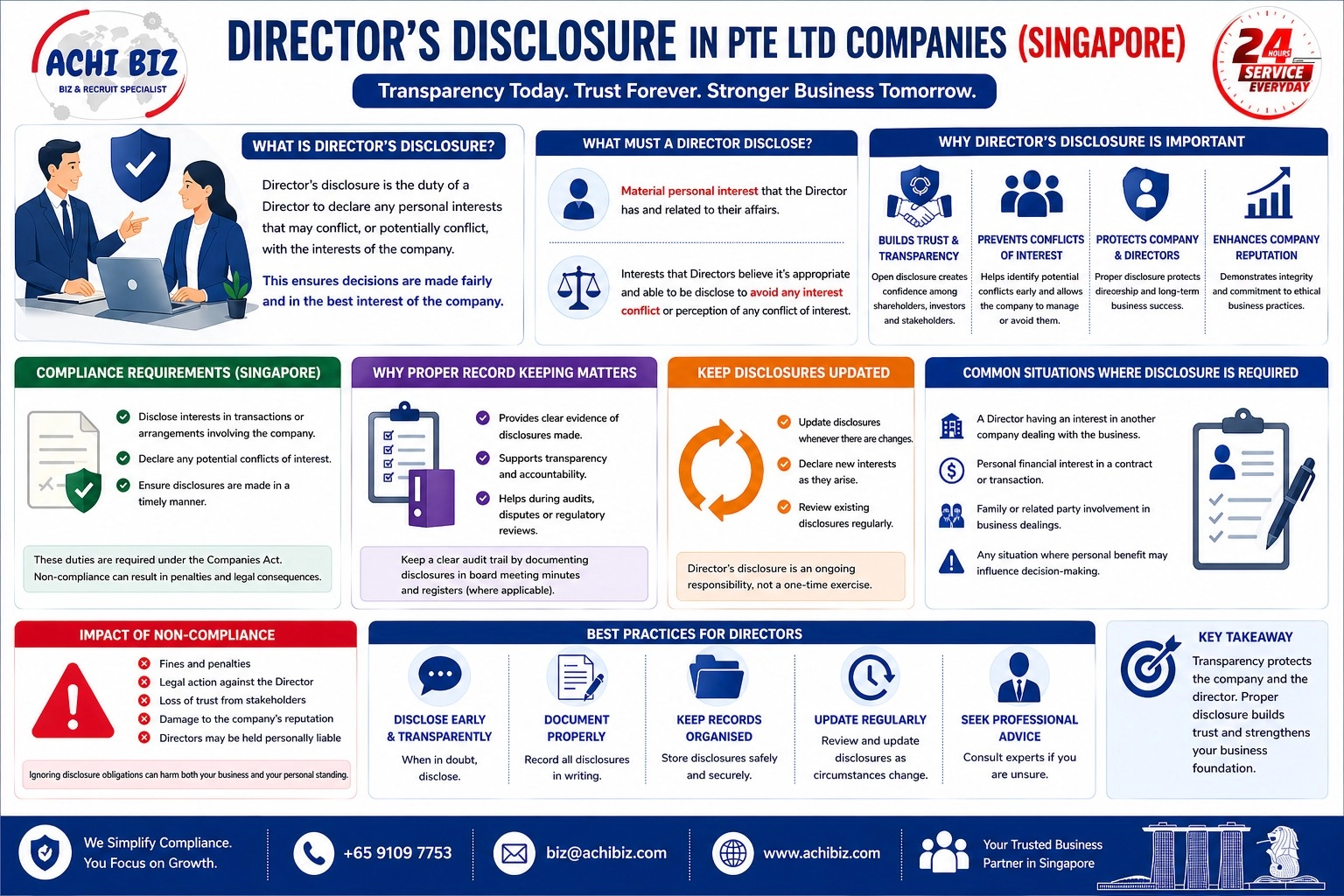
Director’s Disclosure in Singapore Pte Ltd Companies: Why It Matters and What You Must Do
If you are a director of a private limited company (Pte Ltd) in Singapore, your responsibilities go far beyond managing day-to-day operations. One key duty that is often overlooked is director’s disclosure.
It may sound technical, but in reality, it plays a critical role in maintaining transparency, preventing conflicts of interest, and protecting both the company and its stakeholders.
Let’s break it down in a clear and practical way.
What Is Director’s Disclosure?
Director’s disclosure refers to the obligation of a director to declare any personal interests that may conflict—or potentially conflict—with the interests of the company.
In simple terms, if a director has any personal stake in a matter involving the company, it must be disclosed.
This ensures that decisions are made fairly and in the best interest of the company.
What Must a Director Disclose?
Under Singapore’s corporate governance framework, a director must disclose:
👉 Material personal interests related to their affairs that may affect company decisions
👉 Any interests that could give rise to a conflict of interest, or even the perception of a conflict
This is important—even if the conflict is not direct or immediate. Transparency is key.
Why Director’s Disclosure Is Important
Director’s disclosure is not just a compliance requirement—it plays a bigger role in how a company operates.
Builds Trust and Transparency
When directors openly declare their interests, it creates a culture of honesty and accountability. This builds confidence among shareholders, investors, and business partners.
Prevents Conflicts of Interest
Disclosure helps identify potential conflicts early, allowing the company to manage or avoid them before they become serious issues.
Protects the Company and Directors
Proper disclosure ensures that decisions are not questioned later. It protects both the company and the directors from legal or reputational risks.
Supports Good Corporate Governance
Strong governance practices are essential for long-term business success, and disclosure is a key part of that framework.
Compliance Requirements in Singapore
Directors of Pte Ltd companies in Singapore are required to:
- Disclose their interests in transactions or arrangements involving the company
- Declare any potential conflicts of interest
- Ensure disclosures are made in a timely manner
These requirements are part of directors’ statutory duties under the Companies Act.
Failure to comply can lead to penalties and legal consequences.
Why Proper Record Keeping of Disclosures Matters
Making a disclosure is only part of the process—proper documentation is equally important.
Companies should:
- Record disclosures in board meeting minutes
- Maintain proper registers (where applicable)
- Keep records updated and easily accessible
This ensures there is a clear audit trail if questions arise in the future.
The Importance of Keeping Disclosures Updated
Director’s disclosure is not a one-time exercise.
Circumstances can change, and directors must:
- Update their disclosures whenever there are changes
- Declare new interests as they arise
- Review existing disclosures regularly
Failing to update disclosures can be just as risky as not declaring them at all.
Common Situations Where Disclosure Is Required
Some typical examples include:
- A director having an interest in another company dealing with the business
- Personal financial interest in a contract or transaction
- Family or related party involvement in business dealings
- Any situation where personal benefit may influence decision-making
Even if you’re unsure, it’s always safer to disclose.
Impact of Non-Compliance
Ignoring director’s disclosure obligations in Singapore can lead to:
- Fines and penalties
- Legal action against the director
- Loss of trust from stakeholders
- Damage to the company’s reputation
In serious cases, directors may be held personally liable.
Best Practices for Directors
To stay compliant and protected:
- Disclose early and transparently
- Document all disclosures properly
- Keep records updated regularly
- Seek professional advice if unsure
A proactive approach can prevent many issues down the line.
Final Thoughts
Director’s disclosure is a fundamental part of running a responsible and well-governed company in Singapore.
The key takeaway is simple:
Transparency protects both the company and the director.
By being open about potential conflicts and maintaining proper records, directors not only stay compliant—but also build trust and strengthen the company’s foundation.
Frequently Asked Questions (FAQs) – Director’s Disclosure in Singapore
❓ What is director’s disclosure in a Singapore company?
👉 Director’s disclosure is the duty of a director to declare any personal interests that may conflict or potentially conflict with the interests of the company.
❓ Is director’s disclosure mandatory in Singapore?
👉 Yes, under the Companies Act, directors are legally required to disclose their interests in transactions or arrangements involving the company.
❓ What must a director disclose?
👉 A director must disclose any material personal interest related to their affairs and any interests that may lead to a conflict of interest or even the perception of a conflict.
❓ When should a director make a disclosure?
👉 A director should disclose their interest as soon as they become aware of it, before the company makes any decision related to the matter.
❓ Why is director’s disclosure important?
👉 It ensures transparency, prevents conflicts of interest, builds trust among stakeholders, and supports good corporate governance.
❓ How does director’s disclosure help build trust?
👉 Open disclosure shows honesty and accountability, giving shareholders, investors, and partners confidence in the company’s decision-making.
❓ Do director’s disclosures need to be documented?
👉 Yes, disclosures should be properly recorded in board meeting minutes and maintained as part of the company’s records.
❓ Do disclosures need to be updated regularly?
👉 Yes, director’s disclosure is an ongoing obligation. Directors must update their disclosures whenever there are changes in their interests.
❓ What happens if a director fails to disclose their interest?
👉 Non-compliance may result in fines, legal action, reputational damage, and in serious cases, personal liability for the director.
❓ What are examples of conflict of interest situations?
👉 Examples include having an interest in another company dealing with the business, personal financial interest in a contract, or involvement of family members in business transactions.
❓ Is disclosure required even if there is only a perceived conflict?
👉 Yes, even if there is no actual conflict, directors should disclose any situation that may give rise to a perception of conflict.
❓ How can directors ensure compliance with disclosure requirements?
👉 Directors should disclose early, document all interests properly, keep records updated, and seek professional advice when in doubt.
#achibiz