
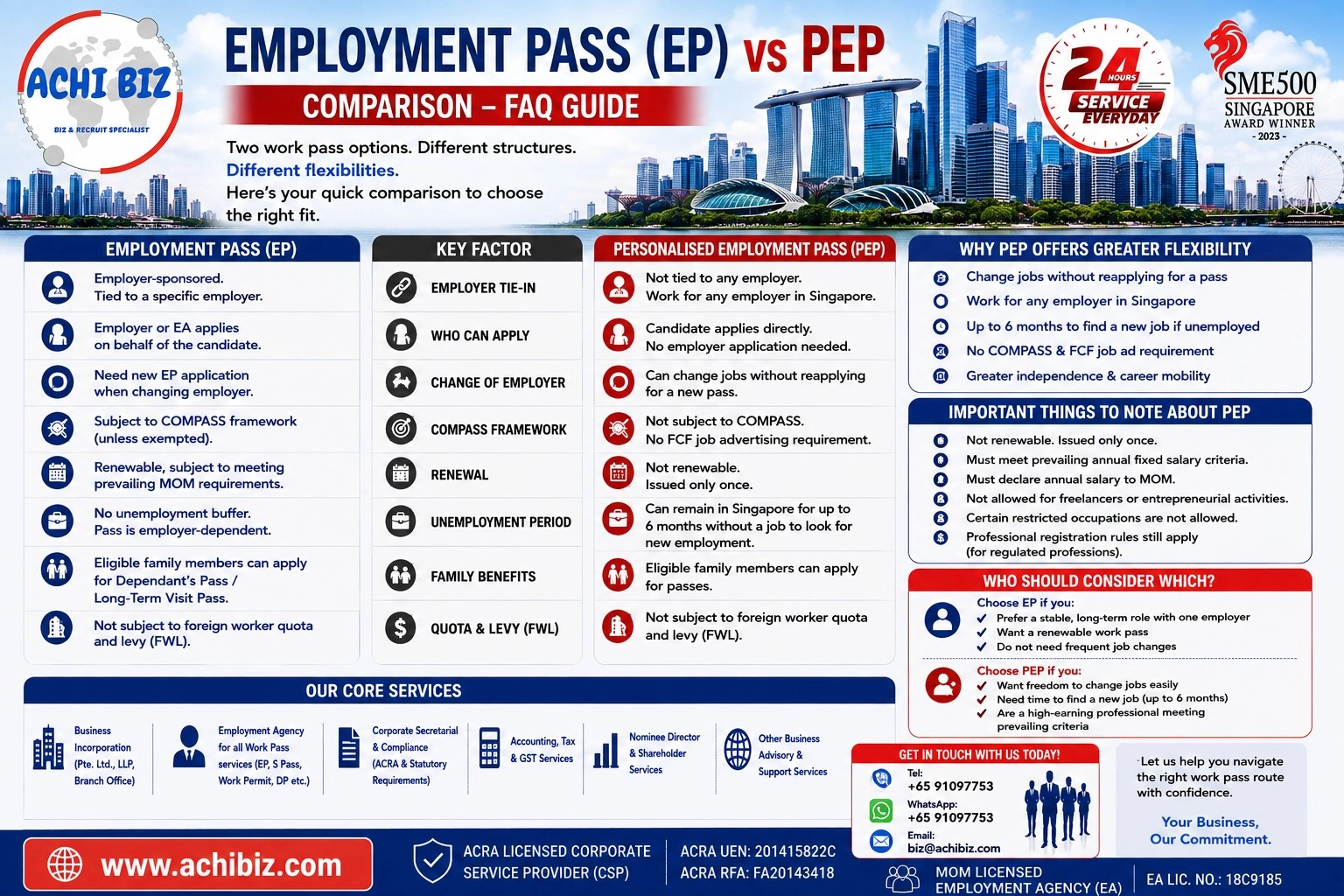
Employment Pass (EP) vs Personalised Employment Pass (PEP) in Singapore
The Employment Pass (EP) and Personalised Employment Pass (PEP) are both work passes administered by Singapore’s Ministry of Manpower (MOM), but they are designed for different professional situations.
The Employment Pass is primarily an employer-linked work pass for eligible foreign professionals, managers and executives with a job offer in Singapore. The employer or its appointed Employment Agency (EA) normally applies on behalf of the candidate.
The Personalised Employment Pass, or PEP, is intended for eligible high-earning Employment Pass holders and overseas foreign professionals. Unlike an EP, it is not tied to a particular employer, giving the holder greater flexibility to change jobs without applying for a new work pass each time. However, PEP comes with important conditions: it is issued only once, cannot be renewed, has continuing salary and employment requirements, and cannot be used for freelancing or entrepreneurial activities.
Importantly, neither EP nor PEP is subject to foreign worker quota or Foreign Worker Levy (FWL). Quota and levy are therefore not factors that distinguish the two passes.
As MOM may revise work pass salary requirements, this article does not reproduce fixed salary figures. Any reference to salary means the prevailing salary criteria prescribed by MOM at the relevant time.
What is an Employment Pass (EP) in Singapore?
An Employment Pass is a professional work pass for eligible foreign professionals, managers and executives who have a job offer in Singapore.
The employer or appointed Employment Agency generally submits the application on behalf of the candidate. The candidate must satisfy MOM’s prevailing EP eligibility requirements.
What is a Personalised Employment Pass (PEP)?
The Personalised Employment Pass is a work pass for eligible high-earning EP holders and overseas foreign professionals.
Its defining feature is that it is not tied to a particular employer. This gives an eligible professional considerably more flexibility when moving between jobs.
What is the main difference between EP and PEP?
The main difference is employer dependency.
An EP is connected to the employer for whom the pass was obtained. If the EP holder changes employer, the new employer generally needs to apply for a new Employment Pass.
PEP is personalised to the individual. The holder does not need to reapply for a PEP merely because they change jobs.
Is PEP simply a higher-level or upgraded Employment Pass?
No.
PEP should not be viewed as an upgraded EP.
Although it offers greater job mobility, PEP has its own eligibility criteria and continuing conditions. Most importantly, PEP is issued only once and is not renewable.
The correct question is therefore not whether PEP is “better” than EP, but whether its structure suits the candidate’s career plans.
Who is generally suitable for an Employment Pass?
An EP is generally suitable for an eligible foreign professional, manager or executive who has a job offer in Singapore and intends to work under a conventional employer-employee arrangement.
For someone planning stable employment with one Singapore employer, an EP may be the more straightforward structure.
Who is PEP designed for?
PEP is specifically designed for high-earning Employment Pass holders and eligible overseas foreign professionals who satisfy MOM’s prevailing eligibility criteria.
It therefore targets a narrower group than the ordinary Employment Pass.
Can every EP holder apply for PEP?
No.
Holding an Employment Pass does not automatically qualify someone for PEP.
The individual must independently satisfy MOM’s prevailing PEP eligibility and salary criteria at the time of application.
Can an overseas foreign professional apply for PEP without first holding an EP?
Yes.
PEP is not restricted to existing EP holders. Eligible overseas foreign professionals may also apply, provided they satisfy MOM’s prevailing requirements.
Does an overseas professional have to be currently employed when applying for PEP?
Not necessarily.
MOM’s PEP documentation requirements expressly cater for applicants who are working overseas as well as those who are currently not working. The candidate must nevertheless be able to establish the required qualifying employment and salary history under the prevailing eligibility rules.
Are the prevailing salary criteria for EP and PEP the same?
No.
EP and PEP have separate eligibility frameworks and salary requirements.
Meeting the prevailing qualifying salary for an Employment Pass does not automatically mean the candidate satisfies the prevailing PEP salary criteria.
Why does this guide not mention the current EP and PEP salary amounts?
MOM may revise qualifying salary thresholds.
For an evergreen business and work pass guide, quoting today’s figures can make the article outdated when MOM changes the requirements.
Candidates and employers should therefore assess applications against the prevailing salary criteria at the time of application or renewal, where applicable.
Does meeting the prevailing PEP salary criterion guarantee approval?
No.
Meeting the salary requirement is an eligibility consideration, not a guarantee of approval.
The candidate must satisfy the applicable MOM requirements and provide the necessary supporting information and documentation.
Does meeting the prevailing EP salary criterion guarantee approval?
No.
An EP candidate must satisfy the applicable EP eligibility framework, which includes the prevailing qualifying salary and, unless exempted, the Complementarity Assessment Framework (COMPASS).
An application remains subject to MOM’s assessment.
Who applies for an Employment Pass?
The employer or an appointed Employment Agency generally applies for the EP on behalf of the candidate.
This reflects the employer-linked nature of the Employment Pass.
Who applies for a Personalised Employment Pass?
An eligible candidate can apply directly for PEP.
This is an important procedural difference from an ordinary EP application.
Does a PEP applicant need an employer to submit the application?
No.
The candidate submits the PEP application based on their own eligibility rather than depending on an employer to submit an employer-sponsored application.
Can an Employment Agency assist with PEP matters?
Yes.
MOM’s PEP procedures allow an Employment Agency to handle certain PEP transactions on behalf of the pass holder, including pass issuance and specified notifications where authorised.
Is an Employment Pass tied to a particular employer?
Yes.
An EP is employer-specific. If the employment relationship ends, the existing EP cannot simply be transferred to another employer.
A prospective new employer generally needs to apply for a new EP.
Is PEP tied to a particular employer?
No.
PEP is specifically designed to provide greater job flexibility than an ordinary Employment Pass.
Does a PEP holder need a new PEP when changing jobs?
No.
MOM states that a PEP holder does not need to reapply for a pass when changing jobs.
The holder must, however, comply with the applicable MOM notification requirements.
Does an EP holder need a new EP when changing employer?
Generally, yes.
Because the Employment Pass is linked to the employing company, a new employer normally needs to obtain a new Employment Pass for the candidate before the candidate works for that employer.
Which provides greater job mobility: EP or PEP?
PEP.
The ability to change jobs without obtaining a new work pass each time is one of PEP’s principal advantages over an ordinary Employment Pass.
Does greater PEP mobility mean there are no administrative requirements when changing jobs?
No.
PEP holders have greater mobility, but they still need to notify MOM of relevant changes to their employment status or employer. MOM provides dedicated notification services for these changes.
“No new work pass application” should therefore not be confused with “no compliance requirements”.
Can a PEP holder work in any sector?
PEP provides broad flexibility to hold a job in different sectors.
However, the pass does not override professional registration or licensing requirements that may apply to regulated professions.
Does PEP override professional licensing requirements?
No.
Holding PEP does not remove the need to satisfy professional registration requirements for regulated professions.
Work pass permission and professional licensing are separate regulatory matters.
Can a PEP holder become unemployed temporarily?
Yes.
MOM allows a PEP holder to remain in Singapore for a continuous period of up to six months without a job while searching for new employment.
This is a significant difference from the employer-linked EP structure.
Does an EP holder have the same six-month unemployment flexibility?
No.
The ordinary EP is tied to the employer supporting the pass and does not provide the same personalised unemployment buffer available under PEP.
What happens if a PEP holder remains unemployed for more than six months?
The PEP must be cancelled if the holder is unemployed for more than six months.
PEP therefore provides a temporary job-search period, not an unlimited right to remain unemployed in Singapore.
Can a PEP holder repeatedly use six-month unemployment periods?
The MOM rule should not be interpreted as providing unlimited six-month career breaks.
MOM states that PEP must be cancelled where the holder is unemployed for more than six months. PEP holders also remain subject to continuing salary requirements and notification obligations.
Does PEP have a continuing annual salary requirement?
Yes.
PEP is not simply assessed once at the application stage. The holder must continue to satisfy MOM’s applicable annual salary requirements.
This is an important consideration for professionals expecting job changes or employment gaps.
Must PEP holders declare their annual salary to MOM?
Yes, where required under MOM’s annual notification exercise.
MOM has a dedicated process through which PEP holders declare annual salary, and holders who are required to participate receive notification from MOM.
Why is the annual salary requirement important when comparing EP and PEP?
Because PEP’s greater job mobility comes with greater personal responsibility.
A PEP holder may change employers without applying for another PEP, but still needs to ensure that their overall employment situation satisfies the prevailing PEP conditions.
Can a PEP holder accept any lower-paying job simply because the pass is already approved?
The holder should first consider whether the proposed remuneration would affect compliance with the prevailing PEP annual salary criteria.
The ability to change employers does not remove the continuing salary requirement.
Why should PEP holders keep proper salary and employment records?
PEP holders may need to demonstrate compliance with MOM’s requirements.
Depending on the circumstances, documents such as payslips, bank statements, employment contracts, employment history and tax-related documents may be relevant. MOM’s application checklist itself requires different employment and salary evidence depending on whether the candidate is working in Singapore, working overseas or not currently working.
Is PEP renewable?
No.
MOM expressly states that PEP is issued only once and cannot be renewed.
This is one of the most important limitations of PEP.
Is an Employment Pass renewable?
Yes.
An Employment Pass can be renewed, subject to the candidate and employer satisfying MOM’s prevailing requirements at the time of renewal.
Renewal should nevertheless never be treated as automatic.
Which offers better job mobility: EP or PEP?
PEP clearly provides greater job mobility.
Which offers a renewable work pass structure: EP or PEP?
EP.
This distinction illustrates why one pass is not automatically superior to the other.
PEP provides greater mobility during its validity, whereas EP provides an employer-linked but renewable work pass structure, subject to prevailing MOM requirements.
Why is PEP non-renewability important for long-term planning?
Because a professional should consider what happens after the PEP expires before deciding to switch to PEP.
The holder cannot simply renew PEP for another term.
What happens when PEP expires?
MOM states that a PEP holder who wishes to continue working in Singapore after the pass expires will need an appropriate Employment Pass or S Pass.
The transition should therefore be planned before expiry.
Must PEP be cancelled before an employer applies for the holder’s next EP or S Pass?
No.
MOM states that an expiring PEP does not have to be cancelled first for the employer to apply for the new EP or S Pass.
This can help with continuity when transitioning from PEP to another work pass.
Can someone obtain another PEP after the first PEP expires?
PEP is issued only once and is not renewable.
It should therefore not be treated as a work pass that can simply be renewed or repeatedly obtained as part of a long-term cycle.
Is PEP suitable for someone who expects to stay with the same employer for many years?
It may be less compelling.
If the professional expects stable, long-term employment with one company, the main benefit of PEP—employer-independent job mobility—may not be particularly important.
The non-renewability of PEP should also be weighed against the renewable nature of EP.
Is PEP suitable for someone expecting to change employers?
Potentially, yes.
For an eligible professional who anticipates genuine career mobility, PEP can reduce the work-pass friction associated with moving from one employer to another.
Can a PEP holder freelance in Singapore?
PEP should not be treated as permission to undertake freelance work.
Its flexibility relates to professional employment and changing employers, rather than creating unrestricted independent work rights.
Candidates planning independent or entrepreneurial activities should ensure that the proposed arrangement is compatible with MOM’s prevailing PEP conditions.
Is PEP an entrepreneur pass?
No.
PEP is a personalised professional work pass, not an entrepreneurship programme.
A professional whose main objective is to establish and actively operate a business should consider the work pass framework appropriate to that activity rather than assuming PEP is suitable.
Is PEP suitable for a digital nomad?
It should not be regarded as a general digital-nomad or remote-working visa.
PEP is intended for qualifying high-earning professionals and carries ongoing employment, salary and compliance requirements.
Is PEP suitable for someone who mainly wants a residence pass without employment?
No.
PEP remains a work pass.
Its permitted unemployment period exists to allow the holder to find another job, rather than to turn the pass into an independent residence visa.
Can PEP be used as a temporary bridge between employers?
Yes, within its conditions.
The ability to change employers without reapplying and remain unemployed for a limited period can make PEP particularly useful to eligible professionals moving between jobs.
However, the holder must continue to observe the applicable annual salary and notification requirements.
What happens if a PEP holder loses a job?
The individual does not automatically need a new work pass simply because that employment ends.
The holder can search for another job during the permitted unemployment period, subject to PEP conditions.
What happens if an EP holder loses a job?
The position is different because the EP is employer-linked.
The existing EP cannot simply be retained indefinitely as an independent work pass for employment with another company.
Does PEP provide greater independence from the employer?
Yes.
Because PEP is not tied to one employer, the individual’s work pass is less dependent on maintaining employment with a particular company.
That can be valuable for senior professionals who expect career movement.
Does greater work pass independence override the employment contract?
No.
PEP affects work authorisation; it does not cancel contractual obligations.
Notice periods, confidentiality provisions and other valid employment terms continue to apply according to the employment relationship and applicable law.
Can an employer still terminate the employment of a PEP holder?
Yes.
PEP provides work pass mobility, not employment security.
The employment relationship remains subject to the employment contract and applicable Singapore employment laws.
Does PEP guarantee employment?
No.
The pass does not guarantee that the holder will obtain or retain a job.
It provides eligible professionals with greater flexibility in managing their employment changes.
Is EP subject to foreign worker quota?
No.
MOM expressly states that no foreign worker quota is required for Employment Pass holders.
This is an important point because EP should not be confused with work passes that operate under quota-based foreign workforce controls.
Is EP subject to Foreign Worker Levy (FWL)?
No.
MOM states that no Foreign Worker Levy is required for Employment Pass holders.
Is PEP subject to foreign worker quota?
No.
PEP is also not subject to foreign worker quota.
Is PEP subject to Foreign Worker Levy (FWL)?
No.
No Foreign Worker Levy is required for PEP.
Is quota or Foreign Worker Levy a difference between EP and PEP?
No.
This is a particularly important point in any Employment Pass vs Personalised Employment Pass comparison.
Neither EP nor PEP is subject to foreign worker quota or FWL.
Therefore, quota and levy should not be used as reasons for choosing PEP over EP.
If EP has no quota, why can the employer’s workforce profile still matter?
Because foreign worker quota and COMPASS are different concepts.
EP does not operate under a foreign worker quota or FWL system. However, an EP application is subject to the applicable EP eligibility framework, including COMPASS unless the candidate is exempt.
Accordingly, “no EP quota” should not be interpreted as “no employer-related assessment”.
Does hiring an EP holder consume S Pass or Work Permit quota?
The EP itself is not subject to the foreign worker quota. MOM’s EP key facts expressly confirm that no quota or levy is required.
Employers should therefore not treat an EP as if it were an S Pass or Work Permit quota position.
Does hiring another EP holder create monthly FWL liability?
No.
There is no Foreign Worker Levy payable merely because the company employs an EP holder.
Does PEP have a quota or levy advantage over EP?
No.
This would be an incorrect reason to favour PEP because both passes have the same no-quota, no-FWL treatment.
PEP’s real advantage lies primarily in its greater employer independence and job mobility.
Does COMPASS apply to an Employment Pass?
The ordinary EP eligibility framework includes the Complementarity Assessment Framework (COMPASS), subject to applicable exemptions.
Candidates and employers should check the prevailing MOM criteria when assessing an EP application.
Should COMPASS be confused with quota?
No.
A quota determines how many workers under a quota-controlled category an employer can employ.
COMPASS is an assessment framework used for Employment Pass applications.
Therefore, saying “EP has no foreign worker quota” is fully consistent with saying that an EP application may still need to satisfy COMPASS.
Can eligible family members join an EP holder in Singapore?
Yes, subject to MOM’s prevailing family-pass eligibility requirements.
MOM lists availability of passes for eligible family members as a feature of the Employment Pass.
Can eligible family members join a PEP holder?
Yes.
PEP holders can apply for the applicable passes for eligible family members.
What family passes may be available to eligible PEP holders?
Depending on the relationship and prevailing requirements, eligible family members may qualify for a Dependant’s Pass or Long-Term Visit Pass.
MOM currently identifies the eligible categories on its dedicated PEP family-pass page.
Should family circumstances influence the EP vs PEP decision?
They can form part of the overall assessment, but the principal applicant’s eligibility and intended employment arrangement should remain the starting point.
Family-pass eligibility should also be checked against MOM’s prevailing requirements rather than assumed.
Can PEP family passes simply continue if PEP is cancelled?
No.
MOM states that when a PEP is cancelled, related passes issued to family members are also cancelled.
This should be considered when planning a transition to another work pass.
What documents may be required for a PEP application?
The documents depend partly on the applicant’s employment situation.
MOM’s current requirements distinguish between applicants working in Singapore, working overseas and not currently working. Supporting evidence can include passport particulars, payslips, bank statements, employment contracts and other employment-related documents.
Applicants should always follow MOM’s prevailing document checklist.
Are non-English PEP documents acceptable?
MOM requires non-English documents to be submitted together with English translations in accordance with its prevailing document requirements.
Can a PEP applicant apply while outside Singapore?
MOM’s PEP framework expressly accommodates overseas foreign professionals, and its document requirements contain a dedicated category for applicants working overseas.
Does a PEP approval allow the candidate to start work immediately?
Applicants should distinguish between application approval, the In-Principle Approval (IPA) and actual pass issuance.
MOM states that the notification letter issued after the PEP is issued allows the candidate to start work while waiting for the physical pass card.
Does an EP application work the same way?
The ordinary EP also involves application approval followed by pass issuance and, where required, registration.
The employer or EA handles the EP application and issuance process, while the candidate completes the required personal registration procedures.
Is PEP necessarily easier to obtain because the candidate applies directly?
No.
Who submits the application does not determine how easy the eligibility criteria are.
PEP is intended for a narrower group of qualifying professionals and must be assessed under its own prevailing criteria.
Is EP necessarily less attractive because an employer must apply?
No.
For a professional intending to work long-term for one Singapore employer, the employer-linked structure may be entirely appropriate.
Greater flexibility only has value where the candidate actually needs it.
Is PEP always better for a senior professional?
No.
A senior professional with a stable employer and no expectation of changing jobs may have little practical need for PEP’s additional mobility.
The fact that PEP cannot be renewed can also make EP more appropriate in some long-term employment situations.
Is PEP suitable for someone planning frequent job changes?
Potentially, yes.
The holder can change jobs without obtaining a fresh PEP each time, making it particularly relevant to eligible professionals who anticipate career movement.
However, frequent job changes should still be managed carefully to ensure continuing compliance with the prevailing salary and notification requirements.
Is EP better for someone who wants long-term renewability?
Potentially, yes.
EP is renewable subject to prevailing MOM requirements, whereas PEP is issued only once and cannot be renewed.
For someone expecting long-term employment with the same company, that difference can be significant.
Is PEP better for someone worried about changing employers?
For an eligible candidate, this is one of PEP’s strongest advantages.
The holder does not need a new PEP simply because the employer changes and has a limited unemployment period in which to find another job.
Is PEP more flexible than EP in every respect?
No.
PEP is clearly more flexible in relation to changing employers, but that does not mean it provides unrestricted freedom for every type of commercial activity.
It also carries continuing salary obligations, a maximum unemployment period and the major limitation of being non-renewable.
Does PEP automatically lead to Singapore Permanent Residence?
No.
PEP remains a work pass. Singapore Permanent Residence is a separate immigration status administered under a different framework.
The same principle applies to an Employment Pass.
Should someone switch from EP to PEP simply to improve a future PR application?
The EP-versus-PEP decision should primarily be based on the person’s employment circumstances, eligibility and career objectives.
Neither pass should be treated as a guarantee of Permanent Residence.
Is PEP suitable simply because someone earns a high salary?
Not necessarily.
Salary eligibility answers only part of the question.
The candidate should also consider whether they need employer-independent job mobility, whether they can continue meeting PEP requirements, whether the permitted unemployment period is relevant and what work pass they will use after PEP expires.
Is EP better simply because it is renewable?
Not necessarily.
Renewability is an advantage for long-term continuity, but a professional expecting several employer changes may place greater value on PEP’s mobility.
The correct choice depends on the candidate’s circumstances.
What are the main advantages of EP compared with PEP?
For an eligible professional, the main practical advantages include a conventional employer-linked structure and the ability to renew the pass subject to prevailing MOM requirements.
EP may therefore be particularly suitable for professionals who expect stable, longer-term employment with one Singapore employer.
Importantly, EP also has no foreign worker quota and no FWL.
What are the main advantages of PEP compared with EP?
The main advantage is greater employment mobility.
PEP holders do not need to obtain another PEP when changing jobs and can remain in Singapore for a limited period without employment while searching for another job.
This provides qualifying professionals with greater independence from a particular employer.
What are the main limitations of an Employment Pass compared with PEP?
The main limitation is employer dependency.
Changing employer generally means obtaining a new EP, whereas a PEP holder can change jobs without applying for a new PEP.
What are the main limitations of PEP compared with EP?
PEP’s principal limitations include:
- stricter and distinct eligibility requirements;
- continuing annual salary requirements;
- a maximum permitted unemployment period;
- ongoing notification obligations;
- restrictions applicable to the activities that may be undertaken;
- being issued only once; and
- no renewal.
These limitations should be considered alongside its greater employment mobility.
What is the biggest misconception about EP vs PEP?
A common misconception is that PEP is simply a “better Employment Pass”.
That is too simplistic.
PEP gives the individual more freedom to change employers, but it also creates different personal compliance obligations and has no renewal pathway.
What is another common misconception about EP and PEP?
Another misconception is that EP is subject to foreign worker quota or levy while PEP is not.
That is incorrect.
MOM expressly states that no foreign worker quota or levy is required for either EP or PEP.
What is the simplest comparison between EP and PEP?
Employment Pass (EP): An employer-linked professional work pass. The employer or appointed EA generally applies. A new EP is generally required when changing employer. It is renewable subject to prevailing MOM requirements. No foreign worker quota and no FWL.
Personalised Employment Pass (PEP): A personalised work pass for eligible high-earning professionals. It is not tied to one employer and provides greater flexibility when changing jobs, including a limited period to search for new employment. However, it is issued only once and cannot be renewed. No foreign worker quota and no FWL.
Should an existing EP holder switch to PEP?
The decision should not be based on prestige or salary alone.
An EP holder considering PEP should ask:
Do I expect to change employers?
Do I value work-pass independence from my current employer?
Can I consistently satisfy the prevailing PEP salary requirements?
Could I experience a significant employment gap?
Do my intended activities remain compatible with PEP conditions?
What work pass will I use when my non-renewable PEP expires?
These questions provide a more meaningful assessment than simply asking which pass appears more attractive.
When might remaining on an Employment Pass make more sense?
Remaining on EP may be more practical where the individual expects stable employment with one employer, values a renewable work-pass structure and does not need employer-independent job mobility.
There is little benefit in changing work passes merely to obtain flexibility that the professional does not expect to use.
When might switching from EP to PEP make more sense?
PEP may be attractive where an eligible professional expects to change employers, values greater independence from employer sponsorship and wants a limited period in which to search for another job between employments.
The candidate should nevertheless be comfortable with PEP’s continuing salary requirements and non-renewability.
What should an overseas professional consider before applying for PEP?
An overseas candidate should consider whether their employment and salary history satisfy the prevailing criteria, whether the required evidence is available and whether PEP fits their intended career structure in Singapore.
MOM’s documentation requirements for overseas applicants include specific employment and salary evidence, so preparation should begin before the application is submitted.
What should an employer know before hiring an existing PEP holder?
The employer should understand that the individual’s PEP is not tied to that company in the same way as an EP.
However, normal employment, contractual and regulatory responsibilities still apply.
The holder must also continue complying with PEP requirements independently of the employment relationship.
What should a PEP holder monitor throughout the validity of the pass?
A PEP holder should pay particular attention to:
- employment continuity;
- the permitted unemployment period;
- prevailing annual salary criteria;
- salary declaration requirements;
- changes that must be notified to MOM;
- professional or occupational restrictions;
- family-pass implications; and
- planning for another appropriate work pass before PEP expires.
PEP offers greater mobility, but that flexibility requires active compliance management.
Which factors should actually be compared when deciding between EP and PEP?
The meaningful factors are:
- Employer dependency: EP is employer-linked; PEP is personalised.
- Job mobility: PEP offers substantially greater flexibility.
- Application structure: EP is generally applied for by the employer or EA; PEP can be applied for directly by the candidate.
- Salary eligibility: Each pass has its own prevailing salary criteria.
- COMPASS: Relevant to the ordinary EP framework unless exempted.
- Unemployment: PEP provides a limited job-search period.
- Renewal: EP is renewable subject to prevailing requirements; PEP is not.
- Ongoing compliance: PEP carries personal salary declaration and employment-change notification obligations.
- Long-term planning: A PEP holder must plan for another appropriate work pass after PEP expires.
Quota and Foreign Worker Levy should not appear on this list as a difference because neither EP nor PEP is subject to them.
What is the key takeaway from the Employment Pass vs PEP comparison?
The difference between Employment Pass and Personalised Employment Pass is much more than the qualifying salary.
An Employment Pass is primarily designed for conventional employment with a particular Singapore employer. It is employer-linked and renewable subject to prevailing MOM requirements.
A Personalised Employment Pass provides qualifying professionals with greater independence from a particular employer. The holder can change jobs without applying for a new PEP and can remain in Singapore for a limited period while searching for another job. However, that flexibility comes with continuing salary and compliance requirements, and PEP is issued only once and cannot be renewed.
Neither pass is subject to foreign worker quota or Foreign Worker Levy (FWL). This should therefore never be presented as a difference between EP and PEP.
The more useful question is:
Does the professional need the renewable, employer-linked structure of an EP, or would the greater job mobility and employer independence of PEP better suit their career plans despite PEP’s continuing conditions and non-renewability?
That assessment should always be made using MOM’s prevailing eligibility and salary criteria at the time of application.
How can ACHI BIZ assist with Employment Pass and PEP matters in Singapore?
ACHI BIZ provides Employment Agency for all Work Pass services, including professional assistance with Singapore Employment Pass and Personalised Employment Pass matters.
Before proceeding, the candidate’s circumstances should be assessed against MOM’s prevailing requirements, particularly the differences in employer dependency, salary criteria, job mobility, unemployment flexibility, continuing PEP obligations and long-term pass planning.
Related Pages
Employment Pass (EP) vs ONE Pass in Singapore – FAQ Guide
Employment Pass (EP) vs Employment Pass (Sponsorship) in Singapore – FAQ Guide
#achibiz