
Employment Pass (EP) vs S Pass in Singapore – FAQ Guide
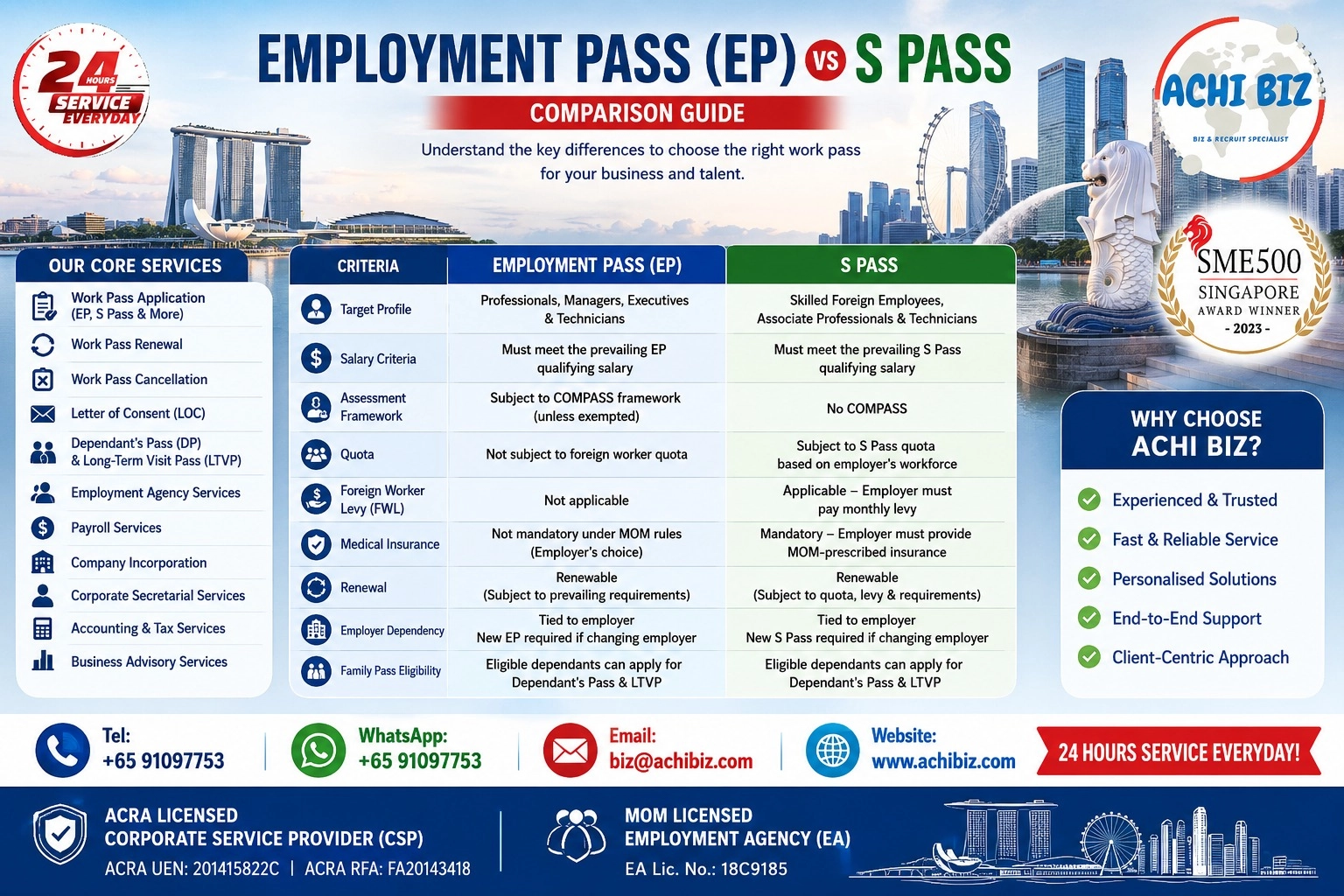
The Employment Pass (EP) and S Pass are two of Singapore’s main work passes for foreign professionals and skilled employees. Although both are administered by the Ministry of Manpower (MOM) and both require a Singapore job offer, they operate under significantly different eligibility and foreign workforce frameworks.
The Employment Pass is intended for foreign professionals, managers, executives and technicians who meet the prevailing EP eligibility requirements. EP candidates generally need to satisfy MOM’s qualifying salary requirement and the Complementarity Assessment Framework (COMPASS) unless an exemption applies. Importantly, EP holders are not subject to foreign worker quota or Foreign Worker Levy (FWL).
The S Pass is intended for skilled workers, particularly Associate Professionals and Technicians (APTs), who meet its prevailing eligibility requirements. Unlike the EP, S Pass employment is subject to the employer having sufficient S Pass quota and paying the applicable monthly Foreign Worker Levy. Employers must also provide prescribed medical insurance for S Pass holders.
This distinction is particularly important. An employee may satisfy the individual eligibility requirements for an S Pass, but the application can still be affected by the employer’s available quota.
As MOM periodically revises salary thresholds and other work pass requirements, this FAQ intentionally does not reproduce fixed salary figures. References to salary mean the prevailing salary criteria applicable at the time of application or renewal.
What is an Employment Pass (EP) in Singapore?
The Employment Pass is primarily intended for eligible foreign professionals, managers, executives and technicians working in Singapore.
The candidate must have a Singapore job offer and satisfy MOM’s prevailing EP eligibility framework.
What is an S Pass in Singapore?
The S Pass is a work pass for eligible skilled foreign employees.
MOM describes it as providing employers with additional flexibility to hire skilled foreign professionals, particularly Associate Professionals and Technicians, subject to qualifying salary, quota and levy requirements.
What is the biggest difference between Employment Pass and S Pass?
One of the most important structural differences is the quota and levy framework.
An EP is not subject to foreign worker quota or Foreign Worker Levy.
An S Pass is subject to both quota and levy.
There are also important differences in eligibility assessment, COMPASS, employer obligations, medical insurance and renewal considerations.
Is an S Pass a lower-level Employment Pass?
It is better to regard them as different work pass categories, rather than simply describing S Pass as a lower EP.
The EP framework is designed around professional, managerial, executive and technical roles and incorporates the prevailing qualifying salary and COMPASS unless exempted.
The S Pass framework provides employers with a route to hire skilled foreign employees who satisfy its criteria, while controlling S Pass numbers through quota and levy.
Who is generally suitable for an Employment Pass?
An EP is generally suitable where the foreign candidate will work in a professional, managerial, executive or technical position and satisfies MOM’s prevailing EP requirements.
The actual job, salary, candidate profile and employer circumstances should be assessed before deciding that EP is the appropriate work pass.
Who is generally suitable for an S Pass?
S Pass is intended for skilled foreign employees who meet its prevailing eligibility criteria.
MOM specifically places the S Pass within the Associate Professionals and Technicians segment of the foreign workforce framework.
Do EP and S Pass have the same prevailing salary criteria?
No.
EP and S Pass have their own qualifying salary frameworks.
The prevailing requirements should always be checked at the time of application because MOM periodically updates salary thresholds and their application to new applications and renewals.
Why does this guide not state the current EP and S Pass salary figures?
Because MOM periodically changes qualifying salary requirements.
Using fixed salary amounts in an evergreen FAQ can cause otherwise useful information to become outdated.
For this reason, employers and candidates should refer to the prevailing EP or S Pass salary criteria applicable on the relevant application or renewal date.
Does salary alone determine whether EP or S Pass is appropriate?
No.
Salary is important, but it should never be the only factor considered.
For EP, the employer and candidate must consider the complete EP eligibility framework, including COMPASS unless an exemption applies.
For S Pass, the employer must consider the candidate’s eligibility together with available S Pass quota and levy obligations.
Can an employee who meets the prevailing EP salary criteria automatically obtain an EP?
No.
Meeting the applicable qualifying salary does not by itself guarantee EP eligibility or approval.
Most EP candidates must also satisfy COMPASS unless exempted, and MOM assesses the application under its prevailing framework.
Can an employee who meets the prevailing S Pass salary criteria automatically obtain an S Pass?
No.
Individual eligibility is only part of the S Pass assessment.
The employer must also have sufficient S Pass quota, and the employment will be subject to the applicable levy.
Does COMPASS apply to Employment Pass applications?
Yes, generally.
EP candidates must satisfy MOM’s points-based Complementarity Assessment Framework (COMPASS) unless an applicable exemption applies.
COMPASS considers both individual attributes and firm-related attributes, including the employer’s workforce profile.
Does COMPASS apply to S Pass applications?
S Pass does not use the EP COMPASS framework.
Instead, S Pass operates under its own eligibility requirements together with the employer’s quota and levy framework.
This is one of the important analytical differences between EP and S Pass.
Does the absence of COMPASS make S Pass easier to obtain than EP?
Not necessarily.
An S Pass may not use COMPASS, but it has a major employer-side constraint that EP does not have: S Pass quota.
Even a candidate who meets the individual S Pass eligibility requirements may face difficulty if the employer does not have sufficient quota.
Is Employment Pass subject to foreign worker quota?
No.
MOM expressly states that no foreign worker quota is required for EP holders.
Is Employment Pass subject to Foreign Worker Levy (FWL)?
No.
Employers do not pay Foreign Worker Levy for Employment Pass holders.
Is S Pass subject to foreign worker quota?
Yes.
S Pass employment is subject to a quota. The employer must have sufficient S Pass quota before it can employ the S Pass holder.
Is S Pass subject to Foreign Worker Levy?
Yes.
Employers must pay the applicable monthly Foreign Worker Levy for S Pass holders.
This creates an ongoing employment cost that does not apply to EP holders.
Is quota and levy therefore a genuine difference between EP and S Pass?
Yes. It is one of the most important differences.
EP: No foreign worker quota and no FWL.
S Pass: Subject to employer quota and monthly FWL.
This should be considered alongside candidate eligibility when an employer is deciding which work pass is appropriate.
What does S Pass quota actually mean for an employer?
It means the company cannot employ an unlimited number of S Pass holders simply because individual candidates qualify.
MOM links the employer’s ability to hire S Pass holders to its total workforce. Firms employing more locals may therefore have greater capacity to employ S Pass holders within the applicable quota framework.
Why can a qualified S Pass candidate still be affected by the employer’s workforce size?
Because S Pass eligibility has both candidate-side and employer-side considerations.
The candidate must meet the prevailing individual criteria, while the employer must have sufficient quota.
This makes S Pass hiring partly dependent on the employer’s workforce composition.
Does an employer need S Pass quota before applying?
The employer must satisfy the applicable quota requirements for S Pass employment.
Quota should therefore be checked before proceeding with an application rather than discovering later that the company cannot support the proposed S Pass hire.
Does an EP employer need an available EP quota before applying?
No.
There is no EP quota.
However, this does not mean the employer is irrelevant to the EP assessment. COMPASS considers firm-related attributes for applicable EP applications.
Is COMPASS the same as foreign worker quota?
No.
These are fundamentally different concepts.
Quota limits the number of S Pass holders an employer can employ based on the applicable workforce framework.
COMPASS is a points-based assessment used for EP eligibility, unless an exemption applies.
An EP can therefore have no quota while still being subject to employer-related assessment through COMPASS.
Does employing more local employees potentially affect S Pass hiring capacity?
Yes.
MOM explains that S Pass quota is linked to the employer’s total workforce and that firms employing more locals are allowed to hire more S Pass holders within the applicable framework.
Does employing more locals create an EP quota?
No.
There is no EP quota.
However, the employer’s local employment share can be relevant under COMPASS.
This distinction should be understood carefully.
Does an S Pass employer continue paying levy throughout the employment period?
Yes.
The S Pass levy is an ongoing employer obligation while the levy liability applies.
MOM’s renewal guidance also confirms that levy continues to be payable during the relevant renewal period.
Can the S Pass levy be deducted from the employee’s salary?
Employers should not treat the levy as part of the employee’s salary obligation. It is an employer-side regulatory cost associated with employing the S Pass holder.
The employer should budget for the levy separately when assessing the total cost of employing an S Pass worker.
Does an EP employer have the same monthly levy cost?
No.
There is no Foreign Worker Levy for Employment Pass holders.
Can S Pass quota affect renewal even if the employee has worked for the company for years?
Yes.
MOM expressly states that the employer must have sufficient S Pass quota for its sector when renewing the pass.
Therefore, an existing employment relationship does not remove the quota requirement.
Can an EP renewal fail because the company has no EP quota?
No, because there is no EP quota.
However, EP renewal is still subject to the prevailing eligibility requirements, including the qualifying salary and COMPASS where applicable. MOM also states that EP renewals are not guaranteed.
Are both Employment Pass and S Pass renewable?
Yes.
Both EP and S Pass can be renewed, subject to the prevailing requirements.
Renewal should never be assumed to be automatic.
Does S Pass renewal require quota to be checked again?
Yes.
MOM requires the employer to have sufficient S Pass quota when renewing.
This is an important long-term workforce planning consideration.
Does EP renewal require COMPASS?
For applicable EP renewals, the candidate must meet the prevailing EP eligibility requirements, including COMPASS unless exempted.
Which pass creates greater workforce planning pressure for the employer?
From a quota-management perspective, S Pass.
An employer hiring S Pass holders needs to consider its available quota not only for the immediate application but also as part of ongoing workforce planning and renewal.
EP does not create this quota constraint.
Can an employer simply apply for EP instead of S Pass to avoid quota and levy?
Only if the proposed candidate and role genuinely satisfy the prevailing EP eligibility requirements.
EP should never be used merely as a mechanism to avoid S Pass quota or levy.
The correct work pass must reflect the actual role, candidate profile, remuneration and applicable MOM requirements.
Can an employer deliberately increase salary just to convert an S Pass candidate into an EP candidate?
The candidate must genuinely satisfy the full prevailing EP requirements.
Salary alone does not establish EP eligibility. COMPASS and the overall application framework may also apply.
Employment terms submitted to MOM should accurately reflect the genuine employment arrangement.
Can an EP holder switch to S Pass?
Yes, potentially.
MOM specifically states that EP holders can consider switching to S Pass if they no longer meet the prevailing EP criteria.
However, the employer must have sufficient S Pass quota and the employee must independently qualify for an S Pass.
Must the existing EP be cancelled before applying for an S Pass?
No.
MOM states that the employer does not need to cancel the EP before submitting the S Pass application.
If the S Pass is approved, the existing EP should be cancelled before the S Pass is issued.
This avoids unnecessarily cancelling the existing work authorisation before the new application outcome is known.
If an EP holder moves to S Pass, will the employer start paying levy?
Yes.
Once the employee becomes an S Pass holder, the S Pass quota and levy framework applies.
This can change the employer’s ongoing cost and workforce planning considerations.
If an S Pass holder becomes eligible for EP, can the employer consider applying for EP?
Potentially, yes.
The candidate must satisfy the prevailing EP requirements, including COMPASS unless exempted.
The employer should assess the candidate under the EP framework rather than assuming that existing S Pass approval automatically establishes EP eligibility.
Would moving from S Pass to EP remove S Pass quota usage?
An approved EP is not subject to the S Pass quota framework.
Therefore, once the employee properly transitions to EP, that individual is no longer employed as an S Pass holder.
The employer should nevertheless plan the timing and pass transition carefully.
Does changing from EP to S Pass affect existing family passes?
Yes, it can.
MOM specifically states that when an EP holder switches to S Pass, new Dependant’s Pass applications are required for the dependants under the S Pass arrangement.
Family-pass implications should therefore be considered before changing the principal work pass.
Can both EP and S Pass holders bring eligible family members to Singapore?
Yes, subject to satisfying MOM’s prevailing family-pass eligibility requirements.
MOM’s Dependant’s Pass framework covers eligible spouses and children of qualifying EP and S Pass holders.
Does simply holding an EP or S Pass automatically qualify the holder for family passes?
No.
The principal work pass holder must satisfy the prevailing requirements for dependant privileges.
Family-pass eligibility should therefore be checked separately rather than assumed from the approval of the principal work pass.
Is medical insurance compulsory for an S Pass holder?
Yes.
Employers must purchase and maintain the prescribed medical insurance for every S Pass holder they employ before the S Pass can be issued or renewed.
This is another major employer-side difference between EP and S Pass.
Is medical insurance compulsory under MOM rules for an EP holder?
MOM states that employers can choose whether to provide medical insurance for EP holders.
This differs directly from the mandatory medical insurance requirement for S Pass holders.
Can an employer pass the mandatory S Pass medical insurance cost to the employee?
No.
MOM expressly states that the cost of the required S Pass medical insurance cannot be passed on to the worker.
The employer must therefore account for this as an employment cost.
Why does medical insurance matter when comparing the total cost of EP and S Pass?
Because an S Pass involves employer-side statutory costs and obligations beyond salary.
The employer needs to consider applicable levy and mandatory medical insurance in addition to the employee’s remuneration.
EP does not have FWL, and MOM does not impose the same mandatory medical insurance requirement on EP employers.
Is a Primary Care Plan (PCP) required for every S Pass holder?
No.
MOM requires a PCP for specified S Pass holders, including those who stay in certain dormitories and those working in the Construction, Marine shipyard and Process sectors under the applicable rules.
Employers should check whether the particular employee falls within the PCP requirement.
Does an EP holder have the same S Pass PCP requirement?
The S Pass PCP requirement described by MOM is part of the applicable S Pass employer obligations and should not be assumed to apply identically to an EP merely because both are work passes.
Does the Fair Consideration Framework apply to both EP and S Pass applications?
Yes, the Fair Consideration Framework (FCF) job advertising requirement applies to both EP and S Pass applications unless an applicable exemption applies.
Employers generally need to advertise the position on MyCareersFuture and fairly consider candidates before submitting the relevant work pass application.
Is FCF the same as COMPASS?
No.
FCF concerns fair consideration of candidates and includes the applicable job advertising requirement.
COMPASS is the points-based assessment framework used for EP applications.
S Pass may be subject to the applicable FCF advertising requirement even though it does not use COMPASS.
Does an S Pass employer have to advertise the job on MyCareersFuture?
Generally, yes, before submitting an S Pass application, unless an applicable exemption from the FCF job advertising requirement applies.
Does an EP employer have to advertise the job on MyCareersFuture?
Generally, yes, subject to applicable exemptions.
The employer must also fairly consider candidates in accordance with the Fair Consideration Framework.
Does being exempt from FCF advertising automatically exempt an EP candidate from COMPASS?
No.
FCF advertising and COMPASS are separate requirements with separate exemption rules.
An employer should not assume that exemption from one automatically means exemption from the other.
Who applies for an Employment Pass?
The Singapore employer or its appointed Employment Agency generally submits the EP application on behalf of the candidate.
Who applies for an S Pass?
The employer or an appointed Employment Agency must apply on behalf of the S Pass candidate.
Can an employee personally submit their own ordinary EP or S Pass application?
The normal EP and S Pass frameworks are employer-led.
The employer or appointed EA submits the application on behalf of the candidate.
Can an Employment Agency assist with both EP and S Pass applications?
Yes.
MOM permits an appointed Employment Agency to submit both EP and S Pass applications on behalf of the employer.
Does using an Employment Agency guarantee EP or S Pass approval?
No.
An EA can assist with eligibility assessment, application preparation and work pass procedures, but the final decision remains with MOM.
No legitimate application should be presented as guaranteed approval.
Are both EP and S Pass tied to the employer?
Yes.
Both are employer-specific work passes.
If the holder changes employer, the new employer must apply for the appropriate new work pass.
Can an EP holder transfer the existing EP to another company?
No.
A new employer generally needs to apply for a new EP.
The existing EP does not simply move from one company to another.
Can an S Pass holder transfer the existing S Pass to another company?
No.
The new employer needs to apply for a new S Pass, and importantly, that new employer must have sufficient S Pass quota.
Does an approved new EP or S Pass automatically cancel the old pass?
No.
MOM states that approval of the new pass does not automatically cancel the existing EP or S Pass. The current employer remains responsible for cancelling the existing pass.
Why is changing employers potentially more complicated for an S Pass holder?
Because the new employer must satisfy not only the candidate-side S Pass requirements but also its own S Pass quota requirements.
A worker who currently holds an S Pass with Company A cannot assume Company B will be able to obtain another S Pass simply because the employee already has one.
Can an S Pass holder move to an employer with no available S Pass quota?
The new employer must satisfy the applicable S Pass quota requirements.
Therefore, lack of available quota can prevent the proposed S Pass employment even where the candidate is otherwise eligible.
Is this quota issue relevant when an EP holder changes employer?
There is no EP quota.
However, the new EP application still needs to satisfy the prevailing EP eligibility framework.
Are EP and S Pass restricted by nationality in the same way as some Work Permit categories?
MOM states that S Pass eligibility is open to foreign employees across all nationalities or citizenships who meet the applicable requirements.
The EP is likewise a professional work pass assessed under its own eligibility framework rather than the source-country restrictions applicable to certain Work Permit categories.
Does S Pass require educational qualifications?
Employers and candidates should follow MOM’s prevailing S Pass eligibility and application requirements rather than assuming that one particular qualification automatically guarantees eligibility.
The candidate’s actual role, experience, salary and overall eligibility should be assessed through the prevailing framework.
Does having a degree automatically mean the candidate should apply for EP instead of S Pass?
No.
Academic qualifications alone do not determine the correct pass.
A degree holder may still need to be assessed against the complete EP framework, while an S Pass candidate must satisfy the applicable S Pass requirements.
The appropriate pass should reflect the actual employment arrangement rather than simply the candidate’s academic title.
Does not having a degree automatically mean EP is impossible?
No such conclusion should be made purely from the absence of a degree.
EP applications should be assessed under MOM’s prevailing eligibility and COMPASS framework, including applicable exemptions and the way qualifications are considered within COMPASS.
Is S Pass intended only for manual workers?
No.
MOM positions the S Pass particularly around Associate Professionals and Technicians (APTs) and skilled foreign employees.
It should not be confused with the Work Permit framework.
Is an S Pass the same as a Work Permit?
No.
S Pass and Work Permit are separate work pass categories with different eligibility, sector, salary, quota and employment frameworks.
This article focuses specifically on the comparison between Employment Pass and S Pass.
Is an EP always preferable to an S Pass?
No.
The appropriate pass depends on the genuine job, candidate profile and MOM eligibility requirements.
If the candidate does not meet the prevailing EP criteria but satisfies the S Pass requirements and the employer has sufficient quota, S Pass may be the appropriate route.
MOM itself describes S Pass as giving firms additional flexibility to hire skilled foreign professionals who may not fully meet EP criteria.
Is S Pass automatically easier to obtain because its salary criterion differs from EP?
No.
S Pass has its own eligibility requirements and employer-side constraints.
A candidate who appears suitable individually may still be affected by the company’s quota position.
Is EP automatically harder because COMPASS applies?
Not necessarily.
The correct comparison is not simply “easy versus difficult”.
EP and S Pass use different regulatory mechanisms. EP generally uses qualifying salary plus COMPASS, while S Pass combines candidate eligibility with quota and levy.
Which pass is more affected by the employer’s local workforce numbers?
S Pass is directly affected because its quota is linked to the employer’s workforce.
EP has no quota, although the employer’s workforce profile can still be relevant under COMPASS.
Which pass is more affected by the employer’s foreign workforce diversity?
For EP, foreign workforce diversity can be relevant under COMPASS.
MOM states that COMPASS considers the firm’s foreign workforce diversity together with other individual and firm-level attributes.
S Pass uses a different quota-based framework.
Does a small company automatically qualify for fewer EPs?
There is no EP quota.
A small company therefore should not calculate “how many EP slots” it has in the same way that it calculates S Pass quota.
However, each EP application still needs to satisfy the prevailing eligibility framework.
Can a newly incorporated company apply for EP?
A newly incorporated company may potentially submit an EP application where there is a genuine employment requirement and the candidate and employer satisfy the prevailing requirements.
The company’s age alone should not be treated as automatic approval or rejection.
Can a newly incorporated company apply for S Pass?
Potentially, but S Pass quota is critical.
Because S Pass quota is linked to workforce composition, a newly established company with limited or no qualifying local workforce may face practical quota constraints.
The employer should check its actual quota position before proceeding.
Why is workforce planning particularly important for companies relying on S Pass employees?
Because hiring decisions can affect future quota availability.
An employer should consider existing S Pass holders, intended hires, local workforce changes and upcoming renewals rather than assessing each S Pass application in isolation.
Can losing local employees affect S Pass quota?
Potentially, yes.
Because S Pass quota is linked to the employer’s workforce, changes in local workforce numbers can affect the company’s foreign workforce capacity under the applicable quota rules.
Can that create problems for future S Pass renewals?
Yes.
Since sufficient quota is required at renewal, changes to the company’s workforce can have consequences for future S Pass retention.
Does losing local employees automatically affect existing EP holders through quota?
No.
There is no EP quota.
However, future EP applications or renewals may still need to satisfy the prevailing COMPASS requirements where applicable.
Which pass has greater direct recurring regulatory cost to the employer?
S Pass generally carries greater direct work-pass-related recurring regulatory costs because of Foreign Worker Levy and mandatory medical insurance.
EP has no FWL, and MOM leaves EP medical insurance to the employer’s choice.
Should an employer compare only the employee’s salary when budgeting for an S Pass?
No.
The employer should consider the total employment cost, including:
-
- salary;
- Foreign Worker Levy;
- mandatory medical insurance;
- applicable PCP requirements; and
- other employment-related obligations.
This gives a more realistic picture of S Pass employment costs.
Should an employer choose EP simply because it avoids levy?
No.
The candidate must genuinely qualify for EP.
Work pass selection should be driven by eligibility and the actual role—not simply by whichever pass has the lower employer cost.
Can MOM reject an EP or S Pass even if the employer believes all requirements are met?
Approval is never guaranteed.
Employers should use MOM’s prevailing eligibility tools and requirements before submitting an application and ensure that the information provided is complete and accurate.
Is renewal guaranteed once an EP or S Pass has been approved previously?
No.
Previous approval does not guarantee future renewal.
MOM expressly states that EP renewals are not guaranteed, while S Pass renewal requires the holder to continue meeting eligibility requirements and the employer to retain sufficient quota.
Can changing salary affect an existing S Pass?
Yes.
MOM states that if an employer intends to lower an S Pass holder’s salary, the employee must continue to qualify for the work pass at the revised salary. Otherwise, the employer should cancel the existing pass and apply for an appropriate work pass based on the employee’s eligibility.
Can a salary reduction also affect family-pass privileges?
Yes.
MOM states that if the revised salary no longer meets the criteria for dependant privileges, existing DP or LTVP arrangements tied to the work pass can be affected.
Should employers therefore assess salary changes before implementing them?
Yes.
Salary changes can have work pass consequences. Employers should check the prevailing criteria before changing the remuneration of an EP or S Pass holder where the change could affect eligibility or dependant privileges.
Which pass is more suitable for a professional managerial role?
Where the role and candidate satisfy the prevailing EP requirements, EP is generally the relevant professional work pass framework.
However, job title alone does not determine eligibility.
Which pass is more suitable for an Associate Professional or Technician?
S Pass is specifically positioned by MOM for skilled workers in the Associate Professionals and Technicians segment.
The candidate must nevertheless satisfy all prevailing requirements.
Can an employer simply change a job title to qualify someone for EP?
No.
Work pass applications should accurately describe the actual role, duties and employment arrangement.
Changing a title without a genuine corresponding role does not create legitimate eligibility.
Can the same occupation potentially have either an EP or S Pass holder?
Potentially, depending on the actual role, seniority, salary, candidate profile and applicable MOM criteria.
The work pass should therefore be assessed from the full employment circumstances rather than occupation title alone.
Does a higher salary automatically mean EP is always the correct pass?
Not necessarily.
Salary is one factor in EP eligibility, but COMPASS and other applicable requirements also need to be considered.
Does a candidate failing COMPASS automatically qualify for S Pass?
No.
The candidate must independently meet S Pass eligibility requirements, and the employer must have sufficient quota.
Failing one work pass framework does not automatically create eligibility under another.
Should employers consider S Pass as a fallback whenever EP is rejected?
Not automatically.
The reason for the EP rejection should first be understood.
S Pass should only be considered where the candidate genuinely meets S Pass requirements and the employer has sufficient quota.
Can an EP rejection be solved simply by applying for S Pass?
Not necessarily.
An S Pass application is a separate application assessed under its own eligibility, quota and levy framework.
The employer should not assume that an unsuccessful EP candidate will automatically qualify.
Can an S Pass candidate later progress to EP?
Potentially, yes.
If the employee’s role, remuneration and overall profile later satisfy the prevailing EP requirements, the employer may assess whether an EP application is appropriate.
The employee’s existing S Pass does not itself guarantee EP approval.
Why might an employer want an eligible employee to move from S Pass to EP?
Where the employee genuinely qualifies for EP, the change may remove that worker from the S Pass quota and levy framework.
However, the decision should reflect genuine EP eligibility and the actual employment arrangement—not merely an attempt to reduce employer costs.
Why might an EP holder move to S Pass?
MOM expressly recognises that an EP holder who no longer meets the prevailing EP criteria may consider S Pass, provided the employee qualifies and the employer has sufficient quota.
This can provide continuity of employment where the S Pass framework is genuinely appropriate.
Is the employer’s responsibility greater for S Pass than EP?
The responsibilities are different.
Both passes require proper work pass administration and compliance.
However, S Pass adds specific employer obligations such as quota management, monthly levy and mandatory medical insurance. Certain S Pass holders may also require a Primary Care Plan.
Does EP have no employer compliance obligations because there is no quota or levy?
No.
The absence of quota and levy does not mean the employer has no responsibilities.
The employer must still comply with MOM’s EP requirements, employment laws, work pass conditions and relevant notification obligations.
Can EP and S Pass holders work for more than one employer using the same pass?
Both ordinary EP and S Pass arrangements are employer-specific.
A pass obtained for employment with one company should not be treated as general permission to work for unrelated employers.
Does an EP or S Pass allow the holder to freelance?
Neither ordinary employer-specific pass should be treated as general freelance authorisation.
The holder’s work authorisation is connected to the approved employment arrangement.
Does an EP or S Pass automatically allow someone to start and operate another business?
No such assumption should be made merely because the individual holds a work pass.
Work pass authorisation and company ownership or management are separate issues, and the actual activities must comply with MOM and other applicable Singapore requirements.
Which pass provides more certainty when the employer already has limited S Pass quota?
If the candidate genuinely qualifies for EP, the absence of EP quota may remove the S Pass quota constraint.
However, that does not mean the company can simply choose EP. The candidate must satisfy the prevailing EP framework.
Which pass is more sensitive to workforce restructuring?
S Pass can be particularly sensitive where restructuring changes the employer’s local workforce and consequently affects quota capacity.
EP has no quota, although restructuring can still affect employer information and other aspects relevant to work pass administration.
Which pass should an SME consider when hiring a foreign professional?
An SME should first determine the genuine role and assess the candidate against the prevailing MOM criteria.
If EP requirements are met, EP may be appropriate without quota or levy.
If the candidate falls within the S Pass framework, the SME should additionally assess its available S Pass quota, levy obligations and mandatory insurance costs.
Which pass should a company consider when it has no available S Pass quota?
Lack of S Pass quota means the company cannot simply proceed with an S Pass application on the assumption that individual eligibility is enough.
If the candidate genuinely satisfies the prevailing EP requirements, EP can be assessed separately. Otherwise, the company should not artificially restructure the role merely to avoid the quota requirement.
Which pass is more suitable when the employer wants predictable workforce numbers without quota dependency?
From a quota perspective, EP does not have the numerical S Pass constraint.
However, only candidates who satisfy EP requirements can use that route.
Does S Pass quota make workforce forecasting important?
Yes.
Employers relying on S Pass employees should monitor quota before new applications and renewals and consider the effect of workforce changes.
This is particularly important where several S Pass renewals or new hires are expected around the same period.
What should an employer check before deciding between EP and S Pass?
The employer should consider the candidate’s genuine role, experience, prevailing salary eligibility, applicable EP COMPASS requirements, S Pass quota position, levy implications, medical insurance obligations, FCF requirements and long-term workforce plans.
The correct work pass should emerge from the actual employment circumstances rather than from a preference for one pass name.
What should a candidate consider when comparing EP and S Pass?
Candidates should understand that the choice is not entirely personal because both applications are employer-led.
They should consider whether their role and profile fit the applicable work pass, how a future change of employer would work, whether family-pass eligibility matters and whether future salary or role changes could affect eligibility.
What should an employer check before submitting an S Pass application?
Particular attention should be given to:
-
- candidate eligibility under the prevailing S Pass criteria;
- available S Pass quota;
- applicable levy;
- FCF job advertising requirements, unless exempted;
- mandatory medical insurance;
- PCP requirements where applicable;
- supporting documents; and
- whether the company can maintain the relevant requirements through renewal.
What should an employer check before submitting an EP application?
The employer should assess:
-
- the genuine professional role;
- prevailing EP qualifying salary criteria;
- COMPASS unless exempted;
- applicable FCF advertising requirements;
- candidate qualifications and supporting documents where relevant;
- company information required for the application; and
- whether the employment arrangement can continue to satisfy the prevailing requirements.
What are the main advantages of EP compared with S Pass?
Where the candidate genuinely qualifies, key structural advantages include:
-
- no foreign worker quota;
- no Foreign Worker Levy;
- no mandatory MOM medical insurance requirement comparable to S Pass; and
- no S Pass-style dependency on available quota for renewal.
These advantages do not make EP automatically obtainable; the candidate must satisfy the more applicable EP eligibility framework.
What are the main advantages of S Pass compared with EP?
S Pass provides employers with an important route for hiring skilled foreign employees who may not fully meet the EP framework.
MOM describes it as providing additional flexibility for skilled foreign professionals, subject to qualifying salary, quota and levy requirements.
Its value therefore lies in serving a different segment of Singapore’s foreign workforce rather than being “better” than EP.
What are the main employer considerations for S Pass compared with EP?
The employer must pay particular attention to:
Quota: S Pass requires sufficient employer quota.
Levy: Monthly FWL applies.
Medical insurance: Mandatory employer-provided coverage applies.
PCP: Required for specified S Pass holders.
Renewal: The employer must continue to have sufficient quota.
These are important differences from EP.
What is the biggest misconception about Employment Pass vs S Pass?
A common misconception is that the only difference is salary.
That is incorrect.
The two passes have fundamentally different assessment and employer-compliance frameworks.
EP generally involves the prevailing qualifying salary and COMPASS but no quota or levy.
S Pass involves its prevailing qualifying salary together with quota, levy and mandatory medical insurance.
What is another common misconception about EP and S Pass?
Another misconception is that an employer can freely choose whichever pass is cheaper.
The correct pass must reflect the candidate’s genuine eligibility and employment circumstances.
An employer cannot simply label an S Pass-level arrangement as EP to avoid quota, levy or insurance obligations.
Is EP automatically better than S Pass because there is no quota or levy?
No.
EP is advantageous from a quota and levy perspective, but that does not make a candidate eligible.
The appropriate pass is the one for which the candidate and employer genuinely satisfy MOM’s prevailing requirements.
Is S Pass inferior because levy and quota apply?
No.
S Pass serves a specific and important role in Singapore’s foreign workforce framework. MOM describes it as providing firms with additional flexibility to hire skilled foreign professionals who may not fully meet EP criteria.
Quota and levy are regulatory features of that framework rather than indicators that the pass is inherently inferior.
What is the simplest comparison between Employment Pass and S Pass?
Employment Pass (EP): Intended for eligible foreign professionals, managers, executives and technicians. The employer or appointed EA applies. The candidate generally needs to meet the prevailing EP salary criteria and COMPASS unless exempted. No foreign worker quota and no Foreign Worker Levy. Medical insurance is not compulsory under the EP framework.
S Pass: Intended for eligible skilled foreign employees, particularly Associate Professionals and Technicians. The employer or appointed EA applies. The candidate must meet the prevailing S Pass eligibility requirements, while the employer must have sufficient quota, pay the applicable FWL and provide mandatory medical insurance.
What are the most important differences to remember when comparing EP and S Pass?
The comparison can be summarised around five practical questions:
-
- Does the candidate satisfy the prevailing eligibility criteria for the intended pass?
- Does COMPASS apply? Generally relevant to EP, not S Pass.
- Is quota required? No for EP; yes for S Pass.
- Is FWL payable? No for EP; yes for S Pass.
- Is MOM-prescribed medical insurance compulsory? Not mandatory for EP; mandatory for S Pass.
These differences are generally more useful than comparing the passes only by salary.
What is the key takeaway from the Employment Pass vs S Pass comparison?
The Employment Pass and S Pass should not be compared simply as a higher-salary pass and a lower-salary pass.
They operate under different regulatory frameworks.
An EP is designed for eligible foreign professionals, managers, executives and technicians. It generally requires the candidate to satisfy the prevailing EP qualifying salary and COMPASS unless exempted. Importantly, EP is not subject to foreign worker quota or Foreign Worker Levy.
S Pass serves skilled foreign employees, particularly the Associate Professionals and Technicians segment. In addition to satisfying the prevailing individual eligibility criteria, the employer must have sufficient S Pass quota, pay the applicable Foreign Worker Levy and provide the prescribed medical insurance.
Therefore, the right question is not simply:
“Does the employee meet the salary requirement?”
A better assessment asks:
“Which work pass genuinely fits the employee’s role and profile, and can the employer satisfy all of the corresponding MOM requirements throughout the employment and renewal period?”
How can ACHI BIZ assist with Employment Pass and S Pass applications in Singapore?
ACHI BIZ provides Employment Agency for all Work Pass services, including assistance with Employment Pass and S Pass applications, renewals, cancellations and related Singapore work pass procedures.
Before an application is submitted, the candidate and employer should be assessed against the prevailing MOM requirements, particularly EP eligibility and COMPASS considerations or, for S Pass, candidate eligibility together with quota, levy and mandatory medical insurance requirements.
Related Pages
Employment Pass (EP) vs ONE Pass in Singapore – FAQ Guide
Employment Pass (EP) vs Personalised Employment Pass (PEP) in Singapore – FAQ Guide
#achibiz