
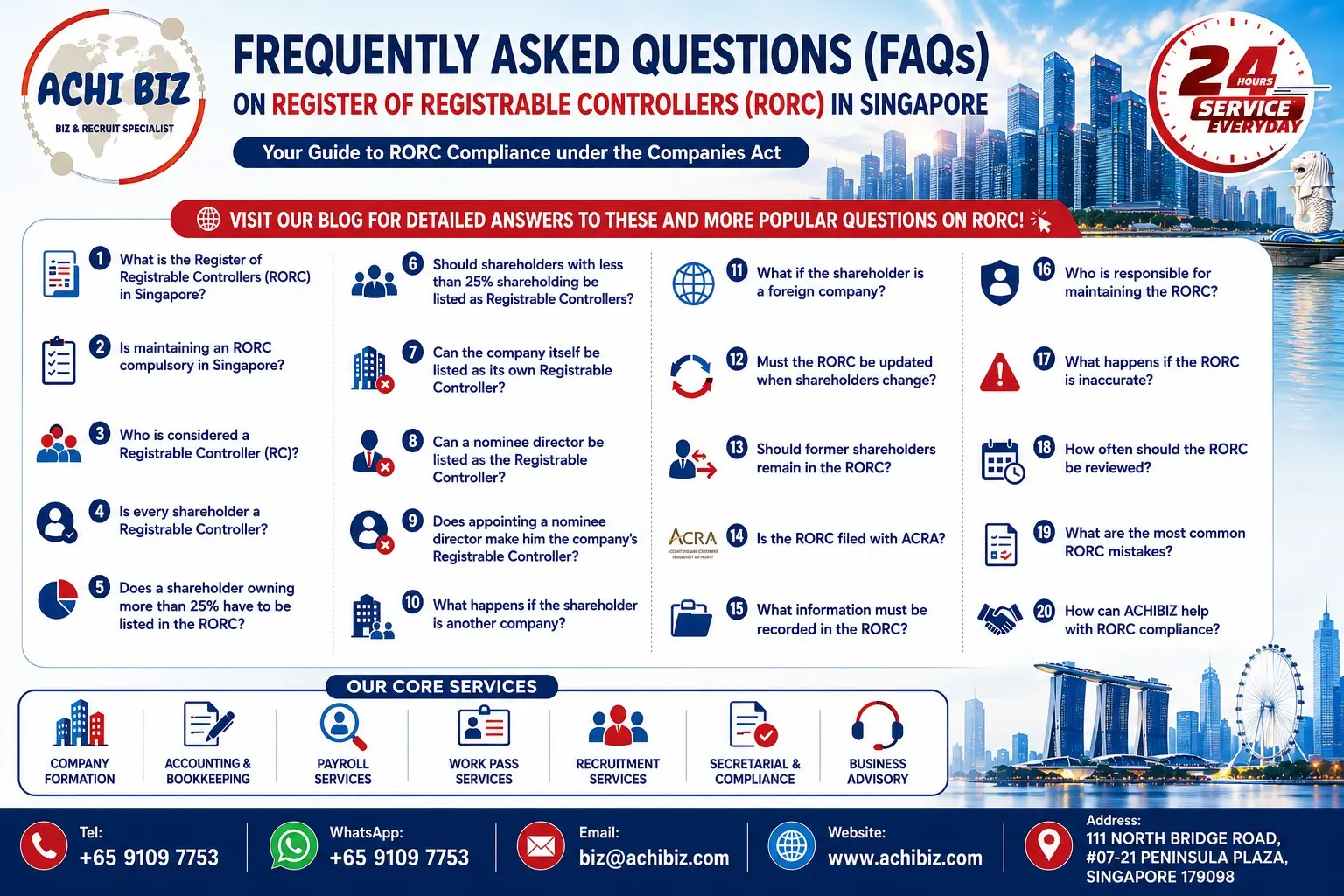
What is the Register of Registrable Controllers (RORC) in Singapore?
The Register of Registrable Controllers (RORC) is a statutory register that most Singapore companies are required to maintain under the Companies Act. It records information about the individuals or legal entities that have significant ownership or control over the company, commonly known as Registrable Controllers (RCs).
Is maintaining an RORC compulsory in Singapore?
Yes. Unless exempted under the Companies Act, every Singapore company must maintain an up-to-date Register of Registrable Controllers and lodge the required information with ACRA.
Who is considered a Registrable Controller (RC)?
A Registrable Controller is an individual or legal entity that has significant interest or significant control over a company.
Generally, a person is regarded as having significant interest if he or she directly or indirectly:
- Holds more than 25% of the company’s shares;
- Holds more than 25% of the voting rights; or
- Exercises significant influence or control over the company.
Is every shareholder a Registrable Controller?
No.
Only shareholders who satisfy the legal criteria for significant ownership or control are Registrable Controllers. Merely owning shares does not automatically make someone an RC.
Does a shareholder owning more than 25% have to be listed in the RORC?
Generally, yes.
A shareholder holding more than 25% of the shares or voting rights will normally qualify as a Registrable Controller unless an exemption applies.
Should shareholders with less than 25% shareholding be listed as Registrable Controllers?
Not necessarily.
A shareholder with less than 25% ownership should not be listed solely because he or she owns shares. However, if that person exercises significant influence or control over the company, he or she may still qualify as an RC.
Can the company itself be listed as its own Registrable Controller?
No.
One of the most common mistakes is listing the company itself as its Registrable Controller. A company cannot be its own controller.
Can a nominee director be listed as the Registrable Controller?
Not automatically.
A nominee director merely acts on behalf of another person. Unless the nominee director independently satisfies the legal criteria for significant ownership or control, he or she should not be listed as the Registrable Controller.
Does appointing a nominee director make him the company’s Registrable Controller?
No.
The appointment of a nominee director alone does not make the individual a Registrable Controller.
What happens if the shareholder is another company?
The company must identify the ultimate individual(s) or legal entity exercising significant ownership or control.
Simply recording the immediate corporate shareholder may not be sufficient.
What if the shareholder is a foreign company?
The ownership chain must still be traced.
Companies should identify the ultimate Registrable Controller even where ownership is held through one or more foreign companies.
Failure to trace foreign ownership is one of the most common RORC compliance errors.
Must the RORC be updated when shareholders change?
Yes.
Whenever there is a change affecting the company’s Registrable Controllers, the register must be updated within the prescribed timeframe.
Should former shareholders remain in the RORC?
No.
Once a person no longer qualifies as a Registrable Controller, the register should be updated accordingly.
Keeping former controllers in the register is a common compliance mistake.
Is the RORC filed with ACRA?
Yes.
Singapore companies are required to lodge Registrable Controller information with ACRA through the relevant electronic filing system.
What information must be recorded in the RORC?
The register generally includes:
- Full name
- Identification details
- Residential or registered address
- Contact email address
- Contact number with country code
- Nationality
- Date of birth
- Date the person became a Registrable Controller
- Date the person ceased to be a Registrable Controller (where applicable)
Who is responsible for maintaining the RORC?
The directors of the company are ultimately responsible for ensuring compliance with the Companies Act.
Many companies appoint a Corporate Service Provider (CSP) to assist in maintaining the register accurately.
What happens if the RORC is inaccurate?
Incorrect or incomplete information may result in regulatory action and penalties under the Companies Act.
Companies should review the register whenever there are changes in ownership or control.
How often should the RORC be reviewed?
There is no annual renewal requirement.
However, companies should review and update the register whenever there is any change affecting ownership, voting rights, control, or corporate structure.
What are the most common RORC mistakes?
Some of the most common mistakes include:
- Listing the company itself as the Registrable Controller.
- Recording nominee directors as Registrable Controllers.
- Failing to trace ownership through foreign companies.
- Omitting shareholders holding more than 25% interest.
- Including shareholders with less than 25% interest without considering the legal criteria.
- Failing to remove former Registrable Controllers after ownership changes.
- Not updating the register promptly following changes.
How can ACHIBIZ help with RORC compliance?
ACHIBIZ assists companies in:
- Determining who qualifies as a Registrable Controller.
- Reviewing complex ownership structures.
- Identifying ultimate beneficial owners through foreign corporate chains.
- Preparing and maintaining the Register of Registrable Controllers.
- Filing the required RORC information with ACRA.
- Advising directors on their statutory obligations under the Companies Act.
- Ensuring ongoing compliance following changes in shareholding or control.
Related articles:
#achibiz