
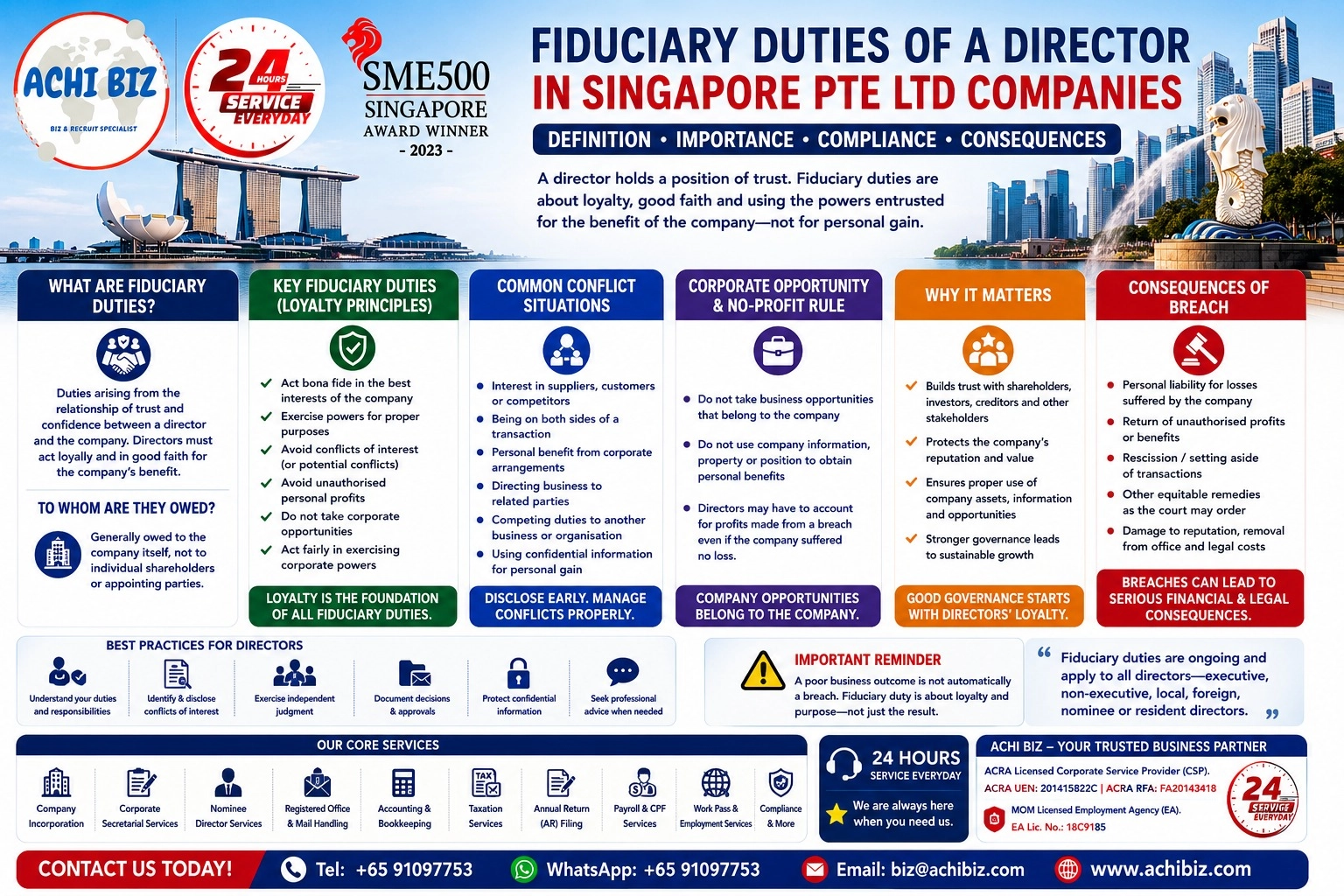
Fiduciary Duties of a Director in Singapore Pte. Ltd. Companies – Definition, Importance, Compliance & Consequences
Directorship in a Singapore private limited company is not merely a title or an administrative appointment. A director occupies a position of trust and is entrusted with powers to manage or oversee the affairs of the company. This gives rise to fiduciary duties owed to the company.
At their core, fiduciary duties are about loyalty, good faith and proper use of the powers entrusted to a director. Singapore courts recognise that directors have a fiduciary relationship with their companies and must act in the company’s interests rather than use their position to advance conflicting personal interests.
This FAQ focuses specifically on directors’ fiduciary duties in Singapore. Statutory duties are a related but separate subject and are intentionally not covered in detail here.
What are fiduciary duties of a director in a Singapore Pte. Ltd. company?
Fiduciary duties are duties arising from the relationship of trust and confidence between a director and the company.
A director is entrusted with corporate powers, information, opportunities and decision-making authority. Those powers must therefore be exercised loyally and genuinely for the benefit of the company, rather than for an improper personal purpose.
The Singapore courts describe loyalty as the foundation from which more specific fiduciary obligations arise.
What does the word “fiduciary” mean?
A fiduciary is someone who has undertaken to act for or on behalf of another person or entity in circumstances that create a relationship of trust and confidence.
For a company director, the company is the principal to whom the fiduciary obligations are generally owed.
Put simply, being a fiduciary means:
the director has been trusted with power belonging to the company and must not misuse that power for an improper purpose or personal advantage.
Why are fiduciary duties important for directors in Singapore?
Directors can influence company assets, contracts, investments, business opportunities, confidential information and strategic decisions.
Without fiduciary obligations, a person controlling those resources could potentially put personal interests ahead of the company.
Fiduciary duties therefore provide an important governance safeguard against self-dealing, undisclosed conflicts, diversion of opportunities and other forms of disloyal conduct.
Are fiduciary duties the same as statutory duties of directors?
No.
Although the two areas can overlap in practice, they should not be treated as identical. Singapore continues to recognise directors’ duties arising under common law and equitable principles alongside duties imposed by legislation. ACRA’s Companies Act review materials expressly recognise that common-law fiduciary duties continue to apply.
For clarity, this FAQ concentrates on the fiduciary side of directorship rather than providing a discussion of directors’ statutory duties.
What are the main fiduciary duties of a company director in Singapore?
Depending on the circumstances, the recognised fiduciary principles include obligations to:
- act bona fide in the best interests of the company;
- exercise powers for their proper purposes;
- maintain independent judgment rather than blindly following another person’s instructions;
- avoid situations where personal interests conflict, or may conflict, with the company’s interests;
- avoid obtaining unauthorised personal profits from the directorship;
- avoid improperly taking corporate opportunities belonging to the company; and
- act fairly in exercising corporate powers where the interests of members may be affected.
These obligations ultimately flow from the director’s fundamental duty of loyalty to the company.
What does “act in the best interests of the company” mean?
A director should genuinely make decisions based on what the director considers to be beneficial to the company rather than what provides the greatest personal benefit to the director or another person.
Importantly, courts generally do not judge an honest commercial decision simply because it later turns out badly. The question is not merely whether the decision made money; the director’s good faith and purpose are important considerations.
Does acting in the company’s best interests mean every decision must be profitable?
No.
Business inherently involves risk. A director can make an honest, properly considered commercial decision that subsequently results in a loss.
A poor commercial outcome does not automatically prove a breach of fiduciary duty.
The more fundamental question is whether the director genuinely exercised the power in what the director considered to be the company’s interests, rather than for an improper or conflicting purpose.
To whom does a director normally owe fiduciary duties?
Generally, the fiduciary duties of a director are owed to the company itself.
This distinction matters. Directors should not automatically treat the wishes of an individual shareholder, founder, investor or person who nominated them as equivalent to the interests of the company.
Does a director owe fiduciary duties directly to individual shareholders?
Not ordinarily merely because the person is a shareholder.
The fundamental fiduciary relationship is between the director and the company. Particular circumstances may potentially create separate obligations, but directors should not assume that their general fiduciary duties are owed individually to every shareholder.
Does a majority shareholder’s instruction override a director’s fiduciary duty?
No.
A director cannot simply justify a questionable decision by saying, “The majority shareholder told me to do it.”
The director holds an office carrying independent responsibilities. Even where a shareholder nominated or controls the appointment of the director, the director must consider the company’s interests and exercise proper judgment.
Does a nominee director owe the same fiduciary duties?
Yes. Being called a “nominee director” does not turn the director into an agent who may simply protect the nominator’s interests at the expense of the company.
The fundamental obligation attached to the office of director remains.
This is particularly important for foreign-owned Singapore companies where a resident director may have been appointed partly to satisfy local directorship requirements.
Can a director simply follow the instructions of the person who appointed them?
A director should not surrender independent judgment.
A director may naturally consider information, proposals and views supplied by shareholders or other stakeholders. But there is an important difference between considering someone’s recommendation and blindly implementing instructions regardless of the company’s interests.
The latter can create serious fiduciary concerns.
What is the fiduciary duty to exercise powers for a proper purpose?
Directors receive corporate powers for particular purposes.
The fact that a director technically possesses a power does not mean that it may be used for any objective the director chooses.
For example, powers involving shares, company assets or corporate decision-making should not be manipulated principally to secure a director’s personal position or achieve some collateral purpose inconsistent with the purpose for which the power exists.
ACRA’s review of directors’ duties identifies using powers for their proper purposes as a recognised common-law obligation.
What is the “no-conflict” rule for directors?
The no-conflict principle requires a fiduciary to avoid placing himself or herself in a position where personal interests, or duties owed elsewhere, conflict or may conflict with duties owed to the company.
The rule is designed to prevent divided loyalty rather than merely punish dishonesty after damage has occurred.
Singapore courts recognise the no-conflict rule as a core manifestation of fiduciary loyalty.
What kinds of situations can create a conflict of interest?
Examples can include a director having an interest in a supplier, customer or competing business; participating on both sides of a transaction; benefiting personally from a corporate arrangement; directing business towards a related party; or facing competing duties to another organisation.
A conflict does not necessarily mean misconduct has already occurred. The important issue is identifying and properly managing the conflict before it compromises the director’s judgment.
What is the “no-profit” rule?
The no-profit principle generally prevents a fiduciary from obtaining an unauthorised benefit through the fiduciary position.
The concern is not limited to taking money directly from the company’s bank account. It can extend to benefits, commissions, opportunities or advantages obtained because the person occupied the position of director.
Singapore courts regard the no-profit rule as another core aspect of fiduciary loyalty.
Can a director keep a personal profit if the company did not suffer any loss?
Directors should not assume that the absence of an obvious company loss makes an unauthorised profit acceptable.
Fiduciary law is concerned with loyalty and unauthorised benefit as well as compensation for loss. Depending on the circumstances, a director may potentially have to account for a benefit obtained through breach even where measuring a corresponding company loss is difficult.
What is a corporate opportunity?
A corporate opportunity is broadly a business or commercial opportunity sufficiently connected with the company that a director cannot simply appropriate it personally without considering fiduciary obligations.
The issue can arise with prospective customers, contracts, acquisitions, investments, property, intellectual property or other opportunities encountered because of the directorship.
Can a director take a business opportunity rejected by the company?
This requires caution.
The fact that the company has not immediately pursued an opportunity does not necessarily make it free for a director to take personally.
Relevant considerations may include how the director learned about the opportunity, whether it properly belonged to the company’s business, why the company did not pursue it and whether informed authorisation was obtained.
Can directors compete with their own company?
Potentially competing activities can create an obvious conflict between the director’s personal commercial interests and the duty of loyalty owed to the company.
Whether a particular arrangement is permissible depends on the circumstances, the company’s constitution, agreements, proper disclosure and any valid authorisation.
A director should therefore not assume that owning or assisting a competing business is harmless merely because the company has not yet complained.
Can a director use confidential company information for personal benefit?
Company information obtained because of the directorship should not be treated as the director’s personal asset.
Using confidential commercial information, pricing, customer information, prospective deals or strategic plans to obtain an improper personal advantage can create serious fiduciary issues.
Is disclosure alone enough to resolve every fiduciary conflict?
Not necessarily.
Disclosure is extremely important, but merely announcing a conflict does not automatically make every conflicted transaction permissible.
Depending on the circumstances, appropriate authorisation, abstention from deliberation or voting, compliance with the constitution or other safeguards may also be necessary.
Should an interested director abstain from a board decision?
Often this is an appropriate governance safeguard, particularly where the director has a meaningful personal interest in the matter.
However, the exact legal position can depend on the company’s constitution, nature of the interest and circumstances surrounding the transaction.
The company should therefore determine the appropriate procedure rather than treating disclosure as the end of the process.
Should directors document how major decisions were made?
Yes, particularly for significant or potentially sensitive transactions.
Proper board minutes and supporting records can demonstrate what information was considered, what conflicts were identified, whether interested directors participated, what alternatives were examined and why a decision was considered appropriate.
Documentation does not cure an improper decision, but good records can provide important evidence of a properly governed decision-making process.
Can a director rely completely on another director?
A board can divide responsibilities, and directors do not personally have to perform every operational function.
However, delegating responsibility does not mean abandoning judgment altogether. Each director should remain sufficiently engaged to discharge the responsibilities associated with the office.
Can a director rely on accountants, lawyers or corporate service providers?
Professional advisers can play an important role, particularly where a transaction involves technical legal, accounting, tax or corporate compliance issues.
However, advisers provide information and professional support; they do not replace the director’s own fiduciary judgment.
A director should understand the decision being made and consider whether it is genuinely in the company’s interests.
Do fiduciary duties apply to non-executive directors?
Yes.
The absence of day-to-day operational responsibilities does not mean that a non-executive director ceases to be a director for fiduciary purposes.
The practical involvement may differ from that of an executive director, but the fundamental duty of loyalty to the company remains.
Do fiduciary duties apply to a local resident director?
Yes.
A Singapore resident director appointed to satisfy the local director requirement is not merely a name appearing on ACRA records.
The position carries genuine legal responsibilities. A person should therefore understand the implications before agreeing to act as a resident or nominee director.
Do fiduciary duties apply to foreign directors of Singapore companies?
Yes.
The fact that a director lives overseas does not remove the fiduciary obligations arising from being a director of the Singapore company.
Does being an unpaid director remove fiduciary responsibility?
No.
A director does not escape fiduciary obligations simply because the position is unpaid or honorary.
The obligations arise from holding and exercising the office, not merely from receiving remuneration.
Does being a shareholder-director change the fiduciary duty?
No. A shareholder-director can legitimately have interests as an investor, but when exercising powers as a director, the person must recognise the separate responsibilities attached to the directorship.
This distinction becomes particularly important where a decision benefits the director personally as a shareholder but may adversely affect the company.
What happens when directors disagree about what is best for the company?
Directors can legitimately hold different commercial views.
A disagreement does not itself indicate that somebody has breached a fiduciary duty. Each director should exercise genuine judgment, consider relevant information and act in good faith.
Corporate governance is not about forcing directors to reach identical conclusions.
Do fiduciary duties change when a company experiences financial distress?
The practical assessment of the company’s interests becomes particularly important as financial distress increases.
The Singapore Court of Appeal has explained that where a company is financially healthy, shareholder interests may generally serve as a sufficient proxy for the company’s interests. As the company approaches insolvency, creditor interests become increasingly significant; when insolvency proceedings are inevitable, creditors become the principal economic stakeholders.
This does not create an entirely separate fiduciary duty owed directly to creditors. Rather, creditor interests become relevant to determining what acting in the company’s best interests requires in those circumstances.
Can directors favour themselves when the company is in serious financial difficulty?
This is particularly risky.
Transactions that favour directors or shareholders while the company is financially distressed can attract greater scrutiny because the economic interests at stake increasingly include those of creditors.
Singapore appellate decisions have specifically considered this issue in determining whether directors acted in the company’s best interests.
Is every mistake by a director a breach of fiduciary duty?
No.
Fiduciary law is fundamentally concerned with loyalty. Singapore’s Court of Appeal has distinguished fiduciary obligations from duties concerned with carelessness or incompetence: a person can make a mistake without necessarily acting disloyally.
This distinction is important when analysing directors’ conduct.
Can a director be personally liable for breaching fiduciary duties?
Yes.
The corporate structure does not give directors a personal shield against liability for their own breach of fiduciary obligations.
Depending on the breach and remedy sought, a director can potentially face personal financial consequences.
What remedies can follow a breach of fiduciary duty?
The precise remedy depends on the nature of the breach and resulting circumstances.
Potential consequences can include an order to compensate the company, restoration of property, an account of unauthorised profits, rescission or setting aside of certain transactions where legally available, or other equitable remedies.
Singapore courts have recognised substantial financial remedies for breaches of fiduciary obligations.
Can a director be required to return profits obtained through a breach?
Potentially, yes.
One of the central principles of fiduciary law is that a fiduciary should not retain an unauthorised profit obtained through the fiduciary position.
This is why directors should deal carefully with commissions, referral payments, corporate opportunities and related-party benefits.
Can shareholders simply forgive every breach of fiduciary duty?
Not every situation can safely be resolved by an informal agreement among shareholders.
Whether conduct can be authorised or ratified depends on the nature of the breach, the company’s circumstances, who is providing approval, whether the decision-makers are themselves interested, and applicable legal principles.
Companies facing an actual or suspected breach should obtain specific legal advice rather than relying on an informal waiver.
Can a director resign to avoid liability for an earlier fiduciary breach?
Resignation does not automatically erase liability arising from conduct during the director’s tenure.
If a breach occurred while the person was a director, subsequently leaving the board does not turn that past conduct into compliant conduct.
Can fiduciary obligations continue to matter after a director resigns?
Certain issues can continue after departure, particularly where they concern confidential information, property, opportunities or benefits connected with conduct occurring during the directorship.
A former director should therefore not assume that resignation automatically permits exploitation of information or opportunities acquired while serving the company.
Who should monitor directors’ fiduciary compliance in a Pte. Ltd. company?
The responsibility begins with each director personally.
At the company level, sound governance can be supported by the board, company secretary, appropriate internal controls and professional advisers. But internal administration cannot transfer the director’s fundamental obligation of loyalty to somebody else.
Should a company have a conflict-of-interest policy?
For many companies, yes.
A practical policy can establish procedures for identifying interests, making disclosures, documenting conflicts, obtaining appropriate approvals and determining when an interested director should abstain.
This becomes increasingly useful as the company grows, introduces investors, appoints multiple directors or enters more related-party transactions.
Should directors make periodic conflict-of-interest declarations?
Periodic declarations can be a useful governance tool, particularly at appointment and as part of regular compliance reviews.
However, a periodic declaration should never become an excuse to delay reporting a new conflict. A director should address a relevant conflict when it actually arises rather than simply waiting for the next annual declaration.
What practical steps can directors take to reduce fiduciary-duty risks?
A sensible governance framework is to identify conflicts early, disclose them appropriately, maintain independent judgment, document significant decisions, avoid unauthorised benefits, protect confidential information, obtain professional advice where necessary and give heightened attention to decisions when the company’s financial condition deteriorates.
The objective is not paperwork for its own sake. It is to create evidence that corporate powers are being exercised loyally, transparently and for legitimate company purposes.
Why should newly appointed directors understand fiduciary duties before accepting appointment?
Because the responsibilities begin with the office.
Someone accepting appointment simply to help a friend, represent an investor, satisfy the Singapore resident-director requirement or “lend their name” may seriously misunderstand the legal nature of directorship.
A prospective director should understand the company’s business, ownership, financial position, governance arrangements and the responsibilities associated with the position before accepting appointment.
Are fiduciary duties relevant to small family-owned Pte. Ltd. companies?
Absolutely.
A company does not lose its separate legal identity merely because its shareholders and directors belong to the same family.
Conflicts can actually become particularly complicated in closely held businesses because personal relationships, ownership interests, remuneration and management decisions frequently overlap.
Are fiduciary duties relevant to a one-director company?
Yes.
A sole director may have fewer board-level conflicts with other directors, but the fundamental fiduciary relationship with the company remains.
Indeed, because one person may control virtually all significant decisions, maintaining clear separation between personal interests and company interests becomes especially important.
What are common warning signs of possible fiduciary-duty problems?
Directors and shareholders should pay attention where company opportunities are diverted to related businesses, personal expenses are paid from company resources without proper basis, directors receive undisclosed benefits, related-party transactions lack commercial justification, confidential information is used outside the company, corporate powers are used to entrench control, or decisions appear designed primarily to benefit particular directors rather than the company.
None of these automatically proves a breach, but each can justify closer examination.
How can good corporate governance help directors comply with fiduciary duties?
Good governance creates a structured decision-making environment.
Clear board procedures, conflict declarations, properly prepared resolutions, reliable accounting information, accurate minutes, documented approvals and appropriate professional advice make it easier for directors to identify problems before they develop into disputes.
Corporate governance therefore supports—not replaces—the director’s personal fiduciary responsibilities.
Why should fiduciary duties be treated as an ongoing responsibility?
Because conflicts and corporate circumstances change continuously.
A transaction that presented no conflict when first discussed may later involve a related party. A company’s financial condition may deteriorate. A director may acquire an interest in another business. A new corporate opportunity may emerge.
Fiduciary compliance is therefore not a declaration completed once when a director is appointed. It is an ongoing obligation associated with exercising the office.
How can ACHI BIZ assist Singapore Pte. Ltd. companies with director and corporate governance matters?
ACHI BIZ is an ACRA Licensed Corporate Service Provider (CSP) supporting Singapore companies with corporate secretarial services, company incorporation, director appointments and changes, corporate resolutions, maintenance of applicable company records and registers, Annual Return filing and related corporate compliance administration.
Where a matter involves an actual or suspected breach of fiduciary duty, litigation, recovery of losses or interpretation of directors’ legal liabilities, appropriate Singapore legal advice should be obtained. Corporate secretarial support should not be treated as a substitute for legal advice on a disputed fiduciary matter.
ACHI BIZ is also a MOM Licensed Employment Agency (EA) providing eligible employment and work pass related services. (EA Lic. No.: 18C9185)
Disclaimer:
This FAQ provides general information on fiduciary principles applicable to directors of Singapore companies. Fiduciary obligations are highly fact-sensitive, particularly in disputes, conflicts of interest and insolvency situations. Specific legal advice should be obtained where necessary.
Related Pages:
Statutory Duties of a Director in Singapore Pte Ltd Companies-FAQ
Key Differences: Fiduciary vs. Statutory Duties of Directors in Singapore Pte Ltd Companies
#achibiz