
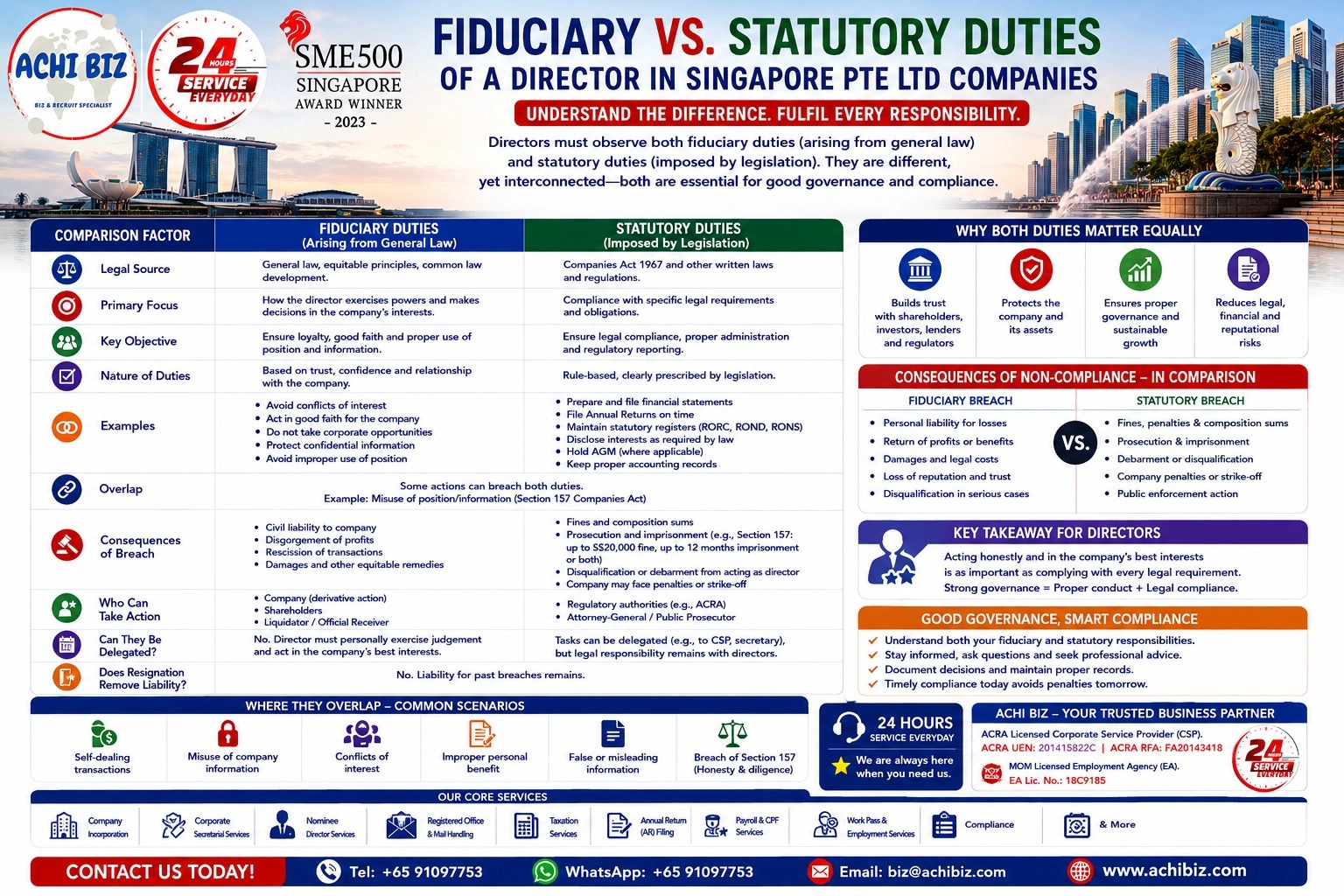
Fiduciary vs. Statutory Duties of a Director in Singapore: Key Differences, Importance & Consequences
A director of a Singapore private limited company does not operate under just one category of responsibility. Directors are subject to duties arising from general law and duties expressly imposed by legislation, particularly the Companies Act 1967.
The distinction between fiduciary duties and statutory duties matters because the source, nature, application and consequences of the two are not always identical. At the same time, they can overlap. Section 157 of the Companies Act itself illustrates this interaction: it requires directors to act honestly and use reasonable diligence, prohibits improper use of position or information, and expressly states that these statutory provisions are additional to other written law and rules of law concerning directors’ duties and liabilities.
This FAQ is intentionally focused on comparison and analysis rather than repeating our separate detailed guides on fiduciary duties and statutory duties.
What is the main difference between fiduciary duties and statutory duties of a director in Singapore?
The simplest distinction is their legal source and character.
Fiduciary duties principally arise from general law and concern the relationship of trust and responsibility between a director and the company. They focus strongly on how directors exercise their powers, handle conflicts and use their position.
Statutory duties arise because legislation expressly requires or prohibits particular conduct. The Companies Act 1967 is the principal corporate statute governing Singapore companies and includes provisions dealing with directors’ duties, accounts, audits and company administration.
In practical terms, fiduciary duties often ask:
“Did the director use the position and powers properly in the interests of the company?”
Statutory duties often ask:
“Did the director comply with what the law specifically requires?”
The distinction is useful, but it should not be treated as an absolute dividing line because the two categories can overlap.
Are fiduciary and statutory duties completely separate?
No. This is one of the most important points for directors to understand.
Singapore’s Companies Act can place statutory obligations on conduct that also has a strong general-law dimension. Section 157 is a clear example. It requires honesty and reasonable diligence and prohibits improper use of a director’s position or information. Importantly, section 157(4) states that the section operates in addition to, rather than replacing, other written law or rules of law concerning directors’ duties and liabilities.
A single act may therefore need to be considered from more than one legal perspective.
Can one action breach both fiduciary and statutory duties?
Potentially, yes.
Directors should not assume that conduct can always be placed neatly into one box labelled “fiduciary” and another labelled “statutory”.
For example, misuse of a director’s position may raise broader questions about the director’s obligations to the company while also falling within an express statutory prohibition. Section 157(2) specifically prohibits improper use of position or information to obtain an advantage for oneself or another person, or to cause detriment to the company.
This overlap can materially affect the legal consequences of misconduct.
What is a simple way for directors to distinguish the two duties?
A useful practical test is to ask two different questions.
| Comparison | Fiduciary Duties | Statutory Duties |
|---|---|---|
| Main source | General law/equitable principles | Legislation |
| Core focus | Proper exercise of entrusted powers and loyalty to the company | Compliance with requirements imposed by legislation |
| Typical concern | How and why a director exercised powers | Whether a legally prescribed requirement was met |
| Nature | Relationship-based obligations | Rule and legislation-based obligations |
| Possible overlap? | Yes | Yes |
| Can professional work be delegated? | Assistance may be obtained, but the director’s own obligations remain relevant | Administrative work may be delegated, but legal responsibility may remain with directors |
| Possible consequences | Civil remedies and other legal consequences depending on the breach | Statutory penalties, civil liability, prosecution and other enforcement consequences depending on the provision |
| Does resignation erase earlier breaches? | No automatic erasure | No automatic erasure |
The correct legal analysis ultimately depends on the particular conduct and applicable law.
Why does the distinction matter if directors must comply with both anyway?
Because identifying the source of the obligation helps determine:
- what standard the director must satisfy;
- what conduct constitutes a breach;
- who may take action;
- what evidence may be relevant;
- whether civil remedies may arise;
- whether a statutory offence has also been committed; and
- what penalties or other consequences may follow.
Calling every director failure simply a “breach of director’s duties” can therefore be too vague.
Which duties are more important – fiduciary or statutory duties?
Neither should be regarded as secondary.
A company can be administratively compliant while serious questions still exist about how its directors exercised their powers. Conversely, directors may believe they have acted properly towards the company but still expose themselves and the company to consequences if mandatory statutory requirements are ignored.
Good corporate governance requires attention to both dimensions simultaneously.
Is statutory compliance enough to show that a director has properly discharged all duties?
No.
Completing ACRA filings, maintaining corporate records and meeting reporting requirements does not by itself answer every question about whether a director has properly exercised the powers entrusted to him or her.
This is why directors should avoid thinking of governance as a checklist that ends when the Annual Return has been filed.
Does acting in the company’s interests excuse failure to comply with a statutory requirement?
Not automatically.
A director’s belief that a decision was beneficial to the company does not generally turn an applicable statutory requirement into an optional one.
Where legislation prescribes a particular obligation, directors need to identify and comply with that requirement.
Which category is more concerned with a director’s decision-making?
Fiduciary obligations are particularly significant when analysing why and for whose benefit a director exercised corporate powers.
Statutory obligations can also regulate decision-making, however, and may impose specific conditions or restrictions on corporate actions.
Therefore, directors should consider both the substance of the decision and the legal process required to implement it.
Which category is more concerned with corporate filing and administrative compliance?
These matters are predominantly statutory.
Annual Returns provide a straightforward example: section 197 of the Companies Act requires companies to file Annual Returns. ACRA can impose late lodgment penalties and take enforcement action against companies and officers where filing requirements are not met.
This illustrates why apparently administrative obligations can still have significant consequences for directors.
Where does financial reporting fit into this comparison?
Financial reporting provides another strong example of statutory responsibility.
Under section 201 of the Companies Act, directors must ensure that the company’s financial statements comply with prescribed accounting standards and give a true and fair view of its financial performance and position. ACRA makes clear that these responsibilities apply to company directors.
The wider conduct surrounding financial decisions may raise additional issues, but the requirement concerning compliant and true-and-fair financial statements is expressly statutory.
Can a director satisfy statutory duties simply by appointing an accountant or company secretary?
No.
Professionals can perform substantial administrative and technical work, but directors should distinguish between delegating a task and eliminating their own responsibility.
For example, ACRA states that directors remain legally responsible for financial statements even where external professionals assist with record-keeping and preparation.
The Companies Act does permit directors, subject to conditions, to rely on information or professional advice. Section 157C requires, among other things, good faith, proper inquiry where circumstances indicate inquiry is necessary, and no knowledge that reliance is unwarranted.
Does professional advice protect a director against every fiduciary or statutory breach?
No.
Professional advice can be extremely important, particularly where accounting, tax, legal or regulatory expertise is required. But directors should not interpret professional engagement as blanket immunity.
A director should understand the issue, provide accurate information, consider the advice and make further enquiries where circumstances warrant them.
Can a director say, “I complied with ACRA requirements, so I have fulfilled all my duties”?
That conclusion is too broad.
ACRA compliance is an important component of corporate administration, but a director’s responsibilities cannot be reduced solely to what appears on the company’s Bizfile records.
Corporate governance involves both regulatory compliance and proper conduct in exercising corporate authority.
Is a conflict of interest mainly a fiduciary or statutory issue?
It can involve both dimensions depending on the circumstances.
A conflict may raise questions about whether the director properly handled competing interests. At the same time, particular disclosure obligations can be imposed by statute.
Directors should therefore avoid analysing a conflict solely as an ethical concern or solely as a filing issue.
Is misuse of company information a fiduciary or statutory matter?
Again, potentially both.
Section 157(2) expressly prohibits an officer or agent from improperly using position or information acquired through that position to gain an advantage for himself, herself or another person, or to cause detriment to the company.
The same factual conduct may also engage broader legal duties owed to the company.
What is the difference between the consequences of breaching fiduciary and statutory duties?
There is no single penalty applicable to every breach in either category.
Broadly, a breach of fiduciary obligation can expose a director to civil remedies, depending on the circumstances—for example, consequences aimed at restoring the company’s position or addressing an improper benefit.
A statutory breach depends on the particular legislation. Consequences may include fines, civil liability, composition sums, prosecution, imprisonment where prescribed, debarment or disqualification.
Some conduct can trigger both civil and criminal consequences. Section 157 demonstrates this clearly: a person breaching the section can be liable to the company for profit made or damage suffered and can also commit an offence.
Can a statutory breach lead to imprisonment?
Certain statutory offences can.
Following amendments effective from 6 May 2026, breach of section 157 can, on conviction, result in a fine of up to S$20,000, imprisonment for up to 12 months, or both. The amendment increased the maximum fine as part of measures strengthening Singapore’s corporate regulatory framework.
This does not mean every statutory default carries this penalty. The applicable provision must always be checked.
Can fiduciary misconduct also create personal financial liability?
Yes, depending on the circumstances and remedy available.
A director should not assume that the absence of a regulatory fine means there is no personal exposure.
Indeed, section 157 provides an illustration of overlapping consequences: an officer breaching the section may be liable to the company for profit made or damage suffered, in addition to potential criminal liability.
Can repeated statutory defaults affect a person’s ability to remain a director?
Yes.
ACRA states that directors convicted of three or more filing offences within five years can face five years’ disqualification. Directors associated with three or more companies struck off by ACRA within five years can also become disqualified under the applicable rules. Debarment can arise for certain continuing filing defaults.
This is an important distinction because statutory non-compliance can directly affect a person’s eligibility to participate in company management.
Can failure to hold an AGM where required have consequences for directors?
Yes.
ACRA states that directors who fail to meet applicable AGM requirements may face enforcement action including prosecution, disqualification and debarment. The company may also face a composition sum, with ACRA stating a minimum composition sum of S$500 for each breach in the circumstances described in its enforcement guidance.
This is a good example of a statutory compliance matter that should not be confused with the broader standards governing directors’ conduct.
Can the same misconduct result in more than one type of legal action?
Potentially, yes.
The fact that conduct breaches a statutory provision does not necessarily eliminate other possible legal consequences. Section 157(4) specifically preserves other written law and rules of law relating to directors’ duties and liabilities.
Directors should therefore avoid assuming that payment of a regulatory penalty necessarily resolves every issue arising from the underlying conduct.
Are fiduciary breaches always intentional while statutory breaches are accidental?
No. That distinction would be misleading.
The required legal elements vary according to the particular duty and circumstances.
A statutory default can arise from deliberate conduct or poor compliance systems. Likewise, the legal assessment of a director’s conduct under general law cannot simply be reduced to whether the director admits an intention to cause harm.
Can ignorance of the difference between the two duties protect a director?
Directors should not rely on ignorance of legal terminology.
A director does not need to become a corporate lawyer, but should understand the practical responsibilities of the office and seek competent advice where necessary.
The safer question is not merely “Which category does this duty belong to?” but also “What am I required to do, and have I actually done it properly?”
Does the distinction apply differently to executive and non-executive directors?
The precise role and circumstances may be relevant to particular legal questions, but a non-executive title should not be treated as a general exemption.
For example, ACRA’s financial reporting guidance confirms that directors’ statutory responsibilities for financial statements apply irrespective of their role or financial expertise.
Directors should understand the responsibilities attached to their actual office rather than relying on internal titles.
Does a nominee director have fewer fiduciary or statutory duties?
Being called a nominee director does not create a general exemption from the legal responsibilities attached to directorship.
A nominee arrangement can actually create circumstances where understanding competing interests and regulatory obligations becomes especially important.
The director should therefore distinguish between who nominated the director and what obligations arise from holding office as a director of the company.
Does being the sole director reduce either category of duty?
No.
Having only one director does not transform legal obligations into optional requirements.
The Companies Act specifically accommodates certain procedural circumstances involving sole directors—for example, section 157B permits a sole director to make certain declarations by recording and signing them—but this does not create a general exemption from directors’ duties.
Can shareholders instruct a director to ignore either type of duty?
Directors should not assume that shareholder approval or instructions automatically cure conduct that would otherwise breach an applicable legal obligation.
The legal effect of shareholder approval depends on the particular matter, governing law and circumstances.
A director confronted with a questionable instruction should therefore obtain appropriate professional advice rather than assuming that majority ownership overrides directors’ legal responsibilities.
Is following the company’s constitution enough to satisfy both duties?
No.
The constitution is important, but it exists within a wider legal framework.
A company’s internal rules cannot simply be treated as a substitute for the Companies Act or other applicable law. Likewise, complying mechanically with the constitution does not necessarily resolve every issue concerning how a director has exercised corporate powers.
What is the practical difference in how directors should manage fiduciary and statutory risk?
For fiduciary risk, directors should pay close attention to the purpose behind decisions, conflicts, personal benefits, use of information and exercise of corporate powers.
For statutory risk, directors need reliable systems for deadlines, filings, financial reporting, disclosures, registers, approvals and other requirements imposed by legislation.
A strong governance framework therefore needs both decision-quality controls and compliance controls.
Can a compliance calendar manage both categories?
It is particularly useful for statutory obligations because many requirements are event-driven or deadline-driven.
A calendar alone, however, cannot ensure that corporate decisions are properly made. Fiduciary issues frequently require judgement about circumstances rather than simply meeting a filing date.
The company therefore needs more than reminders—it needs informed directors.
Why should board minutes distinguish between compliance and decision-making issues?
Good board records can help demonstrate what information directors considered, what interests were disclosed, what advice was obtained, what approvals were required and why a particular decision was made.
This can be relevant when later assessing whether directors properly discharged their responsibilities.
Minutes should reflect genuine corporate decision-making rather than being treated merely as paperwork prepared after the event.
Can proper statutory compliance reduce fiduciary risk?
It can help, but it cannot eliminate it.
Accurate records, proper disclosures, structured approval processes and good financial reporting create transparency. Transparency can make conflicts or questionable transactions easier to identify.
However, a company can have excellent administrative records and still make decisions that raise serious concerns about directors’ conduct.
Can strong fiduciary conduct compensate for poor statutory compliance?
No.
A director who sincerely believes that he or she is acting for the company’s benefit still needs to ensure that applicable statutory requirements are satisfied.
Good intentions are not a replacement for regulatory compliance.
Which type of breach is more dangerous for a director?
There is no useful universal ranking.
A serious fiduciary breach can create substantial personal exposure and damage to the company. A serious statutory breach can lead to prosecution, fines, imprisonment where the relevant provision provides for it, or restrictions on acting as a director.
The severity depends on the facts, legislation, loss caused, conduct involved and enforcement or legal action taken.
Can breaches affect the company even when the director personally caused the problem?
Yes.
Director misconduct or statutory non-compliance can create costs, disputes, regulatory action and reputational problems for the company itself.
Late Annual Returns, for example, can expose the company to late lodgment penalties and enforcement action, while directors can separately face consequences for repeated defaults.
The interests of the company and personal exposure of directors can therefore become intertwined.
Can director resignation eliminate liability for earlier breaches of either duty?
Resignation should not be treated as a method of erasing what happened during the director’s tenure.
Section 157 itself defines “officer” for its purposes to include a person who has at any time been an officer of the company.
The consequences of historical conduct depend on the relevant law and facts, but directors should not assume that leaving office automatically extinguishes prior exposure.
Why should directors understand both duties before accepting appointment?
Because directorship is a legal office, not merely a business designation.
A prospective director should understand that the role involves both:
conduct-based responsibility — how corporate powers and entrusted responsibilities are exercised; and
compliance-based responsibility — whether obligations imposed by legislation are properly fulfilled.
Understanding this before appointment reduces the risk of discovering the seriousness of the position only after a problem occurs.
How should a director approach a decision that may involve both duties?
A useful practical approach is to ask four questions:
- Authority: Does the company and director have legal authority to take the proposed action?
- Purpose: Is the power being exercised for an appropriate corporate purpose?
- Interest: Does the director have any personal or competing interest that needs to be addressed?
- Compliance: Are any statutory approvals, disclosures, records, resolutions or filings required?
This framework helps prevent directors from concentrating on only one side of their responsibilities.
What warning signs suggest that both fiduciary and statutory issues should be reviewed?
Directors should be particularly careful where transactions involve themselves, related parties, unusual payments, substantial company assets, personal benefits, confidential information, conflicts, changes in ownership, significant financing, questionable accounting treatments or corporate actions requiring formal approval.
Such situations can simultaneously raise questions about how the director is exercising authority and whether prescribed legal procedures have been followed.
What is the biggest mistake directors make when distinguishing fiduciary and statutory duties?
The biggest conceptual mistake is believing that one can substitute for the other.
“I acted in good faith” does not automatically answer a statutory compliance failure.
Likewise:
“All our ACRA filings are up to date” does not automatically establish that every corporate decision was properly made.
Directors need both proper conduct and proper compliance.
What happens when a director breaches both duties through the same conduct?
The consequences may potentially operate on different tracks.
Depending on the facts, the company may have civil remedies, while a statutory provision may separately create an offence or regulatory consequence.
Section 157 provides a particularly clear illustration because breach can result in liability to the company for profit made or damage suffered and can also constitute an offence punishable by a fine of up to S$20,000, imprisonment for up to 12 months, or both.
What is the best governance approach for managing both duties?
The strongest approach is not to manage them separately in isolation.
Companies should combine sound board decision-making with reliable corporate administration. Directors should receive sufficient information, disclose relevant interests, question unusual transactions, document significant decisions, maintain accurate corporate and financial records, monitor regulatory deadlines and seek qualified advice where necessary.
That creates a governance system where proper decisions and proper compliance reinforce each other.
What should Singapore Pte. Ltd. directors remember about fiduciary vs. statutory duties?
The distinction can be summarised simply:
Fiduciary duties are fundamentally about how directors exercise the trust, authority and powers placed in them. Statutory duties are obligations expressly imposed through legislation.
But the two are not sealed compartments. They can overlap, and one act can potentially create consequences under more than one legal principle.
A responsible director should therefore avoid asking only:
“Have we filed everything?”
The better question is:
“Have we both acted properly and complied with everything the law requires?”
How can ACHI BIZ support directors with Singapore corporate compliance?
Directors may engage professional assistance for company administration and compliance while continuing to exercise appropriate oversight. ACHI BIZ can support Singapore companies with corporate secretarial services, company incorporation, ACRA filings, Annual Return filing, maintenance of corporate records and registers, accounting, bookkeeping, tax services and related corporate compliance matters.
ACHI BIZ is an ACRA Licensed Corporate Service Provider (CSP).
Disclaimer:
This FAQ provides general information on Singapore corporate compliance. The classification and consequences of a director’s duty or breach depend on the applicable law and particular facts. Companies and directors should obtain appropriate professional or legal advice for specific situations.
Related Pages:
Statutory Duties of a Director in Singapore Pte Ltd Companies-FAQ
Fiduciary Duties of a Director in Singapore Pte Ltd Companies-FAQ
#achibiz