
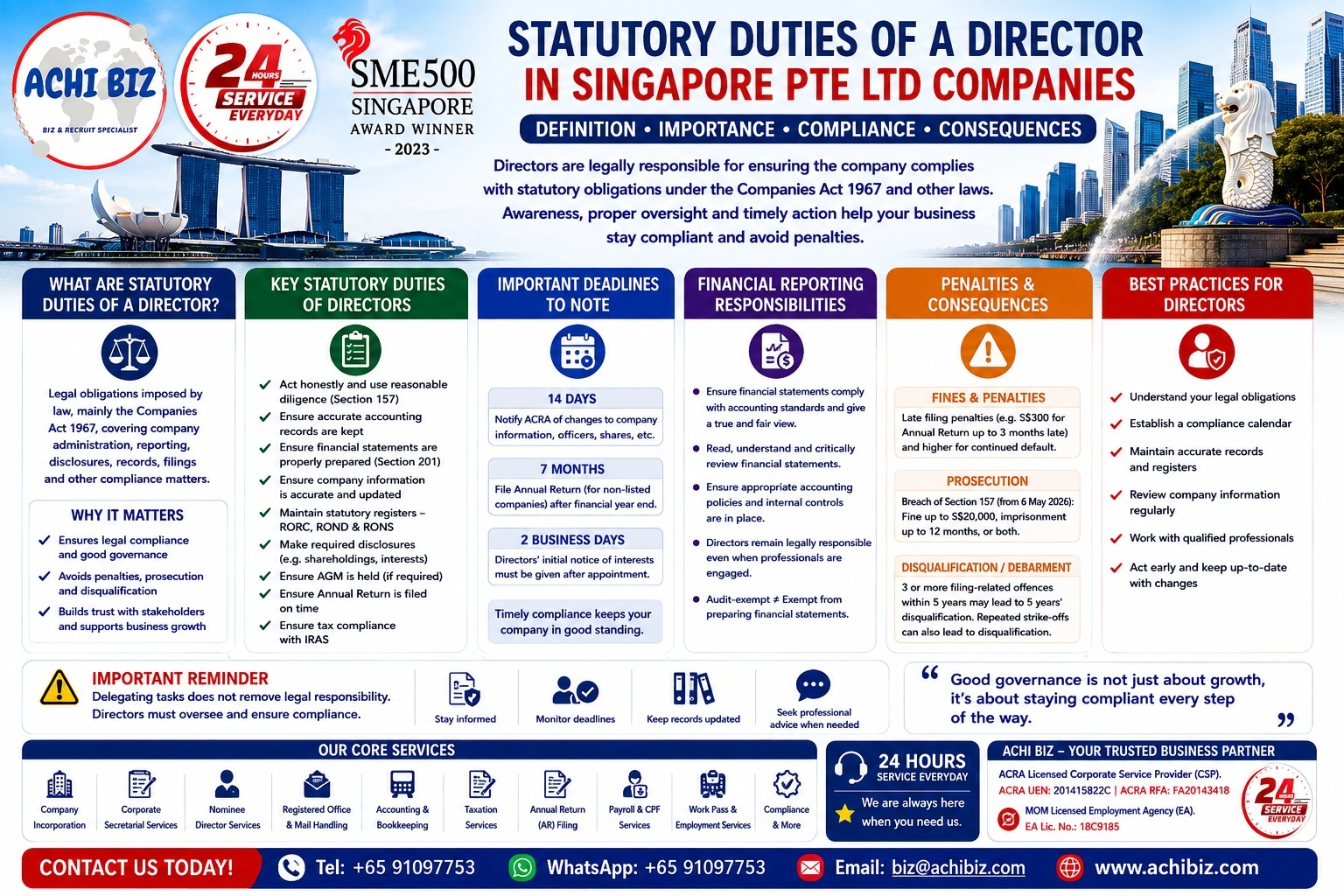
Statutory Duties of a Director in Singapore Pte. Ltd. Companies – Complete FAQ Guide
Being appointed as a director of a Singapore private limited company carries legal responsibilities that go well beyond attending meetings or approving documents. Singapore company law places specific obligations on directors relating to company administration, financial reporting, statutory registers, disclosures, annual compliance and other corporate matters.
These obligations should not be treated as tasks belonging solely to the company secretary, accountant or Corporate Service Provider. A director may delegate administrative work or engage professionals, but delegation does not automatically remove the director’s underlying legal responsibility. ACRA expressly states, for example, that directors remain legally responsible for financial statements even where external professionals are engaged to assist with record-keeping or financial statement preparation.
This FAQ focuses specifically on statutory duties of directors in Singapore Pte. Ltd. companies. Fiduciary duties are intentionally not covered here, as they are a separate subject.
What are statutory duties of a director in a Singapore Pte. Ltd. company?
Statutory duties are legal obligations imposed on directors by legislation. For Singapore companies, the principal legislation is the Companies Act 1967, although directors may also have responsibilities arising under tax, employment and other laws depending on the company’s activities. The Companies Act regulates matters ranging from company management and director obligations to financial reporting and winding up.
In practical terms, statutory compliance requires directors to ensure that the company is properly administered, required information is maintained and updated, financial reporting obligations are fulfilled, mandatory filings are made and legally required disclosures are provided.
Why are statutory duties important for directors of Singapore companies?
A company is a separate legal entity, but it operates through individuals. Directors occupy a central position in ensuring that the company complies with its legal obligations.
Failure to understand these responsibilities can result in more than an administrative inconvenience. Depending on the particular provision breached, consequences may include late filing penalties, composition sums, prosecution, fines, personal liability, debarment or disqualification.
Repeated filing failures can have particularly serious consequences. ACRA states that directors convicted of three or more filing-related offences within five years may be disqualified for five years. Certain repeated company strike-offs can also result in director disqualification.
Are statutory duties applicable to every director?
Generally, a person who accepts appointment as a director assumes the legal responsibilities attached to that office.
Being described internally as an executive director, non-executive director, nominee director or “silent director” does not by itself eliminate the statutory responsibilities imposed on a director.
Directors should therefore understand what they are agreeing to before accepting an appointment rather than assuming another director will take care of compliance.
Can a director say that he or she did not know about the statutory requirements?
A lack of familiarity with company compliance requirements should not be treated as a compliance strategy.
A person accepting a directorship should understand the company’s regulatory obligations and establish appropriate systems to monitor them. Where specialised knowledge is required, professional assistance can be obtained, but directors should remain sufficiently informed to exercise proper oversight.
What does the Companies Act say about a director exercising reasonable diligence?
Section 157 of the Companies Act provides that a director must at all times act honestly and use reasonable diligence in discharging the duties of office.
Following legislative changes effective 6 May 2026, a breach of section 157 can expose an offender, on conviction, to a fine of up to S$20,000, imprisonment for up to 12 months, or both. The section also provides for liability to the company for profit made or damage suffered as a result of a breach.
This article does not examine the broader fiduciary aspects of section 157; the important statutory point here is that reasonable diligence is expressly required by legislation.
Does appointing a company secretary transfer statutory responsibility away from directors?
No.
A competent company secretary plays an important role in maintaining the company’s compliance calendar, preparing resolutions, maintaining records and facilitating statutory filings. However, directors should not assume that appointing a secretary transfers every legal responsibility away from the board.
Directors should establish a system under which compliance matters are brought to their attention and acted upon before deadlines expire.
Can directors outsource corporate compliance to a Corporate Service Provider?
Yes, companies can engage a professional Corporate Service Provider to assist with corporate administration and filings. For example, ACRA expressly permits a CSP to file an annual return on a company’s behalf.
However, outsourcing the administrative work should not be confused with outsourcing the director’s legal responsibilities. Directors should provide accurate information, review documents requiring their approval and respond promptly when action is required.
Are directors responsible for ensuring company information registered with ACRA remains accurate?
Directors should ensure that the company’s registered information is properly maintained and that changes requiring notification are lodged within the applicable deadlines.
ACRA states that changes to company information, officers, shares and shareholders generally need to be updated within 14 days.
Keeping outdated information in Bizfile can create regulatory problems and may also cause practical difficulties with banks, counterparties and other stakeholders relying on the company’s registered particulars.
What company information should directors periodically review?
Directors should ensure that important corporate information remains current, including the registered office, business activities, directors and company secretary, shareholders, issued and paid-up share capital and other information requiring registration.
Before filing an annual return, ACRA specifically advises checking company details, officer particulars, shareholder and share information, registered charges or loans where relevant, financial statement requirements and applicable RORC, ROND and RONS obligations.
Are directors responsible for maintaining statutory registers?
Singapore companies are required to maintain accurate records and applicable statutory registers.
Depending on the company and circumstances, these can include records relating to members, controllers, nominee directors and nominee shareholders. ACRA states that companies must maintain accurate and up-to-date records of directors, shareholders and other relevant persons.
Directors should therefore ensure there is a reliable process for collecting the necessary information and communicating changes to the company secretary or CSP.
What is the director’s responsibility regarding the Register of Registrable Controllers (RORC)?
Unless an exemption applies, a company must comply with its RORC requirements.
Directors should ensure that the company has an appropriate system for identifying registrable controllers, obtaining the required particulars, maintaining the relevant information and completing required filings.
The RORC should not be treated as something checked only once when the company is incorporated. Changes in ownership or control may create further compliance obligations.
What should directors know about the Register of Nominee Directors (ROND)?
Where nominee director arrangements exist, applicable ROND requirements must be complied with.
Companies are required to maintain their ROND and comply with the applicable Central ROND filing requirements.
Directors should therefore ensure that nominee status and the relevant nominator information are properly identified and communicated rather than assuming that appearing as an ordinary director in public records resolves the issue.
What should directors know about the Register of Nominee Shareholders (RONS)?
Where a shareholder holds shares on behalf of another person and falls within the applicable nominee shareholder requirements, the company’s RONS obligations should be considered.
The company should have processes for identifying nominee arrangements, maintaining the necessary information and filing required changes with the Central RONS.
Does a director have statutory disclosure obligations concerning his or her interests?
Yes. Directors have specific disclosure requirements under the Companies Act.
For example, section 165 requires directors and chief executive officers to provide written notice to the company of specified particulars relating to shares, debentures, participatory interests, rights, options and contracts, as well as applicable changes and other information necessary for the company’s compliance with the relevant statutory requirements. Certain initial notices must be provided within 2 business days after appointment.
Directors should therefore promptly inform the company whenever circumstances triggering statutory disclosure requirements arise.
Are directors responsible for proper accounting records?
Directors should ensure that the company maintains proper accounting and supporting records.
This responsibility should not be approached merely as an annual exercise before corporate tax or financial statements become due. A sound record-keeping system should operate throughout the financial year.
IRAS guidance also places responsibility on business owners and company directors to ensure that proper records are maintained and that tax declarations can be supported by the necessary documents.
Are directors responsible for the company’s financial statements?
Yes. This is one of the most important statutory responsibilities of directors.
Under section 201 of the Companies Act, directors must ensure that financial statements comply with prescribed accounting standards and give a true and fair view of the company’s financial performance and position. ACRA makes clear that these responsibilities apply to all directors regardless of their role or financial expertise.
Can a director simply sign financial statements prepared by the accountant?
That is not a sound approach.
ACRA expects directors to read and understand the financial statements, critically consider management’s judgements and estimates, question accounting treatments that appear inconsistent with the underlying transactions and ensure that the financial information is complete and understandable.
A director’s signature should therefore represent meaningful review rather than a routine administrative formality.
Must a director be professionally qualified in accounting?
No. A director does not have to become an accountant simply because he or she holds office.
However, ACRA states that directors should possess sufficient and up-to-date knowledge of accounting principles and practices to conduct an effective high-level review of the company’s financial statements.
Where directors lack specialist knowledge, they should obtain competent assistance while still understanding enough to evaluate the company’s financial position.
Does appointing an external accountant remove the director’s financial reporting responsibility?
No.
ACRA expressly states that directors remain legally responsible for the financial statements even when external assistance is used. Directors should ensure that service providers are suitably qualified and should independently consider the information and advice received.
Are directors responsible for internal controls?
Directors should exercise oversight over the company’s financial reporting systems and controls.
ACRA’s financial reporting guidance says directors should ensure that management adopts appropriate accounting policies, implements suitable internal control systems and maintains complete and accurate accounting and other records.
For smaller Pte. Ltd. companies, this remains important even where only a few people handle accounts.
Must every Singapore Pte. Ltd. company prepare financial statements?
Generally, Singapore-incorporated companies must prepare financial statements, subject to specific exemptions such as those applicable to qualifying dormant relevant companies.
Whether the financial statements must also be filed with ACRA is a separate question and depends on the company’s filing status and applicable exemptions.
Directors should not confuse audit exemption with exemption from preparing financial statements.
Is an audit-exempt company free from directors’ financial reporting duties?
No.
Audit exemption means that a qualifying company may not need its financial statements audited. It does not mean directors can disregard financial reporting responsibilities.
ACRA specifically states that an audit-exempt company can present unaudited financial statements under section 201, while companies that are not audit-exempt must present audited financial statements.
Are directors responsible for AGM compliance?
Yes, where an AGM is required.
Singapore companies generally must hold an AGM within the applicable statutory timeframe unless they qualify for an exemption or otherwise fall within the relevant statutory provisions.
ACRA warns that directors who fail to comply with AGM requirements may face prosecution, disqualification or debarment, while the company may face a composition sum.
Does AGM exemption mean the directors no longer have annual compliance responsibilities?
No.
An AGM exemption affects the requirement to hold the meeting; it does not eliminate other annual corporate obligations.
Financial reporting, annual return filing, tax compliance, maintaining company information and other applicable obligations must still be considered independently.
Are directors responsible for filing the Annual Return with ACRA?
The company must ensure its Annual Return is filed within the statutory deadline, and ACRA expressly describes timely filing as a director’s legal duty.
For a typical non-listed Singapore Pte. Ltd. company, the Annual Return is generally due within 7 months after the financial year end, subject to special circumstances and applicable rules.
Must a dormant company file an Annual Return?
Generally, yes.
ACRA states that companies listed as “live” must file annual returns even if they are inactive or dormant, including where IRAS has granted a tax filing waiver.
Dormancy therefore should not automatically be interpreted as exemption from ACRA compliance.
What happens if the Annual Return is filed late?
Late filing can result in late lodgment penalties and potentially further enforcement action.
For Annual Returns with filing due dates on or after 14 January 2022, ACRA states that a late lodgment penalty of S$300 applies where the filing is up to three months late, with higher consequences where the default continues. Repeated filing offences can ultimately contribute to prosecution or director disqualification.
Can repeated statutory non-compliance lead to director disqualification?
Yes.
ACRA states that a director convicted of three or more filing-related offences within five years can be disqualified for five years. Directors associated with three or more companies struck off by ACRA within five years may also face statutory disqualification periods.
Repeated administrative defaults should therefore never be regarded as harmless paperwork issues.
Can a director be debarred from acting as a director or company secretary?
Yes, statutory non-compliance can lead to debarment in circumstances prescribed by law.
A debarred individual may be prevented from taking on new appointments as a director or company secretary while the debarment remains effective.
This is another reason directors should monitor outstanding statutory obligations across every company in which they hold office.
Are directors responsible for corporate tax compliance with IRAS?
A company’s corporate income tax obligations are separate from its ACRA annual filing requirements.
ACRA expressly reminds companies that filing the Annual Return does not replace tax filing with IRAS.
Directors should therefore ensure that the company has systems for preparing accounts, computing taxable income, maintaining supporting records and meeting applicable IRAS filing deadlines.
Can directors rely entirely on their tax agent?
Professional tax agents can prepare computations and filings, but management should ensure that the underlying information supplied is accurate and complete.
Tax computations ultimately depend on reliable accounting records, supporting documentation and correct treatment of transactions. Directors should therefore ensure that the company’s bookkeeping and financial information are properly maintained throughout the year.
Does a director have to personally perform every statutory filing?
No.
Many filings can be handled by the company secretary, authorised officers or an appointed CSP. ACRA expressly allows a Corporate Service Provider to file an Annual Return on behalf of a company.
The practical distinction is important: a director does not necessarily have to personally perform every administrative task, but should ensure that required compliance is actually completed.
Can one director simply leave all compliance matters to another director?
That can be risky.
Internal division of responsibilities may be sensible, particularly where directors have different expertise. However, directors should not completely disengage from the company’s affairs merely because another director has been assigned responsibility for administration or finance.
Board-level monitoring and appropriate enquiries remain important.
What should a newly appointed director check immediately after appointment?
A new director should understand the company’s present compliance position rather than assuming everything was properly handled before appointment.
A sensible review may cover the company’s constitution, latest ACRA profile, financial year end, accounting records, outstanding financial statements, AGM position, Annual Return status, tax filings, registered office, statutory registers, shareholding structure, controllers, nominee arrangements and any overdue regulatory matters.
Is signing documents without reading them acceptable for a director?
No director should adopt a routine practice of signing resolutions, financial statements, declarations or statutory documents without understanding what is being approved.
Where information is unclear, the director should request explanations and supporting documentation before approving it.
This is particularly important for financial statements because ACRA specifically expects directors to review and understand them rather than simply relying on preparers or auditors.
Does being a nominee director reduce statutory responsibilities?
The label “nominee director” does not create a general exemption from directors’ legal obligations.
A nominee director remains a director of the company and should understand the legal responsibilities attached to the office. In addition, nominee arrangements may trigger specific ROND-related compliance requirements.
Does being a non-executive director remove statutory responsibilities?
No automatic exemption arises merely because a director does not participate in the company’s day-to-day operations.
ACRA’s financial reporting guidance, for example, states expressly that financial reporting duties apply to all directors regardless of their role or financial expertise.
Is a director still responsible if another person actually runs the business?
A director should be very cautious about accepting an appointment where someone else exercises complete control while expecting the director simply to lend his or her name.
Holding a directorship carries genuine legal responsibilities. Directors should maintain sufficient visibility over the company’s activities and compliance to properly discharge their role.
What are common statutory compliance mistakes made by directors?
Common problems include treating the company secretary as solely responsible for compliance, failing to update changes with ACRA, overlooking statutory registers, signing accounts without adequate review, confusing audit exemption with financial reporting exemption, missing AGM or Annual Return deadlines, neglecting tax filings and failing to disclose information that the company requires for statutory purposes.
Many of these problems are preventable through a structured compliance calendar and timely communication with professional advisers.
What happens if statutory non-compliance continues for several years?
The consequences can accumulate.
Late filings can generate penalties; continuing defaults can result in enforcement action; repeated filing offences can affect the director personally; and prolonged non-compliance can ultimately place the company’s continuing registration at risk.
ACRA can strike companies off in applicable circumstances, while repeated filing offences and strike-offs can contribute to director disqualification.
Can directors be personally prosecuted for statutory breaches?
Certain provisions of the Companies Act impose liability directly on directors or company officers.
The precise consequences depend on the particular provision breached. Directors should therefore avoid assuming that every compliance failure results only in a fine payable by the company.
Can statutory non-compliance affect the company’s business reputation?
Yes. Even where a breach initially appears administrative, persistent non-compliance can create wider commercial problems.
Banks, investors, customers, suppliers and prospective business partners may review ACRA information when conducting due diligence. Outdated company particulars, overdue filings or regulatory action can raise questions about the quality of the company’s governance and administration.
Can statutory non-compliance affect financing or investment?
Potentially.
Investors and lenders commonly expect the company’s corporate records, shareholding information, financial statements and statutory filings to be orderly and current.
Problems discovered during due diligence can delay transactions, require corrective filings or cause counterparties to seek further assurances before proceeding.
Should directors conduct a periodic statutory compliance review?
Yes. Waiting until the Annual Return deadline is an inefficient way to manage compliance.
A periodic review can check whether corporate information remains current, accounting records are updated, financial statements are progressing, statutory registers reflect current arrangements, tax obligations are being addressed and upcoming deadlines are known.
How often should directors review statutory compliance?
There is no single review frequency that replaces the individual deadlines prescribed by law.
For practical governance, directors can monitor compliance throughout the year and perform more formal checks around major corporate events and financial reporting periods. Changes in directors, shareholders, share capital, registered office, controllers or nominee arrangements should be addressed when they happen rather than postponed until year-end.
Should directors maintain a statutory compliance calendar?
Yes. A compliance calendar is one of the simplest ways to reduce avoidable defaults.
It can track the financial year end, preparation of financial statements, AGM deadline where applicable, Annual Return filing, corporate income tax deadlines, renewal dates for licences where applicable and recurring reviews of statutory registers and corporate particulars.
What should directors do when they discover an overdue statutory filing?
They should address it promptly rather than waiting for the next annual compliance cycle.
The company secretary or CSP should identify what remains outstanding, determine whether corrective filings or an extension application are available and advise on applicable penalties or remedial steps.
Continuing to ignore an existing default generally increases regulatory risk.
Can engaging a professional Corporate Service Provider help directors manage statutory compliance?
Yes. A professional CSP can assist with corporate secretarial administration, statutory filings, company changes, registers, resolutions, annual compliance and related corporate matters.
However, professional assistance works best when directors actively cooperate by supplying complete information, reviewing documents and notifying the CSP promptly whenever company circumstances change.
What is the practical difference between delegating a task and delegating legal responsibility?
A director can delegate work, such as preparing accounts, drafting resolutions or submitting a filing.
That does not necessarily mean the director has transferred the legal responsibility attached to the office.
This distinction is particularly clear in financial reporting: ACRA expressly states that directors remain legally responsible even where record-keeping and financial statement preparation have been outsourced.
What is the best compliance approach for directors of small Singapore Pte. Ltd. companies?
Small companies benefit from keeping the process straightforward: maintain proper bookkeeping throughout the year, keep corporate information current, immediately report structural changes, maintain required registers, review financial statements carefully, monitor statutory deadlines and use qualified professionals where specialised assistance is required.
The size of a company does not justify ignoring legal obligations.
What is the key takeaway about statutory duties of directors in Singapore?
A directorship should never be viewed as a name appearing on an ACRA business profile.
Directors are entrusted with genuine legal responsibilities concerning the company’s administration, reporting, disclosures and regulatory compliance. They can obtain professional assistance to perform much of the administrative work, but they should remain informed, exercise oversight and make sure required actions are completed accurately and on time.
A well-managed company does not wait for ACRA or another regulator to identify a default. It builds compliance into its normal business operations.
How can ACHI BIZ assist Singapore Pte. Ltd. companies and their directors?
ACHI BIZ SERVICES PTE. LTD. can assist companies with incorporation, corporate secretarial services, statutory compliance, ACRA filings, maintenance of corporate records, accounting, financial reporting support, corporate tax matters and other business compliance requirements. ACHI BIZ is an ACRA Licensed Corporate Service Provider (CSP).
Disclaimer:
This FAQ provides general information on Singapore corporate compliance and should not be treated as legal, tax or professional advice for a particular company or director.
Related Pages:
Fiduciary Duties of a Director in Singapore Pte Ltd Companies-FAQ
Key Differences: Fiduciary vs. Statutory Duties of Directors in Singapore Pte Ltd Companies
#achibiz