
How Can a DP Holder Register a Pte Ltd Company in Singapore? – FAQ Guide
How Can a DP (Dependant’s Pass) Holder Register a Pte Ltd Company in Singapore?
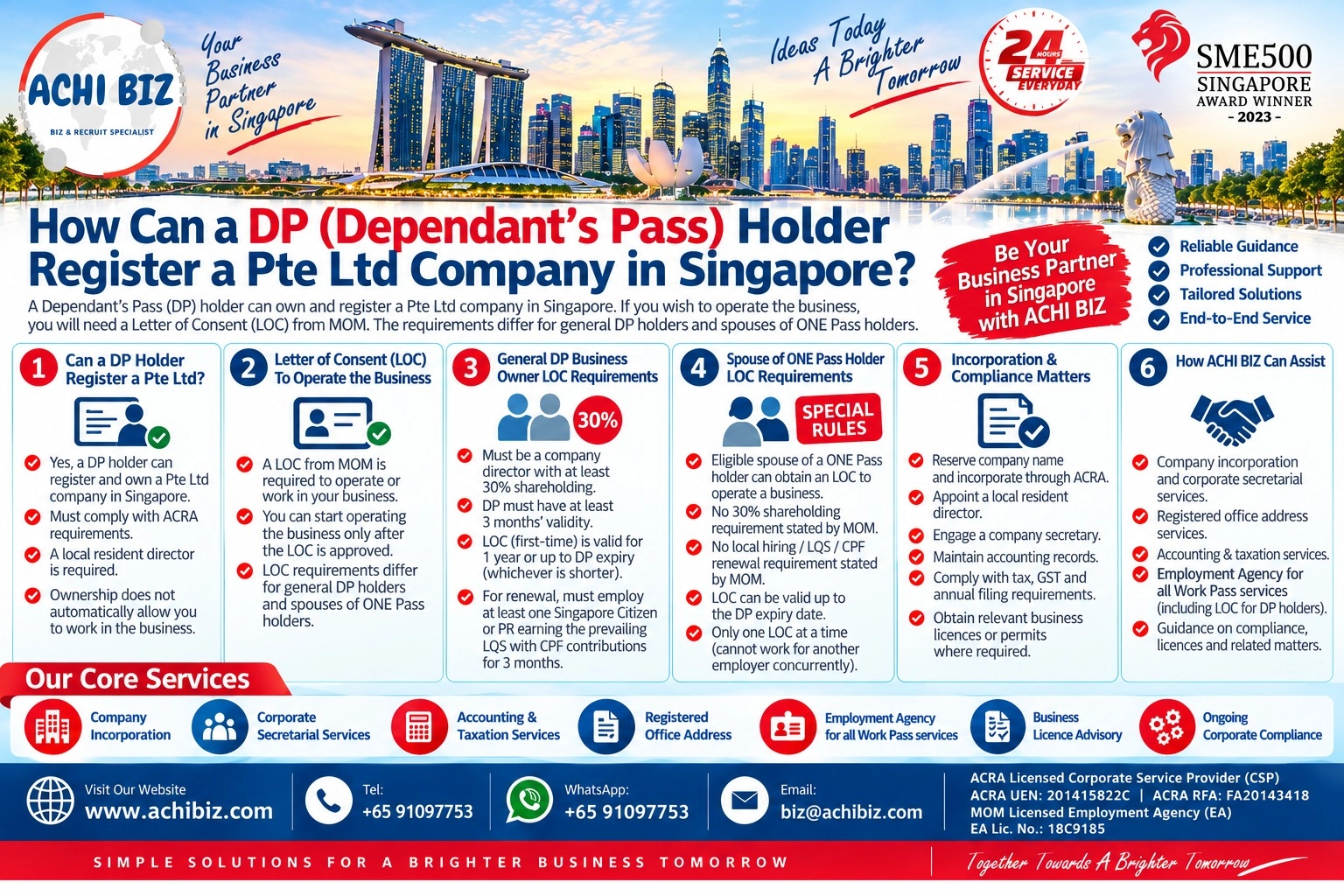
A Dependant’s Pass (DP) holder can establish and own a Private Limited Company (Pte. Ltd.) in Singapore, but there is an important distinction between owning a company and personally working in or operating that company.
For a DP holder, company incorporation involves both ACRA requirements and, if the DP holder intends to actively operate the business, Ministry of Manpower (MOM) requirements.
Under MOM’s general DP business-owner Letter of Consent (LOC) framework, a DP holder who wishes to operate his or her own Pte Ltd company must currently be a company director with at least 30% shareholding to qualify.
However, a spouse holding a Dependant’s Pass under an Overseas Networks & Expertise Pass (ONE Pass) holder is subject to a separate MOM framework. MOM allows an eligible spouse of a ONE Pass holder to work or operate a business in Singapore with an LOC, and the special ONE Pass spouse framework does not currently state the general 30% shareholding requirement.
In either case, the DP holder should obtain the required MOM authorisation before beginning to operate the business.
This FAQ focuses exclusively on a DP holder registering and operating a Singapore Pte Ltd company. Other business structures are not covered here.
Can a Dependant’s Pass holder register a Pte Ltd company in Singapore?
Yes, subject to the applicable ACRA and MOM requirements.
A DP holder is a FIN holder and should not assume that holding a Dependant’s Pass automatically satisfies every ACRA local-residency requirement.
For a Pte Ltd company, the company must have at least one director who satisfies ACRA’s applicable local-residency requirements.
If the DP holder intends to personally operate the business, the applicable MOM work-authorisation requirements must also be considered.
Importantly, the applicable LOC route may differ depending on whether the person holds an ordinary eligible DP or is an eligible spouse of a ONE Pass holder.
Can a DP holder own shares in a Singapore Pte Ltd company?
Yes, subject to applicable laws and regulatory requirements.
Share ownership and permission to work are separate matters. A person can own shares in a company without that shareholding itself giving the person permission to work for or operate the company in Singapore.
For a DP holder intending to use MOM’s general business-owner LOC route, shareholding becomes particularly important because MOM currently requires a company director to hold at least 30% of the shares.
However, this requirement should not automatically be applied to an eligible DP spouse of a ONE Pass holder, because MOM has established a separate LOC framework for this category. MOM’s current ONE Pass spouse LOC requirements do not state the general 30% shareholding condition.
Can a DP holder own 100% of a Pte Ltd company?
Generally, yes, subject to any restrictions applicable to the particular business activity or regulated industry.
However, owning 100% of the shares does not remove the requirement for the company to satisfy ACRA’s applicable local resident director requirement.
It also does not, by itself, authorise the DP holder to work in or operate the business.
Where MOM work authorisation is required, the DP holder should obtain the applicable LOC or other appropriate work authorisation before personally operating the company.
Does registering the Pte Ltd company automatically allow the DP holder to work in it?
No.
This is one of the most important points for a DP holder to understand.
Owning or incorporating a company is not the same as having permission to work in or operate the company.
Under MOM’s general business-owner LOC framework, an eligible DP holder can apply for an LOC to operate his or her own business and can begin operating the business only after receiving the LOC.
For an eligible spouse of a ONE Pass holder, MOM similarly provides a dedicated LOC route to work or operate a business in Singapore.
What is a Letter of Consent for a DP holder who owns a business?
A Letter of Consent (LOC) is an MOM authorisation that permits an eligible DP holder to work or operate a business in Singapore under the applicable LOC framework.
For most eligible DP business owners, MOM provides the LOC for Dependant’s Pass holders who are business owners.
Eligible spouses of ONE Pass holders have a separate dedicated LOC framework under MOM.
It is therefore important to identify the applicant’s DP category before applying the eligibility, application and renewal requirements.
Who qualifies for the business-owner LOC when operating a Pte Ltd company?
Under MOM’s general DP business-owner LOC framework, a DP holder operating a Pte Ltd company must currently be:
a company director with at least 30% shareholding in the company.
For other business structures, MOM also recognises eligible sole proprietors, partners and members of Companies Limited by Guarantee.
For a Pte Ltd company, however, the relevant general business-owner category is the qualifying company director.
The DP must also have at least 3 months’ validity before the LOC application is submitted.
Are the rules different if the DP holder is the spouse of a ONE Pass holder?
Yes. This is an important exception.
MOM has a dedicated framework for spouses holding a Dependant’s Pass under an Overseas Networks & Expertise Pass (ONE Pass) holder.
An eligible spouse of a ONE Pass holder may obtain an LOC to:
- work for an employer in Singapore; or
- operate a business in Singapore.
Where the spouse wishes to operate a business, the candidate or an appointed Employment Agent can apply for the LOC.
Where the spouse wishes to work for an employer, the employer applies on the candidate’s behalf.
Other dependants of ONE Pass holders who are not spouses do not receive this same LOC entitlement and will need the appropriate work pass if they wish to work in Singapore.
Does the 30% shareholding requirement apply to a DP spouse of a ONE Pass holder?
Under MOM’s general DP business-owner LOC framework, a company director must currently hold at least 30% shareholding.
However, MOM’s dedicated LOC framework for an eligible spouse of a ONE Pass holder does not currently state this minimum 30% shareholding requirement.
Accordingly, the general 30% shareholding requirement should not automatically be applied to an eligible DP spouse of a ONE Pass holder.
The applicant must nevertheless satisfy MOM’s prevailing requirements applicable to the dedicated ONE Pass spouse LOC category.
How long can an LOC be granted?
The applicable duration differs between the two LOC frameworks.
For a general DP business-owner LOC, MOM currently states that a first-time LOC will be valid for whichever is shorter:
- one year from the date of issue; or
- up to the expiry date of the Dependant’s Pass.
For subsequent renewals, the LOC may be granted up to the DP expiry date.
For an eligible DP spouse of a ONE Pass holder, MOM states that the LOC duration can be up to the expiry date of the Dependant’s Pass.
Actual validity remains subject to MOM’s approval.
Does a DP business owner need to hire a Singapore Citizen or PR for LOC renewal?
Under MOM’s general DP business-owner LOC framework, yes.
At the point of renewal, MOM currently requires the business to have hired at least one Singapore Citizen or Permanent Resident who:
- earns at least the prevailing Local Qualifying Salary (LQS); and
- has been receiving CPF contributions for at least 3 consecutive months preceding the renewal application submission date.
The DP must also have at least 3 months’ validity remaining.
These requirements should be planned for well before renewal.
Does the local hiring requirement apply to a DP spouse of a ONE Pass holder?
MOM’s dedicated LOC framework for eligible spouses of ONE Pass holders is different from the general DP business-owner LOC framework.
MOM’s current published ONE Pass spouse LOC requirements do not state the general requirement to employ at least one Singapore Citizen or Permanent Resident earning the prevailing LQS with the prescribed CPF contribution period.
Accordingly, that general local-hiring requirement should not automatically be applied to an LOC held by an eligible DP spouse of a ONE Pass holder.
The applicant should nevertheless satisfy MOM’s prevailing renewal requirements at the time of renewal.
Why should the company plan for LOC renewal from the beginning?
Because obtaining the first LOC does not mean that future renewal is automatic.
For a general DP business-owner LOC, first-time eligibility and renewal eligibility are different. In particular, the qualifying local employee, LQS and CPF requirements become relevant at renewal.
For an eligible DP spouse of a ONE Pass holder, the dedicated MOM framework currently does not impose that same published local-hiring condition.
In both cases, the DP holder should monitor:
- DP validity;
- LOC validity;
- applicable renewal criteria; and
- any changes to MOM’s prevailing requirements.
When can the LOC be renewed?
Under the general DP business-owner framework, MOM currently allows the LOC to be renewed when the DP is renewed and up to 6 months before the LOC expires. The DP must have at least 3 months’ validity remaining at the time of renewal.
MOM’s dedicated framework for spouses of ONE Pass holders likewise provides a separate renewal process.
Applicants should not assume that an LOC renews automatically merely because the underlying DP remains valid.
Can a DP holder simply remain a shareholder without obtaining an LOC?
Share ownership and work authorisation are separate issues.
A DP holder who is merely an investor should not assume that shareholding itself constitutes permission to work.
If the DP holder intends to actively operate, manage or work in the business, the applicable MOM authorisation should be obtained.
What happens if the DP holder wants to work for another employer instead of operating the business?
That is a different employment situation.
The general DP business-owner LOC is specifically intended for eligible DP holders who wish to operate their own business.
For spouses of ONE Pass holders, MOM has a special arrangement. A spouse may obtain an LOC to work for an employer, in which case the prospective employer applies on the spouse’s behalf.
Other dependants of ONE Pass holders who are not spouses will need an appropriate work pass to work for an employer.
Does the company still need a locally resident director?
Yes.
The company’s obligations under the Companies Act and ACRA requirements remain separate from MOM’s LOC requirements.
A Singapore Pte Ltd company must have at least one director who satisfies the applicable local-residency requirement.
A DP holder should not assume that the DP or LOC automatically establishes that the individual satisfies every ACRA residency requirement. The circumstances should be assessed separately.
Can the DP holder also be the company secretary?
Potentially, subject to the Companies Act requirements and the person’s eligibility.
However, where a company has only one director, that sole director cannot also act as the company secretary.
For many DP-owned companies, engaging a professional company secretary is therefore the more practical arrangement.
Does the company need a constitution?
Yes.
A copy of the company’s constitution must form part of the incorporation arrangements.
The company may adopt the applicable Model Constitution or use an appropriate customised constitution.
The constitution governs important matters concerning the company’s internal administration, shareholders, directors, shares and decision-making.
What is a Financial Year End and why does it matter?
The Financial Year End (FYE) determines the end of the company’s accounting period.
It affects important subsequent compliance obligations involving financial statements, taxation, AGM requirements where applicable and the ACRA Annual Return.
The FYE should therefore be considered carefully during incorporation rather than treated merely as an administrative date.
Does a DP holder need to engage a Corporate Service Provider to register the Pte Ltd company?
Foreigners who need professional assistance with the registration should use an appropriately licensed Corporate Service Provider.
For a DP holder, professional assistance can be particularly useful because the proposed company structure should be considered together with:
- ACRA requirements;
- the applicable MOM LOC framework;
- local resident director arrangements;
- company secretary requirements;
- registered office requirements; and
- post-incorporation compliance.
What information is normally required to incorporate the Pte Ltd company?
The incorporation process generally requires information concerning:
- proposed company name;
- principal and secondary business activities / SSIC codes;
- directors;
- shareholders;
- share capital and share allocation;
- registered office;
- Financial Year End;
- company secretary arrangements; and
- company constitution.
Prescribed identification, residential address, ownership and other corporate information will also be required.
The proposed company name must first be reserved before the company is incorporated through Bizfile.
What KYC or due diligence should a DP holder expect?
An ACRA Licensed Corporate Service Provider (CSP) is required to carry out applicable Customer Due Diligence (CDD) and regulatory checks before providing regulated corporate services.
Depending on the ownership structure, business activities, source of funds, jurisdictions involved and risk profile, additional information or supporting documents may be requested.
These CSP requirements are separate from MOM’s assessment of the DP holder’s LOC application.
What accounting records must the company maintain?
A Singapore company must maintain proper accounting records and supporting documents in accordance with applicable legal and tax requirements.
This includes appropriate records relating to matters such as:
- income and expenditure;
- sales and purchases;
- assets and liabilities;
- bank transactions;
- invoices and receipts; and
- other supporting accounting documents.
Proper record keeping should begin from the commencement of the business rather than only when the first tax or annual filing becomes due.
Does the company need to file Estimated Chargeable Income?
After each FYE, the company should determine whether Estimated Chargeable Income (ECI) filing is required and whether an applicable waiver is available.
The company should monitor its IRAS obligations even where the business is newly incorporated or has relatively little activity.
Does the company need to file a Corporate Income Tax Return?
A Singapore company generally has annual corporate income tax filing obligations, subject to the applicable IRAS requirements.
The company should not assume that having little or no revenue automatically removes all tax filing obligations.
The company’s tax compliance should therefore be reviewed for each relevant Year of Assessment.
Does the company need GST registration?
Not every new company needs to register for GST.
The company should monitor its taxable turnover and determine whether compulsory GST registration arises under the prevailing IRAS requirements.
Voluntary registration may also be available in appropriate circumstances, subject to IRAS conditions.
Does the company need statutory registers?
Yes.
Depending on applicability and exemptions, Singapore companies have obligations relating to corporate registers such as the:
- Electronic Register of Members;
- Register of Registrable Controllers;
- Register of Nominee Directors; and
- Register of Nominee Shareholders.
These requirements form part of ongoing corporate compliance and should not be treated as a once-a-year exercise.
What is the Register of Registrable Controllers?
The Register of Registrable Controllers (RORC) records prescribed information concerning individuals or legal entities with significant interest in or control over the company.
A DP holder who owns or controls the company may therefore be relevant to the company’s controller reporting requirements, depending on the applicable statutory criteria.
Is a local resident director automatically a nominee director?
No.
Whether a director is a nominee depends on the actual arrangement under which that person acts.
A director should not automatically be described as a nominee merely because he or she is the company’s locally resident director.
Where a nominee relationship exists, the applicable nominee-director disclosure and register requirements should be complied with.
What is a practical roadmap for a DP holder registering a Pte Ltd company in Singapore?
A sensible sequence is:
Step 1 – Review the proposed business activity.
Determine the appropriate SSIC code and whether licences, permits or special regulatory approvals are required.
Step 2 – Identify the DP category.
Determine whether the applicant will use the general DP business-owner LOC route or qualifies for MOM’s dedicated LOC framework as the spouse of a ONE Pass holder. This distinction is important because the applicable shareholding and renewal requirements differ.
Step 3 – Plan the company structure.
Decide the shareholders, shareholding percentages, directors, share capital, registered office, FYE and company secretary arrangements.
For a general DP business-owner LOC applicant, the proposed structure should take into account MOM’s current requirement for the applicant to be a director with at least 30% shareholding.
The same 30% condition should not automatically be applied to an eligible DP spouse of a ONE Pass holder under MOM’s dedicated framework.
Step 4 – Arrange an eligible locally resident director where required.
The company must satisfy ACRA’s applicable resident-director requirement.
Step 5 – Reserve the company name and incorporate the Pte Ltd company.
Complete the applicable ACRA incorporation process and establish the intended ownership and management structure.
Step 6 – Apply for the applicable LOC.
The DP holder should not begin operating the business until the necessary MOM authorisation has been obtained.
Under the general DP business-owner route, MOM’s current procedure begins with an online request. Once approved, the LOC application can proceed through EP eService or through an Employment Agent.
For an eligible ONE Pass spouse who wishes to operate a business, MOM states that the candidate or an appointed Employment Agent can apply under the dedicated framework.
Step 7 – Review the resident-director arrangement after LOC approval.
Any change to the company’s directors should be made only where the company will continue satisfying ACRA’s prevailing director requirements after the change.
Step 8 – Obtain applicable business licences.
Do not commence regulated activities until the required licences, permits or approvals have been obtained.
Step 9 – Set up banking, accounting, statutory registers and employment administration.
Step 10 – Maintain ongoing ACRA, IRAS and MOM compliance.
This includes the company’s annual compliance obligations as well as maintaining the DP holder’s valid DP and LOC and complying with the renewal conditions applicable to the relevant LOC category.
Is registering the Pte Ltd company the final step for a DP holder?
No.
For a DP holder who intends to operate the business, incorporation is only the corporate formation stage.
The business owner should consider three separate regulatory areas:
ACRA: company incorporation, corporate governance and ongoing statutory compliance.
MOM: permission for the DP holder to operate or work in the business and, where relevant, permission for the company to employ foreign workers.
Other regulators: licences, permits and approvals required for the company’s particular business activity.
These requirements should be planned together rather than dealt with independently after problems arise.
Why should a DP holder engage a Corporate Service Provider when registering a Pte Ltd company?
For a DP holder, professional corporate-service assistance can be particularly useful because the proposed incorporation structure may need to accommodate both ACRA corporate requirements and the applicable MOM LOC framework.
An ACRA Licensed Corporate Service Provider (CSP) can assist with matters including:
- company incorporation;
- company secretary services;
- registered office services;
- directors and shareholders;
- share structure;
- statutory registers;
- corporate resolutions and filings; and
- ongoing corporate compliance.
This allows the company to establish an appropriate corporate structure from the beginning.
Why can Employment Agency support also be useful for a DP business owner?
The company’s corporate registration and the DP holder’s work authorisation are separate regulatory matters.
A MOM Licensed Employment Agency can assist eligible applicants with the appropriate LOC application, subject to MOM’s prevailing requirements.
This is particularly relevant now that there are different LOC frameworks to consider:
- the general LOC for eligible DP holders operating their own business; and
- the dedicated LOC framework for eligible spouses of ONE Pass holders.
Under the general business-owner process, MOM permits an approved request to proceed through an Employment Agent.
For a ONE Pass spouse wishing to operate a business, MOM expressly states that the candidate or appointed Employment Agent can apply.
Coordinated corporate and work-pass support can therefore help ensure that the company structure and the applicant’s MOM authorisation are considered together.
How can ACHI BIZ assist a DP holder to register and operate a Pte Ltd company in Singapore?
ACHI BIZ SERVICES PTE. LTD. is an ACRA Licensed Corporate Service Provider (CSP) and can assist eligible DP holders with Singapore Pte Ltd company incorporation, corporate secretary services, registered office address services, corporate compliance, accounting and taxation support and related corporate services.
ACHI BIZ is also a MOM Licensed Employment Agency (EA) and can assist eligible DP holders with applicable Letter of Consent services, including:
- the general LOC for DP holders who are business owners; and
- the dedicated LOC route for eligible spouses of ONE Pass holders who wish to operate a business,
subject to MOM’s prevailing eligibility requirements, assessment and approval.
This combination allows a DP holder to consider the business from both sides:
“How should I register and structure my Singapore Pte Ltd company?”
and
“Which MOM authorisation applies to me before I can personally operate the business?”
For a DP holder, understanding both questions before incorporation is one of the most important steps towards establishing and operating a properly structured and compliant business in Singapore.
Important Regulatory Note
The requirements discussed above are based on the prevailing regulatory framework at the time of publication/update. ACRA, MOM, IRAS and other regulatory requirements may change.
In particular, applicants should distinguish between the general DP business-owner LOC framework and MOM’s dedicated LOC framework for eligible spouses of ONE Pass holders, as their eligibility, application, validity and renewal requirements are not identical.
LOC applications and renewals remain subject to MOM’s assessment and approval.
Related Pages
How Can a DP Holder Register a Sole Proprietorship, Partnership, LP or LLP in Singapore? – FAQ Guide
Learn more with How Can an Employment Pass (EP) Holder Register a Pte Ltd Company in Singapore?
#achibiz