
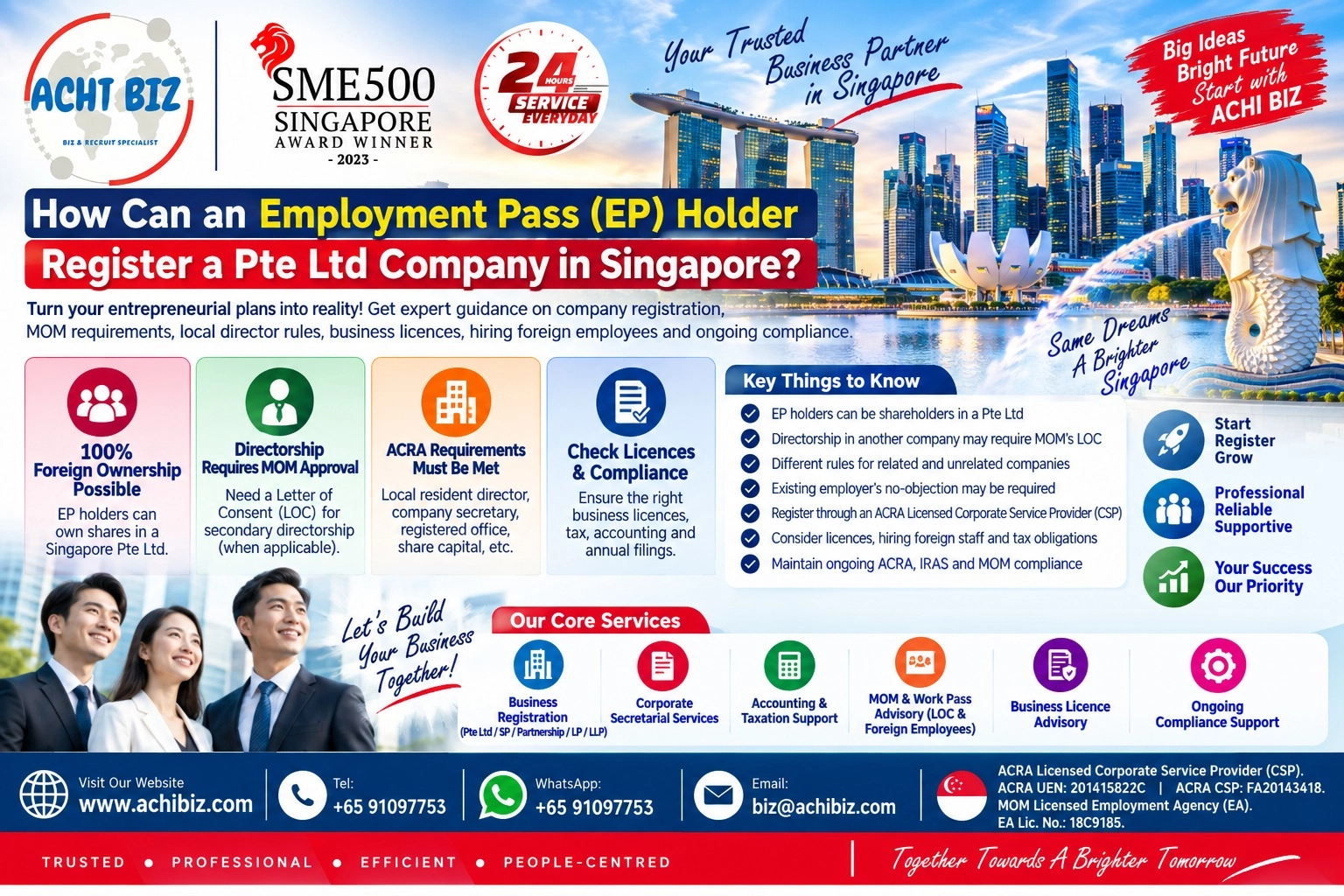
How Can an Employment Pass (EP) Holder Register a Pte Ltd Company in Singapore?
An Employment Pass (EP) holder can own shares in a Singapore Pte Ltd company, including a company that is separate from the employer sponsoring the EP. MOM expressly confirms that an EP holder is allowed to own shares in a Singapore-registered company.
However, owning a company, being appointed as its director and actually working for or operating that company are three different matters.
This distinction is particularly important for Employment Pass holders. An EP is generally tied to the employer stated on the work pass. MOM states that EP holders are generally allowed to work only for the employer specified on their pass. If an EP holder wants to take up a directorship in another company, MOM approval through a Letter of Consent (LOC) may be required.
At the same time, every Singapore company must satisfy ACRA’s incorporation requirements, including the applicable local resident director requirement, registered office, company secretary, share capital, statutory registers and ongoing corporate compliance. ACRA also specifically advises FIN holders to check with their pass issuer before registering a business or accepting a business role.
For this reason, an EP holder planning to establish a Singapore Private Limited Company (Pte Ltd) should consider both the ACRA company-registration requirements and the MOM implications of his or her proposed role before incorporation.
Can an Employment Pass holder register a Pte Ltd company in Singapore?
Yes. An Employment Pass holder can establish and own shares in a Singapore Pte Ltd company, subject to the applicable ACRA and MOM requirements.
MOM expressly confirms that an EP holder may be a shareholder of a Singapore-registered company.
However, incorporation of the company does not automatically authorise the EP holder to work for the newly incorporated company.
Can an EP holder own 100% of a Singapore Pte Ltd company?
Foreign ownership is generally permitted for a Singapore private company, so an EP holder can potentially hold all the shares in the company.
The more important issue for an EP holder is not simply share ownership, but what the person intends to do after becoming a shareholder.
Passive ownership and active participation in management or employment should not be treated as the same thing.
Is being a shareholder the same as being a director?
No.
A shareholder owns shares in the company, while a director manages the company’s affairs and owes statutory duties to the company.
An EP holder may own shares without automatically being entitled to take up a secondary directorship or work for that company.
This distinction is fundamental when structuring an EP holder’s Singapore business.
Does owning shares in another company affect the EP holder’s existing Employment Pass?
Share ownership itself is permitted. MOM confirms that an EP holder can be a shareholder of a Singapore-registered company.
The regulatory issue becomes more significant when the EP holder intends to become a director, perform services, manage operations or otherwise work for the other company.
Can an EP holder be a director of the company he or she establishes?
Potentially, but this requires careful consideration.
MOM states that an EP holder who wants to be registered as a director of another company apart from the company under which the EP is approved must first obtain a Letter of Consent (LOC) from MOM. Directorship duties are treated as work.
Therefore, an EP holder should not assume that incorporating and owning the company automatically permits him or her to become its director.
Why does an EP holder need MOM approval for a secondary directorship?
Because an Employment Pass is tied to the EP holder’s approved employment.
MOM explains that EP holders are generally permitted to work only for the employer specified on their work pass. A director has duties under the Companies Act, and MOM regards the discharge of those duties as a form of work.
A secondary directorship therefore requires the appropriate MOM authorisation.
What is a secondary directorship for an EP holder?
A secondary directorship arises when the EP holder becomes a director of a company other than the company sponsoring his or her Employment Pass.
For example, if an EP holder works for Company A under an EP but wants to become a director of Company B, the Company B appointment is a secondary directorship.
Does an EP holder need an LOC before the secondary directorship is registered with ACRA?
Under MOM’s stated process, the company intending to appoint the EP holder should first obtain MOM’s approval for the secondary directorship. If approved, the directorship can then be registered with ACRA.
The sequencing is therefore important.
Who applies for the EP holder’s secondary-directorship LOC?
MOM’s current guidance places the application on the company intending to appoint the EP holder to its board.
The particular circumstances and supporting documentation should be reviewed before submission.
Does the EP holder’s existing employer need to agree to the secondary directorship?
MOM’s current secondary-directorship guidance states that the appointing company should ensure that the EP holder’s existing employer has no objection to the EP holder taking up the directorship.
This is an important practical consideration before setting up the proposed arrangement.
Is an LOC for secondary directorship automatically approved?
No.
MOM approval should never be assumed merely because the EP holder owns the proposed company.
The circumstances of the secondary company, its relationship with the EP holder’s primary employer and the purpose of the proposed directorship can affect the assessment.
Is it easier to obtain an LOC when the second company is related to the EP holder’s employer?
MOM states that it will generally grant an LOC for a secondary directorship where the second company is related by corporate shareholding to the EP holder’s primary employer and the directorship is related to the person’s primary employment.
Examples may include appropriate holding-company, subsidiary or related-company arrangements.
What if the EP holder’s newly incorporated company is unrelated to the existing employer?
This is more complicated.
MOM states that where the proposed secondary directorship is in an unrelated company, the application is assessed with involvement from the relevant sector government agency that regulates or promotes the industry. The LOC may be granted where that agency supports the application.
Therefore, an EP holder should not assume that forming an unrelated personal business automatically creates a route to becoming its director.
Can an EP holder incorporate an unrelated company purely as a shareholder?
An EP holder may own shares in a Singapore-registered company.
However, the EP holder should distinguish passive share ownership from performing directorship duties or actively working for the company.
The proposed company must also independently satisfy ACRA’s director and other incorporation requirements.
Can the EP holder actively operate the new company using the existing EP?
Generally, the existing EP authorises the holder to work for the employer specified on that Employment Pass.
MOM states that EP holders are generally only allowed to work for their specified employer.
Therefore, an EP holder should not assume that the existing EP permits him or her to work for, manage or operate a separately incorporated personal company.
The appropriate MOM arrangement should be established before undertaking work for the new company.
Is an LOC for secondary directorship the same as permission to work full-time for the new company?
No.
An LOC for a secondary directorship addresses the approved directorship appointment.
It should not automatically be interpreted as an unrestricted work pass allowing the EP holder to take up a separate full-time job or carry out any activity whatsoever for the secondary company.
The scope of the person’s actual activities should remain consistent with MOM’s approval.
What if the EP holder wants to leave the existing employer and work full-time for his or her own company?
In that situation, the work-pass position changes substantially.
If the new company wishes to employ the individual, the company would generally need to be eligible to act as the employer and obtain the appropriate work authorisation for that individual under MOM’s prevailing requirements.
An Employment Pass application is submitted by the employer or an appointed Employment Agency.
The individual should not simply leave the existing employer and continue working on the basis of the old employer’s EP.
Can the newly incorporated company apply for an Employment Pass for its shareholder?
Potentially, provided the company and candidate satisfy MOM’s prevailing Employment Pass requirements.
Shareholding in the company does not by itself guarantee approval.
MOM assesses Employment Pass applications under its prevailing eligibility and assessment framework. Because qualifying salaries and other work-pass criteria can change, they should be checked at the time of the proposed application rather than relying on figures stated in an older article.
Does incorporating a company guarantee that the EP holder can obtain a new EP through that company?
No.
ACRA incorporation and MOM Employment Pass approval are separate processes.
A company may be successfully incorporated but an Employment Pass application may still be unsuccessful.
The company and candidate must independently satisfy MOM’s prevailing requirements.
Should an EP holder resign from the existing job before incorporating a company?
Not necessarily merely for the purpose of owning shares.
An EP holder can own shares in a Singapore company.
However, before accepting a directorship or beginning work for the new company, the EP holder should establish the appropriate MOM position.
Resigning too early without understanding the work-pass implications can create unnecessary immigration and employment difficulties.
Can an EP holder use the new company as a side business?
An EP holder should be very careful with the expression “side business.”
Owning an investment is different from personally carrying out business activities.
Because the EP generally authorises work for the sponsoring employer, an EP holder should not assume that he or she can actively run an unrelated side business simply because the company has been incorporated.
Can an EP holder receive dividends from the new company?
A shareholder may generally receive dividends properly declared by the company according to company law and the company’s financial position.
Receiving a return on share ownership should be distinguished from receiving remuneration for performing work.
Where the EP holder is actively providing services or receiving salary, director’s fees or other compensation for work, the MOM implications should be considered separately.
Can an EP holder receive a director’s fee from another company?
The first question is whether the EP holder is legally permitted to hold and perform that secondary directorship.
MOM treats secondary directorship duties as work and requires the appropriate LOC.
Any remuneration arrangement should therefore be considered only after the directorship itself is properly authorised.
Can an EP holder satisfy the local resident director requirement?
ACRA’s current foreigner-registration guidance includes a valid Employment Pass holder among persons who may satisfy its local residency framework, while specifically telling FIN holders to check with their pass issuer before registering a business or accepting a role.
Accordingly, an EP holder should not assume that holding an EP automatically allows him or her to act as the local resident director of any newly incorporated company.
The ACRA residency position and MOM permission to accept the directorship both need to be considered.
Does every Singapore Pte Ltd company need a local resident director?
Yes.
Every Singapore company must have at least one director who satisfies the applicable local residency requirement. ACRA treats failure to maintain at least one ordinarily resident director as an offence.
What if the EP holder cannot act as the local resident director?
The company must appoint another eligible person who satisfies ACRA’s requirements.
The proposed director must meet the statutory eligibility requirements and genuinely undertake the responsibilities of a company director.
A director should never be appointed merely as a name on paper without understanding and accepting the legal duties associated with the position.
Can an EP holder use a nominee director?
Where a nominee director arrangement is legally appropriate, the arrangement must comply with Singapore’s prevailing CSP and company-law requirements.
Nominee directorship should not be treated as a method of bypassing MOM’s restrictions on an EP holder’s work activities.
The company must also maintain the applicable nominee-director information and registers. ACRA currently requires relevant companies to maintain a Register of Nominee Directors (ROND) and file applicable information with the Central ROND.
Can the local resident director resign later?
Potentially, but only if the company continues to have at least one director who satisfies ACRA’s local residency requirement after the resignation.
For example, if an EP holder subsequently becomes legally eligible and properly authorised to hold the relevant directorship and satisfy the local-residency requirement, the company’s director structure can be reviewed.
The existing local resident director should not simply resign on the assumption that company ownership or EP status alone is sufficient.
Can the EP holder be both shareholder and director?
Potentially, yes, provided the EP holder is legally permitted to take up the directorship.
MOM expressly allows EP holders to own shares, but a secondary directorship in another company requires the appropriate MOM approval.
Therefore:
Shareholder status does not automatically confer director status.
Can the EP holder be the only shareholder?
Potentially, yes.
A Singapore private company can have a single shareholder.
However, the company’s director requirements must still be satisfied independently.
Can the same person be the only shareholder and only director?
Company law can permit one individual to be both the sole shareholder and director, provided that person satisfies all applicable director requirements. ACRA confirms that where there is only one member, that person can also be the director.
For an EP holder, however, the additional MOM restrictions on accepting and performing a secondary directorship must still be considered.
Can the sole director also be the company secretary?
No.
Where a company has only one director, that sole director cannot simultaneously act as the company secretary.
A company secretary must be appointed within six months of incorporation.
When must a company secretary be appointed?
A Singapore company must appoint a company secretary within six months after successful registration.
The secretary plays an important role in maintaining the company’s statutory compliance.
Does the company need a Singapore registered office address?
Yes.
A Singapore Pte Ltd company must maintain a registered office in Singapore for official correspondence and statutory purposes.
The registered office should be established as part of the company’s incorporation and compliance arrangements.
Is a virtual or professional registered office address possible?
A company may use an appropriate registered office service where the address and service arrangement satisfy the applicable legal requirements.
The registered office should not be confused with the company’s actual operational premises where separate premises or licensing requirements apply.
What is the minimum share capital for a Singapore Pte Ltd company?
ACRA states that a company requiring share capital needs at least S$1 in share capital to start.
However, S$1 is merely the statutory minimum. It may not be commercially appropriate for every business.
Should an EP holder always incorporate with only S$1 capital?
Not necessarily.
The capital should reflect the company’s realistic business needs.
Factors can include premises, licences, inventory, staffing, banking, contractual obligations, working capital and expected operating expenses.
Some regulated activities may also have their own financial requirements.
Can the EP holder increase the company’s share capital later?
Yes.
A company can issue additional shares and increase its share capital after incorporation, subject to the company’s constitution, applicable approvals and proper ACRA filings.
Can the company have other shareholders?
Yes.
The EP holder does not have to own the company alone.
Other shareholders may include eligible individuals or corporate entities, subject to applicable laws, ownership restrictions for regulated activities and proper KYC/CDD procedures.
Can a foreign company become a shareholder?
Yes, corporate shareholding is possible.
Where a corporate shareholder is involved, additional corporate documents, ownership information and KYC/CDD documentation will normally be required.
Does the EP holder need to engage a Corporate Service Provider to incorporate the company?
ACRA states that foreigners must engage a Corporate Service Provider (CSP) to reserve a name and register a business structure.
This is particularly relevant to EP holders because they are foreign individuals holding FINs.
What information is normally required to register the Pte Ltd company?
The incorporation process commonly requires the proposed:
company name; principal and secondary business activities/SSIC codes; registered office; financial year end; share capital; shareholders; directors; company constitution; beneficial ownership information; and identification and contact particulars of relevant persons.
The CSP must also carry out the applicable customer due diligence and regulatory checks.
Does an EP holder need to undergo KYC and customer due diligence?
Yes, where the incorporation is handled through a regulated CSP, the applicable customer due diligence requirements must be completed.
Depending on the ownership structure, nationality, source of funds, business activity and risk profile, additional information or enhanced due diligence may be required.
Does registering the company give the EP holder the right to start trading personally?
Company registration allows the company to exist as a legal entity.
It does not necessarily authorise the EP holder personally to perform work for it.
That distinction should be resolved before the EP holder starts managing customers, providing services, carrying out day-to-day operations or otherwise working for the new company.
Is a Singapore Pte Ltd company legally separate from its EP-holder shareholder?
Yes.
A Pte Ltd company is a separate legal entity from its shareholders.
It can own assets, enter contracts, employ staff, incur liabilities and sue or be sued in its own name.
This is different from treating the company merely as the EP holder’s personal business account.
Does limited liability mean the shareholder can never be personally liable?
No.
Limited liability generally protects shareholders from the company’s liabilities beyond their investment, but it does not provide absolute immunity.
Personal liability can still arise in circumstances such as personal guarantees, fraud, breaches of director duties or other situations provided by law.
What business activity should be selected during incorporation?
The company should select the SSIC code or codes that accurately describe its intended principal business activities.
The choice should reflect what the company genuinely intends to do rather than simply selecting a broad activity for convenience.
The SSIC can also affect licensing, regulatory and foreign-manpower considerations.
Does every newly incorporated Pte Ltd company need a business licence?
No.
ACRA incorporation and business licensing are separate.
ACRA advises newly registered companies to check whether additional licences or permits are required before starting operations.
What types of activities may require licences?
Depending on the business, regulatory approval may be relevant to areas such as food and beverage, education, employment agencies, construction, healthcare, travel, financial services, import/export activities and other regulated industries.
The actual licence should be identified according to the company’s activities.
Should the EP holder check licensing requirements before incorporation?
Preferably, yes.
Some licences can impose requirements concerning the company’s ownership, directors, qualified personnel, premises, paid-up capital or other operational matters.
Checking these conditions beforehand can prevent the EP holder from establishing a company structure that later proves unsuitable for the intended activity.
Does incorporation replace the need for a business licence?
No.
ACRA incorporation establishes the company.
The relevant licence or permit authorises a regulated business activity.
A company can therefore be legally incorporated but still be unable to begin a particular regulated activity until the required licence has been obtained.
Does obtaining a business licence give the EP holder permission to work for the company?
No.
Licensing and work authorisation are separate matters.
A licence granted to the company does not override the conditions attached to the individual’s Employment Pass.
Can the new Pte Ltd company hire Singapore Citizens and Permanent Residents?
Yes.
The company can employ local workers, subject to Singapore employment laws and applicable CPF, payroll and other employer obligations.
Can the EP holder’s company hire foreign workers?
Potentially, yes.
The company must satisfy the prevailing MOM requirements for the relevant work-pass category, and each foreign employee must have the appropriate work authorisation.
Can the new company hire Employment Pass holders?
Potentially, subject to MOM’s prevailing employer and candidate requirements.
An EP application must be submitted by the employer or an appointed Employment Agency.
Approval should never be assumed merely because the company has been incorporated.
Can the company hire S Pass holders?
Potentially.
The company and candidate must satisfy MOM’s prevailing qualifying salary, quota, levy, local workforce and other eligibility requirements.
Because these requirements can change, current MOM criteria should be checked when manpower planning or an application is being prepared.
Can the company hire Work Permit holders?
Potentially, depending on the business sector, worker category and prevailing MOM rules.
Applicable requirements can include the company’s sector classification, permitted source countries or regions, occupation, quota, levy and other conditions.
Not every newly incorporated company is automatically eligible to hire every type of Work Permit holder.
Does the company’s local workforce affect foreign worker eligibility?
It can.
For quota-based work-pass categories, the employer’s qualifying local workforce can affect its foreign manpower entitlement.
A business intending to rely on foreign manpower should therefore consider its manpower structure before making employment commitments.
Should the company use old online salary, quota or levy figures when planning foreign employment?
No.
MOM’s manpower requirements change from time to time.
For this reason, the appropriate approach is to check the prevailing MOM qualifying salary, quota, levy, local workforce and eligibility requirements when the actual hiring or application is being planned.
Can the company apply for an EP for its existing EP-holder shareholder while the current EP is still valid?
A prospective employer may submit an Employment Pass application where the applicable MOM requirements are met.
However, the person should carefully coordinate the existing employment, new employment and work-pass arrangements so that he or she does not work for an unauthorised employer.
The current EP does not simply transfer itself to the new company.
Can an EP simply be transferred from one company to another?
For work-pass purposes, the new employer should not assume that an existing Employment Pass can merely be administratively moved over.
The appropriate MOM application and approval process must be followed for employment with the new company.
Can the EP holder work for both the existing employer and the new company simultaneously?
The existing EP generally authorises work for the sponsoring employer.
A secondary directorship can potentially be authorised through MOM’s LOC framework, but that should not be confused with unrestricted concurrent employment with two unrelated companies.
The intended roles should therefore be examined carefully before the arrangement begins.
Can an EP holder become a non-executive director of the new company?
MOM’s secondary-directorship rules apply to executive and non-executive directorship appointments, because both involve duties under the Companies Act.
Calling a position “non-executive” therefore does not automatically remove the need for MOM approval.
Can an EP holder become a director without receiving salary?
The fact that a directorship is unpaid does not necessarily remove the MOM issue.
MOM’s guidance focuses on the performance of directorship duties as a form of work.
Therefore, the EP holder should not assume that an unpaid secondary directorship is automatically permitted.
Can the EP holder sign contracts for the new company merely because he or she is a shareholder?
Share ownership alone does not automatically give the shareholder authority to act for the company.
Authority to execute contracts depends on the company’s governance and authorised-signatory arrangements.
For an EP holder, personally performing operational functions can also raise MOM work-authorisation considerations.
Can the EP holder open the company’s corporate bank account?
The company may apply for a corporate bank account after incorporation, subject to the bank’s own requirements.
Banks typically conduct their own KYC, beneficial-ownership and business-purpose checks.
Company incorporation does not guarantee bank-account approval or continued account maintenance.
Is a corporate bank account legally separate from the EP holder’s personal account?
The company’s money should be treated separately from the shareholder’s personal funds.
This is particularly important because the Pte Ltd company has its own legal identity.
Company income should not simply be treated as the shareholder’s personal money.
Can the EP holder withdraw company money whenever he or she wants?
No.
Payments to shareholders or directors should have a proper legal and accounting basis—for example, authorised reimbursement, salary where legally permitted, director’s fees where properly approved, repayment of a genuine loan or lawfully declared dividends.
The company’s bank account should not be treated as a personal wallet.
Must the company maintain proper accounting records?
Yes.
A Singapore company must maintain appropriate accounting and financial records.
IRAS requires companies to retain relevant source documents, accounting records, schedules, bank statements and other business transaction records for at least five years from the relevant Year of Assessment.
Does the company need to prepare financial statements?
Companies are generally required to prepare financial statements in accordance with the applicable Singapore requirements, subject to the relevant exemptions and filing framework.
Being a small owner-managed company does not mean financial records can be ignored.
Does every Pte Ltd company require an audit?
No.
A private company may qualify for the small-company audit exemption if it satisfies the applicable criteria.
Under the current framework, the company generally needs to be a private company and meet at least two of three criteria relating to annual revenue, total assets and number of employees. Group conditions apply where the company forms part of a group.
Because ACRA announced in 2026 that the audit-exemption framework is under review, the prevailing criteria should be checked when determining audit status.
Is audit exemption the same as exemption from preparing accounts?
No.
An audit exemption removes the requirement for an audit where the statutory conditions are met.
It does not mean that the company can operate without proper accounting records or financial statements.
What is the Singapore corporate income tax rate?
Singapore’s prevailing headline Corporate Income Tax rate is 17% of chargeable income.
The actual tax payable can differ depending on allowable deductions, tax exemptions, incentives and other applicable provisions.
Is a newly incorporated company automatically entitled to start-up tax exemption?
No.
The company must satisfy the prevailing IRAS eligibility requirements.
Incorporating a new Pte Ltd company does not by itself guarantee that every tax exemption or incentive applies.
What is Estimated Chargeable Income (ECI)?
ECI is an estimate of the company’s taxable profits for a Year of Assessment.
A company generally has to file ECI within three months from the end of its financial year, unless it qualifies for the applicable filing waiver or is otherwise not required to file.
When must the company file its Corporate Income Tax Return?
IRAS currently requires the applicable Form C-S, Form C-S (Lite) or Form C by 30 November each year, subject to the applicable filing rules.
This is separate from the ACRA Annual Return.
Is an ACRA Annual Return the same as an IRAS tax return?
No.
They are completely separate filings.
The ACRA Annual Return updates the company’s corporate information and satisfies Companies Act filing obligations.
The IRAS Corporate Income Tax Return reports the company’s taxable income for tax purposes.
Filing one does not replace the other. ACRA specifically reminds companies that tax filing with IRAS remains necessary after the Annual Return is filed.
Does the company need GST registration immediately?
Not necessarily.
GST registration depends on the prevailing IRAS rules, including the company’s taxable turnover and circumstances.
A newly incorporated company should monitor its GST position as the business develops rather than assuming that incorporation automatically makes it GST-registered.
Can the company charge GST before it is GST-registered?
Generally, a business should not represent itself as GST-registered or charge GST merely because it has been incorporated.
Its GST position should be established according to IRAS requirements.
What is the importance of choosing the correct Financial Year End?
The Financial Year End (FYE) determines several important compliance deadlines, including the timing of the AGM and Annual Return.
ACRA allows companies to choose their FYE, but the date should be selected carefully because changing it later can be subject to restrictions.
Must a private company hold an AGM every year?
A non-listed company generally has an AGM deadline of six months after its FYE, but private companies can be exempt from holding an AGM or can dispense with AGMs when the applicable statutory conditions are satisfied.
Therefore, the correct question is not simply whether every Pte Ltd must physically hold an AGM, but whether the company qualifies for an exemption or has properly dispensed with it.
When is the ACRA Annual Return due?
For a typical non-listed company, the Annual Return is generally due within seven months after the FYE.
Special timelines can apply in particular circumstances.
Must an inactive or dormant company still file an Annual Return?
Yes.
ACRA states that the Annual Return is still required even where a company is inactive or dormant.
Dormancy should therefore not be confused with automatic exemption from all corporate compliance.
Does a dormant company still have tax obligations?
Potentially, yes.
IRAS filing obligations may continue unless the company qualifies for and obtains the applicable waiver.
ACRA specifically notes that dormant companies must still address tax filing unless IRAS has granted a waiver.
What statutory registers must the company maintain?
Depending on the company’s circumstances, relevant records can include its electronic registers of members and officers, Register of Registrable Controllers (RORC) and, where applicable, the Register of Nominee Directors (ROND) and Register of Nominee Shareholders (RONS).
ACRA requires companies to keep prescribed registers accurate and up to date.
What is the Register of Registrable Controllers?
The RORC records individuals or legal entities that have significant interest or control over the company.
For companies incorporated from 16 June 2025, ACRA states that the relevant controller information must also be filed with the Central RORC as part of registration, with subsequent updates subject to prescribed timelines.
Does a shareholder-director still have statutory duties as a director?
Yes.
A director’s responsibilities exist separately from the person’s ownership interest.
A shareholder-director must act according to the applicable director duties and should not assume that owning the company allows company assets or decisions to be treated purely as personal matters.
Who is responsible for the company’s compliance?
Ultimately, directors have legal responsibilities for the company’s compliance even where professional service providers are engaged.
For example, IRAS expressly states that directors remain responsible for the timely and accurate filing of the company’s Corporate Income Tax Return even when a tax agent has been appointed.
Must changes to directors or shareholders be updated with ACRA?
Yes.
Changes to the company’s officers, shareholding and other prescribed particulars must be properly filed and the relevant registers updated within the applicable statutory timelines.
This is particularly important if an EP holder’s MOM status changes and the company’s director structure is subsequently changed.
What happens if the EP holder changes employer?
Because an Employment Pass is linked to the approved employer, a change of employer can materially affect the person’s work-pass and secondary-directorship arrangements.
Any LOC linked to the existing EP should be reviewed, and the new employment arrangement should not be assumed to preserve the previous permissions automatically.
What happens to a secondary-directorship LOC if the EP is cancelled or expires?
MOM’s secondary-directorship guidance states that the LOC is valid up to the expiry or cancellation date of the current EP, and a new LOC must be applied for after the EP is successfully renewed.
This means the secondary directorship authorisation is connected to the underlying EP.
What happens if the EP holder’s existing EP is renewed?
MOM states that a new LOC must be applied for after the EP has been successfully renewed if the secondary directorship is to continue.
This should be included in the company’s compliance calendar.
What happens if the EP holder wants the new company to become the primary employer?
The company would need to establish the appropriate MOM work-pass arrangement for the individual.
If the company intends to employ the person under an Employment Pass, the relevant application must be made and approved under the prevailing MOM requirements.
The person should not begin working for the new employer merely because he or she owns its shares.
Does an EP holder need EntrePass simply because he or she owns a company?
Not necessarily.
MOM expressly allows EP holders to own shares in Singapore companies.
However, where the person’s intention is to leave employment and become an entrepreneur actively operating his or her own business, the appropriate work-pass strategy should be considered according to the person’s circumstances and MOM’s prevailing schemes.
EntrePass itself has specific eligibility criteria and is intended for qualifying entrepreneurs, innovators and investors.
Is ONE Pass the same as an Employment Pass for business ownership purposes?
No.
The Overseas Networks & Expertise Pass (ONE Pass) has materially different flexibility. MOM states that ONE Pass holders can concurrently start, operate and work for multiple companies in Singapore and do not need an LOC for a secondary directorship.
An ordinary Employment Pass should therefore not be treated as having the same business flexibility.
Is a Personalised Employment Pass the same as an EP for entrepreneurship?
No.
MOM’s current PEP rules expressly restrict entrepreneurial activity and state that PEP holders are not allowed to start a business or conduct entrepreneurial activity.
The rules for different passes should therefore never be mixed together simply because their names contain the words “Employment Pass.”
Is an EntrePass the same as an Employment Pass?
No.
EntrePass is a separate work-pass category designed for qualifying entrepreneurs, innovators and investors who satisfy its specific requirements.
This article deals only with Employment Pass holders registering a Pte Ltd company.
Can an S Pass or Work Permit holder follow the same route as an EP holder?
No.
MOM has substantially different restrictions for S Pass and Work Permit holders and states that they are not allowed to own or manage a business or register themselves as directors of Singapore-registered companies.
The rules described in this article should therefore not be applied to other work-pass categories.
What are the most common mistakes EP holders make when setting up a Pte Ltd company?
A common mistake is assuming that because an EP holder may legally own shares, he or she can automatically become the company’s director and start operating it.
Other common problems include failing to check the secondary-directorship LOC requirements, assuming the EP can simply be transferred to the new company, appointing an unsuitable local director, beginning a regulated activity before obtaining a licence, mixing company and personal funds, overlooking statutory registers and failing to plan for accounting, tax and Annual Return deadlines.
The most important principle is:
Ownership, directorship and permission to work are separate legal and regulatory questions.
Should an EP holder plan the work-pass position before incorporating the company?
Yes.
This can prevent a situation where the company is successfully incorporated but the EP holder cannot legally perform the intended role.
Before incorporation, it is sensible to determine whether the EP holder intends to be:
a passive shareholder; a secondary director; an investor who will remain employed elsewhere; or an individual who eventually intends the new company to become his or her primary employer.
Each situation can require a different approach.
What should an EP holder consider before choosing a local resident director?
The person should be eligible, willing to undertake genuine director responsibilities and understand the legal obligations involved.
If the EP holder expects eventually to replace the initial local resident director, the future ACRA and MOM eligibility should be considered in advance rather than assuming the replacement will automatically be permitted.
Should the company’s licence requirements be reviewed before selecting its SSIC code?
Yes.
The SSIC classification should accurately reflect the intended activities, and the company should determine whether those activities require licences, qualified personnel, special premises or other regulatory approvals.
ACRA specifically directs newly registered companies to check applicable business licences and permits.
Should foreign-worker planning be done before incorporation?
Where foreign manpower is central to the business model, early planning is advisable.
The proposed business activity, sector, local workforce and intended foreign-worker categories can materially affect whether the company can recruit the employees it needs.
A company should not assume that receiving a UEN automatically creates foreign-worker quota or work-pass eligibility.
What is a practical roadmap for an EP holder registering a Pte Ltd company?
A sensible sequence is:
- Clarify the EP holder’s intended role — shareholder only, secondary director or future employee of the new company.
- Check the MOM implications before accepting a director role or starting work.
- Choose the company name, business activities and SSIC codes.
- Determine the shareholder and director structure, including the required local resident director.
- Decide the appropriate share capital and shareholding.
- Arrange the Singapore registered office and choose the FYE.
- Complete CSP KYC/CDD and incorporate the company with ACRA.
- Where applicable, obtain MOM approval before registering or performing a secondary directorship.
- Obtain required business licences and permits before commencing regulated activities.
- Establish banking, bookkeeping, taxation, payroll and corporate compliance systems.
- Apply separately for any foreign employees’ work passes, subject to prevailing MOM requirements.
- Maintain annual ACRA, IRAS and MOM compliance after the company begins operations.
What compliance should the company handle immediately after incorporation?
Post-incorporation priorities normally include establishing the company’s statutory registers, setting up accounting records, opening the corporate bank account, obtaining licences where required and appointing the company secretary within six months.
An auditor must also be appointed within three months where the company is not exempt from audit requirements.
What regular compliance should the company maintain throughout the year?
Regular compliance can include bookkeeping, bank reconciliation, payroll and CPF where applicable, GST monitoring, licence renewals, maintenance of statutory registers, updating ACRA when prescribed information changes and monitoring the work-pass status of foreign employees.
For an EP-holder shareholder/director, the validity of any relevant MOM authorisation should also be monitored.
What annual compliance should the company expect?
Depending on the company’s circumstances, annual responsibilities can include preparing financial statements, considering AGM requirements, filing the ACRA Annual Return, filing ECI where required, submitting the Corporate Income Tax Return and maintaining or renewing applicable licences and work-pass arrangements.
The exact obligations depend on the company’s circumstances.
What happens if the company has no business activity after incorporation?
The company still exists until it is properly struck off or otherwise dissolved.
ACRA requires Annual Returns even for inactive or dormant companies, while IRAS requirements continue unless the applicable waiver is obtained.
Therefore, simply leaving the company unused does not eliminate its compliance obligations.
Can the EP holder close the company later?
Yes, subject to the appropriate closure process and eligibility.
Before seeking strike-off or another form of closure, outstanding liabilities, taxes, employee matters, bank accounts, licences, work passes and statutory filings should be properly addressed.
Does incorporating a company make it automatically tax resident in Singapore?
Not necessarily.
Incorporation and tax residence are related but distinct concepts. Singapore tax residence generally depends on where the company’s control and management is exercised.
An EP holder with international business arrangements should therefore not assume that Singapore incorporation alone resolves every tax-residency question.
Is a Pte Ltd company suitable for every EP holder wanting to invest in Singapore?
Not necessarily.
The company structure may be commercially useful, but the individual’s objectives matter.
Someone seeking passive investment has different regulatory considerations from someone intending to personally operate the business, employ himself or herself through the company or take up an executive directorship.
The structure should therefore be designed around the intended activity rather than incorporation alone.
What should an EP holder ask before registering the company?
Rather than asking only:
“Can an EP holder own a Pte Ltd company in Singapore?”
it is more useful to ask:
“Will I only own shares, or will I become a director?”
“Will I personally work for the company?”
“Is the company related to my existing EP employer?”
“Do I need MOM approval for a secondary directorship?”
“Could the company eventually become my primary employer?”
“Who will satisfy the local resident director requirement?”
“Does the business require licences?”
“Will the company need local or foreign employees?”
“What accounting, tax and annual compliance obligations will apply?”
Answering these questions before incorporation can avoid significant problems later.
Why engage an ACRA Licensed Corporate Service Provider (CSP)?
ACRA requires foreigners to engage a Corporate Service Provider (CSP) to reserve a name and register a business structure.
For an EP holder, the CSP can also help structure the incorporation correctly by considering the shareholders, directors, registered office, company secretary, share capital, statutory registers and ongoing corporate compliance requirements.
However, ACRA registration should be coordinated with the separate MOM requirements applying to the EP holder.
Why is it useful to work with both a CSP and a MOM Licensed Employment Agency?
An EP-holder business setup can involve two distinct regulatory areas.
ACRA deals with company registration and corporate compliance.
MOM deals with the Employment Pass, secondary-directorship LOC and work authorisation.
Using appropriately licensed professional support can help ensure that the corporate structure and work-pass arrangements are considered together rather than treating incorporation as the only requirement.
How can ACHI BIZ assist an Employment Pass holder registering a Pte Ltd company in Singapore?
ACHI BIZ SERVICES PTE. LTD. is an ACRA Licensed Corporate Service Provider (CSP) and can assist eligible foreign entrepreneurs and Employment Pass holders with Singapore company incorporation, corporate secretarial services, registered office address services, statutory compliance, accounting and taxation support, business licence advisory and other corporate services.
ACHI BIZ is also a MOM Licensed Employment Agency (EA) and can assist with eligible Employment Pass, S Pass and other work-pass services, subject to MOM’s prevailing requirements.
For an existing EP holder, the correct starting point is not simply incorporating a new company. The proposed shareholding, directorship, local resident director arrangement and actual work activities should first be understood so that the ACRA registration and MOM requirements can be approached consistently.
The central principle for an EP holder is straightforward:
You may own shares in a Singapore Pte Ltd company, but owning the company does not automatically give you permission to become its director or work for it.
Planning those three elements—ownership, directorship and work authorisation—before incorporation provides a much stronger foundation for establishing and operating a Singapore business compliantly.
Related Pages
How Can a PEP Holder Register a Pte Ltd Company in Singapore? – FAQ Guide
How Can a ONE Pass Holder Register a Pte Ltd Company in Singapore? – FAQ Guide
#achibiz