
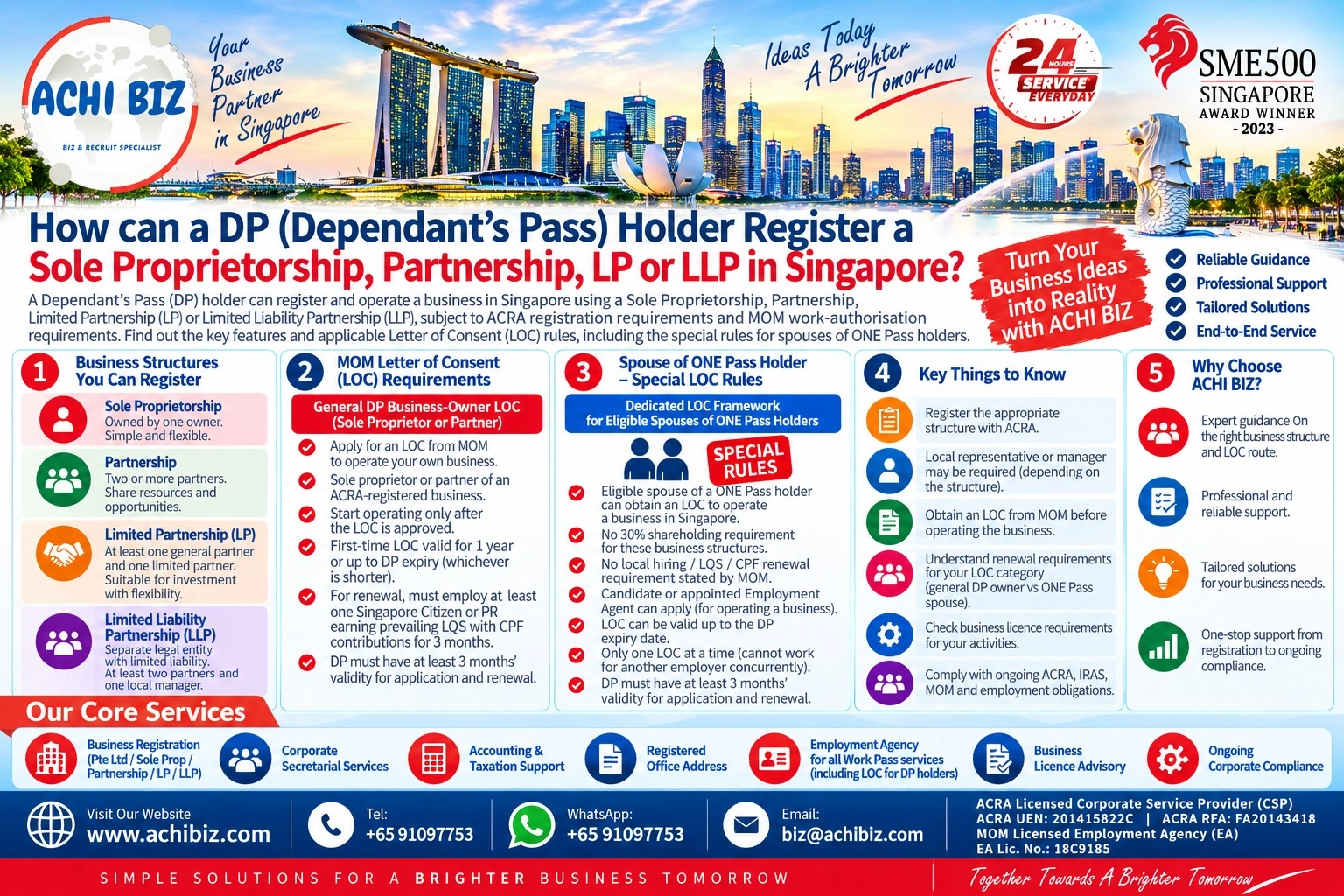
How Can a DP Holder Register a Sole Proprietorship, Partnership, LP or LLP in Singapore? – FAQ Guide
A Dependant’s Pass (DP) holder can potentially register and operate a business in Singapore using a Sole Proprietorship, Partnership, Limited Partnership (LP) or Limited Liability Partnership (LLP), subject to the applicable ACRA registration requirements and Ministry of Manpower (MOM) work-authorisation requirements.
For a DP holder, one of the most important points is that registering or owning a business is not the same as having permission to work in or operate that business.
For most eligible DP business owners, MOM provides a specific Letter of Consent (LOC) for Dependant’s Pass holders who are business owners. For the business structures covered in this FAQ, MOM currently recognises an eligible sole proprietor or partner as a qualifying business owner.
However, an eligible spouse holding a Dependant’s Pass under an Overseas Networks & Expertise Pass (ONE Pass) holder is covered by a separate MOM LOC framework. A spouse of a ONE Pass holder can apply for an LOC to work or operate a business in Singapore, subject to MOM’s prevailing requirements.
This distinction is important because the application process, LOC validity and renewal requirements are not identical under the two frameworks.
In either case, the DP holder should obtain the required MOM authorisation before personally commencing operation of the business.
The local-residency arrangement also depends on the business structure. A Sole Proprietorship or ordinary Partnership may require an authorised representative in certain circumstances; an LP may require a local manager where the applicable conditions are met; and every LLP must have at least one local manager. These roles should not be treated as interchangeable. ACHI Blog 268-20260921 How Can …
This FAQ focuses exclusively on a DP holder registering a Sole Proprietorship, Partnership, LP or LLP in Singapore. It does not cover Pte Ltd companies, which are addressed separately in our dedicated FAQ guide.
Can a Dependant’s Pass holder register a business in Singapore?
Yes, subject to applicable ACRA and MOM requirements.
A DP holder should not assume that the DP itself automatically gives permission to undertake every ACRA business role or to work in the registered business.
The appropriate business structure, the position held by the DP holder and the applicable MOM work-authorisation requirements should therefore be considered together.
An additional distinction must now be made between:
- a DP holder applying under MOM’s general business-owner LOC framework; and
- an eligible DP spouse of a ONE Pass holder, who may qualify under MOM’s dedicated ONE Pass spouse LOC framework.
What business structures are covered in this FAQ?
This FAQ covers:
- Sole Proprietorship;
- Partnership;
- Limited Partnership (LP); and
- Limited Liability Partnership (LLP).
Each has different ownership, liability, local position-holder, tax and compliance characteristics.
A DP holder should understand these differences before selecting the appropriate structure.
Can a DP holder register a Sole Proprietorship in Singapore?
Potentially, yes.
A Sole Proprietorship is owned by one owner and is not a separate legal entity from its owner. The owner is personally responsible for the business’s debts and losses.
For a DP holder intending to personally operate the Sole Proprietorship, the applicable MOM work-authorisation requirements must also be satisfied.
Under MOM’s general DP business-owner LOC framework, a sole proprietor of an ACRA-registered business is one of the expressly recognised eligible business-owner categories.
Where the DP holder is an eligible spouse of a ONE Pass holder, the separate ONE Pass spouse LOC framework should instead be considered.
Can a DP holder register a Partnership in Singapore?
Potentially, yes.
An ordinary Partnership generally has between two and 20 partners, although certain professional partnerships may have more.
A Partnership is not a separate legal entity from its partners, and partners generally have unlimited liability for partnership debts, including liabilities arising from other partners’ actions in the course of the business.
A DP holder who intends to personally operate the Partnership must also satisfy the applicable MOM work-authorisation requirements.
Under MOM’s general business-owner LOC framework, a partner of an ACRA-registered business is an eligible business-owner category.
An eligible DP spouse of a ONE Pass holder should instead consider MOM’s dedicated ONE Pass spouse LOC framework.
Can a DP holder register a Limited Partnership (LP) in Singapore?
Potentially, yes.
An LP requires at least one general partner and one limited partner, and they must be different persons or entities.
An LP is not a separate legal entity.
The distinction between general and limited partners is particularly important for a DP holder who intends to actively operate the business.
A DP holder’s proposed partner role should therefore be properly structured and considered together with the applicable MOM LOC requirements.
Can a DP holder register a Limited Liability Partnership (LLP) in Singapore?
Potentially, yes.
An LLP requires at least two partners and at least one local manager.
Unlike a Sole Proprietorship, ordinary Partnership or LP, an LLP is a separate legal entity from its partners.
A DP holder’s proposed role as partner and, where relevant, manager should be considered separately. The appropriate MOM work authorisation should be obtained before the DP holder begins operating the LLP.
Which of these four structures gives the owner limited liability?
The liability position differs considerably.
A Sole Proprietorship does not separate the owner from the business, so the owner has unlimited personal liability.
Partners in an ordinary Partnership generally have unlimited liability.
In an LP, the general partner has unlimited liability, while a limited partner’s liability is generally limited to the agreed contribution, provided the limited partner does not participate in management in a manner that affects that protection.
An LLP is a separate legal entity. Partners generally have protection from liabilities arising from another partner’s wrongful acts, although a partner remains responsible for his or her own wrongful acts.
Is a Sole Proprietorship legally separate from the DP holder?
No.
A Sole Proprietorship has no separate legal identity from its owner.
This means the DP holder, as sole proprietor, personally owns the business assets and can be personally responsible for its liabilities.
This should be carefully considered before choosing a Sole Proprietorship merely because it appears administratively straightforward.
Is an ordinary Partnership a separate legal entity?
No.
An ordinary Partnership is not legally separate from its partners.
Partners can therefore face personal liability for partnership obligations.
A proper Partnership Agreement is advisable so that matters such as responsibilities, capital contributions, profit sharing, decision-making and withdrawal can be clearly addressed.
Is an LP a separate legal entity?
No.
An LP is not a separate legal entity from its partners.
It must have at least one general partner and at least one limited partner.
This differs from an LLP, which has its own separate legal personality.
Is an LLP a separate legal entity?
Yes.
An LLP has a legal identity separate from its partners.
It can own property, enter into contracts and sue or be sued in its own name.
This is one of the major structural differences between an LLP and an ordinary Partnership.
What is the minimum number of owners or partners required?
The basic structure is:
Sole Proprietorship: One owner.
Partnership: At least two partners and generally not more than 20, subject to exceptions for certain professional partnerships.
LP: At least one general partner and one limited partner, who must be different persons or entities.
LLP: At least two partners.
Is there a minimum share capital requirement for these business structures?
No share capital requirement applies in the same way that share capital applies to a company limited by shares.
A Sole Proprietorship has an owner, while Partnerships, LPs and LLPs have partners.
However, the absence of a statutory share-capital concept does not mean that no business funding is required.
The owners or partners should still provide sufficient funding for the actual business activities, licences, premises, employees, inventory and operating expenses.
Does an LP require a minimum capital contribution from its limited partner?
An LP’s partners should properly establish their contribution arrangements, particularly because a limited partner’s agreed contribution is relevant to the limited partner’s liability position.
This is different from paid-up share capital.
An appropriate LP agreement should clearly document the partners’ respective contributions, rights and obligations.
Does an LLP have share capital?
No.
An LLP is structured around partners rather than shareholders and shares.
Partners can agree on their respective contributions, profit-sharing arrangements, management rights and other matters through an LLP agreement.
Does a DP holder need a local resident representative to register a Sole Proprietorship?
This depends on the DP holder’s circumstances and ACRA’s applicable residency requirements.
Where the applicable local-residency requirements are not otherwise satisfied, an authorised representative who is ordinarily resident in Singapore may be required.
A DP holder should not automatically assume that being a foreign national either requires or removes the need for an authorised representative.
The actual ACRA residency position and MOM work-authorisation position should be reviewed when registration is prepared.
What is an authorised representative for a Sole Proprietorship or Partnership?
An authorised representative is the applicable local position holder where the Sole Proprietorship or Partnership does not otherwise satisfy the relevant local-residency arrangement.
This role should not be confused with an LLP manager or LP local manager.
Does a Partnership require an authorised representative?
Where the Partnership does not otherwise satisfy the applicable local-residency requirements through its partners, an authorised representative may be required.
The actual residency position of the partners should therefore be reviewed when registering or subsequently changing the Partnership.
Does an LP require a local manager?
Depending on its general-partner structure and residency position, an LP may require a local manager.
The residency status of its general partners should therefore be reviewed before registration and before making subsequent changes to the manager arrangement.
Does every LLP require a local manager?
Yes.
Every LLP must have at least one manager who satisfies the applicable local-residency requirements and other applicable eligibility requirements.
Unlike an authorised representative arrangement that may arise in a Sole Proprietorship or Partnership, the LLP local-manager requirement is an ongoing structural requirement.
Can the DP holder eventually become the local position holder after obtaining the LOC?
Potentially, where the DP holder separately satisfies ACRA’s applicable eligibility and local-residency requirements and MOM permits the individual to perform the relevant role.
However, LOC approval should not be treated as automatically making the DP holder an eligible ACRA local position holder.
The ACRA and MOM positions should be reviewed separately before changing any existing authorised representative or manager.
Can an initial authorised representative resign after the DP holder obtains the LOC?
Potentially, but not automatically merely because the LOC has been approved.
For a Sole Proprietorship or Partnership, the authorised representative should be withdrawn only where the business will continue satisfying ACRA’s applicable requirements.
If the DP holder subsequently qualifies to satisfy the relevant residency and position-holder requirements, a change may potentially be made.
Can an LP local manager resign after the DP holder obtains the LOC?
Potentially, but only if the LP will continue satisfying the applicable ACRA requirements after the change.
The general-partner structure and residency position should therefore be reviewed before an existing local manager is withdrawn.
Can an LLP local manager simply resign after the DP holder receives an LOC?
Only if the LLP continues to have at least one eligible local manager.
The LOC itself does not remove the LLP’s local-manager requirement.
Is obtaining an LOC the same as registering the business with ACRA?
No.
These are separate regulatory matters.
ACRA registration establishes the Sole Proprietorship, Partnership, LP or LLP.
The applicable MOM LOC gives an eligible DP holder permission to work or operate the business in Singapore.
One does not replace the other.
Can a DP holder register the business first and apply for the LOC afterwards?
Under the general DP business-owner framework, the business must first be an ACRA-registered business for the person to qualify as the relevant sole proprietor or partner.
However, registration does not mean the DP holder can immediately begin working in or operating the business.
The required MOM authorisation should first be obtained.
Can a DP holder start operating the business immediately after ACRA registration?
No, where an LOC is required.
MOM states that a DP holder under the general business-owner LOC route can only begin operating the business after receiving the LOC.
The same practical principle applies to an eligible ONE Pass spouse who requires an LOC to operate the business.
Business registration with ACRA does not itself constitute permission to work in the business.
Does a DP holder need a work pass to operate his or her own business?
An eligible DP holder who wishes to operate an ACRA-registered business may potentially obtain an LOC under the applicable MOM framework.
The correct route depends on whether the applicant falls under:
General DP business-owner LOC: for an eligible DP holder operating his or her own business; or
ONE Pass spouse LOC: for an eligible spouse holding a DP under a ONE Pass holder.
The two routes should not be treated as identical.
Who qualifies for MOM’s general DP business-owner LOC?
MOM currently recognises the following business-owner categories:
- sole proprietor;
- partner;
- company director with at least 30% shareholding; or
- member of a Company Limited by Guarantee.
For the business structures covered in this article, the relevant categories are sole proprietor and partner.
Pte Ltd company requirements are intentionally not discussed here because they are covered separately in ACHI BIZ’s dedicated Pte Ltd FAQ.
Can a DP Sole Proprietor apply for an LOC?
Yes, subject to MOM’s prevailing requirements.
MOM expressly recognises a sole proprietor of an ACRA-registered business under the general DP business-owner LOC framework.
An eligible spouse of a ONE Pass holder should instead be assessed under the dedicated ONE Pass spouse LOC framework where applicable.
Can a DP holder who is a partner apply for an LOC?
Yes, subject to the applicable requirements.
MOM includes a partner among the eligible general DP business-owner categories.
The person’s role under the particular Partnership, LP or LLP structure should nevertheless be consistent with what the person is legally permitted to do.
Are the LOC rules different if the DP holder is the spouse of a ONE Pass holder?
Yes. This is an important special rule.
MOM has a dedicated LOC framework for an eligible spouse holding a Dependant’s Pass under an Overseas Networks & Expertise Pass (ONE Pass) holder.
A spouse of a ONE Pass holder can obtain an LOC to work or operate a business in Singapore.
Where the spouse wishes to operate a business, the candidate or an appointed Employment Agent can apply. Where the spouse wishes to work for an employer, the employer applies on the candidate’s behalf.
Other dependants of ONE Pass holders who are not spouses do not receive this same LOC privilege and will need an appropriate work pass to work in Singapore.
Can a DP spouse of a ONE Pass holder operate a Sole Proprietorship, Partnership, LP or LLP?
Potentially, subject to the legal requirements of the chosen business structure, ACRA registration requirements and MOM’s prevailing ONE Pass spouse LOC requirements.
MOM’s dedicated framework expressly permits an eligible spouse of a ONE Pass holder to obtain an LOC to operate a business in Singapore.
The particular ACRA role should still be properly established according to whether the business is a Sole Proprietorship, Partnership, LP or LLP.
Does the general business-owner LOC renewal condition apply to a DP spouse of a ONE Pass holder?
The two frameworks should not be treated as having identical renewal requirements.
For the general DP business-owner LOC, MOM currently requires at renewal:
- at least 3 months’ validity remaining on the DP; and
- at least one Singapore Citizen or Permanent Resident earning at least the prevailing Local Qualifying Salary and receiving CPF contributions for at least 3 consecutive months preceding submission.
However, MOM’s dedicated renewal requirements for an LOC held by a DP spouse of a ONE Pass holder currently state the requirement for at least 3 months’ DP validity, but do not state the above general local-hiring, LQS and CPF condition.
Accordingly, the general local-hiring condition should not automatically be applied to a ONE Pass spouse LOC.
Can a DP spouse of a ONE Pass holder hold more than one LOC?
No.
MOM states that a spouse of a ONE Pass holder is allowed to work for one employer only. Where the spouse is a business owner, the spouse is considered employed by his or her own business and cannot concurrently work for another employer under another LOC.
This should be considered if the spouse intends both to operate a business and take employment elsewhere.
Can a DP holder be a limited partner in an LP and actively manage the business?
This requires particular caution.
A limited partner is intended to have a different role from a managing general partner. Participation in management may affect the limited partner’s intended limited-liability position.
A DP holder intending to actively operate an LP should therefore carefully consider whether the general partner role, rather than merely being a limited partner, properly reflects the intended activities.
What is the difference between a general partner and a limited partner?
A general partner manages the LP and has unlimited liability for the LP’s debts and obligations.
A limited partner generally has liability limited to the agreed contribution but does not have the same management role.
This distinction is particularly important where the DP holder intends to personally operate the LP.
Can a DP holder be a partner in an LLP and actively operate it after LOC approval?
Potentially, yes, provided the DP holder has the appropriate MOM authorisation and the LLP continues satisfying all applicable ACRA requirements.
An LLP partner and LLP manager are separate roles.
The DP holder’s intended roles should therefore be properly reflected in the LLP’s records.
Does a DP holder need to wait for LOC approval before earning income from operating the business?
The DP holder should not commence operational work before obtaining the required MOM authorisation.
Under MOM’s general business-owner LOC route, MOM expressly states that the DP holder can begin operating the business only after receiving the LOC.
The fact that the business already has a UEN, bank account, customers or licences does not itself override the work-authorisation requirement.
Does the DP need sufficient validity before an LOC application?
Yes.
Under the general DP business-owner route, MOM currently requires the DP to have at least 3 months’ validity before applying.
MOM also requires at least 3 months’ DP validity under the dedicated ONE Pass spouse LOC framework.
The prevailing requirement should always be checked at the time of application.
How is the general DP business-owner LOC application submitted?
Under MOM’s current general business-owner process:
- An online request to apply for the LOC is submitted.
- MOM states that the request outcome is generally provided within one week.
- If the request is approved, the LOC application can proceed through EP eService or through an appointed Employment Agent.
- The business’s turnover information should be updated before submission.
MOM states that the LOC application itself takes within 4 weeks for most cases, although additional information may extend processing.
Is the application process the same for a DP spouse of a ONE Pass holder?
No.
For an eligible ONE Pass spouse who wishes to operate a business, MOM’s dedicated framework states that the candidate or an appointed Employment Agent can apply.
This should therefore not be confused with the initial-request stage under the general DP business-owner LOC process.
MOM currently states that the ONE Pass spouse LOC is free and takes within 4 weeks for most cases.
Is LOC approval guaranteed because ACRA has already registered the business?
No.
ACRA registration and MOM approval are separate regulatory processes.
Successful registration of a Sole Proprietorship, Partnership, LP or LLP does not guarantee MOM approval of an LOC.
Can the DP holder operate the business while waiting for MOM’s decision?
No, where LOC authorisation is required.
The DP holder should wait until the applicable LOC has been approved before commencing operation of the business.
How long is a first-time general DP business-owner LOC valid?
For the general DP business-owner LOC, MOM currently states that a first-time LOC is valid for whichever is shorter:
- one year from the issue date; or
- up to the expiry date of the DP.
Subsequent renewals may be granted up to the DP expiry date.
How long can an LOC for a DP spouse of a ONE Pass holder be valid?
Under MOM’s dedicated ONE Pass spouse framework, the LOC duration can be up to the expiry date of the Dependant’s Pass.
This is an important difference from the first-time general DP business-owner LOC framework.
The actual validity shown on MOM’s approved LOC should always be checked.
What happens to the LOC if the Dependant’s Pass expires or is cancelled?
The LOC depends on the underlying DP.
Under the general business-owner framework, MOM expressly states that the LOC stops being valid when the DP is cancelled or expires.
The DP holder should therefore monitor both DP validity and LOC validity.
What happens if the business stops operating?
The LOC should not simply be left active indefinitely.
For the general business-owner LOC, MOM states that the LOC stops being valid when the business is no longer active and must be cancelled.
For a ONE Pass spouse LOC, MOM’s dedicated cancellation page requires cancellation where the business is no longer active.
Separate ACRA, IRAS and licensing steps may also be required when the business ceases.
Are there additional requirements for renewing the general DP business-owner LOC?
Yes.
MOM currently requires:
- at least 3 months’ DP validity; and
- at least one qualifying Singapore Citizen or Permanent Resident who earns at least the prevailing LQS and has received CPF contributions for at least 3 consecutive months preceding the renewal application.
These conditions should be considered well before renewal.
Does a general DP business owner need to hire a local employee for LOC renewal?
Yes, under MOM’s current general business-owner LOC framework.
The qualifying local employee must satisfy MOM’s prevailing LQS and CPF contribution requirements.
This requirement should not automatically be applied to a DP spouse of a ONE Pass holder, whose LOC is governed by MOM’s separate framework.
Does a DP spouse of a ONE Pass holder need to hire a local employee to renew the LOC?
MOM’s current dedicated ONE Pass spouse LOC renewal page does not state the general business-owner LOC’s local-hiring, LQS and CPF condition.
It currently states that, before renewal, the DP should have at least 3 months’ validity.
Accordingly, ACHI BIZ should not present the general local-hiring condition as a renewal requirement for a ONE Pass spouse LOC unless MOM’s prevailing requirements change.
When can the general DP business-owner LOC be renewed?
MOM currently allows renewal when the DP is renewed and up to 6 months before the LOC expires.
The DP must have at least 3 months’ validity at the point of renewal.
When can a ONE Pass spouse LOC be renewed?
MOM’s dedicated ONE Pass spouse LOC framework states that renewal can be made when the DP is renewed and up to 6 months before the LOC expires.
The DP should have at least 3 months’ validity before the renewal application.
When should an LOC be cancelled?
For the general DP business-owner LOC, cancellation is required when the business is no longer active.
For a ONE Pass spouse LOC, MOM states that cancellation should be made within one week after the LOC holder’s last day of notice or when the business is no longer active. An advance cancellation request may be submitted up to 14 days beforehand.
Why should LOC renewal requirements be considered when the business is first registered?
Because obtaining the initial LOC does not mean that renewal is automatic.
This is especially important under the general DP business-owner LOC framework, where additional local-employment requirements apply at renewal.
For a ONE Pass spouse LOC, those general local-hiring requirements are not currently stated on MOM’s dedicated renewal page.
The applicant should therefore plan according to the correct LOC category, rather than applying the conditions of one framework to the other.
Does a Sole Proprietorship require a Partnership Agreement?
No, because there is only one owner.
However, the owner should maintain proper business, accounting, contractual and tax records.
Should an ordinary Partnership have a Partnership Agreement?
It is highly advisable.
A written Partnership Agreement can address capital contributions, profit and loss sharing, management responsibilities, banking authority, admission of new partners, withdrawal, disputes and termination.
Should an LP have an LP Agreement?
Yes, it is prudent.
The agreement should clearly distinguish the rights and obligations of the general and limited partners, contributions, profit allocation, management rights and procedures for changes in partners.
Should an LLP have an LLP Agreement?
A properly drafted LLP Agreement is strongly advisable.
It can govern contributions, profit sharing, management authority, admission and retirement of partners, dispute resolution and other internal matters.
Does a Sole Proprietorship need a Singapore business address?
Yes.
The appropriate business address must be provided.
Where a small-scale business is intended to operate from residential premises, the applicable HDB or URA requirements should also be considered.
Does an ordinary Partnership need a business address?
Yes.
The Partnership must provide the applicable business address.
Residential premises should only be used where the proposed business activity and applicable residential-use requirements permit it.
Does an LP need a business address?
Yes.
The LP must maintain the applicable business address in accordance with ACRA requirements.
Does an LLP need a registered office address in Singapore?
Yes.
An LLP must maintain a registered office in Singapore.
The registered office does not necessarily have to be the same location from which the LLP carries out its actual business activities.
Can a DP holder operate a business from home?
Potentially, depending on the business activity, premises and applicable HDB or URA requirements.
Not every business activity can legally or practically be carried out from residential premises.
Is ACRA registration the same as obtaining a business licence?
No.
ACRA registration establishes the business.
A business licence or permit authorises the carrying out of a particular regulated activity.
A business can therefore be successfully registered but still be unable to commence its intended regulated activity until the necessary licence or approval is obtained.
What types of businesses may require licences or permits?
Depending on the activity, licensing may arise in areas such as food and beverage, regulated retail activities, employment agency services, construction, education, healthcare, travel, financial services, import and export, telecommunications and other specialised activities.
The relevant licensing authority should be identified before operations commence.
Should licence requirements be checked before registering the business?
Preferably, yes.
Certain licences may impose conditions relating to business structure, owners or partners, premises, staffing, financial resources or other operational matters.
Checking these requirements early can help avoid selecting an unsuitable structure.
Does an LOC replace a business licence?
No.
The LOC concerns the DP holder’s permission to work or operate the business.
A business licence concerns the business’s permission to carry out a regulated activity.
Both may therefore be required.
Does a business licence replace the LOC?
No.
A licence from another regulatory authority does not itself give the DP holder permission to work in Singapore.
Where an LOC is required, the applicable MOM authorisation should still be obtained.
Can these businesses hire Singapore Citizens and Permanent Residents?
Yes, subject to applicable employment laws and requirements.
Once the business becomes an employer, obligations may arise concerning employment terms, payroll, CPF, Skills Development Levy, employment records, statutory leave, workplace requirements and other employment matters.
Can a DP-owned Sole Proprietorship, Partnership, LP or LLP hire foreign employees?
Potentially, provided the business is eligible to employ the particular category of foreign worker and both the employer and candidate satisfy MOM’s prevailing requirements.
Registration of the business or approval of the DP owner’s LOC does not automatically create entitlement to hire foreign employees.
Does the DP holder’s LOC cover foreign employees hired by the business?
No.
The LOC applies to the eligible DP holder personally.
Each foreign employee requires his or her own appropriate work authorisation.
What work passes may be relevant when hiring foreign employees?
Depending on the position, candidate, sector and employer eligibility, relevant categories may include an:
- Employment Pass;
- S Pass;
- Work Permit; or
- other appropriate MOM work pass.
Each category has separate eligibility requirements.
Can a newly registered business automatically obtain an Employment Pass for a foreign employee?
No.
Both the candidate and employer must satisfy MOM’s prevailing Employment Pass requirements.
Registration of the business and approval of the owner’s LOC do not guarantee an Employment Pass for another individual.
Can the business hire an S Pass holder?
Potentially, subject to prevailing MOM requirements, including applicable salary, quota, levy and workforce requirements.
These requirements should be checked when actual manpower planning or an application is undertaken.
Can the business hire Work Permit holders?
Potentially, depending on the business sector, occupation, worker category and MOM requirements.
Not every registered business can employ every category of Work Permit holder.
Should a DP business owner rely on MOM salary, levy or quota figures found in an older article?
No.
MOM manpower requirements can change.
The prevailing requirements should be checked when actual manpower planning or a work-pass application is undertaken.
Does the business need local employees before hiring certain foreign workers?
For quota-based foreign manpower categories, the employer’s qualifying local workforce may affect its foreign manpower entitlement.
This is a separate issue from the ONE Pass spouse LOC renewal exemption discussed above.
A ONE Pass spouse not being subject to the general business-owner LOC local-hiring renewal condition does not automatically exempt the business from workforce, quota or other requirements applicable when it employs foreign workers.
Is a Sole Proprietor considered self-employed for Singapore tax purposes?
Yes.
A sole proprietor is generally treated as a self-employed individual for Singapore income-tax purposes.
The business income is generally reported as the individual’s business income rather than income of a separate company.
Are partners generally treated as self-employed for tax purposes?
Individual partners may generally be treated as self-employed in relation to their partnership income, subject to applicable IRAS requirements.
Their respective shares of partnership income should be reported accordingly.
How is an ordinary Partnership taxed?
A Partnership generally does not pay income tax as a separate taxable person in the same manner as a company.
The Partnership reports its income and allocations, while the partners are taxed on their respective shares according to their applicable tax status.
How is an LLP taxed?
Although an LLP has a separate legal personality, its Singapore income-tax treatment generally follows the applicable partnership taxation framework.
Each partner is taxed on the partner’s respective share of LLP income according to the applicable tax rules.
Does an ordinary Partnership have tax filing obligations?
Yes.
A Partnership may need to file the applicable Partnership Income Tax Return and allocate partnership income among its partners.
Individual partners must also attend to their respective tax reporting requirements.
Must a Sole Proprietor maintain accounting records?
Yes.
Proper records and supporting documents should be maintained so that business income and expenses can be determined and substantiated.
A small business is not exempt from proper bookkeeping merely because it operates as a Sole Proprietorship.
Must Partnerships, LPs and LLPs maintain proper accounts?
Yes.
Appropriate accounting and supporting records should be maintained for income, expenses, assets, liabilities and partner allocations.
How long should accounting and supporting records generally be kept?
The applicable IRAS and statutory record-retention requirements should be observed.
The original article appropriately notes that self-employed individuals generally need to retain proper accounting records and supporting documents for the prescribed period. ACHI Blog 268-20260921 How Can …
Does every business need GST registration immediately?
No.
GST registration is separate from ACRA registration.
The business should monitor its taxable turnover and determine whether compulsory GST registration arises under prevailing IRAS rules.
Voluntary registration may also be considered where appropriate.
Can the business charge GST immediately after ACRA registration?
No.
Obtaining a UEN does not itself permit the business to charge GST.
GST should only be charged where the business is properly GST-registered and permitted or required to do so under the applicable GST rules.
Does a Sole Proprietorship need to file an ACRA Annual Return?
No.
A Sole Proprietorship does not file the same type of Annual Return as a company.
Instead, it must maintain its prescribed business information and renew the business registration when required.
Does an ordinary Partnership file an ACRA Annual Return?
Not a company-style Annual Return.
The Partnership instead has ongoing registration renewal, information-update and applicable tax obligations.
Does an LP need to renew its registration?
Yes.
The LP’s registration should be renewed before expiry if it is to continue operating.
Does an LLP need to renew its registration every year like a Sole Proprietorship?
An LLP operates under a different compliance framework.
Instead of the same periodic business-registration renewal arrangement, an LLP has an ongoing Annual Declaration requirement.
What is an LLP Annual Declaration?
The Annual Declaration concerns whether the LLP is solvent or insolvent.
The declaration must be filed with ACRA within the applicable timeline.
When is the first LLP Annual Declaration due?
The existing article states that a newly registered LLP must make its first Annual Declaration within 15 months of registration, with subsequent declarations once every calendar year and not more than 15 months after the preceding declaration. ACHI Blog 268-20260921 How Can …
Does an LLP need a Register of Registrable Controllers?
Unless exempt, an LLP must establish and maintain the applicable Register of Registrable Controllers (RORC) and comply with the relevant controller-information requirements.
Must changes to owners, partners, managers or authorised representatives be reported to ACRA?
Yes.
Applicable changes should be reported within ACRA’s prescribed filing period.
The business should therefore keep its ACRA particulars current.
What regular compliance should a DP Sole Proprietor expect?
Regular responsibilities may include maintaining business and accounting records, invoices and supporting documents, current ACRA particulars, applicable licences, tax records, GST records where applicable, employment and CPF records where employees are hired, and MOM compliance concerning the DP holder’s LOC and any foreign employees.
The business registration must also remain valid.
What regular compliance should a DP Partnership expect?
In addition to bookkeeping and operational compliance, the Partnership should maintain accurate partner and authorised-representative information where applicable, comply with its Partnership Agreement, maintain the required tax information and attend to applicable Partnership tax filings and partner income allocations.
What regular compliance should a DP-owned LP expect?
The LP should maintain accurate general-partner, limited-partner and local-manager information, proper accounting records, valid registration, tax records and applicable licensing and employment compliance.
The distinction between general and limited partners should continue to be respected after registration.
What regular compliance should a DP-owned LLP expect?
An LLP should maintain proper accounting records, its registered office and position-holder information, its RORC where applicable, licences, tax records and employment compliance.
It must also attend to its ACRA Annual Declaration requirement.
Do Sole Proprietorships, Partnerships and LPs need to renew their ACRA registrations?
Yes.
They should be renewed according to ACRA’s applicable renewal requirements before their registration expires.
Operating after registration has expired may create regulatory and practical problems.
Does MediSave affect business registration or renewal?
Depending on the circumstances of the relevant self-employed owner or partner, MediSave requirements may affect applicable registration or renewal matters.
The person’s actual circumstances and prevailing ACRA/CPF requirements should therefore be checked.
What happens if the business address changes?
The prescribed change should be updated with ACRA within the applicable filing period.
Business owners should keep all required entity and position-holder particulars current.
Does a DP business owner need a separate business bank account?
A dedicated business account is strongly advisable.
For an LLP, which has a separate legal identity, keeping the entity’s finances separate is particularly important.
Even for a Sole Proprietorship or Partnership, separating business and personal transactions can substantially improve bookkeeping, tax reporting and financial control.
Bank-account opening remains subject to the bank’s own due diligence and approval.
Can the DP holder mix personal and business money?
This should generally be avoided.
Keeping business transactions separately recorded makes it much easier to identify revenue, deductible expenses, owner drawings, partner transactions and taxable business income.
Does an inactive business still have compliance obligations?
Potentially, yes.
Simply stopping sales does not necessarily cancel an ACRA registration, tax obligation, licence or LOC.
If the business genuinely stops operating, the DP holder should attend to the appropriate ACRA, IRAS, MOM and licensing requirements.
What happens to the LOC if the business closes?
The LOC should be cancelled where required.
Under the general business-owner framework, MOM states that the LOC stops being valid when the business is no longer active.
For a ONE Pass spouse LOC, MOM likewise states that cancellation is required when the business is no longer active.
Business closure and LOC cancellation should therefore be coordinated.
Can a DP holder change from one business structure to another later?
Potentially, but the legal process depends on the structures involved.
A new registration, transfer, cessation or other steps may be required.
The DP holder should also consider the impact on the existing LOC because MOM’s authorisation may have been granted based on a particular business and role.
What are the most common mistakes DP holders make when registering these business structures?
Common problems include choosing a structure without understanding personal liability, assuming the DP itself gives permission to work, commencing operations before LOC approval, misunderstanding the role of an authorised representative or local manager, treating a limited partner as a managing general partner, overlooking LLP Annual Declarations, failing to renew a Sole Proprietorship, Partnership or LP, commencing a regulated activity without the required licence and hiring foreign employees without checking MOM requirements.
Another important mistake is assuming that all DP business-owner LOCs follow exactly the same rules.
An eligible DP spouse of a ONE Pass holder has a separate MOM LOC framework, and the general business-owner LOC’s application and renewal conditions should not automatically be imposed on that category.
Which structure is simplest for a single DP holder?
A Sole Proprietorship is structurally the simplest of these four options because it has one owner.
However, simplicity should not be the only consideration.
The owner has unlimited personal liability, and the business does not have a separate legal identity.
The appropriate structure therefore depends on the intended business, risk, number of owners, liability considerations and future plans.
Which structure is appropriate when two or more people want to run the business together?
An ordinary Partnership, LP or LLP may potentially be considered depending on the intended management and liability arrangements.
An ordinary Partnership exposes partners to broader personal liability.
An LP distinguishes between managing general partners and non-managing limited partners.
An LLP provides a separate legal identity and limited-liability characteristics while retaining a partnership structure.
Is an LP suitable where one person wants to invest but not manage the business?
Potentially, yes.
The LP structure distinguishes between a general partner who manages the business and a limited partner who generally does not participate in management.
This can be useful where the parties genuinely intend those different roles.
Is an LLP suitable for professional or jointly managed businesses?
It can be.
An LLP combines partnership-style management with separate legal personality and liability-protection characteristics.
However, regulated professions may have their own professional-body or licensing requirements.
What should a DP holder decide before registering any of these structures?
Before registration, the DP holder should consider:
- business activity and SSIC classification;
- appropriate business structure;
- personal liability;
- owners or partners;
- local authorised representative or manager requirements;
- business or registered office address;
- funding;
- Partnership, LP or LLP agreement;
- business licences;
- which MOM LOC framework applies;
- LOC validity and future renewal requirements;
- accounting and taxation; and
- intended local or foreign workforce.
For a spouse of a ONE Pass holder, the special MOM LOC framework should be identified from the outset so that the general DP business-owner rules are not incorrectly applied.
What is the practical roadmap for a DP holder registering a Sole Proprietorship, Partnership, LP or LLP?
Step 1 – Choose the appropriate structure.
Understand the legal identity, liability, ownership and compliance differences between Sole Proprietorship, Partnership, LP and LLP.
Step 2 – Confirm the business activity and SSIC classification.
Determine whether licences or regulatory approvals will be required.
Step 3 – Identify the DP category and applicable LOC route.
Determine whether the applicant falls under MOM’s general DP business-owner LOC framework or qualifies as an eligible spouse of a ONE Pass holder under MOM’s dedicated LOC framework.
This distinction is important because the application process, LOC validity and renewal requirements are different.
Step 4 – Review the DP holder’s proposed ACRA role.
Determine whether the person will be the sole proprietor, partner, general partner, limited partner, LLP partner and/or manager, as applicable.
Step 5 – Arrange the applicable local position holder where required.
Depending on the structure and circumstances, this may involve an authorised representative, LP local manager or LLP local manager.
Step 6 – Reserve the business name and complete ACRA registration.
Step 7 – Apply for the applicable LOC.
The DP holder should not personally commence operating the business until the required MOM authorisation has been obtained.
For a general DP business owner, the standard business-owner LOC process applies.
For an eligible ONE Pass spouse, the candidate or appointed Employment Agent may apply under MOM’s dedicated framework where the candidate wishes to operate a business.
Step 8 – Review the local position-holder arrangement after LOC approval.
An existing local representative or manager should only be withdrawn where the business will continue satisfying ACRA’s applicable requirements.
Step 9 – Obtain the necessary business licences and permits before regulated operations begin.
Step 10 – Establish banking, bookkeeping, tax, employment and other operational systems.
Step 11 – Maintain ongoing ACRA, IRAS and MOM compliance.
This includes monitoring the validity of the DP and LOC and applying the correct renewal conditions for the relevant LOC category.
Should the local representative or manager always be removed after LOC approval?
No.
There is no general rule that a local position holder should resign merely because an LOC has been issued.
Whether a change is possible depends on the entity structure and whether the business will continue satisfying ACRA’s applicable local-residency requirements.
For an LLP in particular, at least one eligible local manager must continue to be maintained.
What should a DP holder understand before starting the business?
The process is best viewed as four separate but connected areas.
Business structure: Decide whether a Sole Proprietorship, Partnership, LP or LLP properly suits the proposed ownership, management and liability arrangement.
ACRA: Register the business and maintain the required owners, partners, authorised representatives or managers.
MOM: Identify the correct LOC framework and obtain the required authorisation before the DP holder personally operates the business. Different requirements may apply to a general DP business owner and a spouse of a ONE Pass holder.
Other regulators: Obtain any activity-specific licences, permits or approvals before commencing regulated activities.
Satisfying one area does not automatically mean the others have been satisfied.
Is registering the business the end of the process?
No.
Registration is only the beginning.
After registration, the DP business owner may need to address the applicable LOC, licences, banking, bookkeeping, taxation, GST where applicable, employment obligations, foreign work passes where applicable, ACRA updates, business-registration renewal or LLP Annual Declaration and future LOC renewal.
Good compliance should therefore start from the beginning of the business.
Why engage an ACRA Licensed Corporate Service Provider (CSP)?
For a DP holder, professional assistance can be useful because business registration involves more than selecting a name.
An ACRA Licensed Corporate Service Provider (CSP) can assist with the appropriate business registration, structure, position-holder arrangements, registered or business address requirements, ACRA changes and ongoing corporate or business compliance.
For a DP holder, it is also important that the chosen business structure is considered together with the applicable MOM work-authorisation requirements.
Why can a MOM Licensed Employment Agency be useful for a DP business owner?
The ACRA business registration and MOM LOC are separate processes.
For a general DP business owner, MOM’s current process allows an eligible applicant, after approval of the initial request, to proceed through EP eService or engage an Employment Agent to apply.
For an eligible spouse of a ONE Pass holder who wishes to operate a business, MOM separately allows the candidate or an appointed Employment Agent to apply.
A MOM Licensed Employment Agency can therefore assist with the appropriate LOC application according to the applicant’s actual DP category.
How can ACHI BIZ assist a DP holder with a Sole Proprietorship, Partnership, LP or LLP in Singapore?
ACHI BIZ SERVICES PTE. LTD. is an ACRA Licensed Corporate Service Provider (CSP) and can assist eligible DP holders with the registration and ongoing administration of appropriate Singapore business structures, including:
- Sole Proprietorships;
- Partnerships;
- Limited Partnerships (LPs); and
- Limited Liability Partnerships (LLPs),
subject to applicable regulatory requirements.
ACHI BIZ can also assist with related services such as business registration, registered/business address support where applicable, accounting and taxation support, business licence advisory and ongoing compliance services.
As a MOM Licensed Employment Agency (EA), ACHI BIZ can also assist eligible applicants with applicable LOC services, including:
- the general LOC for eligible DP holders who are business owners; and
- the dedicated LOC route for an eligible spouse of a ONE Pass holder who wishes to operate a business,
subject to MOM’s prevailing eligibility requirements, assessment and approval.
For a DP holder, the key question is therefore not simply:
“Can I register a business in Singapore?”
The more useful questions are:
“Which business structure is suitable for what I want to do, what local position-holder arrangement does it require, which MOM LOC framework applies to me, what authorisation do I need before I personally operate the business, and what ongoing compliance will apply after registration?”
Understanding these matters before registration gives a DP holder a clearer foundation for establishing and operating a Sole Proprietorship, Partnership, LP or LLP in Singapore in a properly structured and compliant manner.
Important Regulatory Note
The requirements discussed in this FAQ are based on the prevailing regulatory framework at the time of update.
Applicants should particularly distinguish between:
General DP business-owner LOC: MOM currently recognises eligible sole proprietors and partners, among other business-owner categories. First-time LOC validity is generally the shorter of one year or the DP expiry date, and additional local-employment/LQS/CPF conditions currently apply at renewal.
DP spouse of a ONE Pass holder: MOM provides a dedicated LOC framework under which an eligible spouse can work or operate a business. Where operating a business, the candidate or appointed Employment Agent can apply, and the LOC may be valid up to the DP expiry date. MOM’s current dedicated renewal page requires at least 3 months’ DP validity but does not state the general business-owner LOC’s local-hiring/LQS/CPF renewal condition.
ACRA, MOM, IRAS and other regulatory requirements may change. The prevailing requirements should therefore be checked when an actual registration, LOC application, renewal or other regulatory transaction is undertaken.
Related Pages
How Can a DP Holder Register a Pte Ltd Company in Singapore? – FAQ Guide
Learn more with How Can an Employment Pass (EP) Holder Register a Pte Ltd Company in Singapore?
#achibiz