
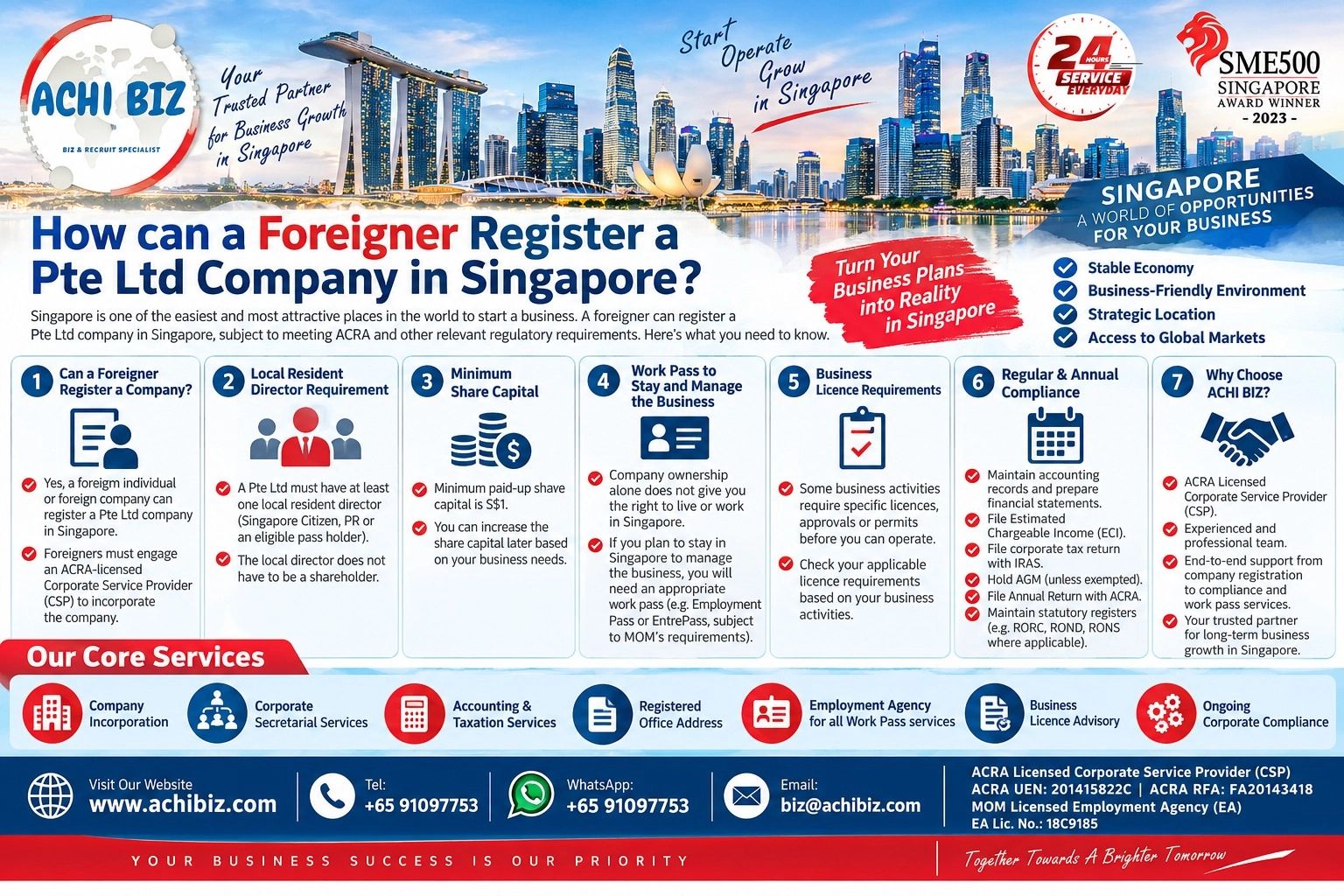
How Can a Foreigner Register a Pte Ltd Company in Singapore?
Singapore is a popular jurisdiction for foreign entrepreneurs who want to establish a company in Asia. A foreigner can own shares in a Singapore Private Limited Company (Pte. Ltd.), including potentially 100% of the shares, but foreign ownership does not remove the company’s local regulatory requirements.
For a foreign entrepreneur, incorporation is only the beginning. Before registering a Singapore company, it is important to understand the requirements for a local resident director, share capital, registered office, company secretary, business licences, work passes, accounting, corporate tax, annual returns and ongoing statutory compliance.
The following FAQs provide a practical overview for foreigners considering company registration in Singapore.
Can a foreigner register a Pte Ltd company in Singapore?
Yes. A foreign individual or foreign corporate entity can own shares in a Singapore Pte. Ltd. company. A Singapore company is a separate legal entity from its shareholders, and shareholders generally enjoy limited liability.
However, ACRA requires foreigners to engage a Corporate Service Provider (CSP) to reserve the business name and register the business structure. Foreigners must also satisfy Singapore’s applicable local residency requirements.
Can a foreigner own 100% of a Singapore Pte Ltd company?
Yes. Singapore generally permits 100% foreign shareholding in a Pte. Ltd. company. Therefore, a foreign entrepreneur does not normally need a Singapore Citizen or Permanent Resident simply to hold shares.
The requirement for a local resident director is separate from share ownership. In other words, the local resident director does not necessarily have to be a shareholder.
Does a foreigner need a Singapore business partner to incorporate a company?
Not necessarily. A foreigner can generally be the sole shareholder of a Singapore Pte. Ltd. company.
What the company must have, however, is at least one director who satisfies Singapore’s local residency requirements. ACRA states that every company must have at least one director and requires at least one director meeting the local residency rules during registration.
Is a local resident director compulsory for a foreign-owned Singapore company?
Yes. A Singapore company must have at least one director who meets ACRA’s local residency requirements.
ACRA currently identifies Singapore Citizens, Singapore Permanent Residents and certain valid pass holders who satisfy the applicable local residency rules. FIN holders should check with the authority that issued their pass, such as MOM or ICA, before registering a business or accepting a company position.
The precise eligibility of a foreign pass holder should therefore be checked rather than assuming that holding a Singapore pass automatically qualifies the person to act as the company’s local resident director.
Does the local resident director have to own shares in the company?
No. Directorship and shareholding are different legal capacities.
A person can be appointed as a director without being a shareholder, while a foreign shareholder may own shares without being appointed as the local resident director.
Can a nominee director be appointed to satisfy the local director requirement?
A nominee director arrangement may be possible, but it is now subject to significantly enhanced regulation.
Since the Corporate Service Providers Act 2024 took effect on 9 June 2025, a person acting as a nominee director by way of business must have the appointment arranged by a registered CSP and must be assessed as fit and proper by that CSP.
Foreign entrepreneurs should therefore not treat a nominee director as merely a name placed on the company record. A director has legal duties and responsibilities under Singapore law.
Can the foreign shareholder also become a director?
Potentially, yes, provided the individual is eligible to be appointed.
However, appointing a foreign shareholder as an additional director does not by itself remove the requirement for the company to maintain at least one director who satisfies the applicable local residency requirement.
How many shareholders can a Singapore Pte Ltd company have?
A private company limited by shares can have up to 50 shareholders, which may include individuals or corporate entities. An exempt private company generally has no more than 20 individual shareholders and no corporate shareholder.
What is the minimum share capital required to register a Singapore company?
For a company type requiring share capital, ACRA states that the company needs at least S$1 in share capital to start.
However, the legal minimum should not automatically be treated as the commercially appropriate capital for every business.
The appropriate amount may depend on the company’s intended operations, working-capital needs, licensing conditions, banking requirements, contractual commitments and, where relevant, work-pass considerations.
Can the share capital be increased after incorporation?
Yes. A company may increase its issued share capital after incorporation by issuing additional shares, subject to the Companies Act, its constitution, required corporate approvals and ACRA filing requirements.
This allows an entrepreneur to start with an appropriate initial capital and inject additional equity as the business develops.
What information is generally required before registering a Singapore Pte Ltd company?
The incorporation process normally requires decisions and information concerning the proposed company name, principal and secondary business activities, registered office, financial year end, directors, shareholders, share capital and share allocation, company constitution and other prescribed particulars.
ACRA requires an approved business name before the local company is registered through Bizfile.
What documents will a foreign shareholder or director normally need to provide?
The exact documents depend on whether the shareholder is an individual or corporate entity and on the CSP’s customer due-diligence requirements.
Foreign individuals should generally expect to provide reliable identification, residential-address information and supporting information concerning their business, ownership and source of funds where required. A corporate shareholder may require additional corporate ownership and control documents.
A registered CSP must conduct the applicable customer due diligence and comply with Singapore’s AML/CFT/PF requirements. The CSP may therefore request additional information before accepting or completing an incorporation.
Why does ACHI BIZ need to conduct KYC/CDD before company incorporation?
Company incorporation is a regulated corporate service. Singapore’s Corporate Service Providers Act imposes obligations on registered CSPs, including anti-money laundering, counter-terrorism financing and proliferation-financing requirements.
Accordingly, incorporation is not simply an administrative submission to ACRA. ACHI BIZ may need to understand the proposed business, shareholders, beneficial owners, controllers, directors and other relevant circumstances before proceeding.
Does a Singapore company need a registered office address?
Yes. Every Singapore company must maintain a registered office in Singapore.
ACRA states that the registered office must be accessible to the public and, under the statutory requirements, must be open for at least three hours during normal business hours on each business day, excluding Saturdays, Sundays and public holidays.
The registered office is also the address to which government agencies and other parties may send official correspondence and legal documents.
Does the foreign shareholder need to rent a physical office in Singapore?
Not necessarily for incorporation itself.
Depending on the nature of the business, an eligible registered office address service may be used. However, certain regulated businesses, operational activities, licences, work-pass applications, banks or counterparties may require evidence of actual operating premises.
A registered office address should therefore not automatically be assumed to satisfy every operational or licensing requirement.
Is a company secretary compulsory?
Yes. Every company must have a company secretary, and the secretary must be appointed within six months after incorporation. The secretary must be a natural person and satisfy the applicable local residency requirements. A sole director cannot simultaneously act as the company secretary.
For a foreign-owned company, having professional corporate secretarial support is particularly useful because many statutory obligations continue throughout the life of the company.
Does a Singapore Pte Ltd company need a constitution?
Yes. A company must have a constitution setting out the rules governing the company and the rights and responsibilities of relevant parties.
A company may adopt the applicable ACRA Model Constitution or use an appropriately customised constitution.
What is the Financial Year End (FYE), and why is it important?
The Financial Year End is the last day of the company’s accounting period.
It is important because it determines or affects several subsequent compliance deadlines, including financial reporting, AGM, Annual Return and tax compliance. Common FYEs include 31 March, 30 June, 30 September and 31 December.
The FYE should therefore be selected thoughtfully rather than simply choosing an arbitrary date during incorporation.
Does registering a Pte Ltd company automatically give a foreigner the right to live in Singapore?
No. Company ownership and immigration status are separate matters.
A foreigner may own a Singapore company without automatically acquiring the right to live or work in Singapore. ACRA specifically states that foreigners who wish to move to Singapore to run their business need an appropriate work pass.
Does a foreign shareholder need a work pass if he or she remains overseas?
Generally, merely owning shares in a Singapore company is different from being authorised to work in Singapore.
If the foreign shareholder remains overseas and is only an investor/shareholder, the issue is different from relocating to Singapore and actively working for or managing the company from Singapore.
The individual’s intended activities should therefore be considered before determining the appropriate immigration or work-pass arrangement.
What work pass may a foreign business owner need to manage the company from Singapore?
The appropriate pass depends on the individual’s role, business model, qualifications, salary, ownership structure and other eligibility conditions.
An Employment Pass (EP) may be relevant in appropriate employment circumstances, while an EntrePass is designed for eligible foreign entrepreneurs operating businesses that are venture-backed or possess innovative technologies. MOM states that EntrePass does not have a stipulated minimum salary.
The incorporation of a company does not guarantee approval of an EP, EntrePass or any other work pass.
Can the newly incorporated company apply for an Employment Pass for its foreign owner or director?
An employer or its appointed Employment Agency can apply for an Employment Pass for an eligible foreign professional. MOM assesses the application under the prevailing EP eligibility framework and application requirements.
The fact that the candidate owns shares or has incorporated the company does not by itself establish eligibility for an EP.
Can an existing Employment Pass holder own shares in another Singapore company?
MOM states that an Employment Pass holder is allowed to own shares in a Singapore-registered company.
However, share ownership should not be confused with permission to work for, manage or take up another role in that company. The individual’s proposed activities and directorship should be checked against the applicable work-pass conditions.
Can an S Pass or Work Permit holder register a company or become its director?
MOM states that S Pass and Work Permit holders are not allowed to own or manage a business in Singapore and cannot register themselves as sole proprietors, partners, directors or secretaries of Singapore-registered companies. Breaching these conditions can result in work-pass consequences.
Therefore, the person’s existing immigration/work-pass status should always be checked before appointing him or her to a company position.
Can a Personalised Employment Pass (PEP) holder start and manage his or her own business?
The PEP should not be treated as an entrepreneur pass. MOM states that a PEP holder cannot be a sole proprietor, partner, or a director who is also a shareholder in an ACRA-registered company, and cannot start a business or conduct entrepreneurial activity while on a PEP.
Is an EntrePass suitable for every foreign entrepreneur?
No. EntrePass is specifically targeted at eligible foreign entrepreneurs whose businesses are venture-backed or possess innovative technologies.
A conventional trading, consultancy, retail or other ordinary business should not assume that EntrePass is automatically available merely because the founder owns a Singapore company.
Does a Singapore company need a business licence before it can operate?
It depends on the business activity.
Some companies can commence their ordinary business activities after incorporation, while regulated activities require additional licences, approvals or permits before operations begin. ACRA specifically advises companies to check applicable business licences and permits after registration.
Examples may include certain food businesses, employment agencies, travel businesses, financial services, education, healthcare, telecommunications, import/export activities and other regulated sectors.
Is ACRA company registration the same as obtaining a business licence?
No.
ACRA incorporation establishes the legal company. A business licence authorises particular regulated activities where licensing is required.
A company can therefore be successfully incorporated but still be prohibited from commencing a regulated activity until the relevant licence or approval has been obtained.
How can a foreign entrepreneur find out which licences are required?
The required licence depends on the company’s exact business activity, operating model and premises.
ACRA directs businesses to Singapore’s GoBusiness Licence e-Advisers to determine applicable licences and permits.
Licensing should ideally be checked before incorporation where the proposed business is regulated, because some licences have requirements concerning directors, shareholders, qualifications, premises, capital or staffing.
Does an import or export company need additional registration?
Potentially, yes. ACRA notes that businesses moving goods across Singapore’s borders require a Customs account to apply for the relevant trade permits.
The specific permits and controlled-goods approvals will depend on the products being imported or exported.
Is opening a Singapore corporate bank account compulsory?
A corporate bank account is strongly recommended to separate company transactions from personal funds, although bank-account opening is a separate process from ACRA incorporation. ACRA notes that a corporate bank account can be opened after registration.
Each bank performs its own due diligence and risk assessment. Incorporation of the company therefore does not guarantee bank-account approval.
Can a foreign director open the corporate bank account remotely?
This depends on the bank, the company’s ownership structure, business activity, countries involved and the bank’s prevailing onboarding procedures.
Some banks or financial institutions may support remote onboarding in appropriate cases, while others may request additional verification or physical presence. Bank requirements can change and should be checked at the time of application.
What statutory registers must a Singapore company maintain?
Companies are required to maintain accurate information concerning their officers, shareholders and other prescribed persons.
Depending on applicability and exemptions, this includes the Electronic Register of Members, Electronic Register of Directors, Register of Registrable Controllers (RORC), Register of Nominee Directors (ROND) and Register of Nominee Shareholders (RONS).
What is the Register of Registrable Controllers (RORC)?
The RORC records persons or legal entities that have significant ownership or control over the company—often described as beneficial owners.
Unless exempted, companies must maintain their private RORC and file the required controller information with ACRA’s Central RORC.
For companies registered from 16 June 2025, the required RORC information is filed as part of registration, with subsequent updates subject to prescribed deadlines.
What are the ROND and RONS?
ROND means Register of Nominee Directors, while RONS means Register of Nominee Shareholders.
Unless exempted, companies must maintain the required nominee registers and make the prescribed filings with ACRA’s Central ROND and RONS. ACRA states that these requirements can apply even where a company has no nominee director or nominee shareholder.
This is particularly relevant to foreign-owned companies using nominee arrangements.
Must changes to directors, shareholders or company particulars be reported to ACRA?
Yes. Companies have ongoing obligations to keep their registered particulars current.
ACRA states that changes to company information, officers, shares and shareholders generally need to be updated within the applicable statutory deadlines; many officer and register changes are subject to a 14-day filing requirement.
Some specialised registers have shorter update and central-filing deadlines.
Does a Singapore Pte Ltd company need to maintain accounting records?
Yes. Incorporating a company creates continuing accounting and tax responsibilities.
The company should maintain proper records of its income, expenses, assets, liabilities and other transactions so that accurate financial statements and tax computations can be prepared.
IRAS generally requires companies to retain relevant records and supporting documents for at least five years from the relevant Year of Assessment.
Must the company prepare financial statements every year?
Generally, a company is required to prepare financial statements in accordance with the applicable Singapore financial reporting and Companies Act requirements, subject to specific exemptions that may apply to certain companies.
Financial statements are also important for determining the company’s financial position, tax computation and annual corporate compliance.
Does every Singapore Pte Ltd company need an audit?
No.
A private company may qualify for the small company audit exemption if it satisfies at least two of the following three thresholds: annual revenue of not more than S$10 million, total assets of not more than S$10 million, and not more than 50 employees. Additional group-level conditions apply where the company belongs to a group.
If the company is not audit-exempt, an auditor generally must be appointed within three months of incorporation.
Does an audit exemption mean the company does not need accounts?
No. Audit exemption is not an exemption from accounting.
An audit-exempt company still needs appropriate accounting records and must comply with applicable financial-statement, tax and annual filing requirements.
What is the Singapore corporate income tax rate?
Singapore’s prevailing corporate income tax rate is 17% of chargeable income.
However, the actual tax payable may differ depending on allowable deductions, capital allowances, tax exemptions, rebates and the company’s particular tax circumstances.
Are new Singapore companies automatically tax-free?
No.
Singapore has tax exemption schemes that may reduce the tax payable of qualifying companies, but incorporation does not mean that every new company automatically pays no corporate tax.
Eligibility should be determined according to the company’s facts and the prevailing IRAS rules for the relevant Year of Assessment.
What is Estimated Chargeable Income (ECI)?
ECI is an estimate of the company’s taxable income for a Year of Assessment.
A company generally has to file its ECI within three months from the end of its financial year, unless it qualifies for the ECI filing waiver or falls within another specified exception.
When must the annual Corporate Income Tax Return be filed?
IRAS currently requires Form C-S, Form C-S (Lite) or Form C, as applicable, to be filed by 30 November each year.
For example, the YA 2026 Corporate Income Tax Return is due by 30 November 2026.
The applicable return depends on the company’s eligibility and circumstances.
Does a company have to file a tax return if it made a loss?
Generally, yes. IRAS states that companies must file the applicable Corporate Income Tax Return even where they did not carry on business or incurred a loss, unless a filing waiver has been granted.
When is GST registration compulsory?
GST registration is generally compulsory where the company’s taxable turnover exceeds the applicable S$1 million threshold under the retrospective test, or where it can reasonably expect taxable turnover to exceed S$1 million in the next 12 months under the prospective test, subject to the detailed rules and exceptions.
A business below the compulsory threshold may consider voluntary registration if it satisfies IRAS’s requirements.
Can a company charge GST immediately after incorporation?
No. A company should not charge GST merely because it has been incorporated.
IRAS states that only GST-registered businesses may charge GST from their effective date of GST registration.
Must a private company hold an Annual General Meeting (AGM)?
A private company may qualify for an AGM exemption if it satisfies the statutory requirements. Where an AGM is required, a private company generally has to hold it within six months after its FYE.
Therefore, it is better to determine whether an exemption applies rather than assume that every private company must physically hold an AGM every year.
When must a Singapore private company file its Annual Return with ACRA?
A private company generally has to file its Annual Return within seven months after its FYE.
Annual Return filing is an ACRA corporate compliance obligation and is separate from the company’s corporate income tax filing with IRAS.
What is the difference between the ACRA Annual Return and IRAS tax return?
They are separate statutory filings.
The ACRA Annual Return updates and confirms prescribed corporate information and fulfils the company’s annual corporate filing requirement.
The IRAS Corporate Income Tax Return reports the company’s tax position and taxable income.
Filing one does not replace the other.
What are the main annual compliance obligations of a foreign-owned Singapore Pte Ltd company?
Depending on the company’s circumstances, annual compliance commonly includes maintaining proper accounting records, preparing financial statements, reviewing audit requirements, completing AGM-related requirements or determining an applicable exemption, filing the ACRA Annual Return, preparing and filing ECI where required, filing the Corporate Income Tax Return, maintaining statutory registers and keeping ACRA information updated.
Additional requirements may arise from GST registration, employment of staff, CPF, licences, work passes, industry regulation or cross-border transactions.
Is compliance still required if the company has little or no business activity?
Yes. A company does not cease to have statutory obligations simply because its revenue is low or operations have not commenced.
The exact requirements may differ for a dormant company, but a dormant company should not simply ignore ACRA and IRAS filing obligations.
Can a foreign owner manage everything from overseas?
Ownership and strategic involvement from overseas are possible, but the company must continue to meet its Singapore statutory requirements, including maintaining the required local resident director, registered office, company secretary and statutory compliance.
Tax residency, banking, substance, licensing and work-pass considerations may also depend on how and where the company is actually managed and operated.
Is a Singapore-incorporated company automatically a Singapore tax resident?
Not necessarily. Incorporation and tax residency are related but distinct concepts.
The tax-residence position can depend on where the company’s control and management is exercised. A foreign entrepreneur managing the company entirely from overseas should therefore obtain appropriate tax advice, particularly where treaty benefits or a Singapore Certificate of Residence may be relevant.
Can a foreign company be a shareholder of a Singapore Pte Ltd company?
Yes. A private company limited by shares may have individual or corporate shareholders, subject to the applicable company-type requirements.
Corporate shareholders will normally involve additional corporate documentation and beneficial-ownership due diligence during incorporation.
Should a foreigner choose a subsidiary, branch or representative office in Singapore?
An overseas business expanding into Singapore may have several possible structures, including a locally incorporated subsidiary, Singapore branch or, where eligible, a representative office.
A Singapore subsidiary is a separate legal entity, whereas a branch remains part of the foreign parent company. The appropriate structure depends on commercial, legal, tax, liability, regulatory and operational considerations. ACRA provides different registration routes for foreign businesses.
How long does Singapore company incorporation take?
Straightforward applications can generally be processed relatively quickly once all required information, KYC/CDD documents, approvals and endorsements are complete.
However, an application can take longer if the proposed company name or business activity requires referral to another government agency, if additional due diligence is required, or if the ownership/business structure is complex.
It is therefore better not to promise a fixed incorporation time before reviewing the proposed business.
Can a foreigner register the company personally through ACRA?
ACRA states that foreigners must engage a Corporate Service Provider (CSP) to reserve the business name and register the business structure.
This makes the choice of a properly registered Singapore CSP particularly important for foreign founders.
Why should a foreign entrepreneur use an ACRA Licensed Corporate Service Provider (CSP)?
A registered CSP can assist with the incorporation process, regulatory filings and related corporate services while carrying out the customer due diligence required under Singapore’s regulatory framework.
The Corporate Service Providers Act 2024 took effect on 9 June 2025 and regulates businesses providing specified corporate services.
For foreign entrepreneurs unfamiliar with Singapore regulations, professional assistance can also help identify requirements that extend beyond incorporation itself.
What should a foreigner check before deciding to register a Pte Ltd company in Singapore?
Before proceeding, the entrepreneur should have a clear understanding of the proposed business activity, ownership structure, directors, local resident director arrangement, initial capital, registered office, company secretary, FYE, expected turnover, business licences, banking needs, source of funds and intended presence in Singapore.
If the foreign owner intends to relocate to Singapore, the appropriate work-pass route should ideally be considered early rather than only after incorporation.
What happens after the company has been incorporated?
Post-incorporation work may include appointing the company secretary if not already appointed, opening a corporate bank account, establishing accounting records, arranging Corppass access, obtaining applicable licences, setting up statutory registers, increasing capital where required, applying for work passes where appropriate and preparing for recurring ACRA and IRAS compliance.
ACRA specifically highlights banking, licences, permits, appointment of the company secretary and, where required, an auditor as important post-registration matters.
What is a practical compliance timeline for a newly incorporated Pte Ltd company?
A useful general roadmap is:
- At incorporation: have the required local resident director, shareholder(s), registered office, share capital, constitution and incorporation particulars in place.
- Within 3 months: appoint an auditor if the company is not audit-exempt.
- Within 6 months of incorporation: appoint a company secretary.
- Within 3 months after each FYE: file ECI unless exempted.
- Within 6 months after FYE: hold the AGM where required.
- Within 7 months after FYE: file the Annual Return for a private company.
- By 30 November: file the applicable Corporate Income Tax Return with IRAS.
Other deadlines apply to changes in directors, shareholders, share capital, addresses, controllers, nominees, licences, GST and other company particulars.
What are the most common mistakes foreign entrepreneurs should avoid?
Common problems arise when an entrepreneur assumes that company ownership automatically provides the right to work in Singapore, appoints an unsuitable local director, chooses an inappropriate business activity, overlooks licensing requirements, underestimates KYC requirements, mixes personal and company funds, ignores accounting until year-end, misses ACRA or IRAS deadlines, or assumes that an audit exemption means no financial statements or tax compliance are required.
It is usually easier and less costly to structure the company correctly from the beginning than to rectify regulatory and corporate issues later.
Can ACHI BIZ assist a foreigner with registering a Singapore Pte Ltd company?
Yes. ACHI BIZ SERVICES PTE. LTD., an ACRA Licensed Corporate Service Provider (CSP), can assist foreign entrepreneurs with Singapore company incorporation and related corporate services, subject to applicable customer due diligence, regulatory requirements and the availability of all required company appointments.
Our services can include assistance with company incorporation, company secretary services, registered office address services, corporate compliance, accounting and taxation support, together with eligible Singapore work pass services through our MOM Licensed Employment Agency services.
Before incorporation, we recommend reviewing not only “Can I register a company in Singapore?”, but also “Can this company legally and practically operate the intended business after incorporation?” The second question brings together the local director, licensing, work-pass, banking, tax, accounting and ongoing compliance requirements that foreign founders should understand from the outset.
Related Pages
How Can a Local Resident (Singapore Citizen/PR) Register a Pte Ltd Company in Singapore? – FAQ Guide
#achibiz