
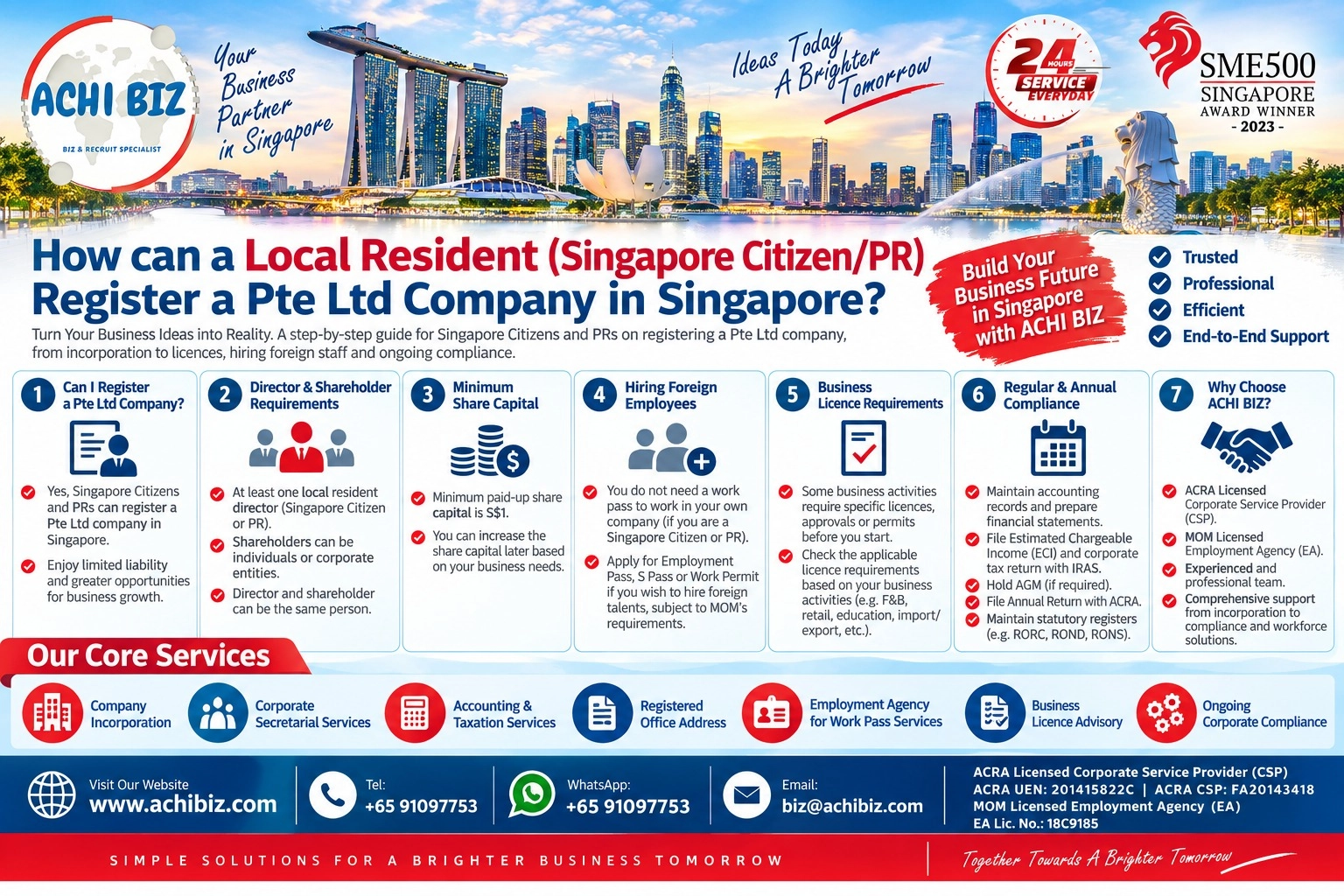
How Can a Local Resident (Singapore Citizen/PR) Register a Pte Ltd Company
Registering a Private Limited Company (Pte. Ltd.) in Singapore is a popular option for Singapore Citizens and Permanent Residents who want to start a business with a separate legal identity and limited liability.
The incorporation process itself can be relatively straightforward, but running a company involves much more than registering a name with ACRA. A business owner should understand the requirements for directors, shareholders, share capital, registered office address, company secretary, business licences, accounting, taxation, GST, employment, foreign workers and annual corporate compliance.
This detailed FAQ explains what a local resident should know before and after registering a Pte Ltd company in Singapore. ACRA’s current registration framework covers matters including company type, Financial Year End (FYE), directors and other officers, share capital, constitution and registration through Bizfile.
Can a Singapore Citizen or Permanent Resident register a Pte Ltd company in Singapore?
Yes. A Singapore Citizen or Permanent Resident (PR) can register a Private Limited Company in Singapore, provided the applicable requirements under the Companies Act and ACRA regulations are satisfied.
A local resident who is eligible to act as a director can generally establish the company without needing another person merely to satisfy the local resident director requirement.
What is a Private Limited Company in Singapore?
A Private Limited Company, commonly shown as “Pte. Ltd.”, is a company limited by shares.
Once incorporated, the company becomes a legal entity separate from its shareholders and directors. It can enter into contracts, own assets, employ staff, open corporate bank accounts, incur liabilities and conduct business in its own name.
This separation between the company and its owners is an important difference between a Pte Ltd company and an unincorporated business such as a sole proprietorship.
Why do many Singapore entrepreneurs choose a Pte Ltd company?
A Pte Ltd company can provide a structured platform for operating and expanding a business. Its separate legal identity can also make it more suitable for businesses intending to bring in additional shareholders, employ staff, enter into commercial contracts or grow beyond a small owner-operated business.
However, a company also has more ongoing statutory and administrative responsibilities than a sole proprietorship.
The appropriate business structure should therefore be selected based on the entrepreneur’s actual business plans rather than simply choosing a Pte Ltd because it is commonly used.
Is a Pte Ltd company suitable for every small business?
Not necessarily.
A small individual business with limited risk and simple operations may consider other structures, while a Pte Ltd company may be more appropriate where limited liability, multiple shareholders, business continuity, investment or future expansion is important.
The advantages should be considered together with the additional requirements for company secretary services, accounting, taxation, annual returns and corporate governance.
Can one Singapore Citizen or PR register a Pte Ltd company alone?
Yes. A Pte Ltd company can generally have a single shareholder and a single director.
Accordingly, an eligible Singapore Citizen or PR may potentially be both the sole shareholder and sole director.
However, a sole director cannot simultaneously act as the company’s company secretary. A separate eligible person must therefore be appointed as company secretary.
Is a local resident director compulsory for a Singapore Pte Ltd company?
Yes. Every Singapore company must maintain at least one director who satisfies the applicable local residency requirements.
For a company established by a Singapore Citizen or PR, the founder may usually fulfil this role personally, provided he or she satisfies the applicable eligibility requirements.
Does a Singapore Citizen or PR need a nominee director?
Generally, no, if the founder is eligible and willing to act as the company’s local resident director.
A local entrepreneur should therefore not assume that a nominee director is a normal requirement for incorporating a Pte Ltd company.
What is the difference between a director and a shareholder?
A shareholder owns shares in the company, while a director is responsible for managing the company and carrying out the duties associated with the office of director.
The same individual can hold both roles, but they remain legally distinct capacities.
For example, a Singapore Citizen may own all the company’s shares and simultaneously act as its director.
Can the director and shareholder be the same person?
Yes.
A single eligible individual can generally be the company’s sole shareholder and sole director.
This arrangement is common for small owner-managed companies.
Can a husband and wife register a Pte Ltd company together?
Yes. A husband and wife can generally become shareholders and/or directors of the same company, subject to the usual eligibility requirements.
Their shareholdings can be allocated according to their intended ownership arrangement.
For example, ownership may be equal or divided in another proportion agreed between them.
Can family members register a Pte Ltd company together?
Yes.
Family members may become shareholders and, if eligible, directors of the company.
However, family relationships should not replace proper corporate planning. Shareholding percentages, voting rights, management responsibilities and procedures for transferring shares should be clearly understood.
Can friends or business partners establish a company together?
Yes.
Where there are multiple founders, it is particularly important to determine the ownership structure carefully.
The founders should consider matters such as shareholding percentages, voting rights, directors, decision-making authority, transfer of shares, additional funding and what should happen if one shareholder wishes to leave.
Depending on the circumstances, a shareholders’ agreement may also be appropriate.
How many shareholders can a Singapore private company have?
A private company is generally limited to not more than 50 shareholders.
Shareholders can include eligible individuals and corporate entities, subject to the applicable company type and any industry-specific restrictions.
Can a Singapore Pte Ltd company have foreign shareholders?
Yes. Singapore generally permits foreign ownership of a local Pte Ltd company.
A Singapore Citizen or PR can therefore establish a company together with foreign individuals or overseas corporate shareholders, subject to applicable laws and any sector-specific ownership restrictions.
Does the local resident director need to own shares?
No.
The requirement to have an eligible local resident director is separate from the ownership of shares.
A director may have no shares, while a shareholder does not necessarily need to be a director.
What is the minimum share capital for registering a Pte Ltd company in Singapore?
A company with share capital can generally be incorporated with a very small amount of initial share capital, including S$1 for an ordinary company structure.
However, the statutory minimum should not automatically be treated as the appropriate commercial capital for every business.
The actual amount should take into account the company’s proposed operations, working-capital needs, licences, contracts, banking arrangements and future plans.
Should every new company start with only S$1 share capital?
No.
Although S$1 may satisfy the basic incorporation requirement in an ordinary case, a business requiring premises, employees, equipment, inventory or significant operating expenditure may require substantially more funding.
Certain regulated activities may also have their own capital requirements.
The initial capital should therefore reflect the actual needs of the business.
Can the company’s share capital be increased later?
Yes.
A company may issue additional shares and increase its share capital after incorporation, subject to the Companies Act, the company’s constitution, applicable approvals and required ACRA filings.
This provides flexibility for businesses that need additional capital as they grow.
Can a company have different classes of shares?
Yes, where appropriately structured.
A company may have different types or classes of shares with different rights, subject to the Companies Act and its constitution.
For a straightforward owner-managed business, ordinary shares may be sufficient. More complex ownership or investment arrangements may require professional advice before the share structure is established.
What information should be decided before incorporating a Pte Ltd company?
Before registration, the founders should generally determine the proposed:
- company name;
- principal and secondary business activities;
- shareholders;
- directors;
- share capital and share allocation;
- registered office address;
- Financial Year End;
- company constitution; and
- other prescribed incorporation particulars.
ACRA’s current company-registration process specifically addresses company type, FYE, directors and other officers, share capital, constitution and registration through Bizfile.
How should I choose a company name?
The proposed company name should appropriately identify the business and comply with ACRA’s requirements.
A name should not be selected solely for marketing purposes without considering whether it accurately represents the intended business.
The company name must first be approved and reserved before incorporation can be completed.
Is reserving a company name the same as incorporating the company?
No.
Name reservation and company incorporation are separate processes.
Approval of a proposed name does not mean that the company has already been incorporated or that it has obtained permission to carry out a regulated business activity.
What is an SSIC code?
SSIC stands for Singapore Standard Industrial Classification.
A company selects the business activity classifications that best describe its principal and, where applicable, secondary activities.
The correct SSIC classification can be important for regulatory, licensing and manpower matters.
Why is choosing the correct SSIC business activity important?
The company’s declared business activities should accurately reflect what it actually intends to do.
An inappropriate activity classification can create problems later when dealing with licences, government agencies, banks, foreign manpower requirements or other regulatory matters.
The SSIC should therefore be selected based on the genuine business model rather than merely choosing the broadest available description.
Does a Pte Ltd company need a Singapore registered office address?
Yes.
A Singapore company must maintain a registered office address in Singapore in accordance with the applicable requirements.
The registered office is the company’s official address for statutory correspondence and notices.
Does the registered office need to be the company’s actual operating premises?
Not necessarily.
Depending on the nature of the business, a company may use an eligible registered office address service.
However, certain businesses may require actual operating premises for licensing or regulatory purposes.
A registered office service therefore should not automatically be assumed to satisfy the premises requirements of every business licence.
Can I use my residential address as the registered office?
This may be possible in appropriate circumstances, but residential-use and home-business requirements should also be considered.
The fact that an address can be entered as a registered office should not automatically be interpreted as permission to conduct every type of business activity from the residential premises.
Is a company secretary compulsory for a Singapore Pte Ltd company?
Yes.
A Singapore company must have a company secretary who satisfies the applicable requirements.
The company secretary plays an important role in maintaining corporate records, supporting statutory filings and helping the company comply with its corporate obligations.
When must a company secretary be appointed?
A company secretary must generally be appointed within six months after incorporation.
For practical compliance, many companies arrange their company secretary from the beginning rather than waiting until the end of the permitted appointment period.
Can the sole director also be the company secretary?
No.
Where a company has only one director, that individual cannot also act as the company’s company secretary.
A separate eligible company secretary must therefore be appointed.
Why does a one-person company need a company secretary?
A Pte Ltd company remains a separate legal entity and is subject to the Companies Act even if it has only one shareholder and one director.
Its statutory obligations do not disappear simply because the company is small.
Professional company secretarial support can therefore help an owner-managed company maintain its corporate records and comply with recurring ACRA requirements.
Does a Pte Ltd company need a constitution?
Yes.
The company’s constitution contains important rules governing matters such as its shares, shareholders, directors and internal administration.
A company may adopt an appropriate model constitution or use a customised constitution where necessary.
What is the Financial Year End (FYE)?
The Financial Year End is the last day of the company’s financial reporting period.
It is important because the FYE affects several subsequent accounting, tax and corporate compliance deadlines.
The FYE should therefore be selected thoughtfully during incorporation. ACRA specifically identifies the FYE as affecting AGM and Annual Return deadlines.
Should every new company choose 31 December as its FYE?
Not necessarily.
The appropriate FYE can depend on the company’s incorporation date, business cycle, group reporting requirements and other practical considerations.
Changing an FYE later may also affect compliance periods and deadlines.
Can the company start business immediately after incorporation?
This depends on the business activity.
A company carrying on an activity that does not require a special licence may generally commence business after the necessary post-incorporation arrangements are completed.
However, a regulated business must obtain the required licence, permit or approval before carrying out the regulated activity.
Is ACRA company registration the same as obtaining a business licence?
No.
This is an important distinction.
ACRA incorporation establishes the company as a legal entity. A business licence or permit authorises the company to carry out a particular regulated activity.
A company can therefore be successfully incorporated but still be unable to commence a regulated business until the appropriate approval is obtained.
What types of businesses may require licences in Singapore?
Licence requirements depend on the precise activity.
Regulated sectors can include certain activities involving food and beverage, employment agencies, construction, education, healthcare, travel, financial services, telecommunications, import and export, and other specialised industries.
The licensing requirements should be checked according to the actual business model rather than assuming that incorporation alone is sufficient.
Should I check business licence requirements before incorporating the company?
Where the intended activity is regulated, it is advisable to investigate the licensing requirements before incorporation.
Some licences may impose conditions relating to the company’s directors, shareholders, premises, qualifications, staffing, business activities or financial resources.
Checking these requirements early can help avoid incorporating a company with an unsuitable structure.
Does an import or export company need additional registrations or permits?
Potentially, yes.
Businesses involved in importing or exporting goods may need the relevant Singapore Customs arrangements and trade permits. Controlled goods may require further approvals from the appropriate authorities.
The requirements depend on what the company intends to import or export.
Does a Singapore Citizen or PR need a work pass to work in his or her own company?
A Singapore Citizen does not require a Singapore work pass to work locally.
A Singapore Permanent Resident likewise does not require an Employment Pass, S Pass or Work Permit simply to work in Singapore.
However, the company must comply with the applicable MOM requirements if it intends to employ foreign workers.
Can a newly incorporated Pte Ltd company hire foreign workers?
Potentially, yes.
However, incorporating a company does not automatically give it an entitlement to employ foreigners.
Both the employer and foreign candidate must satisfy the prevailing Ministry of Manpower requirements applicable to the relevant work-pass category.
Depending on the position and circumstances, this may involve an Employment Pass, S Pass, Work Permit or another appropriate work pass.
What work passes may be relevant when a company hires foreign employees?
The appropriate work pass depends on the nature of the job, candidate and employer.
Common categories include:
- Employment Pass (EP) for eligible foreign professionals, managers and executives;
- S Pass for eligible skilled foreign employees; and
- Work Permit for eligible workers in approved sectors and occupations.
Each pass has its own eligibility and employer requirements.
What is an Employment Pass?
An Employment Pass is intended for eligible foreign professionals, managers and executives.
MOM currently assesses EP candidates under its prevailing eligibility framework, including the applicable qualifying salary and, unless exempted, the Complementarity Assessment Framework (COMPASS). Relevant Fair Consideration Framework requirements may also apply.
Because MOM criteria can change, employers should always check the prevailing requirements at the time of application rather than relying on figures quoted in an older article.
Can a newly incorporated company automatically obtain an Employment Pass for a foreign employee?
No.
Company incorporation and work-pass approval are separate matters.
MOM assesses the employer and candidate according to the prevailing requirements applicable to the particular pass.
A company should therefore not make employment commitments on the assumption that an EP will automatically be approved simply because the company has been incorporated.
What is an S Pass?
The S Pass is intended for eligible skilled foreign employees who satisfy MOM’s prevailing requirements.
The employer must also satisfy the applicable quota, levy and other employment requirements. MOM confirms that S Pass employment is subject to both quota and levy requirements.
As these requirements can change, ACHI BIZ recommends checking the prevailing MOM rules when the company is ready to recruit or apply.
Is there a quota for hiring S Pass holders?
Yes.
S Pass employment is subject to the prevailing MOM quota requirements, which can depend on the employer’s sector and workforce.
MOM uses the employer’s local workforce information, including relevant CPF information, when determining foreign manpower quota.
Rather than relying on a fixed percentage published in an older guide, employers should check their actual available quota under the prevailing MOM rules before recruitment.
Does an employer have to pay a levy for an S Pass holder?
Yes. S Pass employment is subject to the prevailing foreign worker levy requirements.
Levy rules and rates may be revised. The applicable amount should therefore be checked with MOM when the company is planning its manpower costs.
What is a Work Permit?
A Work Permit enables eligible employers in approved sectors to employ eligible migrant workers, subject to the requirements applicable to the relevant sector and worker category.
Work Permit requirements are not the same as Employment Pass or S Pass requirements.
Eligibility can depend on the company’s sector, business activity, worker’s source country or region, occupation and other prevailing MOM conditions.
Can every Pte Ltd company hire Work Permit holders?
No.
Work Permit eligibility depends on the company’s actual business sector and the applicable MOM rules.
Quota and levy requirements apply to Work Permit employment, and MOM states that a company applying for Work Permits or S Passes for the first time must declare its business activity so that it can be assigned to the relevant sector.
Does a company need local employees before hiring S Pass or Work Permit holders?
The company’s qualifying local workforce can affect its foreign manpower entitlement.
MOM uses local workforce information when calculating Work Permit and S Pass quota entitlement.
A company intending to employ quota-based foreign workers should therefore plan its local workforce and CPF compliance before making foreign recruitment commitments.
What is the Local Qualifying Salary and why can it matter?
MOM uses the Local Qualifying Salary (LQS) in determining how local employees count towards Work Permit and S Pass quota entitlement.
As the applicable amount and manpower rules may change, an evergreen company-registration guide should not rely on a fixed LQS figure. Employers should refer to the prevailing MOM requirement when calculating their manpower entitlement.
Can a Singapore Citizen or PR director count towards foreign worker quota?
Potentially, but merely registering a person as a director should not be assumed to create quota.
The person must satisfy the prevailing MOM requirements for being counted as part of the employer’s qualifying local workforce, including the applicable employment, remuneration and CPF conditions.
The company’s actual quota should be checked before a foreign work-pass application is made.
Is CPF important if the company wants to employ foreign workers?
Yes.
CPF records can be relevant to MOM’s calculation of the company’s local workforce and corresponding foreign manpower entitlement. MOM specifically uses CPF information when computing quota.
Employers should therefore ensure that employment arrangements, salary declarations and CPF contributions are genuine, accurate and timely.
Should a company recruit foreign workers before checking its quota?
No.
Where the intended pass is quota-dependent, the employer should check the prevailing eligibility, workforce, quota and levy requirements before making recruitment commitments.
The fact that a company has been incorporated does not mean that foreign manpower quota is automatically available.
Can the company appoint an Employment Agency to handle work-pass applications?
Yes, where applicable.
An employer may engage an appropriately licensed Employment Agency to assist with eligible work-pass applications and related employment agency services.
The work pass remains subject to MOM’s assessment and approval.
What should I consider before incorporating if I already know I will need foreign workers?
Manpower planning should ideally form part of the company’s initial business planning.
Consider the intended business sector, SSIC activity, types of jobs, appropriate work-pass categories, expected local workforce, CPF arrangements and the prevailing MOM salary, quota, levy, advertising, eligibility and sector-specific requirements.
This can help avoid establishing a business model that depends on foreign manpower the company may not be eligible to employ.
Does a Pte Ltd company need a corporate bank account?
A dedicated corporate bank account is strongly recommended.
A Pte Ltd company is legally separate from its shareholders, so company transactions should also be kept separate from personal finances.
Banks and financial institutions conduct their own due diligence, and successful company incorporation does not guarantee bank-account approval.
Can I use my personal bank account for company transactions?
This is not advisable.
Mixing personal and company funds can create accounting, tax, governance and evidentiary problems.
Using a dedicated corporate account helps maintain a clear record of the company’s financial transactions.
Must accounting records be maintained from the beginning?
Yes.
Good accounting should begin when the company starts incurring expenses, receiving money or entering into transactions.
IRAS requires companies to maintain proper financial records and retain relevant source documents, accounting records, schedules, bank statements and other transaction records for at least five years from the relevant Year of Assessment.
Are bank statements alone sufficient accounting records?
No.
The company should retain supporting documents that explain its transactions, including relevant invoices, receipts, contracts and other records.
IRAS requires businesses to maintain records capable of explaining their income, expenditure, purchases and other transactions.
Does a Pte Ltd company need to prepare financial statements?
Companies are generally required to maintain proper accounting records and prepare the applicable financial information and statements in accordance with Singapore requirements.
The precise financial reporting and filing requirements can depend on the company’s circumstances.
Audit exemption should not be confused with an exemption from bookkeeping or financial reporting.
Does every Pte Ltd company need an audit?
No.
Certain private companies may qualify for the applicable small company audit exemption, subject to satisfying the statutory conditions.
A company that does not qualify for an exemption should ensure that the required auditor is appointed and the audit requirements are met.
Does being audit-exempt mean the company does not need accounting?
No.
Audit exemption is not accounting exemption.
An audit-exempt company still needs proper accounting records and must meet its applicable financial reporting, tax and annual compliance obligations.
Does a Pte Ltd company have to pay corporate income tax?
A Singapore company is subject to Singapore corporate income tax rules.
Its actual tax liability depends on its taxable income and the tax provisions, exemptions, deductions, rebates and other rules applicable to the relevant Year of Assessment.
What is Estimated Chargeable Income (ECI)?
ECI is an estimate of the company’s taxable profits for a particular Year of Assessment.
Companies should determine whether an ECI filing is required after their FYE and whether they qualify for an applicable filing waiver.
Does a company have to file a Corporate Income Tax Return every year?
Companies generally have annual corporate income tax filing obligations unless an applicable waiver or exception has been granted.
For the current YA 2026 filing season, IRAS states that companies must file even where they did not carry on business or incurred a loss, unless the relevant filing position provides otherwise.
The filing requirements should be checked for each relevant Year of Assessment.
What is GST and does every new company need to register?
No.
GST registration is separate from ACRA incorporation.
A company should monitor its taxable turnover and determine whether compulsory GST registration is triggered under the prevailing IRAS requirements. A business that is not required to register may, in appropriate circumstances, consider voluntary registration subject to IRAS conditions.
Can a newly incorporated company immediately charge GST?
Not merely because it has been incorporated.
A business should charge GST only when it is properly GST-registered and entitled or required to do so under the applicable GST rules.
What statutory registers must a Pte Ltd company maintain?
Singapore companies must maintain accurate records of relevant company persons and interests.
Depending on applicability and exemptions, the required records can include the Electronic Register of Members (EROM), Register of Registrable Controllers (RORC), Register of Nominee Directors (ROND) and Register of Nominee Shareholders (RONS). ACRA’s current framework requires companies to keep prescribed registers and information up to date.
What is the Register of Registrable Controllers (RORC)?
The RORC identifies individuals or legal entities that have significant interest in or control over the company, subject to the applicable statutory definitions and exemptions.
It forms part of Singapore’s corporate transparency framework.
Companies should identify their registrable controllers, maintain the required information and make the applicable filings within the prescribed timelines.
What is the Register of Nominee Directors (ROND)?
The ROND records the required information relating to nominee directors, subject to the applicable statutory requirements.
Companies should not assume that nominee-related compliance is relevant only at incorporation. Any applicable nominee status and subsequent changes should be properly documented and filed.
What is the Register of Nominee Shareholders (RONS)?
The RONS relates to persons who hold shares as nominees on behalf of another person.
Together with the RORC and ROND requirements, it forms part of Singapore’s corporate ownership and control transparency regime.
Must changes to company particulars be reported to ACRA?
Yes.
A company has continuing obligations to keep prescribed information current.
Changes involving directors, company secretary, registered office, shareholders, shares, business activities and other company particulars should be filed within the applicable statutory deadlines.
Corporate compliance therefore continues throughout the year and is not limited to Annual Return filing.
Does every private company need to hold an AGM?
Not necessarily.
Private companies may qualify for an AGM exemption or other applicable arrangements under the Companies Act.
Where an AGM is required, it must be held within the applicable statutory timeline.
A company should determine whether an exemption applies rather than assuming either that every company must hold an AGM or that every private company is automatically exempt.
Does every Pte Ltd company need to file an Annual Return?
Yes, while the company remains live and subject to the applicable filing requirement.
ACRA states that all Singapore companies must file an Annual Return each year and that the filing contains key company information, including its registered office, activities, officers, members, shares and financial information where required.
Is an ACRA Annual Return the same as the IRAS Corporate Income Tax Return?
No.
They are separate filings made to different government authorities for different purposes.
The ACRA Annual Return deals primarily with statutory company information and annual corporate compliance.
The IRAS Corporate Income Tax Return deals with the company’s tax position.
Filing one does not satisfy the other.
What are the regular compliance responsibilities of a Pte Ltd company?
Regular compliance may include maintaining:
- accounting records and supporting documents;
- statutory registers;
- accurate ACRA company particulars;
- corporate resolutions and records;
- payroll and CPF records where applicable;
- employment records;
- GST records where applicable;
- business licences and permits; and
- work-pass compliance where foreign employees are engaged.
These obligations arise throughout the year and should not be postponed until the Annual Return is due.
What are the main annual compliance requirements?
Depending on the company’s circumstances, annual compliance may include:
- closing the accounts for the financial year;
- preparing financial statements;
- determining whether an audit is required;
- considering AGM requirements or exemptions;
- filing the ACRA Annual Return;
- attending to ECI where applicable;
- preparing and filing the Corporate Income Tax Return;
- reviewing GST obligations; and
- ensuring statutory registers and company particulars remain accurate.
What employment obligations arise when the company hires local employees?
Once a company becomes an employer, additional responsibilities arise.
These can include employment contracts, salary administration, CPF, Skills Development Levy (SDL), employment records, statutory leave and benefits, workplace requirements and compliance with applicable employment legislation.
The exact requirements depend on the employee and employment arrangement.
What additional obligations arise when the company hires foreign employees?
Foreign employment brings additional MOM requirements.
Depending on the particular work pass, these may include prevailing qualifying salary, quota, levy, advertising, insurance, medical examination, security bond, accommodation, sector, source-country and other pass-specific requirements.
Not every requirement applies to every pass.
The company should therefore assess the relevant work-pass category individually rather than treating EP, S Pass and Work Permit requirements as interchangeable.
Why should MOM salary, quota and levy figures not be relied on from old articles?
MOM periodically reviews and changes foreign manpower requirements.
A salary threshold, quota percentage, levy amount or workforce criterion that was correct when an article was published may subsequently change.
For this reason, businesses should use informational articles to understand which requirements apply, and then verify the prevailing MOM criteria at the time of recruitment or application. MOM’s current pages themselves note that quota and levy rules apply and may be adjusted.
Is compliance still required if the company has no business activity?
Yes.
A company does not cease to have legal and filing responsibilities simply because it has no revenue or has temporarily stopped trading.
Dormant or inactive companies may qualify for particular exemptions or simplified requirements, but these should be established rather than assumed.
Can I leave all bookkeeping and compliance until year-end?
This is not recommended.
Many obligations arise during the financial year, and some corporate changes have their own filing deadlines.
Regular bookkeeping also makes it easier to understand the company’s financial position, prepare tax returns and respond to regulatory queries. IRAS specifically highlights the business and tax benefits of maintaining proper records.
What responsibilities does a company director have?
A director is responsible for more than having his or her name registered with ACRA.
Directors have legal and fiduciary duties and are responsible for ensuring that the company is properly managed and complies with applicable requirements.
The fact that a person owns all the company’s shares does not remove his or her responsibilities as a director.
Does limited liability mean a director can never be personally liable?
No.
Limited liability generally concerns a shareholder’s liability in relation to the company’s debts.
It does not protect a director from liability arising from the director’s own breach of duties, unlawful conduct, personal guarantees or other circumstances where personal liability may arise.
Can I withdraw money from the company whenever I want because I own all the shares?
No.
A Pte Ltd company is a separate legal entity.
Money belonging to the company should not simply be treated as the shareholder’s personal funds.
Payments to a shareholder or director should have a proper basis and be correctly documented and recorded—for example, salary, reimbursement, repayment of an amount owed, properly declared dividend or another legitimate transaction.
Can the company pay dividends to its shareholders?
A company may distribute dividends where the applicable legal and accounting requirements are satisfied.
Dividends should not simply be used as a label for arbitrary withdrawals from the corporate bank account.
The company’s financial position and available profits should be properly considered and the appropriate corporate documentation completed.
What are common mistakes made by first-time Pte Ltd company owners?
Common mistakes include selecting an unsuitable business activity, starting a regulated business without the required licence, mixing personal and company money, delaying bookkeeping, misunderstanding GST, overlooking statutory registers, missing ACRA or IRAS deadlines and assuming that incorporation automatically gives the company foreign worker entitlement.
Another important mistake is hiring or promising jobs to foreign workers before checking the company’s eligibility under the prevailing MOM work-pass, quota and manpower requirements.
What should I check before registering a Pte Ltd company if I intend to hire foreign workers?
Consider foreign manpower requirements at the business-planning stage.
The company should consider:
- its actual business activity and sector;
- the types of positions it needs;
- whether local recruitment is possible;
- the appropriate foreign work-pass category;
- its qualifying local workforce;
- CPF compliance;
- applicable job-advertising requirements; and
- the prevailing MOM eligibility, qualifying salary, quota, levy and sector-specific conditions.
This is more useful than simply asking how many foreign workers a newly incorporated company can hire, because the answer depends on the company’s circumstances and the rules in force at the relevant time.
What should I do immediately after the company is incorporated?
Post-incorporation matters may include establishing the corporate bank account, arranging bookkeeping, appointing the company secretary within the statutory period, setting up statutory records, applying for licences, arranging insurance where necessary, establishing payroll and CPF processes if hiring employees and preparing for tax and annual corporate compliance.
The precise requirements depend on the business.
What should I understand before registering a Pte Ltd company in Singapore?
A local entrepreneur should understand both incorporation requirements and post-incorporation responsibilities.
Before proceeding, consider the business model, ownership, directors, capital, SSIC codes, registered office, company secretary, FYE, licences, banking, accounting, taxation, GST, staffing and future growth.
If foreign employees will be required, manpower planning should also be considered before incorporation or recruitment.
Is registering a Pte Ltd company the end of the process?
No. It is the beginning of the company’s regulatory life.
A useful way to view company formation is:
Before incorporation: decide the business model, shareholders, directors, capital, SSIC activities, premises, licences and manpower requirements.
During incorporation: establish the company name, constitution, shares, registered office, FYE and required appointments.
After incorporation: attend to banking, accounting, licences, company secretary, statutory registers, tax, GST where applicable, employment obligations, work passes and annual compliance.
Can a local resident register a Pte Ltd company directly with ACRA?
Eligible local residents may be able to carry out incorporation transactions through ACRA’s Bizfile, subject to the applicable requirements.
However, being able to submit an incorporation electronically is different from understanding how the company should be structured and what must happen after registration.
Entrepreneurs who require assistance can engage an ACRA Licensed Corporate Service Provider (CSP) for incorporation and ongoing corporate services.
Why engage a Corporate Service Provider for Pte Ltd company registration?
A professional CSP can assist beyond the basic submission of an incorporation application.
Depending on the engagement, assistance can include company incorporation, statutory documentation, company secretary services, registered office address services, changes to company particulars, share-related corporate actions and ongoing corporate compliance.
For a first-time business owner, professional support can also help identify issues that should be addressed before the company starts operating.
Can the same service provider assist with accounting, tax and work-pass matters?
This depends on the provider’s scope of services and regulatory status.
Using a provider that can coordinate company incorporation, company secretary, registered office, accounting, taxation and eligible employment agency services may make ongoing administration easier for a growing business.
Work-pass applications should be handled in accordance with MOM’s requirements and, where employment agency services are provided, by an appropriately licensed Employment Agency.
How can ACHI BIZ assist a Singapore Citizen or PR with Pte Ltd company registration?
ACHI BIZ SERVICES PTE. LTD. is an ACRA Licensed Corporate Service Provider (CSP) providing Singapore company incorporation and ongoing corporate support services.
Our services include Pte Ltd company incorporation, corporate secretary services, registered office address services, corporate compliance, accounting and taxation support, together with other eligible corporate services.
ACHI BIZ is also a MOM Licensed Employment Agency (EA) and can assist with eligible Employment Pass, S Pass and other Work Pass services, subject to the prevailing MOM requirements and the circumstances of the employer and candidate.
For a new entrepreneur, the key question should therefore not be only:
“How do I register a Pte Ltd company in Singapore?”
It should also be:
“What does my company need in order to operate legally, hire employees, maintain proper accounts, meet tax obligations and remain compliant after incorporation?”
Understanding both aspects from the beginning gives a Singapore Citizen or PR a much stronger foundation for establishing and managing a Pte Ltd company in Singapore successfully.
Related Pages
How Can a Foreigner Register a Pte Ltd Company in Singapore? – FAQ Guide
#achibiz