
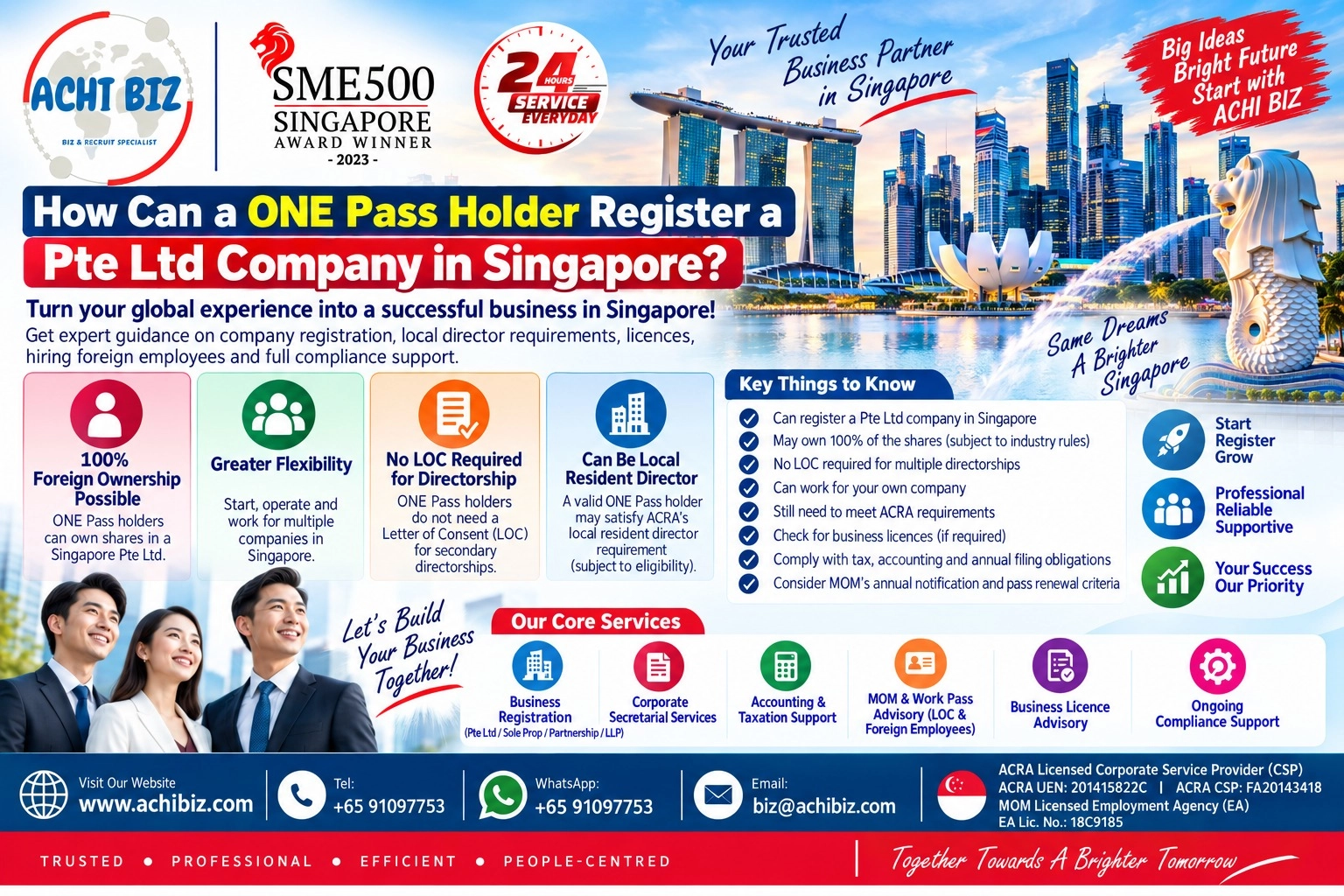
How Can a ONE Pass Holder Register a Pte Ltd Company in Singapore?
The Overseas Networks & Expertise Pass (ONE Pass) gives its holder considerably more flexibility to establish and operate businesses in Singapore than a conventional employer-linked work pass. MOM expressly states that ONE Pass holders may concurrently start, operate and work for multiple companies in Singapore, subject to their employment contract terms where relevant. They also do not need a Letter of Consent (LOC) to hold a secondary directorship.
This makes the ONE Pass particularly relevant to senior professionals, business leaders and entrepreneurs who want the flexibility to participate in more than one Singapore company.
However, having a ONE Pass does not remove the normal requirements for registering and operating a Singapore Private Limited Company (Pte Ltd). The company must still comply with ACRA requirements relating to directors, shareholders, share capital, registered office, company secretary, statutory registers and annual compliance. Business licensing, taxation, accounting and employment obligations also continue to apply.
For a ONE Pass holder planning to establish a company, it is therefore useful to look at two separate questions:
What does the ONE Pass allow the individual to do?
and
What must the Pte Ltd company itself do to remain compliant?
What is a ONE Pass in Singapore?
The Overseas Networks & Expertise Pass, commonly called the ONE Pass, is a personalised work pass administered by Singapore’s Ministry of Manpower (MOM).
One of its most important features is flexibility. Unlike an ordinary Employment Pass that is generally tied to a particular employer, MOM states that a ONE Pass holder may concurrently start, operate and work for multiple companies in Singapore.
This feature is particularly important when considering company ownership and entrepreneurship.
Can a ONE Pass holder register a Pte Ltd company in Singapore?
Yes.
A ONE Pass holder can establish a Singapore Pte Ltd company, subject to the applicable ACRA requirements.
ACRA specifically includes a valid Overseas Networks & Expertise Pass holder within its local-residency framework, while also advising FIN holders to check the applicable conditions with their pass issuer.
MOM separately confirms that ONE Pass holders have the flexibility to start and operate companies in Singapore.
Can a ONE Pass holder own 100% of a Singapore Pte Ltd company?
Singapore generally permits foreign ownership of a private company.
Accordingly, a ONE Pass holder can potentially own 100% of the shares of a Singapore Pte Ltd company, unless the particular business activity or regulatory licence imposes its own ownership restrictions.
Ownership should nevertheless be distinguished from the company’s other statutory requirements.
Does a ONE Pass holder need a Singapore Citizen or PR shareholder?
Generally, no.
A Singapore Pte Ltd company does not ordinarily require a Singapore Citizen or Permanent Resident shareholder merely because its shareholder is a foreigner.
A ONE Pass holder may therefore potentially be the sole shareholder, subject to any sector-specific regulatory restrictions.
Can a ONE Pass holder be both shareholder and director of the same Pte Ltd company?
Potentially, yes.
Shareholding and directorship are separate legal capacities, but a ONE Pass holder can potentially hold both positions.
ACRA recognises ONE Pass holders within its local-residency framework, while MOM gives ONE Pass holders flexibility to start, operate and work for companies in Singapore.
The person must nevertheless satisfy the normal eligibility requirements for company directors.
Can a ONE Pass holder satisfy the local resident director requirement?
Potentially, yes.
ACRA’s current guidance specifically lists a valid Overseas Networks & Expertise Pass holder among persons who may satisfy the applicable local-residency framework. ACRA also advises FIN holders to check with their pass issuer before registering a business or accepting a role.
This is an important distinction between a ONE Pass holder and many foreign entrepreneurs living overseas.
Does every Singapore Pte Ltd company need a local resident director?
Yes.
Every Singapore company must have at least one director who satisfies the applicable local-residency requirement.
ACRA states that directors must be ordinarily resident and meet its applicable eligibility conditions.
Does a ONE Pass holder always need to appoint another Singapore Citizen or PR as local director?
Not necessarily.
Where the ONE Pass holder personally satisfies ACRA’s applicable local-residency and director eligibility requirements, another Singapore Citizen or PR may not be required merely to fulfil the resident-director requirement.
This should be confirmed according to the person’s circumstances at the time of incorporation.
Does a ONE Pass holder need a nominee director to register a Pte Ltd company?
Not necessarily.
If the ONE Pass holder satisfies the applicable ACRA local resident director requirement and is eligible to be appointed as director, there may be no need to appoint a nominee director solely for local-residency purposes.
A nominee director should therefore not be treated as an automatic requirement for every foreign shareholder.
Can a ONE Pass holder be the sole director of the company?
Potentially, yes, if the individual satisfies all applicable ACRA director eligibility and local-residency requirements.
However, the company must separately appoint a company secretary, and a sole director cannot simply fulfil every company-office function personally.
Can the sole shareholder also be the sole director?
Potentially, yes.
A Pte Ltd company can have one shareholder, and that shareholder may also be a director provided the director requirements are satisfied.
For a ONE Pass holder, this can potentially result in a relatively straightforward ownership and management structure.
Can a sole director also act as company secretary?
No.
ACRA requires every company to have a company secretary, and the secretary must be appointed within six months of successful registration. The sole director of a company cannot simultaneously act as that company’s secretary.
When must a company secretary be appointed?
A company secretary must be appointed within six months after incorporation.
The company secretary assists with statutory administration and corporate compliance, although the directors remain responsible for the company’s legal obligations.
Does a ONE Pass holder need a Letter of Consent to become a director of another company?
No.
This is one of the important differences between the ONE Pass and an ordinary Employment Pass.
MOM expressly confirms that a ONE Pass holder does not require an LOC to hold a secondary directorship, because the pass already allows the holder to concurrently start, operate and work for multiple companies in Singapore.
Can a ONE Pass holder hold multiple company directorships?
Yes, subject to the normal legal requirements applicable to each directorship.
The ONE Pass is designed to provide flexibility to concurrently start, operate and work for multiple Singapore companies.
Each company must nevertheless independently satisfy its own ACRA and regulatory obligations.
Does a ONE Pass holder need separate MOM approval for every secondary directorship?
MOM states that ONE Pass holders do not require an LOC to hold secondary directorships.
This is materially different from the secondary-directorship framework that applies to ordinary EP holders.
Is the ONE Pass therefore more flexible than an Employment Pass for running multiple companies?
In this particular respect, yes.
An ordinary EP holder may require MOM’s LOC to undertake a secondary directorship, whereas MOM expressly gives ONE Pass holders the flexibility to start, operate and work for multiple companies and does not require an LOC for secondary directorships.
This does not mean the ONE Pass removes the normal company-law, tax or licensing obligations of each business.
Is the ONE Pass tied to one employer?
The ONE Pass is not structured like an ordinary employer-specific Employment Pass.
MOM specifically highlights that a ONE Pass holder can change jobs without reapplying for a new pass and may concurrently start, operate and work for multiple companies.
This provides considerably greater professional mobility.
Can a ONE Pass holder personally operate the Pte Ltd company?
Yes, subject to the ONE Pass conditions and other applicable laws.
MOM expressly states that ONE Pass holders have the flexibility to start, operate and work for multiple companies in Singapore.
This means a ONE Pass holder does not face the same employer-specific work restriction that applies to a conventional EP.
Can a ONE Pass holder work for his or her own company?
Yes, subject to the applicable ONE Pass conditions, employment arrangements and any sector-specific requirements.
MOM’s stated flexibility expressly includes starting, operating and working for multiple companies.
Can a ONE Pass holder simultaneously work for another company and operate his or her own Pte Ltd?
Potentially, yes.
Concurrent professional activities are one of the principal features of the ONE Pass.
However, MOM states that this flexibility remains subject to employment contract terms, where relevant.
Therefore, a ONE Pass holder should still consider contractual restrictions such as confidentiality, conflicts of interest, non-solicitation and other valid employment obligations.
Does the ONE Pass override an employment contract?
No.
MOM expressly qualifies the ONE Pass holder’s flexibility by referring to employment-contract terms where relevant.
The work pass may permit multiple professional activities, but that does not automatically cancel contractual obligations owed to an employer.
Can a ONE Pass holder establish several Pte Ltd companies?
Potentially, yes.
The ONE Pass permits concurrent involvement with multiple companies.
Each company, however, is a separate legal entity and must independently satisfy its incorporation, governance, licensing, accounting, tax and annual compliance obligations.
Can a ONE Pass holder become an executive director?
Potentially, yes.
The ONE Pass permits its holder to operate and work for companies in Singapore.
The person must nevertheless properly discharge the legal duties attached to the directorship and comply with any industry-specific requirements.
Can a ONE Pass holder become a non-executive director?
Potentially, yes.
MOM does not require a secondary-directorship LOC for ONE Pass holders.
Normal Companies Act duties and any applicable sector regulations continue to apply.
Can a ONE Pass holder receive salary from his or her own company?
Potentially, where there is a genuine employment or remuneration arrangement and the payments are properly authorised, recorded and treated for tax purposes.
The ONE Pass allows the holder to work for multiple companies, but salary, director’s fees, dividends and other distributions should each be properly characterised and accounted for.
Can a ONE Pass holder receive director’s fees?
Potentially, subject to proper corporate approval, accounting and tax treatment.
A director’s remuneration should not simply be withdrawn informally from the company’s bank account.
Can a ONE Pass holder receive dividends from the company?
As a shareholder, a ONE Pass holder can potentially receive dividends lawfully declared by the company.
Dividends are distributions arising from share ownership and should be distinguished from salary or director remuneration for services performed.
Is there a minimum shareholding a ONE Pass holder must have to operate the company?
MOM’s ONE Pass framework does not impose the same business-owner shareholding condition used for certain other pass/LOC arrangements.
The company’s shareholding can therefore be structured according to its commercial needs, subject to the Companies Act and any sector-specific regulatory restrictions.
What is the minimum share capital for a Singapore Pte Ltd company?
ACRA states that a company requiring share capital needs at least S$1 in share capital to start.
This is the statutory starting point, not necessarily the commercially appropriate capital for every business.
Should a ONE Pass holder always incorporate with only S$1 capital?
Not necessarily.
The appropriate capital depends on the business.
A company may require more realistic funding for rent, staffing, technology, inventory, professional services, marketing, licensing or working capital.
Certain regulated businesses may also have their own financial requirements.
Can share capital be increased after incorporation?
Yes.
The company can subsequently issue additional shares or otherwise alter its share capital, subject to the Companies Act, its constitution, required corporate approvals and ACRA filings.
Can a ONE Pass holder have business partners?
Yes.
The company can have other individual or corporate shareholders.
A private company is a separate legal entity, and its ownership can be structured according to the founders’ commercial arrangement, subject to applicable law.
Can foreign individuals become co-shareholders?
Generally, yes.
Singapore generally permits foreign ownership of private companies, although regulated industries can have their own ownership or approval requirements.
Can a foreign corporate entity become a shareholder?
Yes, subject to applicable requirements.
Where a corporate shareholder is involved, additional corporate documents, ownership information and customer due diligence will generally be required.
Does a ONE Pass holder need to use a Corporate Service Provider to register the company?
ACRA states that foreigners must engage a Corporate Service Provider (CSP) to reserve a name and register a business structure.
Accordingly, engaging an appropriately registered CSP should form part of the incorporation planning.
What does a ONE Pass holder normally need to provide for company incorporation?
The information normally includes the proposed company name, business activities and SSIC codes, shareholder details, director details, share capital, registered office address, financial year end and constitution.
Information concerning beneficial ownership and registrable controllers may also be required.
The CSP will conduct the applicable KYC/CDD procedures.
Why is KYC and customer due diligence required?
Corporate Service Providers operate within Singapore’s regulated framework.
They must establish and verify relevant information concerning customers, beneficial owners and proposed transactions.
Depending on the ownership structure, jurisdictions involved, source of funds, business activities and risk profile, additional or enhanced due diligence may be necessary.
Does the company need a Singapore registered office?
Yes.
A Singapore Pte Ltd company must maintain a registered office address in Singapore.
The registered office serves as the company’s official address for statutory notices and corporate records as applicable.
Can the company use a professional registered office address?
Potentially, yes, provided the arrangement complies with Singapore’s legal requirements.
A professional registered office can be useful where the ONE Pass holder does not wish to use a residential address.
It should not be confused with an operational office where the business itself requires specific premises.
Can a ONE Pass holder use a home address for the company?
This depends on the circumstances and applicable requirements.
Operating a business from residential premises can also involve HDB or URA rules, depending on the property and activities.
The suitability of the address should therefore be assessed separately from ACRA incorporation.
What business activities should be declared to ACRA?
The company’s declared business activities should accurately reflect what it intends to do.
Appropriate Singapore Standard Industrial Classification (SSIC) codes should be selected rather than choosing unrelated or overly broad activities merely for convenience.
The chosen activity can also affect licensing and foreign-manpower requirements.
Does registering a Pte Ltd company mean the business can immediately start operating?
Not always.
ACRA incorporation establishes the company as a legal entity.
If the proposed activity is regulated, the company may still need licences, permits or approvals before commencing that activity.
Does every Pte Ltd company require a business licence?
No.
Licence requirements depend on the business activity.
However, regulated industries can require specific approvals, and those requirements should ideally be checked before incorporation.
What businesses commonly require additional licences or approvals?
Depending on the activity, licences or approvals may apply to areas such as food and beverage, education, employment agencies, construction, healthcare, financial services, travel, import/export and other regulated sectors.
The exact licence depends on what the company actually does.
Should licence requirements be checked before incorporating?
Preferably, yes.
Some licences can impose conditions concerning directors, qualified personnel, premises, ownership, capital or other operational matters.
Early review can prevent the company from being incorporated with a structure that is unsuitable for the intended regulated activity.
Does the ONE Pass itself replace a business licence?
No.
A work pass relates to the individual’s immigration/work status.
A business licence relates to the company’s authority to conduct a regulated activity.
The two should not be confused.
Are there occupations a ONE Pass holder cannot automatically undertake?
Yes.
MOM identifies certain restricted occupations, including certain media- or religion-related occupations, for which a ONE Pass holder must obtain MOM approval before starting work in that occupation.
Therefore, the ONE Pass’s broad flexibility is not completely unrestricted.
Should a ONE Pass holder check for restricted occupations before starting work?
Yes, where the intended activity may fall within MOM’s restricted-occupation framework.
MOM states that approval must be obtained before starting work in a restricted occupation.
Is a Pte Ltd company legally separate from the ONE Pass holder?
Yes.
A Singapore Pte Ltd company is a separate legal entity from its shareholder.
ACRA describes a company as providing strong protection for personal assets because the company has separate legal status, although the structure comes with more compliance requirements.
Does limited liability mean a ONE Pass holder can never be personally liable?
No.
Limited liability does not provide absolute immunity.
Personal exposure may still arise through matters such as personal guarantees, breaches of director duties, fraud or other circumstances provided by law.
Can the ONE Pass holder treat company money as personal money?
No.
The company’s funds belong to the company.
Payments to shareholders or directors should have a proper basis, such as authorised salary, reimbursement, director remuneration, repayment of a genuine loan or properly declared dividends.
Maintaining separation between company and personal finances is an important corporate governance and accounting practice.
Should the company open a corporate bank account?
It is strongly advisable.
Separating corporate and personal transactions makes bookkeeping, financial reporting, tax filing and business management considerably clearer.
Bank-account approval remains subject to the individual bank’s KYC, beneficial-ownership, source-of-funds and commercial assessment.
Does company incorporation guarantee corporate bank-account approval?
No.
ACRA incorporation establishes the legal entity, but banks independently assess account applications.
The bank can request further information and has its own acceptance and ongoing-monitoring criteria.
Does the company need Corppass?
Companies dealing electronically with Singapore government agencies will generally need Corppass for government-to-business transactions.
ACRA notes that entities can apply for Corppass after obtaining their UEN.
Must the company maintain proper accounting records?
Yes.
IRAS requires companies to maintain proper financial records and retain relevant source documents, accounting records, schedules, bank statements and other business transaction records for at least five years from the relevant Year of Assessment.
Does a ONE Pass holder’s company need financial statements?
Generally, companies must maintain accounts and prepare the applicable financial statements in accordance with Singapore requirements.
The exact reporting and filing requirements depend on the company’s circumstances.
Does every ONE Pass holder’s Pte Ltd company need an audit?
No.
A private company may qualify for the small-company audit exemption if it meets the applicable statutory criteria.
Under the current framework, qualifying as a small company generally involves being a private company and satisfying at least two of the prescribed revenue, asset and employee criteria for the relevant periods. Group conditions apply where relevant.
The prevailing criteria should be checked for the relevant financial year.
Does audit exemption mean no accounting is required?
No.
An audit exemption is an exemption from having the financial statements audited where the requirements are met.
It does not exempt the company from maintaining proper accounting records, preparing applicable financial information or fulfilling tax and corporate obligations.
What is the corporate income tax rate in Singapore?
Singapore’s prevailing headline Corporate Income Tax rate is 17% of chargeable income.
The actual tax payable can differ because of allowable deductions, exemptions, rebates or incentives.
Is a newly incorporated ONE Pass holder’s company automatically entitled to tax exemptions?
No.
Any start-up tax exemption or other tax treatment depends on the company’s eligibility under the prevailing IRAS rules.
Company incorporation by itself does not guarantee a particular exemption.
What is Estimated Chargeable Income (ECI)?
ECI is an estimate of the company’s taxable profits for a particular Year of Assessment.
Companies generally file ECI within the prescribed period after their FYE unless they qualify for the applicable filing waiver. Current IRAS guidance uses a three-month period from FYE for ECI filing.
Does the company need to file a Corporate Income Tax Return?
Yes, subject to the applicable IRAS rules.
Depending on eligibility, the company may file Form C-S, Form C-S (Lite) or Form C. Current IRAS guidance uses 30 November as the corporate tax return filing deadline.
Is an ACRA Annual Return the same as the IRAS Corporate Income Tax Return?
No.
They serve completely different purposes.
The ACRA Annual Return deals with the company’s corporate/statutory information.
The IRAS Corporate Income Tax Return deals with taxation.
Completing one does not replace the other.
Does the company need GST registration?
GST registration depends on the company’s circumstances and the prevailing IRAS requirements.
The company’s turnover and business activities should therefore be monitored as operations develop.
Should the company choose its Financial Year End carefully?
Yes.
The Financial Year End (FYE) affects important compliance dates, including the AGM, Annual Return and tax-related timelines.
ACRA allows companies to choose their FYE and specifically notes its effect on AGM and Annual Return deadlines.
When does a private company need to hold its AGM?
For a private company that is required to hold an AGM, the general deadline is within six months after the FYE.
However, private companies may be exempt from holding AGMs or may dispense with them where the applicable statutory conditions are satisfied.
When must a Singapore private company file its Annual Return?
For a typical private company, the Annual Return is generally due within seven months after its FYE.
Special circumstances can affect the applicable timeline.
Does an inactive company still have compliance obligations?
Yes.
A company continues to exist until it is properly dissolved or struck off.
Dormant or inactive status should therefore not be treated as meaning that all ACRA, accounting and tax obligations automatically disappear.
What statutory registers must the company maintain?
Depending on the circumstances, the company may need to maintain its electronic registers and prescribed registers relating to shareholders, directors, registrable controllers, nominee directors and nominee shareholders.
ACRA requires company registers to be kept accurate and up to date.
What is the Register of Registrable Controllers (RORC)?
The RORC records persons or legal entities with significant interest or control over the company.
ACRA’s current framework requires relevant companies to establish and maintain the RORC and to file the prescribed controller information with the Central RORC.
What are ROND and RONS?
ROND refers to the Register of Nominee Directors, while RONS refers to the Register of Nominee Shareholders.
These registers apply where the company has the relevant nominee arrangements, and prescribed information must also be filed with ACRA under the current framework.
Is a ONE Pass holder exempt from director duties because the pass allows entrepreneurship?
No.
The ONE Pass gives immigration and work flexibility; it does not remove the legal duties attached to being a Singapore company director.
Directors remain responsible for properly managing the company and complying with applicable corporate obligations.
Can a ONE Pass holder appoint additional directors?
Yes.
A company can have more than one director.
The appointment should be made in accordance with the Companies Act, the company’s constitution and applicable ACRA requirements.
Can the company appoint foreign directors?
Potentially, yes.
However, the company must continue to maintain at least one director satisfying the applicable Singapore local-residency requirement.
Any foreign director must also consider whether his or her immigration/work status permits the proposed role.
Can a ONE Pass holder’s company hire Singapore Citizens and PRs?
Yes.
The company may employ local workers, subject to the applicable employment, CPF, payroll and other employer obligations.
Can a ONE Pass holder’s company hire Employment Pass holders?
Potentially, provided the employer and candidate meet MOM’s prevailing Employment Pass requirements.
Company incorporation does not itself guarantee approval of foreign work passes.
Can the company hire S Pass holders?
Potentially, subject to the prevailing MOM qualifying salary, quota, levy, local workforce and eligibility requirements.
Because these requirements can change, current MOM requirements should be checked when the actual hiring is planned.
Can the company hire Work Permit holders?
Potentially, depending on its business sector and the relevant worker category.
The employer must satisfy MOM’s prevailing sector, quota, levy, source-country or region, occupation and other requirements where applicable.
Does having a ONE Pass give the company special foreign-worker quota?
Not merely because its shareholder or director holds a ONE Pass.
The company’s eligibility to hire other foreign employees should be assessed under the rules applying to the relevant work-pass category.
Does the ONE Pass holder need another work pass to work for his or her Pte Ltd company?
Generally, the key feature of the ONE Pass is precisely that the holder may start, operate and work for multiple companies without changing to an employer-specific pass.
Any special restrictions applicable to the person’s occupation or circumstances must still be observed.
Does the ONE Pass holder need an LOC to work for his or her own company?
MOM’s ONE Pass framework already permits the holder to start, operate and work for multiple companies and expressly confirms that an LOC is not required for secondary directorship.
This should not be confused with the separate LOC arrangements applicable to certain dependants.
Is the ONE Pass holder’s spouse automatically allowed to work for the new company?
No.
The ONE Pass holder’s own work flexibility does not automatically extend to family members.
MOM states that a spouse holding a Dependant’s Pass under a ONE Pass holder may work or operate a business with a Letter of Consent, while other dependants generally require an appropriate work pass.
Can the spouse of a ONE Pass holder operate his or her own business?
Potentially, yes, if the spouse holds the relevant DP and obtains the applicable MOM LOC.
MOM has a specific framework for spouses of ONE Pass holders who want to work or operate a business.
This is separate from the ONE Pass holder’s own business rights.
Can the ONE Pass holder’s spouse hold multiple LOCs?
No.
MOM states that a spouse can hold only one LOC at a time. If the spouse operates a business under the relevant LOC, MOM treats the spouse as employed by that business and the spouse cannot simultaneously obtain another LOC to work for another employer.
Does starting a company affect the ONE Pass holder’s annual MOM obligations?
The ONE Pass has its own ongoing reporting requirements.
MOM states that pass holders must notify MOM of their professional activities and annual income by 31 January of the following year.
A ONE Pass holder who establishes or operates a company should therefore maintain proper records of professional activities and income.
What professional activities should a ONE Pass holder keep track of?
Because MOM requires annual notification concerning professional activities and income, a ONE Pass holder should maintain accurate information about employment, directorships, businesses and other relevant professional activities.
This obligation is separate from the company’s own ACRA and IRAS filings.
Is the ONE Pass holder’s annual MOM notification the same as the company’s Annual Return?
No.
They are completely separate.
The ONE Pass annual notification concerns the individual pass holder’s professional activities and income.
The ACRA Annual Return concerns the company.
The IRAS Corporate Income Tax Return concerns the company’s tax affairs.
A ONE Pass holder operating a company may therefore have individual MOM reporting obligations alongside the company’s corporate and tax obligations.
Does starting a Singapore company help with ONE Pass renewal?
It can be relevant.
Under MOM’s current renewal framework, one possible renewal route is where the ONE Pass holder has started and is operating a Singapore-based company that employs the prescribed number of qualifying local employees. MOM also provides an alternative renewal route based on the holder’s average fixed monthly salary in Singapore.
Because salary and employment thresholds can change, a ONE Pass holder should check MOM’s prevailing renewal criteria closer to renewal rather than relying on historical figures.
Does merely incorporating a dormant company satisfy the business-based ONE Pass renewal route?
No.
MOM’s current renewal wording refers to having started and operating a Singapore-based company that also satisfies the applicable local-employment conditions.
Simply registering a company should therefore not be treated as sufficient for that renewal route.
Should a ONE Pass holder start hiring local employees solely for pass renewal purposes?
Employment decisions should reflect genuine business requirements and comply with Singapore employment laws.
If the holder intends to rely on the business-based renewal route, the company should be genuinely operating and the prevailing MOM renewal conditions should be reviewed well before the pass expires.
How long is a ONE Pass valid?
MOM’s current framework provides a five-year duration, and renewal may also be for five years where the applicable renewal requirements are satisfied.
The pass holder should nevertheless monitor the expiry date and prevailing renewal requirements.
What happens to the company if the ONE Pass expires?
The Pte Ltd company does not automatically cease to exist merely because a shareholder’s or director’s work pass expires.
However, the company must continue to satisfy ACRA’s requirements, including the applicable local resident director requirement.
The individual’s right to work and his or her eligibility to fulfil particular resident roles should therefore be reviewed before the pass expires.
What if the ONE Pass holder later becomes a Singapore PR?
The individual’s immigration status changes, but the company continues as the same legal entity.
Relevant particulars should be updated with the appropriate authorities and the company’s records should be kept accurate.
What if the ONE Pass holder permanently leaves Singapore?
The company may continue to exist, but the directors should review whether it continues to satisfy ACRA’s local-residency and other requirements.
The holder’s MOM obligations and tax position may also need separate consideration.
Can a ONE Pass holder switch jobs without applying for a new ONE Pass?
One of the pass’s stated features is that the holder does not need to reapply for a pass when changing jobs.
This distinguishes the ONE Pass from employer-specific work passes.
Does changing employment affect ownership of the ONE Pass holder’s own company?
Changing employment does not by itself transfer or cancel shares in a separately incorporated company.
Share ownership is governed by the company’s shareholding and corporate records.
The ONE Pass holder should nevertheless continue satisfying MOM’s pass conditions and reporting requirements.
Is a ONE Pass the same as an Employment Pass?
No.
The two passes have materially different characteristics.
A conventional EP is generally employer-specific and an EP holder may require an LOC for a secondary directorship. A ONE Pass holder, by contrast, can concurrently start, operate and work for multiple companies and does not require an LOC for secondary directorship.
Is a ONE Pass the same as an EntrePass?
No.
The ONE Pass and EntrePass are different work-pass schemes with different purposes and eligibility requirements.
A person who already holds a valid ONE Pass does not need to treat EntrePass as the automatic route merely because he or she wishes to establish a company.
Is a ONE Pass the same as a Personalised Employment Pass?
No.
They are separate pass categories with different conditions.
Business owners should therefore avoid applying the restrictions or privileges of one pass category to another.
Can a ONE Pass holder run an online business through a Singapore Pte Ltd?
Potentially, yes.
The same incorporation, licensing, consumer, tax, data-protection and other regulatory requirements applicable to the activity must still be considered.
Operating online does not mean the business is outside Singapore’s regulatory framework.
Can a ONE Pass holder run a consultancy company?
Potentially, yes.
The exact regulatory position depends on the nature of the consultancy.
Professional, financial, employment, immigration, legal, healthcare or other regulated advisory services may require specific licences or professional qualifications.
Can a ONE Pass holder start an import/export company?
Potentially, yes.
The company may need the appropriate Customs arrangements, permits or product-specific approvals depending on what is imported or exported.
ACRA registration alone does not replace those requirements.
Can a ONE Pass holder start a food and beverage company?
Potentially, but the business must satisfy the applicable food, premises and licensing requirements before commencing regulated operations.
The company should investigate these requirements before committing to premises or operational expenditure.
Can a ONE Pass holder invest in Singapore start-ups while operating his or her own company?
The ONE Pass provides substantial flexibility for professional and business activities, but the legal structure of investments and any regulated investment activity should be considered separately.
Passive personal investment should also be distinguished from carrying on a regulated investment-management or financial-services business.
Can the ONE Pass holder act as an investor, director and employee at the same time?
Potentially, yes.
These are legally different capacities:
Investor/shareholder — owns shares.
Director — participates in company governance and owes director duties.
Employee/executive — performs work for the company.
The ONE Pass provides flexibility to work across multiple companies, but each role should still be properly documented and administered.
Can the company employ the ONE Pass holder under an employment contract?
Potentially, yes.
Where the holder is employed by the company, the employment arrangement should be genuine and appropriately documented.
The company should also correctly handle payroll, tax and other applicable employment obligations.
Does the company need to pay CPF for the ONE Pass holder?
CPF obligations depend on the individual’s applicable CPF status rather than simply on being a company shareholder or director.
The company should apply the prevailing CPF rules to each employee rather than assuming that every person on payroll has identical contribution requirements.
Does the ONE Pass holder have personal income-tax obligations?
Potentially, yes.
MOM itself notes that ONE Pass holders may be required to pay income tax.
Personal income tax and the company’s Corporate Income Tax are separate matters.
Is the company automatically a Singapore tax resident because its director holds a ONE Pass?
Not necessarily.
Singapore company incorporation and Singapore corporate tax residence are related but distinct concepts.
Corporate tax residence generally depends on where the company’s control and management are exercised, so cross-border business owners should consider this separately.
What happens if the company earns income overseas?
Foreign-source income can involve additional Singapore and overseas tax considerations.
The company should consider the nature and source of income, where operations are carried out and whether any applicable tax treaty or foreign-tax issue arises.
Can a ONE Pass holder’s company have overseas subsidiaries or branches?
Potentially, yes.
The corporate group should be structured according to commercial, legal and tax requirements in each relevant jurisdiction.
Singapore incorporation does not automatically satisfy overseas registration or licensing requirements.
What are common mistakes ONE Pass holders make when registering a company?
The ONE Pass offers substantial flexibility, but that can sometimes lead business owners to assume that the pass removes all other regulatory requirements.
Common issues include failing to check business licences, choosing unsuitable SSIC codes, underestimating director responsibilities, mixing company and personal money, failing to maintain statutory registers, missing ACRA or IRAS deadlines, overlooking MOM’s annual ONE Pass notification and assuming that foreign-worker hiring is automatically available because the owner holds a ONE Pass.
A useful principle is:
The ONE Pass gives the individual considerable flexibility, but the company remains fully subject to Singapore’s corporate, tax, licensing and employment rules.
What should a ONE Pass holder decide before incorporating a Pte Ltd company?
The holder should consider the intended business activity, ownership structure, directors, share capital, registered office, business licences, staffing requirements, banking arrangements and expected source of revenue.
It is also sensible to consider whether the company may eventually form part of the holder’s ONE Pass renewal planning.
What is a practical roadmap for a ONE Pass holder registering a Pte Ltd company in Singapore?
A practical sequence is:
- Define the proposed business activity and commercial model.
- Check whether the activity or occupation requires regulatory approval.
- Choose and reserve the company name.
- Select accurate SSIC business activities.
- Determine the shareholders and shareholding percentages.
- Confirm the director structure and local-residency requirements.
- Decide appropriate share capital.
- Arrange the Singapore registered office address.
- Select the Financial Year End.
- Complete the CSP’s KYC/CDD requirements and incorporate with ACRA.
- Appoint the company secretary within the required timeframe.
- Set up Corppass, corporate banking, bookkeeping and statutory registers.
- Obtain applicable business licences before regulated operations begin.
- Set up payroll and employment processes where staff are hired.
- Apply separately for foreign employees’ work passes where required.
- Maintain ACRA, IRAS, MOM and other regulatory compliance.
- Complete the ONE Pass holder’s own annual MOM notification.
What should be done immediately after incorporation?
The company should establish its corporate records and accounting system, address beneficial-ownership and statutory-register requirements, arrange banking and Corppass access where appropriate, check licences and prepare for the company-secretary appointment.
The business should also establish a compliance calendar rather than waiting until its first year end.
What regular compliance should a ONE Pass holder’s company maintain?
Depending on the business, regular obligations can include bookkeeping, bank reconciliation, payroll, CPF where applicable, GST monitoring, licence compliance, statutory-register maintenance and timely updates of prescribed company information.
Foreign-worker and work-pass compliance should also be monitored where the company employs foreigners.
What annual compliance should the Pte Ltd company expect?
Annual responsibilities can include preparing financial statements, addressing AGM requirements, filing the ACRA Annual Return, submitting ECI where required, filing the Corporate Income Tax Return and maintaining or renewing relevant licences.
These are company obligations and remain separate from the ONE Pass holder’s personal MOM reporting requirement.
Should the ONE Pass holder keep personal and company compliance calendars separately?
That is a sensible approach.
The company calendar can cover ACRA, IRAS, licences, payroll and employee work passes.
The ONE Pass holder’s personal calendar can cover pass expiry, MOM notifications and other personal immigration or tax obligations.
This reduces the risk of assuming that a filing made for the company also satisfies an obligation belonging personally to the pass holder.
What should a ONE Pass holder ask before incorporating?
Instead of asking only:
“Can I register a company while holding a ONE Pass?”
it is more useful to ask:
“Will I be the sole shareholder or have business partners?”
“Will I personally act as the resident director?”
“What business activity and SSIC codes should the company use?”
“Does the activity require a licence?”
“Will I operate more than one company?”
“Will I hire local or foreign employees?”
“How should salary, director’s fees and dividends be structured?”
“What accounting, tax and annual compliance will apply?”
“How will my business activities be reflected in my annual MOM notification?”
“Could the operating company become relevant to my future ONE Pass renewal?”
Answering these questions before incorporation can produce a much cleaner company structure.
Why engage an ACRA Licensed Corporate Service Provider (CSP)?
ACRA states that foreigners must engage a Corporate Service Provider to reserve a business name and register a business structure in Singapore.
A CSP can assist with the incorporation process, shareholder and director structure, share capital, registered office, company secretary, statutory registers and subsequent corporate filings.
For a ONE Pass holder with several business interests, maintaining accurate corporate records across the different entities can be particularly important.
Why can a MOM Licensed Employment Agency also be useful?
Although a ONE Pass holder personally enjoys broad work flexibility, the company may subsequently wish to hire other foreign employees.
Those employees remain subject to the applicable Employment Pass, S Pass, Work Permit or other work-pass requirements.
A MOM Licensed Employment Agency can assist with eligible work-pass applications and related employment-pass matters, subject to MOM’s prevailing requirements.
How can ACHI BIZ assist a ONE Pass holder registering a Pte Ltd company in Singapore?
ACHI BIZ SERVICES PTE. LTD. is an ACRA Licensed Corporate Service Provider (CSP) providing professional assistance with Singapore company incorporation, company registration, corporate secretarial services, registered office address services, statutory corporate compliance, accounting and taxation support, business licence advisory and related business services.
ACHI BIZ is also a MOM Licensed Employment Agency (EA) and can assist companies with eligible Employment Pass, S Pass and other Singapore work-pass services, subject to MOM’s prevailing requirements.
For a ONE Pass holder, company incorporation can be more straightforward from a work-authorisation perspective than it is for holders of employer-specific work passes. MOM expressly allows ONE Pass holders to start, operate and work for multiple companies concurrently, and no separate LOC is required merely to hold a secondary directorship.
The wider compliance framework nevertheless remains important.
A well-planned ONE Pass business setup should therefore bring together company ownership, directorship, business licensing, taxation, accounting, employment planning and ongoing ACRA/MOM compliance from the beginning.
The key principle is simple:
The ONE Pass provides flexibility to build and operate businesses in Singapore, while each Pte Ltd company must still independently satisfy Singapore’s corporate, tax, licensing and employment requirements.
Related Pages
How Can a PEP Holder Register a Pte Ltd Company in Singapore? – FAQ Guide
How Can an Employment Pass (EP) Holder Register a Pte Ltd Company in Singapore? – FAQ Guide
#achibiz