
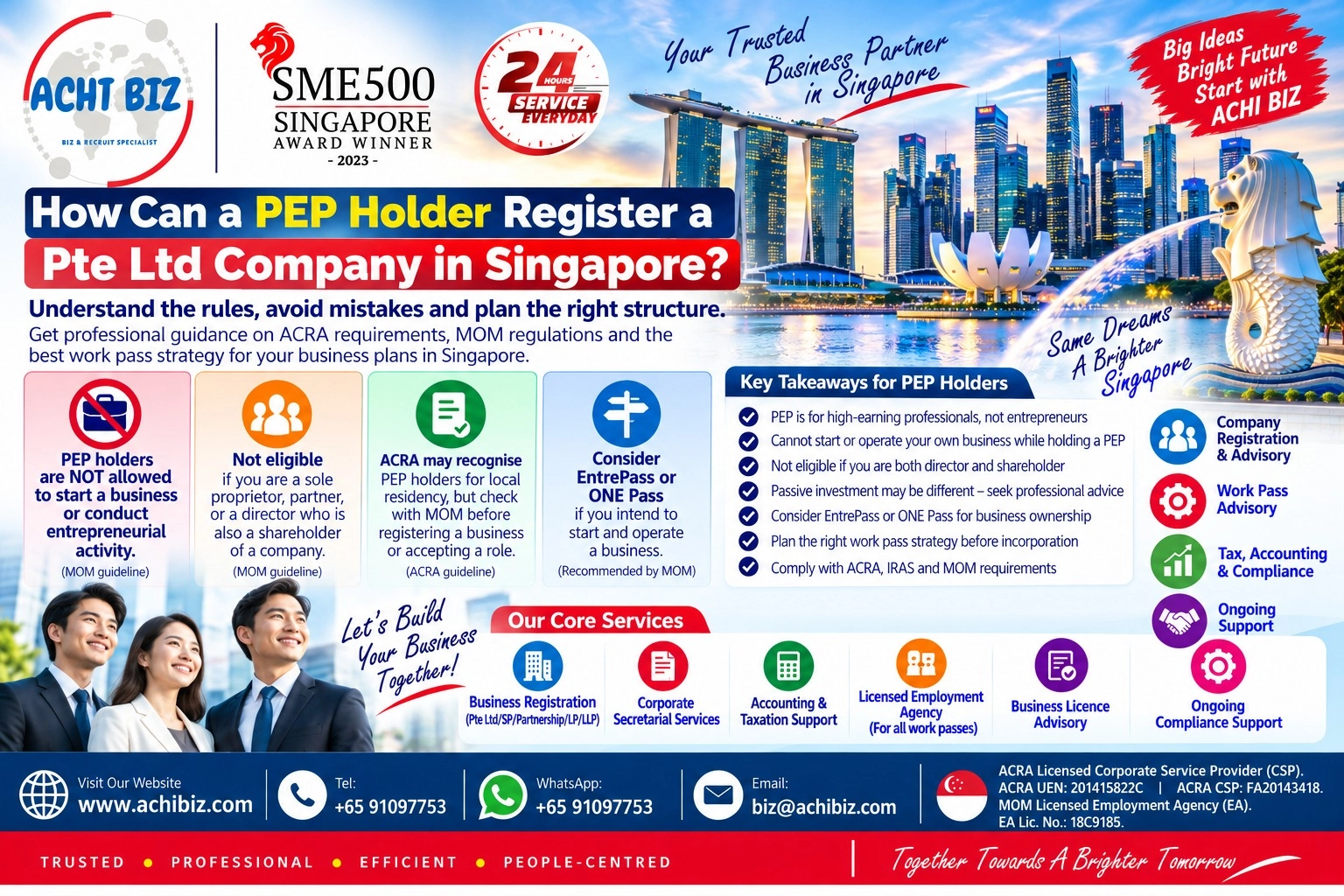
How Can a PEP Holder Register a Pte Ltd Company in Singapore?
A Personalised Employment Pass (PEP) gives a high-earning foreign professional greater employment flexibility in Singapore, but there is an important restriction that anyone considering Singapore company registration while holding a PEP should understand from the beginning:
A PEP holder is not allowed to start a business or conduct entrepreneurial activity while holding the PEP.
MOM also states that a person is not eligible for the PEP if the person is a sole proprietor, partner, or a director who is also a shareholder of an ACRA-registered company. MOM specifically points people who intend to start a business towards the EntrePass or Overseas Networks & Expertise Pass (ONE Pass) instead.
This makes the PEP very different from the ONE Pass.
At the same time, ACRA’s general local-residency guidance lists a valid PEP holder among eligible FIN holders for its residency framework. But ACRA expressly tells FIN holders to check with their pass issuer, such as MOM, before registering a business or accepting a business role. In practice, ACRA eligibility does not override the conditions of the PEP imposed by MOM.
For this reason, a PEP holder who wants to establish and personally operate a Pte Ltd company should plan the work-pass transition and company structure before beginning entrepreneurial activity.
Can a PEP holder register a Pte Ltd company in Singapore?
A PEP holder should not treat the PEP as a pass for starting and operating a business.
MOM expressly states that PEP holders are not allowed to start a business or conduct any form of entrepreneurial activity while holding the PEP.
Therefore, someone whose real intention is to establish and personally operate a Singapore Pte Ltd company should first consider an appropriate immigration/work-pass arrangement rather than simply incorporating the company and beginning business activities under the PEP.
Why is company registration more complicated for a PEP holder?
Because two different regulatory frameworks apply.
ACRA regulates company incorporation, directors, shareholders and corporate compliance.
MOM determines what activities a PEP holder may undertake under the work pass.
ACRA recognises PEP holders within its general local-residency framework but expressly advises FIN holders to check with their pass issuer before registering a business or accepting a role. MOM, meanwhile, expressly prohibits a PEP holder from starting a business or conducting entrepreneurial activity.
Both sets of requirements therefore need to be considered together.
Is a PEP designed for entrepreneurs?
No.
The Personalised Employment Pass is primarily an employment pass for high-earning foreign professionals, offering greater flexibility to change employers without having to apply for a new pass each time.
It is not an entrepreneur work pass.
MOM expressly directs a PEP holder who intends to start a business or undertake entrepreneurial activity towards the EntrePass or ONE Pass, subject to eligibility.
Can a PEP holder start and operate his or her own company?
Not while relying on the PEP for that entrepreneurial activity.
MOM’s current rule is explicit: a PEP holder is not allowed to start a business or conduct any form of entrepreneurial activity.
Therefore, incorporating a company should not be used as a way to circumvent the conditions attached to the PEP.
Can a PEP holder be both a shareholder and director of a Singapore company?
This is specifically problematic under the PEP rules.
MOM states that a person is not eligible for a PEP if the person is a director who is also a shareholder in an ACRA-registered company.
A PEP holder should therefore not structure his or her own company on the assumption that the person can simply become both shareholder and director while retaining the PEP.
Can a PEP holder be the sole shareholder and sole director?
That arrangement would make the PEP holder both a director and shareholder, which falls squarely within MOM’s stated PEP ineligibility condition.
Anyone intending to personally own and run a company should therefore determine the appropriate work-pass strategy before establishing such a structure.
Can a PEP holder be a shareholder without becoming a director?
MOM’s published PEP eligibility page specifically identifies “where a director is also a shareholder” as an ineligible situation, but it also separately states more broadly that PEP holders are not allowed to start a business or conduct any form of entrepreneurial activity.
Accordingly, passive investment and actually founding or operating a business should not be treated as the same thing.
Where a PEP holder is considering acquiring or holding shares purely as an investment, particularly in circumstances that could potentially be viewed as establishing or participating in a business, the specific arrangement should be checked with MOM rather than assuming that passive share ownership permits entrepreneurial involvement.
Can a PEP holder passively invest in an existing Singapore company?
MOM’s published PEP rules focus expressly on prohibited entrepreneurial activity and the situation where a person is simultaneously a director and shareholder. The published eligibility page does not, by itself, establish that every passive minority share investment is prohibited.
However, the line between passive investment and entrepreneurial participation can depend on the facts.
A PEP holder considering an investment should therefore avoid assuming that share ownership automatically permits management, directorship or operational involvement.
Can a PEP holder incorporate a company and appoint somebody else as director?
This should not be used as a workaround for the PEP restriction.
Even if another person is appointed as director, MOM separately prohibits the PEP holder from starting a business or conducting entrepreneurial activity.
The substance of the arrangement matters. A PEP holder who is effectively establishing, controlling and operating a business should not assume that appointing another director changes the underlying MOM position.
Can a PEP holder use a nominee director to start a business?
A nominee director arrangement does not override MOM’s restrictions on the PEP holder.
Singapore’s company framework recognises nominee-director arrangements and requires applicable nominee information to be maintained and filed through the ROND framework.
However, using a nominee director does not convert prohibited entrepreneurial activity by a PEP holder into permitted activity.
Can a PEP holder be the beneficial owner while somebody else appears as shareholder?
Ownership and control should be accurately disclosed.
Singapore companies have beneficial-ownership transparency requirements, including the Register of Registrable Controllers (RORC) and, where applicable, nominee-director and nominee-shareholder registers.
A nominee structure should never be used to conceal the true owner or controller or to circumvent work-pass restrictions.
Can a PEP holder act as a company director without holding shares?
MOM’s PEP eligibility page specifically prohibits the combination where a director is also a shareholder, while separately prohibiting entrepreneurial activity.
A directorship that is genuinely part of professional employment may therefore present a different situation from becoming a shareholder-director of one’s own business.
However, the nature of the appointment and the PEP holder’s actual activities matter. Where the proposed directorship is connected with establishing or operating the person’s own business, the broader prohibition on entrepreneurial activity becomes relevant.
Can a PEP holder be employed as a director by an unrelated company?
Potentially, depending on the actual employment arrangement and compliance with PEP conditions.
The PEP is not tied to one employer, and MOM states that a company can hire a PEP holder similarly to hiring a Singapore Citizen or PR, provided the company is not restricted from employing foreigners on work passes.
However, this should be distinguished from the PEP holder starting his or her own entrepreneurial venture.
Can a company employ a PEP holder?
Yes.
MOM states that a company can hire a PEP holder in broadly the same way it would hire a Singapore Citizen or Permanent Resident, provided the company has not been restricted by MOM from employing foreigners on work passes.
The employer or PEP holder must also comply with the applicable notification requirements.
Does a PEP holder need a new PEP when changing employers?
No.
One of the principal features of the PEP is that the holder does not need to reapply for a new pass simply because he or she changes jobs.
However, MOM must be notified of changes in employment.
How soon must MOM be notified when a PEP holder changes employment?
MOM currently requires notification within one week when the PEP holder starts employment, leaves employment or changes employer.
This is an individual PEP compliance requirement and should not be confused with ACRA company filings.
Can a PEP holder be unemployed?
The PEP provides some flexibility between jobs.
MOM currently permits a PEP holder to remain unemployed for a continuous period of up to six months while searching for new employment.
If the holder remains unemployed beyond the permitted period, the PEP cannot simply be retained indefinitely.
Can a PEP holder leave employment and spend six months building a business?
The unemployment flexibility is intended to allow the PEP holder to search for new employment, not to create a six-month entrepreneurship period.
MOM separately states that a PEP holder is not allowed to start a business or conduct entrepreneurial activity.
Can a PEP holder freelance while building a company?
No.
MOM expressly states that freelancers and foreigners intending to work on a freelance basis are not eligible for the PEP.
Freelancing should therefore not be treated as an alternative way to operate a personal business while retaining the PEP.
Can a PEP holder run an online business?
The fact that a business operates online rather than from physical premises does not change the basic MOM restriction.
ACRA treats regular profit-making online activities as activities that may require business registration, while MOM prohibits PEP holders from starting a business or conducting entrepreneurial activity.
An online store, consultancy platform or digital business should therefore not be assumed to fall outside the PEP rules.
Can a PEP holder run a home-based business?
The same principle applies.
Whether the activity is carried out from an office, home or online, MOM’s restriction concerns starting a business and entrepreneurial activity, rather than simply the location from which it is conducted.
Can a PEP holder provide freelance consultancy services?
A PEP is not intended for freelance work.
MOM specifically identifies a freelancer or foreigner intending to work on a freelance basis as ineligible for the PEP.
Can a PEP holder register a Sole Proprietorship instead?
No, not while seeking to remain eligible for the PEP.
MOM expressly identifies a sole proprietor as ineligible for the PEP.
Can a PEP holder become a partner in a Partnership?
MOM expressly lists a partner among persons who are not eligible for the PEP.
A Partnership should therefore not be treated as an alternative route around the restriction applying to a Pte Ltd business.
Can a PEP holder use an LLP or LP instead of a Pte Ltd company?
Changing the legal structure does not solve the underlying issue if the person is starting or operating a business.
MOM’s broader rule prohibits a PEP holder from starting a business or conducting entrepreneurial activity.
The PEP holder should therefore focus on obtaining the appropriate immigration/work-pass status rather than selecting a different ACRA structure simply to attempt to preserve the PEP.
Why does ACRA list a PEP holder under its local residency requirements?
ACRA’s framework deals with whether an individual can satisfy the applicable local residency requirement for a business position.
ACRA currently lists valid EP, PEP and ONE Pass holders among eligible FIN categories, but immediately cautions FIN holders to check with their pass issuer before registering a business name or accepting a role.
This is why ACRA eligibility should not be read in isolation.
Does ACRA’s recognition of a PEP holder mean MOM allows the PEP holder to start a company?
No.
The two issues are different.
ACRA may recognise the person’s immigration status for its local-residency framework, but MOM determines what the holder is permitted to do under the PEP.
MOM expressly prohibits entrepreneurial activity by PEP holders.
Can a PEP holder satisfy the local resident director requirement?
From ACRA’s general residency perspective, a valid PEP is one of the FIN categories listed in its local-residency framework.
However, a PEP holder considering a director appointment must also satisfy MOM’s PEP conditions. In particular, MOM states that a director who is also a shareholder of an ACRA-registered company is not eligible for PEP, and entrepreneurial activity is prohibited.
Accordingly, ACRA residency eligibility alone does not make a shareholder-director structure permissible under the PEP.
Can a PEP holder act as the local resident director of his or her own company?
A PEP holder should not assume so.
While ACRA recognises PEP holders within its general residency framework, MOM’s rules prohibit entrepreneurial activity and specifically identify a director who is also a shareholder as ineligible for PEP.
Someone intending to own and operate a company should therefore resolve the appropriate work-pass arrangement first.
Can the PEP holder appoint a Singapore Citizen or PR as local director?
A company can appoint eligible directors who satisfy ACRA’s requirements.
However, appointing a Singapore Citizen or PR as local resident director does not remove MOM’s restriction on the PEP holder personally starting or conducting entrepreneurial activity.
What if the PEP holder already owns a company before obtaining the PEP?
This should be reviewed carefully before the PEP is applied for or retained.
MOM’s current eligibility rules expressly address sole proprietors, partners, shareholder-directors and entrepreneurial activity.
The actual ownership, directorship and activities should therefore be disclosed and assessed against the prevailing PEP requirements rather than assuming a pre-existing company is automatically grandfathered.
What if a PEP holder inherits shares in a company?
An inherited passive investment can be factually different from deliberately establishing and operating a business.
However, MOM’s published PEP page does not provide a specific rule for every possible inherited-share scenario. Where the holding could involve directorship, control or active business participation, the PEP holder should seek clarification from MOM before undertaking the role.
What if a PEP holder buys shares in a listed company?
Ordinary personal investment in publicly traded securities is conceptually different from establishing and operating one’s own business.
However, this article concerns registering and operating a Singapore Pte Ltd company, where entrepreneurial involvement can be much more direct.
Can a PEP holder form an investment holding company?
This requires particular caution.
Even if the intended company would mainly hold investments, establishing one’s own corporate vehicle may still raise the broader MOM question of whether the holder is starting a business or conducting entrepreneurial activity.
The label “investment holding company” does not automatically remove the PEP restriction. The proposed arrangement should be checked before incorporation.
Can a PEP holder incorporate now but leave the company completely dormant?
A dormant company is still a registered company.
More importantly, MOM’s prohibition refers to starting a business, not only to generating revenue after incorporation.
A PEP holder should therefore not assume that incorporating a dormant company first and operating it later automatically avoids the PEP issue.
Can a PEP holder reserve a company name first and decide later?
Foreigners must engage a Corporate Service Provider (CSP) to reserve a name and register a business structure. ACRA also expressly advises FIN holders to check with their pass issuer before registering a business name or accepting a role.
Accordingly, the MOM position should ideally be considered before even beginning the registration process.
Does a PEP holder need an ACRA Licensed Corporate Service Provider?
ACRA states that foreigners must engage a Corporate Service Provider (CSP) to reserve a business name and register a business structure.
However, the CSP registration process cannot override MOM’s restrictions on the individual’s PEP.
Should the CSP check the PEP holder’s work-pass position before incorporation?
Yes, this is a sensible part of pre-incorporation planning.
The proposed shareholder, director and operating roles should be understood before the company is registered.
For a PEP holder, the most important question may therefore arise before incorporation:
Will the proposed arrangement amount to starting or operating a business while holding the PEP?
What work pass should a PEP holder consider if he or she genuinely wants to start a business?
MOM expressly states that a PEP holder who intends to start a business or conduct entrepreneurial activity should consider the EntrePass or ONE Pass, subject to the applicable eligibility requirements.
These are different work-pass schemes and should be evaluated separately.
Is ONE Pass more suitable for someone who wants to operate several companies?
The ONE Pass has substantially different business flexibility from the PEP.
MOM’s PEP rules expressly direct prospective entrepreneurs towards the ONE Pass or EntrePass rather than using the PEP for entrepreneurial activity.
Whether the individual actually qualifies for ONE Pass must be assessed under the prevailing ONE Pass criteria.
Is EntrePass automatically available to every PEP holder who wants to start a company?
No.
EntrePass has its own eligibility framework.
MOM describes it as being intended for qualifying serial entrepreneurs, high-calibre innovators or experienced investors whose business meets specified criteria, including relevant requirements relating to the proposed private limited company.
A person’s PEP status does not automatically make him or her eligible for EntrePass.
Can a PEP holder convert directly to ONE Pass?
Eligibility for ONE Pass must be assessed independently under the prevailing MOM criteria.
The fact that someone holds a PEP does not itself guarantee ONE Pass approval.
The individual should therefore establish eligibility before restructuring employment or business arrangements.
Can a PEP holder cancel the PEP and then start a business?
Potentially, provided the individual has the appropriate immigration and work authorisation for the intended business activities.
Cancelling the PEP by itself does not automatically confer permission to remain in Singapore and operate a company.
The next immigration/work-pass arrangement should therefore be planned before business operations begin.
Should the PEP be cancelled before incorporating the company?
There is no single answer suitable for every case because the sequencing depends on the proposed role, immigration status and next work-pass route.
What is clear from MOM’s rules is that the PEP holder should not start a business or conduct entrepreneurial activity while relying on the PEP.
The safest practical approach is therefore to determine the appropriate work-pass route and incorporation sequence before establishing the business.
Can a PEP holder switch to an EP through the new company?
Potentially, if the company and candidate satisfy MOM’s prevailing Employment Pass requirements and the arrangement is genuine.
An EP application is subject to MOM’s applicable eligibility framework, including the prevailing qualifying salary and, unless exempted, COMPASS requirements.
Incorporating a company does not guarantee approval of an EP.
Should the company be incorporated first and then apply for an EP?
This can depend on the proposed structure and circumstances.
A company normally needs to exist before it can act as an employer, but a PEP holder must simultaneously avoid conducting prohibited entrepreneurial activity while holding the PEP.
The proposed sequence should therefore be planned carefully with the appropriate professional advice rather than using a one-size-fits-all approach.
Does owning a company guarantee an Employment Pass from that company?
No.
ACRA incorporation and MOM work-pass approval are separate processes.
Being a shareholder does not guarantee that MOM will approve an Employment Pass application.
The candidate and employer must independently satisfy the prevailing requirements.
Can a PEP holder become an employee of another person’s Pte Ltd company?
Yes, subject to PEP requirements.
MOM states that a company may hire a PEP holder similarly to hiring a Singapore Citizen or PR, provided the company has not been restricted from employing foreigners on a work pass.
This illustrates the central distinction: the PEP provides employment flexibility, not entrepreneurial freedom.
Can a PEP holder work in any industry?
The PEP offers flexibility to work in different sectors, but it does not remove professional registration requirements for regulated professions such as medicine, dentistry, pharmacy, architecture or law. MOM also imposes restrictions on certain occupations.
Is a PEP renewable?
No.
MOM states that the PEP is issued for up to three years and is non-renewable.
A PEP holder planning a future business should therefore consider the longer-term immigration strategy well before the pass expires.
What happens when the PEP expires?
MOM states that a PEP holder who wishes to continue working in Singapore after the PEP expires will need an appropriate work pass, such as an Employment Pass or S Pass where eligible.
Someone planning entrepreneurial activity should instead assess the work-pass route appropriate to that intended activity.
Does the PEP have an annual income requirement?
Yes.
MOM imposes continuing employment and annual income requirements on PEP holders.
Because these monetary thresholds can change, ACHI BIZ recommends checking the prevailing MOM PEP income requirements rather than relying on figures quoted in older articles.
Does a PEP holder need to declare annual salary to MOM?
Yes.
MOM requires PEP holders who are due to make the declaration to submit their annual salary notification, generally by 31 January for the applicable reporting exercise.
The holder should follow MOM’s notification instructions for the relevant year.
Does business income count as PEP salary?
A PEP is built around qualifying professional employment, and MOM separately prohibits entrepreneurial activity.
A PEP holder should therefore not assume that business profits, dividends or entrepreneurial income can simply be substituted for the fixed employment salary required to retain the PEP.
Can dividends from a company be used to satisfy the PEP income requirement?
The PEP framework refers to fixed salary from employment. MOM’s annual declaration guidance calculates fixed annual salary using fixed monthly salary and months worked.
Dividends arising from share ownership should therefore not be treated as fixed employment salary.
Can director’s fees satisfy the PEP salary requirement?
The PEP framework is based on fixed salary from qualifying employment.
A PEP holder should not assume that director’s fees, dividends, investment returns or other non-salary amounts satisfy MOM’s fixed-salary requirement.
Can a PEP holder hire employees through his or her own company?
That would normally imply that the PEP holder has established or is operating a business, which raises the direct MOM restriction on entrepreneurial activity.
The appropriate work-pass and corporate structure should therefore be established before personally operating a company and hiring staff.
Can a company owned by a former PEP holder hire foreign employees?
Potentially, once the company is properly established and the individual’s work-pass position permits the intended business activity.
Each foreign employee must independently qualify for the appropriate work pass, and the employer must satisfy MOM’s prevailing requirements.
Can the company hire EP holders?
Potentially, subject to the prevailing MOM requirements for the employer and candidate.
Current EP applications operate under MOM’s applicable qualifying-salary and COMPASS framework, unless an exemption applies.
Because the qualifying figures can change, they should be checked when the application is actually planned.
Can the company hire S Pass or Work Permit holders?
Potentially, depending on the company’s sector and the relevant work-pass requirements.
The employer must satisfy the prevailing MOM qualifying salary, quota, levy, local workforce, sector, source-country or region and other eligibility requirements, as applicable.
These requirements should be checked when manpower planning is undertaken rather than hard-coded into a long-term business plan.
What is the minimum share capital for a Singapore Pte Ltd company?
The statutory minimum can be very low, but the commercially appropriate amount depends on the proposed business.
The important point for a PEP holder is that meeting the company-law share-capital requirement does not resolve the MOM restriction on entrepreneurial activity.
Can a PEP holder use S$1 share capital to establish a company?
The amount of share capital does not change the work-pass issue.
A small amount of capital may satisfy the basic company-registration requirement, but MOM’s PEP restrictions relate to the individual’s entrepreneurial activity rather than the size of the investment.
Does a Singapore Pte Ltd company need a registered office?
Yes.
A Singapore company must maintain the applicable registered-office arrangements.
The registered office is part of the company’s corporate requirements and is separate from the PEP holder’s work-authorisation position.
Does the company need a company secretary?
Yes.
Every Singapore company must have a company secretary, and ACRA requires the secretary to be appointed within six months after successful registration.
A sole director cannot simultaneously act as the company’s secretary.
Does the company need an auditor?
Not necessarily.
An auditor must generally be appointed within three months unless the company qualifies for an applicable audit exemption.
Under the current small-company framework, a private company can qualify for audit exemption if the prescribed criteria are met, including the applicable revenue, assets and employee tests.
Does the company need a business licence?
That depends on its activities.
ACRA specifically advises companies to check whether additional licences or permits are required before commencing operations.
Company incorporation does not itself authorise every type of business activity.
Should licences be checked before company incorporation?
Preferably, yes.
Certain regulated businesses may have requirements concerning ownership, directors, qualified personnel, premises, financial resources or other matters.
Checking those conditions before incorporation can prevent the company from being structured in a way that is unsuitable for the intended business.
Does obtaining a business licence override the PEP restriction?
No.
A business licence authorises the company to conduct a regulated activity.
The PEP determines what the individual pass holder is permitted to do.
Obtaining a licence does not convert prohibited entrepreneurial activity into permitted activity.
What statutory registers must a Pte Ltd company maintain?
Depending on its circumstances, the company must maintain applicable records relating to members, officers, registrable controllers and nominee arrangements.
ACRA’s current framework includes the Register of Registrable Controllers (RORC) and, where applicable, the Register of Nominee Directors (ROND) and Register of Nominee Shareholders (RONS).
Why is beneficial ownership particularly important in a PEP-owned business structure?
Because appointing someone else as the registered director or shareholder does not necessarily change who ultimately owns or controls the company.
Singapore’s transparency framework requires applicable beneficial-ownership and nominee information to be maintained and filed.
A corporate arrangement should reflect the genuine ownership and control structure rather than being designed to hide entrepreneurial involvement.
Must a Pte Ltd company keep accounting records?
Yes.
IRAS requires companies to maintain proper records of financial transactions and retain relevant source documents, accounting records, schedules, bank statements and other business records for at least five years from the relevant Year of Assessment.
Does the company need financial statements?
Generally, Singapore companies must maintain proper accounts and prepare financial statements in accordance with the applicable requirements.
Audit exemption, where available, should not be confused with an exemption from maintaining proper accounting records.
Does the company need to file ECI?
Generally, companies must file Estimated Chargeable Income (ECI) within three months after their FYE, unless they qualify for the applicable filing waiver or are otherwise not required to file.
Does the company need to file Corporate Income Tax?
Yes, subject to the applicable IRAS rules.
Corporate tax compliance is separate from the PEP holder’s personal income-tax and MOM obligations.
Does a Pte Ltd company need to file an ACRA Annual Return?
Yes.
ACRA states that all Singapore companies must file an Annual Return each year while the company remains live.
The Annual Return is separate from the company’s Corporate Income Tax filing with IRAS.
Does an inactive company still need an Annual Return?
Yes.
A company remaining live on ACRA’s register continues to have Annual Return obligations.
Simply ceasing business activity does not automatically dissolve the company.
Can a PEP holder incorporate a company now and wait until the PEP expires before operating it?
This should not be assumed to be automatically compliant.
MOM expressly prohibits a PEP holder from starting a business, not merely from drawing salary from one.
If the commercial plan is to establish a company now and operate it later, the sequencing should be reviewed before incorporation.
Can the PEP holder prepare a business plan while still employed?
Ordinary personal planning is different from actually starting or conducting a business.
However, once activities move into incorporation, contracting, selling, operating, managing or other entrepreneurial conduct, the PEP restriction becomes materially relevant.
The specific facts should be considered before crossing from planning into actual business activity.
Can the PEP holder negotiate with investors before changing pass?
Early discussions do not necessarily amount to operating a business, but the distinction can become fact-specific.
Where the person is actively raising funds, entering commercial commitments or establishing the venture, professional advice and, where necessary, MOM clarification should be obtained before proceeding.
Can the PEP holder sign contracts for the new company?
Signing business contracts on behalf of one’s own venture would normally indicate active participation in the business.
A PEP holder should therefore not assume that incorporation through another director allows him or her to perform operational functions prohibited by the PEP conditions.
Can a PEP holder open and operate the company’s bank account?
Opening and controlling the bank account of one’s own newly established operating company can form part of active business management.
The individual should first resolve the underlying MOM work-pass position rather than treating banking authority as separate from the entrepreneurial activity.
Can the PEP holder market the company’s services while still holding the PEP?
Marketing, selling, negotiating with customers and providing services are all capable of forming part of operating a business.
The fact that no salary has yet been drawn does not necessarily convert active entrepreneurship into passive investment.
Can the PEP holder work for the company without salary?
The MOM restriction is not expressed merely as a prohibition on receiving salary.
It prohibits starting a business or conducting entrepreneurial activity.
Working for one’s own company without remuneration should therefore not be assumed to solve the problem.
Can the PEP holder call himself or herself an adviser instead of director?
Job titles do not determine the substance of the activity.
If the PEP holder is effectively founding, controlling, managing or operating the venture, changing the title to “adviser” does not necessarily change the underlying entrepreneurial nature of the activity.
What happens if the PEP holder no longer satisfies the PEP conditions?
MOM states that where the holder no longer meets the requirements, the PEP will need to be cancelled.
The holder should therefore address changes in circumstances promptly rather than waiting until the annual notification exercise.
What employment changes must a PEP holder report to MOM?
MOM requires notification within one week if the holder starts employment, leaves employment or changes employer.
Other personal-information changes also have prescribed notification timelines.
Is the PEP more flexible than an ordinary Employment Pass?
It is more flexible in relation to changing employment.
The PEP is not tied to a single employer and does not require the holder to obtain a new pass each time the person changes jobs.
However, that flexibility should not be confused with permission to become an entrepreneur.
Is the PEP more flexible than ONE Pass for business ownership?
No. The two passes serve different purposes.
The PEP offers employment mobility but prohibits entrepreneurial activity. MOM specifically points prospective entrepreneurs towards ONE Pass or EntrePass.
What is the biggest difference between PEP and ONE Pass for company founders?
For someone intending to establish and operate businesses, the distinction is fundamental:
PEP: designed for flexible professional employment, with entrepreneurial activity prohibited.
ONE Pass: a different pass framework intended to provide substantially broader professional and business flexibility, subject to its own eligibility and conditions.
A founder should therefore not assume that “personalised” means unrestricted business activity.
What is the biggest difference between PEP and EntrePass?
PEP is aimed at qualifying high-earning foreign professionals and does not permit entrepreneurial activity.
EntrePass is specifically intended for qualifying entrepreneurs, innovators and investors seeking to operate eligible businesses in Singapore.
What are the most common mistakes PEP holders make when planning a Pte Ltd company?
The most significant mistake is assuming that because the PEP offers flexibility to change employers, it also permits the holder to become an entrepreneur.
Other potential mistakes include becoming both shareholder and director, appointing a nominee director and assuming this removes the restriction, starting an online or consultancy business, working without salary for one’s own company, treating passive investment and active management as the same thing, or incorporating first and only considering MOM requirements afterwards.
The central principle is:
Employment flexibility under the PEP is not the same as entrepreneurial freedom.
What should a PEP holder do before starting a Singapore company?
The first step should be to define the intended role.
Is the individual making a passive investment?
Does the person intend to become a shareholder?
Will the person be a director?
Will the person personally manage or operate the company?
Will the company become the person’s primary business?
If the intention is genuine entrepreneurship, the appropriate work-pass route should be determined before entrepreneurial activity begins.
What is a practical roadmap for a PEP holder who wants to establish a Pte Ltd company?
A sensible sequence is:
- Define the proposed ownership, directorship and operational role.
- Assess whether the intended activities amount to starting or operating a business.
- Review the PEP restrictions before reserving a company name or incorporating.
- Determine whether another work-pass route, such as ONE Pass or EntrePass, may be appropriate and whether the individual qualifies.
- Plan the immigration/work-pass transition and company-incorporation sequence.
- Choose the company name, business activities and appropriate SSIC codes.
- Determine the shareholder and director structure.
- Confirm the local resident director arrangement.
- Decide appropriate share capital and registered office arrangements.
- Complete CSP KYC/CDD and ACRA incorporation when the structure and work-pass position permit.
- Appoint the company secretary within the required period.
- Obtain business licences and permits before commencing regulated activities.
- Establish banking, accounting, taxation and statutory registers.
- Address local and foreign employment requirements where employees will be hired.
- Maintain ongoing ACRA, IRAS, MOM and other applicable compliance.
Should a PEP holder incorporate first or resolve the work-pass strategy first?
For someone who intends to personally own and operate the business, the work-pass strategy should be considered first.
Otherwise, the individual may end up with a company that has been incorporated but cannot be personally operated under the existing PEP conditions.
What should a PEP holder ask before registering a Pte Ltd company?
Instead of asking only:
“Can I register a company while holding a PEP?”
the more useful questions are:
“Am I intending to invest passively or start a business?”
“Will I be both shareholder and director?”
“Will I personally manage or operate the company?”
“Will I provide services to customers?”
“Will I receive salary, director’s fees or dividends?”
“Does my proposed activity conflict with the PEP’s prohibition on entrepreneurial activity?”
“Should I consider ONE Pass, EntrePass or another appropriate work-pass arrangement before incorporation?”
“Who will satisfy the company’s local resident director requirement?”
“Does the proposed business require licences?”
“What ACRA, IRAS and MOM compliance will apply after incorporation?”
These questions provide a much safer basis for planning than treating company incorporation as an isolated ACRA exercise.
Why should a PEP holder engage an ACRA Licensed Corporate Service Provider (CSP)?
ACRA requires foreigners to engage a Corporate Service Provider to reserve a business name and register a business structure.
For a PEP holder, the CSP should first understand the proposed ownership and director arrangement and recognise that ACRA incorporation does not override MOM’s work-pass conditions.
A properly structured incorporation should therefore follow, rather than precede, consideration of the PEP holder’s regulatory position.
Why can a MOM Licensed Employment Agency be useful for a PEP holder planning a business?
The core difficulty is not simply company registration. It is coordinating the proposed corporate structure with the person’s immigration and work-authorisation position.
A licensed Employment Agency can assist with eligible MOM work-pass matters, while the CSP handles the ACRA corporate aspects.
Where a change of work-pass strategy is required, the eligibility and appropriate sequence should be considered before the PEP holder begins operating the proposed company.
How can ACHI BIZ assist a PEP holder who wants to establish a Pte Ltd company in Singapore?
ACHI BIZ SERVICES PTE. LTD. is an ACRA Licensed Corporate Service Provider (CSP) providing professional assistance with Singapore company incorporation, company registration, corporate secretarial services, registered office address services, statutory compliance, accounting and taxation support, business licence advisory and related corporate services.
ACHI BIZ is also a MOM Licensed Employment Agency (EA) and can assist with eligible Singapore work-pass services, subject to MOM’s prevailing requirements.
For a Personalised Employment Pass holder, however, the starting point should not simply be filing an incorporation application.
MOM’s current rules expressly state that a PEP holder cannot start a business or conduct entrepreneurial activity and that a person who is both director and shareholder of an ACRA-registered company is not eligible for the PEP.
Accordingly, a PEP holder who genuinely wants to become a Singapore entrepreneur should first consider the appropriate work-pass strategy and only then structure the Pte Ltd company accordingly.
The key principle is:
A PEP provides flexibility to work for different employers in Singapore, but it is not an entrepreneur pass. If the objective is to start, own and personally operate a business, the work-pass position should be resolved before the business is established or operated.
Related Pages
How Can a ONE Pass Holder Register a Pte Ltd Company in Singapore? – FAQ Guide
How Can an Employment Pass (EP) Holder Register a Pte Ltd Company in Singapore? – FAQ Guide
#achibiz