
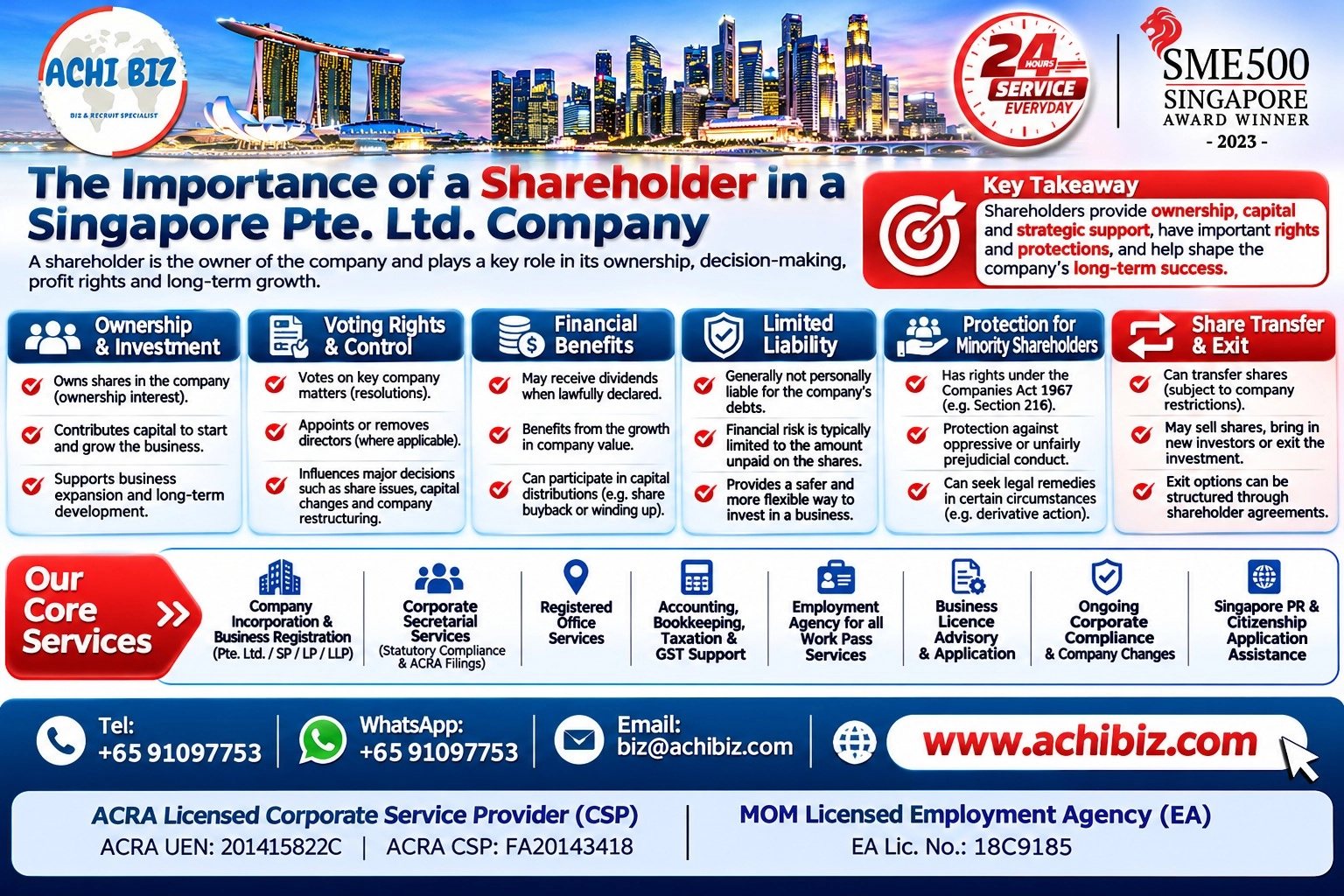
Importance of Shareholders in Singapore Pte. Ltd. Companies: Ownership, Rights, Benefits, Responsibilities & FAQ Guide
A Comprehensive Guide to Shareholder Ownership, Voting Rights, Share Capital, Dividends, Limited Liability, Minority Shareholder Protection and Corporate Governance in Singapore
Introduction
Every Singapore Private Limited Company (Pte. Ltd.) has an ownership structure, and at the centre of that structure are its shareholders.
Shareholders are individuals or corporate entities that hold shares in a company. Their ownership interests can influence how the business is funded, how important corporate decisions are approved, how profits may be distributed and how the company develops over time.
However, being a shareholder involves much more than having a name recorded in ACRA’s company information.
Shareholders have legal rights, financial interests and important powers under the Companies Act 1967, the company’s constitution and, where applicable, shareholder agreements.
These rights may include voting on corporate matters, receiving dividends when lawfully declared, participating in certain decisions and exercising remedies when their interests are unfairly prejudiced.
At the same time, share ownership does not automatically give a shareholder the right to manage the company’s daily operations, withdraw company funds or disregard the rights of other shareholders.
Singapore’s corporate framework distinguishes between shareholders, directors and company secretaries.
Shareholders hold ownership interests. Directors manage or direct the management of the company’s business. Company secretaries support statutory administration and corporate compliance.
Understanding these distinctions is especially important for startups, SMEs, family-owned businesses, investment holding companies, foreign-owned subsidiaries and businesses with multiple investors.
It is also essential when companies issue new shares, transfer existing shares, introduce investors, distribute dividends or restructure their ownership.
This comprehensive FAQ article explores the importance of shareholders in Singapore Pte. Ltd. companies, focusing on ownership rights, voting power, financial benefits, shareholder protection, investment risks, ownership changes and long-term business continuity.
The article is intentionally different from our separate guides on the importance of company directors and company secretaries. Its primary focus is the shareholder’s position as an owner and investor, rather than the management or administrative functions of company officers.
Part 1: Understanding the Importance of Shareholders in Singapore
Why are shareholders important in a Singapore Pte. Ltd. company?
Shareholders are important because they provide the ownership foundation of a company.
Through their shares, they hold economic interests and exercise certain rights over significant corporate matters.
Shareholders may contribute capital, support business expansion, appoint or remove directors through applicable procedures and influence important decisions requiring shareholder approval.
Their participation can also affect the company’s ownership stability, investment attractiveness and long-term succession planning.
What is the main purpose of having shareholders in a private limited company?
Shareholders provide the ownership structure through which individuals or entities invest in and hold interests in a company.
Their shares may entitle them to voting rights, dividends, capital distributions or other rights, depending on the share class and applicable arrangements.
The shareholder structure also establishes who may exercise ownership-related powers under the Companies Act and the company’s constitution.
Is having at least one shareholder mandatory for a Singapore Pte. Ltd. company?
Yes.
A Singapore private limited company must have at least one member or shareholder.
A company may be incorporated with a single shareholder, provided the applicable incorporation requirements are satisfied.
Can a Singapore Pte. Ltd. company have only one shareholder?
Yes.
A private limited company may have one shareholder who owns all its issued shares.
This arrangement is common among owner-managed businesses and wholly owned subsidiaries.
The sole shareholder may also serve as a director, subject to the relevant legal requirements.
What is the maximum number of shareholders in a Singapore private company?
An ordinary private company is generally limited to 50 members, subject to the applicable statutory rules for counting members.
A private company must also restrict the right to transfer its shares through its constitution.
Companies planning to admit additional investors should consider these requirements before changing their ownership structure.
Can a shareholder be an individual or a company?
Yes.
A shareholder may be a natural person or a corporate entity, subject to applicable legal requirements.
For example, a Singapore Pte. Ltd. company may be owned by an individual entrepreneur, another Singapore company or an overseas corporate investor.
Can a foreigner own shares in a Singapore Pte. Ltd. company?
Yes.
Singapore generally permits foreign individuals and corporate entities to own shares in locally incorporated private limited companies.
In many business sectors, a company may be wholly foreign-owned.
However, certain regulated activities may be subject to specific ownership restrictions, licensing conditions or approval requirements.
Can a Singapore company be 100% foreign-owned?
Yes, generally.
A Singapore Pte. Ltd. company may have all its shares owned by foreign persons or overseas companies, subject to applicable sector-specific restrictions.
However, foreign ownership does not remove the requirement to appoint at least one director who is ordinarily resident in Singapore.
Is a shareholder automatically a director?
No.
A shareholder is an owner of shares, while a director holds a separate corporate management position.
A shareholder may also be appointed as a director, but share ownership alone does not create a directorship.
Is a shareholder automatically an employee?
No.
A shareholder does not become an employee merely by owning shares.
Employment requires a separate legal relationship.
A shareholder may be an employee, director or both, but each capacity has different rights and obligations.
Why is the distinction between shareholder and director important?
Shareholders exercise ownership-related rights, while directors are responsible for managing or directing the company’s business.
Certain major decisions require shareholder approval, but shareholders do not automatically control every operational matter.
Understanding this distinction helps prevent disputes over decision-making authority.
Why is the distinction between shareholder and company secretary important?
A shareholder owns shares in the company.
A company secretary is a statutory officer responsible for supporting corporate administration and compliance procedures.
A shareholder may hold both roles if legally eligible, but ownership does not automatically confer the secretary’s appointment or responsibilities.
Does owning shares mean owning the company’s physical assets?
No.
A company is a separate legal entity.
Its property, money, equipment and other assets generally belong to the company, not directly to its shareholders.
Shareholders own shares representing interests in the company.
This distinction is fundamental to understanding corporate ownership.
Can a shareholder use company property for personal purposes?
Not simply because the person owns shares.
Company property must be used in accordance with the company’s lawful arrangements and relevant approvals.
A shareholder cannot automatically take company assets or money for personal use.
Why do shareholders matter even when they do not participate in daily operations?
Shareholders may exercise important rights without managing daily activities.
They may vote on resolutions, receive information through applicable legal processes and participate in major ownership decisions.
Their investment also gives them a financial interest in the company’s performance and future value.
Part 2: Shareholder Eligibility, Ownership Structure and Incorporation
What is the minimum age to become a shareholder in Singapore?
The legal position depends on the nature of the shareholding arrangement and the person’s capacity to enter into the relevant transaction.
For straightforward company incorporation and direct share subscription arrangements, adult shareholders are generally used.
Where a minor is proposed as a shareholder, the company should obtain appropriate legal advice concerning contractual capacity, registration and the relevant arrangements.
Must a shareholder be ordinarily resident in Singapore?
No.
There is no general requirement for every shareholder of a Singapore Pte. Ltd. company to reside in Singapore.
Foreign individuals and overseas companies may hold shares, subject to applicable legal and regulatory requirements.
Does a foreign shareholder need an Employment Pass to own shares?
No.
Owning shares in a Singapore company does not, by itself, require an Employment Pass.
However, share ownership does not automatically authorise the person to work in Singapore or undertake activities requiring an appropriate work pass.
Can an Employment Pass holder own shares in a Singapore company?
Yes, subject to applicable laws and work pass conditions.
However, owning shares and actively working for or managing a business are different matters.
The person should ensure that any employment or business activities comply with the relevant Ministry of Manpower requirements.
Can a foreign company become the sole shareholder of a Singapore subsidiary?
Yes.
An overseas company may own all the shares in a Singapore-incorporated subsidiary, subject to applicable legal requirements.
The Singapore subsidiary remains a separate legal entity with its own statutory obligations.
Can a holding company own shares in several Singapore subsidiaries?
Yes.
A holding company may hold shares in multiple subsidiaries.
Such arrangements may be used for investment, business expansion or group structuring.
However, group ownership does not automatically eliminate the separate legal responsibilities of each company.
Can a family jointly own a Singapore Pte. Ltd. company?
Yes.
Family members may hold shares individually or through suitable ownership arrangements.
The company should clearly document shareholdings, voting rights and relevant transfer restrictions.
A shareholder agreement may also help address succession and potential disagreements.
Can spouses own shares in the same company?
Yes.
Spouses may each hold shares in a Singapore company.
Their respective ownership percentages and rights should be properly documented.
Personal relationships do not automatically replace the legal rights attached to the shares.
Can a company have shareholders with unequal ownership percentages?
Yes.
Shareholders may own different numbers of shares and therefore hold different percentages of the company’s issued share capital.
For example, one shareholder may own 70% and another 30%.
However, voting power and financial entitlements also depend on the rights attached to the relevant share classes.
Can two shareholders own exactly 50% each?
Yes.
A company may have two shareholders holding equal ownership interests.
However, a 50:50 structure can create decision-making deadlocks where the shareholders disagree.
Companies adopting equal ownership arrangements should consider suitable dispute resolution and deadlock provisions.
Can a shareholder own less than 1% of a company?
Yes.
A shareholder may hold a very small percentage of the company’s shares.
The legal rights associated with that holding depend on the share class, the Companies Act and applicable corporate arrangements.
Is there a minimum percentage of shares that a shareholder must own?
There is generally no universal minimum ownership percentage applicable to every shareholder of a Singapore Pte. Ltd. company.
A person may hold a small number of shares, provided the shareholding is validly created or transferred.
Can a company have different categories of shareholders?
Yes.
A company may issue different classes of shares with different rights, subject to the Companies Act and its constitution.
For example, ordinary shareholders and preference shareholders may have different voting, dividend or capital rights.
What is the difference between a registered shareholder and a beneficial owner?
A registered shareholder is the person or entity recorded as holding the shares.
A beneficial owner is generally the individual who ultimately owns or controls the relevant interest, directly or indirectly.
The two may be different, particularly where nominee arrangements or corporate ownership structures are involved.
Why is identifying the ultimate beneficial owner important?
Beneficial ownership transparency helps prevent the misuse of corporate structures for unlawful activities.
Singapore companies may have obligations concerning registrable controllers and nominee arrangements.
Accurate ownership information also supports regulatory compliance and appropriate customer due diligence.
Part 3: Share Capital, Investment and Ownership Interests
What is share capital in a Singapore Pte. Ltd. company?
Share capital generally represents the capital associated with shares issued by the company.
It is an important part of the company’s ownership and financing structure.
However, share capital should not be confused with the company’s current cash balance, profitability or overall market value.
Why is share capital important to shareholders?
Share capital reflects the shares issued and the relevant capital contributions or consideration.
It helps establish the company’s ownership structure and may influence how shareholders participate in future financing transactions.
However, the rights of individual shareholders depend on more than the amount of share capital alone.
Can a Singapore Pte. Ltd. company be incorporated with S$1 share capital?
Generally, yes.
A company may be incorporated with a low amount of initial issued share capital, subject to applicable requirements.
However, a business may require additional funding to operate effectively.
Certain regulated activities may also have minimum capital requirements.
Does a shareholder have to contribute cash to receive shares?
Not necessarily.
Shares may be issued for appropriate non-cash consideration, subject to applicable law and proper corporate procedures.
Examples may involve assets or other consideration.
The company should ensure that the transaction is appropriately documented and accounted for.
What is the difference between issued share capital and paid-up share capital?
Issued share capital concerns shares that the company has issued.
Paid-up share capital refers to the amount paid or credited as paid on those shares.
The distinction matters where shares are not fully paid.
Can a shareholder own shares that are not fully paid?
Yes, where the relevant share terms and arrangements permit.
However, the shareholder may remain liable for unpaid amounts in accordance with the applicable terms and law.
The company’s records should accurately reflect the payment status of the shares.
Does a higher share capital amount mean that the company is financially stronger?
Not necessarily.
Share capital is only one aspect of the company’s financial position.
Financial strength also depends on assets, liabilities, profitability, cash flow and other factors.
A company with substantial share capital may still experience financial difficulties.
How is a shareholder’s ownership percentage calculated?
Where all shares carry the same relevant ownership rights, the basic calculation is:
For example, if a shareholder holds 300 out of 1,000 issued ordinary shares, the shareholder owns 30% of those shares.
However, this percentage does not necessarily represent the same proportion of voting power or dividend entitlement where different share classes exist.
Does the number of shares determine voting power?
Often, but not always.
Voting rights depend on the terms attached to the relevant shares and applicable law.
Some share classes may carry different voting rights or no general voting rights.
Therefore, share quantity and voting power should not automatically be treated as identical.
Can shareholders contribute additional money without receiving new shares?
Yes.
A shareholder may provide additional funding through arrangements such as shareholder loans or other lawful capital contributions.
The legal and accounting treatment depends on the transaction.
Providing additional money does not automatically increase the shareholder’s ownership percentage.
What is a shareholder loan?
A shareholder loan is a financing arrangement in which a shareholder lends money to the company.
Unlike an ordinary share subscription, a loan generally creates a repayment obligation according to its terms.
The arrangement should be documented and assessed for accounting, tax and related-party considerations.
What is the difference between equity investment and a shareholder loan?
An equity investment involves acquiring an ownership interest through shares.
A shareholder loan generally creates a creditor relationship.
Shareholders and lenders may have different rights, risks and repayment priorities.
The company should clearly distinguish between the two arrangements.
Can shareholders recover their original investment whenever they wish?
Not automatically.
Shares are ownership interests rather than ordinary repayable deposits.
A shareholder may recover value through lawful mechanisms such as share transfers, dividends, capital reductions or distributions following a winding up.
Each mechanism is subject to its own legal and commercial requirements.
Does a shareholder’s investment guarantee a financial return?
No.
Share investments involve risk.
A company may experience losses, decline in value or become insolvent.
Shareholders are not guaranteed dividends or repayment of their original investment merely because they hold shares.
Part 4: Shareholder Voting Rights and Corporate Decision-Making
Why are shareholder voting rights important in a Singapore Pte. Ltd. company?
Voting rights allow shareholders to participate in decisions reserved for members under the Companies Act and the company’s constitution.
These decisions may affect the company’s ownership structure, governance arrangements and future direction.
Voting rights are particularly important where several shareholders have different interests or expectations.
Does every shareholder have the right to vote?
Not necessarily.
Voting rights depend on the class of shares held and the applicable legal and constitutional provisions.
Ordinary shares commonly carry voting rights, while certain preference or other share classes may have restricted voting rights.
The precise rights should be checked before shares are issued or acquired.
What is an ordinary shareholder resolution?
An ordinary resolution is generally passed by a simple majority of votes cast by shareholders entitled to vote, subject to the applicable law and voting arrangements.
Ordinary resolutions are used for various corporate decisions where a higher approval threshold is not required.
What is a special resolution?
A special resolution generally requires at least 75% of the votes cast by shareholders entitled to vote, together with the applicable notice and procedural requirements.
Special resolutions are required for certain significant corporate matters.
Examples include amendments to a company’s constitution and particular capital-related transactions.
Does owning 51% of the shares give a shareholder complete control?
No.
Where shares carry equal voting rights, a shareholder holding 51% may generally control decisions requiring a simple majority.
However, that holding may not be sufficient to pass a special resolution requiring at least 75% approval.
Other restrictions may arise under the constitution, shareholder agreements or applicable law.
Does owning 75% of the shares allow a shareholder to make every company decision?
No.
A 75% voting interest may be sufficient for many special resolutions, depending on the voting circumstances.
However, some transactions involve additional statutory conditions, class rights, contractual restrictions or court procedures.
A shareholder’s voting power does not override directors’ legal duties or the company’s other obligations.
Can a shareholder holding 25% of the shares block a special resolution?
Potentially.
Where all relevant shares have equal voting rights, a shareholder holding more than 25% of the votes cast against a proposed special resolution can prevent the required 75% majority.
A holding of exactly 25% does not necessarily block a special resolution if the remaining 75% vote in favour.
The outcome also depends on voting participation and the rights attached to the shares.
Can a minority shareholder influence company decisions?
Yes.
Minority shareholders may exercise voting rights, ask questions through appropriate procedures and use rights provided by law, the constitution or shareholder agreements.
Their influence depends on the size of their holding, the relevant voting thresholds and the nature of the proposed decision.
Can a shareholder vote against a decision proposed by the directors?
Yes, where the matter is properly submitted for shareholder approval and the shareholder has the relevant voting rights.
Directors may recommend a proposal, but shareholders entitled to vote may support or oppose it.
Can shareholders make decisions without holding a physical meeting?
Yes, in circumstances where the Companies Act permits resolutions to be passed by written means and the applicable requirements are satisfied.
This can be particularly convenient for private companies with shareholders located in different countries.
However, the correct procedure must be followed.
Can shareholders attend general meetings remotely?
Remote participation may be possible where permitted by applicable law and the company’s constitution.
The arrangements should satisfy relevant meeting, identification, participation and voting requirements.
Can a shareholder appoint a proxy to vote?
Generally, shareholders entitled to attend and vote at a general meeting may appoint a proxy in accordance with the Companies Act and the company’s constitution.
The company should ensure that the proxy appointment satisfies the relevant procedural requirements.
Does a shareholder have the right to receive notice of general meetings?
Shareholders entitled to receive notice must be notified in accordance with the applicable law and constitution.
The required notice period and content may depend on the type of meeting and resolution.
Can shareholders request an extraordinary general meeting?
Shareholders meeting the applicable statutory thresholds may have rights to require directors to convene a general meeting or use other statutory meeting procedures.
The specific requirements should be assessed under the Companies Act.
Can a shareholder demand that every business decision be put to a vote?
No.
Shareholders do not ordinarily have a right to vote on every operational decision.
Many matters fall within the directors’ management authority.
The company must distinguish between decisions reserved for shareholders and those entrusted to the board.
What happens if shareholders disagree on a major resolution?
If the required voting threshold is not achieved, the proposed resolution generally does not pass.
The company may need to reconsider the proposal, negotiate alternative arrangements or use relevant dispute resolution procedures.
Persistent disagreement can affect business continuity.
Part 5: Shareholders’ Rights to Dividends and Financial Benefits
Why are dividends important to shareholders?
Dividends provide a mechanism through which a company may distribute profits to shareholders.
For some investors, dividends are an important source of investment returns.
However, dividends are not guaranteed and must comply with applicable law and the rights attached to the shares.
Is every shareholder automatically entitled to annual dividends?
No.
A Singapore Pte. Ltd. company is not generally required to declare dividends every year.
The decision depends on the company’s financial position, applicable corporate procedures and the relevant share rights.
Can shareholders demand dividends whenever the company earns profits?
Not automatically.
The existence of profits does not necessarily create an immediate right to receive a dividend.
The company must follow the applicable dividend declaration procedures.
Shareholders should also consider whether the business needs to retain profits for operations or expansion.
Can dividends be paid when a company has no profits?
Section 403 of the Companies Act generally prohibits dividends from being paid except out of profits.
A company should not assume that having sufficient cash automatically permits a dividend distribution.
Can different shareholders receive different dividend amounts?
Yes, where the differences arise from valid share rights or other lawful arrangements.
For example, shareholders holding different classes of shares may have different dividend entitlements.
However, a company should not arbitrarily discriminate between holders of shares carrying identical dividend rights.
Do preference shareholders receive dividends before ordinary shareholders?
Preference shares may provide priority dividend rights, depending on their terms.
However, the exact entitlement depends on the company’s constitution and the rights attached to those shares.
Not every preference share arrangement provides an unconditional dividend guarantee.
What is the difference between cumulative and non-cumulative preference dividends?
Cumulative preference shares may provide for unpaid preferential dividends to accumulate in accordance with their terms.
Non-cumulative preference shares generally do not provide the same accumulation right.
The actual legal and financial consequences depend on the share terms.
Can shareholders receive dividends without being directors?
Yes.
Dividend entitlement arises from share ownership and the rights attached to the shares, not from holding a directorship.
A shareholder may receive dividends without participating in the company’s management.
Can a shareholder receive both salary and dividends?
Yes, where the shareholder also has a genuine employment or executive role and the relevant payments are lawfully authorised.
Salary compensates the individual for employment or services, while dividends arise from share ownership.
The payments have different legal, accounting and tax characteristics.
Are dividends received by individual shareholders taxable in Singapore?
Dividends paid by Singapore-resident companies under the one-tier corporate tax system are generally not taxable in the hands of shareholders in Singapore.
However, different rules may apply to particular distributions, foreign-sourced income or other arrangements.
Shareholders should consider their individual tax circumstances, including any overseas tax obligations.
Can foreign shareholders receive dividends from Singapore companies?
Yes.
Foreign shareholders may receive dividends where they are entitled under the relevant share rights and a lawful dividend is declared.
Singapore generally does not impose withholding tax on ordinary dividends paid by Singapore-resident companies under its one-tier corporate tax system.
However, the shareholder’s country of tax residence may impose separate tax obligations.
Can a company retain profits instead of distributing them?
Yes.
A company may retain profits for working capital, future investments, debt repayment or business expansion.
The decision must be made in accordance with applicable law, corporate authority and directors’ duties.
Can shareholders challenge an unfair refusal to distribute profits?
Potentially, depending on the circumstances.
A refusal to declare dividends does not automatically constitute misconduct.
However, persistent withholding of distributions combined with unfair or oppressive conduct may raise legal issues, particularly in closely held companies.
Shareholders should obtain legal advice where a serious dispute arises.
Part 6: Limited Liability and Financial Risks of Shareholders
What does limited liability mean for shareholders?
Limited liability generally means that shareholders of a company limited by shares are not personally responsible for the company’s debts merely because they own shares.
Their liability as members is generally limited to any amount unpaid on their shares.
However, separate personal obligations and unlawful conduct may create additional exposure.
Can a shareholder lose more than the amount invested?
A shareholder may lose the value of the investment.
Additional financial exposure may arise where shares are not fully paid or where the shareholder has separately undertaken obligations, such as a personal guarantee.
Ownership alone does not normally make the shareholder liable for all company debts.
Can company creditors sue shareholders personally for unpaid company debts?
Not ordinarily merely because the individuals are shareholders.
Creditors generally pursue the company for its liabilities.
However, personal guarantees, fraud, specific statutory provisions or other exceptional circumstances may create separate grounds for liability.
Does a shareholder become liable for company debts by owning 100% of the shares?
No.
Sole ownership does not automatically remove the company’s separate legal personality.
Nevertheless, a sole shareholder who is also a director may have additional responsibilities and potential liabilities arising from the directorship.
Can a shareholder personally guarantee the company’s bank loan?
Yes.
A shareholder may voluntarily provide a personal guarantee to a lender.
The guarantee creates a separate contractual obligation and may expose the shareholder’s personal assets if the company defaults.
Can a shareholder be required to contribute additional capital after incorporation?
Not automatically.
The answer depends on whether the shares are fully paid and whether the shareholder has agreed to additional funding obligations.
A company cannot simply assume that every shareholder must contribute more money whenever the business requires funds.
What happens to shareholders if the company becomes insolvent?
Shareholders generally rank behind creditors in the distribution of assets during a winding up.
They may receive no return if the company’s assets are insufficient to satisfy its liabilities.
This is one of the principal financial risks of equity ownership.
Are shareholders guaranteed repayment when a company is wound up?
No.
Any distribution to shareholders depends on the remaining assets after applicable liabilities and winding-up expenses have been addressed.
The rights attached to different share classes may also affect distribution priorities.
Can shareholders be personally liable for fraudulent activities?
Potentially.
Limited liability does not provide immunity for a shareholder’s own fraud, unlawful conduct or other personal wrongdoing.
The relevant consequences depend on the person’s involvement and applicable law.
Does limited liability protect shareholders who also act as directors?
Limited liability protects the shareholder in the capacity of member, subject to applicable exceptions.
It does not automatically protect the same individual against liability arising from breaches of directors’ duties, statutory offences or personal guarantees.
The two capacities must be considered separately.
Part 7: Minority Shareholders and Protection Against Unfair Treatment
Who is considered a minority shareholder?
A minority shareholder generally holds a non-controlling ownership or voting interest in the company.
For example, a person holding 10% of ordinary voting shares may be a minority shareholder where another shareholder controls the remaining 90%.
However, minority status alone does not determine every legal right.
Why are minority shareholders important in a Pte. Ltd. company?
Minority shareholders may contribute capital, expertise, business relationships and alternative perspectives.
They also have legally recognised interests that should not be disregarded simply because they hold fewer shares.
Fair treatment of minority investors can support confidence and stable business relationships.
Do minority shareholders have legal rights in Singapore?
Yes.
Minority shareholders may have rights under the Companies Act, the company’s constitution and applicable shareholder agreements.
These may include voting rights, information rights and access to certain statutory remedies.
Can a majority shareholder ignore minority shareholders completely?
No.
Although a majority shareholder may control many voting decisions, that power is not unlimited.
Certain actions may be restricted by law, the company’s constitution or shareholder agreements.
Unfairly prejudicial or oppressive conduct may also give rise to legal remedies.
What is minority shareholder oppression under Section 216 of the Companies Act?
Section 216 provides remedies in circumstances involving specified forms of oppression, disregard of members’ interests or conduct that is unfairly discriminatory or otherwise prejudicial.
A qualifying shareholder may apply to the court for relief.
Whether conduct amounts to oppression depends on the particular facts and legal principles.
Can minority shareholders take legal action against majority shareholders?
Potentially.
A minority shareholder may have legal remedies where the relevant statutory or legal conditions are satisfied.
However, disagreement with a majority decision does not automatically establish a legal claim.
Can a minority shareholder stop the majority from issuing new shares?
Not automatically.
The answer depends on the proposed transaction, voting requirements, pre-emption rights and other applicable legal arrangements.
A minority shareholder may have grounds to challenge an improper share issue in particular circumstances.
What is unfair dilution of minority shareholders?
Dilution occurs when new shares are issued and an existing shareholder’s percentage ownership decreases.
Dilution is not automatically unlawful.
However, an allotment undertaken for an improper purpose or in breach of relevant rights may raise legal concerns.
Can a majority shareholder force a minority shareholder to sell shares?
Not simply because the majority shareholder wants to acquire them.
A compulsory transfer may be possible under particular lawful arrangements, contractual provisions or statutory procedures.
The company must consider the applicable requirements before attempting to compel a sale.
What are tag-along rights?
Tag-along rights are contractual protections that may allow minority shareholders to participate in a sale by a controlling shareholder on specified terms.
They are commonly addressed in shareholder agreements.
Such rights do not automatically apply to every Singapore private company.
What are drag-along rights?
Drag-along rights are contractual provisions that may allow qualifying shareholders to require other shareholders to participate in a sale under specified conditions.
They may help facilitate a sale of the entire company.
Their operation depends on the relevant contractual terms and applicable law.
Can minority shareholders inspect the company’s accounting records?
Shareholders do not have an unrestricted right to inspect every internal accounting document merely because they own shares.
They may have rights to specified company information and records under applicable law.
Additional inspection rights may arise under the constitution, shareholder agreements or court orders.
Can minority shareholders request financial statements?
Shareholders may have statutory rights concerning financial statements and related documents, subject to the applicable requirements and exemptions.
The extent of access should be considered under the Companies Act and the company’s arrangements.
Can a minority shareholder challenge a director’s misuse of company funds?
Potentially.
Depending on the circumstances, remedies may include action by the company, proceedings under Section 216 or an application for permission to bring a statutory derivative action under Section 216A.
The appropriate remedy depends on the facts and legal requirements.
What is a statutory derivative action?
A statutory derivative action allows an eligible applicant, with the court’s permission and subject to the relevant conditions, to bring proceedings in the name and on behalf of the company.
It may be relevant where the company has suffered an alleged wrong but those controlling it do not pursue appropriate action.
Why should minority shareholders negotiate protections before investing?
Negotiating protections before investing may be easier than resolving disputes after disagreements arise.
Important matters may include voting arrangements, information rights, share transfer restrictions, funding obligations and exit procedures.
The protections should be properly documented and legally reviewed.
Part 8: Share Transfers, Ownership Changes and Exit Rights
Why is the ability to transfer shares important to shareholders?
Share transfer rights affect how shareholders can sell, reorganise or exit their investments.
Unlike shares in publicly traded companies, shares in a private limited company may be subject to significant transfer restrictions.
Shareholders should understand these restrictions before investing.
Can a shareholder freely sell shares in a Singapore Pte. Ltd. company?
Not necessarily.
A private company’s constitution must restrict the right to transfer shares.
The relevant restrictions may require approvals, notices or opportunities for existing shareholders to purchase the shares.
Shareholders should review the constitution and any shareholder agreement before arranging a sale.
Can a shareholder sell shares to an outsider?
Potentially.
However, the proposed transfer must comply with the company’s constitution, any applicable contractual restrictions and relevant legal procedures.
The company may need to complete appropriate documentation and ACRA filings.
What are pre-emption rights in a share transfer?
Transfer pre-emption rights may require a selling shareholder to offer shares to existing shareholders before transferring them to an outsider.
Their existence and operation depend on the relevant legal and constitutional arrangements.
They should not be confused with pre-emption rights concerning the issue of new shares.
Can a company refuse to register a share transfer?
Potentially, where the refusal is permitted under the applicable law and constitution.
However, directors should exercise any relevant discretion properly and in accordance with their legal duties.
A refusal may be challenged in appropriate circumstances.
Does signing a share transfer agreement automatically make the buyer a registered shareholder?
No.
A signed agreement is not necessarily sufficient to complete the legal registration of a share transfer.
The company must satisfy the relevant transfer requirements, including applicable ACRA procedures for private companies.
Is stamp duty payable on transfers of shares in Singapore?
Generally, share transfers may be subject to stamp duty.
For ordinary share transfers, the standard rate is generally 0.2% of the higher of the purchase price or the value of the shares, subject to the applicable valuation rules.
Additional rules may apply to particular transactions, including transfers involving property-holding entities.
Can shares be transferred as a gift?
Yes, subject to the applicable legal and constitutional requirements.
However, a transfer without monetary consideration does not automatically eliminate stamp duty or other relevant obligations.
Can a shareholder transfer shares to a spouse or child?
Potentially.
Family transfers must still comply with the company’s constitution, transfer procedures and applicable stamp duty requirements.
Additional considerations may arise where the proposed recipient is a minor.
What happens to shares when a shareholder dies?
The shares form part of the deceased shareholder’s estate or are otherwise dealt with according to the applicable legal arrangements.
The transfer or transmission process may involve probate, letters of administration and the company’s constitution.
The company should not automatically treat the deceased shareholder’s next of kin as the new registered shareholder.
Can shares be inherited by beneficiaries?
Yes, subject to applicable succession law and the necessary administration procedures.
The company should verify the authority of the personal representative and complete the appropriate corporate formalities.
Can shareholders sell their shares back to the company?
A company may be able to purchase its own shares through a lawful share buyback arrangement.
However, share buybacks are subject to specific statutory requirements, including approval, funding and procedural conditions.
A shareholder does not have an automatic right to require the company to repurchase shares.
Can a shareholder simply surrender shares and walk away?
Not necessarily.
Share ownership is a legal interest that must be dealt with through a recognised mechanism.
A shareholder generally cannot terminate ownership merely by notifying the company that the shares are no longer wanted.
What happens if a shareholder cannot find a buyer?
The shareholder may need to continue holding the shares unless another lawful exit mechanism is available.
This is an important liquidity risk associated with private company investments.
A shareholder agreement may help establish procedures for future exits.
Why should shareholders consider exit strategies before investing?
An exit strategy clarifies how an investor may recover value or dispose of shares.
It can address valuation, transfer restrictions, buyout arrangements and dispute resolution.
Without suitable arrangements, shareholders may become locked into a company for an extended period.
Part 9: Share Allotments, Dilution and Changes in Ownership Percentages
Why do companies issue additional shares?
Companies may issue additional shares to raise capital, admit investors, compensate eligible parties or implement corporate restructuring arrangements.
A share issue can affect existing ownership percentages and shareholder rights.
Can existing shareholders lose ownership percentage when new shares are issued?
Yes.
Where a company issues additional shares to another investor, an existing shareholder’s percentage may decrease unless the shareholder receives a proportionate allocation.
This is commonly called shareholding dilution.
How does shareholding dilution work?
Suppose a company has 1,000 issued ordinary shares.
Shareholder A owns 600 shares, representing 60%.
The company then issues 500 new ordinary shares to a new investor.
Illustration: Ownership dilution after a new share issue
Before allotment
A: 60% | B: 40%
After 500 new shares
A: 40% | B: 26.67% | New investor: 33.33%
Shareholder A
Shareholder B
New investor
Illustrative ordinary shares with identical ownership rights; percentages are rounded.
Shareholder A still owns 600 shares, but now holds only 40% of the enlarged total of 1,500 shares.
This illustrates why shareholders should understand the consequences of proposed allotments.
Does dilution always mean that an existing shareholder loses money?
No.
Although an existing shareholder’s percentage may decrease, the company’s overall value may increase if the new investment is commercially beneficial.
The economic impact depends on the issue price, company valuation, use of proceeds and other factors.
Can shareholders prevent dilution?
Shareholders may have protections under the company’s constitution, shareholder agreement or applicable law.
These may include pre-emption rights, consent requirements or other negotiated safeguards.
The availability of protection must be assessed for the particular company.
Can shares be issued at different prices?
Potentially, yes.
However, the issue must comply with the applicable legal requirements, share terms and corporate approvals.
The directors must also exercise their powers for proper purposes.
Differences in issue prices may raise valuation, fairness and governance considerations.
Can a shareholder maintain the same ownership percentage after a new allotment?
Yes, where the shareholder receives or subscribes for an appropriate proportion of the newly issued shares.
However, this depends on the terms of the allotment and any relevant rights.
Can a company issue shares to only one existing shareholder?
Potentially.
The company must comply with the Companies Act, its constitution and applicable shareholder rights.
An allotment that unfairly disadvantages other shareholders may create legal risks, depending on the circumstances.
Why should shareholders examine the terms of new share issues?
New shares may affect voting power, dividend entitlements, ownership percentages and control.
Shareholders should understand the commercial and legal implications before approving or participating in an allotment.
Part 10: Shareholder Agreements and Corporate Relationships
What is a shareholder agreement?
A shareholder agreement is a contract between some or all shareholders, and sometimes the company, governing specified aspects of their relationship.
It may address management participation, share transfers, funding, voting arrangements and dispute resolution.
Is a shareholder agreement mandatory for a Singapore Pte. Ltd. company?
No.
A shareholder agreement is not generally mandatory for every private limited company.
However, it can be particularly useful where several shareholders have different commercial expectations.
What is the difference between a shareholder agreement and the company’s constitution?
The constitution governs the company’s internal corporate framework and has statutory significance.
A shareholder agreement establishes contractual rights and obligations between its parties.
The two documents may overlap, but they are not interchangeable.
Can a shareholder agreement override the Companies Act?
No.
A shareholder agreement cannot lawfully override mandatory statutory requirements.
The agreement should be drafted consistently with applicable law and the company’s constitution.
Why should business partners sign a shareholder agreement?
Business partners may agree informally about ownership and management when starting a company.
However, disagreements can arise later concerning financing, profits, responsibilities or exits.
A properly drafted shareholder agreement helps clarify expectations before disputes occur.
What matters should a shareholder agreement address?
Relevant matters may include ownership percentages, voting rights, funding arrangements, dividend policies, share transfer restrictions, exit mechanisms and dispute resolution.
The appropriate provisions depend on the company’s ownership structure and business objectives.
Can shareholders agree to restrict the sale of shares?
Yes, subject to applicable law.
Restrictions may include rights of first refusal, approval requirements or lock-in periods.
Such provisions should be carefully drafted to avoid uncertainty.
What is a shareholder deadlock?
A deadlock occurs when shareholders cannot reach a decision necessary for the company’s operations or governance.
Deadlocks are particularly common in equal ownership arrangements.
A shareholder agreement may provide procedures for resolving them.
Can a shareholder agreement require shareholders to provide future funding?
Potentially.
Shareholders may contractually agree to specified funding obligations.
However, the terms should clearly explain the amount, circumstances and consequences of failing to contribute.
Can a shareholder agreement protect confidential business information?
Yes.
The agreement may contain confidentiality provisions addressing sensitive company information.
These provisions should be proportionate and consistent with applicable law.
Can shareholders agree not to compete with the company?
A shareholder agreement may contain non-competition provisions.
However, enforceability depends on the circumstances and applicable legal principles, including restrictions on unreasonable restraints of trade.
Such provisions should receive appropriate legal review.
What happens when a shareholder breaches the shareholder agreement?
The consequences depend on the contractual terms and applicable law.
Possible remedies may include damages, injunctions or other relief.
Not every breach automatically entitles the other shareholders to force a share transfer.
Part 11: Shareholders’ Access to Information and Corporate Transparency
Why is access to company information important for shareholders?
Access to appropriate company information helps shareholders understand the performance and governance of their investment.
It may also assist them in making informed voting decisions and assessing whether their interests are being treated fairly.
However, information rights are subject to applicable legal and contractual limits.
Can shareholders request copies of the company’s constitution?
Shareholders may have rights to obtain the company’s constitution under the applicable statutory framework.
The company should follow the relevant procedures for providing documents and charging any permitted fees.
Can shareholders inspect the company’s Register of Members?
The Companies Act provides rights concerning inspection of specified company registers, subject to the applicable framework.
For private companies, ACRA’s electronic register arrangements are relevant.
The shareholder should use the appropriate statutory or ACRA process.
Can shareholders access directors’ meeting minutes?
Shareholders do not automatically have an unrestricted right to inspect every board meeting minute.
Board minutes may contain confidential management information.
Access depends on applicable law, the company’s constitution, contractual rights or other lawful arrangements.
Can shareholders inspect minutes of general meetings?
The Companies Act provides rights concerning records of general meetings and members’ resolutions, subject to applicable requirements.
These records help shareholders understand formal corporate decisions.
Can shareholders demand access to company bank statements?
Not automatically.
Share ownership alone does not provide unrestricted access to all company banking records.
Additional rights may arise under contractual arrangements, court orders or other applicable legal provisions.
Can shareholders request information about directors’ remuneration?
Shareholders may have access to certain remuneration information through applicable financial reporting and corporate governance requirements.
The scope of disclosure depends on the company’s circumstances and relevant legal obligations.
Can shareholders request an independent audit?
The answer depends on the company’s audit status, the shareholder’s rights and the applicable statutory provisions.
Shareholders should not assume that any individual investor can automatically require a full independent audit at the company’s expense.
Where serious financial concerns arise, legal advice may be appropriate.
Why is transparency important in a company with multiple shareholders?
Transparent communication helps reduce misunderstandings about financial performance, corporate decisions and ownership matters.
It can also strengthen trust between shareholders and management.
However, transparency should operate within appropriate confidentiality and governance arrangements.
Part 12: Shareholders in Family Businesses, Startups and Foreign-Owned Companies
Why are shareholders important in a family-owned Singapore company?
Family shareholders may provide capital, continuity and long-term commitment.
However, combining family relationships with corporate ownership can create challenges concerning succession, voting and management.
Clear documentation helps separate personal expectations from legal ownership rights.
Can family members hold different classes of shares?
Yes.
A family-owned company may establish different share classes, subject to applicable legal requirements.
This may be relevant to dividend arrangements, voting rights and succession planning.
The structure should be carefully considered before implementation.
Can parents transfer company shares to their children as part of succession planning?
Potentially.
Such transfers must comply with applicable share transfer restrictions, stamp duty rules and succession arrangements.
Professional advice may be necessary where significant assets or complex family circumstances are involved.
Why is succession planning important for shareholders?
Succession planning addresses what happens to ownership when a shareholder retires, becomes incapacitated or dies.
Without clear arrangements, the company may experience uncertainty over ownership and decision-making.
Why are shareholders important for startups seeking investors?
Startup shareholders may contribute the capital required to develop products, employ personnel and expand operations.
New investors may also provide business knowledge, commercial networks and strategic support.
However, admitting investors can change the founders’ ownership and voting power.
Can startup founders lose control after accepting investors?
Yes.
Founders may experience dilution or agree to investor rights that affect corporate decisions.
The extent of control depends on the shareholding structure, voting rights and contractual arrangements.
Why should founders understand valuation before issuing shares?
Valuation affects how much ownership an investor receives in exchange for an investment.
An inappropriate valuation may lead to unexpected dilution or disputes.
Founders should consider the commercial terms and obtain professional advice where necessary.
Can foreign shareholders manage their Singapore company from overseas?
Foreign shareholders may exercise ownership rights from overseas.
However, owning shares does not automatically authorise them to undertake employment or operational activities in Singapore.
The company must also comply with local director and other statutory requirements.
Why should foreign investors understand Singapore shareholder rights before incorporation?
Foreign investors may be unfamiliar with local rules concerning share transfers, shareholder resolutions, dividends and corporate governance.
Understanding these matters helps them establish suitable ownership arrangements and avoid unrealistic expectations.
Does foreign ownership change the legal rights attached to shares?
Not automatically.
The rights attached to shares generally arise from the applicable law, share class, constitution and relevant agreements.
However, sector-specific regulations and other legal restrictions may affect particular foreign investment arrangements.
Part 13: Shareholders During Restructuring, Sale and Company Closure
What happens to shareholders when a company is sold?
The outcome depends on whether the transaction involves a sale of shares, a sale of business assets or another structure.
In a share sale, the selling shareholders transfer their ownership interests.
In an asset sale, the company may remain owned by the existing shareholders while transferring specified assets.
Can shareholders sell the entire company?
A company’s ownership may be transferred through a lawful sale of its shares.
However, the transaction must comply with applicable transfer restrictions, contractual obligations and regulatory requirements.
Can a majority shareholder sell the company without minority shareholder consent?
The answer depends on the transaction structure and applicable rights.
A majority shareholder may sell its own shares, subject to relevant restrictions.
However, compelling other shareholders to sell or approving particular corporate transactions may require additional authority.
What happens to shareholders during a merger or corporate restructuring?
A restructuring may change the company’s ownership, share classes or corporate structure.
The consequences depend on the legal mechanism used.
Shareholders should review the proposed transaction carefully before approving it.
Can shareholders approve a reduction of share capital?
Share capital reductions are subject to specific Companies Act procedures.
Shareholder approval may be required, together with other statutory safeguards.
The transaction should be distinguished from an ordinary dividend or share transfer.
Can shareholders voluntarily close a Singapore Pte. Ltd. company?
Shareholders may participate in approving relevant closure procedures, depending on the circumstances.
However, the company must comply with the applicable requirements for striking off or winding up.
Shareholders cannot simply declare the company closed while disregarding outstanding obligations.
What happens to shareholders when a company is struck off?
Once the company is struck off, it ceases to exist as a registered company, subject to the applicable legal framework and restoration provisions.
Shareholders should ensure that assets, liabilities and other relevant matters are properly addressed before the company applies for striking off.
What happens to remaining assets during a solvent winding up?
After liabilities and relevant expenses are satisfied, remaining assets may be distributed to shareholders according to their legal entitlements.
The distribution depends on the applicable winding-up procedures and share rights.
Do preference shareholders receive priority during liquidation?
Preference shares may carry preferential rights concerning the return of capital.
However, the actual priority depends on the share terms and applicable law.
Creditors generally rank ahead of shareholders.
Part 14: Practical Shareholder Scenarios in Singapore Pte. Ltd. Companies
Example 1: Why should a sole shareholder understand the company’s separate legal identity?
An entrepreneur incorporates a Pte. Ltd. company and owns all its shares.
The entrepreneur assumes that the company’s bank balance is personal money.
However, the company is a separate legal entity.
Any withdrawal must have a lawful basis and be properly recorded.
Sole ownership does not remove this distinction.
Example 2: What happens when two shareholders own 50% each and disagree?
Two business partners each hold 50% of the company’s voting shares.
They disagree about admitting a new investor.
Neither has sufficient voting power to approve the proposal independently where the applicable decision requires a majority they cannot obtain.
Without a suitable deadlock mechanism, the disagreement may prevent the transaction from proceeding.
Example 3: How can a minority shareholder’s ownership be diluted?
A company has two shareholders holding 80% and 20% of its ordinary shares.
The company proposes issuing substantial new shares to another investor.
If the minority shareholder does not participate proportionately, the shareholder’s ownership percentage may decrease.
The company must ensure that the allotment complies with applicable approval and shareholder rights requirements.
Example 4: Why should a shareholder review share transfer restrictions before investing?
An investor purchases shares in a private company expecting to sell them freely after two years.
Later, the investor discovers that the constitution restricts transfers to outsiders.
The investor may be unable to complete a proposed sale without satisfying the relevant procedures.
Reviewing these restrictions before investing could have prevented the misunderstanding.
Example 5: Why does a profitable company not necessarily pay dividends?
A company earns profits but needs substantial working capital for expansion.
Its directors decide that retaining funds is commercially appropriate.
Shareholders may be disappointed, but profits do not automatically create an immediate dividend entitlement.
The decision must be assessed against the applicable legal and corporate arrangements.
Example 6: Why should family shareholders prepare succession arrangements?
A family business has three shareholders, including a parent who owns the controlling interest.
The parent dies without clear arrangements concerning the shares.
The family may need to resolve estate administration and corporate ownership matters before the shares can be properly transmitted.
Advance succession planning can reduce uncertainty.
Example 7: What happens when a shareholder personally guarantees a company loan?
A shareholder owns 30% of a company and signs a personal guarantee for its bank financing.
The company subsequently defaults.
The shareholder may face liability under the guarantee even though the person owns only a minority shareholding.
The guarantee is separate from the shareholder’s limited liability as a member.
Example 8: Why is a shareholder agreement important when several investors join a company?
Three investors contribute capital to a startup but do not agree on future funding or exit arrangements.
After two years, one investor wants to sell while the others wish to continue operating the business.
Without clear contractual arrangements, the disagreement may become difficult to resolve.
A shareholder agreement could have established suitable procedures in advance.
Example 9: Can a foreign shareholder own all the shares without living in Singapore?
A foreign entrepreneur incorporates a Singapore Pte. Ltd. company and holds 100% of its shares.
This ownership arrangement is generally permissible.
However, the company must separately meet the requirement to have at least one ordinarily resident director and fulfil its other statutory obligations.
Example 10: Why is the difference between voting rights and ownership percentage important?
A company has ordinary shares and another class of shares with restricted voting rights.
One investor holds a substantial percentage of the total issued shares but does not have an equivalent percentage of general voting power.
The investor must examine the rights attached to each share class rather than rely solely on the overall number of shares held.
Part 15: Frequently Overlooked Questions About Shareholders
Can a shareholder remain anonymous to the public?
Shareholder information may be available through ACRA’s business information services, subject to the applicable disclosure framework.
Companies may also have obligations concerning registrable controllers and nominee shareholders.
A shareholder should not assume that ownership can be kept completely confidential.
Can a shareholder use a nominee to hold shares?
Nominee shareholding arrangements may be legally permissible.
However, applicable disclosure, recordkeeping and beneficial ownership requirements must be satisfied.
The arrangement should be properly documented and should not be used to conceal unlawful activities.
Can a shareholder own shares in competing companies?
Potentially.
Share ownership in competing businesses is not automatically prohibited.
However, contractual restrictions, confidentiality obligations, conflicts of interest or other legal considerations may apply.
Can a shareholder hold shares in several Singapore companies?
Yes.
An individual or corporate entity may hold shares in multiple companies, subject to applicable restrictions.
Each investment should be considered separately.
Can a shareholder receive a salary without being a director?
Yes, where the shareholder is genuinely employed by the company.
The employment relationship and remuneration must be appropriately documented.
Share ownership alone does not create an entitlement to salary.
Can shareholders receive interest on their share capital?
Shares do not ordinarily create a right to interest in the same manner as a loan.
Shareholder returns may arise through dividends or changes in investment value.
A shareholder loan is a separate financing arrangement that may provide for interest.
Can shareholders request repayment of share capital?
Not automatically.
Share capital is not an ordinary repayable loan.
Returning capital requires an appropriate lawful mechanism, such as a qualifying capital reduction or share buyback.
Can a shareholder refuse to contribute more money when the company experiences losses?
Generally, a fully paid shareholder is not automatically required to provide additional capital merely because the company incurs losses.
However, separate contractual commitments or unpaid share obligations may change the position.
Can a shareholder be removed from a company without consent?
A shareholder’s ownership cannot ordinarily be cancelled or transferred merely because another shareholder or director wants the person to leave.
Any compulsory transfer or other removal mechanism must have a lawful basis.
Can shareholders challenge inaccurate shareholding records?
Yes, where there is a legitimate basis for doing so.
The appropriate procedure depends on the nature of the error and the relevant legal framework.
Supporting documentation may be required to establish the correct ownership position.
Can a shareholder demand that the company be valued?
Not automatically.
A shareholder may obtain an independent valuation or exercise contractual valuation rights where available.
A company is not generally required to conduct a valuation whenever any shareholder requests one.
Does holding more shares always mean having greater control?
Not necessarily.
Control depends on voting rights, share classes, shareholder agreements and other governance arrangements.
A person with fewer shares may possess significant contractual or voting protections.
Can shareholders lose voting rights?
Voting rights depend on the share terms and applicable legal arrangements.
Changes to rights must comply with the relevant statutory and constitutional requirements.
They cannot simply be removed arbitrarily.
Can shareholders appoint someone to represent them?
Shareholders may use proxies or authorised representatives in circumstances permitted by the Companies Act and applicable procedures.
Corporate shareholders may also act through duly authorised representatives.
Can shareholders be involved in corporate governance without becoming directors?
Yes.
Shareholders may exercise voting rights, consider resolutions and participate in governance through lawful ownership mechanisms.
However, they should distinguish those rights from directors’ management responsibilities.
What is the biggest mistake shareholders make when investing in a Pte. Ltd. company?
A common mistake is focusing only on the ownership percentage without understanding the rights and restrictions attached to the shares.
Investors should also consider voting power, dividend entitlements, transfer restrictions, dilution risks and exit arrangements.
What should a person check before becoming a shareholder?
A prospective shareholder should review the company’s business and financial position, the relevant share class, ownership structure and applicable corporate documents.
The person should also understand the investment risks and any additional contractual obligations.
Why is professional advice important before entering into complex shareholding arrangements?
Complex ownership arrangements may affect corporate control, taxation, succession, financing and legal rights.
An improperly structured transaction may create disputes or unexpected financial consequences.
Professional advice can help identify relevant issues before the parties commit to an arrangement.
Part 16: The Long-Term Importance of Shareholders in Business Development
How do shareholders contribute to long-term business sustainability?
Shareholders can contribute financial capital, strategic support and a stable ownership structure.
Their willingness to support responsible investment and appropriate governance can help the company pursue long-term objectives.
However, shareholders should also recognise the commercial risks associated with their investments.
Why is a stable shareholder structure important?
A stable ownership structure can support continuity in corporate decision-making and investment planning.
Frequent ownership disputes or unexpected changes may create uncertainty for management, employees and business partners.
Can shareholders help attract additional investors?
Yes.
An established shareholder base, transparent ownership arrangements and appropriate governance practices may contribute to investor confidence.
However, investment decisions depend on many other factors, including business performance and financial prospects.
Why should shareholders periodically review their ownership arrangements?
A company’s circumstances may change as it grows.
New financing, business expansion, succession planning or changes in personal circumstances may make existing arrangements less suitable.
Periodic reviews can help identify whether the ownership structure continues to serve the shareholders’ objectives.
What is the long-term value of responsible shareholders?
Responsible shareholders recognise that ownership carries both rights and investment risks.
They exercise their powers appropriately, respect the company’s separate legal identity and consider the long-term consequences of major corporate decisions.
This can contribute to more stable governance and healthier relationships between owners and management.
Conclusion: Shareholders Are the Foundation of Ownership in Singapore Pte. Ltd. Companies
Shareholders play an essential role in Singapore private limited companies because they establish the company’s ownership structure and exercise important rights over its financial and corporate affairs.
Their importance extends beyond providing initial capital.
Shareholders may influence major corporate decisions, participate in voting, receive lawful distributions and exercise statutory protections where their interests are affected.
However, share ownership also involves financial risks and legal limitations.
Every shareholder should understand five fundamental principles:
-
Ownership and management are different. Shareholders own shares, while directors are responsible for managing or directing the company’s business.
-
Voting power depends on share rights. Ownership percentages do not always correspond directly to voting control.
-
Dividends are not guaranteed. Shareholders receive distributions only where they are lawfully declared and entitled to them.
-
Limited liability has boundaries. Shareholders are generally protected from company debts merely through ownership, but separate guarantees and personal misconduct may create liability.
-
Proper ownership documentation matters. Share transfer restrictions, shareholder agreements, dilution provisions and exit arrangements can significantly affect an investment.
For entrepreneurs and investors, understanding these principles before acquiring shares can help prevent costly misunderstandings.
For existing shareholders, reviewing their rights and obligations can support better decision-making, stronger ownership relationships and long-term business continuity.
Ultimately, the importance of shareholders lies not only in how much of a company they own, but also in how effectively their ownership rights, investment interests and responsibilities are understood and managed.
How can ACHI BIZ assist with shareholder and member compliance?
ACHI BIZ can assist Singapore companies with incorporation, share allotments and transfers, corporate secretarial matters, shareholder/member updates, nominee-shareholder compliance, statutory registers and ongoing corporate compliance.
Related Articles
Shareholder vs Member in a Singapore Pte. Ltd. Company: Are They the Same? – FAQ Guide
Shareholder Vs Beneficial Owner In Pte Ltd Company
#achibiz