
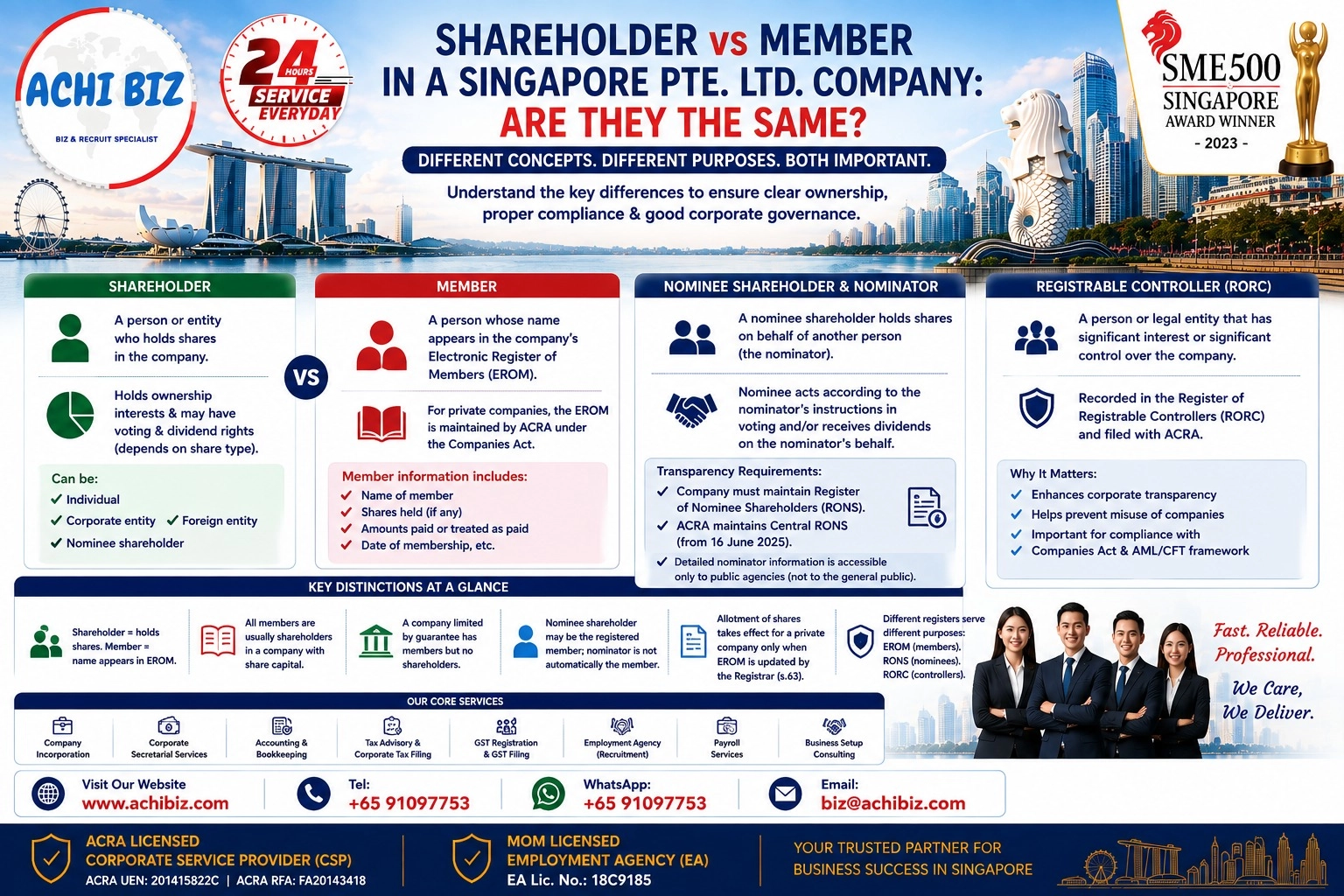
Shareholder vs Member in a Singapore Pte Ltd Company: Are They the Same?
“Shareholder” and “member” are often used as though they mean exactly the same thing. For an ordinary Singapore Pte. Ltd. company with share capital, they commonly overlap in practice, but the legal concepts should still be understood correctly.
ACRA currently explains the distinction directly: a member is a person whose name appears in the company’s Electronic Register of Members (EROM), while shareholders are persons or entities holding shares. ACRA also notes that the concepts do not always overlap—for example, a company limited by guarantee has members but no shareholders because it has no share capital.
What is a shareholder of a Singapore Pte. Ltd. company?
A shareholder is a person or entity that holds shares in the company.
Shares represent ownership interests, and ACRA states that shareholders can be individuals or corporate shareholders.
What is a member of a Singapore private company?
ACRA defines a member as a person whose name appears in the company’s Electronic Register of Members.
The Companies Act requires the Registrar to maintain the EROM for private companies.
Is every shareholder automatically called a member?
For a typical private company with share capital, the concepts commonly overlap once the relevant person’s membership/shareholding has legally taken effect and is reflected in the EROM.
However, it is safer not to state universally that “shareholder” and “member” always mean exactly the same thing.
Is every member necessarily a shareholder?
Not across every type of company.
ACRA gives the important example of a company limited by guarantee, which has members but no shareholders because it does not have share capital.
For an ordinary Pte. Ltd. company with share capital, the relationship is much closer.
What is the Electronic Register of Members (EROM)?
The EROM is the electronic register maintained by ACRA for private companies.
The Companies Act provides that it contains information including members’ names and, for companies having share capital, the shares held by each member, amounts paid or treated as paid, allotment information and dates of membership.
Why is the EROM important?
Because membership is not merely an informal description of who considers themselves an owner.
For private companies, the EROM has important legal significance in determining and recording membership.
When does a new share allotment take effect for a private company?
This is a particularly important point.
Under section 63 of the Companies Act, an allotment of shares by a private company generally does not take effect until the Electronic Register of Members is updated by the Registrar, subject to the statutory provisions.
This is one reason accurate and timely ACRA filings matter.
Can someone say “I paid for the shares, so I am already a member”?
Payment alone should not be used as the sole test.
The share allotment, corporate approvals, filing and EROM position must be considered.
Can an individual be a shareholder?
Yes.
Can another company be a shareholder?
Yes.
ACRA expressly recognises corporate shareholders, including limited companies, LLPs and certain other organisations.
Can a foreign person be a shareholder and member?
Generally, foreign individuals or entities may hold shares in Singapore companies, subject to any specific restrictions applicable to the relevant business or sector.
Is a director automatically a member?
No.
A director and a member perform different legal roles.
A director does not automatically become a shareholder or member merely by being appointed as a director.
Is a member automatically a director?
No.
Owning shares or being entered as a member does not automatically make someone a director.
Is a beneficial owner automatically the member shown in the EROM?
Not necessarily.
This is where nominee arrangements and beneficial ownership concepts become particularly important.
The person whose economic or beneficial interests are involved may not always be the same person appearing in a particular registered capacity.
Is a nominee shareholder a shareholder?
Yes. ACRA defines a nominee shareholder as a shareholder who, broadly, votes according to another person’s instructions and/or receives dividends on behalf of another person.
The person represented by the nominee is called the nominator.
Is it correct to say that a nominee shareholder can never be a member?
No. That would be too broad and potentially misleading.
Nominee status and membership should not be confused.
The fact that a shareholder holds shares under a nominee arrangement does not, by itself, mean that the person cannot appear in the EROM in the capacity recognised under the Companies Act.
This is why the EROM, RONS and RORC perform different functions.
Is the nominator automatically the registered member instead of the nominee shareholder?
Not necessarily.
The nominee arrangement identifies the person on whose behalf the nominee acts, but that does not mean the nominator automatically replaces the nominee in every statutory register.
Each register serves a different legal and transparency purpose.
What is the Register of Nominee Shareholders (RONS)?
The RONS records prescribed information concerning nominee shareholders and their nominators.
Singapore companies with share capital are subject to nominee-shareholder transparency requirements unless an applicable exemption applies. ACRA also maintains a Central RONS under the enhanced regime effective from 16 June 2025.
Is RONS the same as the Electronic Register of Members?
No.
They serve different purposes.
The EROM records company membership/shareholding information for private companies, whereas RONS specifically addresses nominee-shareholder arrangements.
Is RONS the same as the Register of Registrable Controllers (RORC)?
No.
The RORC concerns persons or legal entities that meet the statutory criteria for significant interest or significant control.
The RONS concerns nominee shareholders and their nominators.
One person may potentially appear in more than one relevant capacity, but the registers should not be treated as interchangeable.
Is a nominee shareholder automatically a registrable controller?
Not simply because the person is a nominee shareholder.
Whether someone is a registrable controller must be determined under the applicable control and ownership tests.
Is the nominator automatically a registrable controller?
Again, not automatically merely because that person is the nominator.
The RORC criteria must be separately applied.
Is nominee-shareholder status publicly visible?
Following the transparency reforms effective from 16 June 2025, nominee status filed with ACRA’s Central RONS is publicly reflected, including on the relevant company’s Business Profile, while detailed nominator information is restricted to public agencies for administration or enforcement of written law.
Does the public therefore know who the nominator is?
Not simply from the public nominee-status disclosure.
ACRA states that detailed particulars of nominators in its Central Registers are accessible only to public agencies for the administration or enforcement of written law.
Why does Singapore distinguish nominee arrangements from ordinary shareholding records?
The nominee framework enhances transparency over situations where the person formally acting as shareholder does so for another person.
The reforms are part of Singapore’s broader beneficial-ownership and anti-money-laundering transparency framework.
Can someone be a member without being the ultimate beneficial owner?
Potentially, yes.
This is precisely why registered membership, nominee status and beneficial/control concepts must be analysed separately.
Does being a member prove that the person ultimately benefits from the shares?
Not necessarily in every arrangement.
A nominee arrangement is an obvious example of why the registered position and the underlying economic arrangement may need separate analysis.
Why is the distinction between member and beneficial owner important?
Because different legal questions depend on different concepts.
For example:
- EROM addresses membership;
- RONS addresses nominee shareholders and nominators; and
- RORC addresses registrable controllers.
Using the word “owner” loosely can therefore create confusion.
Can a nominee arrangement be used without disclosure?
Companies and nominee shareholders must comply with the applicable statutory nominee-shareholder disclosure and register requirements.
ACRA’s current framework requires private RONS maintenance and Central RONS filings, subject to the relevant rules and exemptions.
Does being a member give someone voting rights?
That depends on the shares and rights involved.
Membership by itself should not be used to assume identical voting rights for every member. Different share classes can carry different rights.
Does every member have the same percentage of ownership?
No.
Members may hold different numbers and classes of shares.
Does every member have equal dividend rights?
Not necessarily.
Dividend rights can depend on the relevant share class and terms.
Can a company have only one member?
Yes. ACRA states that every company must have at least one member.
A Singapore private company can therefore have a sole shareholder/member structure where applicable.
Can the identity of members change?
Yes.
Membership/shareholding can change through transactions such as share allotments and transfers, subject to the Companies Act, constitution and required filings.
Why is accurate member information important?
The EROM is an official corporate register.
Incorrect or outdated shareholder information can create problems involving ownership, corporate actions, transactions, due diligence and compliance.
What is the simplest way to understand shareholder vs member?
For a conventional Singapore Pte. Ltd. company with share capital:
Shareholder describes a person or entity holding shares.
Member refers to a person whose name appears in the Electronic Register of Members.
They frequently refer to the same person in an ordinary private company, but they are not concepts that should be treated as universally identical in every corporate context.
What is the difference between shareholder, member, nominee shareholder and registrable controller?
In simplified terms:
Shareholder: holds shares in the company.
Member: appears in the EROM as a member.
Nominee shareholder: a shareholder meeting the statutory nominee criteria because the shareholder acts for another person in relation to voting and/or dividends.
Registrable controller: a person or legal entity satisfying the statutory significant interest or significant control criteria.
Understanding these distinctions is particularly important for Singapore corporate compliance.
What are the advantages of correctly distinguishing shareholders and members?
It helps companies maintain accurate records, structure share transactions properly, identify nominee arrangements, conduct due diligence and comply with statutory registers.
It also prevents misunderstandings about legal ownership, beneficial interests and control.
What are the disadvantages or risks of misunderstanding these terms?
Possible consequences include incorrect corporate records, improper share transactions, misunderstanding voting or ownership rights, incorrect nominee disclosures and potential compliance failures.
The terminology therefore matters beyond semantics.
How does this article connect with ordinary shares and paid-up capital?
A member may hold ordinary or other classes of shares, and those shares may be fully or partly paid depending on the arrangement.
For further analysis, see our related articles:
Why Do Singapore Pte. Ltd. Companies Commonly Issue Ordinary Shares?
Should Shareholders Fully Pay Their Share Capital in a Singapore Pte. Ltd. Company?
Paid-Up Capital at Incorporation or Later: What Is Better for a Singapore Pte. Ltd. Company?
How can ACHI BIZ assist with shareholder and member compliance?
ACHI BIZ can assist Singapore companies with incorporation, share allotments and transfers, corporate secretarial matters, shareholder/member updates, nominee-shareholder compliance, statutory registers and ongoing corporate compliance.
ACHI BIZ – Singapore Corporate Services
Our core services include company incorporation and business registration, corporate secretarial and compliance services, accounting and bookkeeping, corporate tax and GST, payroll and employment-related services, share allotments and transfers, and Employment Agency services for Work Pass matters.
Disclaimer: This FAQ provides general information about Singapore companies and should not be treated as legal, tax, accounting or investment advice. Share structures and shareholder arrangements should be considered according to the company’s constitution, applicable legislation and individual circumstances.
#achibiz