
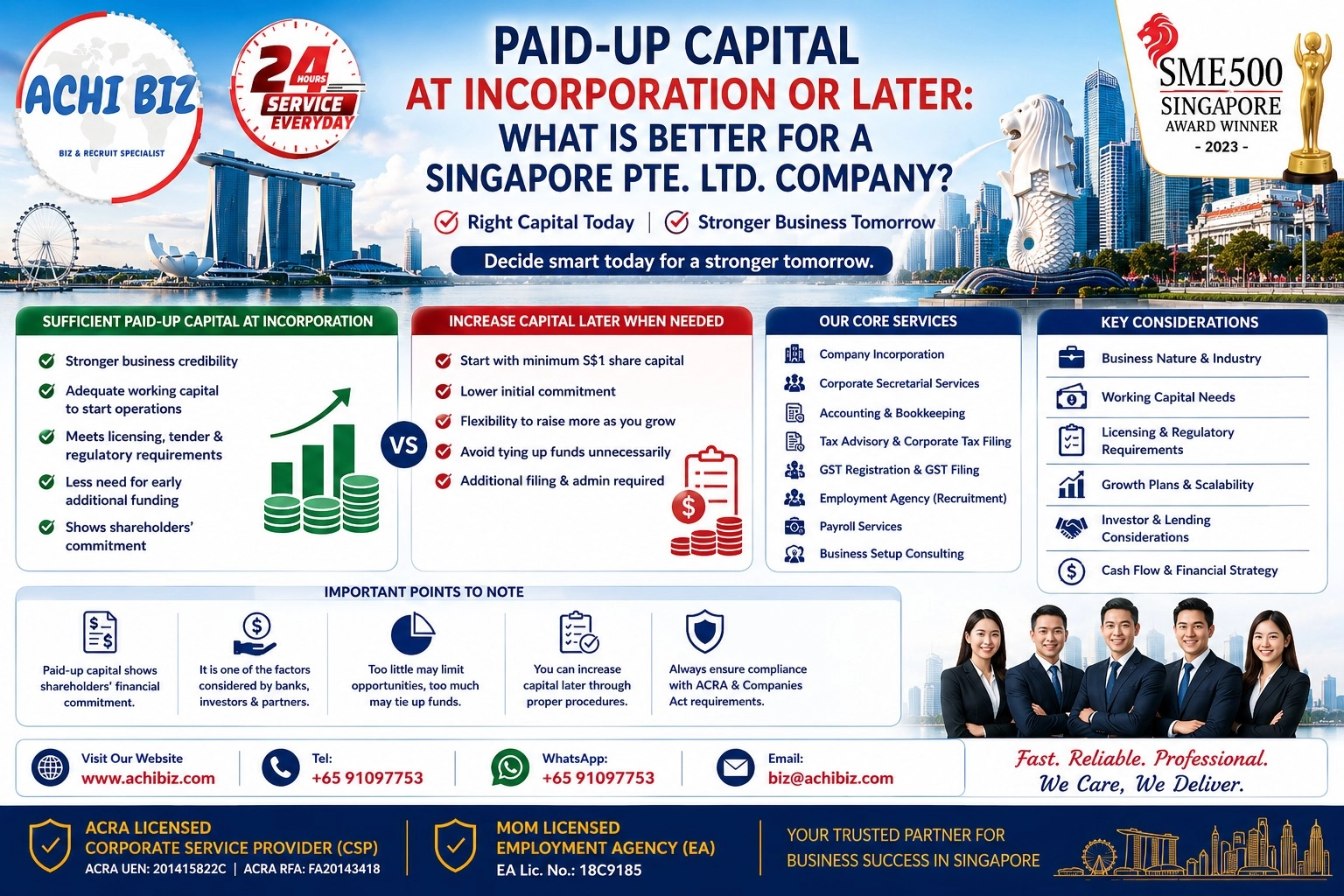
Paid-Up Capital at Incorporation or Later: What Is Better for Pte Ltd Company?
When incorporating a Singapore Private Limited (Pte. Ltd.) company, one of the practical decisions shareholders need to make is how much paid-up capital the company should have from the beginning.
A Singapore company that requires share capital can start with as little as S$1 in share capital. However, simply because a company can start with a very small amount does not necessarily mean that this is the most suitable amount for every business. ACRA defines share capital as the amount shareholders have committed to invest, while paid-up share capital is the amount they have actually paid for their shares.
The appropriate amount depends on the company’s intended operations, working-capital requirements, regulatory environment, shareholders’ plans and future funding needs.
What is paid-up capital in a Singapore Pte. Ltd. company?
Paid-up share capital is the amount shareholders have actually paid for the shares issued to them.
For example, if a company issues shares with an aggregate value of S$100,000 and the shareholders have paid S$100,000, the paid-up capital is S$100,000.
If only S$50,000 has been paid, the company may have S$100,000 of issued share capital but S$50,000 of paid-up capital, depending on the terms of the issue. ACRA expressly recognises that shares can be fully or partially paid.
What is the difference between issued share capital and paid-up capital?
The distinction is important.
Issued share capital represents the amount committed through the shares issued by the company, whereas paid-up share capital represents the amount actually paid by shareholders for those shares.
They should therefore not automatically be treated as the same figure.
What is the minimum share capital required to start a Singapore company?
According to ACRA, where the company type requires share capital, it needs at least S$1 in share capital to start.
However, minimum legal capital and appropriate commercial capital are two different questions.
A business that requires significant expenditure immediately after incorporation may find S$1 commercially impractical.
Should every Singapore Pte. Ltd. company incorporate with only S$1 capital?
Not necessarily.
S$1 may satisfy the basic incorporation requirement, but the company’s directors and shareholders should consider how the business will actually finance its initial operations.
A business may immediately need funds for rent, employees, equipment, inventory, software, professional services, deposits, marketing and other expenses.
Is it better to declare sufficient paid-up capital during incorporation?
Where shareholders already know how much permanent equity funding they intend to contribute, putting an appropriate amount of capital into the company at incorporation can make the initial capital structure clearer.
It can also reduce the need to undertake additional share allotments soon after incorporation.
However, “sufficient” does not mean declaring an unnecessarily large figure. The capital should have a genuine commercial basis.
What are the advantages of having adequate paid-up capital from incorporation?
Potential advantages include:
- providing the company with initial working capital;
- demonstrating shareholders’ financial commitment;
- reducing immediate dependence on shareholder loans;
- avoiding an early additional share allotment purely to raise the originally intended capital;
- supporting certain commercial, contractual or regulatory requirements where capital matters; and
- presenting a capital position that is more proportionate to the intended scale of operations.
ACRA itself notes, in the context of assessing company information, that paid-up capital can indicate shareholders’ commitment and the capital available relative to potential obligations.
What are the disadvantages of declaring unnecessarily high paid-up capital at incorporation?
More is not automatically better.
Shareholders should not choose an artificially high figure simply because they believe a larger paid-up capital always makes the company look stronger.
Capital structure should reflect genuine funding arrangements and business requirements. Shareholders should also understand whether amounts are being introduced as equity or through other legitimate funding arrangements such as shareholder loans.
Can paid-up capital be increased after incorporation?
Yes.
A company can generally increase its share capital after incorporation by undertaking an appropriate share allotment and complying with the applicable corporate approvals, constitution and ACRA filing requirements.
ACRA provides specific procedures for updating share information and filing returns of allotment.
Does increasing paid-up capital later mean simply transferring money into the company’s bank account?
No.
A bank transfer by itself should not automatically be treated as an increase in share capital.
The legal and accounting nature of the payment matters. If money is intended as consideration for newly allotted shares, the proper corporate and ACRA procedures should be followed.
Money introduced as a shareholder loan is conceptually different from equity capital.
Can shareholders increase capital without changing their ownership percentages?
Potentially, yes.
For example, where two shareholders own 60% and 40% and subscribe for additional shares proportionately, their percentages may remain unchanged.
However, the actual result depends on the number, class and rights of the new shares issued.
Can increasing capital later dilute an existing shareholder?
Yes.
If additional shares are allotted disproportionately, an existing shareholder’s percentage ownership may decrease.
Shareholders should therefore consider dilution before approving new share issues.
Does higher paid-up capital automatically mean a company is financially strong?
No.
Paid-up capital is only one indicator.
A company with substantial paid-up capital can still have losses, liabilities or cash-flow problems. Conversely, a profitable company may operate successfully with comparatively modest share capital.
Is paid-up capital the same as cash available in the company’s bank account?
No.
Once legitimately contributed to the company, the funds belong to the company and may be used for legitimate company expenditure.
Therefore, a company may have S$100,000 of paid-up capital historically while having a very different cash balance today.
Can paid-up capital be used for normal business expenses?
Generally, capital contributed to the company becomes company funds and may be deployed for legitimate business purposes, subject to applicable law and directors’ duties.
Paid-up capital does not normally have to remain untouched permanently in a bank account merely because it was originally contributed as share capital.
Should paid-up capital be determined according to the company’s actual business?
That is usually a sensible approach.
A consultancy with limited startup expenditure may have very different capital requirements from a construction, manufacturing, wholesale or capital-intensive business.
Can licences or regulatory approvals affect the amount of capital required?
Yes, depending on the regulated activity.
The general ACRA incorporation minimum should not be confused with capital requirements that may be imposed under a particular licence, approval, tender or regulatory framework.
Companies should assess their specific business activity before deciding on capital.
Does paid-up capital affect business credibility?
It can form part of how third parties assess a company, but it should never be viewed in isolation.
ACRA Business Profiles disclose issued and paid-up share capital information, and ACRA itself identifies paid-up capital as information that may be considered when assessing a business.
Customers, suppliers, landlords, lenders and other parties may nevertheless consider many other factors.
Is a larger paid-up capital a guarantee that creditors will be paid?
No.
Paid-up capital does not guarantee solvency or payment.
Actual assets, liabilities, cash flow and financial performance matter.
Should shareholders contribute everything as paid-up capital rather than shareholder loans?
Not automatically.
Equity capital and shareholder loans serve different purposes and have different legal, accounting and commercial characteristics.
The appropriate funding structure should be considered based on the company’s circumstances.
Is it cheaper or easier to decide the appropriate capital during incorporation?
If the shareholders already know their intended initial capital and ownership structure, establishing it correctly from the beginning can reduce unnecessary subsequent corporate actions.
However, companies should not overcapitalise merely to avoid a future filing.
What happens if the company genuinely needs more capital later?
The company can consider further equity funding, shareholder funding or other appropriate financing methods.
The fact that a company was incorporated with modest capital does not permanently prevent it from increasing its capital.
What is the main disadvantage of waiting too long to provide sufficient funding?
The issue is less about the number recorded at ACRA and more about whether the company has adequate financial resources to meet its obligations.
An underfunded business may face unnecessary cash-flow pressure.
What is the best approach to paid-up capital at incorporation?
There is no universal amount.
The better question is:
How much genuine equity funding does this particular company reasonably require at the beginning, considering its operations, obligations and future plans?
A commercially appropriate amount is usually more meaningful than choosing either S$1 or a very large figure without proper analysis.
How is this different from whether shareholders should fully pay for their shares?
This article considers when and how much capital a company should establish.
Whether the shares issued to shareholders should be fully or partly paid is a separate issue. Please refer to our related articles:
Should Shareholders Fully Pay Their Share Capital in a Singapore Pte. Ltd. Company?
Shareholder vs Member in a Singapore Pte. Ltd. Company: Are They the Same?
How can ACHI BIZ assist?
ACHI BIZ can assist with Singapore company incorporation, share capital structuring, subsequent share allotments, corporate secretarial compliance, accounting, taxation and related corporate services.
Disclaimer: This FAQ provides general information about Singapore companies and should not be treated as legal, tax, accounting or investment advice. Share structures and shareholder arrangements should be considered according to the company’s constitution, applicable legislation and individual circumstances.
#achibiz