
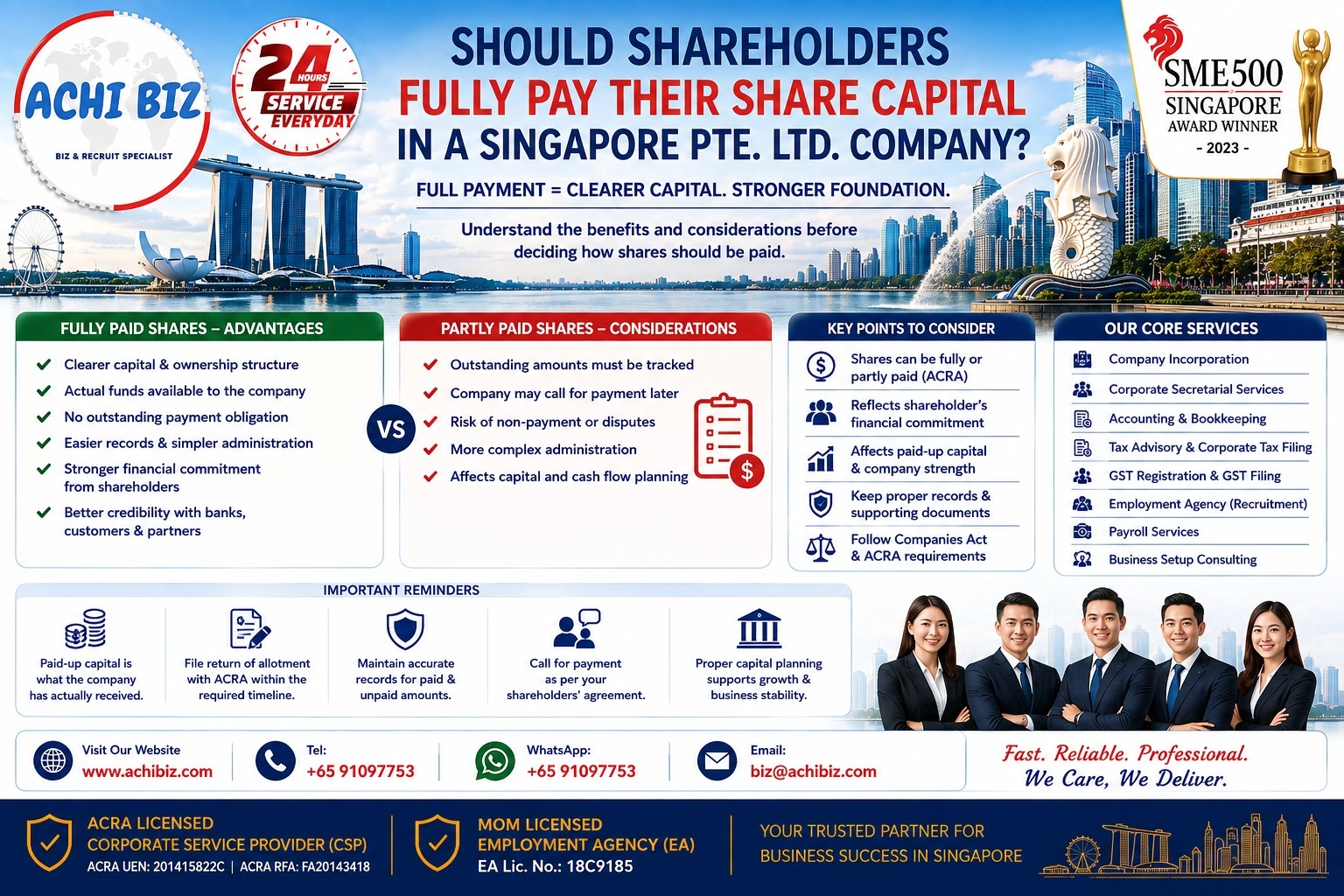
Should Shareholders Fully Pay Their Share Capital in Pte Ltd Company?
When shares are issued by a Singapore Pte. Ltd. company, an important but sometimes overlooked question is whether shareholders should fully pay for those shares immediately.
ACRA recognises both fully paid and partially paid shares. Therefore, this article does not suggest that every share must legally be fully paid in every situation. Instead, it examines why full payment is often commercially simpler and what companies should consider before issuing partly paid shares.
Must all shares in a Singapore Pte. Ltd. company be fully paid?
No.
ACRA specifically states that a share may be fully paid or partially paid.
The Companies Act’s return-of-allotment provisions likewise contemplate disclosure of the amount paid and the amount unpaid on allotted shares.
What does a fully paid share mean?
A fully paid share means the shareholder has paid the full amount required for that share.
There is no remaining unpaid amount attached to it.
What is a partly paid share?
A partly paid share is one for which only part of the required amount has been paid, leaving an unpaid balance.
For example, if a share requires S$1 of payment and the shareholder has paid S$0.50, it is only partly paid.
Is unpaid share capital the same as paid-up capital?
No.
Paid-up capital represents amounts actually paid. An amount still unpaid on issued shares should not be represented as though the company has already received it.
Why might shareholders prefer fully paid shares?
Fully paid shares can make the company’s capital position simpler to understand and administer.
There is no outstanding amount to collect from those shareholders in respect of the issue price, and the distinction between issued and paid-up capital may be easier for stakeholders to understand.
What are the main advantages of fully paying issued shares?
Potential advantages include:
- clearer capital records;
- actual availability of the contributed funds to the company;
- no outstanding payment obligation for the issue price;
- simpler shareholder administration;
- reduced risk of disputes over unpaid amounts;
- clearer financial commitment from shareholders; and
- easier understanding of the company’s issued versus paid-up capital.
What is the main disadvantage of requiring full payment immediately?
The shareholder must provide the entire required contribution upfront.
For a large capital commitment, that may reduce the shareholder’s personal or corporate liquidity.
Why would a company intentionally issue partly paid shares?
There can be genuine commercial reasons.
The company and investors may agree that capital will be funded progressively rather than entirely upfront.
Partly paid shares should therefore not automatically be regarded as improper. The important point is that the arrangement should be correctly structured and recorded.
Does issuing S$100,000 of shares mean the company has received S$100,000?
Not necessarily.
If the shares are only partly paid, the paid-up capital can be lower than the issued capital.
ACRA provides exactly this distinction in its share-capital guidance.
Why is the distinction important for third parties?
Because issued capital and paid-up capital communicate different information.
Issued capital represents the commitment associated with issued shares; paid-up capital shows what has actually been paid.
A third party assessing a company should not assume the two figures are always identical.
Should shareholders simply declare shares as fully paid even if the money was never paid?
No.
Corporate filings and accounting records should accurately reflect the underlying transaction.
A company should not represent capital as paid merely to create the appearance of stronger financial standing.
Should there be evidence that shareholders paid for their shares?
Good corporate and accounting practice supports keeping appropriate evidence of capital contributions and maintaining records that reconcile with the company’s share and accounting records.
The form of evidence will depend on how consideration was provided.
Must shares always be paid for in cash?
Not necessarily.
ACRA’s Bizfile incorporation guidance recognises shares payable in cash, otherwise than in cash, no consideration in appropriate circumstances, and partially in cash and otherwise than in cash.
The transaction must nevertheless be properly structured and recorded.
Can a shareholder pay for shares using non-cash consideration?
Depending on the circumstances and applicable requirements, shares may be issued for consideration other than cash.
This should be properly documented, valued and accounted for where relevant.
What happens when one shareholder fully pays but another does not?
This can create a more complicated capital position.
The company’s records must accurately reflect the amounts paid and unpaid in relation to the relevant shares.
The legal consequences will depend on the terms governing those shares, the company’s constitution and applicable law.
Does holding the same number of shares necessarily mean shareholders contributed the same amount?
Not necessarily.
Companies can have different share classes and different payment arrangements. Therefore, the number of shares alone does not always tell the entire economic story.
Does fully paying shares increase the shareholder’s ownership percentage?
Payment status and percentage ownership are related but different concepts.
Ownership percentage is generally driven by the relevant shares held and their rights. Paying an outstanding amount on already-issued shares does not automatically mean additional shares have been acquired.
Can partly paid shares create future shareholder disputes?
Potentially.
Disputes may arise over when the outstanding amount must be paid, whether the company can require payment, or what happens when a shareholder cannot meet an obligation.
Proper documentation is therefore particularly important.
Are partly paid shares suitable for every small business?
Not necessarily.
For a straightforward owner-managed SME where shareholders intend to provide the entire modest capital immediately, a complicated partly paid structure may offer little practical benefit.
Are fully paid shares always better?
No absolute rule should be applied.
For many straightforward SMEs, full payment may provide simplicity and clarity. More sophisticated investment arrangements may have legitimate reasons for using other structures.
Should shareholders pay according to their agreed shareholding proportions?
Where the commercial intention is that capital contribution and ownership should correspond proportionately, shareholders should structure the allotment and payment accordingly.
However, different commercial arrangements are possible, and the legal documentation should reflect the intended rights and obligations.
Can the company use money received as paid-up capital?
Once properly contributed, it is company money and may generally be used for legitimate corporate purposes, subject to directors’ duties and applicable laws.
It is not simply money being held for the shareholder.
Can paid-up capital simply be returned to shareholders whenever they want?
Share capital is not the same as a shareholder’s personal deposit account.
Returning capital to shareholders can engage specific Companies Act mechanisms and should not be done informally simply because the shareholder originally contributed the money.
Why should directors pay attention to unpaid share capital?
Directors are responsible for the proper administration of the company and should understand its actual financial position.
Confusing committed capital with money actually received can distort decision-making.
What is the practical conclusion for Singapore SMEs?
Where shareholders intend to contribute the full agreed capital and there is no commercial reason for deferred payment, fully paid shares can provide a straightforward and transparent structure.
But partly paid shares are legally recognised, so each case should be considered on its merits.
How is this different from deciding the amount of paid-up capital at incorporation?
This article deals with whether shareholders should fully pay for shares that are issued.
For the separate question of how much capital to establish and whether to provide it during incorporation or later, see the related articles:
Paid-Up Capital at Incorporation or Later: What Is Better for a Singapore Pte. Ltd. Company?
Shareholder vs Member in a Singapore Pte. Ltd. Company: Are They the Same?
How can ACHI BIZ assist?
ACHI BIZ can assist companies with incorporation, share allotments, share-capital changes, corporate secretarial matters, accounting and statutory compliance.
Disclaimer: This FAQ provides general information about Singapore companies and should not be treated as legal, tax, accounting or investment advice. Share structures and shareholder arrangements should be considered according to the company’s constitution, applicable legislation and individual circumstances.
#achibiz