
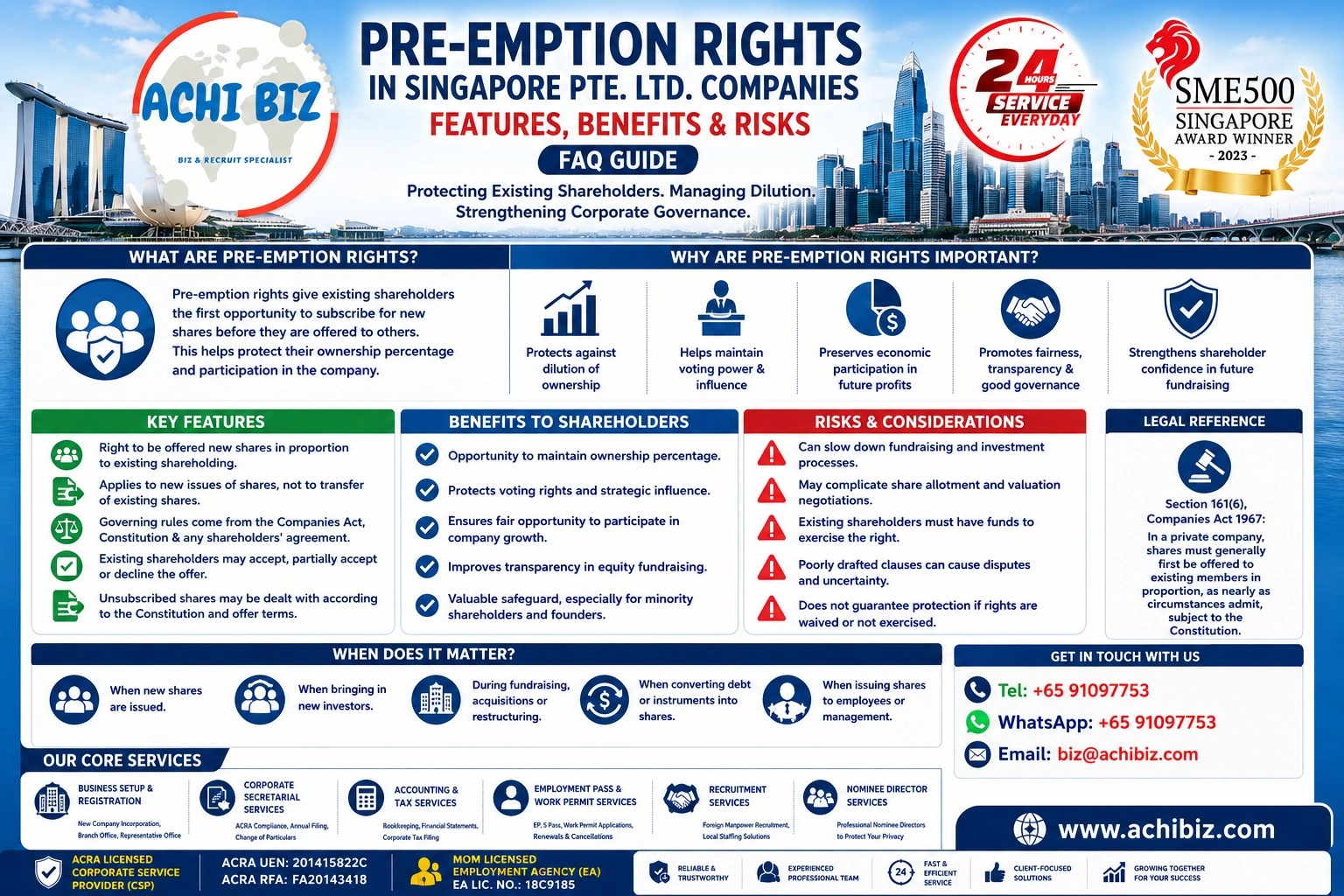
Pre-emption Rights in Singapore Pte. Ltd. Companies
Pre-emption rights in a Singapore Private Limited (Pte. Ltd.) company can play an important role in protecting existing shareholders when the company proposes to issue new shares. In practical terms, these rights can give existing shareholders an opportunity to participate in a new share issue before the relevant shares are offered to outsiders, helping them protect their existing ownership position.
For founders, investors and existing shareholders, pre-emption rights can therefore be an important part of shareholding protection, dilution management, ownership continuity and corporate governance.
However, pre-emption rights are not simply a mechanism for “blocking new investors”. Their actual operation depends on Singapore company law, the company’s Constitution, the particular share structure and, where applicable, shareholders’ agreements. Poorly drafted provisions can also make fundraising slower or create disagreements between shareholders.
This FAQ guide focuses specifically on the features, purpose, importance, benefits and risks of pre-emption rights in Singapore Pte. Ltd. companies.
The separate issues of waiving or excluding pre-emption rights and a detailed comparison of share issues with and without pre-emption rights are covered in our separate articles and are intentionally not repeated here.
What are pre-emption rights in a Singapore Pte. Ltd. company?
Pre-emption rights generally give existing shareholders a priority opportunity to participate when a company proposes to issue certain new shares.
The basic objective is to give existing shareholders an opportunity to maintain their relative ownership position before the relevant shares are issued to others.
For example, if a shareholder owns 30% of a company before a new share issue, an appropriately structured pre-emption mechanism may provide that shareholder with an opportunity to subscribe for a proportionate part of the proposed issue.
Why are pre-emption rights important in a private company?
They are important because issuing new shares can change the company’s ownership structure.
A shareholder’s existing shares do not disappear when additional shares are issued, but the shareholder’s percentage interest in the enlarged share capital can decrease.
Pre-emption rights can provide existing shareholders with an opportunity to participate before that dilution occurs.
What is the main purpose of pre-emption rights?
The central purpose is to protect existing shareholders against unwanted dilution by providing an opportunity to participate in relevant new share issues.
However, their importance extends beyond percentages.
A reduction in percentage ownership can potentially affect voting influence, economic participation, negotiating strength and, depending on the company’s structure, the ability to influence particular shareholder decisions.
Pre-emption rights can therefore have both economic and governance significance.
Are pre-emption rights recognised under Singapore company law?
Yes.
For Singapore private companies, section 161 of the Companies Act 1967 is particularly important in relation to directors issuing shares.
Under section 161(6), where an approval authorising directors to issue shares has been given and the company is a private company, shares must generally first be offered to existing members in proportion, as nearly as circumstances admit, to the number of existing shares they hold, subject to the statutory framework and the company’s Constitution.
The statutory wording and the company’s Constitution should therefore be considered together before a proposed allotment is implemented.
Does every Singapore Pte. Ltd. company automatically have identical pre-emption rights?
No.
Companies can have different Constitutions, share classes and shareholder arrangements.
The practical operation of pre-emption rights should therefore be determined by reviewing the Companies Act, company’s Constitution and any relevant shareholders’ agreement rather than assuming that every Singapore private company operates identically.
Why is the company’s Constitution important for pre-emption rights?
The Constitution governs important aspects of the relationship between the company and its shareholders.
It may contain provisions dealing with new share issues, existing shareholder priority, offer procedures, time limits, allocation of unsubscribed shares and different share classes.
Accordingly, directors should review the Constitution before approving or implementing a new allotment.
Can a company’s Constitution affect statutory pre-emption arrangements?
Yes.
The Companies Act itself makes the statutory private-company pre-emption requirement subject to the company’s Constitution.
This makes the Constitution particularly important when determining exactly how a proposed issue should be handled.
A company should therefore avoid relying solely on a general understanding that “existing shareholders must always be offered shares first” without examining its own constitutional provisions.
Is a Shareholders’ Agreement relevant to pre-emption rights?
It can be very relevant.
A shareholders’ agreement may contain contractual provisions governing how shareholders expect future share issues to be handled.
However, a shareholders’ agreement and the Constitution do not perform exactly the same legal function.
Where both documents exist, they should be reviewed together to identify whether their provisions are consistent and whether additional contractual requirements apply.
What is the difference between pre-emption rights and ownership percentage?
Ownership percentage describes the shareholder’s current proportionate interest.
Pre-emption rights are a mechanism that may allow the shareholder to protect that proportion when new shares are proposed to be issued.
The two concepts are connected but not identical.
How do pre-emption rights help prevent dilution?
Consider a company with 1,000 issued shares.
Shareholder A owns 300 shares, representing 30%.
If the company issues 500 additional shares entirely to a new investor, Shareholder A would continue owning 300 shares, but those 300 shares would now represent only 20% of the enlarged 1,500-share total.
A pre-emption mechanism can give Shareholder A an opportunity to subscribe for an appropriate proportion of the new issue and thereby seek to preserve the existing percentage.
Does dilution mean an existing shareholder loses existing shares?
No.
This is an important distinction.
The shareholder normally continues to own the same number of existing shares. What changes is the percentage those shares represent after the total number of issued shares increases.
Pre-emption rights address this potential percentage dilution by giving the shareholder an opportunity to participate in the new issue.
Can dilution affect more than a shareholder’s ownership percentage?
Yes.
Depending on the company’s circumstances, dilution can affect:
- voting influence;
- participation in future distributions;
- proportionate economic interest;
- influence over shareholder resolutions;
- negotiating leverage among shareholders; and
- the practical balance of power within the company.
This is why pre-emption rights can be strategically important even where the number of shares held by the existing shareholder remains unchanged.
Do pre-emption rights guarantee that a shareholder will never be diluted?
No.
They generally provide an opportunity to protect the shareholder’s position.
The shareholder may still need to contribute additional capital by subscribing for the offered shares.
If the shareholder cannot or does not wish to invest additional funds, dilution may still occur.
This distinction is fundamental: pre-emption rights protect the opportunity to maintain a position; they do not necessarily preserve it automatically.
Does a shareholder have to exercise pre-emption rights?
Not simply because the opportunity exists.
A shareholder may decide that investing additional capital is commercially unattractive or financially impractical.
The consequence can be that other shareholders or investors ultimately acquire the relevant shares and the non-participating shareholder’s percentage interest decreases.
Why might an existing shareholder choose not to exercise pre-emption rights?
There can be many legitimate reasons.
The shareholder may not have sufficient funds, may disagree with the company’s valuation, may not want to increase exposure to the business, may believe the investment terms are unattractive or may simply prefer to accept dilution.
Pre-emption therefore provides a choice, not necessarily an obligation to invest further.
Are pre-emption rights valuable even if a shareholder never uses them?
Potentially, yes.
The existence of the right itself can provide protection because the company and other shareholders know that a new issue may need to respect the existing shareholder’s priority opportunity.
This can encourage greater transparency and consultation when the company raises new equity.
Can pre-emption rights protect founders?
Yes.
Founders can be particularly concerned about maintaining their ownership percentages as outside investors enter the company.
Pre-emption rights can allow founders to participate in future issues if they have the financial capacity and wish to maintain their relative position.
However, founders should also consider whether they will realistically have sufficient capital to exercise those rights during future funding rounds.
Can pre-emption rights protect minority shareholders?
They can be particularly important to minority shareholders.
A minority shareholder may have limited ability to prevent the majority from supporting a new fundraising exercise. A proportionate participation right can nevertheless provide an opportunity to protect the minority shareholder’s existing percentage.
However, the effectiveness of the protection depends on the actual legal and constitutional arrangements and the shareholder’s ability to fund the subscription.
Can pre-emption rights protect majority shareholders?
Yes.
A majority shareholder can also be diluted if substantial new shares are issued to other parties.
Where maintaining majority control is commercially important, the ability to participate in future issues can be highly significant.
Can pre-emption rights help a shareholder maintain more than 50% ownership?
Potentially.
If a shareholder’s percentage would otherwise fall below a particular level because of a new issue, exercising proportionate subscription rights may help maintain that percentage.
However, the precise outcome depends on the size and structure of the issue, the rights attached to the shares and whether other corporate actions are taking place simultaneously.
Can pre-emption rights help protect important voting thresholds?
Potentially, yes.
Certain shareholder decisions under Singapore company law require particular voting thresholds.
A reduction in a shareholder’s percentage may therefore have consequences beyond simple economic ownership.
For example, falling below a strategically important percentage could affect the shareholder’s practical ability to influence or block particular resolutions.
This makes dilution analysis important before deciding whether to exercise a pre-emption opportunity.
Are pre-emption rights particularly important in closely held Pte. Ltd. companies?
Often, yes.
In a closely held company with only a few shareholders, even a relatively small change in percentage ownership can materially alter the balance between the owners.
For example, a company owned by two or three founders may operate very differently if a substantial new investor enters and one existing founder does not participate in the new issue.
Pre-emption rights can provide a structured process before such a change occurs.
Are pre-emption rights useful in family-owned companies?
They can be.
Family-owned companies may place particular importance on maintaining ownership within an existing family or shareholder group.
Pre-emption provisions can form part of a broader ownership-continuity strategy.
However, new-share pre-emption should be distinguished from restrictions or rights applying when an existing shareholder transfers existing shares. Those are separate transactions and may be governed by different provisions.
Are pre-emption rights on new shares the same as a right of first refusal on existing shares?
No.
This distinction is very important.
Pre-emption on new share issues concerns shares that the company proposes to issue.
A right of first refusal or transfer pre-emption arrangement generally concerns existing shares that a shareholder proposes to sell or transfer.
Although both mechanisms can give existing participants priority, they operate in different circumstances.
Do pre-emption rights stop a company from raising new capital?
No.
Properly structured pre-emption rights do not necessarily prevent fundraising.
They establish a process under which existing shareholders receive the relevant opportunity before shares are allocated elsewhere.
If existing shareholders do not take up all the shares, the remaining shares may potentially be dealt with according to the applicable Constitution, approvals and offer terms.
Can pre-emption rights slow down fundraising?
Yes, potentially.
This is one of their practical disadvantages.
A company needing capital quickly may have to complete the applicable shareholder offer process before allocating the relevant shares to a new investor.
The company therefore needs to balance shareholder protection against fundraising efficiency.
Can pre-emption rights make an investment round more complicated?
Yes.
Suppose an external investor agrees to subscribe for a specific number of shares at an agreed valuation.
If existing shareholders have applicable priority rights, the company needs to determine how those rights interact with the proposed investment.
Existing shareholders taking up their entitlements can affect the number of shares ultimately available to the incoming investor or require the overall financing structure to be adjusted.
Can pre-emption rights discourage new investors?
Sometimes.
A new investor may want certainty regarding the number of shares and ownership percentage it will receive.
If existing shareholders have rights that could alter the final allocation, the investment process may require additional planning.
This does not make pre-emption rights undesirable. It simply means they need to be identified early in negotiations.
Why should pre-emption rights be checked before signing an investment agreement?
Because the company should know whether it can actually deliver the proposed share allocation.
Agreeing to issue a particular number of shares to an investor before reviewing applicable shareholder rights can create avoidable problems.
A proper corporate review should therefore occur before the investment terms are finalised, not only when the company is ready to file the allotment.
Can pre-emption rights affect company valuation negotiations?
Indirectly, yes.
Existing shareholders deciding whether to subscribe need to evaluate the price at which the new shares are being offered.
A high valuation may make participation expensive. A low valuation may make the offer attractive but could also raise concerns among shareholders about why new equity is being issued on those terms.
The pricing of the new issue can therefore become commercially significant.
Must existing shareholders be offered shares on identical terms?
The applicable statutory, constitutional and contractual provisions need to be examined.
The purpose of a genuine pre-emption process is generally to provide the relevant existing shareholders with the required opportunity in accordance with the applicable proportion and terms.
A company should be cautious about structuring an apparent pre-emption offer in a manner that unfairly or improperly circumvents existing shareholder rights.
Why is the issue price important in a pre-emption offer?
Because the right is only commercially meaningful if the shareholder understands the investment being offered.
The issue price determines how much additional capital the shareholder must contribute to maintain the relevant position.
It also affects the company’s valuation and the economics of the fundraising.
Can pre-emption rights apply when shares are issued at a premium?
The existence of a premium does not by itself eliminate the need to consider applicable pre-emption rights.
The company should review the nature of the proposed allotment and its governing provisions.
The issue price and any share premium are part of the commercial terms that existing shareholders need to evaluate.
Can different share classes complicate pre-emption rights?
Yes.
Where a company has ordinary shares, preference shares or multiple classes, determining who is entitled to participate in a proposed issue can become more complex.
The Constitution may contain class-specific provisions, and the rights attached to existing and proposed shares need to be reviewed carefully.
Do Preference Shareholders automatically have the same pre-emption rights as Ordinary Shareholders?
This should not be assumed.
The answer depends on the company’s Constitution, the rights attached to the relevant preference shares, the nature of the proposed allotment and applicable law.
For a detailed explanation of preference-share rights themselves, refer to our separate article on Preference Shares in Singapore Pte. Ltd. Companies.
Can pre-emption rights apply to a new issue of Preference Shares?
Potentially, depending on the company’s constitutional arrangements, existing share classes and applicable statutory requirements.
A company proposing to introduce a new preference-share class should therefore analyse both the rights of the proposed investor and the rights of existing shareholders before proceeding.
Can pre-emption rights affect the introduction of a new investor?
Yes.
This is one of the situations where they matter most.
The company may have identified a strategic investor, employee, business partner or external financier to receive new shares. Before issuing those shares, it should determine whether existing shareholders have an applicable priority opportunity.
Failing to do so can create corporate and shareholder disputes.
Can pre-emption rights affect founder shares issued to a new co-founder?
Potentially.
If an existing company proposes to issue new shares to a person joining as a co-founder, the company should still consider its Constitution, statutory requirements and existing shareholder rights.
Calling the recipient a “co-founder” does not itself determine the legal treatment of the allotment.
Can pre-emption rights be relevant when issuing shares to employees?
Potentially.
Where a company proposes to issue new shares directly to employees or management, applicable pre-emption provisions should be considered.
The analysis may differ where the company has an appropriately established employee share scheme or other specific arrangement.
The transaction should therefore be reviewed before implementation.
Are pre-emption rights relevant to Employee Share Option Plans (ESOPs)?
They can be relevant when a company establishes or operates an equity incentive structure, depending on how shares are issued and what the Constitution and shareholder approvals provide.
Companies expecting to introduce an ESOP should therefore consider the impact on existing shareholder rights at the planning stage rather than after options become exercisable.
Can pre-emption rights apply to shares issued as consideration instead of cash?
The company should review the precise statutory and constitutional provisions applicable to the proposed issue.
A new share allotment can arise in transactions other than a conventional cash fundraising.
For example, shares might be issued as consideration in an acquisition or restructuring.
The fact that no cash subscription occurs should not lead the company to assume that existing shareholder rights are irrelevant.
Are pre-emption rights relevant during business acquisitions?
Potentially.
If a company acquires another business and proposes to issue new shares to the seller as part of the purchase consideration, those new shares can materially dilute existing shareholders.
The company should therefore examine applicable pre-emption and corporate approval requirements before committing to the share consideration structure.
Are pre-emption rights relevant when capitalising a debt?
Potentially.
A company may agree with a creditor or shareholder lender to convert debt into newly issued shares.
Because this increases issued share capital and can change ownership percentages, applicable shareholder rights should be reviewed before the debt-to-equity conversion is implemented.
Can pre-emption rights affect a debt-to-equity restructuring?
Yes.
The commercial objective may be to reduce debt and strengthen the balance sheet, but the resulting new shares can still alter existing ownership percentages.
The restructuring should therefore be analysed from both financing and shareholder-right perspectives.
Do pre-emption rights apply to a transfer of treasury shares?
Treasury-share transactions involve a distinct statutory framework and should not automatically be treated as identical to a conventional allotment of newly issued shares.
The company should review the Companies Act, Constitution and relevant approvals for the particular transaction rather than applying new-share rules mechanically.
Can pre-emption rights apply when a convertible instrument converts into shares?
Potentially, and this should ideally be addressed when the convertible investment is originally structured.
If an instrument may later result in shares being issued, the company should understand how the conversion interacts with existing shareholder rights and previously obtained approvals.
Leaving the issue unresolved until conversion can create uncertainty.
Why should convertible investments be considered when drafting pre-emption provisions?
Because future conversion can create significant dilution.
A company may receive funds today under an instrument that does not immediately change the shareholding, but conversion later can substantially alter ownership.
Well-planned corporate documents should anticipate foreseeable financing events rather than addressing them only when they occur.
Can pre-emption rights protect shareholders from shares being issued cheaply to another person?
They can provide an important practical safeguard because existing shareholders may receive an opportunity to participate in the issue on the applicable terms.
This can make it more difficult to dilute existing shareholders simply by directing a favourable new issue entirely to another person.
However, pre-emption rights are only one aspect of directors’ legal duties and proper corporate governance.
Can directors use a new share issue to change control of a company?
Directors need to exercise their powers consistently with their legal duties and for proper purposes.
A new share issue can affect control, but the fact that directors have authority to issue shares does not mean that the power can be exercised improperly merely to manipulate voting control.
Pre-emption rights can provide an additional layer of shareholder protection, but they do not replace directors’ duties.
Are pre-emption rights a substitute for directors’ duties?
No.
These are separate protections.
Pre-emption rights regulate the shareholder’s opportunity in relation to relevant share issues.
Directors separately owe statutory and fiduciary duties concerning how they exercise their powers.
Compliance with one does not automatically establish compliance with the other.
Can directors issue shares whenever they want?
No.
Section 161 of the Companies Act generally requires prior approval of the company in general meeting before directors exercise a power to issue shares, subject to statutory exceptions.
The authority to issue shares and the pre-emption process are therefore related but distinct considerations.
Is shareholder approval to issue shares the same as pre-emption rights?
No.
This distinction is important.
Authority to issue shares concerns whether directors have the necessary corporate authority to make the allotment.
Pre-emption rights concern whether existing shareholders must receive the applicable opportunity before those shares are issued elsewhere.
A company may therefore need to consider both questions in the same transaction.
Does an existing authority under Section 161 automatically remove pre-emption rights?
No.
The existence of directors’ authority to issue shares should not automatically be interpreted as eliminating applicable pre-emption requirements.
Indeed, section 161(6) specifically addresses proportional offers to existing members of private companies where the relevant approval has been given, subject to the company’s Constitution.
How does a proportional pre-emption offer generally work?
The company determines the proposed number and terms of the new shares and identifies the existing shareholders entitled to participate.
The relevant shareholders are then offered an opportunity based on their existing holdings, as required by the applicable provisions.
A deadline is normally established.
After the offer period expires, shares not taken up may potentially be dealt with according to the Constitution, corporate approvals and terms of the offer.
Does “proportionately” always produce an exact whole number of shares?
Not necessarily.
A shareholder’s mathematical entitlement can result in fractions depending on the number of new shares being issued and the existing shareholdings.
The statutory wording itself recognises proportionality “as nearly as circumstances admit.”
The company’s documents and offer process should therefore address practical allocation issues appropriately.
What happens if some shareholders take up their entitlement and others do not?
The participating shareholders may preserve or increase their relative position while non-participating shareholders may experience dilution.
What happens to the remaining shares depends on the applicable Constitution, offer terms and corporate approvals.
The company should establish this process clearly before making the offer.
Can one shareholder subscribe for shares that another shareholder does not take up?
Potentially, depending on the applicable pre-emption provisions and offer structure.
Some arrangements provide mechanisms for oversubscription or allocation of shares that other shareholders decline.
However, the company should follow the actual Constitution and approved terms rather than assuming that unaccepted shares automatically belong to another existing shareholder.
Why should the offer period be clearly stated?
Because shareholders need a defined period within which to decide whether to invest.
Without a clear deadline, the company may be uncertain when it can proceed with the remaining fundraising.
A well-designed process balances shareholders’ need for sufficient decision-making time with the company’s need for commercial certainty.
What information should shareholders consider before exercising pre-emption rights?
A shareholder should generally understand the number and class of shares offered, issue price, amount payable, existing and post-issue capital structure, purpose of the fundraising, relevant investment terms and deadline for acceptance.
Where the investment is substantial, the shareholder may also consider the company’s financial position, valuation and future funding strategy.
Should a shareholder exercise pre-emption rights merely to avoid dilution?
Not necessarily.
Avoiding dilution can be important, but subscribing requires additional investment.
A shareholder should assess whether maintaining the percentage justifies committing further capital.
The economically sensible decision may sometimes be to accept dilution rather than invest more money into an unattractive opportunity.
Can exercising pre-emption rights increase a shareholder’s financial exposure?
Yes.
Protecting an ownership percentage requires additional investment.
If the company later performs poorly, the shareholder has more capital at risk.
Pre-emption rights should therefore be viewed as an investment opportunity and protection mechanism, not as something that must always be exercised.
What are the main benefits of pre-emption rights for existing shareholders?
Their principal benefits include the opportunity to maintain percentage ownership, reduce unwanted dilution, protect relative voting influence, preserve economic participation, improve transparency around new share issues and provide existing shareholders with a first opportunity to participate in the company’s next stage of financing.
These benefits can be particularly valuable in closely held private companies.
What are the main benefits for minority shareholders?
For minority shareholders, pre-emption rights can provide an important safeguard against their percentage being reduced through new issues made entirely to other parties.
The rights can also provide visibility into fundraising that could materially change the company’s ownership structure.
Their effectiveness, however, still depends on the shareholder having sufficient resources to participate.
What are the main benefits for founders?
Founders may value the opportunity to maintain their relative ownership as external investment enters the company.
Pre-emption provisions can also encourage future financing discussions to take place within a clear framework rather than through unexpected share allotments.
Can pre-emption rights improve corporate governance?
Potentially, yes.
A transparent pre-emption process encourages the company to communicate proposed equity financing to relevant shareholders before implementing it.
That can improve predictability and reduce suspicion around changes in shareholding.
However, good governance also requires appropriate board processes, shareholder approvals, accurate documentation and compliance with directors’ duties.
Can pre-emption rights improve shareholder confidence?
Yes.
Investors may be more comfortable investing in a private company if they know there is a mechanism allowing them to participate proportionately in relevant future share issues.
This can be particularly important where there is no public market through which the shareholder can easily increase the holding later.
What are the disadvantages of pre-emption rights for a company?
The main disadvantages relate to time, flexibility and transaction complexity.
A company may need to complete an internal offer process before bringing in a new investor.
This can slow urgent fundraising, complicate investment negotiations and require additional corporate documentation.
Can pre-emption rights make emergency fundraising difficult?
Potentially.
A company experiencing urgent cash-flow problems may need new capital quickly.
A lengthy shareholder offer procedure can create commercial pressure.
This is one reason why companies should design their capital arrangements carefully before an emergency occurs.
Can pre-emption rights give an existing shareholder too much leverage?
Potentially.
Where a shareholder’s participation is important to the transaction, the shareholder may have significant negotiating leverage.
This is not necessarily improper—the right exists precisely to protect shareholder interests—but poorly designed provisions can make legitimate fundraising unnecessarily difficult.
Can pre-emption rights create disputes over valuation?
Yes.
An existing shareholder may believe that the proposed issue price is too high and decline to participate, or believe that it is too low and question why an incoming investor is receiving shares at that valuation.
Because pricing affects both capital raising and dilution, disagreements can arise even where the formal pre-emption process is followed.
Can pre-emption rights create disputes over timing?
Yes.
Shareholders may disagree over whether sufficient notice was provided, whether the acceptance deadline was reasonable or whether the company proceeded with an outside allotment too early.
Clear procedures can significantly reduce these disputes.
Can pre-emption rights create disputes over whether two offers are genuinely the same?
Potentially.
A company might offer existing shareholders shares at a stated price but later agree additional commercial benefits with an outside investor.
Existing shareholders may then question whether they genuinely received the same economic opportunity.
The complete transaction should therefore be reviewed rather than focusing only on the headline price per share.
What are the risks of poorly drafted pre-emption clauses?
Poor drafting can create uncertainty over:
- which share issues are covered;
- which shareholders qualify;
- how entitlements are calculated;
- whether different classes participate;
- how long the offer remains open;
- what happens to unaccepted shares;
- whether oversubscription is permitted;
- whether exceptions exist; and
- how the company may subsequently issue the remaining shares.
These uncertainties can delay financing and lead to shareholder disputes.
Can very broad pre-emption rights harm the company’s flexibility?
Yes.
A provision that captures virtually every possible equity transaction without practical exceptions can make routine corporate actions cumbersome.
The appropriate balance depends on the company’s ownership structure and expected financing needs.
Can very weak pre-emption rights leave shareholders inadequately protected?
Yes.
If the provision contains broad exceptions or allows new shares to be issued easily outside the mechanism, shareholders may discover that the protection is much weaker than expected.
The clause should therefore reflect the commercial bargain rather than merely use the label “pre-emption rights”.
Why should pre-emption rights be considered when drafting a company’s Constitution?
Because future fundraising is foreseeable for many businesses.
A company that considers the issue early can establish a clear process for existing shareholders and directors.
This can be significantly easier than trying to resolve competing expectations after an investor is already waiting to subscribe.
Why should startups think about pre-emption rights before multiple funding rounds?
Because repeated financing can progressively dilute early shareholders.
Founders and early investors should understand from the outset whether they will have an opportunity to participate in later rounds and how the process interacts with new investor requirements.
A poorly planned structure can become increasingly difficult to manage as more shareholders and share classes are introduced.
Can an investor negotiate enhanced pre-emption rights?
Potentially, through the relevant corporate and contractual arrangements.
For example, sophisticated investors sometimes negotiate specific participation rights for future financing rounds.
The company should consider carefully how any enhanced rights interact with other shareholders, the Constitution and future fundraising.
Can different shareholders have different contractual participation rights?
Potentially.
A shareholders’ agreement or investment agreement can contain negotiated rights applicable to particular investors.
However, companies should ensure that contractual arrangements are consistent with their Constitution and statutory obligations.
Can pre-emption rights have long-term strategic value?
Yes.
Their importance often becomes apparent only when the company grows.
A right that appears unimportant when the company is small can become extremely valuable if future investment rounds occur at much higher valuations or if maintaining a particular ownership percentage becomes strategically important.
Can pre-emption rights become less useful if a shareholder cannot fund future investments?
Yes.
A shareholder may possess a valuable legal opportunity but lack the capital needed to exercise it.
This is particularly relevant to founders whose company raises progressively larger investment rounds.
Pre-emption rights cannot eliminate the economic reality that maintaining ownership in a growing company may require additional capital.
Do pre-emption rights guarantee the same percentage forever?
No.
This deserves emphasis.
The right may provide an opportunity to maintain a percentage during relevant share issues, but maintaining that percentage can require repeated investment.
Other corporate events may also affect the capital structure.
Pre-emption rights are therefore a protection against particular forms of dilution, not a permanent guarantee of ownership percentage.
Do pre-emption rights guarantee control of the company?
No.
Control depends on voting rights, share classes, shareholder agreements, board arrangements and the overall ownership structure.
Pre-emption rights can help protect a percentage position but cannot by themselves guarantee corporate control.
Do pre-emption rights guarantee investment returns?
No.
They have nothing to do with guaranteeing profitability.
A shareholder can maintain the same percentage of a company that later performs poorly.
Pre-emption rights protect participation opportunities, not investment performance.
Are pre-emption rights always beneficial?
Not necessarily.
From an existing shareholder’s perspective they can provide valuable protection.
From the company’s perspective they can introduce additional procedure and reduce financing flexibility.
The appropriate structure therefore depends on balancing shareholder protection with the company’s ability to raise capital efficiently.
What is the biggest misconception about pre-emption rights?
One common misconception is:
“If I have pre-emption rights, my percentage can never decrease.”
That is incorrect.
The right normally provides an opportunity to subscribe. If the shareholder does not exercise the opportunity, the shareholder can still be diluted.
Another misconception is that pre-emption automatically prevents the company from accepting outside investment. It generally regulates the process rather than permanently closing the company to new investors.
What should directors check before issuing new shares?
Before proceeding with a new allotment, directors should consider the company’s authority to issue shares, section 161 of the Companies Act, the Constitution, existing share classes, applicable pre-emption provisions, shareholders’ agreements, investment agreements, directors’ duties and the required corporate approvals and ACRA filings.
This review should ideally occur before commercial terms are finalised with the incoming investor.
What should an existing shareholder check after receiving a pre-emption offer?
The shareholder should understand the number and class of shares offered, subscription price, total investment required, acceptance deadline, proposed use of funds and the effect of participating or not participating on the post-allotment shareholding.
Where material amounts are involved, professional advice may be appropriate.
What should a new investor check before agreeing to subscribe for shares?
A new investor should understand whether existing shareholders have rights that could affect the proposed allotment.
Otherwise, the investor may negotiate for a particular percentage only to discover that existing shareholders are entitled to participate in the financing.
Corporate due diligence should therefore include the Constitution and existing shareholder arrangements.
What happens if a company ignores applicable pre-emption rights?
The consequences depend on the source and nature of the rights, the Constitution, statutory requirements and the circumstances of the allotment.
Ignoring applicable shareholder rights can expose the company and the transaction to disputes, challenges and potential legal consequences.
A company should therefore resolve the issue before allotment, rather than attempting to correct an improperly implemented transaction afterwards.
Can pre-emption rights be waived or excluded?
Depending on the applicable legal and constitutional framework, circumstances can arise where pre-emption rights are waived, excluded or otherwise do not operate in the usual manner.
However, this is an important topic in its own right involving questions such as who can waive the right, whether waiver can apply to one transaction, what approvals are required and what happens to shareholders who do not waive.
To avoid duplicating that subject here, please refer to our separate article:
“Waiver or Exclusion of Pre-emption Rights in Singapore Pte. Ltd. Companies.”
Is issuing shares without pre-emption rights necessarily better for the company?
Not necessarily.
Removing or not applying a pre-emption process may increase financing flexibility, but it can also increase dilution concerns for existing shareholders.
The appropriate approach depends on the company’s ownership, financing objectives and shareholder arrangements.
For a detailed side-by-side analysis rather than repeating it here, refer to our separate article:
“Share Issue With vs Without Pre-emption Rights in Singapore Pte. Ltd. Companies.”
What is the key benefit of pre-emption rights?
The key benefit is the opportunity for existing shareholders to protect their relative position when new equity is introduced.
This can protect not only percentage ownership but also the voting, economic and strategic importance associated with that percentage.
What is the key risk of pre-emption rights?
The key risk from the company’s perspective is that a protective mechanism can become a fundraising constraint if it is poorly structured or unnecessarily complicated.
A company may need to move quickly when an investment opportunity arises. Ambiguous or overly restrictive pre-emption provisions can delay the transaction.
The objective should therefore be meaningful shareholder protection without creating unnecessary corporate rigidity.
Why are pre-emption rights particularly relevant to Singapore Pte. Ltd. companies?
Private companies often have relatively concentrated ownership and no public market for their shares.
Changes in shareholding can therefore have a significant effect on the relationships among founders, family shareholders, investors and business partners.
A proportionate participation mechanism can be particularly valuable in this environment because existing shareholders cannot simply buy additional shares on a stock exchange if their holding becomes diluted.
What is the key takeaway about pre-emption rights in Singapore Pte. Ltd. companies?
Pre-emption rights are fundamentally about protecting an existing shareholder’s opportunity to participate before a relevant new share issue changes the company’s ownership structure.
They can help manage dilution, protect relative voting and economic interests, increase transparency and provide greater confidence to founders and investors.
However, they are not an automatic guarantee against dilution. A shareholder generally needs both the right and the financial ability to exercise it.
For the company, the challenge is achieving the right balance. Strong protection can reassure shareholders, but excessively complicated provisions can make fundraising slower and more difficult.
The Companies Act, company’s Constitution, share classes, shareholders’ agreements and proposed investment terms should therefore be reviewed together before issuing new shares.
Companies proposing a new share allotment, fundraising exercise, introduction of an investor, amendment of the Constitution or restructuring of share capital should establish whether applicable pre-emption requirements have been properly addressed before completing the transaction.
ACHI BIZ, as an ACRA Licensed Corporate Service Provider (CSP), can assist Singapore companies with corporate secretarial procedures relating to share allotments, share capital changes, shareholder resolutions, Constitution-related corporate actions and applicable ACRA filings.
For related subjects, refer separately to our FAQ guides:
“Waiver or Exclusion of Pre-emption Rights in Singapore Pte. Ltd. Companies” and
“Share Issue With vs Without Pre-emption Rights in Singapore Pte. Ltd. Companies.”
#achibiz