
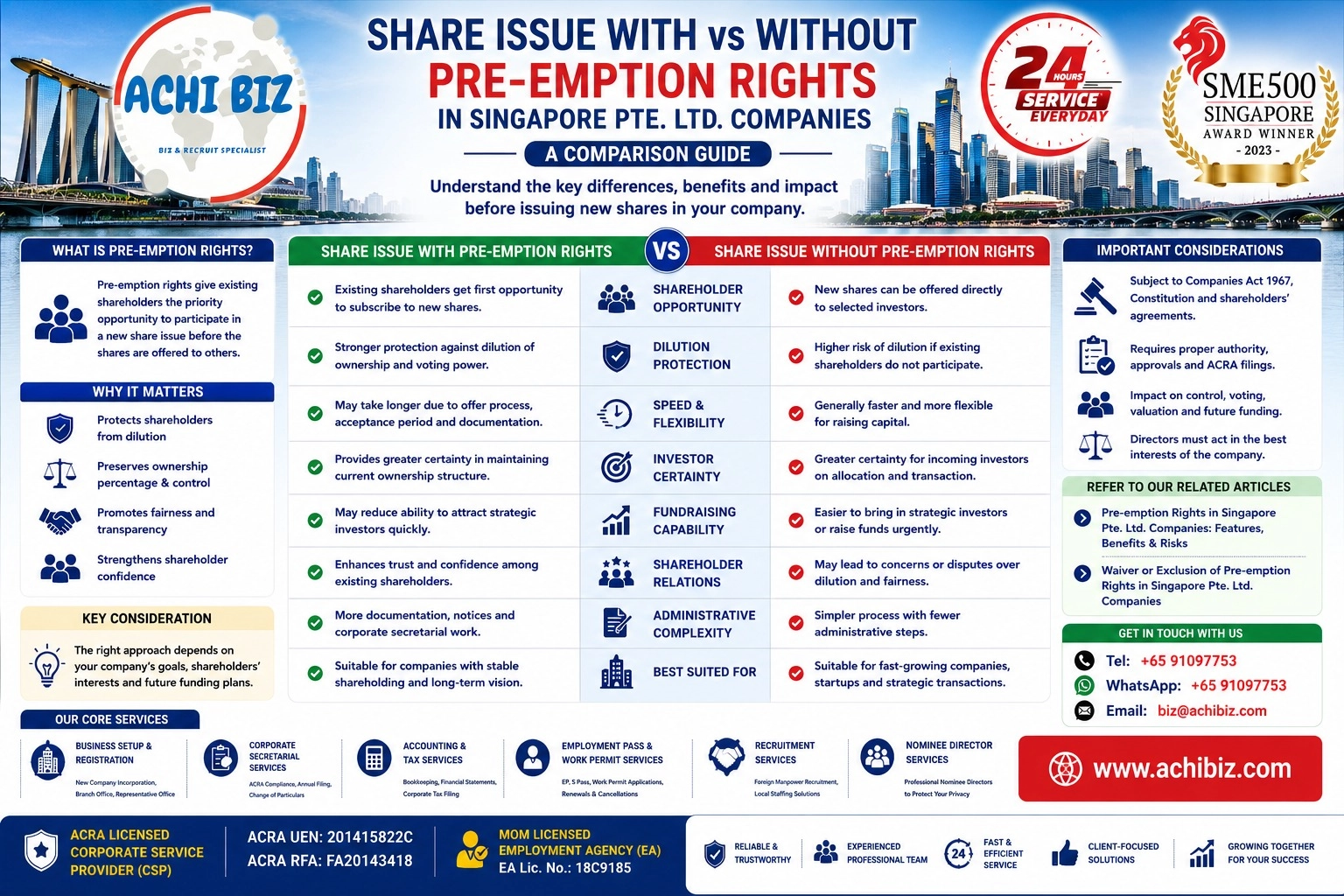
Share Issue With vs Without Pre-emption Rights in Singapore
When a Singapore Private Limited (Pte. Ltd.) company wants to issue new shares, one important question is how existing shareholders should be treated before those shares are allotted to someone else.
A share issue with pre-emption rights generally gives relevant existing shareholders a priority opportunity to participate in the new issue, subject to the Companies Act 1967, the company’s Constitution and any applicable shareholder arrangements. A structure without an applicable pre-emption requirement can provide greater flexibility to place the new shares directly with the intended investor, subject to the necessary authority, approvals and other legal requirements.
Neither approach is automatically better.
For some companies, protecting existing shareholders against unexpected dilution is the priority. For others, the ability to raise capital quickly, introduce strategic investors or implement more flexible equity transactions may be commercially important.
The real comparison is therefore between shareholder protection and financing flexibility, while also considering dilution, control, valuation, investment certainty, corporate governance and the company’s future capital strategy.
This FAQ guide focuses exclusively on that side-by-side comparison.
For the underlying nature, features, benefits and risks of pre-emption rights themselves, refer to our separate article “Pre-emption Rights in Singapore Pte. Ltd. Companies: Features, Benefits & Risks.”
For how pre-emption rights may be waived, excluded, modified or disapplied, refer separately to “Waiver or Exclusion of Pre-emption Rights in Singapore Pte. Ltd. Companies.”
What is the fundamental difference between issuing shares with and without pre-emption rights?
The fundamental difference is who gets the first opportunity to participate in the proposed share issue.
With applicable pre-emption rights, existing shareholders generally receive the relevant priority opportunity before the shares can be issued elsewhere.
Without an applicable pre-emption requirement, the company may have greater flexibility to issue shares directly to the intended subscriber, subject to its Constitution, the Companies Act, directors’ authority and other applicable corporate requirements.
Is this simply a choice between protecting shareholders and protecting the company?
No.
That would oversimplify the issue.
Pre-emption rights can protect shareholders, but they can also benefit the company by increasing shareholder confidence. Conversely, flexibility in issuing shares can benefit the company and may ultimately benefit existing shareholders if new investment strengthens the business.
The question is how much protection, flexibility and transaction certainty the company’s ownership structure requires.
Which approach provides stronger protection against dilution?
A share issue subject to pre-emption rights generally provides stronger procedural protection against unwanted dilution, because existing shareholders receive an opportunity to participate before the relevant shares are allocated elsewhere.
A share issue without such a requirement can expose existing shareholders more directly to dilution if they do not otherwise participate in the financing.
This does not mean that pre-emption eliminates dilution altogether.
Which approach gives the company greater fundraising flexibility?
A structure without an applicable pre-emption process generally provides greater flexibility.
The company can potentially negotiate more directly with the intended investor without first completing a proportional offer process for existing shareholders.
That flexibility can be valuable where timing and certainty are important.
Which approach is generally faster for bringing in a new investor?
All else being equal, an issue without an applicable pre-emption process can be faster because one procedural stage may be removed.
However, the company still needs to comply with directors’ authority requirements, its Constitution, board procedures, shareholder approvals where applicable and ACRA filing requirements.
“No pre-emption” does not mean “no corporate procedure.”
Which approach gives an incoming investor greater certainty?
An investor may obtain greater transaction certainty where there is no outstanding pre-emption process capable of changing the number of shares available to the investor.
For example, if an investor negotiates for a particular post-investment percentage, existing shareholders exercising participation rights could affect the final allocation unless the transaction has been structured around those rights.
Which approach gives existing shareholders greater certainty?
Pre-emption rights can provide existing shareholders with greater certainty that a qualifying new share issue will not unexpectedly reduce their percentage without first giving them the relevant opportunity to participate.
Therefore, the same mechanism that may reduce certainty for an incoming investor can increase certainty for existing shareholders.
Is a share issue without pre-emption rights automatically unfair to existing shareholders?
No.
The absence of an applicable pre-emption requirement does not by itself make an allotment unfair or improper.
The commercial reason for the issue, price, investor, value received by the company, directors’ duties and overall circumstances remain important.
A strategically valuable investment may benefit all shareholders even though their percentages are diluted.
Is a share issue with pre-emption rights automatically fair?
Not necessarily.
Following a pre-emption process is an important procedural safeguard where applicable, but it does not automatically establish that every aspect of the transaction is commercially fair.
Questions concerning valuation, issue price, directors’ duties, conflicts of interest and the purpose of the allotment may still need consideration.
Which approach better protects a shareholder’s ownership percentage?
Pre-emption rights provide the shareholder with an opportunity to maintain the relevant proportion by participating in the issue.
Without that opportunity, maintaining the percentage may depend on whatever alternative participation arrangements exist.
However, a pre-emption right is useful only if the shareholder is willing and financially able to invest additional capital.
Which approach better protects voting influence?
Where voting power broadly follows shareholding percentages, pre-emption rights can help a shareholder protect voting influence by allowing participation in the new issue.
Without pre-emption, a substantial allotment to another person could reduce the shareholder’s relative voting strength.
The actual effect depends on the voting rights attached to the relevant share classes.
Which approach better protects minority shareholders?
Pre-emption rights can be particularly valuable to minority shareholders because they provide an opportunity to defend their percentage against dilution through relevant new issues.
Without such protection, a minority shareholder may have less practical ability to maintain its position if the company issues substantial new equity to others.
However, minority protection should be considered as part of the company’s wider governance structure rather than through pre-emption alone.
Which approach is generally preferred by majority shareholders?
There is no universal preference.
A majority shareholder may value pre-emption protection because a sufficiently large new issue could reduce its control.
Alternatively, a controlling founder may prefer greater fundraising flexibility, particularly where the founder does not expect to contribute additional capital in future rounds.
The answer depends on the shareholder’s long-term strategy.
Can a majority shareholder lose majority control without pre-emption protection?
Potentially, yes.
If enough voting shares are issued to other parties, an existing shareholder holding more than 50% could fall below that level.
This is why the post-allotment cap table should be modelled before a substantial share issue.
Can a shareholder fall below an important voting threshold under either structure?
Yes.
A shareholder who does not participate in a new issue can fall below strategically significant voting levels.
Pre-emption gives an opportunity to respond to that risk. It does not guarantee the shareholder will have the funds or desire to do so.
Without applicable pre-emption protection, the shareholder may have less ability to preserve the threshold.
Which approach better protects founders?
It depends on what founders are trying to protect.
If maintaining their ownership percentage is the priority, pre-emption rights can be valuable.
If the founders’ priority is raising outside capital quickly without repeatedly funding their own proportion, a more flexible structure may be preferable.
Founders therefore need to distinguish between percentage preservation and financing flexibility.
Which approach is more attractive to external investors?
It depends on whether the investor is entering the company or already invested in it.
Before investing, an investor may prefer certainty that the agreed allocation will not be reduced by other shareholders exercising priority rights.
After investing, the same investor may want pre-emption protection for future funding rounds.
This apparent contradiction is common in investment negotiations.
Why might a new investor initially prefer fewer pre-emption restrictions?
Because the investor may want certainty over how much of the company it will acquire.
If existing shareholders can subscribe for part of the proposed issue, the investor’s final allocation may need adjustment.
Removing that uncertainty can make transaction execution easier.
Why might that same investor later want pre-emption rights?
Once the investor becomes an existing shareholder, its perspective changes.
It may now want an opportunity to maintain its percentage when the company raises its next round.
This demonstrates why pre-emption rights should be considered as part of the long-term capital structure, not merely the current transaction.
Which approach is more suitable for a simple owner-managed company?
A company with a small number of long-term shareholders may place significant value on proportionate protection.
If the owners intend to maintain relatively stable ownership, pre-emption arrangements can provide predictability.
However, the appropriate structure still depends on the company’s Constitution and future financing plans.
Which approach may be more suitable for a fast-growing startup?
A startup often needs repeated fundraising and transaction speed, which can make flexibility attractive.
At the same time, founders and early investors commonly care deeply about dilution.
The better structure may therefore be neither unrestricted pre-emption nor unrestricted issuance, but a carefully designed arrangement that protects important interests while allowing agreed exceptions.
Which approach may suit a family-owned Pte. Ltd. company?
Family companies often value continuity of ownership and control.
Pre-emption protection can support that objective by giving existing family shareholders an opportunity to maintain their relative holdings when new shares are proposed.
A broad ability to issue shares externally without priority participation may be less consistent with that objective.
Which approach may suit a joint venture company?
Joint ventures often depend on carefully negotiated ownership proportions.
Pre-emption rights can help preserve the agreed balance if additional capital is required.
On the other hand, the joint venture agreement may contain specific funding mechanisms that make a general pre-emption process unnecessary.
The agreed commercial structure should govern the design.
Which approach works better where shareholders have unequal financial resources?
This can be challenging.
Pre-emption rights formally provide shareholders with an opportunity to maintain their percentages, but shareholders with fewer financial resources may repeatedly be unable to participate.
Over multiple funding rounds, wealthier shareholders may therefore maintain their percentages while others become diluted.
The existence of equal rights does not necessarily mean equal financial capacity to use them.
Does issuing shares with pre-emption rights mean every shareholder must invest more money?
No.
Shareholders generally decide whether to participate in the relevant offer.
Those who do not participate may accept dilution.
The comparison is therefore not between “mandatory investment” and “no investment”; it is between having and not having the applicable priority opportunity.
Which approach better supports emergency fundraising?
Greater flexibility can be advantageous when capital is urgently required.
A company facing immediate cash-flow needs may find an extensive pre-emption process commercially inconvenient.
However, urgency should not be used as a reason to disregard rights that legally or contractually apply.
Companies anticipating emergency funding needs should design their governance framework before the emergency occurs.
Which approach better supports planned funding rounds?
Either can work effectively if planned properly.
With pre-emption rights, the timetable can incorporate the existing shareholder offer process.
Without them, execution may be more direct.
The real problem usually arises when the company negotiates an investment without first understanding its existing corporate framework.
Which approach is better for a strategic investor?
A direct issue without an applicable pre-emption process may provide greater certainty where the company specifically wants one strategic investor.
For example, the investor may contribute technology, distribution access or industry expertise that existing shareholders cannot replicate simply by investing cash.
However, existing shareholder protection and required approvals still need to be considered.
Which approach is better when the company simply needs cash?
Where the purpose is purely capital raising rather than introducing a particular strategic party, a proportional participation opportunity may fit more naturally because existing shareholders may be willing to provide some or all of the required funding.
The company can then determine how any remaining requirement should be funded according to the applicable arrangements.
Which approach is more suitable when issuing shares as acquisition consideration?
Flexibility may be particularly useful when the company needs to issue shares specifically to a seller as consideration for acquiring a business.
A proportional offer to existing shareholders would not necessarily achieve the commercial objective of compensating the seller.
This is one reason why sophisticated corporate structures may contain carefully defined exceptions.
Which approach works better for debt-to-equity conversion?
A debt-to-equity conversion often requires shares to be issued specifically to the creditor whose debt is being converted.
A rigid proportional participation process may not align naturally with that objective.
However, because the conversion can materially dilute existing shareholders, the transaction should be anticipated and appropriately authorised.
Which approach is better for convertible investment instruments?
The best approach is usually to address the issue when the convertible instrument is created.
If everyone understands from the beginning how conversion shares will be treated, future uncertainty can be reduced.
Failing to plan can create a situation where the investor has a contractual conversion expectation but the company later discovers competing shareholder participation requirements.
Which approach is more suitable for an Employee Share Option Plan?
A company operating an ESOP may benefit from an agreed carve-out or other mechanism allowing shares to be issued under the approved plan without repeatedly reopening the general pre-emption process.
However, shareholders should understand the potential dilution associated with the employee pool when approving the structure.
Which approach is easier for corporate administration?
A structure without an applicable pre-emption process can be administratively simpler for individual allotments.
There may be fewer offer notices, acceptance periods and allocation calculations.
However, administrative convenience alone should not determine a shareholder protection policy.
Which approach involves more corporate secretarial work?
A share issue involving a pre-emption process can require additional documentation and coordination.
The company may need to identify entitlements, prepare offers, track responses and document how remaining shares are handled.
Without an applicable pre-emption process, the transaction may be more streamlined, although normal corporate approvals and filings still remain.
Does either approach remove the need for Section 161 approval?
No.
Pre-emption and directors’ authority to issue shares are separate questions.
Under section 161 of the Companies Act 1967, directors generally require prior approval of the company in general meeting before exercising a power to issue shares, subject to statutory exceptions.
Whether pre-emption applies does not eliminate the need to determine whether the directors have proper authority.
Why is Section 161(6) particularly relevant to this comparison?
Section 161(6) addresses private companies where approval for directors to issue shares has been given and provides for shares to first be offered to existing members in proportion, as nearly as circumstances admit, to their existing holdings, subject to the company’s Constitution.
That statutory framework is an important reason why the Constitution must be reviewed before deciding how a Singapore private company’s proposed allotment should proceed.
Does “without pre-emption rights” mean directors have unlimited freedom?
No.
Directors remain subject to the Companies Act, Constitution, applicable resolutions and their legal duties.
The absence of a particular pre-emption restriction does not convert the share-issue power into an unrestricted discretion.
Which approach creates a greater risk of directors being accused of manipulating control?
A direct issue without an existing shareholder participation opportunity can attract greater scrutiny if it materially changes control, particularly where shares are issued to a director, controlling shareholder or connected party.
However, following a pre-emption process does not automatically cure an allotment made for an improper purpose.
Directors’ duties remain a separate consideration.
Which approach provides greater transparency to existing shareholders?
A formal pre-emption process generally provides greater transaction visibility because relevant shareholders need to be informed of the opportunity.
A structure without pre-emption can still be transparent if the company has strong governance and communication practices, but the participation mechanism itself does not compel the same interaction.
Which approach is more likely to create shareholder disputes?
Either can create disputes for different reasons.
With pre-emption, disputes may concern entitlement calculations, timing, offer terms or compliance with the procedure.
Without pre-emption, disputes may focus on dilution, issue price, investor identity, directors’ motives or whether shareholders expected protection under other arrangements.
Good drafting and governance reduce risk under both approaches.
Which approach creates greater valuation sensitivity?
Both approaches involve valuation considerations, but they arise differently.
Under pre-emption, existing shareholders must decide whether the offered price justifies investing more money.
Without pre-emption, shareholders may question whether the incoming investor received shares at an appropriate valuation.
In both cases, issue price can become central to whether dilution is commercially acceptable.
Can a low-priced share issue be more concerning without pre-emption rights?
Potentially.
If substantial shares are issued cheaply to another party, existing shareholders can suffer significant percentage dilution without receiving the same opportunity to invest on those terms.
The circumstances, directors’ duties and governing documents therefore matter considerably.
Does pre-emption guarantee that new shares are fairly priced?
No.
Pre-emption provides a participation mechanism; it does not itself determine fair value.
A shareholder might be offered the same shares at the same price but still consider the valuation inappropriate.
Pricing and pre-emption are related but separate issues.
Which approach better preserves the existing ownership structure?
Pre-emption generally favours continuity because existing shareholders have an opportunity to maintain their relative positions.
A structure without pre-emption makes changes in ownership potentially easier.
Whether continuity is desirable depends on the company’s commercial objectives.
Which approach makes it easier to change the shareholder composition?
Greater issuance flexibility generally makes it easier to introduce new shareholders and change the relative ownership structure.
That can be advantageous where the company wants new capital, expertise or strategic relationships.
It can be undesirable where existing owners value a stable shareholder group.
Which approach is better for founders who do not have money for future funding rounds?
This creates an important trade-off.
Pre-emption rights give founders an opportunity to maintain their holdings, but that opportunity has limited practical value if they cannot fund it.
A founder may therefore need to negotiate other protections rather than assuming pre-emption alone will preserve long-term control.
Which approach is better for investors with substantial capital reserves?
Investors capable of participating in future rounds may place considerable value on pre-emption rights because they have the financial capacity to use them.
For such an investor, the right can provide a practical mechanism for maintaining a strategic percentage over time.
Can pre-emption rights favour wealthier shareholders over time?
In practical terms, repeated funding rounds can have that effect.
All shareholders may receive proportionate opportunities, but those with greater access to capital may consistently participate while others cannot.
This is not necessarily a defect in the right; it reflects the economic cost of maintaining an equity percentage.
Which approach produces more predictable dilution?
A properly structured pre-emption process can make dilution more predictable because shareholders can model whether they will participate.
Without pre-emption, the company may have greater flexibility to determine the allocation, although shareholders can still model dilution once the proposed terms are known.
Predictability ultimately depends on transparency and advance planning.
Which approach is better for preserving founder voting control while raising external capital?
There is no single answer because voting control can also be structured through share classes and voting rights.
Pre-emption can help founders preserve percentage ownership if they participate, while alternative share structures may address voting control differently.
For detailed share-class analysis, refer to ACHI BIZ’s separate articles on Ordinary Shares and Preference Shares in Singapore Pte. Ltd. Companies.
Can preference shares reduce the importance of this comparison?
No.
Preference shares may carry different economic and voting rights, but issuing them can still affect existing shareholders.
The company must analyse the proposed share class together with any applicable participation rights.
The share type and the pre-emption structure answer different questions.
Can issuing non-voting shares avoid dilution concerns?
Not entirely.
Non-voting shares may reduce voting dilution, but they can still create economic dilution or affect rights to company value.
Ownership, voting power and economic participation should therefore be analysed separately.
Is voting dilution more important than economic dilution?
Neither is universally more important.
A founder managing the company may prioritise voting influence.
A financial investor may care more about economic participation and exit value.
A proper comparison should therefore examine both rather than relying solely on percentage ownership.
Which approach is more flexible when the company has multiple share classes?
A structure without broad pre-emption restrictions may provide greater transaction flexibility, but multiple classes can also make shareholder protection more important.
The Constitution should clearly address how new issues interact with the rights of different classes.
Ambiguity becomes more dangerous as the capital structure becomes more complex.
Can an Ordinary Shareholder have pre-emption rights over a proposed Preference Share issue?
This should not be assumed either way.
The company’s Constitution, statutory framework and rights attached to the relevant classes need to be reviewed.
The label attached to the existing or proposed shares does not by itself answer the pre-emption question.
Can a Preference Shareholder have pre-emption rights over new Ordinary Shares?
Again, this depends on the governing rights and applicable provisions.
Companies with multiple classes should avoid using a simplistic assumption that every shareholder automatically participates in every future issue on identical terms.
Which approach is easier to explain to shareholders?
A straightforward proportional pre-emption mechanism can be conceptually easy to understand: existing shareholders receive an opportunity before outsiders.
A no-pre-emption structure can also be simple operationally.
Complexity usually arises from exceptions, multiple share classes, different investor rights and poorly coordinated corporate documents.
Which approach is easier to explain to potential investors?
Investors generally want clarity rather than a particular label.
They want to know whether anyone else can participate in the round, how many shares they will receive, what percentage they will own and what approvals are required.
A clear pre-emption structure can therefore be preferable to an ambiguous supposedly flexible one.
Does a company with pre-emption rights necessarily take longer to complete every share issue?
Not necessarily.
If the procedures are clearly drafted, shareholders respond promptly and the transaction is planned properly, the process can be managed efficiently.
Delays often arise from unclear documents or discovering the requirements too late.
Can a company prepare for pre-emption in advance?
Yes.
The company can maintain accurate shareholder records, understand its Constitution, establish clear procedures and factor the offer period into fundraising timetables.
Good preparation reduces the difference in transaction speed between the two approaches.
Is a no-pre-emption structure always more efficient?
Not necessarily in the broader sense.
It may reduce procedural steps for a particular allotment, but if shareholders subsequently dispute unexpected dilution, the overall cost and disruption can far exceed the administrative time saved.
Efficiency should include governance certainty, not merely speed.
Which approach is better for future institutional funding?
Institutional investors may require sophisticated participation rights, reserved matters, anti-dilution provisions or other investor protections.
A company that begins with a simple structure may therefore need to modify its arrangements later.
The important point is to avoid unnecessary complexity before it is commercially required while still preserving appropriate shareholder protections.
Which approach is better before a major investment round?
The company should first understand what the incoming investor requires.
If the investor needs a specific ownership percentage, existing pre-emption arrangements need to be factored into the deal from the beginning.
If shareholders are expected to participate alongside the investor, pre-emption can form part of the funding structure rather than being an obstacle.
Which approach makes a term sheet easier to negotiate?
A structure with fewer existing participation restrictions may make initial allocation negotiations easier.
However, sophisticated investors may themselves request future pre-emption rights in the term sheet.
Therefore, removing today’s restriction may simply result in negotiating tomorrow’s protection.
Which approach gives founders greater negotiating leverage?
This depends on the circumstances.
Existing participation rights can give founders leverage because an investor knows the founders may have the ability to maintain their positions.
Conversely, excessive restrictions can weaken the company’s bargaining position if an investor is unwilling to wait for a complicated process.
Which approach gives existing investors greater negotiating leverage?
Pre-emption rights can give existing investors meaningful leverage in later rounds because their participation must be considered.
However, the extent of that leverage depends on the rights, the financing structure and whether the investors actually have the capital to participate.
Which approach gives directors greater discretion?
A structure without applicable pre-emption restrictions can give directors more practical flexibility in determining the proposed recipient of new shares, subject to proper authority and their duties.
Greater discretion also creates greater responsibility.
The board should be able to explain why the proposed allotment is in the company’s interests.
Is greater director discretion necessarily good?
Not always.
It can help the company respond quickly to financing opportunities, but shareholders may be uncomfortable giving directors broad powers that can materially change ownership.
The appropriate level of discretion depends on trust, governance and the company’s stage of development.
Which approach is better where shareholders do not fully trust one another?
Pre-emption protection can provide useful procedural certainty in companies where shareholders are concerned about unexpected dilution.
However, if the underlying relationship has already deteriorated, even detailed provisions may become contentious.
Clear governance can reduce risk but cannot substitute for a workable shareholder relationship.
Which approach better supports long-term shareholder confidence?
Pre-emption rights can increase confidence because shareholders know they will have an opportunity to respond to relevant new issues.
On the other hand, shareholders may also value a company’s ability to obtain financing without unnecessary obstacles.
Confidence comes from knowing the rules in advance and seeing them applied consistently.
Can a company use a hybrid approach?
Yes.
Many commercial structures do not need to choose between absolute pre-emption protection and complete freedom.
The company’s arrangements can potentially provide general protection while allowing properly defined exceptions for specific transactions.
This can create a balance between shareholder protection and financing flexibility.
For how exclusions and waivers may operate, refer to our separate article “Waiver or Exclusion of Pre-emption Rights in Singapore Pte. Ltd. Companies.”
Is a hybrid approach always better?
No.
More exceptions can mean more drafting complexity.
For a small company with straightforward ownership, a simple structure may be preferable.
A sophisticated structure should exist because the company’s financing model genuinely requires it, not simply because more clauses appear more protective.
Can a company have pre-emption rights for large issues but not small issues?
Potentially, depending on how its governing arrangements are lawfully structured.
A company might consider whether small routine issues should be treated differently from transactions capable of materially changing ownership.
The drafting and statutory implications should be reviewed carefully.
Can the company distinguish between strategic and financial investors?
Potentially, where properly structured.
The commercial rationale might justify different treatment for a specific strategic transaction.
However, vague exceptions can create uncertainty over whether a particular investor qualifies.
Definitions should therefore be sufficiently clear.
Can existing shareholders voluntarily choose not to participate even where pre-emption applies?
Yes, subject to the applicable process.
The existence of the right does not mean every shareholder must invest.
This is different from structuring the transaction so that the right does not apply at all.
For detailed treatment of waiver and exclusion rather than repeating it here, refer to “Waiver or Exclusion of Pre-emption Rights in Singapore Pte. Ltd. Companies.”
Is waiving pre-emption rights equivalent to having no pre-emption rights?
No.
This is an important comparison.
A shareholder can possess a continuing pre-emption right but decide not to rely on it for a particular transaction.
A shareholder in a structure where the right does not apply may never receive that choice in the first place.
The immediate allotment can look similar, but the long-term shareholder protection is different.
Which approach is more suitable if shareholders want transaction-by-transaction control?
Maintaining pre-emption rights while permitting appropriate transaction-specific waivers can provide that flexibility.
Shareholders retain their general protection but can support individual investments where they consider dilution acceptable.
A broad exclusion provides the company with greater advance flexibility but gives shareholders less transaction-specific control.
Which approach is better if shareholders want management to make financing decisions quickly?
A structure with appropriately broad issuance flexibility may better support that objective.
However, shareholders should understand that giving management greater flexibility can reduce their ability to protect existing percentages before future allotments.
Can either approach affect a future sale of the company?
Yes, indirectly.
Repeated share issues determine who ultimately owns the company and in what percentages.
Those percentages, together with the rights attached to each share class, can influence voting on a future sale and how sale proceeds are distributed.
Today’s financing structure can therefore affect tomorrow’s exit.
Which approach is better if the company expects an eventual sale?
Neither is inherently better.
The company should focus on maintaining a capital structure that investors and potential buyers can understand.
Overly complicated rights can create due-diligence and transaction issues, while inadequate shareholder protections can create disputes before a sale.
Can pre-emption rights increase the value of an existing shareholder’s investment?
They can have strategic value because they provide an opportunity to maintain the investment percentage in future rounds.
However, they do not guarantee that the underlying shares become more valuable.
The company’s commercial performance remains the primary driver of investment value.
Does the absence of pre-emption rights make shares less valuable?
Not necessarily.
Share value depends on many factors, including the company’s financial position, growth prospects, voting rights, dividend rights, class rights, transfer restrictions and expected dilution.
The absence of a participation right is one factor rather than a complete valuation method.
Which approach is more suitable when the company expects frequent share issues?
Greater flexibility may reduce repeated administrative processes.
However, frequent issuance also means greater cumulative dilution risk, which may make existing investors more concerned about protection.
Companies expecting repeated funding rounds should therefore design the capital framework carefully from the outset.
Which approach is better when share issues are rare?
Where ownership is stable and new issues are unusual, maintaining pre-emption protection may impose relatively little administrative burden while providing shareholders with meaningful reassurance.
There may be less commercial reason to sacrifice protection merely to simplify an infrequent transaction.
Can the company change from one approach to the other later?
Potentially, subject to the Companies Act, Constitution, existing shareholder and class rights, contractual obligations and required approvals.
Changing the framework later can become more difficult once multiple investors and share classes exist.
Early planning therefore has value.
Is it easier to introduce pre-emption rights later or establish them from the beginning?
This depends on the existing corporate structure and shareholder relationships.
Introducing new restrictions after investors have already acquired shares may require negotiation and approvals.
Likewise, removing established protections can face resistance from shareholders who value them.
The company’s likely financing model should therefore be considered early.
Should a new company automatically include extensive pre-emption provisions?
Not necessarily.
Corporate documents should reflect genuine commercial needs.
An unnecessarily complex mechanism can create administrative difficulties without providing meaningful additional value.
At the same time, ignoring foreseeable dilution concerns can create problems when the first external investor arrives.
Should every company remove pre-emption restrictions to make fundraising easier?
No.
Fundraising efficiency is only one objective.
Existing shareholders may have invested on the expectation that they will have an opportunity to protect their relative ownership.
Removing protection purely for convenience can undermine shareholder confidence.
What should a company compare before choosing its approach?
The company should compare its expected funding frequency, shareholder composition, founder objectives, investor expectations, ability of existing shareholders to contribute future capital, desired level of director discretion, likely employee equity plans, strategic investment plans and long-term exit strategy.
The right structure is the one that supports the company’s actual commercial model.
What should founders compare?
Founders should ask:
- How important is maintaining our ownership percentage?
- Can we realistically fund future rounds?
- How important is maintaining voting control?
- Will the company need rapid external investment?
- Are strategic investors expected?
- Will employees receive equity?
- How much discretion should the board have?
- What level of dilution are we prepared to accept?
These questions are usually more useful than simply asking whether pre-emption is “good” or “bad”.
What should an existing investor compare?
An investor should consider the ability to maintain its percentage, expected future capital commitments, dilution risk, voting thresholds, rights attached to future share classes and the likelihood of repeated fundraising.
An investor should also ask whether exercising future participation rights fits its investment strategy.
What should directors compare?
Directors should consider how each structure affects the company’s ability to obtain capital on commercially attractive terms while maintaining appropriate governance and shareholder confidence.
They should also consider whether the existing Constitution remains suitable as the company grows.
What should a new investor check before subscribing?
The investor should review the company’s Constitution, existing share classes, capitalisation, relevant shareholder arrangements, authority for the proposed issue and whether any existing participation rights can affect the agreed allocation.
This should be part of transaction planning rather than an afterthought.
Should the company prepare a pre-issue and post-issue cap table under both approaches?
Yes.
A cap table is one of the clearest ways to understand the practical consequences of a proposed allotment.
It should show the ownership position before and after the issue and, where relevant, different scenarios based on which existing shareholders participate.
Why is scenario modelling especially useful where pre-emption applies?
Because the final ownership structure can depend on shareholder responses.
The company can model scenarios such as all shareholders participating, only some participating or none participating.
This helps directors and investors understand the range of possible outcomes before committing to the transaction.
Why is scenario modelling useful without pre-emption rights?
Because direct allotment can still have substantial consequences.
The company should model how the proposed issue affects founder percentages, voting thresholds, economic ownership and the incoming investor’s position.
Greater flexibility should not mean less analysis.
Is the cheapest administrative structure necessarily the best?
No.
Saving time or corporate secretarial costs on one share issue may be insignificant compared with the value of preventing future shareholder disputes.
Conversely, an unnecessarily complicated structure can generate recurring administrative costs without providing proportionate benefit.
The appropriate objective is efficient and commercially appropriate governance.
Is the most shareholder-protective structure necessarily the best?
Not always.
A company that cannot raise capital efficiently may ultimately harm all shareholders.
Protection should therefore not become so restrictive that commercially necessary financing becomes impractical.
The challenge is finding an appropriate balance.
Is the most flexible structure necessarily the best?
No.
Maximum flexibility for directors can mean minimum predictability for shareholders.
Investors may be reluctant to commit capital if their percentage can later be substantially diluted without an opportunity to participate.
Flexibility has value, but so does investment confidence.
What is the biggest mistake when comparing share issues with and without pre-emption rights?
The biggest mistake is reducing the comparison to:
“Pre-emption is good for shareholders; no pre-emption is good for the company.”
The real position is more nuanced.
A strong company needs both the ability to finance its growth and a governance structure that gives investors confidence.
The correct balance depends on who the shareholders are, how the business expects to raise capital and what everyone agreed when investing.
What is another common mistake?
Another common mistake is looking only at immediate dilution.
A proposed share issue can affect voting influence, future funding obligations, shareholder relationships, employee equity capacity, future investment rounds and eventual exit proceeds.
The analysis should therefore extend beyond the post-allotment percentage alone.
Which approach is ultimately better for a Singapore Pte. Ltd. company?
There is no universal winner.
Issuing shares with pre-emption rights can provide stronger protection and greater predictability for existing shareholders.
Issuing shares without an applicable pre-emption requirement can provide greater flexibility and transaction efficiency for the company.
The better structure is the one that appropriately balances ownership protection, capital raising, control, investment certainty and future business needs.
What is the key takeaway when comparing share issues with and without pre-emption rights?
Pre-emption rights and financing flexibility sit on opposite sides of an important corporate balancing exercise, but they do not need to be absolute alternatives.
Existing shareholders need reasonable protection against unexpected dilution. At the same time, a growing company needs the ability to attract capital, introduce investors and implement legitimate equity transactions without unnecessary obstacles.
The most suitable structure therefore depends on the company’s shareholders, financing strategy, Constitution, share classes and future plans.
Before issuing new shares, the company should understand not only whether it has authority to issue them, but also who has the right to participate, what the post-issue ownership will look like and whether the proposed structure remains appropriate for future fundraising.
ACHI BIZ, as an ACRA Licensed Corporate Service Provider (CSP), can assist Singapore companies with share allotments, share capital changes, corporate resolutions, Constitution-related corporate actions and applicable ACRA filings.
Related Pages
For the detailed features, purpose and risks of the underlying right itself, refer to our separate FAQ guide “Pre-emption Rights in Singapore Pte. Ltd. Companies: Features, Benefits & Risks.”
For detailed analysis of transaction-specific waivers, exclusions, constitutional arrangements and related considerations, refer to “Waiver or Exclusion of Pre-emption Rights in Singapore Pte. Ltd. Companies.”
#achibiz