
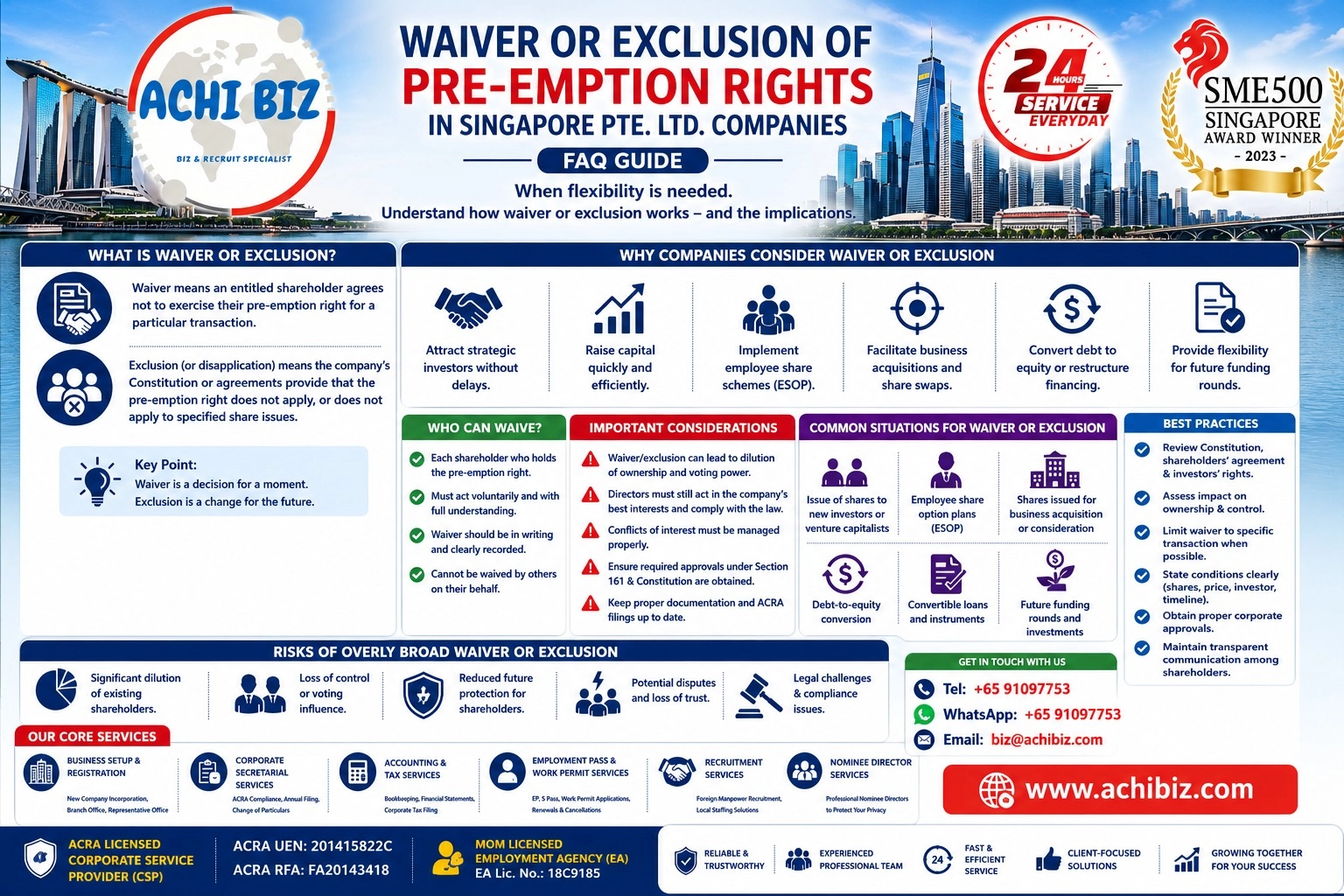
Waiver or Exclusion of Pre-emption Rights in Singapore Pte. Ltd. Companies
Pre-emption rights can protect existing shareholders when a Singapore Private Limited (Pte. Ltd.) company proposes to issue new shares. However, there are commercial situations where requiring every new share issue to go through a pre-emption process may be unnecessary, impractical or inconsistent with the company’s intended ownership and fundraising structure.
This is where the waiver or exclusion of pre-emption rights in a Singapore Pte. Ltd. company becomes important.
A waiver generally concerns an existing right that an entitled shareholder agrees not to exercise or enforce in relation to a particular situation. An exclusion, modification or disapplication, depending on how the company’s governing provisions are structured, can instead affect whether the right applies in the first place.
The distinction matters. A company should not assume that directors can simply “ignore” pre-emption rights because shareholders appear comfortable with a proposed allotment.
This FAQ guide focuses exclusively on waiving, excluding, modifying or disapplying pre-emption rights, why companies may consider doing so, the practical and governance implications, and the precautions that should be taken.
For a detailed explanation of what pre-emption rights are and their features, benefits and risks, refer to our separate article “Pre-emption Rights in Singapore Pte. Ltd. Companies: Features, Benefits & Risks.”
For a side-by-side commercial analysis of the two approaches, refer to “Share Issue With vs Without Pre-emption Rights in Singapore Pte. Ltd. Companies.”
What does waiver of pre-emption rights mean?
A waiver generally means that a shareholder who would otherwise be entitled to a pre-emption right agrees not to rely on that right in the relevant circumstances.
For example, if the company proposes to issue shares to a new investor and an existing shareholder has an applicable right to be offered a proportion of those shares first, that shareholder may, where legally and contractually permissible, agree not to exercise the right for that proposed transaction.
The precise legal effect depends on the source and wording of the right.
What does exclusion of pre-emption rights mean?
An exclusion generally refers to structuring the company’s governing arrangements so that pre-emption rights do not apply, or do not apply to specified categories of share issues.
Rather than an entitled shareholder deciding not to exercise a right on one occasion, the relevant provisions may define from the outset when the right exists and when it does not.
This distinction can have significant long-term consequences.
Are waiver and exclusion of pre-emption rights the same thing?
No.
Although the expressions are sometimes used loosely in commercial discussions, they should not automatically be treated as interchangeable.
A waiver normally concerns an existing right that a person agrees not to exercise in a particular circumstance.
An exclusion generally concerns whether the right applies to the transaction at all under the company’s governing arrangements.
There can also be modifications, exceptions and other mechanisms affecting how pre-emption operates.
The actual documents should therefore be reviewed instead of relying solely on terminology.
What does “disapplication of pre-emption rights” mean?
“Disapplication” is another expression commonly encountered in discussions about shareholder pre-emption.
In practical terms, it describes circumstances in which an otherwise applicable pre-emption mechanism is made inapplicable to a particular issue or category of issues.
However, companies should focus on the actual Singapore statutory and constitutional framework and the wording of their own documents rather than assuming terminology used in another jurisdiction operates identically in Singapore.
Can a Singapore Pte. Ltd. company issue shares without applying the usual pre-emption process?
Potentially, depending on the company’s Constitution, applicable statutory provisions, contractual arrangements and the circumstances of the proposed issue.
For Singapore private companies, section 161 of the Companies Act 1967 is particularly relevant to directors’ authority to issue shares and the proportional offer requirement under section 161(6), which operates subject to the company’s Constitution.
The company should therefore establish the legal basis for proceeding without the usual pre-emption process before the allotment is made.
Why is the phrase “subject to the Constitution” important?
Because section 161(6) of the Companies Act makes the private-company proportional offer requirement subject to the company’s Constitution.
The Constitution can therefore be highly significant in determining whether and how the statutory pre-emption mechanism applies.
This is why reviewing the Constitution should be one of the first steps in any proposed new share issue.
Can directors simply decide that pre-emption rights will not apply?
Directors should not assume they have an unrestricted power to disregard applicable shareholder rights.
They must identify the source of the pre-emption right, review the Constitution and any relevant contractual arrangements, ensure that the required authority to issue shares exists and comply with their duties when exercising the share-issue power.
Commercial convenience alone does not replace proper corporate procedure.
Why would a company want pre-emption rights excluded?
The main reason is usually fundraising flexibility.
A company may expect to raise capital regularly from external investors and may not want every qualifying share issue to require a full proportional offer process to existing shareholders.
Other reasons can include employee equity arrangements, strategic investments, acquisition consideration, restructuring or other specifically contemplated transactions.
However, increased flexibility should be weighed against the reduction in protection available to existing shareholders.
Why would shareholders agree to waive their pre-emption rights?
A shareholder may support the proposed investor or transaction and have no intention of contributing additional capital.
For example, an incoming investor may bring funding, industry knowledge, technology, market access or other strategic value.
The existing shareholder may therefore consider the resulting dilution commercially acceptable.
Does waiving pre-emption rights mean the shareholder approves the whole transaction?
Not necessarily.
Waiving one particular right should not automatically be treated as approval of every aspect of the transaction.
The company may still require separate shareholder approvals, board approvals or other corporate actions.
Documentation should therefore state clearly what is being waived and what, if anything, is separately being approved.
Is a waiver the same as voting in favour of a share allotment?
Not necessarily.
Authority for directors to issue shares and a shareholder’s individual pre-emption entitlement are conceptually different matters.
A shareholder might support the company’s fundraising proposal but still have a participation right, or might waive a participation right without that waiver replacing another required corporate approval.
The documentation should address each requirement separately.
Does a waiver of pre-emption rights automatically give directors authority to issue shares?
No.
This is an important distinction.
A waiver deals with the relevant pre-emption entitlement. It does not automatically satisfy the separate question of whether directors have the necessary authority under section 161 of the Companies Act and the company’s corporate approvals to issue the shares.
Both issues should be checked.
Can a shareholder waive pre-emption rights for only one share issue?
Potentially, yes, where the applicable arrangements allow it.
A transaction-specific waiver can be useful where the shareholder supports one particular investment but does not want to surrender protection against all future issues.
The waiver should be drafted clearly enough to identify the transaction to which it relates.
Can a shareholder give a permanent waiver of pre-emption rights?
A company should approach broad or permanent waivers carefully.
The legal effect depends on the source of the right, wording of the waiver and governing corporate documents.
From a commercial perspective, giving up protection indefinitely is materially different from approving one specific allotment.
A shareholder should understand that distinction before agreeing.
Is a one-off waiver safer than a general waiver?
It can provide greater certainty about the scope of what the shareholder is agreeing to relinquish.
A one-off waiver can identify the proposed allotment, investor, number or class of shares and other relevant terms.
A broad waiver may provide more flexibility to the company but can create greater long-term consequences for the shareholder.
Neither approach should be used mechanically.
Can a waiver be limited to a particular investor?
Potentially.
A waiver can be structured, where appropriate, around a specific proposed transaction or investor.
For example, existing shareholders might agree that a strategic investor can subscribe for a specified number of shares without those shareholders exercising their applicable priority rights.
Clear identification of the transaction helps reduce future uncertainty.
Can a waiver be limited to a particular number of shares?
Potentially, yes.
A carefully structured waiver may apply only to the number of shares contemplated by a particular transaction.
If the company subsequently proposes to issue additional shares, the earlier waiver should not automatically be assumed to cover the additional allotment unless its wording actually does so.
Can a waiver be limited to a particular share class?
Potentially.
Where a company has ordinary shares, preference shares or multiple classes, the scope of any waiver should be considered carefully.
A shareholder agreeing to a particular issue of preference shares, for example, should not necessarily be assumed to have waived rights relating to every future ordinary or preference share issue.
Can a waiver be subject to conditions?
Potentially, and this can be commercially useful.
A shareholder might agree to waive an applicable right only if the investment occurs at a specified price, by a particular deadline or on other agreed terms.
If the transaction later changes materially, the company should determine whether the original waiver still applies.
What happens if the investor changes after a waiver is signed?
That depends on the wording and scope of the waiver.
If the shareholder agreed specifically to an allotment to Investor A, the company should not automatically assume the waiver also applies to Investor B.
A materially changed transaction should be reviewed again.
What if the number of shares changes after the waiver?
Again, the wording matters.
A waiver covering 100,000 proposed shares should not automatically be assumed to cover 200,000 shares if the financing is subsequently expanded.
The revised allotment may have a substantially greater dilution effect.
What if the issue price changes after shareholders waive their rights?
A price change can materially alter the economics of the transaction.
If the waiver was given based on a particular price or valuation, the company should consider whether the changed terms fall within the original waiver.
Obtaining updated confirmation may be appropriate rather than relying on an ambiguous document.
What if the share class changes after the waiver?
This can be particularly significant because different share classes can carry different voting, dividend, capital, redemption or conversion rights.
A waiver given for an ordinary share issue should not casually be treated as covering a subsequently redesigned preference-share investment.
Material changes should be assessed before allotment.
Can only some shareholders waive their pre-emption rights?
Potentially, depending on the applicable arrangements.
Where rights belong individually to different shareholders, one shareholder may be willing to waive while another may wish to preserve and exercise the relevant entitlement.
The company must determine the effect of each shareholder’s decision under the applicable provisions rather than treating the shareholder body as a single person.
What happens if one shareholder waives but another does not?
The non-waiving shareholder’s rights must still be considered.
The waiver by Shareholder A does not automatically extinguish Shareholder B’s separate entitlement.
This is particularly important in companies with several founders or investors.
Can a majority shareholder waive the rights of a minority shareholder?
Not simply because the shareholder holds a majority of the shares.
An individual pre-emption entitlement should not automatically be treated as something another shareholder can surrender on that person’s behalf.
The source of the right, Constitution, applicable resolutions and contractual arrangements must be examined.
Can minority shareholders be pressured into waiving pre-emption rights?
A company should avoid treating waiver as a procedural formality where the shareholder is expected to sign without understanding the effect.
The shareholder should know what transaction is proposed and how the waiver may affect the shareholding.
Where the circumstances involve conflicts, significant dilution or unusual terms, obtaining independent legal advice may be appropriate.
Does a shareholder need to receive enough information before giving a waiver?
As a matter of sound governance and risk management, the shareholder should understand what is being waived.
Relevant information can include the proposed number and class of shares, issue price, identity of the proposed subscriber where relevant, expected post-allotment ownership and material rights attached to the shares.
A vague waiver given without sufficient transaction context can create disputes later.
Should a waiver be in writing?
A written waiver is generally far better from a corporate governance and evidential perspective.
It creates a clear record of what the shareholder agreed to and the transaction to which the waiver applies.
Relying on an informal conversation, telephone call or assumption of consent can create unnecessary risk.
Is an email from a shareholder sufficient as a waiver?
Whether a particular communication constitutes an effective waiver depends on the legal requirements, governing documents, wording and circumstances.
For important share allotments, companies should not rely casually on an ambiguous email such as “I’m okay with it.”
Proper documentation provides much greater certainty.
Is silence from a shareholder considered a waiver?
A company should not assume that silence equals waiver unless the applicable legal and contractual framework clearly produces that result.
There is an important difference between a shareholder failing to exercise a right after receiving a valid offer and the company treating silence as advance consent to bypass the applicable process altogether.
Is declining a pre-emption offer the same as signing an advance waiver?
Not exactly.
A shareholder who receives a valid offer and chooses not to subscribe is declining the opportunity presented under the pre-emption process.
An advance waiver may allow the company to proceed without making that offer in the first place, depending on the applicable framework.
The practical outcome may sometimes appear similar, but the legal route is different.
Can shareholders waive rights before the final investor has been identified?
Broad advance waivers require careful consideration.
A shareholder may be comfortable allowing the company general financing flexibility, but agreeing without knowing the investor, valuation, share class or scale of dilution can carry greater risk.
Companies and shareholders should understand exactly how broad the proposed waiver is intended to be.
Should founders give blanket pre-emption waivers to make fundraising easier?
Not automatically.
A blanket waiver can make fundraising more flexible but can significantly weaken the founders’ ability to protect their percentage in later rounds.
A better structure depends on the company’s expected financing model, founder funding capacity and investor requirements.
Should investors agree to blanket waivers?
Again, not automatically.
An investor who negotiates pre-emption protection usually does so because maintaining its percentage may matter strategically or economically.
A blanket waiver could undermine that protection.
Transaction-specific flexibility may sometimes achieve the company’s objective without eliminating the investor’s long-term protection.
Can pre-emption rights be excluded through the company’s Constitution?
The Constitution is central because section 161(6)’s private-company proportional offer requirement is expressly subject to the Constitution.
The company’s constitutional provisions can therefore affect the operation of the requirement.
However, any proposed amendment should be properly drafted, approved and implemented in accordance with the Companies Act and the company’s existing rights and arrangements.
Can an existing company amend its Constitution to change pre-emption provisions?
Potentially, yes.
A Singapore company may amend its Constitution by following the applicable statutory procedures, generally involving a special resolution.
However, the company should also consider existing shareholder rights, class rights and contractual obligations.
A constitutional amendment should not be approached solely as an administrative filing exercise.
What voting threshold generally applies to an amendment of the Constitution?
A special resolution generally requires the statutory threshold applicable under the Companies Act—typically not less than 75% of the votes cast by members entitled to vote on the resolution, subject to the applicable provisions and circumstances.
Companies should ensure that the notice, resolution and filing requirements are properly handled.
Does passing a special resolution automatically resolve every shareholder issue?
No.
A valid constitutional amendment does not necessarily eliminate separate contractual rights or other protections that may exist.
For example, shareholders may have negotiated rights under a shareholders’ agreement or investment agreement.
The company should therefore review all relevant documents before concluding that a constitutional amendment alone resolves the issue.
Can changing pre-emption provisions affect class rights?
Potentially.
If a company’s share classes carry particular rights relating to future issues or participation, a proposed amendment may need to be examined for its effect on those class rights.
The statutory rules on variation or abrogation of class rights and the company’s Constitution may therefore become relevant.
Can a Shareholders’ Agreement exclude or modify pre-emption rights?
A shareholders’ agreement can contain contractual arrangements governing future share issues and participation rights.
However, contractual arrangements should be coordinated with the company’s Constitution and statutory requirements.
A private agreement should not simply be assumed to override the Companies Act or produce the same corporate effect as a constitutional provision.
What happens if the Constitution and Shareholders’ Agreement say different things?
This can create significant legal and practical complications.
The Constitution operates as a corporate constitutional document, while the shareholders’ agreement creates contractual obligations among its parties.
If they are inconsistent, the company and shareholders may face a situation where a corporate action is effective under one framework but potentially breaches contractual obligations under another.
The documents should therefore be aligned wherever possible.
Can a company exclude pre-emption rights only for certain transactions?
Potentially, and targeted exceptions can sometimes provide a better balance than removing the protection entirely.
For example, the governing arrangements might specifically address particular types of employee equity, strategic transactions or other defined issues.
The appropriateness and drafting of exceptions depend on the company’s circumstances.
Can employee share issues be excluded from pre-emption arrangements?
Potentially.
Companies planning employee equity incentives may want enough flexibility to issue shares under an approved scheme without repeatedly triggering a general shareholder participation process.
However, the exception should be properly established because employee equity can still dilute existing shareholders.
Can an ESOP be carved out from pre-emption rights?
Potentially, subject to the company’s Constitution, shareholder arrangements and applicable approvals.
A clearly defined ESOP carve-out can provide certainty over the pool of shares available for employee incentives.
Existing shareholders should understand the maximum potential dilution when agreeing to such an arrangement.
Can shares issued for an acquisition be excluded?
Potentially.
A company may want to acquire a business and issue its own shares to the seller as consideration.
Requiring a proportional cash subscription opportunity for existing shareholders may not fit the commercial structure of that acquisition.
Where such transactions are contemplated, the governing documents can be designed appropriately, subject to legal requirements and shareholder protections.
Can strategic investor issues be excluded?
Potentially.
A company may want to bring in an investor specifically because of the investor’s expertise, distribution network, technology or market access.
Existing shareholders subscribing proportionately would not necessarily replicate that strategic benefit.
A carefully structured exception may therefore be commercially appropriate.
Can debt-to-equity conversions be excluded?
Potentially, where the company’s arrangements properly address them.
A lender converting debt into equity may be part of a negotiated financing or restructuring.
However, because conversion can substantially dilute existing shareholders, the consequences should be understood when the relevant financing arrangement is approved.
Can convertible instruments be dealt with in advance?
Yes, and doing so can reduce uncertainty.
When a company issues a convertible instrument, it should consider from the outset what will happen when the instrument converts.
Waiting until conversion to discover that existing shareholder rights conflict with the agreed financing structure can create serious problems.
Can future funding rounds be excluded in advance?
Broad exclusions for future fundraising should be considered carefully.
They can provide the company with significant flexibility, but existing shareholders may be surrendering protection against unknown future investors, valuations and dilution.
A more targeted structure may sometimes provide a better balance.
Can pre-emption rights be excluded only up to a particular funding amount?
Potentially.
A company might establish a defined level of fundraising flexibility rather than an unlimited exclusion.
The drafting needs to make clear whether the limit relates to number of shares, percentage of capital, monetary value, a particular funding round or another measure.
Can an exclusion expire after a certain date?
Potentially.
Time-limited arrangements can allow the company to complete a contemplated financing while avoiding an indefinite removal of shareholder protection.
Clear drafting is essential so everyone knows when the exception begins and ends.
Can an exclusion be conditional on a minimum share price?
Potentially.
This can be one way of protecting existing shareholders against highly dilutive low-price issues while still giving the company financing flexibility above an agreed valuation.
The commercial and legal drafting needs careful consideration.
Can an exclusion apply only if the new investor is independent?
Potentially, where properly drafted.
Shareholders may be more comfortable allowing flexibility for genuine third-party investment than for an issue to a director, controlling shareholder or connected person.
Related-party situations can create additional conflict-of-interest concerns and should be handled carefully.
Does exclusion of pre-emption rights mean directors can issue shares at any price?
No.
Removing or modifying a pre-emption mechanism does not remove directors’ duties or other applicable corporate requirements.
Directors must still exercise their powers properly and in the company’s interests in accordance with Singapore law.
Does exclusion allow directors to dilute a shareholder deliberately?
It should not be viewed as a licence to misuse the share-issue power.
Directors’ duties remain relevant regardless of whether a pre-emption mechanism applies.
An allotment designed for an improper purpose can raise issues independently of pre-emption rights.
Are directors’ duties removed when every shareholder signs a waiver?
No.
Shareholder waiver of a particular participation right does not erase directors’ statutory and fiduciary responsibilities.
The board should still properly consider and document the purpose and terms of the allotment.
Can a director who is also the incoming investor participate in the decision?
This can raise conflict-of-interest considerations.
The company should examine the Companies Act, Constitution and applicable governance procedures concerning disclosure and management of directors’ interests.
A pre-emption waiver does not automatically resolve a director conflict.
Why is a conflict of interest particularly important when pre-emption rights are waived?
Because the transaction may transfer a larger ownership percentage to a director, founder, related party or connected investor without the usual participation opportunity for other shareholders.
That does not automatically make the transaction improper, but it increases the importance of transparent decision-making and proper documentation.
Can waiver of pre-emption rights lead to substantial dilution?
Yes.
This is one of the most important consequences.
Suppose a shareholder owns 30% before a substantial new allotment. If the shareholder waives an applicable participation right and the shares are issued to another person, the shareholder’s percentage can fall materially.
The shareholder should therefore understand the post-allotment capitalisation before waiving.
Should a cap table be prepared before shareholders sign a waiver?
This is a very good practice.
A pre-transaction and post-transaction capitalisation table can show shareholders exactly how the proposed allotment changes ownership percentages.
This makes the commercial effect of the waiver much easier to understand.
Can a shareholder lose majority control after waiving?
Potentially, yes.
If the new issue is sufficiently large, a shareholder holding more than 50% before the allotment could fall below that level afterwards.
The consequences can be significant, so the post-issue voting position should be analysed before the waiver is given.
Can a shareholder lose the ability to block a special resolution?
Potentially.
Because special resolutions generally involve a 75% voting threshold, changes in voting percentages can alter whether a shareholder has sufficient voting strength to prevent such a resolution from passing.
The exact outcome depends on voting rights and attendance/voting circumstances, but strategically important thresholds should be considered before substantial dilution is accepted.
Can waiver affect dividend participation?
Potentially.
Where a shareholder’s economic participation is linked to the number or proportion of shares held, dilution can reduce the shareholder’s relative participation in future distributions.
The effect may be more complex where multiple share classes exist.
Can waiver affect sale proceeds when the company is eventually sold?
Yes.
A smaller percentage ownership can mean a smaller share of sale proceeds, although the precise outcome depends on the rights attached to each share class and the transaction structure.
A shareholder considering waiver should therefore think beyond the immediate funding round.
Can waiver affect future fundraising rights?
Potentially.
A transaction-specific waiver should not necessarily affect later rights, but broad drafting could have wider consequences.
Shareholders should understand whether they are waiving only today’s opportunity or altering their position for future financing rounds.
Can a waiver affect anti-dilution protection?
Pre-emption rights and contractual anti-dilution mechanisms are different concepts.
A company may have both.
Waiving a pre-emption right should not automatically be assumed to waive separate anti-dilution rights unless the relevant documents clearly provide for that outcome.
Is pre-emption waiver the same as consent to dilution?
Commercially, the shareholder may be accepting that dilution will occur.
Legally, however, the precise scope of the waiver matters.
A properly drafted document should make clear what right is being waived and the transaction being permitted.
Can a shareholder waive the right and still invest separately?
Potentially, depending on the transaction.
For example, a shareholder might waive a formal proportional entitlement but separately negotiate participation on different terms.
However, the company should ensure that the resulting arrangement is consistent with the Constitution, corporate approvals and treatment of other shareholders.
Can a shareholder receive compensation for waiving pre-emption rights?
This is a more complex commercial and legal issue.
Any payment or benefit given in exchange for waiver should be carefully considered for corporate-law, directors’ duties, tax, accounting, contractual and conflict-of-interest implications.
It should not be treated as a routine administrative arrangement.
Is it risky to obtain waivers after shares have already been allotted?
Yes.
The preferable approach is to identify and address applicable pre-emption rights before the allotment.
Trying to obtain retrospective consent or waiver after a potentially non-compliant transaction has occurred can create uncertainty and should not be treated as equivalent to proper advance compliance.
Can a retrospective waiver cure an earlier breach automatically?
A company should not assume so.
Whether a later waiver, ratification or other remedial action has legal effect depends on the nature of the original requirement and the circumstances.
Where an allotment may already have breached statutory, constitutional or contractual requirements, legal advice may be appropriate.
What happens if the company wrongly assumes pre-emption rights were excluded?
The company can face shareholder disputes, contractual claims or challenges concerning the corporate process.
The directors’ conduct may also come under scrutiny depending on the circumstances.
The safest approach is to establish the basis for the exclusion before the shares are issued.
What evidence should the company retain regarding a waiver?
The company should maintain appropriate corporate records demonstrating the relevant decision and approvals.
Depending on the transaction, this may include the written waiver, board resolutions, shareholder resolutions, notices, subscription or investment documents, updated cap table and other supporting records.
Good records can be critical if the transaction is questioned years later.
Does a pre-emption waiver itself need to be filed with ACRA?
A waiver document is not necessarily itself a standalone ACRA filing merely because it exists.
However, the resulting share allotment, changes to share capital, constitutional amendment or other corporate action may trigger applicable ACRA filing requirements.
The filing requirements should therefore be determined based on the actual transaction.
Does an amendment to the Constitution need to be lodged with ACRA?
Yes, where the company amends its Constitution, the applicable resolution and amended Constitution must be lodged in accordance with the Companies Act and ACRA filing requirements.
The company should ensure that its registered corporate records accurately reflect the adopted Constitution.
Does issuing shares after a waiver still require ACRA filing?
Yes, applicable statutory filing requirements for the allotment remain relevant.
Waiving pre-emption rights does not remove the company’s obligations to properly approve, document and lodge the share allotment.
Should the company update its cap table after the allotment?
Yes.
The company should ensure its shareholding and corporate records accurately reflect the completed issue.
This is particularly important where the waiver results in a significant change in ownership percentages.
Should the company secretary review a proposed waiver?
Corporate secretarial review can help identify the company’s Constitution, existing resolutions, share classes, statutory filing requirements and procedural steps.
Where the transaction involves complex legal rights, disputes, unusual drafting or potentially contentious shareholder issues, Singapore legal advice may also be necessary.
Should a lawyer draft every pre-emption waiver?
Not every straightforward corporate transaction necessarily requires bespoke legal drafting, but the level of professional input should reflect the complexity and risk.
Legal advice becomes particularly important where there is substantial dilution, multiple share classes, disagreement among shareholders, contractual inconsistencies, unusual investor rights or uncertainty over the effectiveness of the proposed waiver.
When should a company consider a transaction-specific waiver instead of changing its Constitution?
A transaction-specific waiver may be appropriate where the company wants to preserve its normal shareholder protections but needs flexibility for one particular investment.
Changing the Constitution can have continuing effects beyond the immediate transaction.
The company should therefore consider whether the commercial need is temporary or structural.
When might changing the Constitution be more appropriate?
If the existing pre-emption provisions repeatedly interfere with the company’s intended financing model, a structural review may be more appropriate than obtaining the same type of waiver for every funding round.
Any amendment should nevertheless be considered carefully because it can affect future shareholders and future transactions.
Is excluding all pre-emption rights always the simplest solution?
It may appear simpler administratively, but simplicity should not be measured only by the speed of the next allotment.
Removing protection can create future disputes if shareholders later believe they were unexpectedly diluted.
A well-designed structure seeks the right balance between flexibility, predictability and shareholder protection.
Can excessive waiver requirements also become inefficient?
Yes.
If every small or routine equity transaction requires separate documents from numerous shareholders, corporate administration can become burdensome.
Companies expecting frequent equity transactions should consider whether their governing provisions remain suitable for the business.
Should a startup exclude pre-emption rights from the beginning?
There is no universal answer.
Startups often need financing flexibility, but founders and early investors may also strongly value protection against dilution.
The appropriate structure depends on anticipated fundraising, employee equity plans, investor expectations and the desired balance of control.
Should a family-owned company exclude pre-emption rights?
Again, not automatically.
Family businesses may place greater importance on maintaining existing ownership relationships and avoiding unexpected dilution.
Broad exclusions may therefore be inconsistent with the shareholders’ long-term objectives.
Should a joint venture company allow broad exclusions?
Joint ventures often depend heavily on agreed ownership proportions.
A substantial change in percentage ownership can alter the commercial balance between the joint venture parties.
Accordingly, pre-emption arrangements and any permitted exceptions usually require careful negotiation.
Are exclusions more useful for companies expecting institutional investment?
They can be useful, but institutional investors themselves may require substantial participation protections.
A company cannot assume sophisticated investors will prefer the absence of pre-emption rights.
In many investment structures, the negotiation concerns who receives which participation rights and under what circumstances, rather than simply whether all rights should disappear.
Can a new investor require existing shareholders to waive their rights as a condition of investment?
Yes, this can arise commercially.
An investor may agree to invest only if it receives a specified percentage of the company.
If existing shareholders exercising pre-emption rights would reduce the number of shares available to that investor, the investment may be conditional upon appropriate waivers.
Existing shareholders should understand the consequences before agreeing.
Why should waiver discussions happen early in fundraising?
Because they can determine whether the proposed investment structure is achievable.
If an investor expects 20% ownership but the company discovers shortly before completion that existing shareholders intend to exercise participation rights, the transaction may need to be renegotiated.
Early corporate review can avoid this problem.
Should a term sheet address pre-emption waivers?
Where applicable, yes.
If completion of the proposed investment depends on existing shareholders waiving rights, that condition should ideally be identified during the transaction planning stage.
It should not emerge unexpectedly on the scheduled completion date.
Can pre-emption waiver become a condition precedent to investment completion?
Yes, where appropriate.
Investment documentation may make satisfactory waiver or other required shareholder approvals conditions that must be fulfilled before the subscription completes.
This gives the incoming investor greater certainty that the company can validly proceed with the agreed allotment.
Can exclusion of pre-emption rights make future fundraising easier?
Potentially, yes.
It can reduce procedural barriers and give directors greater flexibility to allocate shares to incoming investors, subject to the company’s other corporate requirements.
However, this flexibility comes at the cost of reducing an important mechanism by which existing shareholders can protect their relative ownership.
Can exclusion make the company more attractive to investors?
Sometimes, particularly where an incoming investor wants certainty over the exact allocation.
But existing investors may prefer strong pre-emption protection for future rounds.
Therefore, what attracts one investor today could concern that same investor when it becomes an existing shareholder tomorrow.
This illustrates why long-term capital planning matters.
Can waiver of pre-emption rights be beneficial to the company but disadvantage an individual shareholder?
Yes.
The company may receive valuable new capital while an existing shareholder experiences dilution.
Corporate benefit and individual shareholder impact are not always identical.
This is why transparency and proper governance are important.
Can waiver benefit an existing shareholder even though the shareholder is diluted?
Yes.
A smaller percentage of a substantially stronger or more valuable company may be commercially preferable to a larger percentage of an underfunded company.
For example, new capital may allow expansion, debt reduction or business development.
Dilution should therefore be evaluated alongside what the company receives in return.
Is dilution always harmful?
No.
Dilution describes a reduction in relative ownership; it does not by itself determine whether the transaction is economically good or bad.
If the company issues shares at an appropriate valuation and receives valuable capital or strategic benefits, the transaction may increase the overall value of the business.
The key question is not merely “Am I diluted?” but also “What value does the company receive for that dilution?”
What should shareholders analyse before waiving pre-emption rights?
They should consider the proposed investor, number and class of shares, issue price, valuation, percentage dilution, voting impact, economic impact, rights attached to the new shares, use of investment funds and whether the waiver affects only this transaction or future transactions.
The post-allotment cap table should also be understood.
What should directors analyse before requesting waivers?
Directors should consider why the proposed investor or transaction is in the company’s interests, whether the terms are commercially reasonable, what dilution will occur, whether conflicts exist, whether all relevant shareholders have been properly treated and whether statutory, constitutional and contractual requirements have been satisfied.
What should an incoming investor analyse?
The investor should confirm that the company has properly dealt with applicable pre-emption arrangements and has the necessary authority to make the agreed allotment.
This reduces the risk of completing an investment that later becomes the subject of a shareholder dispute.
What is the biggest mistake when dealing with pre-emption waivers?
One of the biggest mistakes is treating the waiver as a standard signature form rather than a substantive shareholder decision.
The consequences can include loss of percentage ownership, voting influence and future economic participation.
The document should therefore accurately reflect an informed and clearly defined transaction.
What is another common mistake?
Another common mistake is believing:
“All shareholders support the investment, so pre-emption does not matter.”
Informal support does not necessarily satisfy the applicable statutory, constitutional or contractual requirements.
The company should document the transaction properly.
Is a waiver necessarily evidence that pre-emption rights are undesirable?
No.
A shareholder may strongly value pre-emption rights generally while choosing not to exercise them for one attractive strategic investment.
This is precisely why transaction-specific waivers can be useful.
They can provide flexibility without permanently abandoning protection.
What is the main benefit of waiving pre-emption rights?
The main benefit is flexibility.
Where existing shareholders support a particular investment but do not wish to subscribe themselves, an appropriate waiver can allow the company to proceed without an unnecessary participation process, subject to the governing requirements.
What is the main risk of waiving pre-emption rights?
The main risk for the shareholder is accepting dilution without fully understanding its long-term consequences.
Those consequences can extend beyond ownership percentage to voting influence, economic participation, future exit proceeds and negotiating position.
What is the main benefit of excluding pre-emption rights?
A properly structured exclusion can make future equity transactions more efficient where the company’s business model requires substantial flexibility.
This can be useful for companies expecting frequent investment, employee equity or specifically contemplated strategic transactions.
What is the main risk of excluding pre-emption rights?
The main risk is removing a valuable safeguard too broadly.
Existing shareholders may later discover that substantial new shares can be issued without giving them an opportunity to maintain their relative ownership.
The convenience gained by the company should therefore be weighed against the protection surrendered by shareholders.
Is waiver or exclusion of pre-emption rights better?
Neither is universally better.
A waiver can be suitable where the company needs an exception for a particular transaction while preserving the general protection.
A structural exclusion may be more suitable where the company deliberately wants a different long-term financing framework.
The choice should reflect the company’s commercial objectives rather than administrative convenience alone.
Is this the same as comparing a company with and without pre-emption rights?
No.
This article focuses specifically on the mechanisms and implications of waiver, exclusion and modification.
For a broader comparison of the practical consequences of issuing shares under the two different approaches, refer to our separate article:
“Share Issue With vs Without Pre-emption Rights in Singapore Pte. Ltd. Companies.”
Where can I read about the underlying features, benefits and risks of pre-emption rights themselves?
Those matters are intentionally not repeated here.
For the underlying concept, shareholder protection, dilution mechanics, benefits and disadvantages of pre-emption rights, refer to our dedicated article:
“Pre-emption Rights in Singapore Pte. Ltd. Companies: Features, Benefits & Risks.”
What is the key takeaway on waiver of pre-emption rights?
A waiver should be viewed as an informed decision by an entitled shareholder not to rely on an applicable protection in defined circumstances, rather than merely an administrative form required to complete an allotment.
The narrower and clearer the waiver, the easier it is to determine exactly what transaction the shareholder has agreed to permit.
What is the key takeaway on exclusion of pre-emption rights?
Exclusion is a more structural question.
It concerns how much flexibility the company should have to issue shares without first providing existing shareholders with the usual participation opportunity.
A broad exclusion can simplify fundraising but can also materially reduce shareholder protection.
What should a Singapore Pte. Ltd. company do before waiving or excluding pre-emption rights?
The company should first identify where the pre-emption right comes from.
It should then review the Companies Act 1967, Constitution, shareholders’ agreement, investment agreements, existing share classes, directors’ authority to issue shares, relevant shareholder approvals and the proposed allotment terms.
Where a waiver is required, its scope should be clearly documented before the shares are allotted. Where a structural exclusion or constitutional amendment is proposed, the company should consider the longer-term consequences rather than focusing only on the immediate fundraising.
The central principle is simple: flexibility should be deliberate, not accidental.
A company should know exactly which shareholder protection is being waived or excluded, why it is doing so, which transaction is covered and how the resulting allotment will affect existing shareholders.
ACHI BIZ, as an ACRA Licensed Corporate Service Provider (CSP), can assist Singapore companies with share allotments, share capital changes, corporate resolutions, Constitution amendments and related corporate secretarial procedures and ACRA filings.
For related reading, see our separate ACHI BIZ FAQ guides:
“Pre-emption Rights in Singapore Pte. Ltd. Companies: Features, Benefits & Risks” – for the nature and purpose of pre-emption rights themselves.
“Share Issue With vs Without Pre-emption Rights in Singapore Pte. Ltd. Companies” – for the detailed side-by-side comparison of the two approaches.