
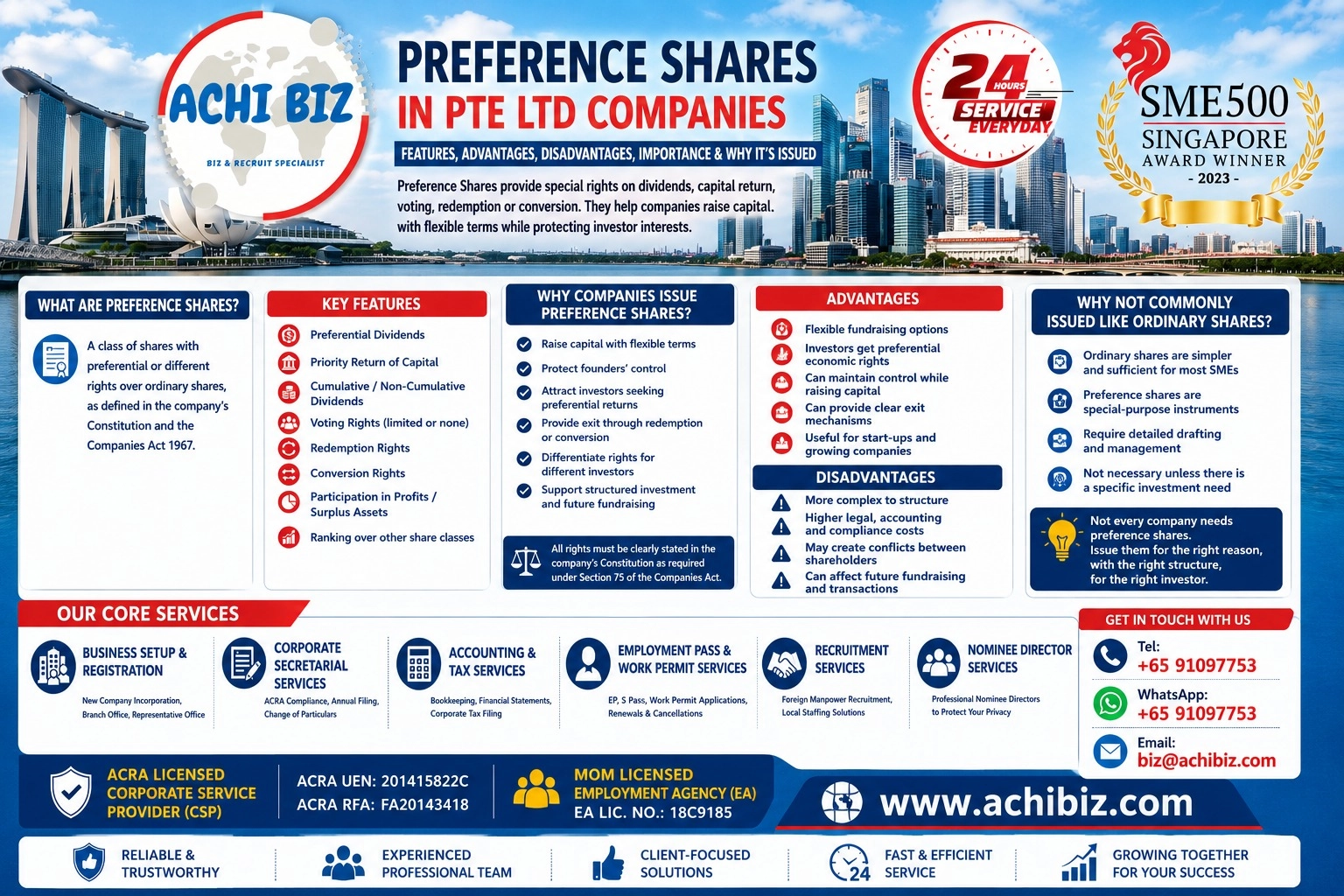
Preference Shares in Singapore Pte. Ltd. Companies – FAQ Guide
Preference shares can be an important financing and corporate structuring tool for a Singapore Private Limited (Pte. Ltd.) company, particularly when a business wants to raise capital while giving a particular investor or group of investors specially defined economic or investment rights.
Unlike a simple shareholding structure, preference shares can be designed with specific rights concerning dividends, repayment of capital, participation in profits or surplus assets, voting, redemption and conversion. This flexibility makes them useful for certain investors, growing businesses, family investment structures and companies undertaking more sophisticated fundraising.
However, preference shares are not required or suitable for every company. Their value comes from careful structuring of the rights attached to them. Poorly drafted preference-share terms can create uncertainty over dividends, voting, redemption, conversion, liquidation and future fundraising.
This FAQ guide focuses exclusively on preference shares in Singapore Pte. Ltd. companies, including their features, purpose, advantages, disadvantages, legal requirements, practical applications and important considerations before issuance.
For a detailed side-by-side analysis of different share classes, please refer to our separate article on “Ordinary Shares vs Preference Shares in Singapore Pte. Ltd. Companies.”
What are Preference Shares in a Singapore Pte. Ltd. company?
Preference shares are a class of shares carrying specifically defined rights or preferences.
Depending on their terms, those preferences may relate to dividends, repayment of capital, participation in profits or surplus assets, voting, redemption, conversion or other agreed rights.
ACRA explains that preference shares typically receive fixed dividends, with dividends generally paid before distributions to ordinary shareholders, and commonly do not carry voting rights. They may also have priority in receiving capital during liquidation. However, the actual rights always depend on how the particular preference shares have been structured.
Why are they called Preference Shares?
They are called “preference” shares because their holders are given preference or priority in specified areas.
For example, a class may have preferential entitlement to dividends or repayment of capital.
The word “preference” should not be interpreted to mean that the shareholder automatically receives superior rights in every aspect of the company.
A shareholder might receive preferential economic rights while having limited voting or participation rights. The precise package of rights must therefore be examined.
Are Preference Shares legally recognised in Singapore?
Yes.
The Companies Act 1967 specifically recognises preference shares and imposes requirements concerning the rights attached to them.
Section 75 is particularly important. A company must not allot preference shares, or convert issued shares into preference shares, unless its Constitution sets out the rights of preference shareholders regarding repayment of capital, participation in surplus assets and profits, cumulative or non-cumulative dividends, voting, and priority of capital and dividend payments in relation to other shares or classes of preference shares.
Must Preference Share rights be stated in the company’s Constitution?
Yes. This is one of the most important legal requirements when establishing preference shares.
The company’s Constitution must properly address the rights relating to:
- repayment of capital;
- participation in surplus assets and profits;
- cumulative or non-cumulative dividends;
- voting; and
- priority of payment of capital and dividends relative to other shares or classes of preference shares.
Therefore, preference shares should not be created merely through an informal understanding between a company and investor.
The rights need to be properly incorporated into the company’s corporate framework.
Why is the Constitution so important when issuing Preference Shares?
The commercial value of preference shares depends heavily on the rights attached to them.
For example, stating that an investor will subscribe for “8% preference shares” is not sufficient by itself.
Important questions remain. Is the 8% a dividend rate? Is it cumulative? When can it be paid? Can the company redeem the shares? Can the investor require redemption? Are the shares convertible? Does the investor participate in additional profits? What happens on liquidation? What voting rights exist?
These issues should be clearly addressed rather than left for interpretation after the investment has been made.
Can a Singapore Pte. Ltd. company issue different classes of Preference Shares?
Yes, subject to its Constitution and compliance with the Companies Act.
For example, a company could establish different series or classes of preference shares carrying different dividend, capital, voting, redemption or conversion rights.
This can provide significant flexibility when investors enter the company at different stages or on different commercial terms.
However, every additional class increases the complexity of the company’s capital structure.
What are the main features that can be attached to Preference Shares?
Depending on the structure, preference shares may contain features relating to preferential dividends, cumulative dividends, priority return of capital, participation in additional profits, redemption, conversion, restricted voting rights and ranking against other share classes.
Not every preference share contains all these features.
The appropriate rights should be selected according to the purpose of the investment rather than simply adding every possible preference.
Why would a Singapore company issue Preference Shares?
The main reason is to raise capital on terms specifically designed for a particular investor or financing arrangement.
A company may require investment but find that a standard equity investment does not adequately address the investor’s expectations or the company’s longer-term financing strategy.
Preference shares allow the company to create an investment instrument with carefully defined rights.
What is the importance of Preference Shares in corporate financing?
Their importance lies in flexibility.
Businesses and investors do not always have identical objectives. One investor may prioritise regular economic returns. Another may want an eventual conversion opportunity. Another may require priority if the business is wound up. A company may want an investor’s capital but need a carefully structured governance arrangement.
Preference shares provide a mechanism through which these commercial expectations can potentially be reflected in the company’s share structure.
When can Preference Shares become particularly useful?
They can become useful where a company is:
- bringing in external investors;
- raising growth capital;
- undertaking structured equity financing;
- introducing strategic investors;
- planning different investment rounds;
- providing investors with preferential economic rights;
- establishing an investment exit mechanism;
- considering future conversion of an investment;
- separating different categories of investors; or
- restructuring its existing capital arrangements.
Their usefulness should always be assessed against the company’s actual commercial objectives.
Are Preference Shares suitable for startups?
They can be.
Startups seeking sophisticated investors may need an investment structure that goes beyond a straightforward subscription for shares.
An investor may require priority economic rights, conversion mechanisms or other negotiated protections before committing capital.
Preference shares can provide the flexibility to structure these rights.
However, startup investment terms can become highly sophisticated, particularly where multiple funding rounds are expected. Appropriate legal, tax and accounting advice is therefore important.
Are Preference Shares useful for established SMEs?
Potentially.
An established SME may wish to bring in a strategic or financial investor without completely restructuring its existing ownership arrangements.
Preference shares can be considered where the incoming investor requires specifically negotiated economic or exit rights.
For a conventional owner-managed SME that does not require external investment, however, creating preference shares may add unnecessary complexity.
Are Preference Shares suitable for passive investors?
They can be, depending on the terms.
Some investors may primarily be interested in the economic performance of their investment rather than participating actively in company management.
Preference shares can potentially be structured around economic rights such as preferential dividends or capital priority while limiting ordinary voting participation.
However, the investor should understand exactly what rights are being received and what rights are being surrendered or restricted.
Can Preference Shares carry a fixed dividend?
Yes, preference shares can be structured with a specified dividend rate.
This is one of their commonly recognised features.
However, describing a dividend as “fixed” should not be misunderstood as creating an unconditional guaranteed payment regardless of the company’s circumstances.
The terms of the shares and the applicable legal requirements concerning distributions still need to be considered.
Is the dividend on Preference Shares guaranteed?
Not merely because a specified dividend rate appears in the share terms.
A preference share is not automatically equivalent to a fixed deposit or guaranteed investment product.
Whether a dividend can be declared or paid depends on the applicable terms and Singapore company law requirements.
An investor should therefore distinguish between having a preferential dividend entitlement and having an unconditional debt repayment obligation.
What are Cumulative Preference Shares?
Cumulative preference shares generally provide for unpaid preference dividends to accumulate according to the rights attached to the shares.
If the relevant dividend is not paid for one period, the entitlement may carry forward and have to be addressed in accordance with the applicable terms.
This can provide additional economic protection for the preference shareholder.
The Companies Act specifically requires the company’s Constitution to state whether preference dividends are cumulative or non-cumulative.
What are Non-Cumulative Preference Shares?
Non-cumulative preference shares generally do not allow an unpaid dividend for a particular period to accumulate indefinitely for future payment in the same manner as cumulative preference shares.
The distinction can materially affect the value of the investment.
Companies and investors should therefore clearly understand which structure is being created.
What are Participating Preference Shares?
Participating preference shares can be structured to allow their holders to receive specified preferential entitlements and then participate further in profits or surplus distributions according to an agreed formula.
For example, the investor might receive a preferential entitlement first and then participate in an additional distribution if specified conditions are satisfied.
Because this can materially affect other shareholders’ economic interests, the participation rights should be drafted precisely.
What are Non-Participating Preference Shares?
Non-participating preference shares generally restrict holders to their specified preferential entitlements without giving them additional participation beyond those rights.
Such a structure may be useful where an investor requires a defined economic preference but the company does not intend to provide unlimited participation in additional profits or surplus assets.
What are Redeemable Preference Shares?
Redeemable preference shares are preference shares structured so that they may be redeemed by the company in accordance with applicable law and the terms governing the shares.
Redemption can provide an important exit mechanism.
For example, an investment might be structured with the expectation that the company will redeem the shares after a specified period or when agreed conditions are satisfied.
The actual redemption provisions require careful drafting.
Why would a company issue Redeemable Preference Shares?
They can be useful where the investment is not intended to remain permanently in the company’s capital structure.
An investor may be willing to provide capital for a particular period while expecting an eventual exit.
A redemption mechanism can establish a clearer pathway for that exit, subject to the company’s financial position, statutory requirements and the agreed terms.
Can Redeemable Preference Shares be redeemed at any time?
Not simply at will unless the terms and applicable law permit it.
The company must follow the redemption provisions and Companies Act requirements.
Among other requirements, redeemable preference shares must be fully paid before redemption. The funding method for the redemption and applicable solvency requirements also need to be considered.
Accordingly, redemption should never be treated as an automatic repayment mechanism without reviewing the company’s legal and financial position at the relevant time.
What happens if Redeemable Preference Shares are redeemed out of capital?
Additional statutory requirements apply.
Where the applicable redemption is funded out of capital, the relevant solvency requirements and directors’ obligations must be satisfied.
This is important because redemption affects the company’s capital position and potentially the interests of creditors.
What are Convertible Preference Shares?
Convertible preference shares provide for the preference shares to be converted into another share class, commonly upon specified events or according to predetermined terms.
The conversion mechanism may depend on time, valuation, financing events or another agreed trigger.
This gives investors the possibility of initially holding preferential rights while potentially participating differently in the company’s future ownership structure.
Why might an investor want Convertible Preference Shares?
Conversion can provide flexibility between current protection and future growth participation.
For example, an investor may initially value preferential economic rights but want the ability to convert the investment if the company’s value increases significantly or a future financing event occurs.
The conversion ratio, conversion price, timing, triggering events and resulting rights should therefore be clearly documented.
Can Preference Shares automatically convert after a certain event?
They can potentially be structured to convert upon specified events, subject to applicable law and the company’s constitutional provisions.
A conversion might be triggered by a future fundraising, expiry of an agreed period, corporate transaction or another predetermined event.
Automatic conversion provisions should be drafted carefully because they can significantly alter ownership and shareholder rights.
Can Preference Shares provide priority when a company is wound up?
Yes, where the applicable class rights provide for priority in repayment of capital.
This is an important potential feature of preference shares.
However, priority does not mean guaranteed recovery.
The shareholder remains an equity investor, and claims that legally rank ahead of shareholders must first be considered.
Does liquidation preference guarantee that the investor will recover the original investment?
No.
A liquidation preference determines how available value is distributed among shareholders according to their respective rights. It cannot create money that the company does not have.
If insufficient assets remain after satisfying higher-ranking liabilities, even a preference shareholder may recover only part of the investment or potentially nothing.
This distinction is extremely important when explaining investment risk.
Can Preference Shares participate in surplus assets?
They can, depending on their terms.
Section 75 of the Companies Act specifically requires the Constitution to address preference shareholders’ rights concerning participation in surplus assets and profits.
The company therefore needs to determine whether the preference shareholder receives only a defined capital preference or can participate further after that preference has been satisfied.
Can Preference Shares carry voting rights?
Yes, depending on the terms.
Preference shares are often structured with limited voting rights, but it would be incorrect to assume that all preference shares are automatically non-voting.
Voting rights should be expressly considered when the class is created.
Can Preference Shareholders vote on matters affecting their own class rights?
Class-right issues can require special consideration under the Companies Act and the company’s Constitution.
A company should therefore not assume that restricted general voting rights mean the preference shareholders can simply be ignored when a proposed transaction affects the rights attached specifically to their class.
Can the rights attached to existing Preference Shares be changed later?
Potentially, but the company must consider the Companies Act, its Constitution and applicable class-right protections.
Changing an existing class’s dividend, voting, redemption, conversion or capital rights can materially affect the value of shareholders’ investments.
The appropriate corporate approval procedures should therefore be followed rather than treating the amendment as an ordinary administrative change.
What is meant by variation of class rights?
A variation of class rights generally involves altering rights attached specifically to a particular class of shares.
For preference shares, this could potentially concern dividend priority, voting, redemption, conversion or capital entitlement.
Because shareholders invested on the basis of those rights, legal and constitutional procedures governing variations need to be respected.
Can Preference Shares have different voting rights from one class to another?
Yes, where properly structured.
For example, different classes may have different voting arrangements or rights triggered only in specified circumstances.
This flexibility can be useful but also makes corporate governance more complex.
What are the major advantages of Preference Shares for a company?
The principal advantage is the ability to customise an equity investment.
A properly structured preference-share issue may help the company raise capital, accommodate investor requirements, differentiate shareholder rights, establish dividend priorities, provide capital preferences, introduce redemption mechanisms and create conversion opportunities.
This makes preference shares particularly valuable when a standard investment structure does not adequately reflect the commercial agreement.
What are the advantages of Preference Shares for investors?
Depending on the terms, investors may benefit from preferential dividends, accumulated dividend rights, priority return of capital, redemption mechanisms, conversion opportunities and other negotiated protections.
The investor can therefore obtain an investment tailored to a particular risk-and-return expectation.
However, every benefit should be assessed together with the corresponding restrictions and risks.
Can Preference Shares help a company attract investors?
Yes.
An investor who would not be willing to invest under a basic equity arrangement may be prepared to invest if appropriate preferential rights are provided.
Preference shares can therefore expand the company’s financing options.
However, companies should avoid granting excessive rights merely to secure immediate funding, as those rights can affect the business for many years.
Can Preference Shares provide an investor with a clearer exit strategy?
Potentially.
Redeemable or convertible structures can provide mechanisms addressing how the investor may eventually exit or change the nature of the investment.
A clearer exit structure can make an investment more attractive, particularly where there may not be an active market for shares in a private company.
What are the major disadvantages of issuing Preference Shares?
The biggest disadvantage is usually complexity.
Creating preference shares can require more detailed constitutional provisions, corporate approvals, investor negotiations, accounting analysis, tax consideration and ongoing administration.
The company may also need to manage different shareholder classes whose commercial interests are not always aligned.
Can Preference Shares become expensive to structure and administer?
Yes.
A sophisticated preference-share issue may require corporate secretarial, legal, accounting, valuation and tax advice.
Additional costs may also arise when the company later undertakes redemption, conversion, variation of class rights, further fundraising or restructuring.
For a relatively small investment, these costs should be weighed against the actual benefit of creating the structure.
Can Preference Shares make the company’s capital structure complicated?
Yes.
Complexity increases when a company has multiple preference classes with different dividend rates, liquidation preferences, conversion formulas and redemption rights.
Directors must understand these rights before approving distributions, fundraising, restructurings or other corporate transactions.
A structure that appears attractive during fundraising can become administratively burdensome if it is unnecessarily complicated.
Can Preference Shares create conflicts between different shareholders?
Yes.
Different shareholder classes can have different economic objectives.
One group may favour retaining profits for business expansion, while another may prioritise distributions. Some investors may prefer an early exit while others want long-term growth.
Preference rights can therefore create competing interests.
Clear documentation and careful structuring can reduce uncertainty but cannot eliminate every potential commercial conflict.
Can generous Preference Share terms disadvantage the company later?
Yes.
This is an important risk.
A company eager to obtain investment today may grant substantial dividend, redemption, conversion or liquidation rights without fully considering their long-term impact.
Those rights can later affect cash flow, restructuring flexibility, new investment rounds or negotiations with future investors.
Preference-share terms should therefore be assessed not only against today’s funding requirement but also against the company’s expected future development.
Can Preference Shares affect future fundraising?
Yes.
Future investors will normally review existing shareholder rights before investing.
If existing preference shareholders have substantial dividend priorities, liquidation preferences, conversion rights or redemption entitlements, a new investor may require different or superior protections.
This can lead to increasingly complicated financing structures.
Can Preference Shares make a future sale of the company more complicated?
Potentially.
When a company is sold, the economic outcome can depend on the rights attached to each class.
Conversion rights, liquidation preferences, participation rights and class approvals may need to be analysed before sale proceeds can be allocated or the transaction completed.
Poorly drafted rights can become particularly problematic at this stage.
Can Preference Shares restrict corporate flexibility?
They can.
A company may need to consider preference shareholders’ rights before restructuring capital, issuing new shares, varying rights, undertaking certain transactions or making distributions.
The more extensive the protections granted, the more carefully directors must consider them when making future corporate decisions.
Are Preference Shares risk-free for investors?
No.
This is one of the most important misconceptions to avoid.
Preference shares can provide priority or preferential rights, but the investor remains exposed to the company’s commercial and financial performance.
A company that fails may have insufficient assets to provide any meaningful return to shareholders.
Can a Preference Shareholder lose the entire investment?
Potentially, yes.
Preference affects relative entitlement. It does not eliminate business risk.
If a company becomes insolvent and insufficient value remains after higher-ranking liabilities have been satisfied, preference shareholders may suffer substantial or complete loss.
Are Preference Shares equivalent to a fixed deposit?
No.
A fixed dividend rate or redemption feature can make certain preference shares appear similar to fixed-return investments, but they should not automatically be treated as deposits.
The legal nature, financial risk, dividend conditions, redemption provisions and insolvency position are fundamentally important.
Are Preference Shares the same as a shareholder loan?
No.
A subscription for preference shares and a shareholder loan create different legal relationships.
A shareholder is an equity holder. A lender is generally a creditor.
The distinction can affect repayment rights, insolvency ranking, tax treatment, accounting treatment and corporate procedures.
Preference shares should therefore not be used merely as a different label for what is commercially intended to be a loan.
Can Preference Shares have debt-like characteristics?
Yes.
Some preference shares may contain fixed-return, redemption or other features that economically resemble debt.
This is why sophisticated preference-share structures may require careful accounting and tax analysis.
The label attached to an instrument does not always answer every accounting or taxation question.
How does IRAS view Preference Shares for tax purposes?
IRAS considers the legal form and characteristics of the instrument when determining the tax treatment of preference shares.
Where preference shares are characterised as equity, distributions such as dividends are treated accordingly and are not simply converted into deductible financing costs because the company accounts for them as finance expenses.
Hybrid or unusual structures therefore require particular care.
Are dividends paid on equity Preference Shares tax-deductible to the company?
Generally, where the preference shares are characterised as equity, dividends paid or payable are not tax-deductible to the company.
This is an important consideration when a company evaluates the overall cost of its financing arrangement.
Can Preference Shares be issued to foreign investors?
Generally, a Singapore Pte. Ltd. company may have foreign shareholders, subject to applicable laws and any sector-specific restrictions.
Preference shares can therefore be used as part of a cross-border investment arrangement.
Where substantial foreign investment is involved, tax, regulatory, beneficial ownership and other compliance implications should also be reviewed.
Does holding Preference Shares make the investor a shareholder?
Yes.
A holder of preference shares is a shareholder of the company.
The particular rights associated with that shareholding are determined by the class rights.
Does holding Preference Shares make the investor a director?
No.
Shareholding and directorship are separate legal capacities.
An investor does not automatically become a director simply because the investor subscribes for preference shares.
If board representation forms part of the investment arrangement, the relevant appointment must be separately considered and implemented.
Does a Preference Shareholder automatically have management rights?
No.
Ownership of preference shares does not itself make the shareholder responsible for managing the company’s daily operations.
Management authority, board representation and shareholder rights should be distinguished from each other.
Can Preference Shares be transferred?
Generally, shares in a private company may be transferred subject to the Companies Act, the company’s Constitution, applicable restrictions and any shareholders’ agreement.
Preference shares may also have class-specific transfer restrictions.
The company should review these requirements before registering a transfer.
Can the company restrict who may acquire its Preference Shares?
A private company’s Constitution and investment documentation may contain restrictions governing share transfers, subject to applicable law.
This can be particularly important where preference shares were issued to a strategic investor and the company does not want the rights attached to those shares freely transferred to an unsuitable third party.
Is stamp duty relevant when Preference Shares are transferred?
Yes, Singapore stamp duty requirements for share transfers should be considered.
The value of the shares and the applicable valuation methodology may be relevant to determining the stamp duty payable.
Where the company has multiple share classes with materially different rights, valuation can require additional consideration.
Can Preference Shares be converted into another class of shares?
Potentially, where the applicable rights, Constitution and Companies Act requirements permit the conversion.
Conversion should be implemented through the appropriate corporate procedures and filings.
The resulting effect on issued share capital and shareholder rights should also be properly recorded.
Can an existing company introduce Preference Shares even if it currently has none?
Yes, potentially.
However, the company must first review its existing Constitution.
If the Constitution does not contain the necessary provisions for the proposed preference shares, it may need to be amended before the shares are issued.
Existing shareholder rights, corporate approvals and any shareholders’ agreement should also be considered.
Does introducing Preference Shares require amendment of the Constitution?
It may.
If the existing Constitution does not adequately specify the rights required under the Companies Act or does not accommodate the proposed class, an amendment will generally be necessary before the proposed preference-share structure is implemented.
This is why the Constitution should be reviewed at the beginning of the exercise rather than after the investment terms have already been agreed.
What corporate approvals may be required before issuing Preference Shares?
The required approvals depend on the company’s Constitution, existing share structure, applicable shareholder authorities and the nature of the proposed issue.
Board and/or shareholder approvals may be required, and amendments to the Constitution or other corporate actions may also be necessary.
The company should determine the complete approval sequence before accepting investment funds or representing that the preference shares have been validly issued.
Must the allotment of Preference Shares be filed with ACRA?
Applicable allotment and share-capital information must be properly lodged with ACRA in accordance with the Companies Act and prevailing filing requirements.
The company’s statutory records should also accurately reflect the new shareholding and class of shares.
Should a Shareholders’ Agreement also be considered?
Yes, particularly where an external investor is involved.
The Constitution establishes important corporate and class rights, while a shareholders’ agreement may address additional commercial matters between the parties.
However, the two documents should be prepared consistently. Important statutory class rights that must appear in the Constitution should not simply be left in a private agreement.
Can Preference Shares be issued without properly documenting the investor’s rights?
That would create substantial risk.
If the company and investor have different expectations concerning dividends, voting, redemption, conversion or exit, disputes may arise later.
The larger the investment, the greater the potential financial consequences of unclear documentation.
What happens if Preference Share terms are ambiguous?
Ambiguous terms can create disagreement precisely when the financial stakes are highest.
For example:
Does an unpaid dividend accumulate?
Who can initiate redemption?
At what price?
Is conversion optional or compulsory?
What happens if the company is sold?
Does the shareholder participate after receiving the liquidation preference?
Which preference class ranks first?
These questions are much easier to answer before investment than during a shareholder dispute.
Why should redemption terms be drafted carefully?
A statement such as “the shares are redeemable after five years” can still leave major questions unanswered.
Who has the right to initiate redemption? Is redemption mandatory? What is the redemption price? Is there a premium? What happens if the company cannot legally fund the redemption at that time? What happens if redemption is delayed?
These matters can materially change the investor’s rights and the company’s obligations.
Why should conversion terms be drafted carefully?
Conversion directly affects the company’s future shareholding structure.
The conversion ratio, price, valuation formula, triggering events, timing, treatment of accumulated dividends and resulting rights should be clear.
A poorly designed conversion formula can create unexpected dilution or disputes when the conversion event eventually occurs.
Why should dividend rights be drafted carefully?
The company should determine whether the dividend is fixed or variable, cumulative or non-cumulative, participating or non-participating, and how it ranks relative to other classes.
Simply specifying a percentage without addressing these issues may not adequately define the commercial arrangement.
Why should liquidation rights be clearly defined?
Because the parties may have very different expectations about what happens if the business is sold, wound up or fails.
The documentation should make clear the relevant capital priority and participation rights.
A liquidation preference can materially affect how remaining value is distributed among shareholders.
Why should voting rights be clearly defined?
Because economic investment and corporate control are different considerations.
The company and investor should understand whether the preference shares carry general voting rights, restricted voting rights, voting rights only in particular circumstances, or other class protections.
Uncertainty over voting rights can lead to governance disputes.
Can Preference Shares protect an investor from poor company performance?
Only to a limited extent.
Contractual and constitutional preferences can determine how certain rights operate, but they cannot guarantee that the business will succeed.
An investor should still conduct appropriate due diligence before investing.
Can Preference Shares be used purely to promise an investor a guaranteed return?
Companies should be cautious about describing preference-share returns as “guaranteed”.
A share investment carries corporate and financial risks, and statutory requirements can affect distributions and redemption.
If the commercial intention is genuinely to create an unconditional repayment obligation with interest, the parties should obtain professional advice on whether a debt instrument may be more appropriate.
Why shouldn’t a company issue Preference Shares merely because an investor requests them?
Because the rights granted today may bind or affect the company for many years.
Directors should understand the commercial consequences of dividend priority, capital preference, conversion, redemption, voting rights and future fundraising before approving the issue.
Investor preference is relevant, but the company’s long-term interests also matter.
What should directors analyse before approving Preference Shares?
Directors should consider the purpose of the investment, amount being raised, investor expectations, dividend structure, capital priority, voting rights, redemption provisions, conversion rights, future fundraising, potential exit scenarios, cash-flow implications, accounting classification, taxation and interaction with existing shareholder rights.
The structure should solve a genuine financing need without creating disproportionate future obligations.
Why should future fundraising be considered before the first Preference Share issue?
Because rights granted to the first preference investor can influence what later investors will accept.
If an early investor receives very strong preferences, subsequent investors may demand equal or superior rights.
This can create layers of competing preferences and make future financing more difficult.
Why should a company avoid unnecessarily complicated Preference Share structures?
Every additional feature has consequences.
Complexity can increase legal costs, accounting work, corporate administration, investor negotiations and the possibility of future disputes.
A well-designed preference-share structure should therefore be as sophisticated as necessary, but no more complicated than required.
What are the most important risks a company should consider before issuing Preference Shares?
The company should consider long-term dividend expectations, redemption pressure, potential conversion dilution, investor conflicts, class-right restrictions, future fundraising implications, administrative costs, accounting and tax consequences, and the impact on a future sale or restructuring.
The immediate receipt of investment funds should not overshadow these longer-term considerations.
What are the most important risks an investor should consider before subscribing for Preference Shares?
The investor should consider the company’s financial condition, dividend restrictions, redemption uncertainty, limited liquidity, voting limitations, insolvency risk, conversion mechanics, transfer restrictions, ranking of other securities and whether the rights have been properly documented.
A preferential position is still an investment position and therefore carries risk.
Why are Preference Shares not commonly issued by many Singapore Pte. Ltd. companies?
Preference shares are primarily special-purpose financing and investment instruments. Many private companies simply do not have a commercial requirement for customised investor rights.
Creating them requires more detailed consideration of constitutional rights, dividends, voting, capital priority, redemption, conversion, taxation, accounting and ongoing administration.
Therefore, the fact that preference shares are less frequently seen in smaller private companies does not indicate that they are undesirable. It generally means that their benefits become relevant only when the company’s financing or investment requirements justify the additional complexity.
For a dedicated analysis of how different share classes operate and when each may be appropriate, refer to our separate article on “Ordinary Shares vs Preference Shares in Singapore Pte. Ltd. Companies.”
What is the biggest misconception about Preference Shares?
The biggest misconception is that the word “preference” means guaranteed profit, guaranteed dividend or guaranteed repayment.
It does not.
Preference means that the holder receives particular preferential rights defined by the company’s Constitution and the terms of the shares.
Those rights remain subject to company law, the company’s financial circumstances and the inherent risks of investment.
What is the key advantage of Preference Shares?
The key advantage is customisation.
Instead of forcing every investor into an identical investment structure, preference shares allow the company to create rights appropriate to a particular financing arrangement.
That flexibility can make an otherwise difficult investment commercially workable.
What is the key disadvantage of Preference Shares?
The key disadvantage is complexity and long-term commitment.
Once significant rights have been granted to investors, those rights cannot simply be ignored because they later become inconvenient to the company.
Careful planning before issuance is therefore essential.
What is the real importance of Preference Shares for a Singapore Pte. Ltd. company?
Their real importance lies in their ability to connect capital raising with customised investor rights.
A business may require funding while an investor requires economic priority, a defined exit route, conversion potential or another form of protection. Preference shares provide a corporate mechanism through which those requirements can potentially be reconciled.
Their value therefore comes not from being a “better” type of share, but from being a flexible financing instrument for situations requiring specially designed shareholder rights.
What is the key takeaway before issuing Preference Shares in Singapore?
A Singapore Pte. Ltd. company should never issue preference shares simply because they sound attractive or sophisticated.
The company should first answer:
Why are we issuing them?
What rights does the investor genuinely require?
What will those rights cost the company economically and strategically?
How will the structure affect future fundraising, distributions, redemption, conversion or a future sale?
Does the Constitution properly provide for the proposed rights?
Once those questions are answered, preference shares can be an effective corporate financing tool.
Where the objective can be achieved without unnecessary complexity, the share structure should remain as straightforward as possible.
For readers looking specifically for a side-by-side analysis of the different share classes—including voting, dividends, ownership rights, capital priority, risks, fundraising and suitability—please refer to our related separate FAQ article:
- Ordinary Shares vs Preference Shares in Singapore Pte. Ltd. Companies
- Why Do Singapore Pte. Ltd. Companies Commonly Issue Ordinary Shares? – FAQ Guide
For companies considering the creation or allotment of preference shares, amendment of the Constitution, conversion or redemption of shares, changes to share capital or related ACRA filings, professional review is recommended before implementation to ensure that the intended commercial arrangement is properly reflected in the company’s corporate documents and statutory filings.
ACHI BIZ can assist Singapore companies with corporate secretarial and compliance matters relating to share capital and applicable ACRA filings as an ACRA Licensed Corporate Service Provider (CSP).
#achibiz