
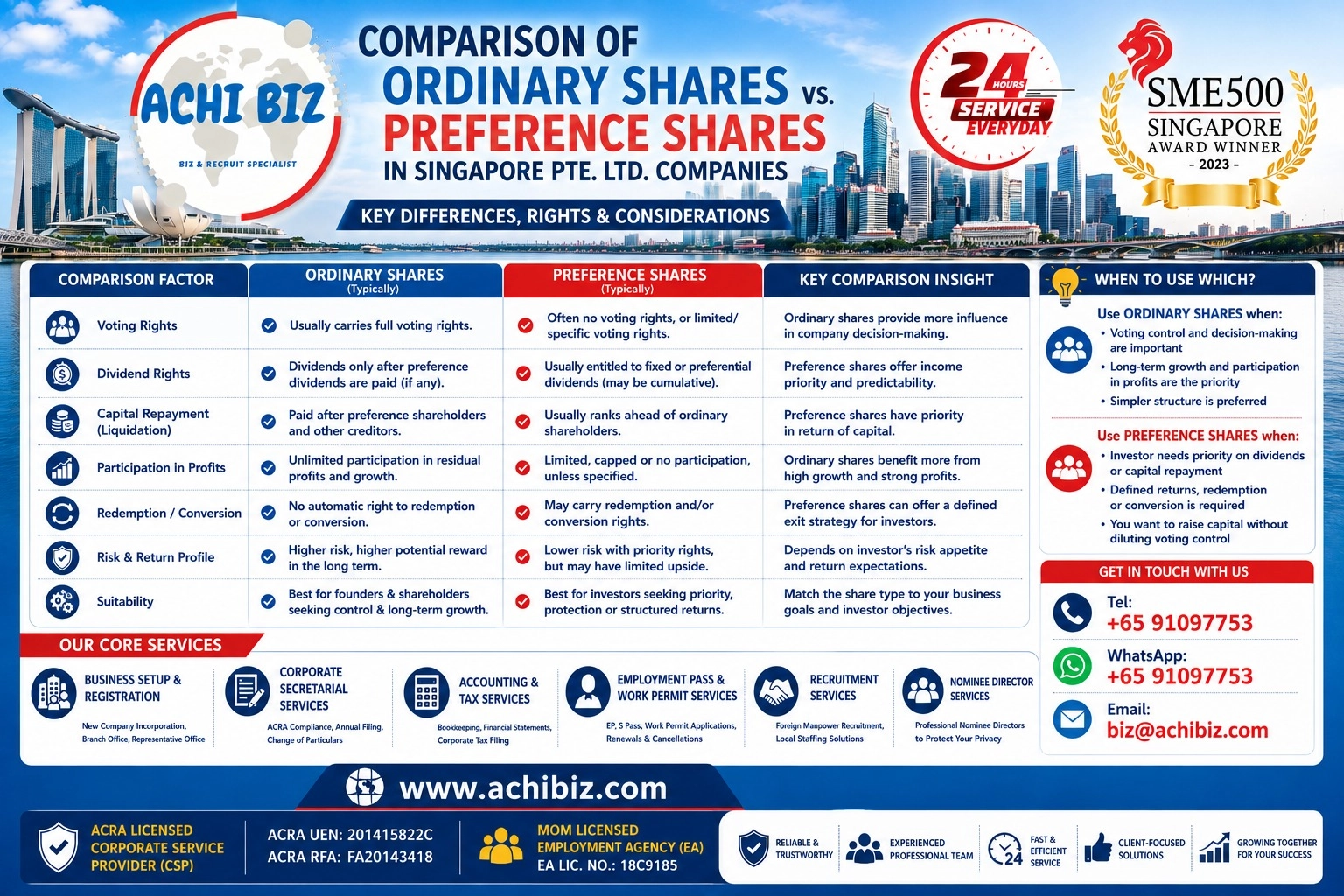
Ordinary Shares vs Preference Shares in Singapore Pte. Ltd. Companies
Choosing between ordinary shares and preference shares in a Singapore Private Limited (Pte. Ltd.) company is not simply about deciding which share type is “better”. The more important question is what rights, returns, control and investment objectives the company and its shareholders are trying to achieve.
ACRA describes ordinary shares as the most common share type. They usually carry voting rights, while preference shares are typically structured with preferential economic rights and often have no voting rights. However, the actual rights depend on the company’s Constitution and the particular share class.
We have covered the features, advantages, disadvantages and practical considerations of Ordinary Shares and Preference Shares separately in our dedicated articles. Therefore, this FAQ does not repeat those subjects. Instead, it focuses exclusively on Ordinary Shares vs Preference Shares in Singapore, analysing the practical differences and when one structure may be more appropriate than the other.
What is the fundamental difference between Ordinary Shares and Preference Shares?
The fundamental difference is the rights attached to the investment.
Ordinary shares generally represent the conventional ownership structure of a company, while preference shares are commonly used where a particular shareholder or investor requires specially structured economic or other rights.
Therefore, the real comparison is not simply between two names of shares. It is between two different packages of shareholder rights.
For the detailed characteristics of each share type individually, refer to our separate articles on Ordinary Shares and Preference Shares in Singapore Pte. Ltd. companies.
Why are Ordinary Shares more commonly issued than Preference Shares in Singapore Pte. Ltd. companies?
The main reason is simplicity.
ACRA identifies ordinary shares as the most common share type. For many Singapore SMEs and owner-managed companies, a straightforward shareholding structure is sufficient.
Preference shares tend to become relevant when there is a specific financing or investor requirement that cannot be adequately addressed through the company’s existing share structure.
Therefore, lower usage of preference shares should not be interpreted as meaning that they are inferior. They simply solve a more specialised problem.
Which is simpler to understand and administer?
Ordinary shares will generally be simpler where all shareholders are intended to have broadly conventional shareholder rights.
Preference shares can require detailed consideration of dividend priority, capital priority, participation, voting, redemption, conversion and ranking against other classes.
Singapore law reinforces this distinction. Section 75 of the Companies Act requires the rights of preference shareholders concerning repayment of capital, participation in surplus assets and profits, cumulative or non-cumulative dividends, voting, and priority of capital and dividends to be set out in the company’s Constitution.
Which is generally more suitable for company founders?
For founders establishing and operating their own business, ordinary shares are commonly the more straightforward starting point.
Founders normally want an ownership interest that participates in the company’s long-term development and corporate decision-making.
However, once external investors enter the company, it may no longer be commercially appropriate for every investor to receive exactly the same package of rights.
That is where a differentiated share structure can become relevant.
Which is generally more suitable for an external investor?
It depends on what the investor wants.
An investor focused primarily on long-term ownership and participation may be comfortable with ordinary shares.
An investor seeking negotiated economic priority, redemption, conversion or another specially structured investment arrangement may prefer preference shares.
Therefore, the investor’s risk, return, control and exit expectations should be understood before deciding on the share class.
Which share type generally provides stronger voting influence?
ACRA states that ordinary shares usually have voting rights, whereas preference shares often have no voting rights.
However, this should not be treated as an absolute rule.
Different share classes can carry different voting arrangements. The company’s Constitution must therefore be reviewed before determining the actual voting power associated with any shareholding.
Does holding more Preference Shares necessarily mean having more control?
No.
The number of shares held and the amount of corporate control obtained are not necessarily the same thing.
If the preference shares have restricted voting rights, an investor may contribute substantial capital without acquiring equivalent voting influence.
This is one of the most important reasons to analyse share rights rather than merely the number or percentage of shares issued.
Can a shareholder with fewer Ordinary Shares have greater voting influence than a shareholder with more Preference Shares?
Potentially, yes.
If the ordinary shares carry voting rights and the relevant preference shares have limited voting rights, the ordinary shareholder may have greater influence over shareholder decisions despite holding fewer shares or having invested less capital.
The answer depends on the Constitution and the precise rights attached to each class.
Which share type generally has priority for dividends?
Preference shares are commonly structured to receive dividends ahead of ordinary shareholders. ACRA describes preference shares as typically receiving fixed dividends and having dividend priority.
The comparison, however, should not stop at priority.
Investors should consider whether the preference dividend is cumulative or non-cumulative, whether further participation is available, and what conditions govern distributions.
Does dividend priority mean Preference Shares always produce a higher return?
No.
Priority and total return are different concepts.
A preference shareholder may receive a defined preferential return while an ordinary shareholder may have greater participation in the company’s long-term growth.
If the business becomes exceptionally profitable, the economic outcome can therefore depend substantially on the particular rights attached to each class.
Which shareholder may benefit more if the company grows substantially?
There is no automatic answer.
Ordinary shareholders generally participate in the residual economic value of the business according to their rights.
A preference shareholder’s upside may be limited, enhanced or convertible depending on how the preference shares have been structured.
Therefore, investors should compare downside priority against upside participation, rather than looking only at the dividend rate.
Which share type provides better downside protection?
Preference shares can provide stronger relative economic priority where they have preferential dividend or capital rights.
However, this does not make them risk-free.
A preference shareholder remains exposed to the company’s financial condition. Priority determines who receives available value first among the relevant shareholder classes; it does not guarantee that sufficient value exists.
Which share type generally ranks first when capital is returned on liquidation?
Preference shares are commonly structured to receive capital before ordinary shareholders. ACRA identifies liquidation priority as a typical feature of preference shares.
But this is a ranking between shareholder classes.
It does not mean preference shareholders automatically rank ahead of creditors or are guaranteed full recovery.
Does liquidation priority make Preference Shares safer than Ordinary Shares?
It can provide greater protection relative to ordinary shareholders, but describing preference shares simply as “safer” can be misleading.
If the company has insufficient assets remaining for shareholders, even the first-ranking shareholder class may suffer a substantial or total loss.
The better description is that preference shares may provide priority, not security.
Which share type provides greater participation in the company’s future value?
Ordinary shares generally provide the more straightforward residual ownership participation.
Preference shares can be structured differently. Some may have limited participation, while participating or convertible structures may provide greater exposure to future value.
Accordingly, the comparison depends on whether the investor prioritises predictability and priority or broader participation in future growth.
Which share type is generally more attractive to an entrepreneur expecting substantial business growth?
An entrepreneur expecting to build significant long-term enterprise value may place greater importance on ownership participation and voting influence.
That can make ordinary shares particularly important to founders.
An external investor may have a different objective and prioritise investment protection or a defined exit.
The appropriate capital structure can therefore involve different share classes serving different objectives simultaneously.
Which share type is more suitable when an investor wants a relatively defined economic return?
Preference shares can be more adaptable for this purpose because their dividend and capital rights can be specifically structured.
However, a preference dividend should not automatically be described as guaranteed interest.
If the commercial intention is actually to create an unconditional repayment obligation with interest, the company should separately consider whether equity is the appropriate financing instrument at all.
Which is better when an investor wants maximum upside rather than preferential return?
Potentially ordinary shares, because conventional ordinary equity is associated with residual participation in the company’s value.
However, a convertible or participating preference structure could produce a different outcome.
Therefore, the correct comparison must consider the complete investment terms rather than the share-class label alone.
Which is generally better for retaining founder voting control while raising external capital?
A carefully structured preference-share investment can potentially allow founders to raise equity while limiting the voting rights granted to the incoming investor.
This can be attractive where founders need capital but do not want voting power to move proportionately with the amount invested.
However, the company should not assume that all preference shares are automatically non-voting. The actual rights must be expressly structured.
Does issuing Preference Shares mean there is no dilution to existing Ordinary Shareholders?
No.
This is an important misconception.
Preference shares may potentially reduce voting-control dilution if they carry limited voting rights, but the new investor still obtains an economic interest and rights against the company’s value.
Companies should therefore distinguish between:
voting dilution, economic dilution and ownership dilution.
They are not necessarily the same thing.
Which share type creates greater dilution for existing founders?
There is no single answer.
An ordinary-share issue may directly dilute existing shareholders’ percentage ownership and voting influence.
A preference-share issue may have less immediate voting impact but can introduce substantial dividend, liquidation, redemption or conversion rights.
Therefore, the better question is not “Which causes more dilution?” but “Which rights are being diluted or subordinated?”
Which share type is more flexible for investor negotiations?
Preference shares generally provide greater scope for customised investment economics.
That flexibility can help bridge a negotiation where founders and investors have different objectives.
However, flexibility comes at the cost of greater complexity.
Ordinary shares may therefore be preferable where sophisticated differentiation is unnecessary.
Which share type is more suitable for a simple SME ownership structure?
For a company with a small number of owner-managers and no sophisticated external financing requirements, ordinary shares are generally the simpler structure.
Adding preference shares merely because they are available may provide no meaningful commercial benefit.
A more complicated share structure should solve an actual problem.
Which share type is more suitable for sophisticated fundraising?
Preference shares can become particularly useful where investors negotiate different economic, conversion, redemption or capital rights.
This is why they may be relevant in structured investment rounds.
The trade-off is that each additional right can affect future financing and the company’s long-term capital structure.
Which share type is better for a passive investor?
It depends on what “passive” means.
If the investor does not require management influence but wants negotiated economic rights, preference shares may be suitable.
If the investor wants long-term participation in the company’s overall value despite not being involved in management, ordinary shares may still be appropriate.
Passive investment should therefore not automatically be equated with preference shares.
Which share type is better for a strategic investor?
A strategic investor may want both economic participation and influence over important decisions.
The appropriate class therefore depends on the negotiated commercial arrangement.
Sometimes conventional ownership rights are appropriate; in other situations a specially structured share class combined with contractual protections may better reflect the relationship.
Which share type provides a clearer investor exit mechanism?
Preference shares can provide greater structuring flexibility where redemption or conversion rights are included.
Ordinary shares generally do not create an automatic exit simply because the shareholder wants to leave.
However, redemption is subject to the applicable terms and statutory requirements. Under section 70 of the Companies Act, redeemable preference shares must be authorised by the Constitution, redemption must follow its terms, and the shares must be fully paid before redemption.
Which is easier to sell or transfer?
Neither should automatically be assumed to be easier.
Shares in a private company do not have the same liquidity as publicly traded securities, and transfers may be subject to the company’s Constitution, shareholders’ agreements and other restrictions.
Preference shares can become particularly valuation-sensitive because a buyer must understand the exact rights being acquired.
Which share type is easier to value?
Ordinary shares in a straightforward one-class company can often be easier to understand from a valuation perspective.
Preference shares may require analysis of dividend rights, redemption value, conversion rights, liquidation preferences and participation rights.
The more sophisticated the preference terms, the more important it becomes to distinguish the number of shares from the economic value of those shares.
Does one Ordinary Share necessarily have the same value as one Preference Share?
No.
Two shares carrying different economic and voting rights do not necessarily have the same commercial value merely because each is described as “one share”.
This is especially important in companies with multiple classes.
Share count alone can therefore provide a misleading picture of economic ownership.
Can an investor pay more per Preference Share than founders paid per Ordinary Share?
Yes, depending on the transaction and agreed valuation.
Different investors may invest at different stages, valuations and commercial terms.
The price paid for a share and the rights attached to that share should be analysed together.
Which share type is more likely to create future shareholder conflicts?
Neither inherently creates conflict.
However, multiple classes can increase the possibility of different economic interests.
Ordinary shareholders may prefer reinvestment and long-term growth, while preference investors may prioritise dividend, redemption or exit rights.
The potential for conflict therefore increases when the parties’ economic incentives diverge and the documentation does not clearly address those differences.
Which structure is easier for directors to administer?
A straightforward ordinary-share structure is generally easier.
With multiple share classes, directors must consider the rights of each class when dealing with distributions, new investment, conversion, redemption, capital restructuring or a company sale.
This does not make preference shares undesirable. It means their additional complexity should produce a corresponding commercial benefit.
Which structure creates more corporate secretarial work?
A company with different classes and specially structured rights generally requires more careful corporate administration.
The Constitution, statutory records, resolutions, allotments, conversions, redemptions and variations of class rights may all require particular attention.
Section 75 also imposes specific constitutional requirements for preference-share rights.
Which share type gives the company more flexibility for future restructuring?
A simple capital structure can generally be easier to restructure.
Existing preference rights can affect future transactions because those rights cannot simply be disregarded.
Under section 74 of the Companies Act, variation or abrogation of class rights is subject to the Constitution and statutory class-approval requirements; where the Constitution does not specify the relevant threshold, the Act provides for approval by holders of at least 75% of the shares of that class.
Why are class rights more important when Preference Shares exist?
Because different shareholders may have fundamentally different legal and economic entitlements.
A decision that appears favourable to shareholders generally may adversely affect one particular class.
Companies with multiple classes must therefore analyse transactions at both the company level and class-right level.
Which share type can make future fundraising more complicated?
Existing preference shares can add more complexity because a future investor must understand and negotiate around rights already granted to earlier investors.
For example, an incoming investor may examine existing dividend priorities, liquidation ranking, conversion rights and redemption obligations before agreeing to invest.
This can result in several layers of investor rights if successive financing rounds are not carefully planned.
Can issuing only Ordinary Shares make future fundraising easier?
It can make the starting capital structure simpler.
However, simplicity alone does not guarantee successful fundraising. A sophisticated investor may require rights that the existing structure does not provide.
The company may then need to introduce a new class or amend its Constitution.
Therefore, founders should balance present simplicity against foreseeable financing needs.
Which share type can complicate a future sale of the company?
Preference shares can add additional considerations if their rights address conversion, liquidation preference, participation or class approvals.
When a company is sold, the parties may need to determine how different classes participate in the sale proceeds and whether conversion or other rights are triggered.
A straightforward ordinary-share structure can make allocation easier, but the commercially correct structure should still reflect the investment agreements entered into by the company.
Which shareholders may receive more from a company sale?
There is no universal answer.
The outcome depends on the sale price and rights attached to each class.
At a relatively low exit value, preferential capital rights could be particularly significant.
At a very high valuation, unrestricted residual participation could become more valuable.
This is why the economic comparison should be tested across different exit scenarios, not merely at the date of investment.
Can Preference Shareholders receive more than Ordinary Shareholders even if they own a smaller percentage?
Potentially, depending on the rights and transaction.
For example, preferential capital or participating rights could alter how available proceeds are allocated.
This demonstrates why percentage ownership alone may not tell the full economic story when multiple classes exist.
Can Ordinary Shareholders eventually receive more despite ranking behind Preference Shareholders?
Potentially, yes.
Priority determines who receives specified amounts first. It does not necessarily determine who ultimately receives the greatest return in every successful outcome.
Where ordinary shareholders participate more fully in substantial residual value, their eventual return may exceed a capped preferential entitlement.
Again, the precise rights control the result.
Which share type is more suitable when the company expects to retain profits rather than distribute dividends?
The answer depends on investor expectations.
If an investor expects preferential distributions while the company’s strategy is to retain earnings for expansion, the parties’ objectives may conflict.
A conventional long-term equity investor may be more comfortable with growth through retained earnings.
The company should therefore align the share structure with its actual dividend and growth strategy.
Which share type places more pressure on company cash flow?
Preference shares with dividend expectations or redemption mechanisms can potentially create greater commercial pressure on future cash flows.
That does not necessarily mean the company has an unconditional payment obligation, but investor expectations can still affect financial planning.
Ordinary equity generally has fewer specially negotiated economic priorities.
Which share type is more appropriate if the investor eventually wants to become a conventional equity shareholder?
Convertible preference shares may provide a bridge between preferential investment rights and future conventional equity participation.
ACRA specifically recognises convertible preference shares and notes that conversion prices must be stated in the Constitution.
Whether this is commercially preferable to issuing ordinary shares from the outset depends on the investment arrangement.
Should founders issue Preference Shares simply to avoid giving investors votes?
No.
Voting control is only one consideration.
Founders should also examine dividend rights, capital priority, conversion, redemption, future fundraising, sale scenarios, accounting implications and investor expectations.
A structure designed solely around preserving votes can create much larger economic obligations elsewhere.
Should investors automatically insist on Preference Shares?
No.
An investor should first determine which protections are actually necessary.
An unnecessarily complicated preference structure can increase legal costs and make future transactions more difficult without materially improving the investment.
The objective should be appropriate protection, not maximum complexity.
Can a company have both Ordinary Shares and Preference Shares at the same time?
Yes.
Indeed, that is precisely where comparison becomes commercially relevant: different shareholder groups can hold different classes designed around different objectives.
ACRA recognises ordinary shares, preference shares, redeemable preference shares and convertible preference shares among the share types companies may allot.
Does having both share types automatically create an unfair structure?
No.
Different rights are not inherently unfair if they reflect a properly agreed investment arrangement and comply with the company’s Constitution and applicable law.
A founder who built the company from inception and a later investor contributing substantial new capital may legitimately negotiate different rights.
The key issues are transparency, proper approval and clear documentation.
Is it better to have only one class of shares?
For simplicity, often yes.
For commercial flexibility, not necessarily.
A single-class structure is easier to understand and administer. Multiple classes can better accommodate different investors.
The correct structure is therefore the simplest structure that still achieves the company’s genuine commercial objectives.
What should a company compare before choosing between Ordinary Shares and Preference Shares?
The company should compare the proposed shareholder’s role, voting expectations, investment amount, desired return, dividend expectations, downside protection, capital priority, exit strategy, conversion requirements, future fundraising plans and the long-term effect on existing shareholders.
The decision should be made by looking at the entire investment relationship rather than one attractive feature.
Should voting rights be the main factor in choosing the share class?
No.
Voting rights are important, but focusing on them alone can produce a poorly balanced structure.
A share with little voting power may still carry substantial economic rights.
Conversely, voting rights may be valuable even where the shareholder receives no preferential economic return.
Control and economics should be analysed separately and then considered together.
Should dividend priority be the main deciding factor?
No.
Dividend priority is only one component.
The company should also consider capital ranking, participation, voting, redemption, conversion, transferability, future fundraising and exit outcomes.
A seemingly attractive dividend preference can be much less important than the liquidation or conversion provisions when a major corporate event occurs.
Which is more important: the name of the share or the rights attached to it?
The rights attached to the share are far more important.
Calling something an “Ordinary Share” or “Preference Share” does not by itself answer every question about voting, dividends or economic participation.
The Constitution and applicable terms must be examined.
This is especially important for preference shares because section 75 expressly requires specified rights to be set out in the Constitution.
Is Ordinary Shares vs Preference Shares mainly a legal comparison or a commercial comparison?
It is both, but the decision usually begins with the commercial objective.
The company first needs to determine what relationship it wants with the investor. The legal documentation then needs to translate that commercial arrangement into valid shareholder rights.
Starting with complicated legal terms before defining the commercial objective can result in an unnecessarily complex capital structure.
What is a practical example where Ordinary Shares may be more appropriate?
Consider two founders establishing a business together and intending to operate it jointly for the long term.
If they want conventional ownership participation and governance rights, there may be no commercial reason to introduce an additional preference structure.
A straightforward structure may be entirely sufficient.
What is a practical example where Preference Shares may be more appropriate?
Consider an established founder-owned company seeking substantial capital from an outside investor.
The founders want to continue controlling the business, while the investor requires preferential economic protection and an agreed exit mechanism.
A properly designed preference-share class may potentially reconcile those different objectives more effectively than giving the investor exactly the same rights as the founders.
What is a practical example where both share types may work together?
A company could have founders holding ordinary shares while an external investment round is undertaken through a separately structured preference class.
The founders retain their conventional ownership position while the investor receives the specifically negotiated investment rights.
Whether such a structure is appropriate depends entirely on the transaction.
Which share type should a new Singapore Pte. Ltd. company issue at incorporation?
There is no rule that every company should adopt a sophisticated share structure from the beginning.
For many newly incorporated SMEs, the initial ownership arrangement is straightforward.
If a specialised investor structure is already contemplated, however, the company should consider its future capital requirements early rather than repeatedly restructuring its Constitution and share capital.
Should a company introduce Preference Shares before it actually has an investor requiring them?
Not necessarily.
Creating elaborate rights “just in case” can add complexity without benefit.
It may be preferable to design the relevant class around an actual investment transaction, because the investor’s requirements, valuation and commercial terms will then be known.
Can a company change from a simple Ordinary Share structure to having Preference Shares later?
Potentially, yes, subject to the Companies Act, the company’s Constitution, existing shareholder rights and the required corporate procedures.
However, Singapore law requires the relevant preference-share rights to be set out in the Constitution before preference shares are allotted or existing shares are converted into preference shares.
Therefore, introducing preference shares later may require constitutional and corporate changes.
Which structure is generally more cost-effective?
A straightforward ordinary-share structure will usually involve less structuring and ongoing administrative complexity.
Preference shares may involve additional professional work because the rights must be properly designed and documented.
However, cost should not be viewed in isolation. If preference shares enable the company to secure strategically important funding on commercially acceptable terms, the additional structuring cost may be justified.
Which structure has greater risk of drafting mistakes?
More complicated structures naturally create more opportunities for ambiguity.
Preference-share documentation may need to address dividend accumulation, ranking, redemption, conversion, participation, voting and multiple exit scenarios.
That makes professional drafting particularly important.
Can poor Preference Share drafting affect Ordinary Shareholders?
Absolutely.
An unclear preference formula can affect how much value remains available to other shareholders, whether future fundraising can proceed smoothly and how sale proceeds are distributed.
Preference-share terms are therefore not relevant only to the preference investor. They can materially affect every shareholder in the company.
Should existing Ordinary Shareholders understand the Preference Shares being issued to a new investor?
Yes.
Existing shareholders should understand how the proposed class could affect voting, dividends, economic participation, capital ranking, conversion, dilution and future transactions.
The fact that they themselves will not hold the preference shares does not mean those rights are irrelevant to them.
Should a Preference Share investor understand the rights of existing Ordinary Shareholders?
Yes.
An investor should understand where its rights sit within the company’s complete capital structure.
A preference only has meaning when its ranking and interaction with other rights are understood.
What is the biggest mistake when comparing Ordinary Shares and Preference Shares?
The biggest mistake is reducing the comparison to:
“Ordinary shares have votes; preference shares get dividends first.”
That is only a starting point.
A proper comparison considers control, economic participation, downside priority, upside potential, exit mechanisms, dilution, liquidity, future fundraising, corporate flexibility and long-term administration.
Which is ultimately better: Ordinary Shares or Preference Shares?
Neither is universally better.
Ordinary shares are generally more suitable where straightforward ownership and long-term participation are the main objectives.
Preference shares can be more suitable where an investment requires specially structured economic or other rights.
The correct choice depends on who is investing, why they are investing, what rights they require and how those rights affect the company’s existing and future shareholders.
What is the key takeaway from comparing Ordinary Shares vs Preference Shares in Singapore?
The most important lesson is that a company’s share structure should reflect the commercial relationship between the company, founders and investors.
Ordinary shares generally provide a simpler conventional ownership structure. Preference shares can provide greater flexibility when different investors require different economic or investment rights. ACRA’s current guidance similarly distinguishes ordinary shares as the most common type while recognising the different dividend, voting, liquidation, redemption and conversion characteristics that may apply to preference shares.
The best structure is therefore not necessarily the one with the most investor protections or the simplest documentation. It is the structure that appropriately balances ownership, control, investment return, risk, future financing and corporate flexibility.
For detailed explanations of the individual share types rather than the comparison itself, readers may refer to our separate ACHI BIZ articles on Ordinary Shares in Singapore Pte. Ltd. Companies and Preference Shares in Singapore Pte. Ltd. Companies.
Companies planning to introduce a new share class, amend their Constitution, allot shares, convert shares or restructure their existing share capital should review the corporate requirements carefully before implementation.
ACHI BIZ, as an ACRA Licensed Corporate Service Provider (CSP), can assist Singapore companies with corporate secretarial procedures, share capital changes, Constitution-related corporate actions and applicable ACRA filings.
Related Pages
Preference Shares in Pte Ltd Companies: Features, Benefits & Risks – FAQ Guide
Why Do Singapore Pte Ltd Companies Commonly Issue Ordinary Shares? – FAQ Guide
Redeemable Preference Shares in Pte Ltd Companies – FAQ Guide
Convertible Preference Shares in Pte Ltd Companies – FAQ Guide
Treasury Shares in Pte Ltd Companies – FAQ Guide
#achibiz