
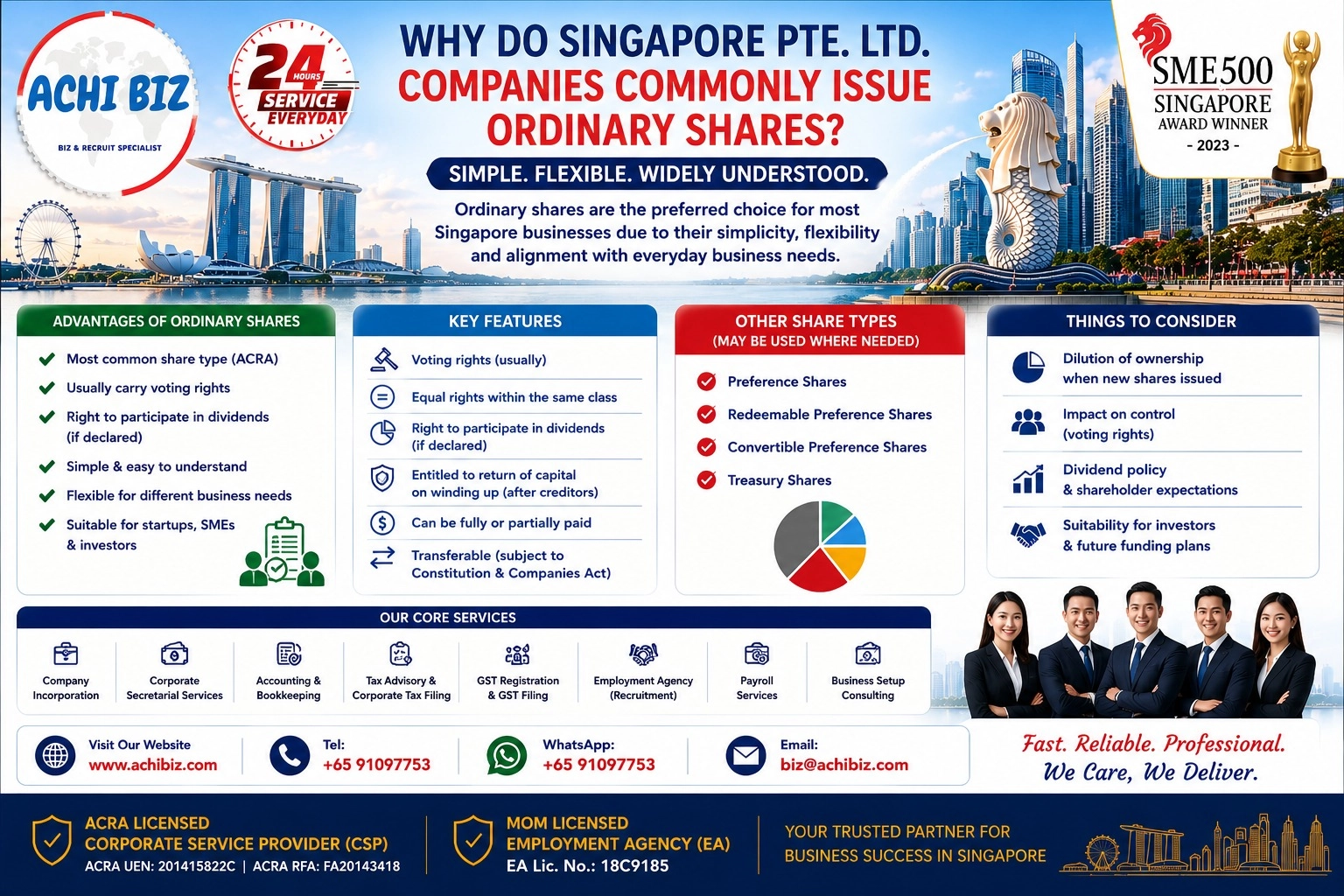
Why Do Singapore Pte Ltd Companies Commonly Issue Ordinary Shares?
Singapore companies can have different classes of shares, but ordinary shares are the most common type, according to ACRA.
For many owner-managed businesses and SMEs, ordinary shares provide a relatively straightforward way of representing company ownership and shareholder rights. However, they are not automatically the best choice for every investor or every corporate structure.
What is an ordinary share in a Singapore company?
An ordinary share is a type of ownership interest in a company.
ACRA describes ordinary shares as the most common share type. They usually carry voting rights, although the precise rights depend on the company’s constitution and share terms.
Why are ordinary shares commonly used by Singapore Pte. Ltd. companies?
The principal reason is simplicity.
Where founders intend shareholders to participate in ownership in a conventional manner without complex preferential rights, ordinary shares can provide an understandable structure.
Do ordinary shares normally carry voting rights?
According to ACRA, ordinary shares usually have voting rights.
However, companies should always consider their constitution and the specific rights attached to the relevant class.
Does an ordinary shareholder automatically have a right to receive dividends?
No.
ACRA specifically notes that ordinary shares do not give shareholders the right to receive or demand dividends merely because they hold those shares.
Dividend declarations remain subject to the applicable legal and corporate requirements.
What are the main advantages of ordinary shares?
Common advantages include:
- relatively straightforward ownership structure;
- commonly understood by founders and investors;
- usually carrying voting rights;
- convenient for allocating ownership percentages;
- suitable for many owner-managed SMEs;
- fewer specialised rights to administer where only one ordinary class exists; and
- flexibility to introduce additional classes later where properly approved.
What are the possible disadvantages of ordinary shares?
Potential disadvantages include:
- they may not satisfy investors seeking preferential economic rights;
- ordinary shareholders may not have priority over preference shareholders for certain distributions;
- issuing additional ordinary shares can dilute existing ownership;
- voting control can change as additional voting shares are issued; and
- a simple ordinary-share structure may become inadequate for sophisticated investment arrangements.
Are ordinary shares compulsory for a Singapore Pte. Ltd. company?
Companies can issue different share types, subject to applicable law and their constitutional arrangements.
ACRA identifies ordinary, preference, redeemable preference, convertible preference and treasury shares in its share guidance.
What is the difference between ordinary and preference shares?
Broadly, ordinary shares commonly provide conventional ownership and voting participation.
Preference shares may provide preferential economic rights. ACRA notes that preference shares often have no voting rights, typically receive fixed dividends and generally rank ahead of ordinary shareholders for return of capital upon liquidation.
The actual rights depend on the terms of the shares.
Why might a startup issue ordinary shares to founders?
Founders commonly need a clear ownership structure.
Ordinary shares can allocate ownership percentages and voting participation without immediately introducing a complicated investor-rights structure.
Why might an investor want preference shares instead?
An investor may seek priority dividends, liquidation preferences or other specially negotiated rights.
This becomes more relevant when outside investment is being raised.
Can a company have different classes of ordinary shares?
Yes.
ACRA expressly notes that companies may create different ordinary-share classes, such as Class A and Class B, with different rights.
Can ordinary shares have different voting rights?
Potentially, where the company’s share structure and constitution properly provide for different classes and rights.
The label “ordinary” should therefore not be used as a substitute for reviewing the actual rights attached to the shares.
Does one ordinary share always equal one percentage point of ownership?
No.
Ownership percentage depends on the total relevant shares in issue.
For example, 10 shares out of 100 represents a different percentage from 10 shares out of 1,000.
Should a company issue 1 share or 100 shares at incorporation?
There is no universal number suitable for every company.
A larger number of shares can sometimes make percentage allocations and future transactions more convenient, while a simple structure may be adequate for a single-owner company.
The share structure should reflect actual ownership intentions.
Can two shareholders own 50 ordinary shares each?
Yes, where the company issues 100 equivalent ordinary shares and each shareholder holds 50, that commonly represents an equal shareholding position, subject to the rights attached to those shares.
Can ordinary shares be fully or partly paid?
Yes.
Payment status and share class are separate concepts. Ordinary shares can be fully or partially paid, subject to the relevant terms and requirements.
Does paid-up capital determine voting rights?
Not necessarily.
Voting rights arise from the rights attached to shares rather than merely from the company’s total paid-up capital.
Can ordinary shares be transferred?
Shares can generally be transferred subject to the Companies Act, the company’s constitution, restrictions applicable to private companies and any relevant shareholder arrangements.
The required ACRA filing must also be made.
Can new ordinary shares dilute existing shareholders?
Yes.
If the company issues additional shares to one or more persons, existing shareholders’ percentage interests may decrease unless they participate proportionately or other arrangements apply.
Can issuing ordinary shares affect control of the company?
Yes.
Where ordinary shares carry voting rights, issuing additional voting shares can alter the balance of voting power.
Directors and shareholders should therefore consider both funding and control before an allotment.
Is owning ordinary shares the same as being a director?
No.
Share ownership and directorship are different legal capacities.
A shareholder owns an interest in the company. A director manages and oversees the company’s affairs and owes statutory and fiduciary duties.
The same individual may be both, but one role does not automatically create the other.
Can a corporate entity hold ordinary shares?
Yes.
ACRA recognises both individual and corporate shareholders, including other limited companies and LLPs.
Can a foreigner own ordinary shares in a Singapore Pte. Ltd. company?
Foreign ownership is generally possible for Singapore companies, subject to any restrictions applying to the particular industry, activity, licence or transaction.
Foreign shareholding should not be confused with the separate requirement concerning locally resident directors.
Can a nominee shareholder hold ordinary shares?
Yes, nominee arrangements can involve company shares.
A nominee shareholder is a shareholder who meets the statutory nominee criteria, such as regularly voting according to another person’s instructions and/or receiving dividends on another person’s behalf. Nominee-shareholder disclosure requirements must also be considered.
Are ordinary shares always the best choice?
No.
They are common because they are suitable for many conventional ownership arrangements, not because every company must use only ordinary shares.
A company expecting sophisticated investors, different dividend entitlements or different control arrangements may require a more tailored share structure.
Should a company create complicated share classes unnecessarily?
Usually there should be a genuine commercial reason for complexity.
Different classes can be extremely useful, but unnecessary complexity can create additional administrative, legal and governance considerations.
What should founders decide before issuing ordinary shares?
They should consider:
- who should own the company;
- intended ownership percentages;
- voting control;
- capital contributions;
- future investors;
- potential dilution;
- dividend expectations;
- exit arrangements; and
- whether different shareholder rights may eventually be required.
How does ordinary-share ownership relate to company membership?
Shareholder and member are closely connected concepts in a company with share capital, but they should not always be treated as interchangeable without qualification.
For a detailed analysis, see our separate article:
Shareholder vs Member in a Singapore Pte. Ltd. Company: Are They the Same?
Where can I learn more about paying for ordinary shares?
See our related articles:
Paid-Up Capital at Incorporation or Later: What Is Better for a Singapore Pte. Ltd. Company?
and
Should Shareholders Fully Pay Their Share Capital in a Singapore Pte. Ltd. Company?
How can ACHI BIZ assist with company shares?
ACHI BIZ can assist with Singapore company incorporation, share allotments, share transfers, changes in share capital, corporate secretarial compliance and related corporate services.
Disclaimer: This FAQ provides general information about Singapore companies and should not be treated as legal, tax, accounting or investment advice. Share structures and shareholder arrangements should be considered according to the company’s constitution, applicable legislation and individual circumstances.
Related Pages
Preference Shares in Pte Ltd Companies: Features, Benefits & Risks – FAQ Guide
Ordinary Shares vs Preference Shares in Pte Ltd Companies – FAQ Guide
Redeemable Preference Shares in Pte Ltd Companies – FAQ Guide
Convertible Preference Shares in Pte Ltd Companies – FAQ Guide
Treasury Shares in Pte Ltd Companies – FAQ Guide
#achibiz