
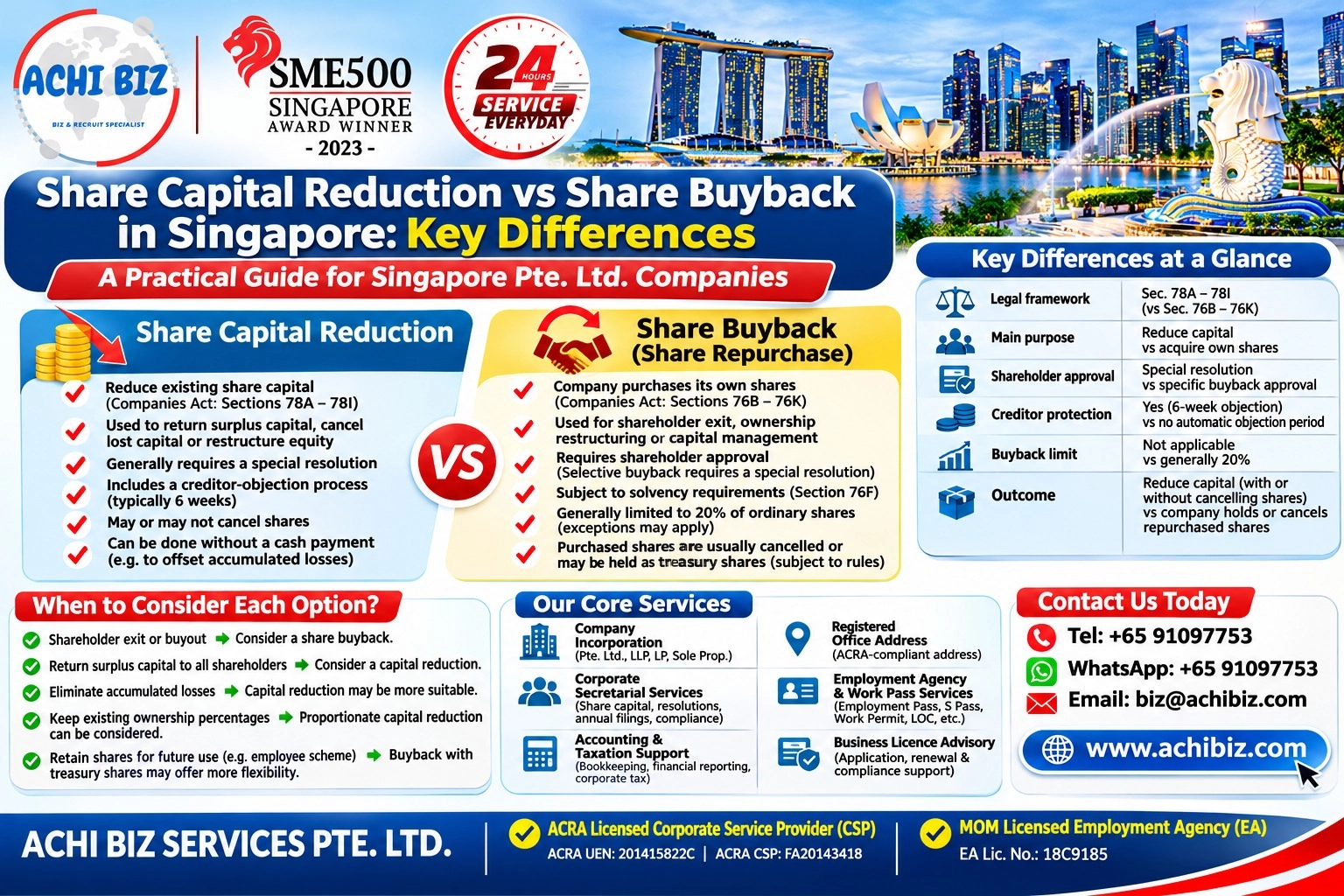
Share Capital Reduction vs Share Buyback in Singapore Pte Ltd Company: Key Differences – FAQ Guide
A Comprehensive FAQ Guide to Singapore Companies Act Requirements, Shareholder Exits, Capital Restructuring, Share Repurchases, Creditor Protection, Tax Implications and ACRA Compliance.
Introduction: Should a Singapore Company Reduce Its Share Capital or Buy Back Its Own Shares?
When a Singapore Private Limited Company (Pte. Ltd.) wants to return funds to shareholders, restructure its ownership or facilitate the departure of an existing shareholder, two possible corporate transactions often come into consideration: share capital reduction and share buyback.
Although both transactions can affect a company’s share capital and shareholders’ financial interests, they are not interchangeable.
A share capital reduction generally involves reducing the company’s existing share capital through a statutory procedure. Depending on the structure, it may involve returning surplus capital, cancelling shares, eliminating capital lost through accumulated losses or reducing unpaid share obligations.
A share buyback, also called a share repurchase, occurs when a company purchases its own shares from existing shareholders in accordance with the Companies Act 1967.
For example, suppose a Singapore company has three shareholders. One shareholder wants to leave the business, while the other two prefer to retain their existing shares.
The company may consider whether a selective share buyback or an appropriately structured capital reduction could achieve the intended result.
However, the choice involves much more than deciding which procedure appears simpler.
Directors and shareholders must consider the legal requirements, source of funding, solvency, shareholder approvals, creditor protection, tax implications, ownership changes and whether the company can lawfully undertake the proposed transaction.
A poorly structured transaction can create disputes, unexpected costs, inaccurate ACRA records or breaches of statutory requirements.
This FAQ guide by ACHI BIZ SERVICES PTE. LTD., an ACRA Licensed Corporate Service Provider (CSP), explains the important differences between share capital reduction and share buyback in Singapore.
The article focuses specifically on comparing the two methods and helping business owners identify which may be appropriate for their circumstances.
For the detailed statutory procedure for reducing paid-up capital, readers should refer to our separate article, Can a Singapore Pte. Ltd. Company Reduce Its Paid-Up Capital? Requirements & Procedures.
Share Capital Reduction vs Share Buyback: Quick Comparison
| Comparison | Share capital reduction | Share buyback |
|---|---|---|
| Main purpose | Reduce existing share capital | Company acquires its own issued shares |
| Main legal framework | Companies Act Sections 78A–78I | Companies Act Sections 76B–76K |
| Typical uses | Return surplus capital, cancel lost capital, restructure capital | Shareholder exit, ownership restructuring, capital management |
| Shares cancelled? | Depends on the structure | Purchased shares are generally cancelled unless validly held as treasury shares |
| Can share quantities remain unchanged? | Yes | Generally, the company acquires identifiable shares |
| Does it require shareholder approval? | Yes, normally a special resolution | Yes, under the applicable buyback authorisation requirements |
| Is a solvency assessment relevant? | Yes, depending on the route and transaction | Yes, the statutory solvency requirements must be considered |
| Creditor-objection procedure | Applicable statutory objection process under the special-resolution route | No equivalent automatic six-week objection period under the ordinary buyback framework |
| Can it affect ownership percentages? | Yes, depending on the structure | Yes, especially where shares are acquired from selected shareholders |
| Can it return funds to shareholders? | Yes | Yes, through the purchase consideration |
| Can it address accumulated losses without a shareholder payout? | Potentially | Not its ordinary purpose |
| Can the company retain acquired shares? | Not applicable in the same way | Treasury share treatment may be available |
| ACRA requirements | Capital reduction filings | Relevant share buyback, cancellation or treasury share filings |
| Main commercial question | How should the company’s existing capital be reduced? | Should the company purchase shares from its shareholders? |
Important: The table describes the general distinction. The actual requirements depend on the company’s constitution, share class, transaction structure and applicable statutory provisions.
Understanding the Fundamental Differences
What is the difference between share capital reduction and share buyback in Singapore?
The fundamental difference concerns the legal transaction being undertaken.
In a share capital reduction, the company reduces its existing share capital through an authorised statutory process.
In a share buyback, the company acquires its own shares from shareholders through a permitted purchase arrangement.
Both transactions may ultimately reduce the company’s issued share capital, but they achieve their objectives through different legal mechanisms.
Is share capital reduction the same as share buyback?
No.
Although the financial or ownership outcomes may sometimes appear similar, they are legally distinct transactions.
A company should not treat the statutory requirements for one as automatically satisfying the requirements for the other.
Why do Singapore companies compare capital reduction with share buyback?
Companies commonly compare these options when considering a shareholder exit, return of excess funds, restructuring of ownership or reduction of equity capital.
The comparison helps directors determine which transaction better matches the intended commercial outcome.
Can both methods reduce a company’s issued shares?
Yes, potentially.
A capital reduction may involve cancellation of existing shares.
A share buyback involves acquisition of existing shares, which may subsequently be cancelled or held as treasury shares where permitted.
However, not every capital reduction changes the number of shares.
Can both methods reduce the company’s cash reserves?
Yes.
Where a capital reduction involves a cash return, the company’s cash reserves may decrease.
Similarly, a cash-funded share buyback generally reduces the company’s available cash.
However, a reduction used to eliminate accumulated losses may involve no cash payment.
Can both methods be used to restructure shareholder ownership?
Yes.
A selective capital reduction or a purchase of shares from particular shareholders may change the relative ownership of the remaining shareholders.
The company must consider the legal and fairness implications of either arrangement.
Which method is generally more suitable for reducing capital without changing ownership percentages?
A proportionate capital reduction may be more directly suited to that objective.
For example, a company may reduce the capital amount attributable to all ordinary shares while leaving the number of shares and ownership percentages unchanged.
A proportionate buyback can also preserve relative ownership percentages in some circumstances, but it involves acquiring shares.
Which method is generally more suitable when one shareholder wants to exit?
A selective share buyback may be worth considering.
However, the company must establish that the proposed buyback is permitted and that all applicable statutory requirements can be satisfied.
A selective capital reduction may also be considered in suitable circumstances.
Does a share buyback automatically reduce paid-up capital?
Not necessarily in the same way as a direct capital reduction.
The treatment depends on whether the purchased shares are cancelled or held as treasury shares, the applicable legal rules and the accounting treatment.
The company should not assume that the buyback payment equals the amount by which statutory share capital must decrease.
Does a capital reduction require the company to purchase shares?
No.
A company can undertake certain capital reductions without acquiring shares from shareholders.
For example, a reduction may be structured to cancel capital lost through accumulated losses.
Can a share buyback take place without reducing the number of shares originally issued?
The company may be permitted to hold purchased shares as treasury shares rather than immediately cancelling them.
However, treasury shares are subject to specific statutory restrictions and should not be treated as ordinary outstanding shares carrying full shareholder rights.
Share Buyback Requirements Under the Singapore Companies Act
Can a Singapore Pte. Ltd. company legally buy back its own shares?
Yes.
Section 76B of the Companies Act 1967 allows a company to acquire its own issued shares, provided its constitution expressly permits the transaction and the company complies with the applicable statutory provisions.
A Singapore private company must therefore confirm that it has the necessary constitutional authority before arranging a buyback.
Singapore Statutes Online
Does the company constitution have to permit share buybacks?
Yes.
Unlike an ordinary share transfer between shareholders, a company’s acquisition of its own shares is subject to specific statutory requirements.
If the constitution does not authorise share buybacks, the company must consider whether a valid constitutional amendment is appropriate before proceeding.
Which sections of the Companies Act govern share buybacks?
The principal statutory provisions are Sections 76B to 76G, together with Sections 76H to 76K where treasury shares are involved.
| Section | Main subject |
|---|---|
| 76B | Company’s power to acquire its own shares |
| 76C | Off-market acquisition under an equal access scheme |
| 76D | Selective off-market acquisition |
| 76DA | Contingent purchase contracts |
| 76E | Market acquisition |
| 76F | Solvency requirements for payments |
| 76G | Capital or profits treatment when repurchased shares are cancelled |
| 76H | Treasury shares |
| 76I | Maximum treasury share holdings |
| 76J | Voting and other rights of treasury shares |
| 76K | Disposal and cancellation of treasury shares |
The provisions should be read together with the relevant regulations and the company’s constitution.
lpr.adb.org
What types of share buybacks are available in Singapore?
ACRA identifies several types of share buyback.
For a private company, the most relevant are an off-market purchase under an equal access scheme, a selective off-market purchase and a purchase under an authorised contingent purchase contract.
Market purchases through the stock exchange are relevant to listed companies, not ordinary unlisted private companies.
Accounting and Corporate Regulatory Authority
What is an off-market share buyback under an equal access scheme?
It is a purchase arrangement under which the company offers shareholders of the relevant class an opportunity to sell shares on the applicable equal-access terms.
This may suit a company seeking to return funds through a repurchase opportunity available to eligible shareholders.
The company must satisfy Section 76C and the relevant authorisation requirements.
What is a selective off-market share buyback?
A selective off-market buyback is a transaction in which the company purchases shares from particular shareholders rather than offering the same purchase opportunity to all shareholders under an equal access scheme.
It may be relevant where one shareholder wishes to exit the business.
However, Section 76D imposes specific approval requirements.
Does a selective share buyback require a special resolution?
Yes.
ACRA states that a selective off-market purchase requires a special resolution.
Importantly, the shareholders whose shares are being purchased are not entitled to vote on that approval.
Accounting and Corporate Regulatory Authority
Can the selling shareholder vote to approve their own selective buyback?
No, not under the applicable selective off-market approval procedure.
This restriction helps address the potential conflict of interest where a shareholder is personally benefiting from the proposed purchase.
The company should calculate the voting position after excluding the affected shareholder’s votes.
Does every share buyback require a special resolution?
No.
The approval requirements depend on the type of buyback.
For example, an equal-access off-market purchase follows the authorisation requirements under Section 76C, while a selective off-market purchase requires a special resolution under Section 76D.
The company should not apply one approval rule indiscriminately to all buybacks.
Can a company buy back shares without the selling shareholder’s agreement?
A buyback is ordinarily a purchase transaction involving the selling shareholder’s agreement or an applicable contractual arrangement.
This differs from certain legally authorised capital reductions, which may result in share cancellation without each affected shareholder separately agreeing to sell their shares.
Nevertheless, a capital reduction must still comply with statutory protections and cannot be used arbitrarily.
Can a company buy back shares from its sole shareholder?
Potentially, but the proposed transaction requires careful consideration.
The company must comply with the statutory buyback limits and maintain a legally valid corporate and membership structure.
A sole-shareholder company should not assume it can simply purchase and cancel every issued share.
Can a company buy back ordinary shares and preference shares?
The statutory buyback framework applies to ordinary shares and certain preference shares.
However, different limits and conditions may apply depending on the class and terms.
Redeemable preference shares may also involve a separate redemption mechanism, which should not be confused with an ordinary share buyback.
Is there a maximum percentage of shares a private company can buy back?
Yes.
Section 76B generally imposes a 20% limit for ordinary shares and stocks in a class during the relevant period, subject to statutory exceptions and applicable adjustments.
Separate provisions apply to preference shares.
This is an important distinction from a capital reduction, which is not governed by the same general 20% buyback limit.
A company should not assume that the exception automatically permits any proposed purchase above the ordinary limit.
Singapore Statutes Online
Is the maximum share buyback limit always 10%?
No.
The general Companies Act limit applicable to an unlisted private company’s ordinary shares should not be confused with the separate restrictions imposed on SGX-listed companies.
For example, SGX Mainboard rules generally impose a 10% limit under the relevant share buyback mandate.
Rulebooks
Can a company buy back more than 20% of its ordinary shares?
Potentially, where a statutory exception applies.
However, the company must carefully establish the relevant legal basis, applicable calculation and approval requirements.
A substantial shareholder exit should not be structured around an assumed exception without professional review.
Can a company buy back shares at a price higher than their original issue price?
Potentially, yes.
The purchase price may differ from the amount originally paid for the shares.
However, the price must be commercially supportable, properly authorised and consistent with the relevant statutory and contractual requirements.
Can a company buy back shares below their original issue price?
Potentially.
A shareholder may agree to sell at a price below the original subscription amount, subject to applicable legal requirements.
The transaction should still be supported by appropriate valuation and documentation.
Can a company buy back shares for S$1?
Potentially.
However, the nominal price does not remove the need to comply with the Companies Act.
Where the transaction is between related parties or involves a material transfer of economic value, tax and fairness considerations may arise.
Solvency and Financial Requirements: Which Method Is More Restrictive?
Must a Singapore company be solvent before buying back its shares?
Yes.
Section 76F imposes solvency requirements for the relevant payments associated with a company’s acquisition of its own shares.
The company must not proceed with a purchase that fails the applicable statutory solvency requirements.
Singapore Statutes Online
Can a company use its profits to finance a share buyback?
Yes.
The Companies Act permits qualifying share buyback payments from profits, provided the statutory solvency requirements are satisfied.
However, using profits for a buyback may reduce the funds otherwise available for dividends or other business purposes.
Can a company use paid-up capital to finance a share buyback?
Potentially, yes.
Section 76F permits qualifying payments out of capital or profits, subject to the applicable statutory solvency conditions.
The accounting and share capital consequences must be considered separately.
Can a company use both capital and profits for a share buyback?
Potentially.
Section 76G addresses the corresponding reduction of capital, profits or both where repurchased shares are cancelled.
The company must determine the appropriate treatment based on the transaction and source of funding.
Does a share buyback require the same solvency statement as a capital reduction?
Not necessarily.
A share buyback is governed by Section 76F’s statutory solvency requirements.
A capital reduction using the special-resolution route is governed by the relevant provisions under Section 78B, including the solvency statement requirements where applicable.
Although both frameworks protect creditors, their legal procedures are not identical.
Can a company with accumulated losses undertake a share buyback?
Potentially, but only if the company satisfies the relevant legal and solvency requirements.
Accumulated losses do not, by themselves, establish whether the statutory solvency conditions are met.
Can an insolvent company buy back its own shares?
A company cannot lawfully make a buyback payment that fails Section 76F’s solvency requirements.
Directors should not attempt to use a buyback to transfer company funds to shareholders at the expense of creditors.
Can a financially distressed company reduce its share capital instead?
Potentially.
A reduction that does not involve distributing assets or releasing shareholder liabilities may be legally and commercially different from a cash-funded buyback.
However, a capital reduction does not automatically resolve insolvency.
Which method generally provides stronger direct creditor-objection rights?
The ordinary special-resolution capital reduction route includes a statutory creditor-objection period.
A share buyback does not use the same automatic six-week objection procedure.
Instead, the buyback framework relies on statutory solvency and other protections.
This does not mean creditors have no remedies where a buyback is unlawful.
Does a company need sufficient cash to undertake either transaction?
A cash-funded buyback or capital return requires the company to have the necessary resources.
However, a capital reduction undertaken solely to cancel capital lost through accumulated losses may not require a cash payment.
Can directors approve a buyback based only on the latest financial statements?
They should not rely on financial statements alone if those statements do not adequately reflect the company’s present and prospective financial position.
The directors should consider current liabilities, contingent obligations, cash-flow forecasts and other material developments.
ACRA Filing Requirements: Share Capital Reduction vs Share Buyback
Does a share buyback require the same ACRA filing as a share capital reduction?
No.
ACRA provides different filing procedures for these transactions.
A company undertaking a share buyback generally uses the notice of purchase or acquisition, while a company reducing capital under Sections 78B and 78E follows the relevant capital reduction filing process.
What must a private company file after buying back shares?
ACRA requires private companies to file the notice of purchase or acquisition so that the transaction is reflected in the company’s Electronic Register of Members (EROM).
For a private company, ACRA states that the purchase or acquisition takes effect on the filing date once the EROM has been updated.
Accounting and Corporate Regulatory Authority
Does the share buyback take effect immediately after the purchase agreement is signed?
Not necessarily.
For a Singapore private company, the legal effect must be considered together with the applicable statutory requirements and ACRA’s EROM filing process.
A signed purchase agreement alone should not be treated as sufficient evidence that the company’s share records have been validly updated.
What is the ACRA government fee for filing a share buyback notice?
ACRA currently lists the notice of purchase or acquisition as a free filing, with immediate processing.
This does not include professional fees or the actual price paid for the shares.
Accounting and Corporate Regulatory Authority
Can a director file the share buyback notice directly?
Yes.
ACRA permits authorised company officers, including directors and company secretaries, to make the relevant filing.
The company may also engage an authorised corporate service provider.
Does a share buyback require a six-week waiting period?
Not under the ordinary statutory share buyback procedure.
This is a practical difference from the special-resolution capital reduction route.
However, the company must still satisfy all relevant approval, solvency, contractual and filing requirements.
Is a share buyback always faster than a capital reduction?
Not necessarily.
A straightforward, properly authorised buyback may avoid the capital reduction route’s six-week creditor-objection period.
However, negotiations, valuation disputes, shareholder approvals, financing arrangements and regulatory issues can delay a buyback.
The company should assess the actual transaction rather than assume one method will always be faster.
Can a capital reduction be completed without court proceedings?
Yes, where the company satisfies the special-resolution procedure under the applicable Companies Act provisions.
However, the statutory creditor-protection and filing requirements still apply.
Does a capital reduction always require court approval?
No.
Singapore law provides both a special-resolution route and a court-confirmed route.
The company should select the appropriate procedure based on its circumstances.
What happens if a share buyback is incorrectly filed with ACRA?
The company should investigate the error and identify the appropriate correction procedure.
ACRA cautions that some share transaction errors cannot be corrected through an ordinary Notice of Error and may require a court order.
This is why share quantities, shareholder identities, purchase details and cancellation or treasury share treatment should be checked before filing.
Accounting and Corporate Regulatory Authority
Treasury Shares vs Cancelled Shares: Why the Difference Matters
What are treasury shares in Singapore?
Treasury shares are qualifying shares that a company has lawfully repurchased and retains instead of immediately cancelling.
They are subject to specific statutory restrictions.
Can a Singapore private company hold treasury shares?
Yes, where the applicable statutory requirements are satisfied.
The company should confirm that the shares qualify for treasury share treatment and that the relevant holding limits are observed.
Can preference shares be retained as treasury shares?
The statutory treasury share framework under Section 76H principally concerns ordinary shares and stocks.
A company should not assume that every type of repurchased preference share can be retained as treasury shares.
Is there a maximum limit for treasury shares?
Yes.
Section 76I generally limits treasury shares to 10% of the relevant total share quantity, calculated in accordance with the statutory provisions.
This is different from the general 20% ordinary-share buyback limit.
Companies must distinguish between how many shares may be repurchased and how many may be retained as treasury shares.
Singapore Statutes Online
Can treasury shares carry voting rights?
No.
Section 76J restricts voting and other rights associated with treasury shares.
The company cannot treat treasury shares as ordinary voting shares held by an independent shareholder.
Can treasury shares receive dividends?
Treasury shares generally do not carry ordinary dividend entitlements in the same way as shares held by external shareholders.
The company must comply with Section 76J and the applicable statutory rules.
Can treasury shares be sold to another investor later?
Yes, where the relevant statutory requirements are satisfied.
Section 76K permits qualifying disposals of treasury shares.
This can provide flexibility where the company anticipates future investment or ownership arrangements.
Can treasury shares be transferred to employees?
Potentially.
The statutory framework permits certain uses of treasury shares, including transfers under appropriate share schemes.
However, the company must consider the scheme terms, corporate approvals and applicable legal requirements.
Can a company cancel treasury shares after holding them for some time?
Yes.
A company may subsequently cancel treasury shares in accordance with Section 76K.
The cancellation must be properly recorded and the relevant ACRA filing completed.
Does cancelling treasury shares require the same procedure as an ordinary capital reduction?
Not necessarily.
Cancellation of treasury shares is governed by the relevant treasury share provisions and filing requirements.
It should not automatically be treated as a new Section 78B capital reduction.
What must a private company file when cancelling treasury shares?
ACRA provides a notice of cancellation or disposal of treasury shares under Section 76K.
For private companies, the filing updates the EROM, with the cancellation or disposal taking effect upon the relevant filing and register update.
Accounting and Corporate Regulatory Authority
Can a company hold treasury shares indefinitely?
Potentially, subject to the applicable statutory limits and continuing requirements.
The company should periodically review whether retaining the shares serves a legitimate commercial purpose.
Which is better: cancelling repurchased shares or holding them as treasury shares?
It depends on the company’s objectives.
Cancellation may suit a permanent reduction in the number of shares.
Treasury shares may provide flexibility for future disposal or permitted corporate purposes.
However, treasury shares are subject to restrictions and should not be retained merely because cancellation appears administratively inconvenient.
Shareholder Exit: Capital Reduction or Share Buyback?
Which method is better when one shareholder wants to leave a Singapore company?
A selective share buyback may be suitable where the company is legally permitted to purchase the shareholder’s shares, the seller agrees and the relevant approval and solvency requirements are satisfied.
A selective capital reduction may also achieve a shareholder exit in appropriate circumstances.
The better choice depends on the transaction structure, voting arrangements, available funds and legal requirements.
Can a company buy back shares from a retiring shareholder?
Potentially, yes.
A retiring shareholder may wish to realise the value of their investment while the remaining shareholders continue operating the business.
A properly structured buyback may provide an exit mechanism without requiring another shareholder to purchase the shares personally.
Can a company buy back shares from a deceased shareholder’s estate?
Potentially.
However, the company must consider the estate’s legal representatives, share ownership documentation, contractual arrangements and statutory buyback requirements.
A shareholder’s death does not automatically authorise the company to acquire the shares.
Can a shareholder force the company to buy back their shares?
Not ordinarily.
A shareholder does not automatically have an unrestricted right to require the company to repurchase their shares.
However, the constitution, shareholder agreements or other legally enforceable arrangements may provide relevant rights.
Can majority shareholders force a minority shareholder to sell through a share buyback?
A voluntary buyback is not ordinarily a mechanism for compelling an unwilling shareholder to sell.
Other contractual or statutory mechanisms may exist in particular circumstances, but they require separate legal analysis.
Can a selective capital reduction remove a minority shareholder?
A selective capital reduction may affect particular shareholders in appropriate circumstances.
However, it must satisfy the applicable statutory requirements and legal protections.
A company should not assume that obtaining a special resolution gives majority shareholders unrestricted power to remove minority shareholders.
Can a company use a share buyback to resolve a shareholder dispute?
Potentially.
A negotiated buyback may provide a commercial exit where shareholders can agree on valuation and transaction terms.
However, the company must remain legally and financially capable of completing the purchase.
Can a capital reduction resolve a shareholder deadlock?
Potentially, where a lawful restructuring is agreed or otherwise properly authorised.
However, a capital reduction does not automatically resolve disputes concerning control, valuation or shareholder rights.
Is a share transfer simpler than a share buyback?
In some cases, yes.
If one existing shareholder wishes to purchase another shareholder’s shares personally, an ordinary share transfer may be more appropriate.
A transfer does not require the company itself to fund the acquisition.
However, share transfer restrictions, stamp duty and other requirements may apply.
Can a shareholder exit without the company spending its own money?
Potentially, through a sale to another shareholder or third-party purchaser.
This is different from a company-funded buyback or cash capital return.
The company should consider all commercially realistic options before committing its funds.
Shareholder Ownership, Voting Control and Dilution
Does a share buyback increase the ownership percentages of remaining shareholders?
It can.
When shares are repurchased and cancelled, the total number of issued shares decreases.
The remaining shareholders may therefore hold a larger percentage of the company’s issued shares even though they have not purchased additional shares.
Can a capital reduction also increase the ownership percentages of remaining shareholders?
Yes.
A selective cancellation of shares through a lawful capital reduction can produce a similar mathematical result.
However, the legal transaction and statutory requirements remain different.
Can a share buyback change who controls the company?
Yes.
If the company acquires shares from one shareholder and those shares are cancelled or held without voting rights as treasury shares, the relative voting power of other shareholders may increase.
Can a share buyback cause a shareholder to become the majority owner?
Yes.
For example, a shareholder holding 45% of the voting shares may obtain more than 50% of the effective voting power following a properly structured repurchase from another shareholder.
The precise result depends on the share quantities, classes and treatment of repurchased shares.
Does a proportionate capital reduction dilute shareholders?
Not ordinarily where the reduction preserves each shareholder’s relative ownership and voting rights.
However, the company should examine the precise terms rather than assume that every reduction is neutral.
Can a share buyback be structured so that ownership percentages remain unchanged?
Potentially.
If shareholders participate proportionately and the repurchased shares are cancelled, their relative ownership percentages may remain the same.
However, the transaction must comply with the applicable buyback limits and procedures.
Does holding treasury shares affect the voting percentages of other shareholders?
Yes, potentially.
Because treasury shares do not carry ordinary voting rights, the remaining voting shares may represent a larger proportion of votes that can be exercised.
Can a buyback affect a shareholder’s veto rights?
Potentially.
Where contractual or constitutional rights depend on ownership percentages or voting thresholds, a buyback may affect those rights.
The company should review shareholder agreements before completing the transaction.
Can a share buyback trigger a change-of-control clause?
Yes, depending on the relevant agreement.
Bank facilities, investment agreements and commercial contracts may contain provisions concerning changes in ownership or control.
The company should check these arrangements before proceeding.
Can a capital reduction affect beneficial ownership reporting?
Potentially.
A selective reduction may change the individuals or entities exercising significant control over the company.
The company should consider whether relevant registers or disclosures require updating.
Share Buyback Price and Company Valuation
How should a Singapore private company determine its share buyback price?
There is no single valuation formula appropriate for every private company.
The company may consider its net assets, earnings, future cash flows, business prospects, comparable transactions and contractual valuation provisions.
The valuation method should reflect the nature of the business and the transaction.
Must the buyback price equal the company’s paid-up capital per share?
No.
The original subscription amount is not necessarily the current economic value of the shares.
A company may have accumulated profits, losses, valuable assets or significant liabilities since the shares were issued.
Can a company buy back shares at a premium?
Potentially.
The company may agree to pay more than the original amount subscribed, provided the transaction is lawful and commercially justified.
However, the directors must consider the financial and tax consequences.
Can a company buy back shares at a discount?
Potentially.
The agreed price may be below the shareholder’s original investment.
However, the company should consider whether the arrangement is fair, properly authorised and consistent with applicable agreements.
Is an independent valuation mandatory for every private-company share buyback?
Not universally.
However, an independent valuation may be advisable where shareholders disagree, the transaction is substantial or the price could be challenged.
Can shareholders agree on a fixed buyback price in advance?
Potentially, through a properly structured agreement.
However, the company must still satisfy the applicable statutory requirements when the transaction is implemented.
A contractual price does not override the Companies Act.
Can a share buyback price be paid in instalments?
The possibility depends on the transaction terms and applicable legal requirements.
Deferred payment arrangements can create additional issues involving solvency, completion, enforceability and accounting.
Professional advice is advisable.
Can the company pay different prices to different shareholders?
Potentially, depending on the type of buyback and the applicable statutory requirements.
An equal-access scheme is subject to specific conditions.
A selective transaction may involve separately negotiated terms, but it must comply with the relevant legal and approval requirements.
Can a capital reduction involve compensation to shareholders at different amounts?
Potentially, depending on the structure and applicable rights.
However, selective or unequal treatment requires careful legal consideration.
Which method is better when shareholders disagree about the company’s valuation?
Neither method automatically resolves a valuation dispute.
A negotiated buyback may be practical if the parties can agree on a price.
A contested capital reduction may involve significant legal and fairness issues.
Independent valuation or dispute-resolution assistance may be appropriate.
Tax and Accounting Differences
Is a share buyback treated the same as a dividend for Singapore tax purposes?
Not automatically.
The tax treatment depends on the nature of the transaction, the source and character of the payment, the shareholder’s circumstances and applicable tax law.
The company should not assume that every buyback payment is a tax-free return of capital.
Is a capital reduction payment automatically tax-free?
No universal conclusion should be drawn.
A genuine capital return may have different tax consequences from a dividend or other distribution.
The treatment should be assessed based on the actual transaction.
Is stamp duty payable on a share buyback in Singapore?
Stamp duty may be relevant where a dutiable share transfer instrument is executed.
The applicable treatment depends on the transaction structure, documents and statutory rules.
The company should verify the position with reference to IRAS requirements.
Is stamp duty automatically payable on every capital reduction?
No.
The stamp duty consequences depend on whether the transaction involves a dutiable instrument or other relevant transfer.
A capital reduction should not automatically be treated as an ordinary share sale.
Can a foreign shareholder face overseas tax when selling shares back to a Singapore company?
Yes.
The shareholder’s country of tax residence may impose its own rules on capital gains, distributions or other receipts.
Cross-border advice may be necessary.
How does a cash-funded share buyback affect the company’s balance sheet?
A buyback generally reduces cash or other assets used to fund the purchase.
The corresponding equity treatment depends on the source of funds, whether shares are cancelled or held as treasury shares and the applicable accounting standards.
How does a cash capital reduction affect the balance sheet?
A cash capital return generally reduces both the company’s assets and equity.
However, a capital reduction used to offset accumulated losses may change equity classifications without a cash outflow.
Can a share buyback improve earnings per share?
Potentially.
Where shares are cancelled or otherwise excluded from the relevant earnings-per-share calculation, the reduced share base may increase earnings per share if earnings remain unchanged.
However, this does not mean the company’s underlying business profitability has improved.
Can a share buyback improve return on equity?
Potentially.
A reduction in equity may increase the calculated return on equity where net income remains unchanged.
However, the company should consider whether the apparent improvement reflects genuine business performance.
Can a capital reduction improve financial ratios?
Potentially.
The effect depends on whether the reduction involves cash distributions, cancellation of losses or other restructuring.
The company should distinguish accounting changes from improvements in operating performance.
Can a share buyback reduce future dividend payments?
Yes.
Where company funds are used for a buyback, fewer resources may remain available for future dividends.
However, the company may also have fewer outstanding shares entitled to receive distributions.
Can a capital reduction create distributable profits?
A capital reduction may affect the company’s equity structure and accumulated losses.
However, it should not be assumed that every reduction automatically creates profits legally available for distribution.
The company must consider the relevant accounting and legal requirements.
Practical Examples: Share Capital Reduction vs Share Buyback in Singapore
The following examples are hypothetical. They illustrate the differences in commercial outcomes rather than prescribing a particular legal structure.
Example 1: Which method should a company consider when it wants to return S$200,000 to all shareholders?
Suppose a company has S$500,000 in paid-up share capital, held equally by two shareholders.
The company has surplus funds and wants to return S$200,000 without changing their relative ownership.
A proportionate capital reduction may be suitable.
| Particulars | Before | After |
|---|---|---|
| Paid-up share capital | S$500,000 | S$300,000 |
| Shareholder A ownership | 50% | 50% |
| Shareholder B ownership | 50% | 50% |
| Total capital returned | — | S$200,000 |
This example assumes the reduction is structured without cancelling shares.
A proportionate share buyback may produce a similar ownership outcome, but it would require the company to purchase identifiable shares and satisfy the applicable buyback requirements.
Example 2: Which method should a company consider when one shareholder wants to exit?
Suppose a company has three shareholders.
| Shareholder | Existing shares | Existing ownership |
|---|---|---|
| A | 50,000 | 50% |
| B | 30,000 | 30% |
| C | 20,000 | 20% |
| Total | 100,000 | 100% |
Shareholder C wants to leave.
A selective share buyback may appear suitable, but acquiring all 20,000 shares would reach the ordinary 20% limit if that limit is calculated on the 100,000-share base and no other relevant transactions affect the calculation.
The company must verify the statutory limit, the applicable period, the approval procedure and whether any exception applies.
If all 20,000 shares are lawfully acquired and cancelled, the resulting ownership would be:
| Shareholder | Remaining shares | New ownership |
|---|---|---|
| A | 50,000 | 62.5% |
| B | 30,000 | 37.5% |
| C | 0 | 0% |
| Total | 80,000 | 100% |
A selective capital reduction may also be considered, but it involves a different legal process.
Example 3: Can a capital reduction eliminate accumulated losses without buying back shares?
Potentially, yes.
Suppose a company has:
| Equity item | Before | After proposed reduction |
|---|---|---|
| Share capital | S$300,000 | S$100,000 |
| Accumulated losses | (S$200,000) | S$0 |
| Total equity | S$100,000 | S$100,000 |
| Cash paid to shareholders | S$0 | S$0 |
This simplified example assumes the reduction is lawfully structured and the accounting treatment is appropriate.
A share buyback would not ordinarily serve the same purpose because it involves acquiring shares rather than simply restructuring capital lost through accumulated losses.
Example 4: Can a company buy back shares without cancelling them?
Yes, where treasury share treatment is legally available.
Suppose a company has 100,000 ordinary shares and lawfully buys back 5,000 shares.
If the company retains those shares as treasury shares, the company may later consider permitted cancellation or disposal.
However, treasury shares do not carry ordinary voting rights, and the company must observe the statutory holding limits.
A capital reduction does not create the same treasury share arrangement.
Example 5: What happens if a company wants to buy back 40% of its ordinary shares?
Suppose a private company has 100,000 ordinary shares and wishes to repurchase 40,000.
The proposed purchase exceeds the general 20% statutory buyback limit unless an applicable exception permits it.
The company should not attempt to divide the transaction into artificial stages merely to circumvent the statutory requirements.
An appropriately structured capital reduction or another lawful shareholder exit arrangement may need to be considered.
Example 6: Can a company return S$100,000 without reducing the number of shares?
Potentially, through a lawful capital reduction.
For example, a company with 100,000 ordinary shares and S$300,000 in share capital may reduce its capital by S$100,000 while retaining all 100,000 shares.
The company’s share capital would become S$200,000.
The transaction must comply with the relevant statutory requirements.
Example 7: What happens when a company buys back shares at a price above their original subscription amount?
Suppose a shareholder originally subscribed S$20,000 for 20,000 shares.
The company subsequently agrees to repurchase those shares for S$80,000.
The S$80,000 purchase price does not automatically mean the company’s statutory share capital decreases by precisely S$20,000.
The treatment depends on the source of funding, cancellation or treasury share status, Section 76G and the relevant accounting requirements.
Example 8: Which method should a company consider when shareholders want to preserve their existing voting percentages?
A proportionate capital reduction may be suitable where the company wants to reduce capital without changing voting control.
An equal-access share buyback may also be considered, but shareholders’ actual participation can affect the result.
If some shareholders sell and others do not, their relative voting positions may change.
Example 9: Can a company use a buyback to facilitate an employee shareholder’s departure?
Potentially.
Suppose an employee holds a minority stake under an employee share arrangement.
When the employee leaves, the company may consider whether a buyback is permitted under its constitution, shareholder agreements and the Companies Act.
The company should also review the relevant employment and share scheme documents.
Example 10: Which method is more suitable for a company with accumulated losses and limited cash?
A non-cash capital reduction may be more relevant if the objective is to restructure capital lost through accumulated losses.
A cash-funded share buyback may be inappropriate where the company lacks sufficient resources or cannot satisfy the statutory solvency requirements.
However, a capital reduction does not create additional cash or automatically restore solvency.
Choosing Between Share Capital Reduction and Share Buyback
Which method is better for returning surplus funds to shareholders?
Both may be appropriate.
A proportionate capital reduction may suit a company seeking to return funds without changing share quantities.
A share buyback may suit a company that wants to acquire shares from willing shareholders.
The choice depends on the intended ownership outcome and statutory requirements.
Which method is better for removing a departing shareholder?
A selective share buyback may be commercially straightforward where the shareholder agrees to sell and the company satisfies the applicable requirements.
A selective capital reduction may also be possible, but it should be carefully reviewed.
Which method is better for reducing accumulated losses?
A capital reduction may be more appropriate where the objective is to cancel capital lost through accumulated losses.
A share buyback is not ordinarily designed for that purpose.
Which method is better for maintaining ownership percentages?
A proportionate capital reduction may be more directly suited to maintaining existing percentages.
A buyback may preserve percentages only where participation and share treatment produce that result.
Which method is generally faster?
A straightforward buyback may be faster because it does not follow the ordinary capital reduction route’s six-week creditor-objection period.
However, this is not guaranteed.
Which method is generally cheaper?
There is no universal answer.
A buyback may involve valuation, negotiation and transaction documentation costs.
A capital reduction may involve statutory publication, creditor-protection procedures and, in some circumstances, court proceedings.
Professional fees depend on complexity.
Which method offers more flexibility for future share arrangements?
A qualifying share buyback followed by lawful retention of treasury shares may offer flexibility for future disposal or employee share arrangements.
A permanent capital reduction generally serves a different purpose.
Which method is more appropriate for a company planning to close?
Neither should automatically be selected as a substitute for proper business closure.
Where the company intends to cease operations permanently, the directors should assess whether striking off, winding up or another legally appropriate process is required.
Can a company combine a share buyback with a capital reduction?
Potentially, where each transaction has a valid legal basis and the company complies with the applicable statutory requirements.
However, combining transactions may create additional complexity concerning capital limits, shareholder rights, accounting and filing sequences.
Can a company reverse a completed share buyback?
Not simply by cancelling the original filing.
Once a buyback has legally taken effect, any subsequent restructuring must be carried out through an appropriate lawful transaction.
Can a company reverse a completed capital reduction?
A completed capital reduction cannot ordinarily be undone merely by changing the company’s accounting records.
A further legally authorised capital transaction may be necessary.
Common Mistakes When Comparing Capital Reduction and Share Buyback
What is the biggest mistake when choosing between these transactions?
The biggest mistake is choosing a transaction based solely on the desired financial result without considering its legal structure.
Two transactions that appear to produce the same ownership percentages may have very different approval, solvency and filing requirements.
Can a company buy back shares without checking its constitution?
No.
Section 76B requires express constitutional permission for the company to acquire its own shares.
Can shareholders approve a selective buyback without excluding the seller’s votes?
The company must comply with the voting restrictions under Section 76D.
It should not count votes that the statute excludes.
Can a company ignore the statutory buyback percentage limit?
No.
The company must determine the applicable limit and whether any statutory exception applies.
Can a company keep all repurchased shares as treasury shares?
Not necessarily.
The treasury share framework is subject to eligibility requirements and holding limits.
Can a company use a buyback to avoid creditor protection?
A buyback must comply with Section 76F and other applicable legal requirements.
The absence of the capital reduction route’s six-week objection period does not permit an unlawful distribution.
Can directors use either method to benefit themselves unfairly?
Directors must comply with their statutory and fiduciary duties.
Transactions involving directors or related shareholders may raise conflicts of interest and fairness concerns.
Can a company record a buyback as an ordinary share transfer between shareholders?
No.
A company purchasing its own shares is legally different from one shareholder selling shares to another.
The statutory procedure and ACRA filing must reflect the actual transaction.
Can a company incorrectly classify treasury shares as cancelled shares?
It should not.
Treasury shares and cancelled shares have different legal consequences.
The company must accurately record the treatment selected.
Can a company use either transaction to misrepresent its financial strength?
No.
The company must maintain accurate accounting and statutory records.
Neither transaction should be presented as evidence of improved financial performance unless the underlying facts support that conclusion.
Advanced FAQs: Special Situations and Commercial Risks
Can a foreign-owned Singapore subsidiary undertake a share buyback?
Yes, subject to the applicable statutory requirements.
Foreign ownership does not, by itself, prevent a Singapore company from buying back its shares.
However, the company should consider cross-border tax, shareholder and financing implications.
Can a foreign-owned subsidiary undertake a capital reduction?
Yes.
The subsidiary must comply with Singapore company law and any relevant contractual or regulatory requirements.
Can a parent company sell some of its shares back to its Singapore subsidiary?
Potentially.
The subsidiary must have the necessary constitutional authority and satisfy the applicable buyback conditions.
The transaction should also be assessed for related-party, valuation and tax implications.
Can a company buy back shares while it has outstanding bank loans?
Potentially, provided it satisfies the statutory requirements and does not breach its financing agreements.
The company should review loan covenants and any consent requirements.
Can a capital reduction breach a financing agreement?
Yes.
A financing agreement may restrict capital distributions, changes in capital or transactions affecting financial ratios.
The company should review its obligations before proceeding.
Can a share buyback affect a company’s business licence?
Potentially.
Certain regulated businesses may be subject to minimum capital, net-worth or ownership requirements.
A buyback that changes capital or control may have licensing implications.
Can a capital reduction affect a company’s licensing eligibility?
Yes, where relevant licensing conditions depend on capital or financial requirements.
The company should confirm the applicable conditions before reducing capital.
Can either transaction affect Employment Pass applications?
There is no universal rule that a capital reduction or share buyback automatically causes an Employment Pass application to be rejected.
However, the company must provide accurate information and satisfy the applicable MOM requirements.
Can either transaction affect corporate banking due diligence?
Potentially.
Banks may review changes in ownership, beneficial ownership, capital and source of funds.
A substantial transaction may trigger additional due diligence or contractual notifications.
Can a company undertake either transaction while facing litigation?
Potentially, but significant caution is necessary.
Pending claims may affect solvency, contingent liabilities and the directors’ assessment of whether company funds can lawfully be distributed.
Can either transaction be undertaken when the company is dormant?
Potentially.
Dormant status does not automatically prohibit either transaction.
The company must still satisfy the relevant statutory and financial requirements.
Can a company buy back shares from a director?
Potentially.
However, the transaction may involve conflicts of interest, disclosure obligations and shareholder approval requirements.
The company should obtain appropriate professional advice.
Can a director sell shares back to the company and remain a director?
Potentially.
Share ownership and directorship are legally distinct.
Selling shares does not automatically terminate a directorship unless relevant legal or contractual provisions produce that result.
Can a shareholder sell all their shares through a buyback and remain an employee?
Potentially.
Shareholder and employment relationships are separate.
The company should review the relevant employment agreement and share arrangements.
Can a company buy back shares from a corporate shareholder?
Yes, potentially.
The selling corporate shareholder must have the necessary authority, and the purchasing company must comply with the statutory buyback requirements.
Can a company undertake a buyback immediately before admitting a new investor?
Potentially.
However, the company should assess the effect on ownership, valuation, financial resources and investment terms.
The buyback and subsequent investment should be properly coordinated.
Can a capital reduction be used before an investment round?
Potentially.
A capital reduction may form part of a wider restructuring, but it should have a legitimate commercial purpose.
The company should consider investor expectations, existing shareholder rights and applicable legal requirements.
Can either transaction affect a company’s ultimate beneficial ownership information?
Yes.
Where ownership or control changes, the company should review its obligations concerning relevant statutory registers and disclosures.
Can a company undertake a share buyback without changing its UEN?
Yes.
A share buyback does not ordinarily change the company’s legal identity or UEN.
Can a company undertake a capital reduction without changing its company name?
Yes.
A capital reduction does not ordinarily require the company to change its registered name.
Final FAQs: Share Capital Reduction vs Share Buyback
Are share capital reduction and share buyback interchangeable in Singapore?
No.
They are separate statutory transactions with different legal procedures and consequences.
Can both transactions result in fewer issued shares?
Yes, depending on the structure and whether repurchased shares are cancelled.
Can both transactions return money to shareholders?
Yes.
However, a capital reduction does not always involve a payment to shareholders.
Can both transactions change shareholder ownership percentages?
Yes.
Selective cancellation or acquisition of shares may alter the relative ownership of remaining shareholders.
Is a special resolution always required for both methods?
A capital reduction generally requires a special resolution.
For a share buyback, the required approval depends on the type of purchase.
Does every share buyback require a court order?
No.
An ordinary compliant share buyback does not automatically require court approval.
Does every capital reduction require a court order?
No.
A private company may use the special-resolution route where the applicable requirements are satisfied.
Can a company buy back shares without paying the selling shareholder?
An ordinary share purchase involves consideration under the relevant agreement.
A transaction involving no payment should not automatically be classified as a standard buyback without examining its legal nature.
Can a company reduce capital without paying shareholders?
Yes.
A capital reduction may be undertaken without distributing assets, depending on its purpose and structure.
Can a company hold shares acquired through a buyback?
Yes, where treasury share treatment is legally available.
Can a company hold shares cancelled through a capital reduction as treasury shares?
No.
Shares cancelled through a capital reduction do not become treasury shares merely because they previously belonged to shareholders.
Is a share buyback always the better option for a shareholder exit?
No.
The answer depends on the applicable buyback limits, available funds, shareholder consent and the intended outcome.
Is a capital reduction always the better option for returning surplus capital?
No.
A buyback may also be appropriate where the company wants to purchase shares from willing shareholders.
Can either method guarantee a better company valuation?
No.
A change in capital structure does not automatically increase the economic value of the business.
What should directors consider before choosing between a capital reduction and a buyback?
They should identify the intended commercial outcome, review the company’s constitution and shareholder agreements, assess solvency and available funds, determine the applicable statutory approvals, consider tax and accounting implications, and evaluate the effects on creditors and remaining shareholders.
What is the most important difference to remember?
A share capital reduction changes the company’s existing capital through a statutory reduction procedure, while a share buyback involves the company acquiring its own shares from shareholders.
Although the outcomes may overlap, the legal requirements and commercial implications are different.
Practical Decision Checklist: Capital Reduction or Share Buyback?
| Question | Why it matters |
|---|---|
| Is the objective to return surplus capital? | Both methods may be relevant |
| Is one shareholder seeking to exit? | A selective buyback or reduction may be considered |
| Does the company want to preserve share quantities? | A reduction without share cancellation may be appropriate |
| Does the company want to retain acquired shares? | Treasury share rules become relevant |
| Does the constitution permit buybacks? | Express permission is required |
| What is the applicable buyback percentage limit? | A proposed acquisition may exceed statutory limits |
| Is the selling shareholder willing to sell? | Relevant to a negotiated buyback |
| Are there minority shareholder concerns? | Selective transactions may create disputes |
| Is there sufficient cash? | Cash-funded transactions affect liquidity |
| Does the company satisfy solvency requirements? | Essential to lawful buyback payments and relevant reductions |
| Are there outstanding creditors? | Creditor protection must be considered |
| Are bank consents required? | Financing agreements may restrict distributions |
| Are share valuations supportable? | Important for negotiated transactions |
| Will ownership percentages change? | May affect voting control |
| Will shares be cancelled or held as treasury shares? | Determines further statutory treatment |
| Are tax or stamp duty implications involved? | May affect overall transaction costs |
| Are business licence conditions affected? | Regulatory capital or ownership requirements may apply |
| What ACRA filings are necessary? | Different transactions require different notices |
| Is professional advice required? | Complex transactions may involve significant legal risks |
Conclusion: Which Is Better for a Singapore Private Limited Company?
There is no universally superior choice between share capital reduction and share buyback.
The appropriate transaction depends on what the company is trying to achieve.
A share capital reduction may be more suitable where the company wants to return surplus capital proportionately, restructure capital lost through accumulated losses or make a broader change to its existing capital structure.
A share buyback may be more suitable where the company wants to acquire shares from willing shareholders, facilitate a negotiated shareholder exit or retain qualifying shares as treasury shares for future permitted purposes.
However, a share buyback is subject to statutory acquisition limits, solvency requirements and specific approval procedures.
A capital reduction follows a separate legal framework, including special-resolution requirements, applicable solvency statements and creditor-protection procedures.
Companies should also consider whether an ordinary share transfer between shareholders would achieve the desired outcome without requiring the company to use its own funds.
Ultimately, the correct decision should be based on legal compliance, financial sustainability, shareholder fairness and the company’s long-term commercial objectives.
The key is not simply choosing the faster or cheaper procedure. It is choosing the transaction that lawfully achieves the intended result without creating unnecessary financial, regulatory or shareholder risks.
How ACHI BIZ Can Assist with Share Capital Restructuring in Singapore
ACHI BIZ SERVICES PTE. LTD., an ACRA Licensed Corporate Service Provider (CSP), provides corporate secretarial and compliance support to Singapore companies considering changes to their share capital or shareholder structure.
Depending on the proposed transaction, ACHI BIZ can assist with reviewing existing corporate records, coordinating relevant documentation, preparing corporate secretarial resolutions, handling applicable ACRA Bizfile filings and maintaining updated statutory information.
Where transactions involve complex shareholder rights, valuation disputes, solvency assessments or significant tax implications, appropriate legal, valuation and accounting advice should be obtained.
Disclaimer: This article is intended for general informational purposes. It does not constitute legal, accounting, tax, valuation or financial advice. Share capital reductions and share buybacks can involve complex statutory requirements, shareholder rights, solvency assessments and financial consequences. Companies should obtain appropriate professional advice before implementing either transaction.
Related Articles
Can a Singapore Company Issue Shares Without Receiving Full Payment? – FAQ Guide
How to Increase Issued Share Capital in Singapore Pte Ltd Company – FAQ Guide
#achibiz