
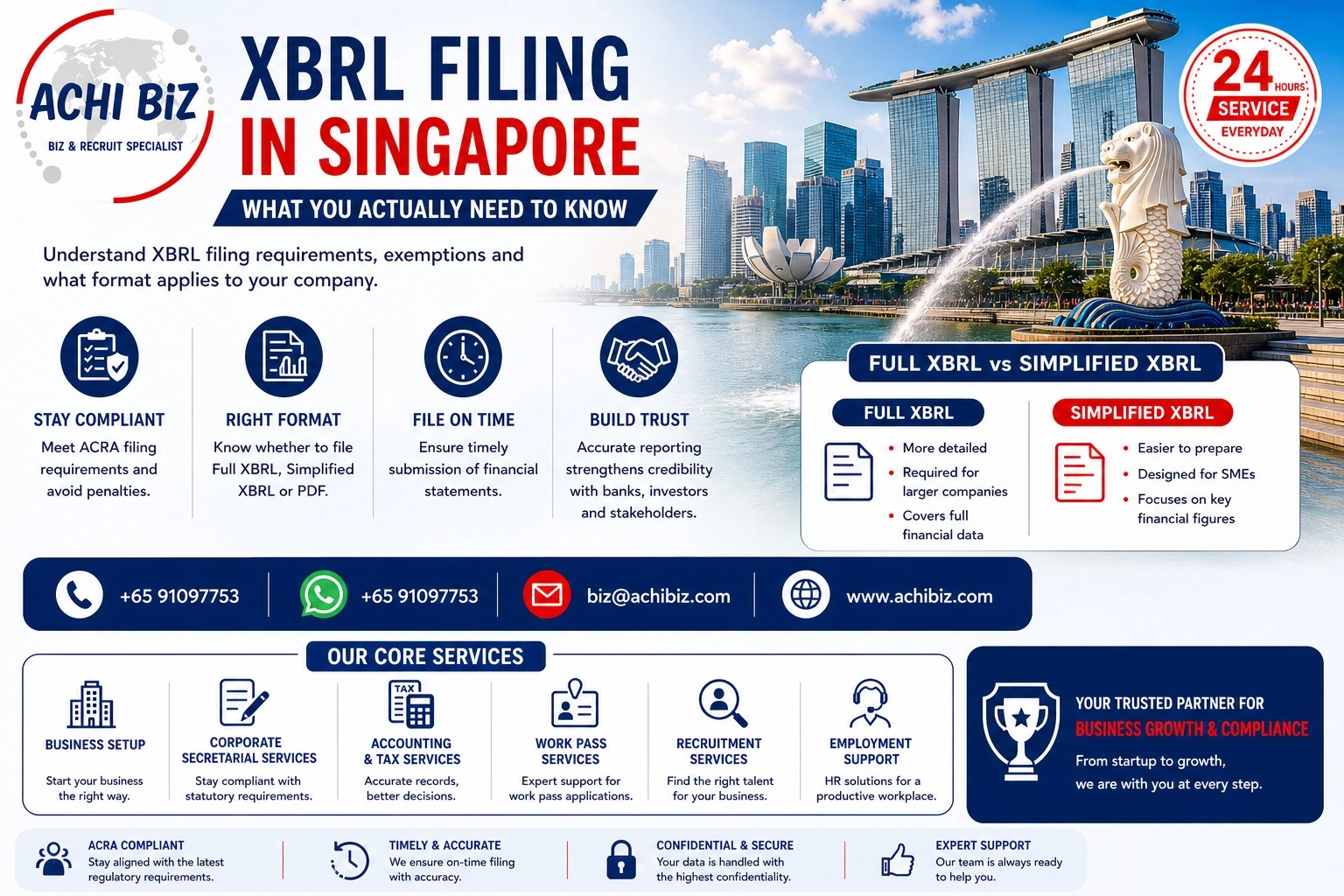
What You Actually Need to Know about eXtensible Business Reporting Language
If you run a company in Singapore, filing financial statements with ACRA is part of the job. But once XBRL filing Singapore comes into the picture, that’s where many people start getting confused. What format do you use? Do you even need XBRL? And why does ACRA insist on it? Let’s break it down in a way that’s easy to follow.
So, what is XBRL?
XBRL (eXtensible Business Reporting Language) is simply a structured way of submitting your financial statements. Instead of just uploading a PDF, your numbers are tagged in a format that ACRA can read, analyse, and compare across companies. It helps improve transparency and supports ACRA financial statements filing in a more standardised way.
Who needs to file in XBRL?
This depends on your company type. Not everyone follows the same rules under ACRA XBRL requirements Singapore.
If you’re a small or non-publicly accountable company
This is where most SMEs fall. You’ll need to submit Simplified XBRL financial statements and a PDF copy of your financial statements approved by your directors. This is a lighter version of XBRL filing Singapore SMEs, designed to keep things manageable.
If you’re in banking, finance, or insurance
These companies have stricter reporting requirements. You’ll need XBRL FSH financial statements specific to your industry and a PDF copy of your financial statements approved by directors. This ensures proper compliance with financial reporting Singapore regulations.
If your company is limited by guarantee or uses special accounting standards
In these cases, the requirement is simpler. You only need to submit a PDF copy of your financial statements. No XBRL submission ACRA is required.
If you don’t fall into any of the above categories
Then you’re likely required to file Full XBRL financial statements along with a PDF copy approved by directors. Full XBRL Singapore is more detailed and usually applies to larger companies.
What about exempt private companies (EPCs)?
If your EPC is solvent, you have some flexibility. You can choose to file in XBRL format Singapore (full or simplified, depending on eligibility) or skip XBRL and submit in PDF. While it’s optional, some companies still choose XBRL for better transparency and corporate compliance Singapore.
Full XBRL vs Simplified XBRL
Full XBRL Singapore is more detailed, required for larger companies, and covers full financial data. Simplified XBRL Singapore is easier to prepare, designed for SMEs, and focuses on key financial figures. Which one applies depends mainly on your company size and whether it’s publicly accountable under ACRA filing requirements Singapore.
Why this matters more than you think
It’s easy to treat XBRL as just another filing requirement. But getting it wrong can create unnecessary problems. Late or incorrect filings can lead to penalties, inconsistent data between PDF and XBRL can raise questions, and poorly prepared reports can affect credibility with banks or investors. Proper XBRL compliance Singapore helps avoid these issues and improves reporting quality.
Where companies usually go wrong
Common issues include picking the wrong XBRL format, leaving the filing too late, mismatched figures between XBRL and PDF, and treating it as a last-minute task. These mistakes often affect ACRA annual return filing Singapore and compliance status.
How to keep things simple
A few practical steps make a big difference. Know your filing category early, prepare your financial statements ahead of time, ensure consistency across all formats, and get professional help if needed. Following ACRA XBRL guidelines Singapore properly helps you stay compliant without stress.
How Achibiz can Support you
XBRL filing can get technical, especially for full XBRL requirements. At Achibiz, we help businesses prepare and convert financial statements into XBRL Singapore format, ensure compliance with ACRA requirements, handle Annual Return filing Singapore, and provide accounting and corporate secretarial support. The goal is to keep your filings accurate, compliant, and stress-free.
Final Thoughts
XBRL filing Singapore isn’t as complicated as it looks once you understand where your company fits. Know your category, use the right format, and don’t leave it to the last minute. Get these basics right, and it becomes just another routine part of running your business.
Learn more about Dormant Pte Ltd Company in Singapore
Learn more about Financial Year End in Singapore Pte Ltd
#achibiz