
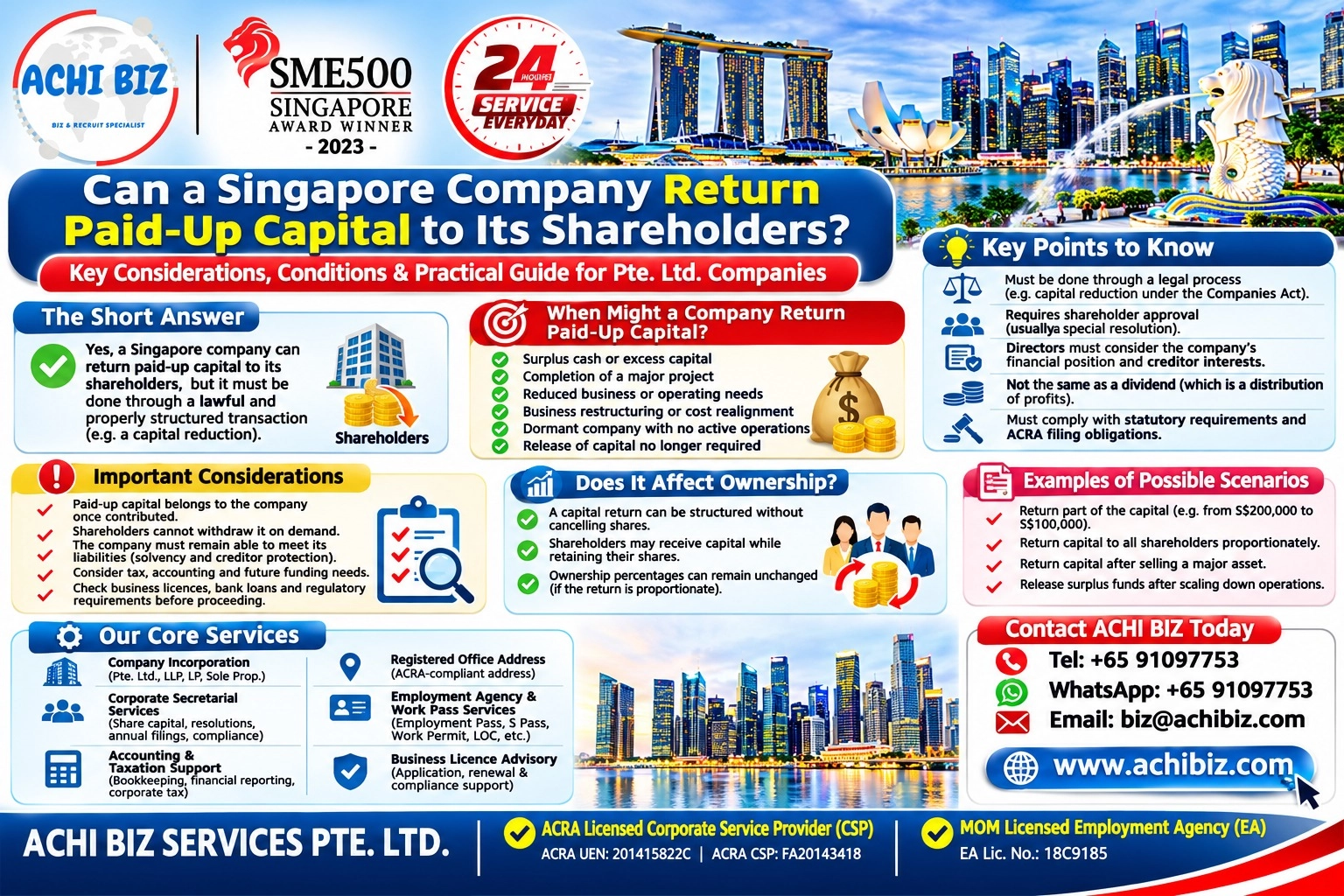
Introduction: Can Shareholders Get Their Paid-Up Capital Back from a Singapore Company?
When shareholders incorporate a Singapore Private Limited (Pte. Ltd.) company, they may contribute money or other assets in exchange for shares. These contributions form part of the company’s share capital and help finance its business activities.
But what happens when the company no longer needs all that capital?
Perhaps the business has accumulated surplus cash, completed a major project, scaled down its operations or decided to return some of its original funding to shareholders.
A common question then arises:
Can a Singapore company return its paid-up capital to shareholders without closing the business?
The short answer is yes, potentially—but not simply by transferring money back to shareholders.
Under Singapore’s Companies Act 1967, a company must respect the rules governing share capital maintenance, lawful distributions, shareholder rights and creditor protection.
Paid-up share capital belongs to the company once it has been contributed. Shareholders cannot automatically demand repayment merely because they originally provided the funds.
Depending on the circumstances, a lawful return of capital may be possible through an appropriate capital reduction, a qualifying share buyback or another legally recognised arrangement. However, these transactions are not interchangeable, and each has different consequences.
This FAQ guide focuses specifically on whether, when and how shareholders may receive a return of their invested share capital, including practical financial considerations, ownership implications, documentation, taxation, creditor protection and common mistakes.
For detailed statutory procedures, readers should refer separately to ACHI BIZ’s articles on Can a Singapore Pte. Ltd. Company Reduce Its Paid-Up Capital? Requirements & Procedures and Share Capital Reduction vs Share Buyback in Singapore: Key Differences.
Understanding the Right to Receive Paid-Up Capital Back
Can a Singapore Pte. Ltd. company legally return paid-up capital to its shareholders?
Yes, provided the return is carried out through a legally permitted mechanism and the company satisfies all applicable requirements.
A company cannot ordinarily return paid-up share capital as an informal repayment. A capital reduction may be used to return surplus capital, subject to the Companies Act, the company’s constitution and the required approvals.
The important distinction is between a lawful return of capital and an unauthorised distribution of company assets.
Does paid-up capital still belong to the shareholders after incorporation?
No.
Once shareholders contribute money as share capital, the money becomes the company’s property.
In exchange, shareholders receive shares carrying the rights attached to those shares.
They own an interest in the company, not a direct ownership interest in the company’s bank account or individual assets.
For example, if a shareholder contributes S$100,000 to a company, that shareholder cannot simply withdraw S$100,000 whenever they wish.
Can shareholders demand the return of their original investment?
Not ordinarily.
A shareholder’s entitlement to repayment depends on the company’s legal obligations, the rights attached to the shares, any applicable agreements and whether a lawful capital transaction is undertaken.
Share ownership does not generally create an ordinary debt repayable on demand.
Is paid-up capital refundable in Singapore?
It may be returned through a lawful corporate transaction, but it is not automatically refundable.
The term refundable paid-up capital should not be understood as meaning shareholders can request a refund in the same way they might recover a security deposit.
A company must first establish a valid legal basis for the payment.
Can shareholders withdraw paid-up capital from the company’s bank account?
Not merely because they are shareholders.
Any withdrawal must have a legitimate legal and accounting basis.
An unsupported withdrawal may create problems involving directors’ duties, unauthorised distributions, financial reporting and the company’s obligations to creditors.
Can a shareholder recover paid-up capital without selling their shares?
Potentially, yes.
A properly structured capital reduction may allow shareholders to receive capital while continuing to hold their shares.
The exact effect depends on how the reduction is implemented.
Can shareholders receive their paid-up capital back while remaining shareholders?
Yes, potentially.
For example, a company may reduce the capital represented by its existing shares without cancelling those shares.
Shareholders may receive a lawful capital repayment while retaining their ownership percentages.
Can shareholders receive more than their original paid-up capital?
Potentially, but the legal character of any additional payment matters.
A payment exceeding a shareholder’s original contribution should not automatically be described as a return of that shareholder’s paid-up capital.
Depending on the transaction, the excess may relate to share value, profits or another form of consideration, with different legal, accounting and tax consequences.
Does a company have to return paid-up capital when it becomes profitable?
No.
Profitability does not create an automatic obligation to repay share capital.
The directors and shareholders may decide to retain funds for business expansion, working capital, debt repayment or other legitimate purposes.
Can a shareholder receive a capital repayment even if the company has never declared dividends?
Yes, potentially.
A lawful return of capital and a dividend are legally distinct.
A company may have a valid reason to return capital even where it has not declared dividends, provided the relevant statutory requirements are satisfied.
When Might a Singapore Company Return Paid-Up Capital?
Why would a Singapore company return paid-up capital to shareholders?
A company may consider returning capital when its original funding requirements have changed.
Common commercial reasons include surplus funding, reduced operating requirements, completion of major projects, business restructuring or a decision to release capital that is no longer needed.
However, the company should assess whether the funds are genuinely surplus after considering future obligations.
Can a company return capital because it has more cash than it needs?
Potentially.
Excess cash may support a proposal to return capital, but the existence of cash alone does not establish that the company can lawfully make the payment.
Directors must consider the company’s financial position and the applicable statutory requirements.
Can a company return paid-up capital after completing a major project?
Yes, potentially.
For example, a company established to undertake a large commercial project may initially require substantial shareholder funding.
After completion, the company may no longer need the same capital base.
A lawful capital return may be considered if the remaining resources are sufficient for its obligations.
Can a company return capital after reducing its business operations?
Potentially.
A smaller operating business may require less capital than it did previously.
However, directors should assess ongoing expenses, contractual liabilities, employee obligations and potential future claims.
Can a dormant Singapore company return paid-up capital?
Yes, potentially.
Dormant status does not automatically prevent a capital return.
The company must still comply with the relevant statutory requirements and consider any outstanding liabilities.
Can a company return capital before becoming dormant?
Potentially.
A company planning to suspend operations may consider whether part of its capital is no longer required.
However, it should retain sufficient resources for continuing obligations and potential liabilities.
Can a company return paid-up capital while continuing to trade?
Yes.
A lawful capital return does not necessarily require the company to cease business.
However, the directors should ensure that the transaction does not undermine the company’s ability to continue meeting its obligations.
Can a company return capital before expanding into a different business?
Potentially, although doing so may not be commercially sensible if the new activity requires substantial funding.
The company should evaluate its future capital requirements rather than focusing solely on its present cash balance.
Can a company return capital after receiving a large customer payment?
Not automatically.
Customer receipts are not necessarily surplus capital.
The company may still owe suppliers, taxes, salaries, refunds or other contractual payments.
A capital return should be based on the company’s overall financial position, not a single bank receipt.
Can a company return paid-up capital after selling a major asset?
Potentially.
The sale may release funds that are no longer required for operations.
However, the company must consider any related tax liabilities, outstanding debts, contractual restrictions and replacement asset requirements.
Can a company return capital because its shareholders need personal funds?
A shareholder’s personal financial needs do not independently justify a capital repayment.
The company must have a legitimate corporate basis for the transaction and satisfy the relevant legal requirements.
Can a company return capital simply because shareholders unanimously agree?
No.
Unanimous shareholder agreement does not override the Companies Act or eliminate the company’s obligations to creditors.
Even where all shareholders support the proposal, the company must follow a lawful procedure.
Return of Paid-Up Capital vs Dividends and Other Payments
Is returning paid-up capital the same as paying a dividend?
No.
A dividend is generally a distribution of profits, subject to the applicable legal requirements.
A return of paid-up capital involves a legally authorised transaction affecting the company’s capital.
The distinction matters for financial reporting, tax treatment and creditor protection.
Can a company pay dividends instead of returning paid-up capital?
Potentially, if it has profits legally available for distribution and the relevant requirements are satisfied.
However, dividends and capital returns should not be treated as interchangeable merely because both involve payments to shareholders.
Can a company return paid-up capital when it has no profits?
Potentially.
Unlike an ordinary dividend, a lawful capital reduction does not necessarily depend on the existence of distributable profits.
However, the company must still satisfy the applicable statutory requirements and protect its ability to meet its liabilities.
Can a company return capital instead of declaring dividends to avoid tax?
A company should not select a transaction solely on the assumption that calling a payment capital produces a particular tax outcome.
The actual legal and tax treatment depends on the transaction’s substance and applicable law.
Tax advice may be necessary, especially where shareholders are overseas residents.
Is repayment of a shareholder loan the same as returning paid-up capital?
No.
A genuine shareholder loan is a liability owed by the company, subject to its repayment terms.
Paid-up share capital is part of the company’s equity.
Repaying a genuine loan does not ordinarily reduce the company’s issued or paid-up share capital.
Can a shareholder withdraw money previously advanced to the company?
Potentially, where the advance is properly documented as a repayable loan and the company can lawfully make the repayment.
The company should verify the accounting records, loan terms and any financing restrictions.
Can directors’ fees be used to return paid-up capital?
No.
Directors’ fees compensate directors for their services and are subject to the relevant approval and legal requirements.
They should not be used to disguise a capital repayment.
Can a shareholder receive salary instead of a capital return?
A shareholder who genuinely works for the company may receive lawful remuneration for that work.
However, salary must not be falsely characterised as employment compensation merely to transfer company funds to a shareholder.
Can a company distribute assets instead of cash as a return of capital?
Potentially.
An in-kind capital return may involve transferring property or other assets to shareholders.
Such transactions require careful consideration of valuation, title, tax, stamp duty, creditor protection and the applicable corporate procedure.
Can a company transfer a vehicle to a shareholder as repayment of capital?
Potentially, through a properly structured and lawful transaction.
The vehicle must be appropriately valued, and any financing, ownership transfer, tax and regulatory implications must be addressed.
The company cannot simply remove the vehicle from its records without documenting the transaction.
Can a company transfer property to shareholders as a return of capital?
Potentially, but property transactions may involve substantial legal, tax and stamp duty implications.
Independent valuation and specialist advice are particularly important.
Can a company make a capital repayment in a foreign currency?
Potentially.
However, the company should account for the currency of its share capital, the transaction documents, exchange rates, banking requirements and financial reporting treatment.
How Much Paid-Up Capital Can Be Returned?
Can a Singapore company return 100% of its paid-up capital?
A company may be able to undertake a substantial or complete capital return, depending on the transaction and its legal and financial circumstances.
However, a company that intends to continue operating must consider whether the proposed reduction is legally permissible and whether it will retain sufficient resources to meet its obligations.
A company should not assume that a complete return of capital is appropriate simply because shareholders approve it.
Can a company return only part of its paid-up capital?
Yes.
A partial capital return may be suitable where the company wants to release surplus funds while retaining a capital base for continuing operations.
For example, a company with S$300,000 in paid-up capital may consider returning S$100,000, subject to the applicable requirements.
Can a company return S$50,000 from S$100,000 paid-up capital?
Potentially.
The company would need to establish that the proposed return is legally permissible and financially appropriate.
If implemented as a reduction of share capital from S$100,000 to S$50,000, the transaction would require the applicable corporate approvals and statutory compliance.
Can a company return capital exceeding its bank balance?
A proposed cash return must be assessed against the company’s actual financial resources and ability to meet its obligations.
A company should not commit to a cash repayment that it cannot lawfully and sustainably fund.
The accounting value of share capital does not establish how much cash is available.
Can a company return capital when its cash balance is lower than its paid-up capital?
Potentially.
A company’s cash balance and paid-up capital are different financial measures.
For example, a company may have S$200,000 in paid-up capital but only S$80,000 in cash because the remaining funds have been invested in equipment, inventory or other assets.
A partial return may still be considered, subject to the company’s financial position and legal requirements.
Does a company’s paid-up capital equal the amount available for repayment?
No.
Paid-up capital is an equity amount, not a dedicated bank deposit.
The company may have used its original capital to fund operations, acquire assets or meet expenses.
The amount potentially available for return depends on the company’s financial circumstances and the proposed transaction.
Can shareholders recover their full original investment if the company has suffered losses?
Not necessarily.
A shareholder’s original investment is exposed to business risk.
Where the company has incurred losses, its remaining assets may be insufficient to support repayment of the original capital.
Shareholders do not ordinarily have priority over the company’s creditors.
Can a company return capital even when its total equity is lower than its paid-up capital?
Potentially, but the circumstances require careful assessment.
A company may have accumulated losses that reduce its total equity below the recorded share capital.
The directors must consider whether a proposed payment is legally permissible and whether the company can satisfy its obligations.
Can a company return capital while retaining sufficient working capital?
Potentially.
This is an important commercial consideration.
The company should calculate the working capital required for salaries, suppliers, rent, taxes, loan repayments and other operating expenses before deciding whether funds are genuinely surplus.
Is there a minimum amount of paid-up capital that must remain after a capital return?
There is no single universal minimum applicable to every Singapore Pte. Ltd. company.
However, certain regulated activities, licensing conditions, financing agreements or contractual arrangements may require specified capital or financial resources.
The company must consider any requirements applicable to its business.
Can a company return capital in several instalments?
Potentially, depending on the legally authorised transaction and its terms.
However, instalments should be expressly addressed in the relevant documentation, including payment conditions, timing and financial obligations.
A company should not assume that approving one capital return automatically authorises unlimited future repayments.
Can a company return different amounts in different financial years?
Potentially.
Each proposed return must have an appropriate legal basis and comply with the requirements applicable at the relevant time.
The company should not rely on an earlier transaction as automatic approval for a later payment.
Which Shareholders Are Entitled to Receive Returned Capital?
Must a company return paid-up capital to all shareholders equally?
Not necessarily.
The appropriate treatment depends on the rights attached to the shares, the company’s constitution and the structure of the proposed transaction.
A proportionate return may preserve existing ownership relationships, while selective arrangements require particular care.
Can shareholders receive capital in proportion to their shareholdings?
Yes, potentially.
For example, if two shareholders hold 60% and 40% of the same class of shares, a proportionate S$100,000 return may result in payments of S$60,000 and S$40,000 respectively.
This assumes equal capital rights per share and a properly authorised transaction.
Can one shareholder receive a capital repayment while another receives nothing?
Potentially, through an appropriately structured selective transaction.
However, the company must consider shareholder rights, fairness, required approvals and the applicable legal framework.
A selective payment should not be treated as an ordinary discretionary withdrawal.
Can a majority shareholder receive more capital than a minority shareholder?
Potentially, where the distribution reflects their respective rights or a legally authorised selective arrangement.
However, a majority shareholder cannot simply direct the company to pay them an additional amount without a proper legal basis.
Can a minority shareholder object to a proposed return of capital?
Potentially.
A minority shareholder may have rights under the company’s constitution, the Companies Act or other applicable legal arrangements.
The nature of those rights depends on the proposed transaction and the circumstances.
Can a shareholder refuse to accept a capital repayment?
The consequences depend on the transaction structure and the shareholder’s rights.
A shareholder’s refusal does not automatically invalidate every properly approved capital reduction, but the company must respect the applicable legal requirements.
Can a shareholder who has not fully paid for their shares receive returned capital?
The answer depends on the rights attached to the shares and the proposed transaction.
Unpaid subscription obligations may affect the amount payable and the appropriate treatment.
The company should review its share records and the terms of issue before proceeding.
Can a shareholder receive back capital that another shareholder originally contributed?
The legal entitlement to a capital return is generally determined by the relevant share rights and transaction terms, rather than by tracing particular bank deposits.
However, unequal contribution arrangements and contractual rights may require special consideration.
Can preference shareholders receive their capital before ordinary shareholders?
Potentially.
Preference shares may carry priority rights relating to capital returns or liquidation distributions.
The company must examine the actual rights attached to each class of shares.
Can ordinary shareholders receive capital while preference shares remain outstanding?
Potentially, subject to the applicable class rights and transaction terms.
The company should not assume that all classes of shares have identical capital entitlements.
Can a foreign shareholder receive returned capital from a Singapore company?
Yes, potentially.
Foreign shareholders may receive lawful capital repayments, subject to applicable corporate, banking, tax and cross-border requirements.
Can a corporate shareholder receive a return of paid-up capital?
Yes.
A shareholder that is another company may receive a lawful capital return in accordance with its share rights and the relevant transaction.
Can a deceased shareholder’s estate receive returned capital?
Potentially.
The company must determine the legally recognised holder or person entitled to the shares and comply with the relevant estate administration and share transmission requirements.
Can a former shareholder claim a capital repayment after selling their shares?
Not ordinarily merely because they previously contributed capital.
The entitlement generally follows the relevant share rights and contractual arrangements.
Any separate entitlement arising under an agreement must be assessed on its own terms.
Ownership and Shareholding Percentage After Returning Capital
Does returning paid-up capital automatically reduce the number of issued shares?
No.
A capital return may be structured without cancelling shares.
The number of issued shares and the recorded amount of share capital are separate matters.
Can shareholders retain the same number of shares after receiving capital?
Yes, potentially.
A lawful capital reduction may reduce the capital represented by existing shares while leaving the number of shares unchanged.
Can a company return capital without changing shareholder percentages?
Yes.
Where the transaction is proportionate and preserves the relevant share rights, the shareholders’ ownership percentages may remain unchanged.
Does returning paid-up capital automatically dilute shareholders?
No.
A proportionate capital return does not ordinarily cause dilution.
Dilution generally arises where a shareholder’s relative ownership or voting interest decreases.
Can a selective capital return change voting control?
Yes, potentially.
Where the transaction involves selective cancellation or changes to share rights, the relative voting power of remaining shareholders may change.
Can a company return capital without issuing new shares?
Yes.
A capital return does not ordinarily require the company to issue additional shares.
The legal mechanism must nevertheless be properly established.
Does a return of capital change the company’s UEN?
No.
A capital return does not ordinarily change the company’s legal identity or ACRA Unique Entity Number.
Does returning capital change the company’s shareholders’ register?
It may.
If the transaction changes the number of shares, shareholders or other registrable particulars, the relevant statutory information must be updated.
Even where the share count remains unchanged, the company’s capital records and required filings must accurately reflect the transaction.
Financial Position, Solvency and Creditor Protection
Why must creditors be considered before returning paid-up capital?
Because the company’s assets are available to meet its liabilities.
Returning assets to shareholders may reduce the financial resources available to creditors.
Singapore’s capital maintenance framework is designed, in part, to prevent inappropriate distributions that prejudice creditors.
Can a company return paid-up capital while owing money to suppliers?
Potentially, but outstanding liabilities must be considered.
The existence of trade creditors does not automatically prohibit every capital return.
However, the company must comply with the relevant legal requirements and should not compromise its ability to pay suppliers when payments become due.
Can a company return capital while it has outstanding bank loans?
Potentially.
However, loan agreements may restrict capital distributions or require lender consent.
The company should examine its financing arrangements before proceeding.
Can a bank prevent a company from returning paid-up capital?
A bank may have contractual rights under its financing documents that restrict or condition capital distributions.
For example, a loan agreement may prohibit certain payments to shareholders without prior consent.
Can a company return capital while it has unpaid corporate income tax?
A company must consider its existing and anticipated tax liabilities.
A capital return that leaves insufficient funds to meet tax obligations may create serious financial and legal concerns.
Can a company return capital when it has outstanding GST liabilities?
The company must account for GST liabilities and ensure the proposed transaction complies with the applicable legal and financial requirements.
Funds required to satisfy tax obligations should not be treated as freely available surplus capital.
Can a company return capital when employees’ salaries or CPF contributions remain unpaid?
This is a significant warning sign.
The company must address its employment and statutory obligations and assess whether a capital return would be lawful and appropriate.
Directors should not prioritise shareholder payments in a manner that improperly prejudices employees or other creditors.
Can a company return paid-up capital when it is insolvent?
A company should not assume that it can lawfully return capital while insolvent.
The applicable statutory route, solvency requirements and directors’ duties must be examined.
Where the company is insolvent or approaching insolvency, creditor interests become especially important, and specialist legal advice is necessary.
Can a company return capital when it has contingent liabilities?
Potentially, but contingent liabilities must be considered.
Examples include pending litigation, warranties, guarantees and possible tax assessments.
A company should not ignore potential obligations merely because payment is not yet due.
Can a company return capital while facing a lawsuit?
Potentially, but the proposed return requires careful assessment.
The directors should consider the nature of the claim, potential financial exposure and whether the transaction could prejudice creditors or claimants.
Can a company return capital immediately after receiving a loan?
The receipt of loan proceeds does not automatically make a capital return appropriate.
Borrowed money creates a repayment obligation.
Using debt-funded cash to return shareholder capital may increase financial risk and may breach financing restrictions.
Can a company borrow money specifically to return capital?
Such an arrangement requires careful legal, financial and contractual analysis.
The company must consider the commercial purpose, financing terms, solvency and the applicable statutory requirements.
A company should not assume that borrowing money makes an otherwise impermissible capital return lawful.
Can directors become personally liable for an unlawful capital return?
Potentially.
Depending on the circumstances, directors may face consequences for breaches of statutory obligations, fiduciary duties or improper authorisation of company payments.
The consequences depend on the relevant law and facts.
Can shareholders be required to repay money received through an unlawful capital distribution?
Potentially.
The legal consequences depend on the nature of the payment, the applicable statutory provisions and the recipient’s circumstances.
Shareholders should not assume that an improperly received payment is automatically theirs to retain.
Does shareholder approval protect directors from liability?
Not automatically.
Shareholder approval does not remove directors’ independent legal duties or authorise conduct prohibited by law.
Is a solvent company always allowed to return paid-up capital?
No.
Solvency is important, but it does not replace the need for a lawful transaction, proper approvals, accurate documentation and statutory compliance.
Legal Requirements and ACRA Compliance for Returning Paid-Up Capital
What is the usual legal method for returning paid-up capital in Singapore?
Where the objective is to return part of the company’s existing share capital while shareholders retain their shares, a reduction of share capital is often the relevant mechanism.
For Singapore companies, the capital reduction framework is principally found in Sections 78A to 78I of the Companies Act 1967.
The appropriate method depends on the company’s circumstances and the intended transaction.
Does a Singapore company need ACRA approval before returning paid-up capital?
The company must comply with the applicable statutory procedures and ACRA filing requirements.
However, not every capital reduction involves obtaining discretionary approval from ACRA.
The legal process depends on the statutory route used, and the required notices must be lodged correctly.
Can a company return paid-up capital through a special resolution?
A special resolution is a key requirement under the relevant capital reduction procedures.
However, passing a special resolution alone does not necessarily complete the transaction or authorise immediate payment.
Other statutory conditions must also be satisfied.
Is a solvency statement required before returning capital?
For a reduction using the solvency-statement route under Section 78B, the relevant directors’ solvency statement requirements must be satisfied.
The company should assess the statutory conditions carefully, including the directors’ reasonable grounds for their conclusions.
Must all directors sign the solvency statement?
The applicable statutory requirements depend on the type of company and transaction.
For a private company using the relevant solvency-statement route, the required directors must make the statement in accordance with Section 78C.
The company should not assume that a statement signed by only one director is sufficient in every case.
Can a company return capital without a solvency statement?
Potentially, through the court-approved capital reduction route, subject to the relevant legal requirements.
This does not mean financial condition and creditor interests can be ignored.
Is there a creditor objection period before capital can be returned?
Under the relevant special-resolution capital reduction route, creditors have statutory objection rights, including a six-week period associated with the resolution.
The company must comply with the applicable notice and filing requirements.
Can the company pay shareholders immediately after passing the capital reduction resolution?
It should not assume that it can.
The company must establish when the proposed reduction legally takes effect and ensure all relevant statutory conditions are satisfied before implementing the repayment.
Does a capital reduction require a court order?
Not in every case.
Singapore law provides different statutory routes, including a solvency-statement procedure and a court-approved procedure.
The correct route depends on the circumstances.
Can a shareholder capital repayment be completed without updating ACRA?
The company must comply with the relevant ACRA notification and filing requirements.
Failure to update statutory information may create discrepancies between the company’s records and its registered particulars.
What documents should a company prepare before returning paid-up capital?
Depending on the transaction, relevant documents may include:
-
Current ACRA business profile and share capital records.
-
Company constitution and applicable shareholder agreements.
-
Latest financial statements and management accounts.
-
Updated cash-flow forecasts and liability schedules.
-
Directors’ resolutions and applicable solvency statements.
-
Shareholders’ special resolution.
-
Required notices, declarations and ACRA filings.
-
Shareholder payment instructions and supporting bank records.
-
Updated statutory registers and accounting entries.
The exact documents depend on the legal route and transaction structure.
Does the company secretary have a role in returning paid-up capital?
Yes.
The company secretary or appointed corporate service provider may assist with preparing corporate documents, coordinating resolutions, maintaining statutory records and handling applicable ACRA filings.
However, corporate secretarial assistance does not replace legal advice where complex capital rights or disputes arise.
Can the company backdate a return of capital?
The company should not falsify the dates of resolutions, payments or statutory filings.
The records must accurately reflect when the relevant decisions and transactions occurred.
Can a company treat an earlier informal shareholder withdrawal as a capital reduction?
Not automatically.
A historical withdrawal should be examined according to its actual legal and accounting nature.
Passing a later resolution does not necessarily make an earlier unauthorised payment lawful retrospectively.
What happens if a company has already returned paid-up capital without following the proper procedure?
The company should promptly seek appropriate professional advice.
The payment may require investigation, accounting correction, recovery or other lawful remedial action.
The company should not simply relabel the transaction as a capital reduction without examining the legal consequences.
Tax, Stamp Duty and Accounting Implications
Is returned paid-up capital taxable to shareholders in Singapore?
There is no universal answer applicable to every shareholder and transaction.
Singapore generally does not impose capital gains tax, but the tax treatment depends on the nature of the receipt and the shareholder’s circumstances.
For example, amounts received in the course of a share dealing business may require different consideration from an ordinary capital investment.
Is a return of paid-up capital subject to Singapore withholding tax?
A genuine capital repayment is not automatically subject to withholding tax merely because the recipient is a foreign shareholder.
However, the company should verify the actual character of the payment and whether any withholding tax provisions apply.
Is stamp duty payable when paid-up capital is returned?
Not necessarily.
Stamp duty depends on the legal transaction and whether a dutiable instrument or transfer is involved.
A capital reduction should not automatically be treated as an ordinary share transfer.
Does a return of capital reduce the company’s taxable profits?
A return of share capital is not ordinarily an operating expense deductible simply because cash is paid to shareholders.
The accounting and tax consequences should be assessed according to the actual transaction.
Does a capital repayment affect the company’s corporate income tax filing?
It may affect the company’s financial statements and supporting records.
However, a capital repayment should not automatically be recorded as an expense reducing taxable business income.
How should a company record the return of paid-up capital in its accounts?
For a straightforward, legally effective cash capital reduction, the accounting entry may generally involve reducing share capital and reducing cash or bank balances.
For example:
| Accounting entry | Debit | Credit |
|---|---|---|
| Share capital | S$50,000 | — |
| Bank | — | S$50,000 |
This is a simplified illustration. The actual entries depend on the transaction terms, timing and applicable accounting standards.
Does returning paid-up capital reduce the company’s total equity?
A cash-funded return of capital will generally reduce total equity because assets leave the company.
However, a non-cash capital restructuring that merely offsets accumulated losses may not reduce total equity.
Does a capital repayment affect the company’s profit and loss statement?
A genuine return of capital is generally an equity transaction rather than an ordinary operating expense.
It should not be confused with salary, rent, professional fees or other business expenses.
Can a company return capital without reducing its cash balance?
Potentially, where the transaction involves a non-cash distribution or a different capital restructuring.
However, the transaction must have a lawful basis and appropriate accounting treatment.
Does a return of capital improve the company’s financial performance?
Not automatically.
A capital repayment may reduce assets and equity without improving revenue, profitability or operating cash generation.
Financial ratios may change, but those changes do not necessarily indicate better business performance.
Can returning capital reduce the company’s net asset value?
Yes.
Where cash or other assets are distributed to shareholders, the company’s net assets will generally decrease.
Can a return of capital affect the company’s debt-to-equity ratio?
Yes.
If equity decreases while borrowings remain unchanged, the debt-to-equity ratio may increase.
This could affect lending assessments and financial covenants.
Can a capital repayment affect future dividends?
Potentially.
Returning cash reduces the resources available for future operations and distributions.
However, future dividend capacity depends on profits legally available for distribution and other relevant circumstances.
Does a shareholder need to keep records of the capital repayment?
Yes, as a practical matter.
Shareholders should retain relevant corporate resolutions, payment records, shareholding information and tax documentation.
These records may be important for future disposals, tax reporting, audits or ownership disputes.
Returning Capital to Foreign and Corporate Shareholders
Can a foreign shareholder receive a capital repayment into an overseas bank account?
Potentially.
The company should ensure that the payment is properly authorised and supported by appropriate banking and shareholder documentation.
Banks may request information concerning the payment’s purpose and source of funds.
Can a Singapore company return paid-up capital to a foreign parent company?
Yes, potentially.
A Singapore subsidiary may return capital to its foreign parent through a lawful transaction.
The group should assess Singapore corporate requirements, overseas tax treatment, banking documentation and any group financing restrictions.
Does returning capital to a foreign parent company require the subsidiary to close?
No.
A subsidiary may continue operating after a lawful capital return, provided it continues to satisfy its legal, financial and regulatory obligations.
Can a foreign shareholder receive capital in USD rather than SGD?
Potentially.
The company must consider the currency of the relevant share capital, the transaction terms, exchange rates and applicable accounting requirements.
Can a foreign shareholder face tax in their home country after receiving returned capital?
Yes.
The shareholder’s country of tax residence may treat the receipt differently from Singapore.
Overseas tax advice may be appropriate, particularly for substantial payments.
Can a holding company return capital received from its subsidiary to its own shareholders?
Potentially, but these are separate corporate transactions.
A subsidiary’s payment to its parent does not automatically authorise the parent to distribute the same amount to its shareholders.
Each company must satisfy its own legal requirements.
Business Licences, Work Passes and Commercial Considerations
Can returning paid-up capital affect a Singapore company’s business licence?
Yes, potentially.
Some regulated activities have minimum capital, financial resource or net-worth requirements.
A capital repayment could affect the company’s continued eligibility.
Can an ACRA Licensed Corporate Service Provider (CSP) return paid-up capital?
A licensed corporate service provider must consider the requirements applicable to its regulated activities.
Any proposed capital return should be reviewed against its financial, licensing and continuing compliance obligations.
Can a MOM Licensed Employment Agency (EA) return paid-up capital?
Potentially, but the agency must consider any applicable licensing, security bond and financial requirements.
A capital return must not compromise its ability to comply with MOM obligations.
Can a company return paid-up capital while employing Employment Pass holders?
Potentially.
There is no universal rule that every capital reduction automatically invalidates an Employment Pass.
However, the employer must continue satisfying applicable MOM requirements and provide accurate information when required.
Can a capital return affect future Employment Pass applications?
Potentially, where the company’s financial circumstances form part of the assessment.
However, no universal outcome should be assumed.
Can returning paid-up capital affect a company’s eligibility for government tenders?
Yes, potentially.
Certain tenders, registrations or prequalification arrangements may involve financial eligibility requirements.
A company should review the relevant tender conditions before reducing its capital or financial resources.
Can returning capital affect the company’s ability to obtain bank financing?
Potentially.
Banks may assess the company’s capital base, equity, cash flow, leverage and financial stability.
A substantial capital repayment may influence lending decisions or breach existing loan covenants.
Can returning capital affect suppliers’ willingness to offer credit?
Potentially.
Suppliers may consider the company’s financial position when deciding whether to offer trade credit.
A reduction in available financial resources may affect their assessment.
Can a capital return affect the company’s commercial credibility?
Potentially.
A lower paid-up capital figure may influence perceptions in some commercial situations.
However, paid-up capital alone does not establish the company’s financial strength, reliability or creditworthiness.
Can a company return capital immediately before applying for a business licence?
It should first determine whether the proposed licence has capital or financial eligibility requirements.
Returning funds before an application may be commercially unwise if the business subsequently needs to restore its capital.
Practical Examples: Returning Paid-Up Capital in Singapore
The following hypothetical examples illustrate how a capital return may affect a company’s finances and shareholders. They are not substitutes for the applicable legal procedures.
Example 1: Can a company with S$200,000 paid-up capital return S$100,000 equally to two shareholders?
Suppose ABC Pte. Ltd. has two shareholders who each hold 50% of the company’s ordinary shares.
The company has S$200,000 in paid-up capital and proposes a S$100,000 proportionate return.
| Particulars | Before return | After return |
|---|---|---|
| Paid-up capital | S$200,000 | S$100,000 |
| Shareholder A ownership | 50% | 50% |
| Shareholder B ownership | 50% | 50% |
| Capital returned to A | — | S$50,000 |
| Capital returned to B | — | S$50,000 |
If the capital reduction is lawfully structured without cancelling shares, both shareholders may retain their original ownership percentages.
Example 2: Can a sole shareholder recover part of their original S$100,000 investment?
Suppose a sole shareholder initially contributed S$100,000.
After several years, the company has sufficient surplus resources and proposes returning S$40,000.
A lawful capital reduction may potentially reduce paid-up capital to S$60,000 while the shareholder continues to own 100% of the company.
However, the shareholder cannot simply withdraw S$40,000 without the required legal process.
Example 3: Can a company return capital when it has accumulated losses?
Suppose a company has the following financial position:
| Financial item | Amount |
|---|---|
| Paid-up capital | S$200,000 |
| Accumulated losses | (S$150,000) |
| Total equity | S$50,000 |
| Bank balance | S$20,000 |
The company cannot assume that S$200,000 remains available for repayment.
Its original capital has been affected by business losses, and its current resources are substantially lower.
A capital restructuring to address accumulated losses may be relevant, but that is different from distributing S$200,000 to shareholders.
Example 4: Can a company return capital when its bank balance includes customer deposits?
Suppose a company has S$250,000 in its bank account.
However, S$150,000 represents customer advance payments for services not yet delivered.
The company should not automatically treat the full S$250,000 as surplus cash.
It must consider the obligations associated with those customer payments, together with other liabilities and future cash requirements.
Example 5: Can a company return capital without changing the number of issued shares?
Suppose a company has 100,000 ordinary shares representing S$100,000 in paid-up capital.
It proposes a lawful S$30,000 capital return without cancelling shares.
| Particulars | Before | After |
|---|---|---|
| Issued ordinary shares | 100,000 | 100,000 |
| Paid-up capital | S$100,000 | S$70,000 |
| Capital returned | — | S$30,000 |
The number of shares remains unchanged, although the company’s recorded share capital decreases.
Example 6: Can a company return capital when one shareholder wants to exit?
Suppose a company has three shareholders holding 50%, 30% and 20%.
The shareholder holding 20% wishes to leave.
A selective capital reduction or share buyback may be considered, depending on the intended structure and legal requirements.
However, this situation differs from an ordinary proportionate return of surplus capital because the transaction may change ownership and voting control.
Example 7: Can a company return S$80,000 after selling unused equipment?
Suppose a company sells equipment for S$120,000.
It intends to return S$80,000 to shareholders.
Before doing so, the directors should consider whether the company has outstanding equipment financing, tax liabilities, replacement asset requirements or other obligations.
The sale proceeds alone do not establish that S$80,000 is available for a lawful capital return.
Example 8: Can a foreign-owned subsidiary return S$500,000 to its parent company?
Suppose a Singapore subsidiary has S$1 million in paid-up capital contributed by its overseas parent.
Following a business restructuring, the subsidiary proposes returning S$500,000.
A lawful capital reduction may potentially achieve this result.
However, the company must assess its financial obligations, any applicable licensing requirements, corporate approvals, ACRA filings and cross-border tax implications.
Example 9: Can a company return capital when its shareholders contributed different amounts?
Suppose two shareholders hold equal numbers of ordinary shares but originally subscribed for them on different financial terms.
A proposed capital return should be assessed by reference to their legal share rights and the transaction structure.
The company should not assume that each shareholder is automatically entitled to recover the exact amount they personally contributed.
Example 10: Can a company return capital shortly before winding up?
Potentially, but this requires particular caution.
Where a company intends to close, directors should assess its outstanding liabilities, the appropriate closure procedure and whether a separate capital return is necessary or advisable.
A capital reduction must not be used to circumvent creditor protection or insolvency requirements.
Common Mistakes When Returning Paid-Up Capital
What is the most common misunderstanding about paid-up capital repayment?
The most common misunderstanding is that paid-up capital remains the shareholder’s personal money and can be withdrawn whenever required.
In reality, the contribution becomes company property.
A repayment requires a lawful legal basis.
Can a company describe any shareholder payment as a return of capital?
No.
The payment must reflect the actual legal transaction.
A company should not use the description return of capital to conceal dividends, remuneration, loans or other payments.
Is a bank transfer sufficient evidence of a lawful capital return?
No.
A bank transfer proves that money moved between accounts.
It does not establish that the payment was properly authorised or legally permissible.
Can a company use a director’s resolution alone to return paid-up capital?
A director’s resolution alone will not ordinarily satisfy the requirements for a statutory capital reduction.
The applicable shareholder approvals and other statutory conditions must be considered.
Can a company return capital without checking its constitution?
The company’s constitution should be reviewed before proceeding.
It may contain provisions affecting shareholder rights, approvals and the proposed transaction.
Can a company ignore outstanding liabilities because shareholders unanimously support the return?
No.
Shareholder agreement does not eliminate creditor rights or statutory obligations.
Can a company use an accounting journal entry to return paid-up capital?
An accounting entry cannot, by itself, create a legally effective capital return.
The underlying transaction must be lawful and properly documented.
Can a company return paid-up capital simply to make its balance sheet look better?
A transaction should have a legitimate commercial and legal basis.
A capital return may change financial ratios, but it does not automatically improve the company’s economic condition.
Can a company return capital without considering future business expenses?
It should not.
A responsible assessment should consider foreseeable expenses, commitments and potential liabilities.
Can a company return capital and then immediately increase it again?
Potentially, through separate lawful transactions.
However, circular or artificial arrangements may create legal, accounting, tax or regulatory concerns.
The company should have a genuine commercial reason for each transaction.
Advanced FAQs: Special Circumstances
Can a Singapore company return capital when it has only one shareholder and one director?
Potentially.
However, the company’s ownership and management structure does not exempt it from the Companies Act.
The relevant resolutions, solvency requirements and statutory procedures must still be satisfied.
Can a company return capital to shareholders who live overseas?
Yes, potentially.
The company should verify shareholder identity, payment instructions and any applicable cross-border requirements.
Can shareholders receive returned capital through a joint bank account?
The company should ensure that the payment instructions are properly authorised and consistent with the shareholder’s legal entitlement.
Appropriate documentation should be retained.
Can a company return capital to a shareholder who owes money to the company?
Potentially, but the outstanding debt should be considered.
Any proposed set-off or net settlement must have a valid legal and accounting basis.
Can a company offset a capital repayment against a shareholder loan?
Potentially, where the relevant obligations and transaction terms support a lawful set-off.
However, the company should distinguish the reduction of equity from the settlement of a loan balance.
Can a company return capital while a shareholder dispute is ongoing?
Potentially, but the transaction may be contentious.
The company should assess whether the proposal affects disputed ownership rights or could give rise to unfair prejudice claims.
Can a company return capital while changing its directors?
Potentially.
However, the directors responsible for making the relevant decisions and statements must satisfy their legal obligations.
Changes in directors should not be used to avoid statutory responsibility.
Can a company return capital during an audit?
Potentially.
The company should ensure that the transaction is properly documented and that the auditors receive the relevant information.
The timing may affect financial statement recognition and disclosure.
Can a company return capital after its financial year-end?
Potentially.
The transaction should be accounted for in the appropriate reporting period based on when the relevant legal and accounting conditions are satisfied.
Can a company return capital before filing its annual return?
Potentially.
However, the company must satisfy the applicable capital reduction requirements and ensure its statutory information is accurate.
The annual return does not replace transaction-specific filings.
Can a company return capital while it has outstanding guarantees?
Potentially, but guarantees may create significant contingent liabilities.
Directors should assess the financial exposure before authorising a payment.
Can a company return capital after a major shareholder sells their shares?
Potentially.
However, the new shareholding structure and relevant shareholder rights should be confirmed before proceeding.
Can a company return capital to shareholders of different share classes?
Potentially.
The company must respect the rights attached to each class and any applicable approval requirements.
Can a company return capital without changing its business registration status?
Yes.
A lawful capital return does not ordinarily require the company to cancel its registration or cease operating.
Can a company return paid-up capital more than once?
Potentially.
A company may undertake separate lawful capital returns at different times.
Each transaction must satisfy the relevant requirements and be properly documented.
Final FAQs: Returning Paid-Up Capital in Singapore
Is paid-up capital permanently locked inside a Singapore company?
No.
However, it cannot ordinarily be withdrawn informally.
A lawful capital transaction may allow some or all of the capital to be returned, depending on the circumstances.
Is returning paid-up capital a legal right of every shareholder?
No.
Shareholders do not generally have an automatic right to demand repayment of their share capital.
Can a company return capital without making a profit?
Potentially, subject to the relevant statutory requirements and financial circumstances.
Can a company return capital without cancelling shares?
Yes, potentially.
Can a company return capital without closing down?
Yes.
Can a company return capital without obtaining shareholder approval?
A company must comply with the approval requirements applicable to the chosen transaction.
For a statutory capital reduction, the required shareholder resolution is a central part of the process.
Can a company return capital without considering its creditors?
No.
Creditor protection is an important consideration.
Is returning capital always better than paying dividends?
No.
The appropriate approach depends on the company’s financial position, the source and purpose of the payment, shareholder rights and legal requirements.
Is returning capital always better than repaying a shareholder loan?
No.
A genuine shareholder loan repayment and a return of share capital are different transactions.
The company should correctly identify the nature of the funds originally provided.
Does returning paid-up capital guarantee that shareholders recover their investment?
No.
Shareholders may suffer investment losses, and the company’s available resources may be insufficient to support the desired repayment.
What should a company do before deciding to return paid-up capital?
The company should establish the purpose of the proposed return, review its financial position, identify the relevant shareholder rights, assess creditor obligations, confirm the appropriate legal mechanism and obtain professional advice where necessary.
What is the most important principle shareholders should remember?
Paid-up capital is company property, not money that shareholders can withdraw on demand.
It may be returned through a lawful transaction, but the company must respect its statutory obligations, financial responsibilities and the rights of creditors and other shareholders.
Practical Checklist Before Returning Paid-Up Capital to Shareholders
| Key consideration | What the company should verify |
|---|---|
| Commercial purpose | Why is the capital being returned? |
| Amount of repayment | How much capital is proposed to be returned? |
| Financial position | Does the company have sufficient assets and liquidity? |
| Future working capital | Can the business continue operating sustainably? |
| Outstanding creditors | Have existing and foreseeable liabilities been considered? |
| Shareholder rights | Who is legally entitled to receive the payment? |
| Ownership structure | Will share quantities or voting percentages change? |
| Share classes | Are there preference or other special rights? |
| Company constitution | Are there relevant restrictions or approval provisions? |
| Legal mechanism | Is a capital reduction or another transaction appropriate? |
| Solvency requirements | Can the relevant statutory requirements be satisfied? |
| Shareholder approval | Have the necessary resolutions been obtained? |
| Creditor protection | Have applicable notice and objection requirements been met? |
| Bank financing | Are there restrictions on distributions? |
| Business licences | Will the capital return affect licensing conditions? |
| Tax implications | Has the Singapore and overseas tax treatment been reviewed? |
| Accounting treatment | Are the proposed entries appropriate? |
| ACRA compliance | Have the required filings been identified and completed? |
| Payment documentation | Are shareholder entitlements and payment records accurate? |
| Professional review | Is legal, accounting or tax advice necessary? |
Conclusion: Can a Singapore Company Return Paid-Up Capital to Its Shareholders?
Yes. A Singapore Pte. Ltd. company may lawfully return paid-up capital to shareholders, but the repayment must be carried out through an appropriate legal mechanism.
The important point is that paid-up capital is not a refundable deposit. Once contributed, it becomes part of the company’s equity and is subject to Singapore’s company law framework.
A return of capital may be commercially appropriate where a company has surplus funding, reduced operational requirements or a legitimate reason to release capital to its shareholders.
However, the decision must take account of the company’s financial position, creditor obligations, shareholder rights, regulatory requirements and future funding needs.
A lawful capital return may allow shareholders to recover part of their investment while continuing to hold shares in the company. Nevertheless, the amount returned, the timing and the ownership consequences depend on the transaction structure.
Companies should also distinguish a genuine return of capital from dividends, shareholder loan repayments, share transfers and share buybacks.
The objective should not simply be to recover shareholders’ money as quickly as possible. It should be to return capital legally, fairly and without compromising the company’s financial responsibilities.
How ACHI BIZ Can Assist with Returning Paid-Up Capital in Singapore
ACHI BIZ SERVICES PTE. LTD., an ACRA Licensed Corporate Service Provider (CSP), provides corporate secretarial and compliance support to Singapore companies considering changes to their share capital.
Our assistance may include reviewing existing corporate records, coordinating shareholder and directors’ resolutions, preparing relevant corporate secretarial documentation, assisting with applicable ACRA Bizfile filings and maintaining updated statutory records.
Where the proposed capital return involves complex solvency assessments, shareholder disputes, creditor claims, tax questions or unusual transaction structures, appropriate legal and financial advice should be obtained.
Related Articles
How to Increase Issued Share Capital in Singapore Pte Ltd Company – FAQ Guide
How to Increase Paid-Up Capital in a Singapore Pte. Ltd. Company – FAQ Guide
#achibiz