
Types of Director Duties in Singapore Pte Ltd Companies – FAQ Guide
Becoming a director of a Singapore Private Limited (Pte. Ltd.) company is not merely accepting a title on an ACRA record. Directors are responsible for directing and supervising the company’s affairs and are subject to multiple, overlapping categories of duties and responsibilities.
These obligations can arise from the Companies Act 1967, common law and fiduciary principles, the company’s Constitution, contractual arrangements, financial reporting requirements, insolvency law and other legislation applicable to the company’s activities.
Importantly, calling someone an “inactive”, “sleeping” or “nominee” director does not remove these responsibilities. ACRA expressly states that all directors are responsible under the legislation, whether active or not.
This FAQ provides an overview of the different types of directors’ duties in Singapore and explains how they interact. As ACHI BIZ has separate detailed guides dealing specifically with fiduciary duties and statutory duties, those two areas are summarised here rather than repeated in detail.
What are the main types of duties applicable to a director in Singapore?
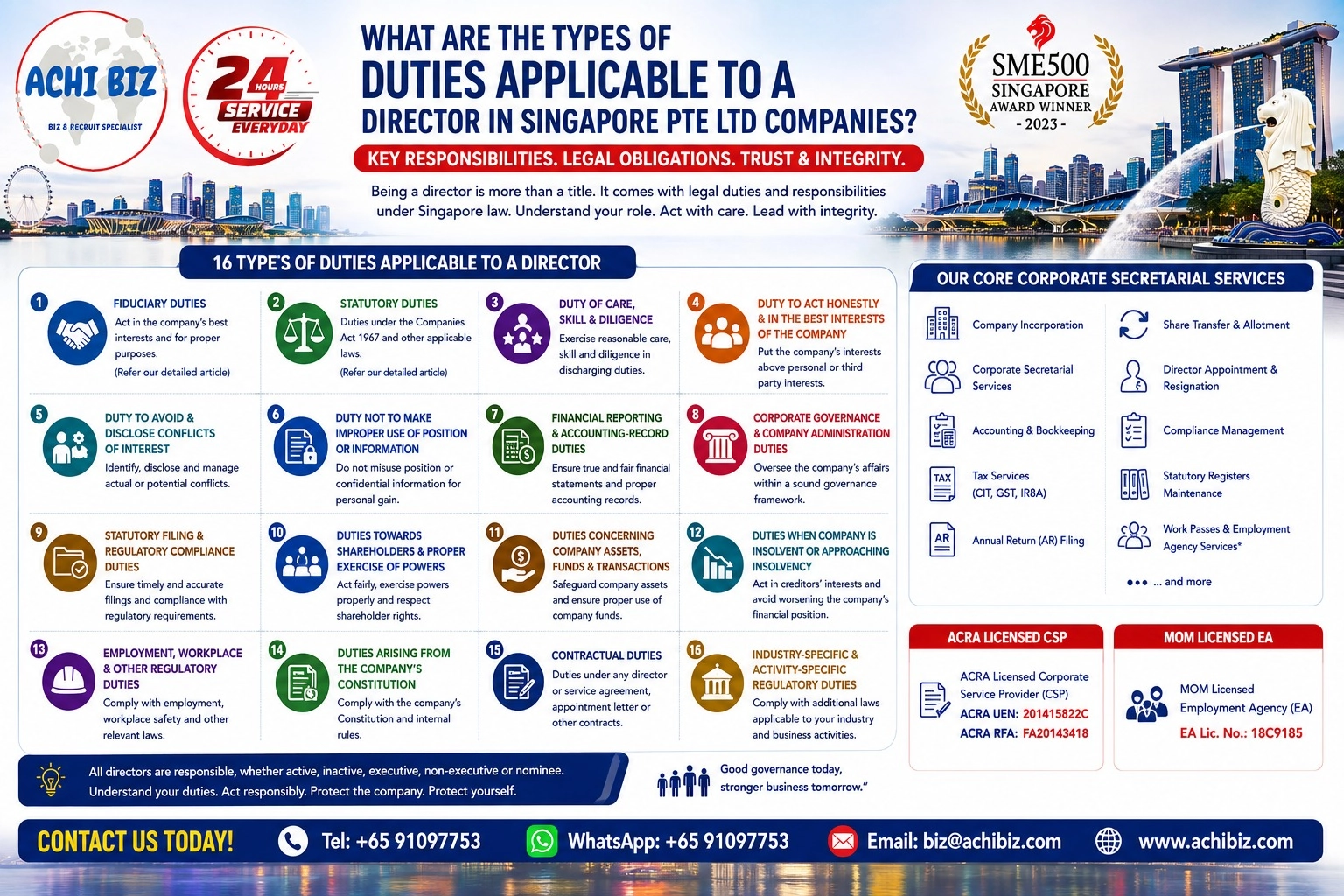
The duties and responsibilities of a Singapore company director can broadly be grouped into the following areas:
- Fiduciary duties
- Statutory duties under the Companies Act 1967 and other legislation
- Duty of care, skill and diligence
- Duty to act honestly and in the best interests of the company
- Duty to avoid and disclose conflicts of interest
- Duty not to make improper use of position or information
- Financial reporting and accounting-record duties
- Corporate governance and company administration duties
- Statutory filing and regulatory compliance duties
- Duties relating to shareholders and proper exercise of directors’ powers
- Duties concerning company assets, funds and transactions
- Duties when the company is insolvent or approaching insolvency
- Employment, workplace and other regulatory duties, where applicable
- Duties arising from the company’s Constitution
- Contractual duties, where applicable
- Industry-specific and activity-specific regulatory duties
These categories overlap. A single act or omission can therefore engage more than one type of duty.
Are directors’ duties limited to the Companies Act 1967?
No.
This is one of the most important concepts for directors to understand.
Section 157 of the Companies Act itself expressly provides that its requirements operate in addition to, and not in derogation of, other written law or rules of law concerning directors’ duties or liabilities.
A director therefore cannot simply read one section of the Companies Act and assume that it contains the complete list of responsibilities.
What are fiduciary duties of a Singapore company director?
Fiduciary duties arise principally from the relationship of trust and responsibility between a director and the company.
Broadly, they concern matters such as acting in the company’s interests, exercising powers for proper purposes, avoiding conflicts, maintaining independent judgment and not improperly profiting from the director’s position.
These duties remain an important part of Singapore company law alongside statutory obligations.
For a detailed explanation, please refer to our separate ACHI BIZ article on “Fiduciary Duties of a Director in Singapore Pte. Ltd. Companies.”
What are statutory duties of a director?
Statutory duties are obligations imposed by legislation.
For Singapore company directors, many important statutory obligations arise under the Companies Act 1967, including requirements concerning honest conduct, reasonable diligence, disclosure, accounting records, financial reporting, company administration and regulatory compliance.
Other legislation may impose additional obligations depending on what the company does.
For a detailed discussion, please refer to our separate ACHI BIZ article on “Statutory Duties of a Director in Singapore Pte. Ltd. Companies.”
Are fiduciary and statutory duties the only duties directors need to understand?
No.
Although these are two major legal categories, a director’s practical responsibilities extend further.
For example, directors need to understand financial statements, exercise reasonable care in decision-making, safeguard company assets, manage conflicts, ensure corporate records remain accurate and consider additional obligations when a company experiences financial distress.
This is why analysing directors’ responsibilities by functional area can be more useful than simply labelling everything “fiduciary” or “statutory”.
What is the director’s duty of care, skill and diligence?
A director is expected to exercise appropriate care and diligence when carrying out the role.
Section 157 expressly requires a director to act honestly and use reasonable diligence in discharging the duties of office.
Practically, this means directors should remain informed, review important information, ask questions where necessary and properly consider decisions rather than simply approving whatever is placed before them.
Can a director say, “I did not know what was happening in the company”?
Lack of knowledge is not automatically a defence.
A director cannot simply accept the appointment and then completely disengage from the company.
ACRA specifically warns that a person cannot escape responsibility by being described as an “inactive director”, “nominee director” or “sleeping director.”
Directors should maintain sufficient oversight to discharge their responsibilities properly.
Must a director understand every technical matter personally?
No. A director is not expected to personally possess every professional skill required by the company.
The Companies Act recognises that directors may rely on information or professional advice from competent employees, advisers, experts, other directors or authorised committees in appropriate circumstances.
However, such reliance is subject to conditions. The director must act in good faith, make proper inquiry where circumstances indicate that inquiry is necessary, and have no knowledge that reliance is unwarranted.
Can a director simply rely on the accountant for all financial matters?
No.
Engaging an accountant does not transfer the director’s legal responsibilities to that accountant.
The accountant may prepare financial information and provide professional assistance, but directors remain responsible for fulfilling their own financial reporting and oversight obligations.
What financial reporting duties apply to directors?
Financial reporting is a particularly important area of directors’ responsibility.
ACRA states that directors must ensure that applicable financial statements comply with prescribed accounting standards and give a true and fair view of the company’s financial position and performance.
Directors should therefore understand enough about the company’s financial affairs to properly consider the financial statements presented to them.
Must directors understand the company’s financial statements before signing them?
Yes, directors should understand the financial statements sufficiently to discharge their responsibilities.
A director should not treat the signing process as a formality simply because an accountant, bookkeeper or external professional prepared the accounts.
If something appears unusual, inconsistent or unclear, the director should seek clarification before approval.
Are directors responsible for maintaining proper accounting records?
Yes.
ACRA states that companies must maintain proper accounting records that enable true and fair financial statements to be prepared, and records generally need to be retained for at least five years after the end of the financial year in which the relevant transactions or operations were completed.
Proper record keeping therefore forms part of the director’s broader compliance oversight.
Does audit exemption remove directors’ financial reporting responsibilities?
No.
Being exempt from statutory audit does not mean directors can ignore financial reporting.
ACRA expressly distinguishes between audit requirements and the obligation to prepare appropriate financial statements. Companies generally must prepare financial statements unless a specific exemption applies.
What is the director’s duty to act honestly?
Section 157 requires a director to act honestly in the discharge of the duties of office.
This requirement goes to the heart of the director-company relationship.
A director should not use corporate powers to advance an improper personal objective or deliberately disadvantage the company for personal benefit.
What does acting in the best interests of the company mean?
Directors manage the company’s affairs for the benefit of the company rather than simply for whichever person nominated or appointed them.
This distinction becomes particularly important where the director is also a shareholder, employee, founder, creditor, family member of a shareholder or nominee director.
The director must recognise when personal or third-party interests diverge from the interests of the company.
Does a director appointed by a shareholder owe duties only to that shareholder?
No.
A director’s position should not be confused with the commercial relationship that resulted in the appointment.
Even a nominee director remains subject to directors’ duties. ACRA specifically states that nominee directors are not exempt from directors’ responsibilities.
What is the director’s duty concerning conflicts of interest?
Directors should identify situations where their personal, financial or other interests may conflict—or potentially conflict—with their responsibilities to the company.
Depending on the circumstances, disclosure and other corporate procedures may be required.
This is not limited to obvious cash payments. Conflicts can arise through ownership interests, family relationships, other directorships, business opportunities or competing responsibilities.
Is disclosure enough to cure every conflict of interest?
Not necessarily.
Disclosure is an important compliance step, but the consequences of a conflict depend on the circumstances, applicable law and the company’s Constitution.
A director should not assume that merely announcing a conflict automatically authorises every proposed transaction.
Should conflict-of-interest declarations be properly documented?
Yes.
Where a declaration or disclosure is required, maintaining a clear corporate record can be important.
This helps demonstrate what was disclosed, when it was disclosed and how the company dealt with the matter.
For a fuller discussion, refer to our separate ACHI BIZ FAQ on “Disclosure of Conflicts of Interest by Directors in Singapore Pte. Ltd. Companies.”
What is the duty not to misuse a director’s position?
A director must not improperly use the position to obtain an advantage for himself, herself or another person, or to cause detriment to the company.
Section 157 expressly addresses improper use of position and information.
This obligation can remain highly relevant even where the company itself has not immediately suffered an obvious cash loss.
Can a director use confidential company information for personal benefit?
A director should not improperly exploit information obtained through the office.
Section 157 specifically prohibits improper use of information acquired by virtue of the person’s position where it is used to gain an advantage or cause detriment to the company.
Examples may involve confidential commercial information, customer data, transaction opportunities, pricing information or strategic plans.
What corporate governance duties apply to directors?
Directors are responsible for directing and supervising the company’s business and affairs within the applicable governance framework.
This includes properly considering decisions, exercising the powers given to the board, observing required approval procedures and ensuring important corporate decisions are appropriately documented.
Good governance is therefore not limited to large listed companies.
Does a small family-owned Pte. Ltd. company still need proper corporate governance?
Yes.
The scale and complexity may differ, but incorporation creates a separate legal entity with its own corporate framework.
Even where the same family members are shareholders and directors, corporate decisions should not simply be treated as personal decisions made informally between family members.
What company administration duties should directors oversee?
ACRA identifies several key ongoing obligations, including maintaining company information and registers, preparing financial information where required, holding AGMs unless exempt or dispensed with, and filing annual returns.
Directors should ensure systems are in place so these obligations are not overlooked.
Are directors responsible for keeping ACRA information updated?
Directors have responsibilities concerning the accuracy and timely updating of company information.
ACRA states that changes involving company information, officers and shareholders generally need to be reported within the applicable timeframe; its directors’ duties guidance highlights a 14-day reporting period for relevant changes.
The exact filing requirement should be checked for the particular transaction.
Are directors responsible for the company’s Annual Return?
The company has an annual obligation to file its Annual Return with ACRA, including where it is dormant.
ACRA states that company officers must ensure Annual Returns are filed on time, and failure can result in late-lodgement penalties and enforcement consequences.
A company secretary or Corporate Service Provider may handle the filing, but directors should ensure the underlying information is correct and the filing obligation is met.
Does appointing a company secretary remove the directors’ compliance responsibility?
No.
The company secretary performs an important compliance and administrative function, but appointment of a secretary does not make directors passive observers.
Directors remain responsible for their own statutory and governance obligations.
Does appointing a Corporate Service Provider transfer directors’ duties to the CSP?
No.
An ACRA Licensed Corporate Service Provider (CSP) can assist with company secretarial procedures, statutory records, corporate documentation and applicable ACRA filings, but directors retain their own legal responsibilities.
Professional support helps a company comply; it does not replace the board.
What duties do directors have towards shareholders?
Directors need to exercise corporate powers properly and observe the governance framework applicable to shareholder rights.
Depending on the circumstances, this can involve matters such as calling or conducting meetings, providing required information, implementing resolutions, handling dividends, issuing or transferring shares and respecting rights attached to different classes of shares.
Does a director owe exactly the same duty directly to every individual shareholder?
Not necessarily.
Directors’ core duties are generally owed to the company. This should be distinguished from specific obligations that may arise towards shareholders under legislation, the Constitution, contractual arrangements or particular circumstances.
This distinction can become important in shareholder disputes.
What does the duty to exercise directors’ powers properly mean?
Being given a corporate power does not mean the director can use it for any desired purpose.
The director should first establish the source and scope of the power and exercise it for a proper corporate purpose.
This can be particularly significant for decisions involving share allotments, corporate assets, financing and transactions affecting control of the company.
Are directors responsible for protecting company assets?
Directors should exercise appropriate oversight over the company’s assets, funds and property.
Company money is company money, even where one person owns all the shares.
Directors should therefore ensure that company assets are used for legitimate corporate purposes and that material transactions are appropriately authorised and recorded.
Can a shareholder-director treat company money as personal money?
No.
A Pte. Ltd. company is a separate legal entity.
Even a 100% shareholder who is also the sole director should maintain the distinction between personal funds and corporate funds.
Transactions involving the director personally should be properly accounted for and dealt with under the applicable corporate, accounting and tax requirements.
What duties apply when approving major company transactions?
Directors should understand the proposed transaction, its purpose, material risks, financial implications and authority required before approval.
Depending on the transaction, directors may need to consider the Constitution, shareholder approvals, conflicts of interest, solvency, financing arrangements and professional advice.
A board resolution should represent an actual decision—not merely paperwork prepared after the event.
Do directors have special responsibilities when the company faces financial difficulty?
Yes.
The company’s financial condition can materially affect the considerations directors need to take into account.
When insolvency is approaching, directors should be particularly careful about incurring additional liabilities, disposing of assets, preferring particular parties or continuing transactions that may prejudice creditors.
Professional legal and insolvency advice may become necessary.
Can directors simply continue trading when the company cannot pay its debts?
Directors should not assume that continuing business as usual is always appropriate.
Financial distress can trigger significant legal issues, including potential personal consequences depending on the director’s conduct.
Early recognition of financial difficulty and appropriate professional advice can therefore be critical.
Do directors have responsibilities concerning employees?
Potentially, yes.
Where the company employs people, it must comply with applicable employment, CPF, workplace safety, foreign manpower and other employment-related laws.
The extent to which particular duties or liabilities attach to directors depends on the relevant legislation and circumstances.
Can directors be responsible for regulatory compliance outside the Companies Act?
Yes.
A company may be subject to numerous laws depending on its activities.
Examples can include tax, employment, workplace safety, data protection, licensing, anti-money laundering or sector-specific requirements.
Directors should understand which regulatory regimes apply to their particular business.
What are duties arising from the company’s Constitution?
The Constitution forms part of the company’s governance framework.
It may regulate directors’ powers, board proceedings, voting procedures, share matters, appointments and other internal corporate processes.
Directors should therefore understand the Constitution rather than assuming that the Companies Act is the company’s only rulebook.
Can directors ignore the Constitution if all directors agree?
That is generally not an appropriate approach.
The board’s agreement does not automatically override procedures or restrictions contained in the Constitution or legislation.
If the Constitution has become unsuitable, the proper approach may be to consider whether it should be formally amended through the required corporate process.
What are contractual duties of a director?
Some directors—particularly executive directors—may also have contractual obligations under an employment contract, service agreement, appointment letter or other agreement.
These obligations exist alongside the person’s duties as a director.
A breach of an employment or service agreement and a breach of directors’ duties are therefore not necessarily the same thing.
Can a director’s appointment letter reduce statutory or fiduciary duties?
A private contractual document cannot simply eliminate duties imposed by law.
The appointment letter can define matters such as responsibilities, remuneration and employment conditions, but directors remain subject to applicable legal obligations.
Are industry-specific duties relevant to directors?
Yes.
A director of a regulated business may need to consider requirements imposed by the regulator overseeing that industry.
Financial services, employment agencies, healthcare, education, construction and other regulated activities may involve additional licensing, compliance or governance requirements.
The director’s responsibilities therefore need to be considered in the context of what the company actually does.
Do nominee directors have fewer duties than ordinary directors?
No.
ACRA expressly states that nominee directors remain responsible under the legislation.
A nominee arrangement does not create a lesser category of directorship.
Does a non-executive director have no responsibility for daily company affairs?
No.
The practical role of an executive and non-executive director may differ, but ACRA’s guidance states that the key duties and obligations apply to all directors, non-executive directors and nominee directors.
The precise standard expected in particular circumstances can depend on the facts, but the title “non-executive” is not an exemption from directors’ duties.
Is there legally such a thing as a “sleeping director” who carries no responsibility?
Not as a way of avoiding responsibility.
ACRA explicitly warns that a person cannot simply be an “inactive director”, “nominee director” or “sleeping director” and escape the responsibilities imposed on directors.
Anyone considering accepting a directorship should therefore understand what the appointment actually entails.
Does being a local resident director only for compliance purposes reduce the director’s duties?
No.
A person appointed to satisfy Singapore’s resident-director requirement is still legally a director.
The reason for the appointment does not eliminate the responsibilities associated with the office.
Can directors delegate their duties to employees?
Directors can delegate appropriate operational functions, but delegation does not mean abandoning oversight.
The board should maintain appropriate supervision and make inquiries where circumstances require them.
Can directors rely on professional advisers?
Yes, within limits.
As noted earlier, section 157C permits reliance on appropriate information and professional or expert advice where the statutory conditions are met. The director must act in good faith, make proper inquiry where indicated and have no knowledge that reliance is unwarranted.
Therefore, “my adviser told me to do it” should never be treated as a universal defence.
What happens if directors disagree with each other?
A director should exercise independent judgment rather than simply following the majority without consideration.
If the director genuinely disagrees with a significant proposal, the concern should be raised through the appropriate board process.
Where appropriate, the director may want the objection or dissent accurately reflected in the corporate records and may need independent professional advice.
Can a director simply follow instructions from the majority shareholder?
A director should not treat the role as merely executing a shareholder’s instructions.
The person may have been nominated by a shareholder, but after appointment the individual holds the office of director and must discharge the responsibilities associated with that office.
What if the same person is both director and majority shareholder?
The person wears two different legal hats.
As shareholder, the individual exercises shareholder rights.
As director, the individual exercises board powers and must discharge directors’ duties.
Keeping these roles conceptually separate becomes particularly important where personal interests conflict with the company’s interests.
Are sole directors subject to the same duties?
Yes.
A company having only one director does not reduce the duties applicable to that person.
In fact, the sole director may need to exercise particular care because there is no second director providing an additional layer of board scrutiny.
For example, ACRA states that where a company has only one director, that director must sign the directors’ statement for annual-return purposes; where there are multiple directors, at least two must sign.
Can directors be personally liable for breaches?
Potentially, yes.
The consequences depend on the duty breached and applicable law. They may include civil liability, repayment of profits, compensation for company losses, regulatory enforcement, fines, disqualification and, for certain offences, imprisonment.
For example, under the current section 157, a breach can expose the director to liability to the company for profit made or damage suffered and, upon conviction, a fine of up to S$20,000, imprisonment for up to 12 months, or both.
Can one act breach several directors’ duties at the same time?
Yes.
Suppose a director uses confidential company information to divert a valuable business opportunity to another company in which the director has an undisclosed personal interest.
The same conduct could potentially raise questions concerning conflicts of interest, misuse of information, proper purpose, acting honestly and fiduciary obligations.
Directors’ duties therefore should not be viewed as isolated boxes.
Can directors’ responsibilities continue to matter after resignation?
Yes.
Resignation does not necessarily erase liability for conduct occurring while the person was a director.
The Companies Act’s section 157 definition of “officer” expressly includes a person who has at any time been an officer of the company for purposes of that section.
A director should therefore not assume that resigning automatically cures an earlier breach.
Should directors receive proper information before accepting appointment?
Yes.
A prospective director should understand the company, its activities, financial condition, ownership structure, Constitution, regulatory obligations and what will actually be expected from the director.
Accepting an appointment first and asking questions later is poor practice.
Should a newly appointed director be informed about directors’ duties?
Yes.
A newly appointed director should be equipped with sufficient information to understand the responsibilities of the role, including the company’s governance structure, statutory obligations, financial reporting responsibilities, conflicts procedures and the director’s fiduciary and statutory duties.
Director education should be viewed as part of sound governance rather than merely an administrative formality.
Is formal training from the Singapore Institute of Directors compulsory for every Pte. Ltd. company director?
There is no general requirement that every director of an ordinary Singapore private company must complete a course from the Singapore Institute of Directors merely because the person has been appointed as a director.
However, directors are expected to understand and properly discharge their duties. Appropriate training can therefore be valuable, particularly for first-time directors or directors unfamiliar with Singapore company law.
Specific regulated or listed-company circumstances may involve additional training or competency requirements.
Should directors periodically refresh their knowledge?
Yes.
Company legislation, regulatory procedures, filing requirements and business risks evolve.
Directors should therefore keep themselves sufficiently informed rather than relying permanently on what they learned when first appointed.
What compliance system should a Pte. Ltd. company have to help directors discharge their duties?
A practical system should enable directors to monitor important matters such as statutory deadlines, accounting and financial reporting, ACRA records, licences, board and shareholder approvals, conflicts, contracts and regulatory changes relevant to the business.
The system should be proportionate to the company’s size and complexity.
What should directors review regularly?
Rather than relying solely on an annual compliance exercise, directors should periodically consider the company’s financial position, significant transactions, statutory filings, licences, material contracts, regulatory obligations, conflicts of interest and changes affecting directors, shareholders or company information.
The frequency should reflect the nature and risks of the business.
Why should board decisions be properly documented?
Good documentation creates a record of what the board considered and decided.
For significant matters, properly maintained resolutions or minutes can help demonstrate the authority for the transaction, disclosures made, approvals obtained and decisions reached.
Documentation should reflect the actual decision-making process rather than being created merely as a formality afterwards.
Is signing documents without reading them acceptable for a director?
No.
Directors should understand documents they are being asked to approve or sign.
Where a document contains technical material beyond the director’s expertise, the director should obtain an appropriate explanation or professional advice rather than signing blindly.
What should a director do when unsure whether a proposed action is legally compliant?
Ask before acting.
Depending on the issue, the director may need assistance from the company secretary, an ACRA Licensed Corporate Service Provider (CSP), accountant, auditor, lawyer, tax adviser, insolvency practitioner or other relevant specialist.
Seeking appropriate advice early is generally preferable to attempting to rectify an invalid or non-compliant transaction later.
What is the difference between the director’s role and the company secretary’s role?
Directors are responsible for managing and directing the company’s affairs.
The company secretary supports corporate administration and compliance and performs responsibilities assigned under the Companies Act and the company’s governance arrangements.
One role does not replace the other.
Why is understanding all types of directors’ duties important?
Because directors’ responsibilities do not arise from a single source and cannot safely be reduced to a checklist of annual filings.
A director can comply with an ACRA filing deadline but still mishandle a conflict of interest. A director can act with good intentions but fail to exercise adequate diligence. A director can follow the Companies Act yet overlook an industry-specific regulatory requirement.
Effective directorship therefore requires understanding the whole framework of responsibility.
What is the key takeaway about directors’ duties in Singapore Pte. Ltd. companies?
The most important point is that being a director carries real responsibility.
Directors of Singapore Pte. Ltd. companies can be subject to fiduciary duties, statutory duties, duties of care and diligence, conflict-of-interest obligations, financial reporting responsibilities, corporate governance and filing requirements, duties concerning company assets and shareholders, responsibilities during financial distress, obligations under the Constitution and contracts, and additional requirements arising from employment or industry-specific legislation.
These duties frequently overlap.
A director therefore should not ask only:
“Did we file everything with ACRA?”
The better questions are:
“Did I understand the decision? Was I properly authorised to make it? Did I act honestly and diligently? Was there a conflict? Was the company’s interest properly considered? Are the financial and corporate records accurate? Did we comply with the applicable law, Constitution and regulatory requirements?”
Those questions better reflect what responsible directorship actually involves.
How can ACHI BIZ assist Singapore companies and their directors?
ACHI BIZ, an ACRA Licensed Corporate Service Provider (CSP), provides corporate secretarial and compliance support to Singapore companies.
Our services include assistance with company incorporation, appointment and changes of directors and other officers, preparation of applicable corporate resolutions, maintenance of statutory registers and corporate records, Annual Return filings, share and share-capital transactions, company Constitution matters and other ongoing corporate secretarial compliance requirements.
Professional corporate secretarial support can help directors maintain an organised compliance framework, but directors remain responsible for understanding and discharging the duties applicable to their office.
Related Pages:
Types of Directors in a Singapore Pte Ltd Company
Key Differences: Fiduciary vs. Statutory Duties of Directors in Singapore Pte Ltd Companies
#achibiz